Overview
30-60-90 triangles are one of the most frequently tested special right triangles on the ACT Math section. These triangles possess a unique and predictable relationship between their side lengths, making them powerful tools for solving geometry problems quickly and efficiently. Unlike general triangles that require the Pythagorean theorem or trigonometric functions to solve, 30-60-90 triangles follow a fixed ratio pattern that allows students to determine any missing side length when given just one measurement.
Understanding ACT 30-60-90 triangles is essential because they appear in multiple contexts throughout the exam: as standalone geometry problems, embedded within coordinate geometry questions, hidden in word problems involving real-world scenarios, and as components of more complex figures like hexagons or equilateral triangles. The ACT frequently tests whether students can recognize these triangles in non-obvious situations and apply the side ratio relationships under time pressure. Mastery of this topic can save valuable seconds on test day, as the ratio method is significantly faster than using the Pythagorean theorem or calculator-based trigonometry.
This topic connects directly to several other fundamental Math concepts tested on the ACT. The 30-60-90 triangle relationship derives from the properties of equilateral triangles, links to the Pythagorean theorem as a special case, and serves as a foundation for understanding trigonometric ratios. Additionally, these triangles frequently appear in problems involving area calculations, perimeter determinations, and coordinate geometry applications. Students who master 30-60-90 triangles gain a significant advantage in tackling multi-step problems that combine multiple geometric concepts.
Learning Objectives
- [ ] Identify when 30-60-90 triangles is being tested in ACT questions
- [ ] Explain the core rule or strategy behind 30-60-90 triangles
- [ ] Apply 30-60-90 triangles to ACT-style questions accurately
- [ ] Derive the side length ratios of a 30-60-90 triangle from an equilateral triangle
- [ ] Recognize 30-60-90 triangles embedded within other geometric figures
- [ ] Solve for any side length given one side measurement using the ratio method
- [ ] Calculate areas and perimeters of figures containing 30-60-90 triangles
Prerequisites
- Equilateral triangles: All sides equal and all angles measure 60°; 30-60-90 triangles are formed by bisecting equilateral triangles
- Pythagorean theorem: The relationship a² + b² = c² for right triangles; validates the 30-60-90 ratio pattern
- Basic angle relationships: Understanding that triangle angles sum to 180°; necessary for identifying the 30° and 60° angles
- Radical simplification: Ability to work with square roots, particularly √3; essential for expressing side lengths accurately
- Right triangle basics: Recognition of hypotenuse and legs; required to apply the ratio correctly to appropriate sides
Why This Topic Matters
In real-world applications, 30-60-90 triangles appear in architecture, engineering, and design. Roof pitches, ramp inclines, and structural supports often utilize these angles because they provide optimal strength-to-material ratios. Hexagonal patterns in nature (honeycomb structures) and design (tile patterns) decompose into 30-60-90 triangles. Understanding these relationships helps in fields ranging from construction to computer graphics, where efficient angle calculations are essential.
On the ACT Math section, 30-60-90 triangle problems appear with high frequency—typically 2-3 questions per test directly test this concept, with additional questions incorporating it as part of multi-step solutions. These questions usually appear in the medium-to-difficult range (questions 30-50 out of 60), making them critical for students aiming for scores above 25. The ACT tests this topic through various question types: direct side-length calculations, area problems, coordinate geometry applications, and problems requiring recognition of the triangle within complex figures.
Common exam presentations include: finding the height of an equilateral triangle, determining diagonal lengths in rectangles with specific angle measures, calculating coordinates of points on a coordinate plane, solving word problems involving ladders or ramps at 30° or 60° angles, and finding areas of regular hexagons. The ACT particularly favors questions where students must recognize that a 30-60-90 triangle exists rather than explicitly stating it, testing both pattern recognition and geometric reasoning simultaneously.
Core Concepts
The Fundamental Side Ratio
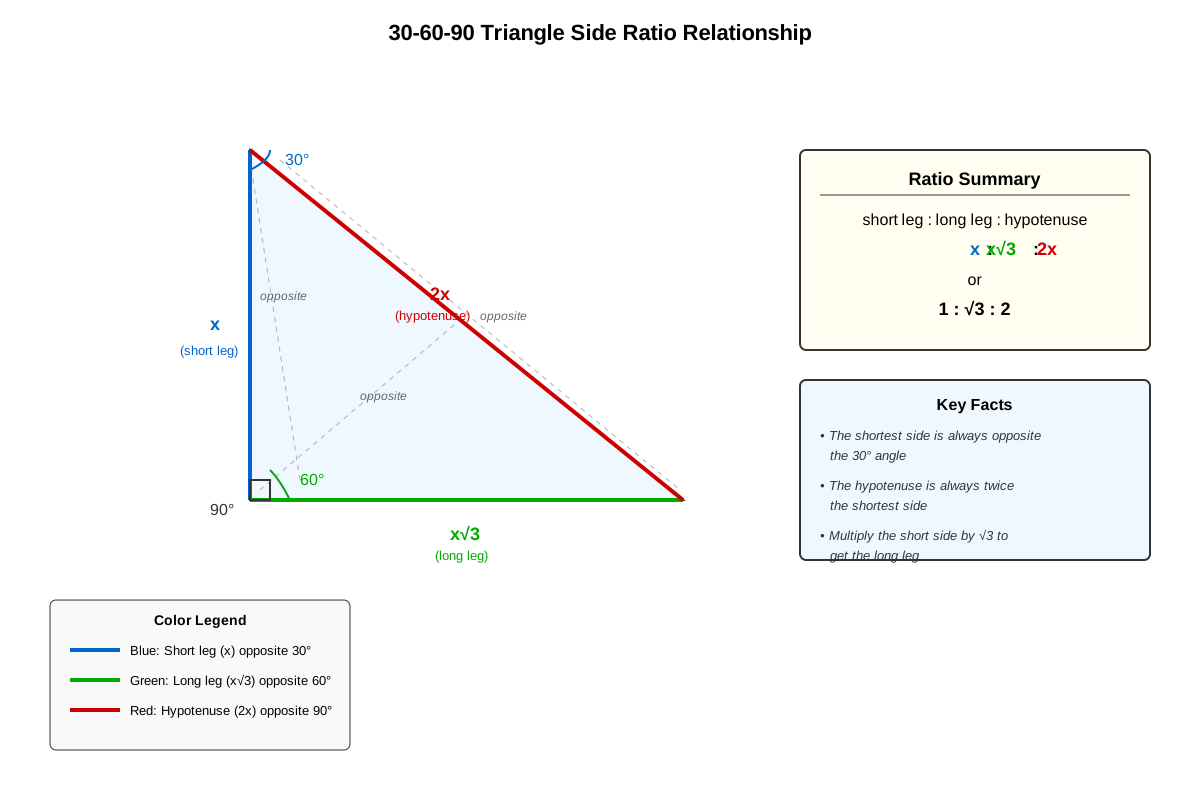
The defining characteristic of a 30-60-90 triangle is its fixed side length ratio. In every 30-60-90 triangle, regardless of size, the sides opposite the 30°, 60°, and 90° angles maintain the ratio 1 : √3 : 2. More specifically:
- The side opposite the 30° angle (shortest leg) has length x
- The side opposite the 60° angle (longer leg) has length x√3
- The side opposite the 90° angle (hypotenuse) has length 2x
This ratio is absolute and unchanging. If you know any one side length, you can immediately determine the other two by identifying which position in the ratio that known side occupies, then scaling the entire ratio accordingly.
Derivation from Equilateral Triangles
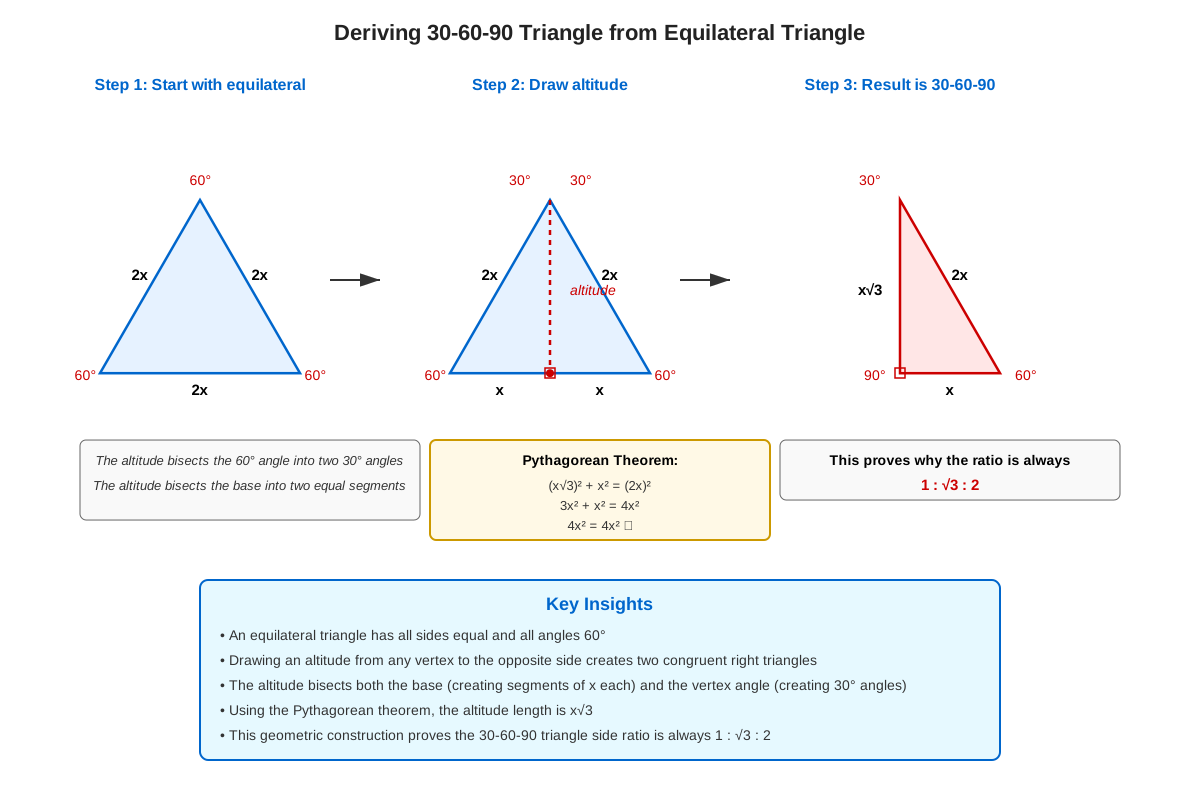
Understanding where the 30-60-90 ratio originates strengthens retention and application. Consider an equilateral triangle with side length 2. All three angles measure 60°, and all three sides equal 2. When you draw an altitude (height) from any vertex to the opposite side, this altitude:
- Bisects the base, creating two segments of length 1
- Creates a right angle with the base (90°)
- Bisects the vertex angle, creating two 30° angles
The result is two congruent 30-60-90 triangles. Each has:
- A base (opposite 30°) of length 1
- A hypotenuse (opposite 90°) of length 2
- A height (opposite 60°) that can be found using the Pythagorean theorem: 1² + h² = 2², so h² = 3, therefore h = √3
This demonstrates the 1 : √3 : 2 ratio directly.
Identifying the Triangle Type
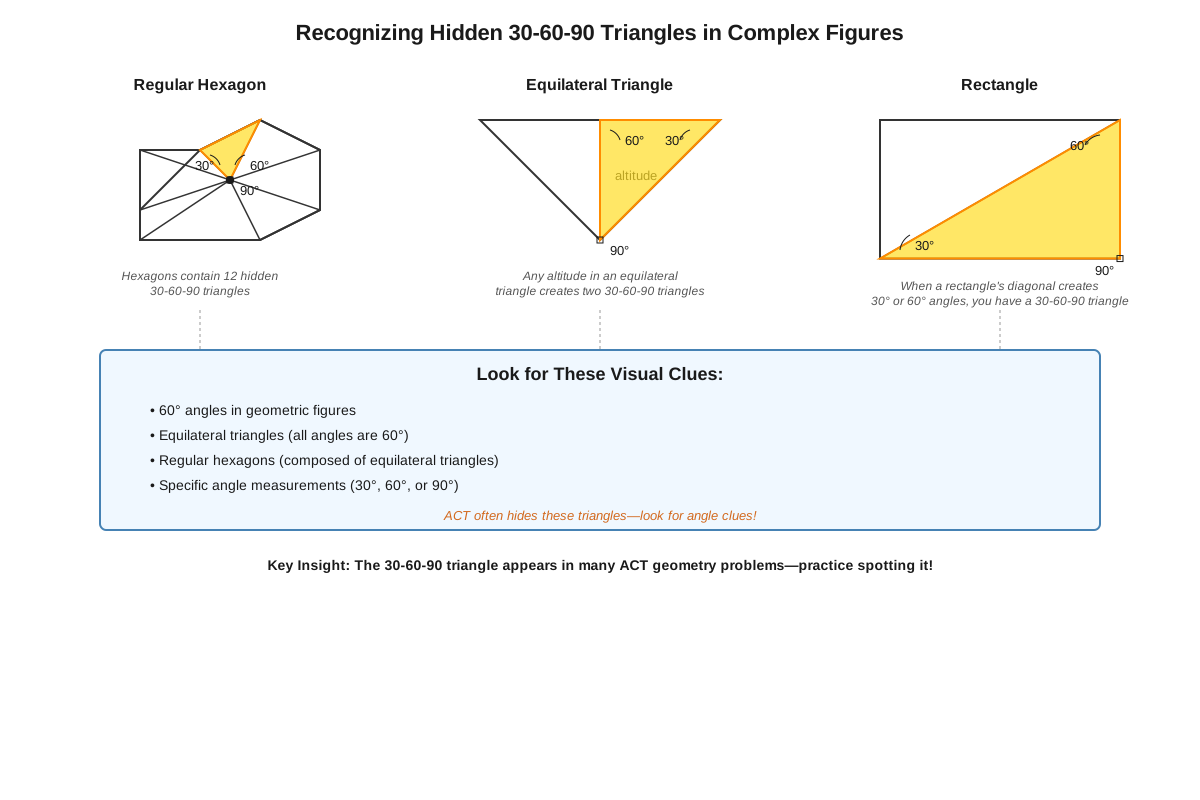
Recognition is often the most challenging aspect of ACT problems involving 30-60-90 triangles. The exam rarely labels a triangle with all three angle measures. Instead, students must identify these triangles through:
Direct angle information: If a right triangle has one angle measuring 30° (or 60°), the third angle must be 60° (or 30°) since angles sum to 180°.
Equilateral triangle contexts: Any altitude, median, or angle bisector in an equilateral triangle creates 30-60-90 triangles.
Regular hexagon decomposition: Regular hexagons can be divided into six equilateral triangles, which further subdivide into 30-60-90 triangles.
Coordinate geometry clues: Points or lines described with specific slope relationships or angle measures may form 30-60-90 triangles.
Applying the Ratio Method
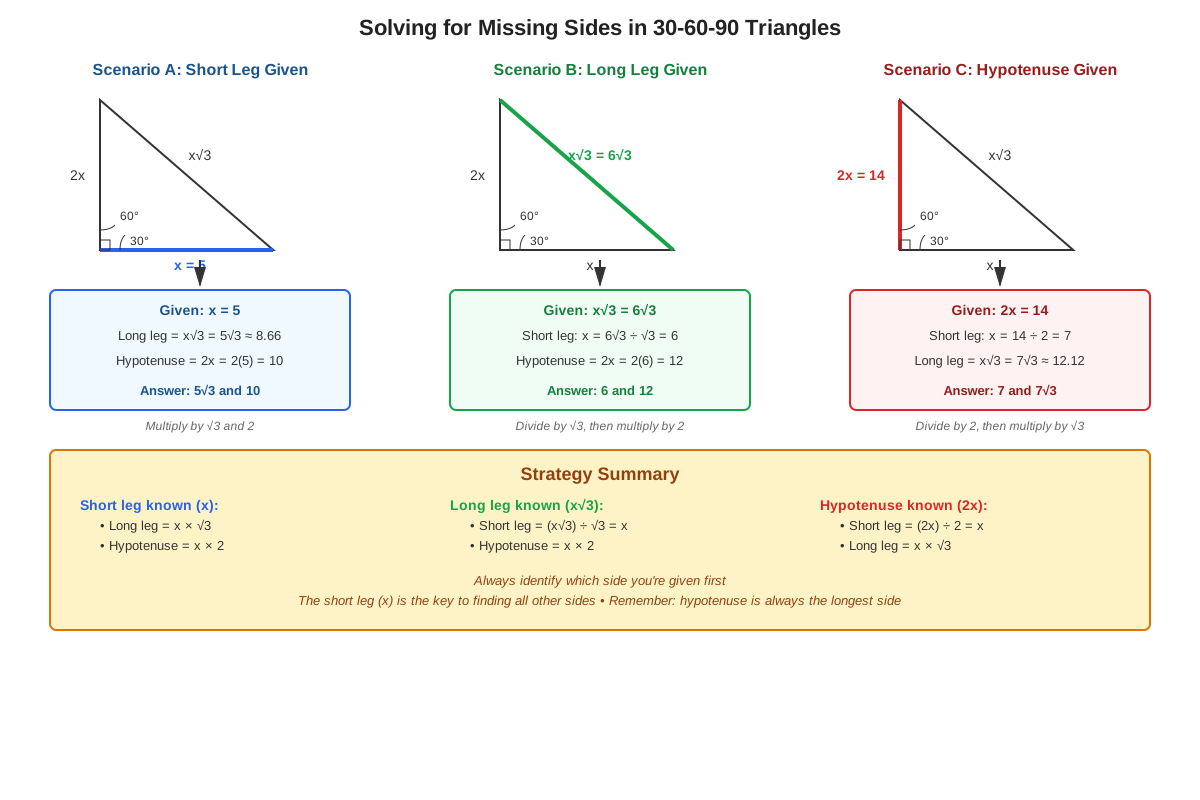
The systematic approach to solving 30-60-90 triangle problems involves four steps:
- Identify which angle (30°, 60°, or 90°) is opposite the given side
- Determine the value of x by setting the given side equal to its ratio expression
- Calculate the other sides by substituting x into their ratio expressions
- Verify that the answer makes logical sense (hypotenuse is longest, etc.)
| Given Side | Ratio Position | Value of x | Short Leg | Long Leg | Hypotenuse |
|---|---|---|---|---|---|
| Short leg = 5 | x | x = 5 | 5 | 5√3 | 10 |
| Long leg = 6 | x√3 | x = 6/√3 = 2√3 | 2√3 | 6 | 4√3 |
| Hypotenuse = 12 | 2x | x = 6 | 6 | 6√3 | 12 |
Special Considerations with Radicals
ACT questions involving 30-60-90 triangles frequently require working with radical expressions, particularly √3. Key skills include:
- Rationalizing denominators: Converting x/√3 to x√3/3 by multiplying by √3/√3
- Simplifying products: Recognizing that x√3 · √3 = 3x
- Comparing magnitudes: Understanding that √3 ≈ 1.732, so x√3 is approximately 1.7x
The ACT answer choices often include both rationalized and non-rationalized forms as distractors, testing whether students can recognize equivalent expressions.
Area Calculations
Many ACT problems require finding the area of a 30-60-90 triangle or a figure containing such triangles. The area formula for any triangle is:
Area = (1/2) × base × heightIn a 30-60-90 triangle with short leg x:
- If using the legs as base and height: Area = (1/2) × x × x√3 = (x²√3)/2
- This formula is worth memorizing for speed on test day
For equilateral triangles with side length s, the area formula (x²√3)/4 where s = 2x derives from the 30-60-90 relationship.
Concept Relationships
The 30-60-90 triangle concept network begins with equilateral triangles, which serve as the geometric parent figure. When an altitude bisects an equilateral triangle → it creates two 30-60-90 triangles → which exhibit the 1 : √3 : 2 side ratio. This ratio can be verified through → the Pythagorean theorem (x² + (x√3)² = (2x)²), demonstrating that 30-60-90 triangles are a special case of right triangles.
The side ratios directly connect to trigonometric functions: sin(30°) = 1/2, cos(30°) = √3/2, tan(30°) = 1/√3, and their complementary values at 60°. While the ACT rarely requires explicit trigonometry, understanding this connection helps students recognize when 30-60-90 patterns apply.
Within coordinate geometry, 30-60-90 triangles enable quick calculation of distances and coordinates. A line segment at 30° or 60° from horizontal creates predictable horizontal and vertical components based on the ratio, allowing rapid determination of endpoint coordinates without extensive calculation.
The concept extends to regular polygons, particularly hexagons, which decompose into six equilateral triangles. Each equilateral triangle contains two 30-60-90 triangles, making hexagon problems heavily dependent on this concept. Similarly, isosceles triangles with specific angle measures (30-30-120 or 60-60-60) relate directly to 30-60-90 analysis.
High-Yield Facts
⭐ The side ratio of a 30-60-90 triangle is always 1 : √3 : 2 (short leg : long leg : hypotenuse)
⭐ The side opposite the 30° angle is always half the length of the hypotenuse
⭐ The side opposite the 60° angle is always √3 times the length of the short leg
⭐ Every altitude in an equilateral triangle creates two 30-60-90 triangles
⭐ If the short leg has length x, the area of the triangle is (x²√3)/2
- The longer leg is always √3 times longer than the shorter leg (approximately 1.73 times)
- A regular hexagon can be divided into 12 congruent 30-60-90 triangles
- In a 30-60-90 triangle, the hypotenuse is always the longest side and equals twice the short leg
- The angles 30°, 60°, and 90° sum to 180°, confirming these form a valid triangle
- If given the hypotenuse, divide by 2 to find the short leg, then multiply by √3 to find the long leg
- The ratio 1 : √3 : 2 can be scaled by any positive number and remains valid
- √3 is approximately 1.732, useful for estimation and answer elimination
Quick check — test yourself on 30-60-90 triangles so far.
Try Flashcards →Common Misconceptions
Misconception: The ratio 1 : √3 : 2 applies to any right triangle with one angle measuring 30° or 60°.
Correction: The triangle must be a right triangle AND have angles of 30° and 60° (which automatically makes the third angle 90°). A non-right triangle with a 30° or 60° angle does not follow this ratio.
Misconception: The side opposite 60° is twice the side opposite 30°.
Correction: The side opposite 60° is √3 times (not 2 times) the side opposite 30°. The hypotenuse is twice the short leg, but the long leg is √3 times the short leg.
Misconception: When given the long leg, you can find the short leg by dividing by √3, and the answer should be left as a fraction with √3 in the denominator.
Correction: While dividing by √3 is correct, the ACT expects rationalized denominators. Convert x/√3 to (x√3)/3 by multiplying numerator and denominator by √3.
Misconception: All triangles formed by bisecting an equilateral triangle are 30-60-90 triangles.
Correction: Only altitudes (which are also medians and angle bisectors in equilateral triangles) create 30-60-90 triangles. Random line segments through an equilateral triangle do not necessarily create these special triangles.
Misconception: The 1 : √3 : 2 ratio means that if one side is 1 unit, the others must be √3 and 2 units.
Correction: The ratio can be scaled by any factor. If the short leg is 5, the sides are 5 : 5√3 : 10. The ratio represents proportional relationships, not absolute measurements.
Misconception: You need a calculator to work with √3 in 30-60-90 problems.
Correction: ACT problems are designed to work with exact radical expressions. Leaving answers in terms of √3 is expected and often required. Converting to decimals usually indicates an error in approach.
Worked Examples
Example 1: Finding Missing Sides
Problem: In a 30-60-90 triangle, the side opposite the 60° angle has length 9. Find the lengths of the other two sides.
Solution:
Step 1: Identify the given information. The long leg (opposite 60°) = 9.
Step 2: Recall the ratio. In a 30-60-90 triangle, if the short leg is x, then:
- Short leg = x
- Long leg = x√3
- Hypotenuse = 2x
Step 3: Set up the equation. Since the long leg = x√3 and we know it equals 9:
x√3 = 9Step 4: Solve for x:
x = 9/√3Step 5: Rationalize the denominator:
x = 9/√3 × √3/√3 = 9√3/3 = 3√3Step 6: Find all sides:
- Short leg (opposite 30°) = x = 3√3
- Long leg (opposite 60°) = 9 (given)
- Hypotenuse (opposite 90°) = 2x = 2(3√3) = 6√3
Step 7: Verify the answer makes sense. The hypotenuse (6√3 ≈ 10.39) should be longer than the long leg (9). ✓
Connection to Learning Objectives: This example demonstrates applying the 30-60-90 ratio to find missing sides (Objective 3) and working with radical expressions accurately.
Example 2: Equilateral Triangle Application
Problem: An equilateral triangle has a side length of 10 inches. What is the area of the triangle?
Solution:
Step 1: Recognize that finding the area requires the height, which creates 30-60-90 triangles.
Step 2: When an altitude is drawn in an equilateral triangle with side 10, it:
- Bisects the base, creating two segments of length 5
- Creates two 30-60-90 triangles
- The altitude becomes the long leg of each 30-60-90 triangle
Step 3: In each 30-60-90 triangle:
- Hypotenuse = 10 (original side of equilateral triangle)
- Short leg = 5 (half the base)
- Long leg = height (what we need)
Step 4: Apply the ratio. If the hypotenuse is 2x, then:
2x = 10
x = 5
Step 5: Find the long leg (height):
Long leg = x√3 = 5√3Step 6: Calculate the area of the equilateral triangle:
Area = (1/2) × base × height
Area = (1/2) × 10 × 5√3
Area = 25√3 square inches
Connection to Learning Objectives: This example shows how to identify 30-60-90 triangles embedded in other figures (Objective 5) and apply the concept to area calculations.
Exam Strategy
When approaching ACT questions involving 30-60-90 triangles, follow this systematic strategy:
Recognition Phase: Look for trigger words and visual cues that indicate a 30-60-90 triangle:
- "Equilateral triangle" with questions about height, area, or altitude
- Right triangles with one angle explicitly stated as 30° or 60°
- "Regular hexagon" problems (these decompose into 30-60-90 triangles)
- Coordinate geometry with points or slopes involving √3
- Word problems mentioning 30° or 60° angles (ramps, ladders, inclines)
Setup Phase: Before calculating, identify:
- Which side length is given
- Which position in the ratio (x, x√3, or 2x) that side occupies
- What the question asks for (another side, area, perimeter, etc.)
Calculation Phase: Use the ratio method rather than the Pythagorean theorem when possible—it's faster and less error-prone. Write out the ratio (1 : √3 : 2) on your scratch paper and scale it appropriately.
Answer Elimination: Use these strategies to eliminate wrong answers quickly:
- The hypotenuse must be the longest side (eliminate any answer where it isn't)
- The long leg should be approximately 1.7 times the short leg (√3 ≈ 1.732)
- If your answer contains √3, eliminate choices that don't (or vice versa)
- Check if the answer requires rationalized denominators (ACT typically does)
Time Management: Allocate 45-60 seconds for straightforward 30-60-90 problems and up to 90 seconds for multi-step problems involving these triangles. If you don't recognize the triangle type within 15 seconds, mark the question and return to it later.
Common Trap Answers: The ACT includes predictable distractors:
- The result before rationalizing the denominator
- Using 2 instead of √3 or vice versa in the ratio
- Forgetting to scale the ratio (using 1, √3, 2 instead of x, x√3, 2x)
- Confusing which leg is opposite which angle
Memory Techniques
The "1-Root 3-2" Chant: Memorize the ratio by repeating "one, root three, two" while visualizing the triangle with angles increasing from 30° to 60° to 90°. The sides increase in the same order: smallest (1), middle (√3), largest (2).
The "Half-Hypotenuse" Rule: Remember that the short leg is always exactly half the hypotenuse. This single fact allows you to find two of the three sides immediately if given either one. Mnemonic: "Half the Hypotenuse" (both start with H).
Visual Anchor: Picture an equilateral triangle with a vertical line down the middle. This creates two mirror-image 30-60-90 triangles. The vertical line (height) is the long leg, the half-base is the short leg, and the original side is the hypotenuse.
The "√3 is the Middle Child" Technique: In the ratio 1 : √3 : 2, the √3 is the only one with a radical. This "middle child" is the long leg, which is neither the shortest nor the longest. The sides without radicals (1 and 2) are the short leg and hypotenuse.
Finger Method: Hold up three fingers. Point to them in order while saying "30-60-90" and "short-long-hypotenuse" and "x, x-root-three, two-x." This multi-sensory approach reinforces the parallel relationships.
Area Formula Acronym: For the area formula (x²√3)/2, remember "X-Squared Root Three Halved" = X-SRTH (sounds like "exert"). When you need to exert effort to find area, use this formula.
Summary
30-60-90 triangles are special right triangles with a fixed side ratio of 1 : √3 : 2, corresponding to the sides opposite the 30°, 60°, and 90° angles respectively. These triangles appear frequently on the ACT Math section, both as direct problems and embedded within more complex geometric figures like equilateral triangles and regular hexagons. The key to mastering this topic is recognizing when a 30-60-90 triangle exists (often through context clues rather than explicit labeling), correctly identifying which side corresponds to which position in the ratio, and accurately scaling the ratio to find missing measurements. Students must be comfortable working with radical expressions, particularly √3, and should rationalize denominators in final answers. The ratio method provides a faster alternative to the Pythagorean theorem for these special triangles. Understanding that these triangles derive from bisecting equilateral triangles helps with both recognition and retention. Success on ACT questions requires not just memorizing the ratio, but developing the ability to spot these triangles in various contexts and apply the relationship efficiently under time pressure.
Key Takeaways
- The side ratio for 30-60-90 triangles is always 1 : √3 : 2 (short leg : long leg : hypotenuse), regardless of the triangle's size
- The short leg is always half the hypotenuse, providing a quick calculation shortcut
- Every altitude in an equilateral triangle creates two 30-60-90 triangles, making this a common ACT setup
- Recognition is often harder than calculation—look for equilateral triangles, right triangles with 30° or 60° angles, and regular hexagons
- Always rationalize denominators containing √3 by multiplying by √3/√3 to convert fractions to acceptable ACT answer format
- The ratio method is faster and more reliable than using the Pythagorean theorem for these special triangles
- Area of a 30-60-90 triangle with short leg x equals (x²√3)/2, a formula worth memorizing for test efficiency
Related Topics
45-45-90 Triangles: The other special right triangle tested on the ACT, with side ratio 1 : 1 : √2. Mastering 30-60-90 triangles provides the foundation for understanding this related concept and knowing when to apply each ratio.
Trigonometric Ratios: The sine, cosine, and tangent values for 30° and 60° angles derive directly from the 30-60-90 triangle ratios. Understanding these triangles makes trigonometry more intuitive.
Regular Polygons: Hexagons, dodecagons, and other regular polygons can be decomposed into triangles, many of which are 30-60-90 triangles. This topic extends your ability to solve complex area and perimeter problems.
Coordinate Geometry: Lines and segments at 30° or 60° angles create 30-60-90 triangles when projected onto axes, enabling quick calculation of distances and coordinates.
Three-Dimensional Geometry: Space diagonals in rectangular prisms and pyramids often involve 30-60-90 triangles, extending this two-dimensional concept into three dimensions.
Practice CTA
Now that you've mastered the core concepts of 30-60-90 triangles, it's time to solidify your understanding through active practice. Attempt the practice questions to test your ability to recognize these triangles in various contexts and apply the ratio method accurately. Use the flashcards to reinforce the key facts and ratios until they become automatic. Remember, the difference between knowing the concept and scoring points on test day is practice under realistic conditions. Each problem you solve builds the pattern recognition and calculation speed you need for ACT success. You've got this—start practicing!
Sign up free to keep reading
Create a free AnvayaPrep account to finish this ACT guide on 30-60-90 triangles — plus flashcards and practice questions.