Overview
45-45-90 triangles are one of the two special right triangles that appear frequently on the ACT Math test. These isosceles right triangles possess unique properties that allow students to quickly determine side lengths without relying on the Pythagorean theorem or trigonometric functions. Understanding these triangles is not merely about memorizing a ratio—it's about recognizing geometric patterns that unlock efficient problem-solving across multiple question types.
The ACT consistently tests 45-45-90 triangles in various contexts, from straightforward geometry problems to complex coordinate geometry questions and even within three-dimensional figures. These triangles emerge naturally when squares are divided diagonally, when working with certain coordinate plane problems, and in optimization scenarios. Mastery of this topic typically saves 30-60 seconds per question compared to using alternative methods, making it a high-return investment of study time.
Within the broader landscape of ACT Math, ACT 45-45-90 triangles serve as a bridge between basic right triangle concepts and more advanced geometric reasoning. They connect to topics including the Pythagorean theorem, coordinate geometry, area calculations, and trigonometry. Students who internalize the 45-45-90 relationship gain a powerful tool that simplifies calculations and reduces the likelihood of computational errors under time pressure.
Learning Objectives
- [ ] Identify when 45-45-90 triangles is being tested
- [ ] Explain the core rule or strategy behind 45-45-90 triangles
- [ ] Apply 45-45-90 triangles to ACT-style questions accurately
- [ ] Derive the side ratio relationship from the Pythagorean theorem
- [ ] Recognize 45-45-90 triangles embedded within other geometric figures
- [ ] Convert between leg lengths and hypotenuse lengths in both directions
- [ ] Solve multi-step problems involving 45-45-90 triangles in coordinate geometry
Prerequisites
- Right triangle fundamentals: Understanding that a right triangle contains one 90-degree angle is essential because 45-45-90 triangles are a special case of right triangles
- Pythagorean theorem (a² + b² = c²): This theorem provides the foundation for deriving the 45-45-90 ratio and serves as a verification method
- Properties of isosceles triangles: Knowing that isosceles triangles have two equal sides and two equal angles helps recognize when a right triangle is also a 45-45-90 triangle
- Basic radical simplification: Working with √2 requires comfort with square roots and radical expressions
- Angle relationships: Understanding that triangle angles sum to 180° enables identification of the two 45° angles
Why This Topic Matters
In real-world applications, 45-45-90 triangles appear in architecture, engineering, and design whenever diagonal bracing or corner-to-corner measurements are needed in square structures. Construction professionals use these relationships when cutting materials at 45-degree angles, and graphic designers rely on them when creating diagonal elements in square canvases. The efficiency gained from recognizing these patterns translates directly to professional problem-solving speed.
On the ACT Math test, 45-45-90 triangle questions appear in approximately 2-4 questions per exam, representing roughly 3-7% of the 60-question Math section. These questions typically fall into the medium difficulty range (questions 30-45), though they can appear as easier questions when presented straightforwardly or as harder questions when embedded in complex scenarios. The ACT favors these triangles because they test both geometric knowledge and algebraic manipulation skills simultaneously.
Common ACT question formats include: finding the diagonal of a square given its side length; determining coordinates of points in the coordinate plane; calculating distances in three-dimensional figures; solving for unknown sides when given the hypotenuse; and identifying these triangles within composite figures. Questions often disguise 45-45-90 triangles within squares, coordinate grids, or word problems about distances, requiring students to recognize the underlying geometric structure before applying the special ratio.
Core Concepts
The Fundamental 45-45-90 Ratio
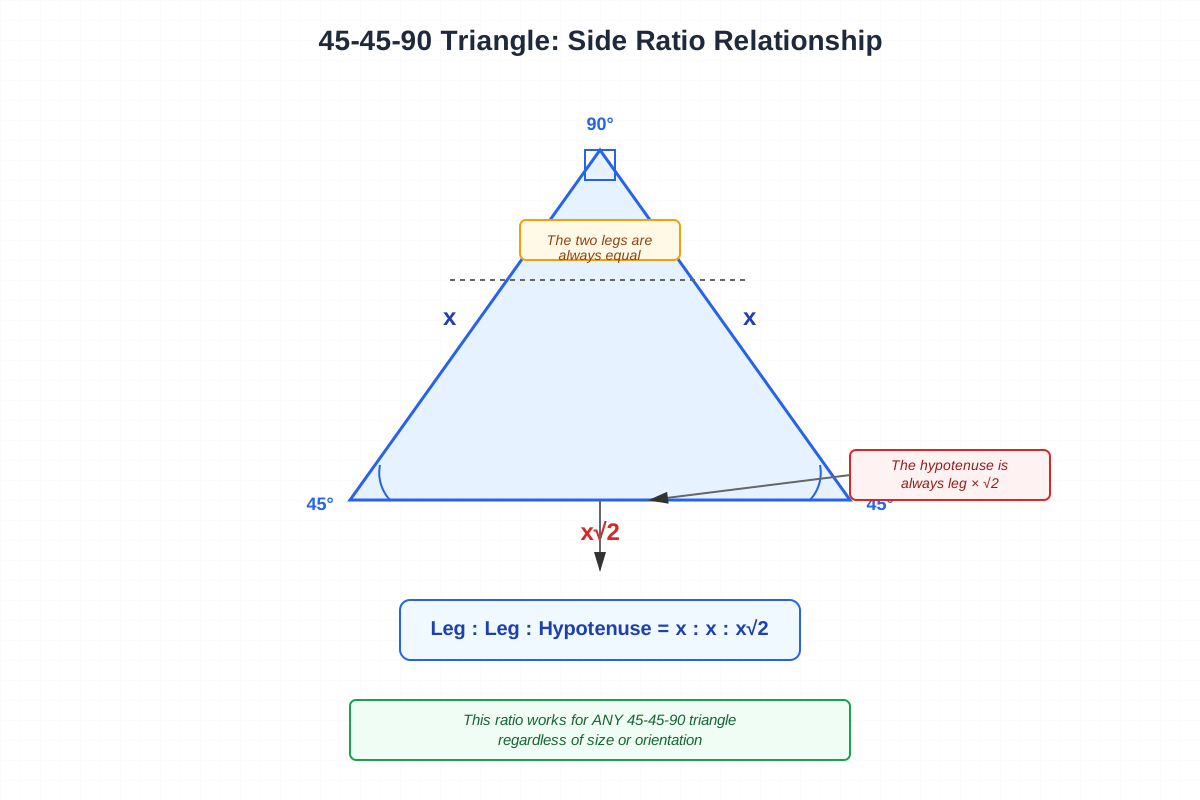
A 45-45-90 triangle is a right triangle with two 45-degree angles and one 90-degree angle. Because two angles are equal, the triangle is isosceles, meaning the two legs (the sides opposite the 45-degree angles) are congruent. The defining characteristic is the side length ratio:
Leg : Leg : Hypotenuse = 1 : 1 : √2
Alternatively expressed: if each leg has length x, the hypotenuse has length x√2.
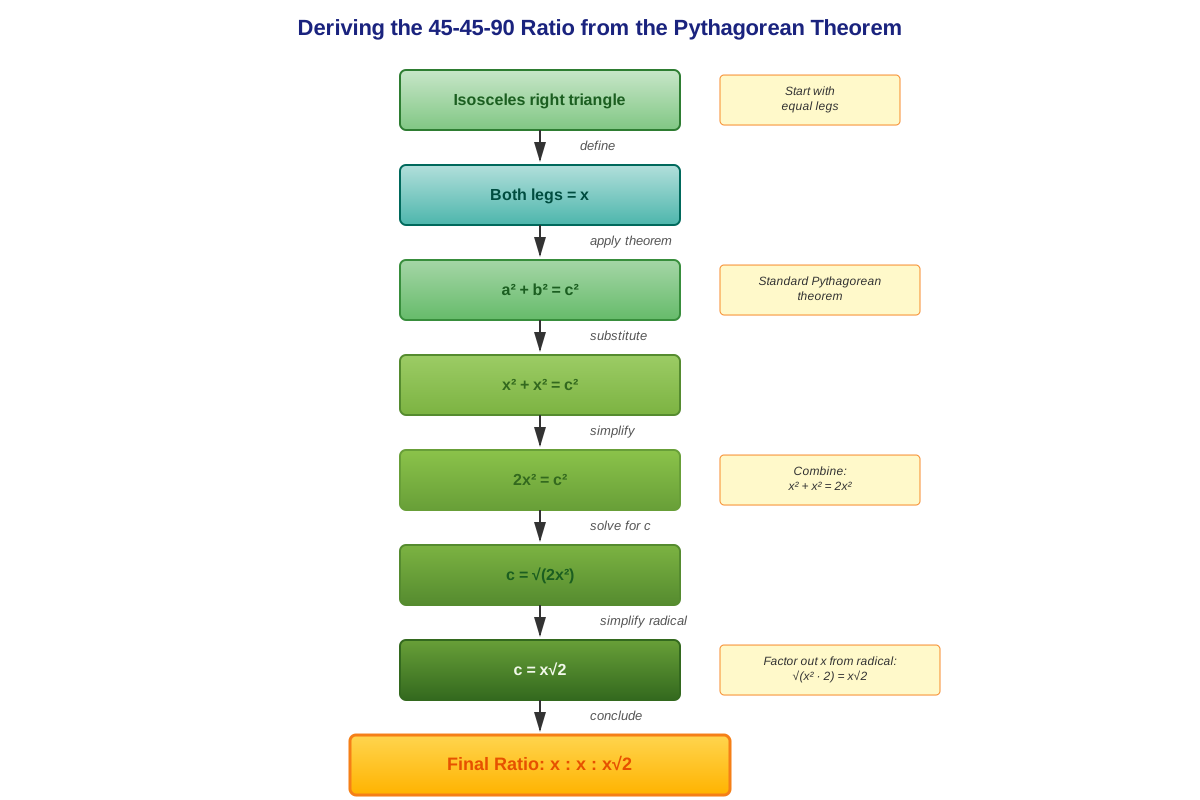
This ratio can be derived using the Pythagorean theorem. Consider a 45-45-90 triangle with legs of length s:
s² + s² = hypotenuse²
2s² = hypotenuse²
hypotenuse = s√2
This derivation demonstrates that the relationship isn't arbitrary—it's a mathematical necessity arising from the triangle's angle measures and the Pythagorean theorem.
Working with the Ratio in Both Directions
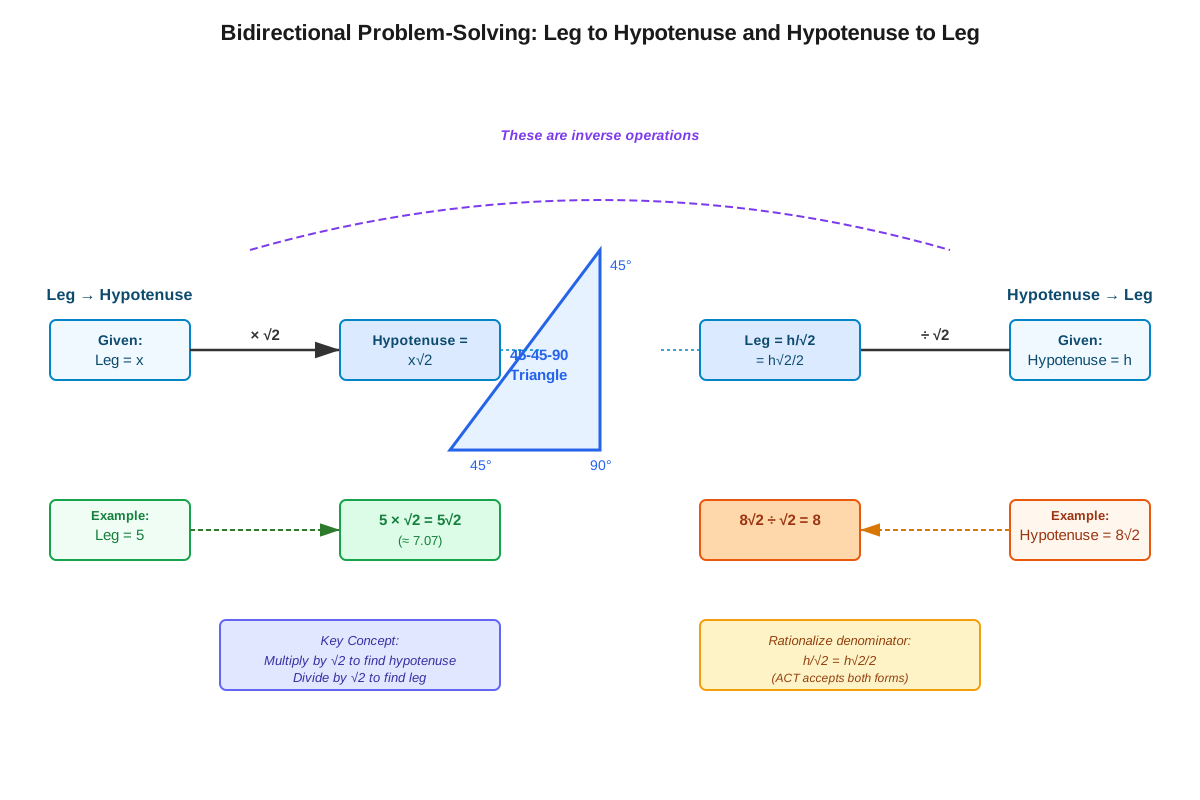
Students must become fluent in applying the ratio bidirectionally:
Given a leg, find the hypotenuse: Multiply the leg length by √2
- If leg = 5, then hypotenuse = 5√2
- If leg = 3, then hypotenuse = 3√2
- If leg = 7, then hypotenuse = 7√2
Given the hypotenuse, find a leg: Divide the hypotenuse by √2 (or multiply by √2/2)
- If hypotenuse = 10√2, then leg = 10
- If hypotenuse = 6√2, then leg = 6
- If hypotenuse = 8, then leg = 8/√2 = 8√2/2 = 4√2
The second direction often requires rationalizing denominators, a skill that ACT questions frequently test. When dividing by √2, multiply both numerator and denominator by √2:
x/√2 = (x/√2) × (√2/√2) = x√2/2Recognition Patterns
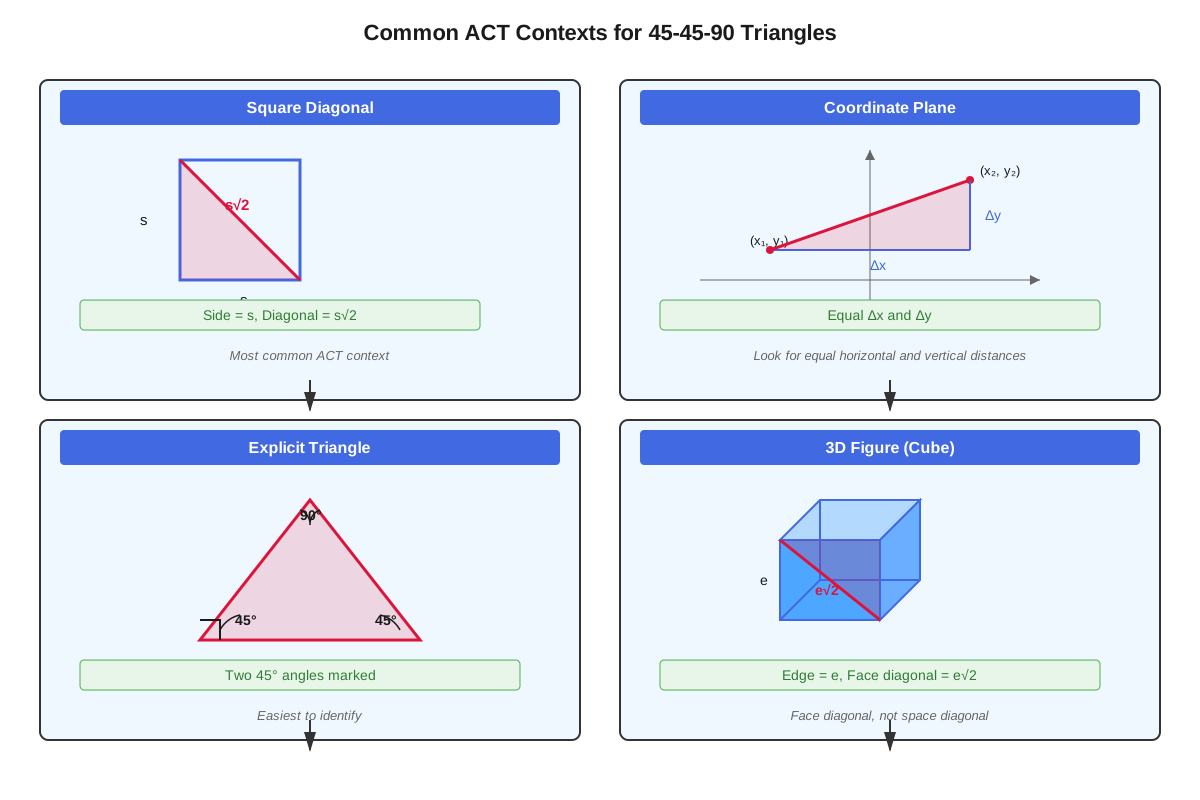
Identifying 45-45-90 triangles requires recognizing several key patterns:
| Context | Recognition Clue | Example |
|---|---|---|
| Explicit angles | Two 45° angles stated | "Triangle ABC has angles measuring 45°, 45°, and 90°" |
| Square diagonal | Diagonal divides square | "What is the diagonal of a square with side 6?" |
| Isosceles right triangle | Right angle + two equal sides | "Right triangle with legs of equal length" |
| Coordinate plane | Points forming 45° slope | Points (0,0), (4,0), and (4,4) |
| Implicit description | "Corner to corner" in square | "Distance from one corner to opposite corner" |
Applications in Squares
The most common ACT application involves squares. When a diagonal is drawn in a square, it creates two congruent 45-45-90 triangles. This relationship enables quick conversions:
- Square side to diagonal: diagonal = side × √2
- Diagonal to square side: side = diagonal ÷ √2 = diagonal × √2/2
For example, a square with side length 8 has a diagonal of 8√2 ≈ 11.31. Conversely, a square with diagonal 12√2 has sides of length 12.
Coordinate Geometry Applications
In the coordinate plane, 45-45-90 triangles appear when horizontal and vertical distances are equal. If a point moves d units right and d units up from the origin, the straight-line distance is d√2. This pattern appears in:
- Distance calculations between points
- Slope problems involving 45° angles (slope = 1 or slope = -1)
- Optimization problems finding shortest paths
- Circle problems involving tangent lines at 45° angles
Three-Dimensional Extensions
45-45-90 triangles extend into three-dimensional geometry, particularly in:
- Space diagonals of cubes: The diagonal across a cube's face is a 45-45-90 relationship
- Pyramids with square bases: Height and base relationships often involve these triangles
- Rectangular prisms: Diagonal calculations may decompose into 45-45-90 components
Concept Relationships
The 45-45-90 triangle concept builds directly on right triangle fundamentals and the Pythagorean theorem, serving as a specialized case that streamlines calculations. The relationship flows: basic right triangles → Pythagorean theorem → special right triangles (45-45-90 and 30-60-90) → advanced geometric applications.
Within the topic itself, the concepts connect as follows:
Fundamental ratio → enables → bidirectional calculations → which support → recognition in various contexts → leading to → applications in squares, coordinate geometry, and 3D figures
The connection to isosceles triangles is bidirectional: recognizing a right triangle as isosceles immediately identifies it as 45-45-90, while knowing the 45-45-90 ratio confirms the isosceles property. This relationship to square geometry is particularly strong—squares and 45-45-90 triangles are inseparable on the ACT, with each concept reinforcing the other.
Looking forward, mastery of 45-45-90 triangles prepares students for trigonometry (where sin 45° = cos 45° = √2/2), 30-60-90 triangles (the complementary special right triangle), and advanced coordinate geometry involving distance optimization and circle problems.
High-Yield Facts
⭐ The side ratio for 45-45-90 triangles is leg : leg : hypotenuse = 1 : 1 : √2
⭐ If a leg has length x, the hypotenuse has length x√2
⭐ If the hypotenuse has length h, each leg has length h/√2 or h√2/2
⭐ The diagonal of a square with side s equals s√2
⭐ A 45-45-90 triangle is always an isosceles right triangle
- The two 45° angles are opposite the two equal legs
- The 90° angle is opposite the hypotenuse (the longest side)
- When a square is cut diagonally, two 45-45-90 triangles are formed
- In coordinate geometry, equal horizontal and vertical distances create 45-45-90 triangles
- The area of a 45-45-90 triangle with leg x is x²/2
- √2 ≈ 1.414, useful for estimation when calculators aren't allowed
- Rationalizing x/√2 yields x√2/2
- The altitude to the hypotenuse in a 45-45-90 triangle has length x√2/2 when legs equal x
Quick check — test yourself on 45-45-90 triangles so far.
Try Flashcards →Common Misconceptions
Misconception: The ratio 1 : 1 : √2 means the sides are 1, 1, and √2 units long in every 45-45-90 triangle.
Correction: The ratio represents the proportional relationship between sides, not absolute lengths. A 45-45-90 triangle can have legs of 5 and 5 with hypotenuse 5√2, or legs of 100 and 100 with hypotenuse 100√2—the ratio scales proportionally.
Misconception: To find a leg when given the hypotenuse, divide by 2 instead of √2.
Correction: The hypotenuse is √2 times longer than each leg, not 2 times longer. If hypotenuse = 10, each leg = 10/√2 = 5√2 ≈ 7.07, not 5. Dividing by 2 would give 5, which is too short.
Misconception: Any right triangle with two equal sides is automatically a 45-45-90 triangle.
Correction: While this is actually true (if two sides of a right triangle are equal, they must be the legs, making it isosceles and therefore 45-45-90), students sometimes incorrectly identify triangles where the hypotenuse equals a leg, which is impossible in Euclidean geometry.
Misconception: The formula x√2 applies to any side of the triangle.
Correction: The x√2 formula specifically gives the hypotenuse when x is the leg length. It doesn't apply to finding one leg from another leg (which are equal) or to other calculations without proper context.
Misconception: When rationalizing x/√2, the answer is x/2.
Correction: Rationalizing requires multiplying by √2/√2, yielding x√2/2, not x/2. The √2 remains in the numerator after rationalization. For example, 8/√2 = 8√2/2 = 4√2, not 4.
Misconception: 45-45-90 triangles only appear in pure geometry problems, not in coordinate geometry or word problems.
Correction: These triangles frequently appear disguised in coordinate plane problems (equal horizontal and vertical distances), in word problems about squares or diagonal paths, and in three-dimensional geometry. Recognition requires looking beyond explicit angle measures.
Worked Examples
Example 1: Square Diagonal Problem
Problem: A square garden has a side length of 12 feet. A gardener wants to walk diagonally from one corner to the opposite corner. What is the distance the gardener will walk?
Solution:
Step 1: Recognize the geometric structure. Walking diagonally across a square creates a 45-45-90 triangle where the square's sides are the legs and the diagonal is the hypotenuse.
Step 2: Identify the given information. Each leg (side of the square) = 12 feet.
Step 3: Apply the 45-45-90 ratio. When the leg = x, the hypotenuse = x√2.
Step 4: Calculate. Hypotenuse = 12√2 feet.
Step 5: If the answer choices require a decimal approximation: 12√2 ≈ 12(1.414) ≈ 16.97 feet.
Answer: 12√2 feet (or approximately 16.97 feet)
Connection to learning objectives: This problem demonstrates recognition of 45-45-90 triangles embedded in squares and application of the core ratio from leg to hypotenuse.
Example 2: Coordinate Geometry Problem
Problem: In the coordinate plane, point A is at the origin (0, 0), and point B is at (7, 7). What is the distance from A to B?
Solution:
Step 1: Recognize the pattern. Moving from (0, 0) to (7, 7) involves moving 7 units right and 7 units up—equal horizontal and vertical distances.
Step 2: Visualize the triangle. Drawing a right triangle with legs along the axes creates a 45-45-90 triangle where both legs equal 7.
Step 3: Identify what we're finding. The distance from A to B is the hypotenuse of this triangle.
Step 4: Apply the ratio. Hypotenuse = leg × √2 = 7√2.
Step 5: Verify using the distance formula if needed:
d = √[(7-0)² + (7-0)²] = √[49 + 49] = √98 = √(49×2) = 7√2Answer: 7√2 units
Connection to learning objectives: This demonstrates recognition of 45-45-90 triangles in coordinate geometry and shows how the special ratio provides a shortcut compared to the full distance formula calculation.
Example 3: Working Backward from Hypotenuse
Problem: A 45-45-90 triangle has a hypotenuse of length 18. What is the length of each leg?
Solution:
Step 1: Identify the relationship. We know hypotenuse = leg × √2, so leg = hypotenuse ÷ √2.
Step 2: Substitute the given value. Leg = 18 ÷ √2.
Step 3: Rationalize the denominator:
18/√2 = (18/√2) × (√2/√2) = 18√2/2 = 9√2Step 4: Verify if needed using Pythagorean theorem:
(9√2)² + (9√2)² = 81(2) + 81(2) = 162 + 162 = 324 = 18² ✓Answer: Each leg has length 9√2
Connection to learning objectives: This example shows bidirectional application of the ratio and demonstrates the rationalization technique frequently required on the ACT.
Exam Strategy
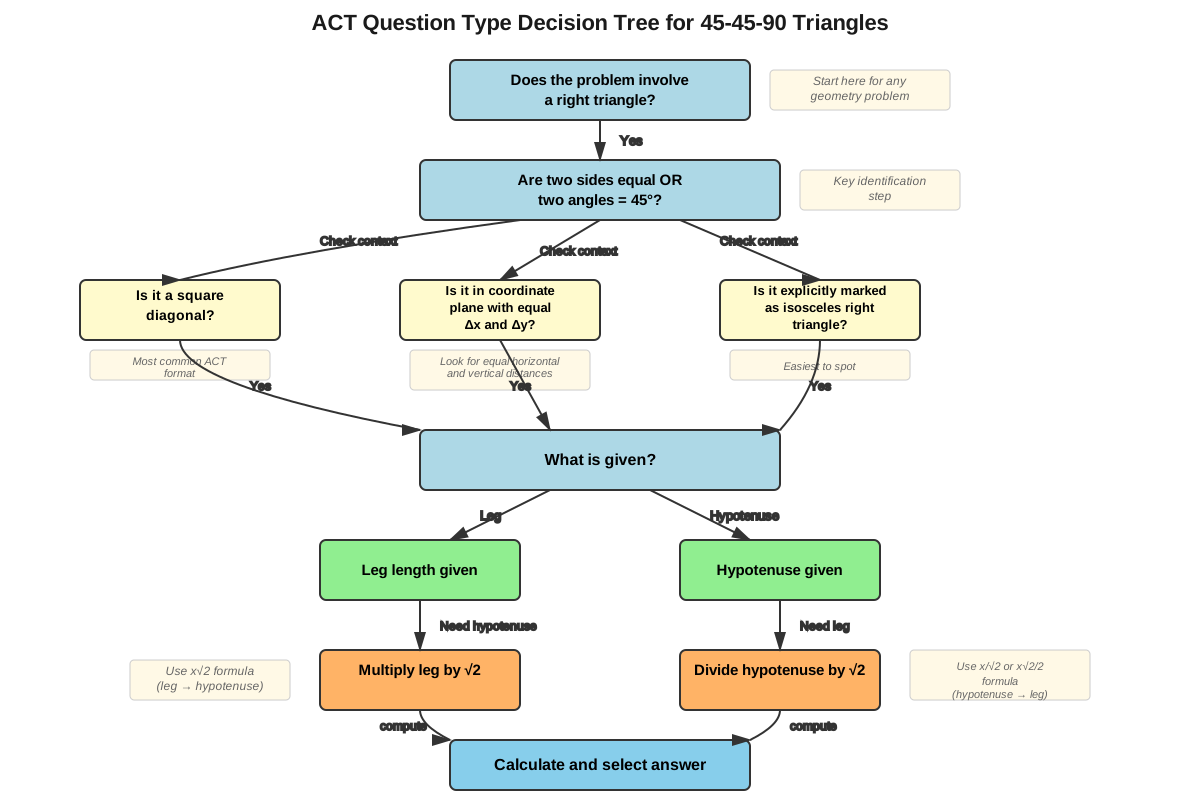
Trigger Recognition: Watch for these phrases that signal 45-45-90 triangles: "diagonal of a square," "isosceles right triangle," "corner to corner," "45-degree angle," coordinates with equal horizontal and vertical distances, and any right triangle described as having "two equal sides."
Approach sequence for ACT questions:
- Scan for angle measures: If you see 45° mentioned twice, or 45° and 90°, immediately think 45-45-90 triangle
- Check for squares: Any problem involving square diagonals automatically involves 45-45-90 triangles
- Examine coordinate points: Calculate horizontal and vertical distances—if equal, you have a 45-45-90 triangle
- Identify what's given and what's needed: Determine whether you're going from leg to hypotenuse (multiply by √2) or hypotenuse to leg (divide by √2)
- Apply the ratio: Use x and x√2 rather than trying to remember multiple formulas
Process of elimination tips:
- If answer choices include both radical and non-radical forms, the correct answer for a 45-45-90 problem typically includes √2
- When given a leg length, eliminate any answer choice for the hypotenuse that's less than the leg (impossible) or more than twice the leg (too large)
- If you're finding a leg from the hypotenuse, the leg must be smaller than the hypotenuse but larger than half the hypotenuse
- Answer choices that are exactly half or exactly double the given measurement are usually incorrect—look for the √2 factor
Time allocation: These problems should take 30-45 seconds once you recognize the pattern. If you find yourself using the Pythagorean theorem with equal legs, stop and use the 45-45-90 ratio instead—it's faster and less error-prone. Budget no more than 60 seconds total, including checking your answer.
Calculator usage: While calculators are permitted on the ACT Math section, 45-45-90 problems are often designed to be solved more efficiently without one. If an answer choice is 7√2, entering it in a calculator and getting 9.899... then trying to match that to answer choices wastes time. Work symbolically with √2 until the final step.
Memory Techniques
The "One-One-Root-Two" Chant: Memorize the ratio by rhythmically saying "one, one, root two" while visualizing a right triangle. The first two "ones" are the equal legs, and "root two" is the hypotenuse.
Visual Anchor: Picture a square with a diagonal drawn through it. The square's sides are "1" and the diagonal cutting across is "√2." This image connects the abstract ratio to a concrete shape you can draw in seconds.
The "Square Connection" Mnemonic: Remember "Square Diagonal = Side times √2" (SD = S√2). The alliteration helps cement the relationship.
Finger Method: Hold up two fingers parallel (representing the equal legs), then cross them with your other hand diagonally (representing the hypotenuse). The diagonal crossing is longer by a factor of √2.
Rationalization Reminder: "Dividing by Root? Multiply Top and Bottom!" (DR-MTB) reminds you that when dividing by √2, you must rationalize by multiplying both numerator and denominator by √2.
The 1.4 Approximation: Remember that √2 ≈ 1.4 (more precisely 1.414). This helps with estimation: a leg of 10 gives a hypotenuse of about 14, not 20.
Summary
45-45-90 triangles are special right triangles characterized by two 45-degree angles and one 90-degree angle, making them isosceles with two equal legs. The fundamental relationship—leg : leg : hypotenuse = 1 : 1 : √2—enables rapid calculation of any side when one side is known. When given a leg of length x, the hypotenuse equals x√2; conversely, when given a hypotenuse of length h, each leg equals h/√2 or h√2/2 after rationalization. These triangles appear most commonly in problems involving square diagonals, coordinate geometry with equal horizontal and vertical distances, and isosceles right triangle scenarios. Recognition is key: ACT questions rarely announce "this is a 45-45-90 triangle" but instead embed them within squares, coordinate planes, or word problems. Mastery requires fluency in both directions of the ratio, comfort with radical expressions, and the ability to recognize these triangles in various disguises. The efficiency gained from using the special ratio rather than the Pythagorean theorem or distance formula translates directly to time savings and accuracy improvements on test day.
Key Takeaways
- The side ratio for 45-45-90 triangles is always leg : leg : hypotenuse = 1 : 1 : √2, regardless of actual side lengths
- Multiply a leg by √2 to get the hypotenuse; divide the hypotenuse by √2 (and rationalize) to get a leg
- Every diagonal of a square creates two 45-45-90 triangles, making square diagonal = side × √2
- In coordinate geometry, equal horizontal and vertical distances signal a 45-45-90 triangle
- Recognition is more important than calculation—train yourself to spot these triangles in squares, coordinate planes, and isosceles right triangle descriptions
- Rationalize denominators: x/√2 becomes x√2/2, not x/2
- These triangles appear in 2-4 questions per ACT Math test, making them high-yield for focused study
Related Topics
30-60-90 Triangles: The complementary special right triangle with ratio 1 : √3 : 2. Mastering 45-45-90 triangles provides the foundation for understanding this related pattern, and together they cover most special right triangle questions on the ACT.
Pythagorean Theorem: While 45-45-90 triangles provide shortcuts, understanding how the ratio derives from a² + b² = c² deepens comprehension and provides a verification method for checking answers.
Coordinate Geometry and Distance Formula: 45-45-90 triangles frequently appear in coordinate plane problems. Recognizing them allows you to bypass the full distance formula calculation, saving time and reducing errors.
Square Properties and Area: Since square diagonals create 45-45-90 triangles, mastering this topic enhances your ability to solve square-related problems, including area calculations and perimeter problems.
Trigonometry Basics: The values sin 45° = cos 45° = √2/2 derive directly from 45-45-90 triangle ratios, making this topic foundational for understanding basic trigonometric values.
Practice CTA
Now that you've mastered the core concepts of 45-45-90 triangles, it's time to solidify your understanding through active practice. Work through the practice questions to test your recognition skills and calculation fluency, and use the flashcards to reinforce the key ratios and relationships until they become automatic. Remember, the difference between knowing these concepts and scoring points on test day is practice—each problem you solve builds the pattern recognition that makes ACT questions feel familiar rather than challenging. You've invested the time to learn the material; now invest a few more minutes to make it permanent!
Sign up free to keep reading
Create a free AnvayaPrep account to finish this ACT guide on 45-45-90 triangles — plus flashcards and practice questions.