Overview
The triangle angle sum theorem stands as one of the most fundamental principles in plane geometry and appears consistently throughout the ACT Math section. This theorem states that the interior angles of any triangle always sum to exactly 180 degrees, regardless of the triangle's shape, size, or type. Understanding this concept is not merely about memorizing a formula—it represents a gateway to solving complex geometric problems involving polygons, parallel lines, and angle relationships that frequently appear on standardized tests.
For ACT test-takers, mastery of the triangle angle sum is essential because it serves as the foundation for numerous multi-step geometry problems. Questions may directly ask students to find a missing angle, or they may embed this concept within more complex scenarios involving exterior angles, multiple triangles, or algebraic expressions. The ACT typically includes 2-4 questions per test that either directly test or require application of this principle, making it a high-yield topic that deserves thorough understanding and practice.
The ACT triangle angle sum concept connects to broader mathematical principles including polygon angle sums, properties of parallel lines cut by transversals, and coordinate geometry. Students who master this topic gain the ability to approach complex geometric figures systematically, breaking them down into triangular components and using angle relationships to solve for unknown values. This skill proves invaluable not only for geometry questions but also for trigonometry problems that appear in the later portions of the ACT Math section.
Learning Objectives
- [ ] Identify when Triangle angle sum is being tested in ACT questions
- [ ] Explain the core rule or strategy behind Triangle angle sum
- [ ] Apply Triangle angle sum to ACT-style questions accurately
- [ ] Calculate missing angles in triangles when given two angle measures
- [ ] Solve algebraic equations involving angle expressions that sum to 180 degrees
- [ ] Recognize and apply the triangle angle sum theorem in complex figures containing multiple triangles
- [ ] Determine whether given angle measures can form a valid triangle
Prerequisites
- Basic angle measurement: Understanding degrees as units and how to measure angles is essential for working with the 180-degree sum
- Algebraic equation solving: Many ACT problems express angles as variables or expressions requiring algebraic manipulation
- Triangle classification: Familiarity with acute, obtuse, right, equilateral, isosceles, and scalene triangles helps recognize special cases
- Angle vocabulary: Knowledge of complementary, supplementary, and vertical angles provides context for related problems
- Variable manipulation: Ability to work with expressions like (2x + 5) and combine like terms when setting up equations
Why This Topic Matters
In real-world applications, the triangle angle sum theorem underlies structural engineering, architecture, navigation, and surveying. Engineers use triangulation to ensure structural stability in bridges and buildings, while surveyors employ angle measurements to calculate distances and map terrain. Architects rely on these principles when designing roof trusses and determining load-bearing angles. GPS technology fundamentally depends on triangulation principles that stem from basic triangle properties.
On the ACT Math section, triangle angle sum questions appear with remarkable consistency. Statistical analysis of released ACT tests shows that approximately 3-5% of all math questions directly involve triangle angle relationships, with an additional 5-8% incorporating these concepts as part of multi-step problems. Questions typically appear in the Plane Geometry category (questions 30-45 in difficulty progression) and often combine angle sum knowledge with other geometric principles.
The ACT presents this topic in several distinct formats: straightforward "find the missing angle" problems, algebraic angle expressions requiring equation setup, complex figures with multiple overlapping triangles, and word problems describing angle relationships. Questions may also combine triangle angle sum with exterior angle theorems, parallel line properties, or coordinate geometry. The test frequently uses diagrams that are intentionally not drawn to scale, requiring students to rely on mathematical relationships rather than visual estimation.
Core Concepts
The Triangle Angle Sum Theorem
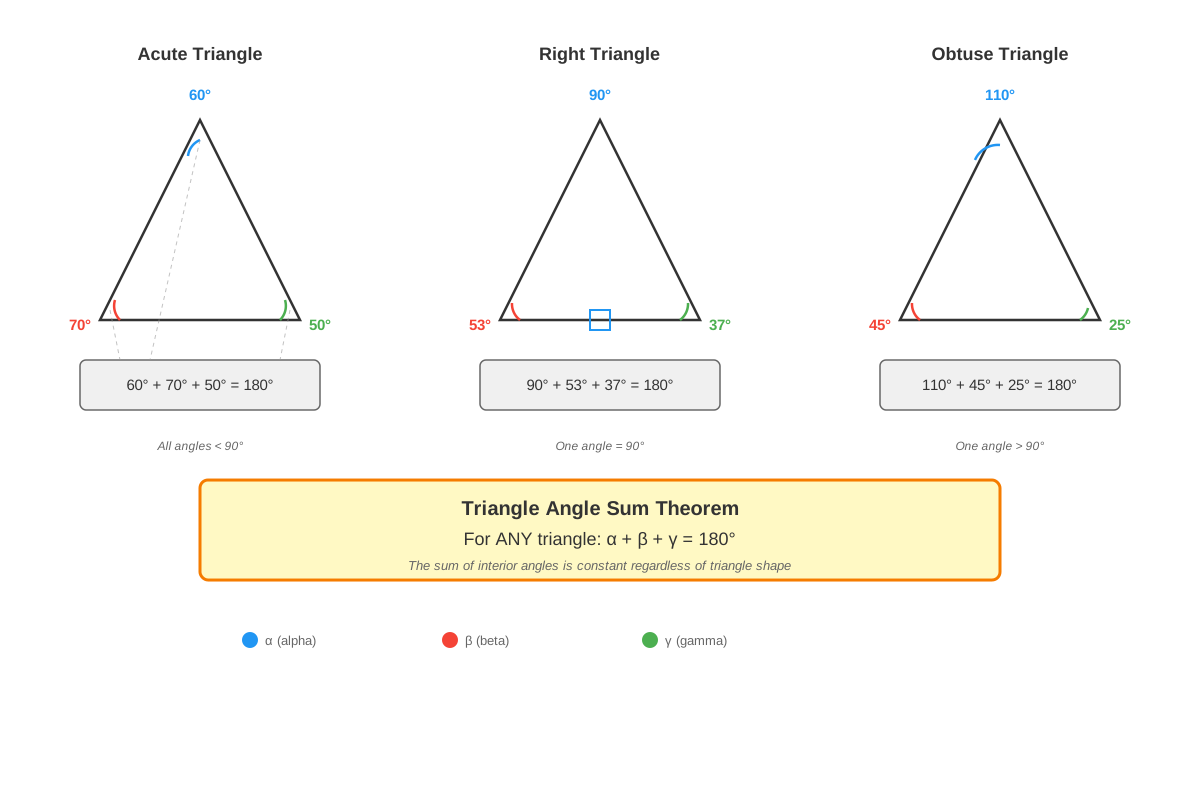
The triangle angle sum theorem is a fundamental geometric principle stating that the sum of the three interior angles of any triangle equals exactly 180 degrees. This relationship holds true universally—whether the triangle is acute, obtuse, right, equilateral, isosceles, or scalene. Mathematically expressed:
∠A + ∠B + ∠C = 180°where ∠A, ∠B, and ∠C represent the three interior angles of a triangle.
This theorem can be proven through several methods, though the ACT does not require students to produce proofs. The most intuitive proof involves drawing a line parallel to one side of the triangle through the opposite vertex, demonstrating that the three angles form a straight line (180 degrees) through alternate interior angles. Understanding this underlying logic helps students remember why the sum must always equal 180 degrees rather than simply memorizing the rule.
Finding Missing Angles
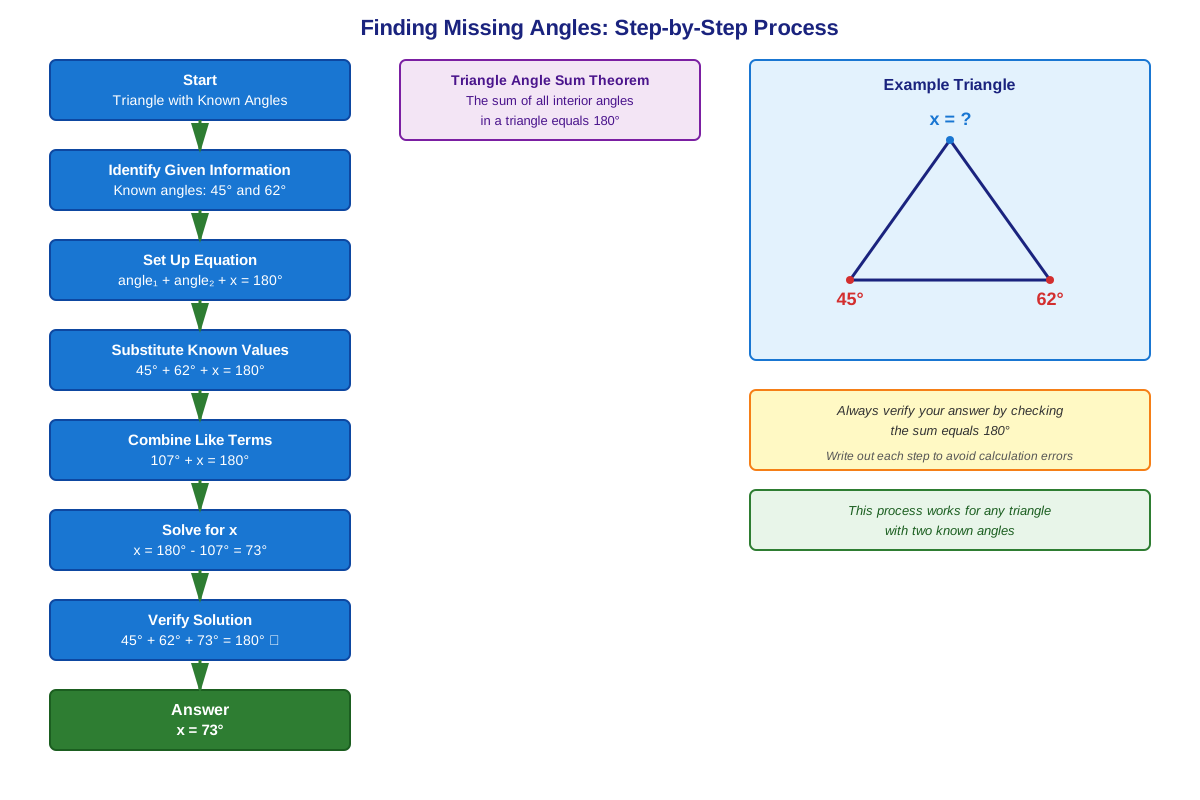
The most direct application involves calculating an unknown angle when two angles are given. The process follows a straightforward three-step approach:
- Add the two known angle measures together
- Subtract this sum from 180 degrees
- The result equals the third angle
For example, if a triangle has angles measuring 45° and 60°, the third angle must measure 180° - (45° + 60°) = 180° - 105° = 75°.
Algebraic Angle Expressions
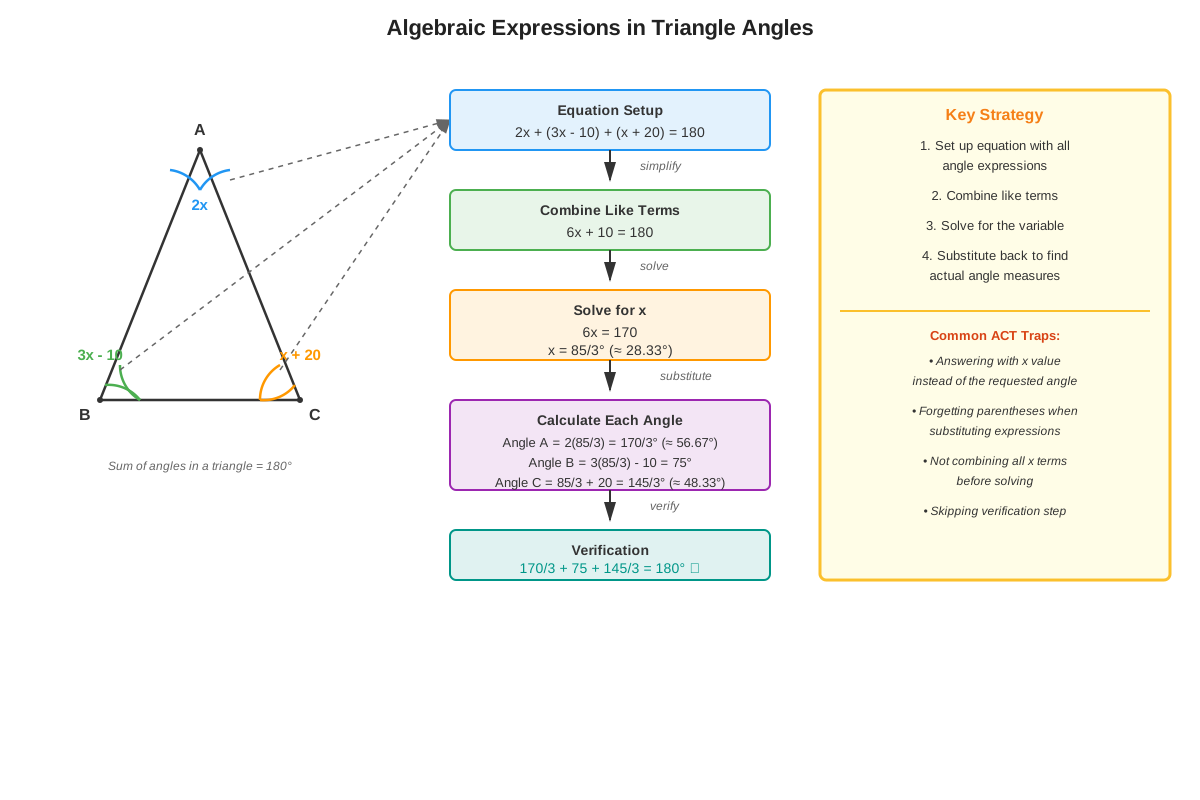
ACT questions frequently express angles using algebraic expressions rather than numerical values. These problems require students to set up and solve equations. When angles are expressed as variables or expressions containing variables, the approach involves:
- Write an equation setting the sum of all three angle expressions equal to 180°
- Combine like terms on the left side of the equation
- Solve for the variable using algebraic techniques
- Substitute the variable value back into the original expressions to find actual angle measures
For instance, if a triangle has angles measuring x°, (2x + 10)°, and (x - 10)°, the equation becomes:
x + (2x + 10) + (x - 10) = 180
4x = 180
x = 45°
Special Triangle Cases
Certain triangle types have specific angle relationships that work in conjunction with the angle sum theorem:
| Triangle Type | Angle Properties | Angle Sum Application |
|---|---|---|
| Equilateral | All three angles equal | Each angle = 180° ÷ 3 = 60° |
| Isosceles | Two angles equal (base angles) | If base angles = x, then 2x + vertex angle = 180° |
| Right | One angle = 90° | The two acute angles sum to 90° |
| Obtuse | One angle > 90° | The two acute angles sum to less than 90° |
| Acute | All angles < 90° | Each angle must be less than 90° but sum to 180° |
Multiple Triangle Configurations
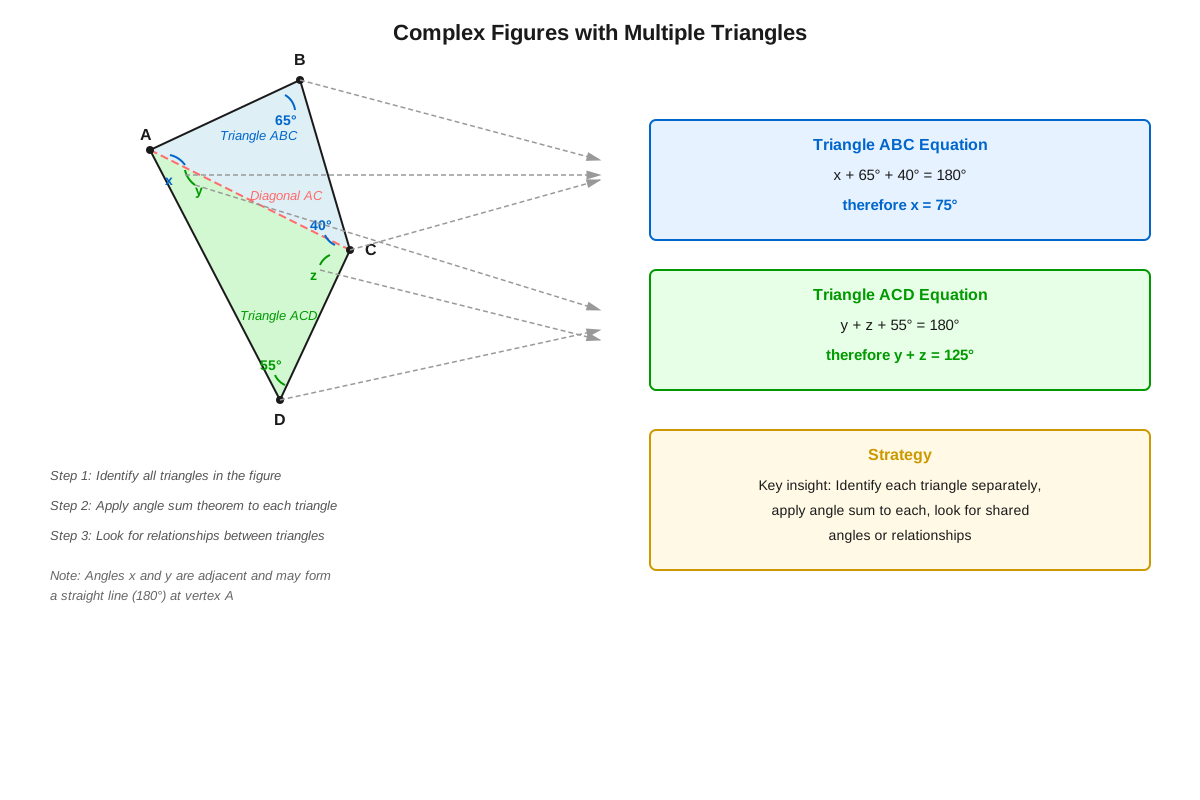
Complex ACT problems often present figures containing multiple triangles sharing sides or vertices. In these scenarios, students must:
- Identify all distinct triangles within the figure
- Apply the angle sum theorem to each triangle separately
- Use shared angles or sides to create relationships between triangles
- Work systematically through the figure, solving for angles in sequence
When triangles overlap or share vertices, angles may be split into component parts. The key strategy involves labeling all angles clearly and recognizing that angles forming a straight line sum to 180° (supplementary angles), while angles around a point sum to 360°.
Exterior Angle Relationships
While technically a separate concept, the exterior angle theorem connects directly to triangle angle sum. An exterior angle of a triangle equals the sum of the two non-adjacent interior angles. This relationship derives from the triangle angle sum theorem: if the three interior angles sum to 180°, and an exterior angle forms a linear pair (also 180°) with one interior angle, then the exterior angle must equal the sum of the other two interior angles.
Concept Relationships
The triangle angle sum theorem serves as a foundational concept that connects to numerous other geometric principles. Understanding these relationships helps students recognize when to apply this theorem and how to combine it with other concepts.
Within the topic: The basic angle sum theorem → leads to → finding missing angles → enables → solving algebraic angle problems → extends to → analyzing multiple triangle configurations → connects with → exterior angle applications.
Connection to prerequisites: Basic angle measurement provides the units and understanding needed to work with the 180-degree sum. Algebraic equation solving becomes essential when angles are expressed as variables. Triangle classification helps identify special cases where additional angle relationships apply alongside the general theorem.
Connection to related topics: The triangle angle sum extends naturally to polygon angle sums (each polygon can be divided into triangles). It connects to parallel lines and transversals through alternate interior angles and corresponding angles. The theorem also relates to trigonometry, where angle measures determine side ratios in right triangles. In coordinate geometry, the angle sum helps verify whether three points form a valid triangle and determine triangle orientation.
Hierarchical relationship: Triangle angle sum → is a special case of → polygon angle sum formula → which states that an n-sided polygon has interior angles summing to (n-2) × 180°. For triangles, n = 3, so (3-2) × 180° = 180°.
High-Yield Facts
⭐ The sum of the three interior angles of any triangle always equals exactly 180 degrees, regardless of triangle type or size.
⭐ To find a missing angle when two are known, subtract the sum of the known angles from 180 degrees.
⭐ When angles are expressed algebraically, set up an equation with all angle expressions summing to 180° and solve for the variable.
⭐ In a right triangle, the two acute angles must sum to 90 degrees (since one angle is already 90°).
⭐ Each angle in an equilateral triangle measures exactly 60 degrees.
- In an isosceles triangle, the two base angles (opposite the equal sides) are congruent.
- An exterior angle of a triangle equals the sum of the two non-adjacent interior angles.
- No triangle can have two right angles or two obtuse angles (this would exceed 180°).
- If you know the ratio of angles in a triangle, you can find actual measures by setting up proportions that sum to 180°.
- Complex figures may contain multiple triangles; apply the angle sum theorem to each triangle separately.
- Angles in a triangle can be expressed as fractions or decimals, as long as they sum to 180°.
- The largest angle in a triangle is always opposite the longest side; this relationship helps verify answers.
Quick check — test yourself on Triangle angle sum so far.
Try Flashcards →Common Misconceptions
Misconception: All triangles have at least one 90-degree angle. → Correction: Only right triangles have a 90-degree angle. Acute triangles have all angles less than 90°, while obtuse triangles have one angle greater than 90°. The angle sum theorem applies to all triangle types equally.
Misconception: The triangle angle sum changes based on the size of the triangle. → Correction: The 180-degree sum is constant regardless of triangle size. A tiny triangle and a massive triangle both have interior angles summing to exactly 180 degrees. This is a fundamental property of Euclidean geometry.
Misconception: When solving for x in angle expressions, the value of x is the angle measure. → Correction: The variable x is often just a component used in an expression. After solving for x, you must substitute it back into the original angle expressions to find the actual angle measures. For example, if an angle is (3x + 5)° and x = 10, the angle measures 35°, not 10°.
Misconception: In a figure with multiple triangles, you can add all visible angles to get 180°. → Correction: The angle sum theorem applies to each individual triangle separately. In complex figures, identify each distinct triangle and apply the theorem to that specific set of three angles. Shared angles may appear in multiple triangles.
Misconception: Exterior angles are included in the 180-degree sum. → Correction: The triangle angle sum theorem refers only to interior angles. Exterior angles form linear pairs with interior angles (summing to 180° with their adjacent interior angle) but are not part of the triangle's interior angle sum.
Misconception: If two angles are given, the third angle can be any value less than 180°. → Correction: The third angle is completely determined by the other two angles. There is exactly one value that makes the sum equal 180°. The third angle equals 180° minus the sum of the other two angles—no other value is possible.
Worked Examples
Example 1: Basic Angle Calculation with Algebraic Expressions
Problem: In triangle ABC, angle A measures (2x + 15)°, angle B measures (3x - 5)°, and angle C measures (x + 20)°. Find the measure of each angle.
Solution:
Step 1: Set up the equation using the triangle angle sum theorem.
(2x + 15) + (3x - 5) + (x + 20) = 180Step 2: Combine like terms on the left side.
2x + 3x + x + 15 - 5 + 20 = 180
6x + 30 = 180
Step 3: Solve for x.
6x = 150
x = 25
Step 4: Substitute x = 25 back into each angle expression.
- Angle A = 2(25) + 15 = 50 + 15 = 65°
- Angle B = 3(25) - 5 = 75 - 5 = 70°
- Angle C = 25 + 20 = 45°
Step 5: Verify the answer by checking that the angles sum to 180°.
65 + 70 + 45 = 180° ✓Connection to learning objectives: This example demonstrates applying the triangle angle sum to ACT-style questions with algebraic expressions, requiring both geometric understanding and algebraic manipulation skills.
Example 2: Complex Figure with Multiple Triangles
Problem: In the figure below (described), line segment BD divides triangle ABC into two smaller triangles, ABD and BCD. Angle BAC measures 40°, angle ABC measures 70°, and angle BDC measures 110°. Find the measure of angle ADB.
Solution:
Step 1: Identify the triangles in the figure. There are two triangles: ABD and BCD.
Step 2: Find angle ACB in triangle ABC using the angle sum theorem.
∠BAC + ∠ABC + ∠ACB = 180°
40° + 70° + ∠ACB = 180°
∠ACB = 70°
Step 3: Recognize that angles ADB and BDC form a linear pair (they're supplementary).
∠ADB + ∠BDC = 180°
∠ADB + 110° = 180°
∠ADB = 70°
Step 4: Verify using triangle ABD.
In triangle ABD: ∠BAD + ∠ABD + ∠ADB should equal 180°.
We need to find ∠ABD. Since ∠ABC = 70° and BD divides it, we'd need more information to verify completely, but our answer of 70° for ∠ADB is correct based on the linear pair relationship.
Connection to learning objectives: This example shows how to identify when triangle angle sum is being tested in complex figures and demonstrates the strategy of working systematically through multiple triangles while using supplementary angle relationships.
Exam Strategy
When approaching ACT questions involving triangle angle sum, follow this systematic process:
Step 1: Identify the question type. Look for trigger phrases such as "find the measure of angle," "what is the value of x," "which of the following could be," or "the angles of a triangle." These signal that angle sum knowledge is required.
Step 2: Draw or annotate the diagram. If a figure is provided, mark all given angle measures directly on the diagram. If no figure exists, sketch a quick triangle and label the angles. This visual reference prevents errors and helps track information.
Step 3: Determine what's given and what's needed. Clearly identify known angles and the unknown angle(s). If angles are expressed algebraically, note which expressions represent which angles.
Step 4: Set up the equation. Write out the angle sum equation explicitly: angle 1 + angle 2 + angle 3 = 180°. This prevents careless errors and provides a clear path forward.
Step 5: Solve systematically. Use algebraic techniques to solve for variables, then substitute back to find actual angle measures. Show your work in the test booklet to catch errors.
Exam Tip: The ACT often includes answer choices that represent common errors. If you get 75° but see 105° as an answer choice, that's likely what you'd get if you subtracted from 360° instead of 180°. Always verify your answer makes sense.
Time allocation: Straightforward triangle angle sum problems should take 30-45 seconds. Problems with algebraic expressions may require 60-90 seconds. Complex multi-triangle problems might need up to 2 minutes. If a problem is taking longer, mark it and return after completing easier questions.
Process of elimination tips:
- Eliminate any answer choice that would make the angle sum exceed 180° or fall short of 180°
- For "which could be true" questions, test each answer choice by checking if the three angles sum to 180°
- If solving for x, eliminate answers that produce negative angle measures or angles greater than 180°
- In multiple triangle problems, eliminate answers that violate the angle sum in any of the individual triangles
Trigger words to watch for: "interior angles," "the third angle," "remaining angle," "sum of the angles," "measure of angle," "value of x," "each angle," and "angles of a triangle."
Memory Techniques
The "Triangle = Half Circle" Mnemonic: Remember that a triangle's angles sum to 180° by visualizing that 180° is a straight line (half of a full 360° circle). Imagine "unfolding" a triangle's three angles and laying them flat—they form a straight line.
The "3-2-1 Formula" for Polygons: To remember how triangle angle sum relates to other polygons, use (n-2) × 180°, where n is the number of sides. For triangles: (3-2) × 180° = 1 × 180° = 180°. This connects triangle angle sum to the broader polygon concept.
The "Right Triangle = 90 + 90" Rule: In right triangles, remember that the two acute angles must sum to 90° (since one angle is already 90°). Think "right triangle, right angles add to 90."
The "Equation Setup" Acronym - SAFE:
- Sum all angle expressions
- Add like terms together
- Find the variable value
- Evaluate each angle by substituting back
Visualization Strategy: When working with complex figures, use different colors or line styles to distinguish separate triangles. This mental (or actual) color-coding prevents confusion about which angles belong to which triangle.
The "180 Check": After solving any triangle problem, always verify that your three angle measures sum to exactly 180°. Make this automatic—like checking your seatbelt. This catches calculation errors before submitting your answer.
Summary
The triangle angle sum theorem—stating that the three interior angles of any triangle always sum to exactly 180 degrees—represents one of the most fundamental and frequently tested concepts in ACT plane geometry. Mastery requires not only memorizing this rule but also developing the ability to apply it in various contexts: finding missing angles when two are known, solving algebraic equations when angles are expressed as variables or expressions, and analyzing complex figures containing multiple triangles. The theorem applies universally to all triangle types (acute, obtuse, right, equilateral, isosceles, and scalene) and serves as the foundation for related concepts including exterior angles and polygon angle sums. Success on ACT questions demands systematic problem-solving: identifying when the theorem applies, setting up equations correctly, solving algebraically, and verifying that final answers make geometric sense. Students must also recognize common variations such as angles forming linear pairs, multiple triangles sharing vertices or sides, and special cases like right triangles where the two acute angles sum to 90 degrees. The ability to quickly and accurately apply this theorem, combined with careful attention to whether answers represent variable values or actual angle measures, distinguishes high-scoring students on the ACT Math section.
Key Takeaways
- The sum of the three interior angles of any triangle always equals exactly 180 degrees, regardless of triangle type or size
- To find a missing angle, subtract the sum of the two known angles from 180 degrees
- When angles are expressed algebraically, set all angle expressions equal to 180° and solve for the variable, then substitute back to find actual angle measures
- In right triangles, the two acute angles must sum to 90 degrees; in equilateral triangles, each angle measures 60 degrees
- Complex figures may contain multiple triangles—apply the angle sum theorem to each triangle separately and use shared angles to create relationships
- Always verify your final answer by checking that the three angles sum to 180 degrees
- Watch for common errors: confusing variable values with angle measures, adding exterior angles to the sum, or applying the theorem to multiple triangles simultaneously rather than individually
Related Topics
Exterior Angle Theorem: Building directly on triangle angle sum, this theorem states that an exterior angle equals the sum of the two non-adjacent interior angles. Mastering triangle angle sum makes exterior angle problems straightforward.
Polygon Angle Sum Formula: The triangle angle sum extends to all polygons through the formula (n-2) × 180°, where n represents the number of sides. Understanding why triangles sum to 180° provides intuition for this general formula.
Parallel Lines and Transversals: When parallel lines are cut by a transversal, the resulting angles often form triangles. Combining parallel line angle relationships with triangle angle sum enables solving complex multi-step problems.
Triangle Inequality Theorem: While angle sum addresses angle measures, the triangle inequality addresses side lengths. Together, these theorems define what makes a valid triangle.
Trigonometry: The angles whose sum equals 180° determine the trigonometric ratios in right triangles. Triangle angle sum provides the foundation for understanding why complementary angles have reciprocal trigonometric relationships.
Practice CTA
Now that you've mastered the triangle angle sum theorem and its applications, it's time to reinforce your understanding through active practice. Complete the practice questions to test your ability to identify when this concept is being tested, apply the theorem to various problem types, and avoid common pitfalls. Use the flashcards to drill the high-yield facts until they become automatic. Remember: the difference between knowing the concept and scoring points on test day lies in repeated, deliberate practice. You've built the foundation—now strengthen it through application. Every practice problem you solve correctly builds confidence and speed for the actual ACT. You've got this!
Sign up free to keep reading
Create a free AnvayaPrep account to finish this ACT guide on Triangle angle sum — plus flashcards and practice questions.