Overview
Supplementary angles represent one of the most frequently tested concepts in the Plane Geometry section of the ACT Math test. These angles appear in approximately 10-15% of geometry questions, making them a high-yield topic that students must master to achieve competitive scores. Understanding supplementary angles forms the foundation for solving complex geometric problems involving parallel lines, polygons, and coordinate geometry.
At their core, supplementary angles are two angles whose measures add up to exactly 180 degrees. This seemingly simple relationship unlocks solutions to numerous ACT problems, from basic angle calculations to multi-step geometry proofs. The concept appears both explicitly—where questions directly ask about supplementary angles—and implicitly, where recognizing supplementary relationships becomes the key to solving problems involving linear pairs, straight angles, and transversals cutting parallel lines.
Mastering ACT supplementary angles connects directly to broader mathematical reasoning skills tested throughout the exam. This topic bridges basic angle measurement with more advanced concepts like complementary angles, vertical angles, and polygon interior angles. Students who develop fluency with supplementary angle relationships gain a significant advantage in time management, as these problems often yield to quick mental calculations rather than lengthy algebraic manipulations. The ability to instantly recognize when two angles must be supplementary—and to set up the corresponding equation—separates high-scoring students from those who struggle with geometry sections.
Learning Objectives
- [ ] Identify when Supplementary angles is being tested
- [ ] Explain the core rule or strategy behind Supplementary angles
- [ ] Apply Supplementary angles to ACT-style questions accurately
- [ ] Recognize supplementary angle relationships in diagrams without explicit labeling
- [ ] Set up and solve algebraic equations involving supplementary angles with variable expressions
- [ ] Distinguish between supplementary angles and other angle relationships (complementary, vertical, adjacent)
- [ ] Apply supplementary angle concepts to problems involving parallel lines and transversals
Prerequisites
- Basic angle measurement: Understanding that angles are measured in degrees and that a full rotation equals 360° is essential for grasping why supplementary angles sum to 180°
- Linear equations: Solving simple equations like x + 65 = 180 forms the algebraic foundation for supplementary angle problems
- Variable expressions: Evaluating expressions such as (2x + 10) requires comfort with algebraic notation used in angle measure problems
- Geometric notation: Reading angle symbols (∠ABC) and understanding diagram conventions ensures accurate problem interpretation
Why This Topic Matters
Supplementary angles appear throughout real-world applications in architecture, engineering, and design. When architects design roof pitches, they work with supplementary relationships between the roof angle and the horizontal. Engineers calculating force vectors use supplementary angles to determine component forces. Even everyday tasks like adjusting a reclining chair or positioning a laptop screen involve intuitive understanding of supplementary relationships.
On the ACT Math test, supplementary angles appear in approximately 3-5 questions per exam, representing roughly 5-8% of the total math score. These questions typically fall into three categories: direct calculation problems (40% of supplementary angle questions), problems involving algebraic expressions for angle measures (35%), and multi-step problems where recognizing supplementary relationships is one step in a larger solution (25%). The concept appears most frequently in questions numbered 30-45, placing them in the medium-to-difficult range where strategic knowledge significantly impacts performance.
Common ACT question formats include: identifying missing angle measures when one supplementary angle is given; solving for variables when both angles are expressed algebraically; recognizing linear pairs formed by intersecting lines; applying supplementary relationships in parallel line diagrams; and using supplementary angles to find polygon interior angles. The versatility of this concept means students encounter it across multiple geometry contexts, making thorough mastery essential for consistent performance.
Core Concepts
Definition of Supplementary Angles
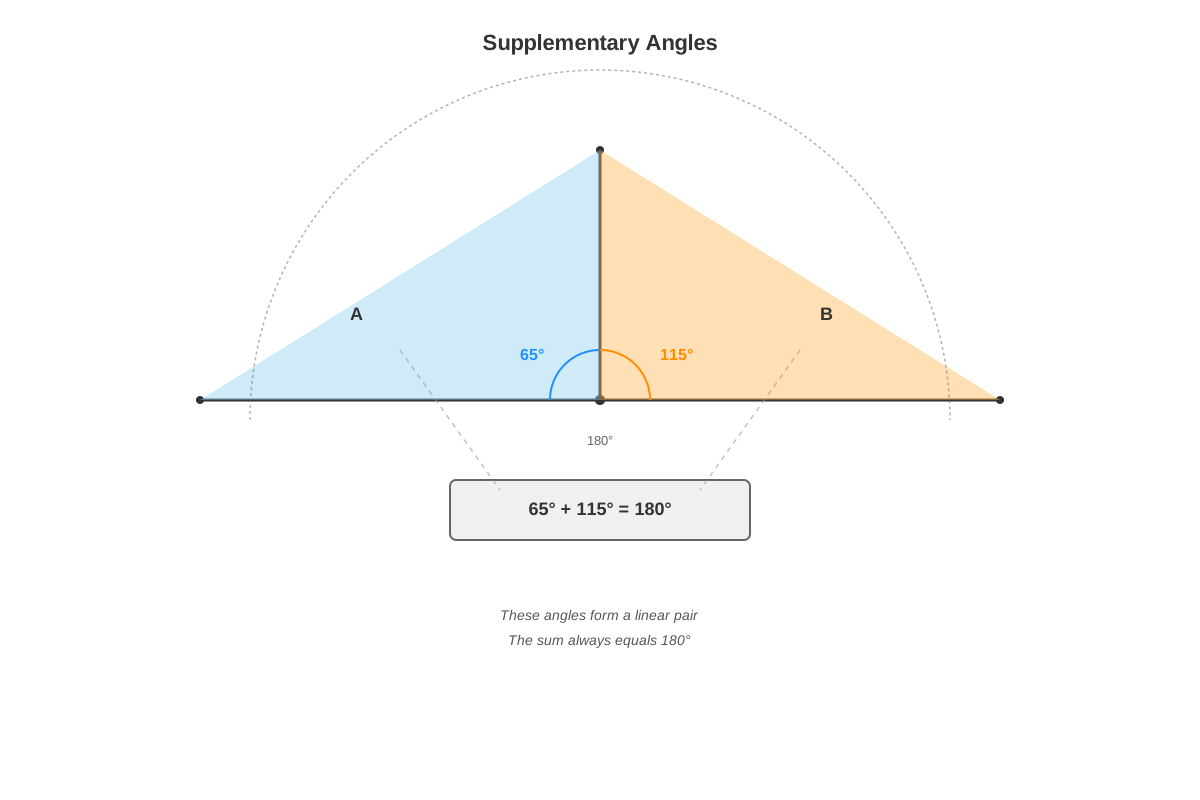
Two angles are supplementary angles if and only if the sum of their measures equals exactly 180 degrees. This relationship can be expressed mathematically as: if angle A and angle B are supplementary, then m∠A + m∠B = 180°. The term "supplementary" derives from the Latin word meaning "to complete," reflecting how these angles complete a straight angle.
Critically, supplementary angles do not need to be adjacent (sharing a common side) or even appear in the same diagram. Two angles measuring 110° and 70° are supplementary regardless of their physical arrangement. However, when supplementary angles are adjacent and share a common vertex, they form a linear pair—a special configuration that appears frequently on the ACT.
Linear Pairs and Straight Angles
A linear pair consists of two adjacent angles whose non-common sides form a straight line. Because a straight line represents a 180° angle, any linear pair must be supplementary. This connection provides a powerful visual cue: whenever you see two angles sharing a vertex and forming a straight line, you immediately know they're supplementary.
Consider a straight line with a ray extending from a point on that line. This ray divides the 180° straight angle into two angles that must sum to 180°. If one angle measures 125°, the other must measure 55° because 125° + 55° = 180°. This relationship holds regardless of the ray's position—the two angles formed always remain supplementary.
Algebraic Expressions in Supplementary Angles
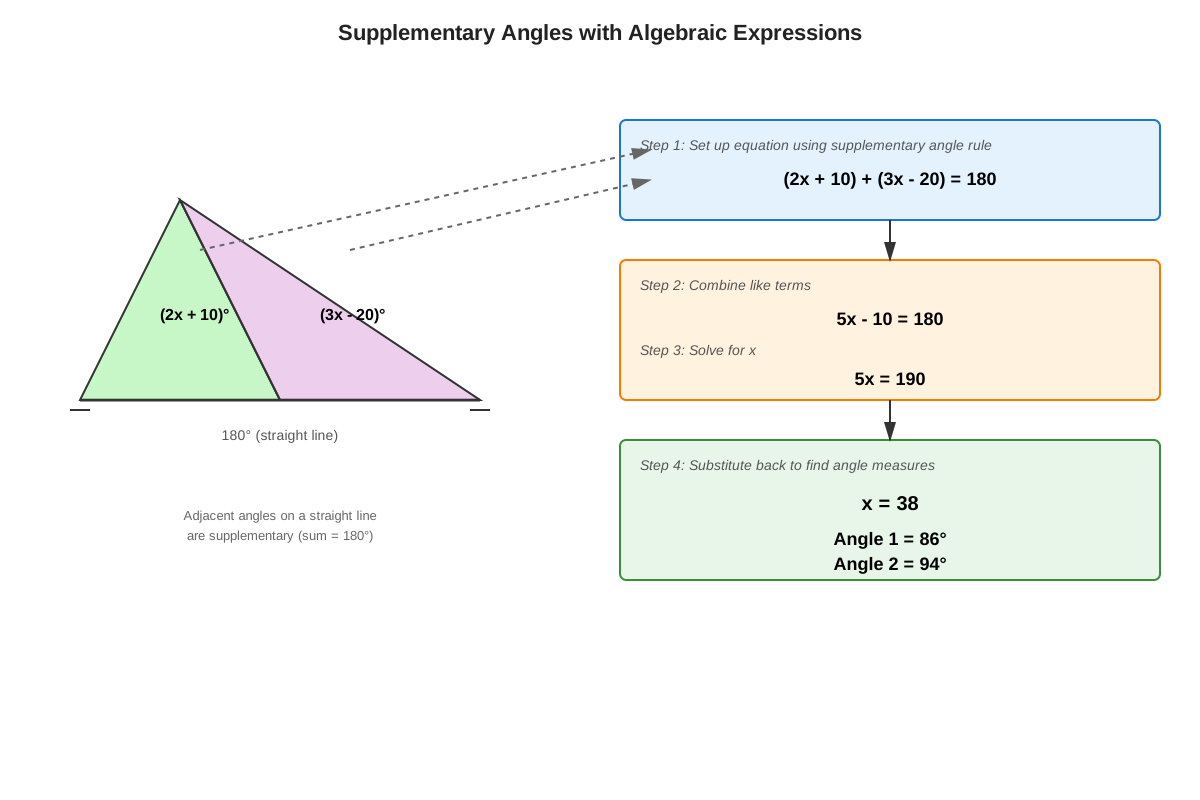
ACT questions frequently express angle measures using variables and algebraic expressions. A typical problem might state: "Two supplementary angles have measures of (3x + 15)° and (2x + 10)°. Find the value of x." The solution process involves:
- Set up the equation: (3x + 15) + (2x + 10) = 180
- Combine like terms: 5x + 25 = 180
- Isolate the variable: 5x = 155
- Solve: x = 31
After finding x, students often need to calculate the actual angle measures by substituting back into the original expressions. This two-step process—finding the variable, then finding the angle—appears in approximately 60% of algebraic supplementary angle problems.
Supplementary Angles in Parallel Lines
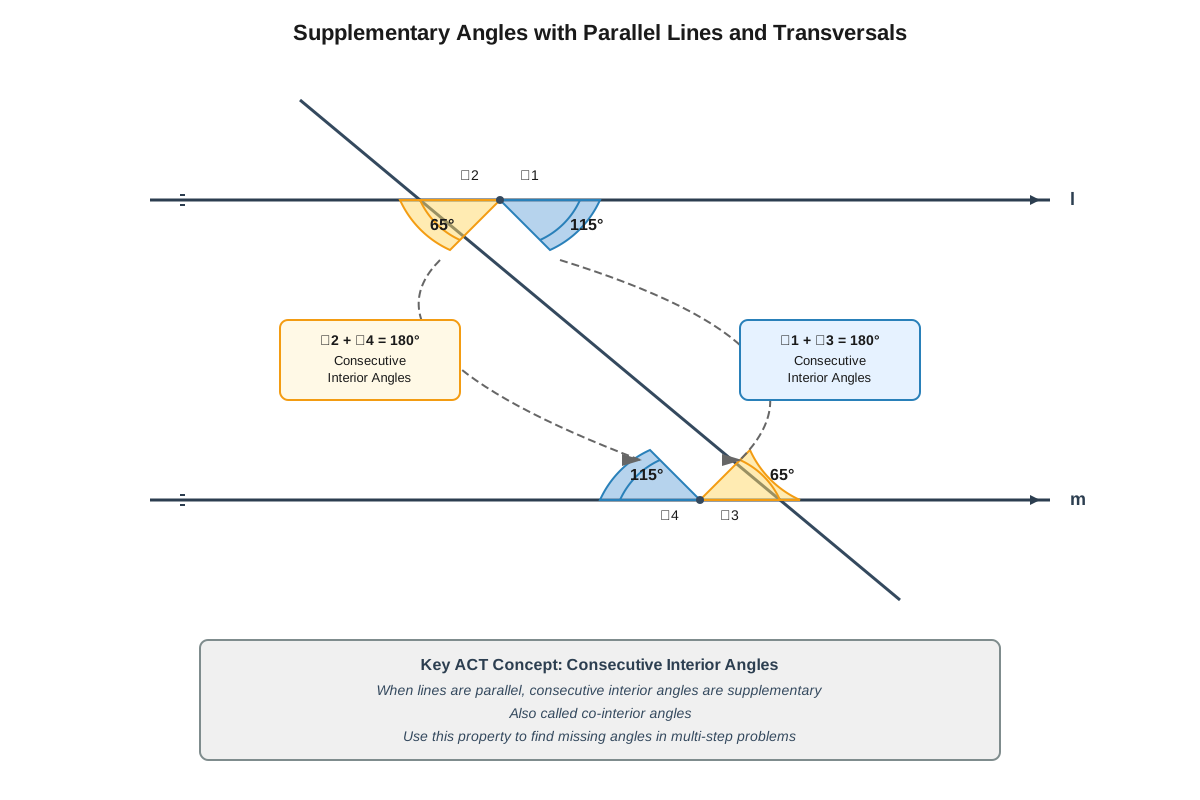
When a transversal intersects two parallel lines, multiple supplementary angle relationships emerge. Consecutive interior angles (also called co-interior angles or same-side interior angles) are always supplementary. This property provides a method for proving lines are parallel: if consecutive interior angles are supplementary, the lines must be parallel.
For example, if a transversal cuts two lines creating consecutive interior angles of 115° and 65°, the lines are parallel because 115° + 65° = 180°. Conversely, if you know lines are parallel and one consecutive interior angle measures 132°, the other must measure 48°.
Multiple Supplementary Relationships
Complex ACT problems may involve chains of supplementary relationships. Consider three angles on a straight line: if the line is divided into three angles measuring x°, y°, and z°, then x + y + z = 180°. While this technically involves three angles rather than a pair, the underlying principle—angles forming a straight line sum to 180°—remains the same.
Additionally, problems may present scenarios where angle A is supplementary to angle B, and angle B is supplementary to angle C. This creates a relationship between A and C: they must be equal. This follows from the transitive property: if A + B = 180° and B + C = 180°, then A + B = B + C, which simplifies to A = C.
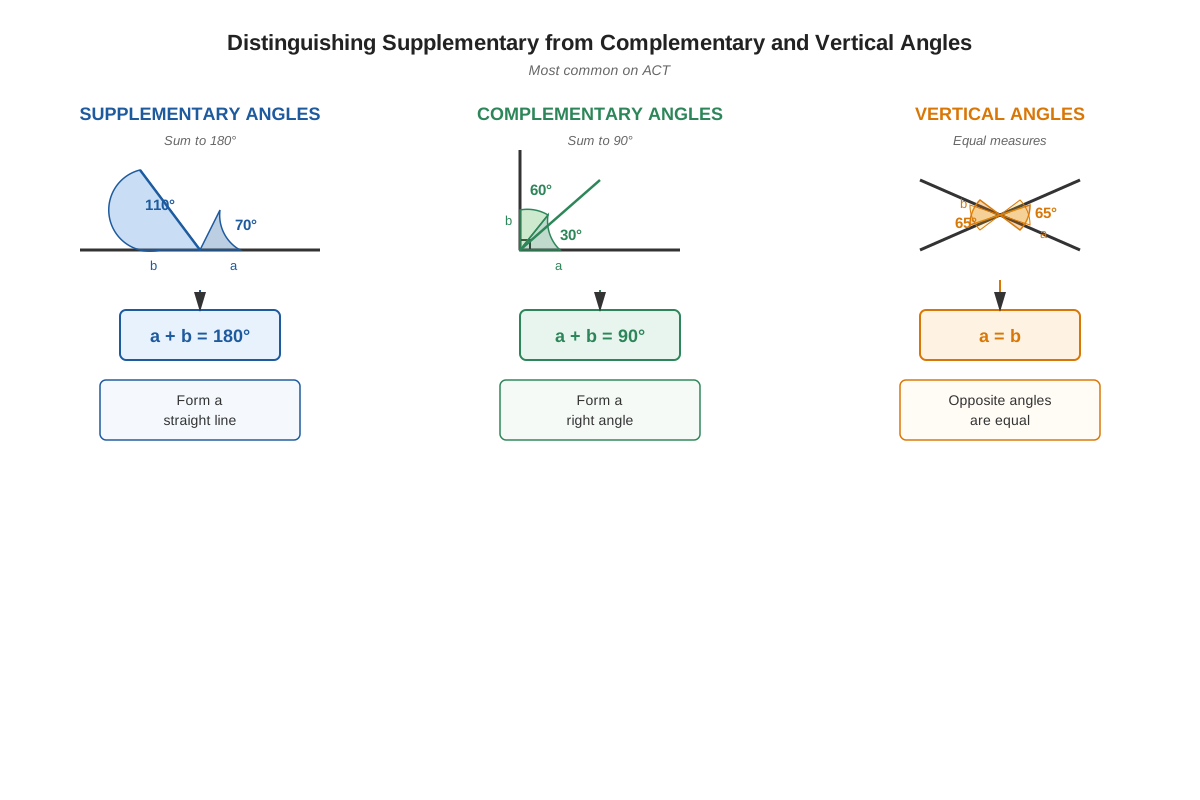
Comparison with Complementary Angles
| Feature | Supplementary Angles | Complementary Angles |
|---|---|---|
| Sum of measures | 180° | 90° |
| Visual representation | Straight line | Right angle |
| Common ACT appearance | Linear pairs, parallel lines | Right triangles, perpendicular lines |
| Algebraic setup | x + y = 180 | x + y = 90 |
| Frequency on ACT | Higher (3-5 questions) | Lower (1-2 questions) |
Understanding this distinction prevents confusion when quickly reading ACT questions. The words "supplementary" and "complementary" differ by only a few letters, but confusing them leads to incorrect answers. A helpful memory device: "S" in supplementary stands for "straight" (180°), while "C" in complementary stands for "corner" of a right angle (90°).
Concept Relationships
The concept of supplementary angles serves as a central hub connecting multiple geometric principles. At the foundational level, supplementary angles build directly on basic angle measurement and the understanding that a straight angle measures 180°. This connection is immediate and intuitive: supplementary angles literally divide a straight angle into two parts.
Moving upward in complexity, supplementary angles connect to linear pairs through the principle that adjacent supplementary angles form a straight line. This relationship flows in both directions: recognizing a linear pair immediately tells you the angles are supplementary, while knowing two adjacent angles are supplementary confirms they form a linear pair.
The concept extends horizontally to vertical angles through a shared context—intersecting lines. When two lines intersect, they create four angles. Adjacent angles are supplementary (forming linear pairs), while opposite angles are vertical (and therefore equal). This creates a web of relationships: if one angle measures 130°, its vertical angle also measures 130°, while both adjacent angles measure 50°.
Supplementary angles connect forward to parallel lines and transversals through the consecutive interior angles theorem. This represents a more sophisticated application where supplementary relationships become diagnostic tools for parallel lines. The logical flow: Basic angle measurement → Supplementary angles → Linear pairs → Consecutive interior angles → Parallel line proofs.
Additionally, supplementary angles relate to polygon interior angles through the principle that exterior angles of polygons are supplementary to their adjacent interior angles. This connection enables solutions to problems asking for exterior angle measures when interior angles are known, or vice versa.
Relationship Map:
Angle Measurement (180° straight angle) → Supplementary Angles (sum = 180°) → Linear Pairs (adjacent supplementary angles) → Intersecting Lines (creating vertical and supplementary angles) → Parallel Lines (consecutive interior angles) → Polygon Angles (interior/exterior relationships)
High-Yield Facts
⭐ Two angles are supplementary if and only if their measures sum to exactly 180 degrees
⭐ All linear pairs are supplementary angles, but not all supplementary angles form linear pairs
⭐ When a transversal intersects parallel lines, consecutive interior angles are always supplementary
⭐ If two angles are each supplementary to the same angle, they are equal to each other
⭐ To find an unknown angle supplementary to a known angle, subtract the known angle from 180°
- Supplementary angles can be adjacent or non-adjacent; their physical arrangement doesn't affect the mathematical relationship
- When setting up equations with algebraic expressions for supplementary angles, always set the sum equal to 180°, not the individual angles
- An angle supplementary to an acute angle must be obtuse, and vice versa
- The only angle that is supplementary to itself is 90° (since 90° + 90° = 180°)
- In a quadrilateral, opposite angles are supplementary if and only if the quadrilateral is cyclic (inscribed in a circle)
- Supplementary angles appear in problems involving angle bisectors, where bisecting one angle in a linear pair creates specific relationships with the other angle
- When three or more angles form a straight line, their measures still sum to 180°, extending the supplementary concept
- Exterior angles of any polygon are supplementary to their adjacent interior angles, regardless of the polygon type
Quick check — test yourself on Supplementary angles so far.
Try Flashcards →Common Misconceptions
Misconception: Supplementary angles must be adjacent to each other.
Correction: Supplementary angles only need to sum to 180°; they can be anywhere in a diagram or even in separate diagrams. Adjacent supplementary angles form the special case called linear pairs, but non-adjacent angles can also be supplementary.
Misconception: If two angles look like they form a straight line in a diagram, they are definitely supplementary.
Correction: ACT diagrams include the disclaimer "Note: Figure not drawn to scale." Never assume angle relationships based solely on appearance. Only conclude angles are supplementary if the diagram explicitly shows a straight line, the problem states they're supplementary, or you can prove it through other given information.
Misconception: Supplementary angles and complementary angles are interchangeable terms.
Correction: These are distinct concepts. Supplementary angles sum to 180° (forming a straight angle), while complementary angles sum to 90° (forming a right angle). Confusing these terms leads to setting up incorrect equations and wrong answers.
Misconception: When solving for x in an equation like (2x + 10) + (3x - 5) = 180, the value of x is the angle measure.
Correction: The value of x is typically not the angle measure itself. After solving for x, you must substitute it back into the original expressions to find the actual angle measures. For example, if x = 35, then the angles measure (2(35) + 10) = 80° and (3(35) - 5) = 100°.
Misconception: All angles on a straight line are supplementary to each other.
Correction: When more than two angles appear on a straight line, they collectively sum to 180°, but individual pairs may not be supplementary. For example, if three angles measuring 60°, 70°, and 50° lie on a straight line, no two of them are supplementary to each other (60° + 70° = 130°, not 180°).
Misconception: Vertical angles are supplementary.
Correction: Vertical angles are equal, not supplementary (unless they both measure 90°). When two lines intersect, adjacent angles are supplementary, while opposite (vertical) angles are equal. This distinction is crucial for solving problems involving intersecting lines.
Misconception: If angle A is supplementary to angle B, and angle C is supplementary to angle D, then A + C = 180°.
Correction: This conclusion doesn't follow logically. A + B = 180° and C + D = 180° doesn't create any specific relationship between A and C. However, if A and C are both supplementary to the same angle B, then A = C.
Worked Examples
Example 1: Basic Algebraic Supplementary Angles
Problem: Two supplementary angles have measures of (4x - 12)° and (2x + 18)°. Find the measure of the larger angle.
Solution:
Step 1: Set up the equation using the definition of supplementary angles.
Since the angles are supplementary, their sum equals 180°:
(4x - 12) + (2x + 18) = 180
Step 2: Combine like terms.
4x + 2x - 12 + 18 = 180
6x + 6 = 180
Step 3: Solve for x.
6x = 174
x = 29
Step 4: Find both angle measures by substituting x = 29.
First angle: 4(29) - 12 = 116 - 12 = 104°
Second angle: 2(29) + 18 = 58 + 18 = 76°
Step 5: Verify and answer the question.
Check: 104° + 76° = 180° ✓
The question asks for the larger angle, so the answer is 104°.
Connection to Learning Objectives: This example demonstrates applying supplementary angles to ACT-style questions accurately, particularly when algebraic expressions represent angle measures. It also reinforces the core rule that supplementary angles sum to 180°.
Example 2: Supplementary Angles with Parallel Lines
Problem: In the diagram below, lines l and m are parallel, and line t is a transversal. If ∠1 measures (5x + 20)° and ∠2 measures (3x + 40)°, where ∠1 and ∠2 are consecutive interior angles, find the measure of ∠1.
Solution:
Step 1: Identify the angle relationship.
The problem states that ∠1 and ∠2 are consecutive interior angles formed by a transversal cutting parallel lines. By the Consecutive Interior Angles Theorem, these angles are supplementary.
Step 2: Set up the equation.
(5x + 20) + (3x + 40) = 180
Step 3: Solve for x.
8x + 60 = 180
8x = 120
x = 15
Step 4: Find the measure of ∠1.
∠1 = 5(15) + 20 = 75 + 20 = 95°
Step 5: Verify the answer.
∠2 = 3(15) + 40 = 45 + 40 = 85°
Check: 95° + 85° = 180° ✓
The measure of ∠1 is 95°.
Connection to Learning Objectives: This example shows how to identify when supplementary angles are being tested in the context of parallel lines and transversals. It demonstrates the strategy of recognizing that consecutive interior angles are supplementary, then applying the core rule to solve for unknown values.
Exam Strategy
When approaching ACT questions involving supplementary angles, begin by scanning for trigger words and phrases: "supplementary," "linear pair," "straight angle," "form a line," "consecutive interior angles," or "sum to 180°." These phrases signal that the supplementary angle relationship is central to the solution.
Visual cues are equally important. Look for diagrams showing:
- Two angles sharing a vertex with their non-common sides forming a straight line
- Angles marked on opposite sides of a transversal between parallel lines
- Angles explicitly labeled with a straight line symbol (a small line segment with 180° marked)
Solution approach sequence:
- Identify the supplementary relationship (2-3 seconds)
- Set up the equation: angle₁ + angle₂ = 180° (5-10 seconds)
- Solve for the variable if present (20-30 seconds)
- Calculate the requested angle measure (10-15 seconds)
- Verify your answer makes sense (5 seconds)
Process of elimination strategies specific to supplementary angles:
- Eliminate any answer choice greater than 180° (angles can't exceed their sum)
- If one angle is given as acute (< 90°), eliminate obtuse angle choices for its supplement
- When solving for x, eliminate choices that would make either angle negative or greater than 180°
- For "which pair is supplementary" questions, quickly add each pair mentally; eliminate any that don't sum to 180°
Time allocation: Straightforward supplementary angle problems should take 30-45 seconds. Multi-step problems involving parallel lines or multiple angle relationships may require 60-90 seconds. If you're exceeding these times, mark the question and return to it after completing easier problems.
Common trap answers to avoid:
- Giving the value of x instead of the angle measure when the question asks for the angle
- Providing the measure of the wrong angle (the smaller when asked for the larger)
- Forgetting to subtract from 180° when finding a supplementary angle
- Confusing supplementary (180°) with complementary (90°) and using the wrong sum
Exam Tip: When you see algebraic expressions for both angles, always check whether the question asks for x, one specific angle, or both angles. ACT test writers frequently ask for the larger or smaller angle to test careful reading.
Memory Techniques
Mnemonic for Supplementary vs. Complementary:
"Supplementary = Straight line = 180" (the "S" connects all three concepts)
"Complementary = Corner (right angle) = 90" (the "C" connects all three concepts)
Visual Memory Aid:
Picture a SUPplementary angle as someone lying down SUPine (flat on their back) forming a straight 180° line. This connects the word "supplementary" with the straight line visual.
Algebraic Setup Acronym - SAFE:
- Set up the equation (angle₁ + angle₂ = 180)
- Add like terms
- Find the variable
- Evaluate the angle measure
Finger Trick for Quick Calculation:
When finding an angle supplementary to a given angle, use this mental shortcut:
- If the given angle is less than 100°, the supplement is "80 plus the difference from 100"
- Example: Supplement of 65° → 100 - 65 = 35, then 80 + 35 = 115°
- This works because 180 = 80 + 100
Relationship Chain Memory:
Remember: "Linear pairs are Always Supplementary" (LAS)
But: "Supplementary angles Aren't Always Linear" (SAAL)
Parallel Lines Reminder:
"Consecutive Interior angles Sum to 180" (CIS-180)
This helps recall that consecutive interior angles formed by parallel lines and a transversal are supplementary.
Summary
Supplementary angles—two angles whose measures sum to exactly 180 degrees—represent a foundational concept in ACT Plane Geometry that appears in multiple question formats across each exam. Mastery requires understanding both the basic definition and its applications in various contexts: linear pairs formed by adjacent supplementary angles, consecutive interior angles in parallel line configurations, and algebraic problems where angle measures are expressed as variable expressions. The key to success lies in quickly recognizing when supplementary relationships exist, setting up the equation angle₁ + angle₂ = 180°, and solving accurately while avoiding common pitfalls like confusing supplementary with complementary angles or providing the variable value instead of the angle measure. Students must distinguish between situations where supplementary angles are explicitly stated versus those requiring recognition of visual cues like straight lines or parallel line configurations. The concept connects to broader geometric principles including vertical angles, polygon angles, and parallel line theorems, making it essential for solving complex multi-step problems that integrate multiple geometric relationships.
Key Takeaways
- Supplementary angles always sum to exactly 180°, regardless of whether they're adjacent or separated in a diagram
- Linear pairs are the special case of adjacent supplementary angles whose non-common sides form a straight line
- Consecutive interior angles formed by a transversal cutting parallel lines are always supplementary—use this to identify parallel lines or find missing angles
- Set up algebraic equations by adding the two angle expressions and setting the sum equal to 180°, then solve for the variable before calculating the actual angle measure
- Distinguish supplementary (180°) from complementary (90°) by associating "S" with "straight" and "C" with "corner"
- Verify answers by checking that the two angles sum to 180° and that you've answered the specific question asked (x value, specific angle, larger angle, etc.)
- Visual recognition is faster than calculation—train yourself to instantly identify linear pairs and consecutive interior angles in diagrams
Related Topics
Complementary Angles: Understanding the relationship between two angles that sum to 90° provides contrast with supplementary angles and appears in right triangle problems. Mastering supplementary angles makes learning complementary angles straightforward through comparison.
Vertical Angles: When two lines intersect, they create both supplementary angle pairs (adjacent angles) and vertical angle pairs (opposite angles). Understanding supplementary angles is prerequisite to analyzing complete intersecting line configurations.
Parallel Lines and Transversals: This advanced topic builds directly on supplementary angles through consecutive interior angles, alternate interior angles, and corresponding angles. Supplementary angle mastery is essential before tackling parallel line proofs.
Polygon Interior and Exterior Angles: Each exterior angle of a polygon is supplementary to its adjacent interior angle. This connection makes supplementary angles foundational for polygon angle sum problems.
Triangle Angle Relationships: While triangles involve 180° as the sum of all three angles, understanding supplementary angles helps with exterior angles of triangles and angles formed when triangles interact with parallel lines.
Practice CTA
Now that you've mastered the core concepts of supplementary angles, it's time to cement your understanding through active practice. Complete the practice questions to test your ability to identify supplementary relationships, set up equations, and solve ACT-style problems under timed conditions. Use the flashcards to drill the key definitions and relationships until they become automatic. Remember: recognizing supplementary angles quickly and accurately can save you valuable time on test day and unlock solutions to problems that might otherwise seem complex. Every practice problem you complete builds the pattern recognition and problem-solving speed that separates good scores from great scores. You've got this!
Sign up free to keep reading
Create a free AnvayaPrep account to finish this ACT guide on Supplementary angles — plus flashcards and practice questions.