Overview
Rectangles are one of the most frequently tested geometric shapes on the ACT Math section, appearing in approximately 3-5 questions per exam. Understanding rectangles goes far beyond simply recognizing a four-sided figure with right angles—it requires mastery of area, perimeter, diagonal properties, and the ability to apply these concepts in complex problem-solving scenarios. The ACT consistently tests rectangles in both straightforward computational problems and multi-step word problems that require spatial reasoning and algebraic manipulation.
The importance of ACT rectangles cannot be overstated. Rectangle problems often serve as the foundation for more complex geometric concepts, including coordinate geometry, three-dimensional figures (rectangular prisms), and optimization problems. Questions involving rectangles frequently integrate multiple mathematical concepts, requiring students to combine knowledge of algebra, ratios, and geometric properties. A solid understanding of rectangle properties enables students to quickly identify solution pathways and avoid time-consuming calculation errors.
Rectangles connect to broader mathematical concepts in several critical ways. They serve as building blocks for understanding parallelograms and other quadrilaterals, provide essential practice with the Pythagorean theorem through diagonal calculations, and frequently appear in coordinate plane problems where vertices are given as ordered pairs. Additionally, rectangle concepts extend into real-world applications tested on the ACT, such as area optimization, perimeter constraints, and scaling problems that involve similar figures.
Learning Objectives
- [ ] Identify when Rectangles is being tested in ACT Math questions
- [ ] Explain the core rule or strategy behind Rectangles problems
- [ ] Apply Rectangles concepts to ACT-style questions accurately
- [ ] Calculate area, perimeter, and diagonal length of rectangles using appropriate formulas
- [ ] Solve multi-step problems involving rectangles in coordinate geometry contexts
- [ ] Determine dimensions of rectangles given constraints involving area, perimeter, or ratios
- [ ] Apply rectangle properties to solve optimization and real-world application problems
Prerequisites
- Basic algebraic manipulation: Essential for solving equations when rectangle dimensions are unknown or expressed as variables
- Understanding of right triangles and Pythagorean theorem: Required for calculating diagonal lengths and solving problems involving rectangle subdivisions
- Familiarity with coordinate plane: Necessary for problems where rectangle vertices are given as coordinate points
- Knowledge of units and unit conversion: Important for interpreting word problems and ensuring dimensional consistency in calculations
- Basic understanding of ratios and proportions: Needed for problems involving similar rectangles or scaling
Why This Topic Matters
Rectangles appear throughout everyday life—from room dimensions and screen sizes to garden plots and construction projects. Understanding rectangle properties enables practical problem-solving in fields ranging from architecture and interior design to computer graphics and engineering. The mathematical principles governing rectangles form the foundation for understanding area, perimeter, and spatial relationships that extend to more complex geometric figures.
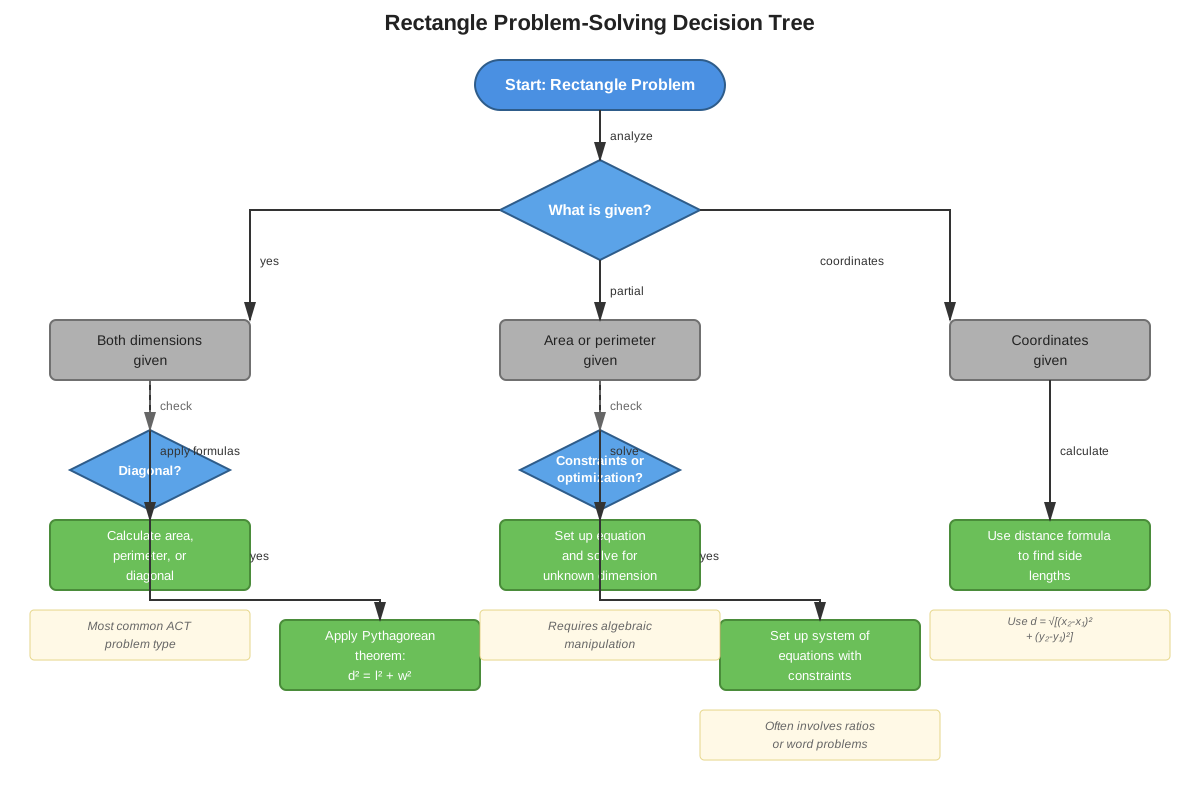
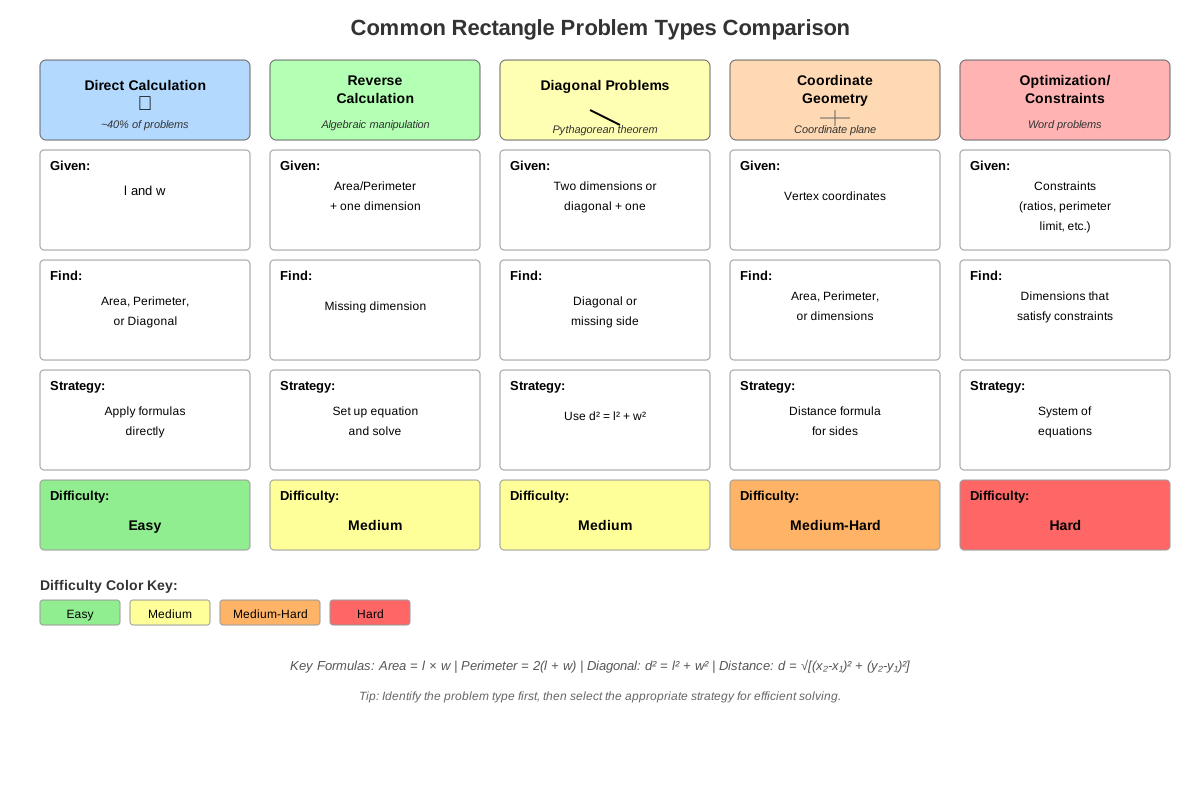
On the ACT Math section, rectangle problems appear with remarkable consistency. Statistical analysis of recent ACT exams reveals that rectangles are tested in 8-12% of all geometry questions, making them one of the highest-yield geometric topics. These questions typically fall into several categories: direct calculation problems (finding area or perimeter given dimensions), reverse problems (finding dimensions given area or perimeter), diagonal problems (using the Pythagorean theorem), coordinate geometry problems (rectangles on the coordinate plane), and word problems (real-world applications involving rectangular regions).
Rectangle questions on the ACT commonly appear disguised within larger problems. A coordinate geometry question might require recognizing that four given points form a rectangle. A word problem about fencing a garden might test perimeter concepts. A three-dimensional problem about a rectangular box requires understanding rectangular faces. The ability to quickly identify when rectangle properties are being tested—even when the word "rectangle" doesn't explicitly appear—is a crucial skill that separates high-scoring students from average performers.
Core Concepts
Definition and Properties of Rectangles
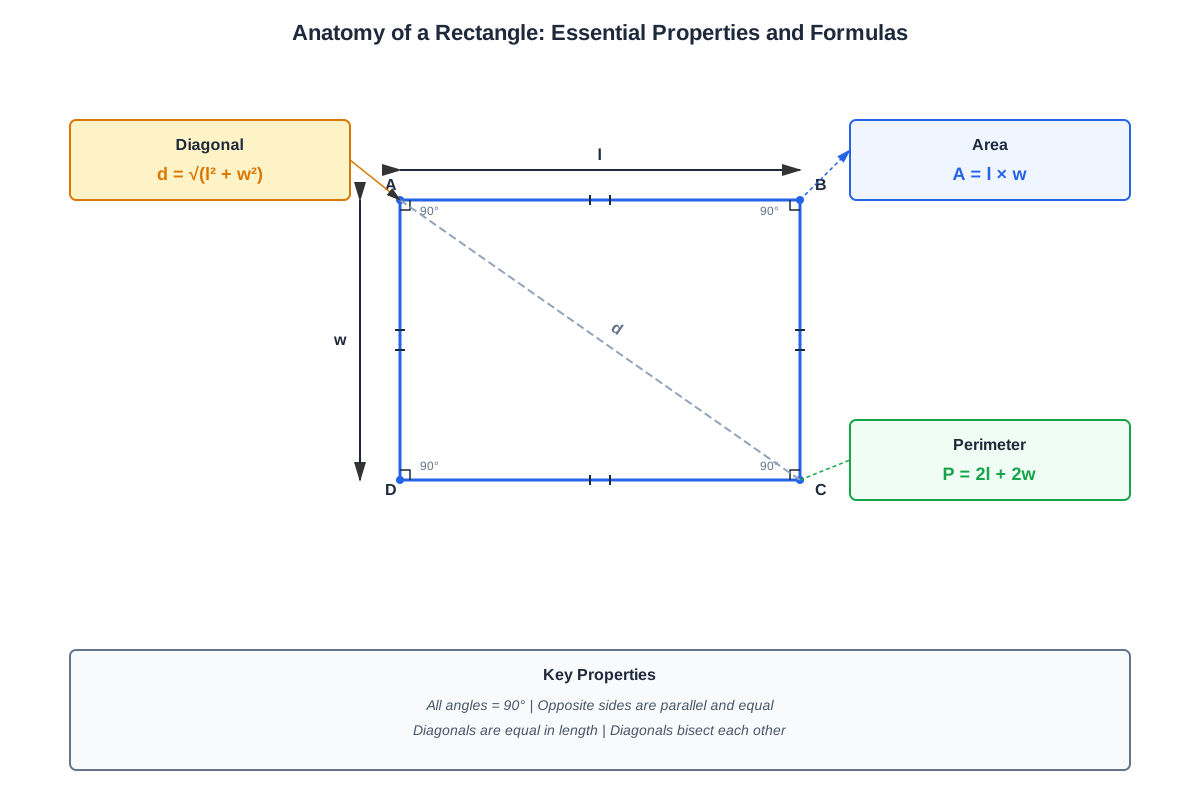
A rectangle is a quadrilateral (four-sided polygon) with four right angles (90-degree angles). This defining characteristic leads to several important properties that the ACT tests repeatedly. Opposite sides of a rectangle are parallel and congruent (equal in length). Adjacent sides are perpendicular to each other. These properties make rectangles a special type of parallelogram with additional constraints.
Every rectangle has two pairs of equal sides: the length (typically the longer dimension, though this convention isn't universal) and the width (typically the shorter dimension, also called height). The ACT may use various terms interchangeably—length/width, base/height, or simply refer to dimensions without specific labels. Understanding that opposite sides are equal is crucial for setting up equations in algebraic problems.
Area Formula and Applications
The area of a rectangle equals the product of its length and width:
Area = length × width = l × wThis fundamental formula appears in numerous ACT contexts. Direct application problems provide both dimensions and ask for the area. Reverse problems provide the area and one dimension, requiring students to solve for the unknown dimension. More complex problems might provide the area and a relationship between dimensions (such as "the length is 3 feet more than twice the width") requiring algebraic equation-solving.
Area problems frequently involve unit conversions. A question might provide dimensions in feet but ask for area in square yards, or provide dimensions in inches but ask for area in square feet. Remember that when converting area units, the conversion factor must be squared. For example, since 1 yard = 3 feet, then 1 square yard = 9 square feet.
Perimeter Formula and Applications
The perimeter of a rectangle is the total distance around its boundary:
Perimeter = 2(length + width) = 2l + 2wAlternatively, this can be expressed as:
Perimeter = 2 × length + 2 × widthPerimeter problems on the ACT often involve real-world contexts such as fencing, framing, or border materials. These problems may provide the perimeter and ask for dimensions, or provide constraints on both area and perimeter simultaneously. When both area and perimeter are given, students typically need to set up and solve a system of equations.
Diagonal Properties
The diagonal of a rectangle is a line segment connecting two non-adjacent vertices. Every rectangle has two diagonals, and these diagonals are always equal in length. The diagonal divides the rectangle into two congruent right triangles, making the Pythagorean theorem applicable.
The diagonal length can be calculated using:
Diagonal = √(length² + width²) = √(l² + w²)This formula derives directly from the Pythagorean theorem, where the diagonal serves as the hypotenuse and the length and width serve as the legs of a right triangle. ACT questions frequently test whether students recognize this relationship and can apply it correctly.
Diagonal problems may be presented in reverse: given the diagonal length and one dimension, find the other dimension. This requires rearranging the Pythagorean theorem and solving for the unknown variable.
Rectangles in the Coordinate Plane
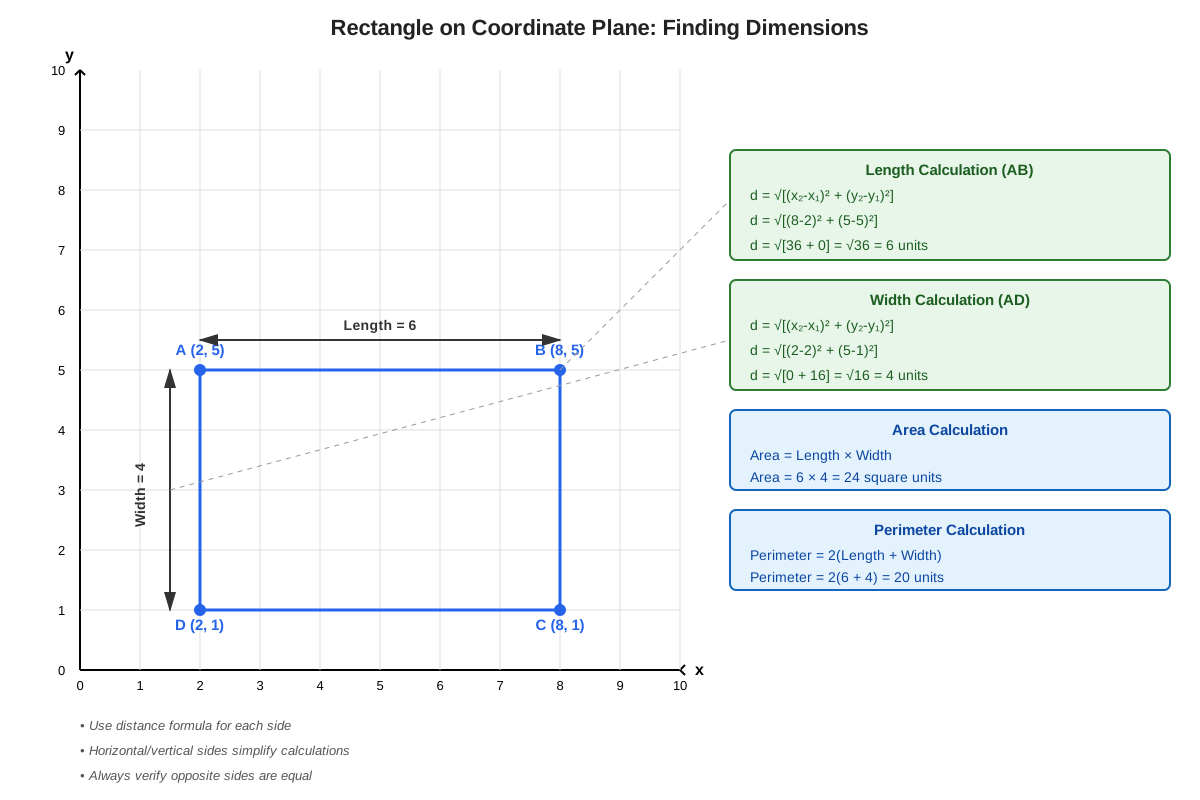
When a rectangle is positioned on the coordinate plane, its vertices are represented as ordered pairs (x, y). The ACT tests several concepts related to coordinate rectangles:
- Identifying rectangles: Given four points, determine whether they form a rectangle by checking that opposite sides are parallel and equal, and adjacent sides are perpendicular
- Finding dimensions: Calculate side lengths using the distance formula between vertices
- Calculating area: Use the dimensions found via the distance formula to compute area
- Determining missing vertices: Given three vertices of a rectangle, find the coordinates of the fourth vertex
For rectangles with sides parallel to the axes (the most common ACT scenario), calculations simplify significantly. The length of a horizontal side equals the absolute difference in x-coordinates, and the length of a vertical side equals the absolute difference in y-coordinates.
Special Rectangle Relationships
The ACT tests several special relationships involving rectangles:
| Relationship Type | Description | Common Application |
|---|---|---|
| Similar rectangles | Rectangles with proportional corresponding sides | Scaling problems, map problems |
| Inscribed rectangles | Rectangles inside circles or other shapes | Optimization problems |
| Composite figures | Rectangles combined with other shapes | Area of irregular regions |
| Three-dimensional extensions | Rectangular prisms and boxes | Volume and surface area problems |
Concept Relationships
The concepts within rectangle geometry form an interconnected web of relationships. The definition (four right angles, opposite sides equal and parallel) → leads to → area and perimeter formulas (which depend on the two distinct dimensions). The right angle property → enables → diagonal calculations (through the Pythagorean theorem). Understanding basic rectangle properties → supports → coordinate plane applications (where distance formula and slope concepts verify rectangle characteristics).
Rectangle concepts connect strongly to prerequisite knowledge. The Pythagorean theorem (prerequisite) → applies directly to → diagonal problems. Algebraic equation-solving (prerequisite) → enables → finding unknown dimensions when given area, perimeter, or relationships between dimensions. Coordinate geometry (prerequisite) → extends to → rectangles on the coordinate plane.
Rectangles also serve as stepping stones to more advanced topics. Mastery of rectangle properties → prepares students for → parallelograms and other quadrilaterals (rectangles are special parallelograms). Understanding rectangle area → extends to → three-dimensional rectangular prisms (volume equals area of base times height). Rectangle optimization problems → introduce → calculus concepts (though calculus isn't tested on the ACT, the problem-solving approach builds mathematical maturity).
Quick check — test yourself on Rectangles so far.
Try Flashcards →High-Yield Facts
⭐ The area of a rectangle equals length times width: A = l × w
⭐ The perimeter of a rectangle equals 2(length + width): P = 2l + 2w
⭐ The diagonal of a rectangle can be found using the Pythagorean theorem: d = √(l² + w²)
⭐ Opposite sides of a rectangle are equal in length and parallel to each other
⭐ All four angles in a rectangle are right angles (90 degrees)
- The two diagonals of a rectangle are equal in length and bisect each other
- A rectangle is a special type of parallelogram where all angles are right angles
- When a rectangle's sides are parallel to the coordinate axes, finding dimensions requires only subtraction of coordinates
- If a rectangle has area A and perimeter P, and you know both values, you can find the dimensions by solving the system: lw = A and 2l + 2w = P
- A square is a special rectangle where length equals width (all four sides are equal)
- The diagonal of a rectangle divides it into two congruent right triangles
- When converting area units, the conversion factor must be squared (e.g., 1 ft² = 144 in²)
- The maximum area for a rectangle with a given perimeter occurs when the rectangle is a square
- In coordinate geometry, four points form a rectangle if opposite sides are equal and parallel, and adjacent sides are perpendicular (slopes are negative reciprocals)
Common Misconceptions
Misconception: The longer side must always be called the "length" and the shorter side the "width."
Correction: While this convention is common, the ACT may use these terms interchangeably or not at all. Focus on identifying the two distinct dimensions rather than worrying about which is "officially" length versus width. The formulas work regardless of which dimension is which.
Misconception: The diagonal formula is d = l + w.
Correction: The diagonal is NOT the sum of the sides. It must be calculated using the Pythagorean theorem: d = √(l² + w²). The diagonal is always shorter than the sum of length and width but longer than either individual dimension.
Misconception: Perimeter and area are measured in the same units.
Correction: Perimeter is measured in linear units (feet, meters, inches), while area is measured in square units (square feet, square meters, square inches). Confusing these units is a common trap on the ACT.
Misconception: If two rectangles have the same perimeter, they must have the same area.
Correction: Rectangles with identical perimeters can have vastly different areas. For example, a 1×9 rectangle and a 4×6 rectangle both have perimeter 20, but their areas are 9 and 24 respectively.
Misconception: When a rectangle is divided by a diagonal, the two resulting triangles have the same perimeter as half the rectangle's perimeter.
Correction: Each triangle's perimeter includes the diagonal, which is longer than either side of the rectangle. The triangle's perimeter equals (length + width + diagonal), not half of 2(length + width).
Misconception: In coordinate geometry, any four points with two pairs of equal distances form a rectangle.
Correction: Equal opposite sides are necessary but not sufficient. The sides must also meet at right angles. A parallelogram has equal opposite sides but isn't necessarily a rectangle. Verify that adjacent sides are perpendicular (slopes are negative reciprocals) or that all angles are 90 degrees.
Worked Examples
Example 1: Multi-Step Area and Perimeter Problem
Problem: A rectangular garden has a perimeter of 60 feet. The length is 6 feet more than the width. What is the area of the garden in square feet?
Solution:
Step 1: Define variables. Let w = width in feet. Then length = w + 6 feet.
Step 2: Use the perimeter formula. We know P = 2l + 2w = 60.
Substituting l = w + 6:
2(w + 6) + 2w = 60
2w + 12 + 2w = 60
4w + 12 = 60
4w = 48
w = 12
Step 3: Find the length. Since l = w + 6, we have l = 12 + 6 = 18 feet.
Step 4: Calculate the area. A = l × w = 18 × 12 = 216 square feet.
Step 5: Verify the answer. Check that perimeter = 2(18) + 2(12) = 36 + 24 = 60 ✓
Answer: 216 square feet
This problem demonstrates the common ACT pattern of providing a relationship between dimensions along with perimeter or area information, requiring algebraic equation-solving to find the actual dimensions before calculating the requested quantity.
Example 2: Coordinate Geometry Rectangle Problem
Problem: In the coordinate plane, three vertices of a rectangle are located at points A(2, 3), B(2, 8), and C(7, 8). What is the area of the rectangle?
Solution:
Step 1: Plot or visualize the points. Points B and C share the same y-coordinate (8), so BC is horizontal. Points A and B share the same x-coordinate (2), so AB is vertical. This confirms we have two perpendicular sides.
Step 2: Find the length of side AB (vertical side).
Length of AB = |8 - 3| = 5 unitsStep 3: Find the length of side BC (horizontal side).
Length of BC = |7 - 2| = 5 unitsStep 4: Calculate the area.
Area = length × width = 5 × 5 = 25 square unitsStep 5: (Optional) Find the fourth vertex. Since we have a rectangle with sides parallel to the axes, the fourth vertex D must be at (7, 3), completing the rectangle.
Answer: 25 square units
This problem illustrates how coordinate geometry rectangle problems often simplify when sides are parallel to the axes—dimensions can be found through simple subtraction rather than using the distance formula. It also demonstrates that recognizing the rectangle's orientation quickly leads to the solution.
Exam Strategy
When approaching ACT rectangles questions, begin by identifying what information is given and what is being asked. Draw a diagram if one isn't provided—visual representation prevents errors and often reveals solution pathways. Label all known dimensions and mark right angles to reinforce the rectangle's properties.
Trigger words and phrases that signal rectangle problems include: "rectangular region," "four right angles," "opposite sides equal," "length and width," "perimeter of a fence," "area of a floor/wall/garden," and "diagonal distance." In coordinate geometry, phrases like "vertices at the following points" or "corners of a rectangle" indicate you'll need to apply rectangle properties to coordinate pairs.
For process of elimination, remember these principles: area must be positive and typically smaller than perimeter squared; diagonal length must be greater than either individual side but less than the sum of both sides; if answer choices include both the correct area and the perimeter value, double-check which quantity the question asks for (this is a common trap). When dimensions are unknown, eliminate answer choices that would result in negative dimensions or violate given constraints.
Time allocation for rectangle problems should average 45-60 seconds for straightforward calculation problems and 90-120 seconds for multi-step word problems or coordinate geometry applications. If a problem requires setting up and solving a system of equations, budget the full two minutes. Don't spend excessive time on a single rectangle problem—if you're stuck after 90 seconds, mark it for review and move forward.
Exam Tip: When a problem provides both area and perimeter, immediately set up two equations. This systematic approach prevents confusion and ensures you use all given information.
Memory Techniques
For the area formula, visualize "A = L × W" as "All Lines Work" to remember that area equals length times width.
For the perimeter formula, use the mnemonic "Two Lengths, Two Widths" or remember "P = 2(L + W)" as "Perimeter equals 2 times the sum of Length and Width."
For diagonal calculations, remember "D-P-T": Diagonal problems use Pythagorean Theorem. Visualize the diagonal cutting the rectangle into two right triangles.
For coordinate rectangles, use "SOPA": Sides Opposite are Parallel and equal; Adjacent sides are perpendicular. This reminds you of the two key properties to verify.
For unit conversions, remember "Square the Scale": when converting area units, square the linear conversion factor. If 1 foot = 12 inches, then 1 square foot = 144 square inches (12²).
Summary
Rectangles are fundamental geometric figures defined by four right angles and two pairs of equal opposite sides. Mastery of rectangle concepts requires fluency with three core formulas: area (A = l × w), perimeter (P = 2l + 2w), and diagonal (d = √(l² + w²)). The ACT tests rectangles through direct calculation problems, reverse problems requiring algebraic manipulation, coordinate geometry applications, and real-world word problems. Success requires recognizing when rectangle properties apply, even when problems don't explicitly mention rectangles, and understanding how these properties connect to broader mathematical concepts like the Pythagorean theorem and coordinate geometry. High-performing students quickly identify which formula applies, set up equations systematically when dimensions are unknown, and verify answers by checking that all given constraints are satisfied. Rectangle problems frequently integrate multiple mathematical skills, making them excellent indicators of overall mathematical proficiency and problem-solving ability.
Key Takeaways
- The three essential rectangle formulas are: Area = l × w, Perimeter = 2(l + w), and Diagonal = √(l² + w²)
- Opposite sides of rectangles are always equal and parallel; all four angles are always 90 degrees
- When both area and perimeter are given, set up a system of two equations to find unknown dimensions
- Rectangle diagonals form right triangles, making the Pythagorean theorem applicable
- In coordinate geometry with axis-aligned rectangles, dimensions equal the absolute differences in coordinates
- Always verify units—perimeter uses linear units while area uses square units
- The diagonal of a rectangle is always longer than either side but shorter than the sum of both sides
Related Topics
Squares: Special rectangles where all four sides are equal; understanding rectangles provides the foundation for square properties and formulas, with the added constraint that l = w.
Parallelograms: Rectangles are special parallelograms with right angles; mastering rectangles enables understanding of the broader parallelogram family and how angle measures affect area calculations.
Rectangular Prisms: Three-dimensional extensions of rectangles; rectangle area concepts extend directly to calculating volume (area of base × height) and surface area (sum of rectangular face areas).
Pythagorean Theorem Applications: Rectangle diagonal problems provide essential practice with the Pythagorean theorem, preparing students for more complex right triangle problems.
Coordinate Geometry: Rectangle problems in the coordinate plane integrate distance formula, slope, and midpoint concepts, building comprehensive coordinate geometry skills.
Optimization Problems: Finding maximum area given perimeter constraints (or vice versa) introduces optimization thinking that extends to more advanced mathematical reasoning.
Practice CTA
Now that you've mastered the core concepts of rectangles, it's time to solidify your understanding through practice! Attempt the practice questions to apply these formulas and strategies to ACT-style problems. Use the flashcards to reinforce the key formulas and properties until they become automatic. Remember, rectangle problems appear on virtually every ACT Math section—your investment in mastering this topic will pay dividends on test day. Approach each practice problem systematically, draw diagrams, and verify your answers. You've got this!
Sign up free to keep reading
Create a free AnvayaPrep account to finish this ACT guide on Rectangles — plus flashcards and practice questions.