Overview
Squares are one of the most frequently tested geometric shapes on the ACT Math section, appearing in approximately 10-15% of all plane geometry questions. A square is a special quadrilateral that combines the properties of both rectangles and rhombuses, making it a fundamental building block for understanding more complex geometric relationships. Mastery of square properties, formulas, and problem-solving techniques is essential for achieving a competitive score on the ACT, as questions involving squares often integrate multiple mathematical concepts including area, perimeter, diagonal relationships, and coordinate geometry.
Understanding squares provides a gateway to comprehending broader geometric principles. The symmetry and regularity of squares make them ideal for testing proportional reasoning, the Pythagorean theorem, and spatial visualization skills. ACT squares questions frequently appear disguised within coordinate plane problems, composite figure calculations, and word problems involving real-world applications like tiling, construction, or optimization scenarios.
The strategic importance of squares extends beyond isolated geometry questions. Square properties frequently serve as stepping stones in multi-step problems that combine algebra, trigonometry, and advanced geometry concepts. Students who develop fluency with square formulas and relationships gain significant advantages in time management and accuracy, as these problems often yield to quick pattern recognition rather than lengthy calculations. The predictable nature of square properties makes this topic one of the highest-yield areas for focused study and practice.
Learning Objectives
- [ ] Identify when Squares is being tested in ACT Math questions
- [ ] Explain the core rule or strategy behind Squares problems
- [ ] Apply Squares concepts to ACT-style questions accurately
- [ ] Calculate area, perimeter, and diagonal length of squares using appropriate formulas
- [ ] Recognize squares embedded within complex figures and coordinate plane scenarios
- [ ] Solve multi-step problems involving squares combined with other geometric shapes
- [ ] Apply the relationship between a square's side length and its diagonal using the Pythagorean theorem
Prerequisites
- Basic properties of quadrilaterals: Understanding that squares belong to the family of four-sided polygons helps contextualize their special properties
- Pythagorean theorem (a² + b² = c²): Essential for calculating diagonal lengths and solving problems involving right triangles formed within squares
- Area and perimeter concepts: Foundational understanding of these measurements enables quick application of square-specific formulas
- Properties of right angles: Recognizing that all square angles measure 90° is crucial for identifying squares and applying appropriate problem-solving strategies
- Basic algebraic manipulation: Necessary for solving equations when square dimensions are expressed as variables or when working backwards from area to side length
Why This Topic Matters
Squares appear throughout real-world applications in architecture, design, engineering, and everyday spatial reasoning. From calculating the amount of tile needed for a square floor to determining the diagonal distance across a city block laid out in a grid pattern, square properties provide practical problem-solving tools. Understanding squares also forms the foundation for more advanced topics in trigonometry, calculus, and three-dimensional geometry.
On the ACT Math section, square-related questions appear with remarkable consistency, typically comprising 2-4 questions per test administration. These questions span multiple difficulty levels and question types, including straightforward formula application problems (easier), composite figure calculations (medium difficulty), and complex coordinate geometry scenarios (harder). The ACT frequently tests squares in combination with other concepts such as circles inscribed in squares, squares inscribed in circles, shaded region problems, and optimization scenarios.
Common question formats include: direct calculation of area or perimeter given a side length; finding side length when given area or diagonal; determining the relationship between inscribed or circumscribed figures; coordinate plane problems where vertices of squares are given; and word problems requiring translation of real-world scenarios into geometric calculations. The predictable nature of these question types makes squares an exceptionally high-yield study topic where focused practice directly translates to test-day points.
Core Concepts
Definition and Properties of Squares
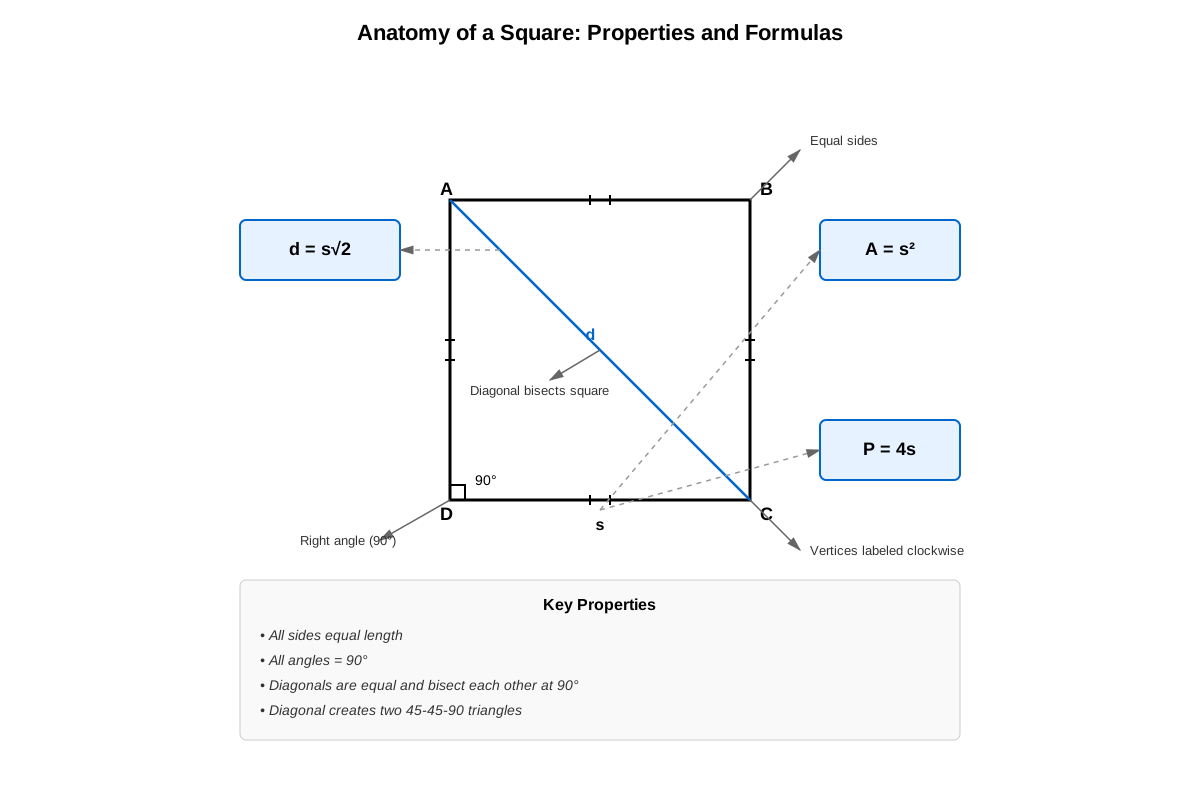
A square is a regular quadrilateral with four equal sides and four right angles (90° each). This dual nature—having both equal sides (like a rhombus) and right angles (like a rectangle)—gives squares unique mathematical properties. All squares possess the following characteristics:
- Four sides of equal length (s = side length)
- Four interior angles, each measuring exactly 90°
- Opposite sides that are parallel
- Diagonals that are equal in length
- Diagonals that bisect each other at right angles (perpendicular bisectors)
- Diagonals that bisect the corner angles, creating 45° angles
- Four lines of symmetry (two through opposite sides, two through opposite vertices)
- Rotational symmetry of order 4 (looks identical after 90°, 180°, 270°, and 360° rotations)
Area Formula
The area of a square represents the amount of two-dimensional space enclosed within its boundaries. The formula derives from the general rectangle area formula (length × width), but since all sides of a square are equal:
Area = s²where s represents the side length. This formula is fundamental and appears in numerous ACT problems. When working backwards from area to side length, take the square root: s = √(Area).
Example: If a square has a side length of 7 inches, its area equals 7² = 49 square inches. Conversely, if a square has an area of 64 square feet, its side length equals √64 = 8 feet.
Perimeter Formula
The perimeter of a square is the total distance around its boundary. Since all four sides have equal length:
Perimeter = 4swhere s represents the side length. This straightforward formula frequently appears in word problems involving fencing, borders, or frames.
Example: A square garden with 12-foot sides has a perimeter of 4(12) = 48 feet. If 48 feet of fencing is needed, and fencing costs $8 per foot, the total cost would be 48 × $8 = $384.
Diagonal Formula and Relationship
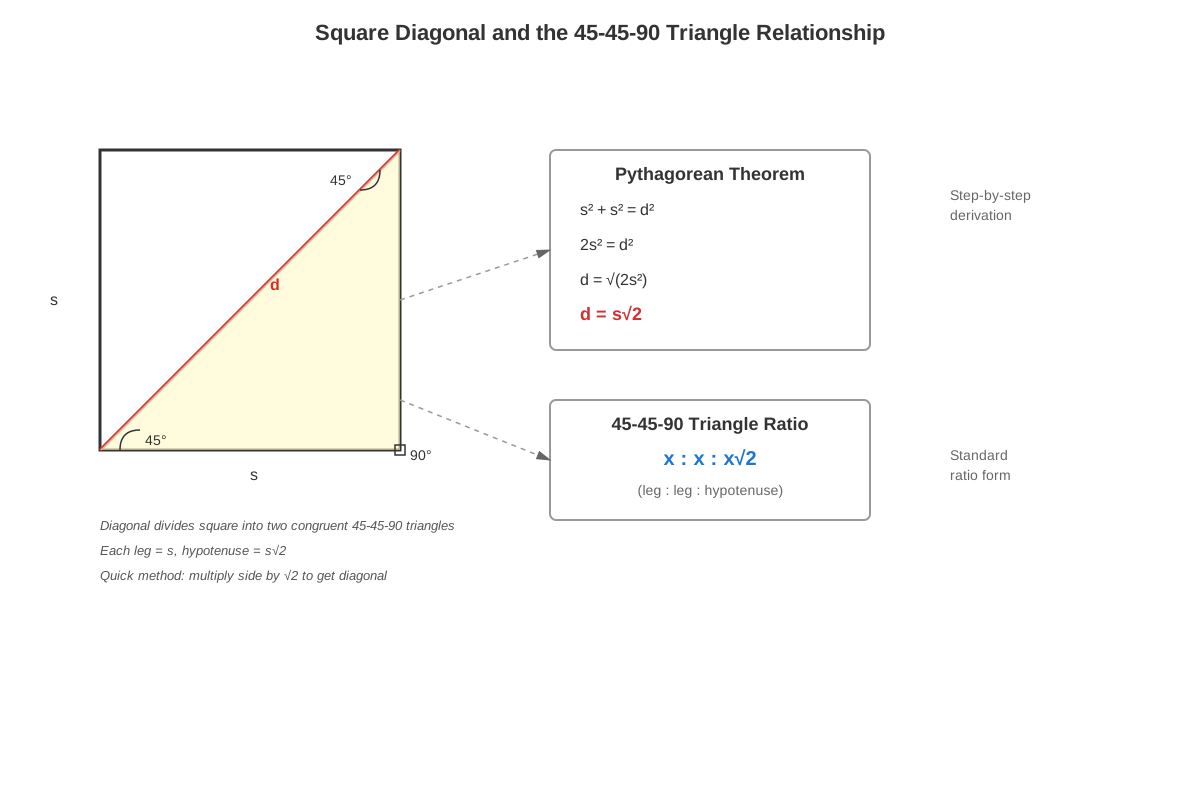
The diagonal of a square connects two opposite vertices and passes through the center. Understanding diagonal relationships is crucial for ACT success, as diagonal problems appear frequently. To derive the diagonal formula, recognize that a diagonal divides the square into two congruent 45-45-90 right triangles.
Using the Pythagorean theorem with both legs equal to s:
d² = s² + s²
d² = 2s²
d = s√2
This relationship—that the diagonal equals the side length multiplied by √2—is one of the most tested square properties on the ACT.
Conversely, if you know the diagonal length, you can find the side length:
s = d/√2 = d√2/2Example: A square with side length 10 cm has a diagonal of 10√2 ≈ 14.14 cm. If a square has a diagonal of 8√2 inches, its side length is 8 inches.
Squares in the Coordinate Plane
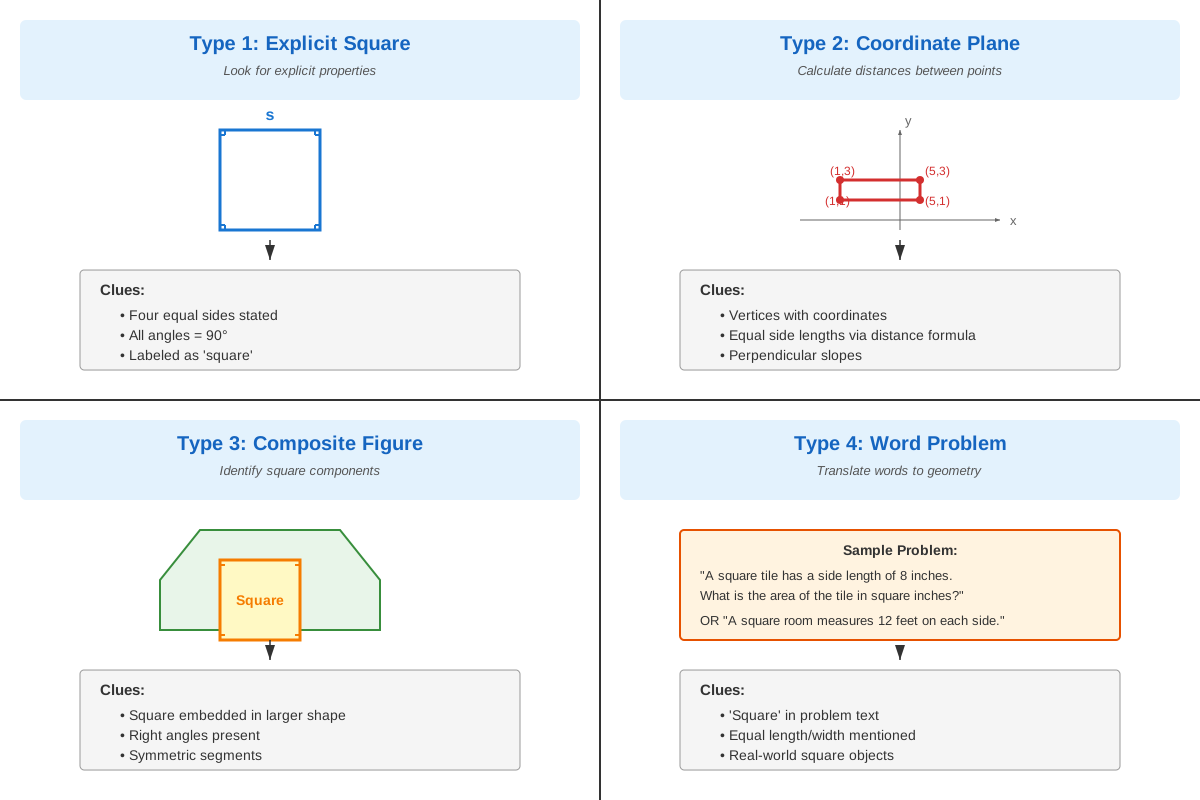
ACT questions frequently present squares with vertices plotted on a coordinate plane. Key strategies include:
- Identifying squares from coordinates: Check that all sides have equal length using the distance formula and that adjacent sides are perpendicular (slopes are negative reciprocals)
- Finding missing vertices: If three vertices are given, use the properties that opposite sides are parallel and equal in length
- Calculating area from coordinates: Find the side length using the distance formula, then apply Area = s²
Example: Given vertices at (2, 3), (5, 3), (5, 6), and (2, 6), verify this is a square by calculating distances: horizontal sides = 3 units, vertical sides = 3 units, all angles are right angles. Area = 3² = 9 square units.
Inscribed and Circumscribed Circles
The relationship between squares and circles creates high-yield ACT problems:
Circle inscribed in a square (circle touches all four sides):
- Circle diameter = square side length (d = s)
- Circle radius = s/2
- Circle area = π(s/2)² = πs²/4
Square inscribed in a circle (all four vertices touch the circle):
- Circle diameter = square diagonal
- If square has side s, circle radius r = s√2/2
- If circle has radius r, square side s = r√2
Composite Figures Involving Squares
ACT problems frequently combine squares with other shapes. Common scenarios include:
- Shaded regions: Finding the area of a region by subtracting one shape's area from another
- Squares within squares: Calculating the area between concentric squares
- Squares and triangles: Recognizing that diagonals create isosceles right triangles
- Multiple squares: Problems involving arrangements of squares in patterns
Concept Relationships
The properties of squares form an interconnected web of relationships. The side length serves as the fundamental measurement from which all other properties derive. Side length → directly determines → area (through squaring) and perimeter (through multiplication by 4). The side length also → connects to → diagonal length through the Pythagorean theorem and the constant ratio of √2.
Diagonal properties → create → 45-45-90 triangles, which → enable → trigonometric relationships and angle calculations. The perpendicular bisection of diagonals → establishes → the center point of the square, which → becomes crucial for → coordinate plane problems and symmetry applications.
Understanding squares → builds upon → prerequisite knowledge of rectangles and rhombuses, combining the right angles of rectangles with the equal sides of rhombuses. This mastery → enables progression to → more complex topics including three-dimensional geometry (cubes), coordinate geometry transformations, and optimization problems.
The relationship between squares and circles (inscribed/circumscribed) → demonstrates → the interplay between rectilinear and curved geometry, → preparing students for → advanced topics in trigonometry and calculus. Square properties → also connect to → algebraic thinking when side lengths are expressed as variables or when solving for unknown dimensions.
Quick check — test yourself on Squares so far.
Try Flashcards →High-Yield Facts
⭐ The area of a square equals the side length squared: A = s²
⭐ The perimeter of a square equals four times the side length: P = 4s
⭐ The diagonal of a square equals the side length times √2: d = s√2
⭐ A square's diagonal divides it into two congruent 45-45-90 right triangles
⭐ All four angles in a square measure exactly 90 degrees
- The diagonals of a square are equal in length and bisect each other at right angles
- A square has four lines of symmetry and rotational symmetry of order 4
- When a circle is inscribed in a square, the circle's diameter equals the square's side length
- When a square is inscribed in a circle, the circle's diameter equals the square's diagonal
- The ratio of a square's diagonal to its side length is always √2:1 (approximately 1.414:1)
- If you know a square's area, find the side length by taking the square root
- The area of a square inscribed in a circle with radius r is 2r²
- Doubling a square's side length quadruples its area (since area depends on s²)
- The diagonals of a square divide each corner angle into two 45° angles
- A square is both a rectangle (with equal sides) and a rhombus (with right angles)
Common Misconceptions
Misconception: The diagonal of a square equals twice the side length.
Correction: The diagonal equals the side length times √2 (approximately 1.414 times the side length), not 2 times. This comes from the Pythagorean theorem: d² = s² + s² = 2s², so d = s√2.
Misconception: Doubling the side length of a square doubles its area.
Correction: Doubling the side length quadruples the area because area depends on the square of the side length. If s doubles to 2s, the new area is (2s)² = 4s², which is four times the original area s².
Misconception: A square with area 16 has a perimeter of 16.
Correction: If area = 16, then s = √16 = 4, so perimeter = 4s = 4(4) = 16. This happens to be true for area 16, but it's coincidental. For area 25, s = 5 and perimeter = 20. The relationship is: if A = s², then P = 4√A.
Misconception: All rectangles are squares.
Correction: All squares are rectangles (rectangles with equal sides), but not all rectangles are squares. A rectangle only becomes a square when all four sides are equal in length.
Misconception: The diagonals of a square divide it into four equal squares.
Correction: The diagonals divide a square into four congruent isosceles right triangles, not four squares. Each triangle has two sides equal to s/√2 and a hypotenuse equal to s.
Misconception: When a square is inscribed in a circle, the circle's radius equals the square's side length.
Correction: When a square is inscribed in a circle, the circle's diameter (not radius) equals the square's diagonal. If the square has side s, the circle's radius is s√2/2, not s.
Misconception: A square rotated 45° is no longer a square.
Correction: Rotation doesn't change a shape's properties. A square rotated any amount remains a square with the same side lengths, area, and angles. On the coordinate plane, a "diamond" orientation is still a square if it has four equal sides and four right angles.
Worked Examples
Example 1: Multi-Step Area and Perimeter Problem
Problem: A square garden has an area of 144 square feet. A walkway 2 feet wide surrounds the garden on all sides. What is the area of the walkway?
Solution:
Step 1: Find the side length of the original garden.
- Area = s²
- 144 = s²
- s = √144 = 12 feet
Step 2: Determine the dimensions of the larger square (garden plus walkway).
- The walkway adds 2 feet on each side
- New side length = 12 + 2 + 2 = 16 feet
- (We add 2 twice because the walkway extends 2 feet on both sides)
Step 3: Calculate the area of the larger square.
- Area = 16² = 256 square feet
Step 4: Find the walkway area by subtraction.
- Walkway area = Total area - Garden area
- Walkway area = 256 - 144 = 112 square feet
Answer: 112 square feet
Connection to learning objectives: This problem requires identifying square properties (area formula), applying the core strategy of working with composite figures, and executing multi-step calculations accurately—all essential ACT skills.
Example 2: Diagonal and Coordinate Plane Problem
Problem: A square has vertices at points A(1, 2) and C(7, 8), which are opposite corners (diagonal endpoints). What is the area of the square?
Solution:
Step 1: Find the length of the diagonal using the distance formula.
- Distance = √[(x₂ - x₁)² + (y₂ - y₁)²]
- d = √[(7 - 1)² + (8 - 2)²]
- d = √[6² + 6²]
- d = √[36 + 36]
- d = √72 = 6√2
Step 2: Use the diagonal-to-side relationship to find the side length.
- We know d = s√2
- 6√2 = s√2
- s = 6
Step 3: Calculate the area.
- Area = s²
- Area = 6² = 36 square units
Alternative approach: For a square with diagonal d, the area can be calculated directly as A = d²/2.
- Area = (6√2)²/2 = 72/2 = 36 square units
Answer: 36 square units
Connection to learning objectives: This problem tests the ability to identify squares in coordinate plane contexts, apply the diagonal formula (core strategy), and work efficiently with the relationship between diagonal and area—a high-yield ACT skill.
Exam Strategy
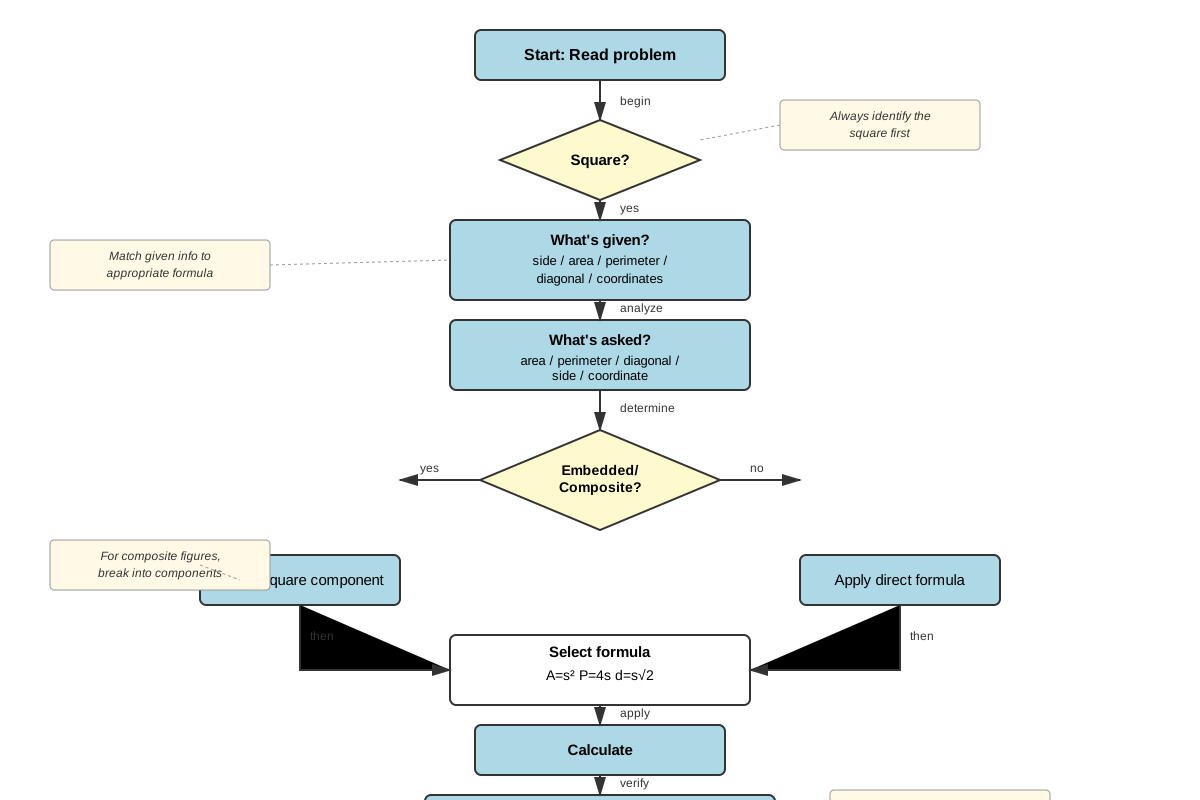
When approaching ACT squares questions, begin by identifying what information is given and what is being asked. The ACT typically provides one measurement (side, area, perimeter, or diagonal) and asks for another. Immediately write down the relevant formula and substitute known values.
Trigger words and phrases that signal square problems include:
- "Square garden/room/plot"
- "Four equal sides"
- "Regular quadrilateral"
- "Diagonal of a square"
- "Inscribed in/circumscribed about"
- "Shaded region" (often involves squares)
- Coordinate plane problems with perpendicular equal sides
Process-of-elimination strategies:
- Eliminate answers that violate basic relationships (e.g., if side = 5, area cannot be 10)
- Check units—area answers should be in square units, perimeter in linear units
- Use estimation: if side ≈ 10, area ≈ 100, diagonal ≈ 14 (since √2 ≈ 1.4)
- Recognize that diagonal > side length (eliminate answers where d < s)
- Remember that area increases faster than perimeter (quadratic vs. linear relationship)
Time allocation: Straightforward square problems (given side, find area) should take 15-30 seconds. Medium difficulty problems (involving diagonals or composite figures) warrant 45-90 seconds. Complex multi-step problems may require up to 2 minutes, but if you're stuck after 90 seconds, mark for review and move on.
Exam Tip: When a problem involves both a square and a circle, immediately identify whether the circle is inscribed in the square or the square is inscribed in the circle—this determines which measurement equals which.
Quick reference for test day:
- Side → Area: square it (s²)
- Area → Side: square root it (√A)
- Side → Diagonal: multiply by √2 (s√2)
- Diagonal → Side: divide by √2 (d/√2)
- Side → Perimeter: multiply by 4 (4s)
Memory Techniques
"SPAD" for square formulas:
- Side to Area: Square it (s²)
- Perimeter: Plus four sides (4s)
- Area to side: Answer is root (√A)
- Diagonal: Double under root (√2 times s)
Visualization for diagonal: Picture a square as two right triangles sharing a hypotenuse. The diagonal is the hypotenuse, and both legs are sides of the square. This mental image immediately triggers the Pythagorean theorem: d² = s² + s².
"Root Two Crew": Remember that √2 appears in three key square relationships:
- Diagonal = side × √2
- Side = diagonal ÷ √2
- Area of inscribed square in circle = 2r² (which comes from (r√2)²)
The "45-45-90 Connection": Whenever you see a square's diagonal, think "45-45-90 triangle" with sides in ratio 1:1:√2. This connects square problems to triangle problems and trigonometry.
Finger trick for inscribed/circumscribed:
- Circle IN square: circle diameter = side (both have "I" sound)
- Square IN circle: circle diameter = diagonal (both have "I" sound, and diagonal is longer)
Summary
Squares represent a fundamental geometric shape that combines equal sides with right angles, creating predictable mathematical relationships essential for ACT success. The three core formulas—area (s²), perimeter (4s), and diagonal (s√2)—form the foundation for solving virtually all square-related problems. Understanding that a square's diagonal creates two 45-45-90 right triangles enables application of the Pythagorean theorem and connects square problems to broader geometric concepts. ACT questions test squares through direct calculation, composite figures, coordinate plane scenarios, and relationships with inscribed or circumscribed circles. Success requires memorizing key formulas, recognizing when square properties apply, and efficiently converting between different measurements (side, area, perimeter, diagonal). The high frequency of square problems on the ACT, combined with their predictable patterns, makes this topic exceptionally high-yield for focused study and practice.
Key Takeaways
- The area of a square is always the side length squared (A = s²), and the perimeter is always four times the side length (P = 4s)
- The diagonal of a square equals the side length times √2, derived from the Pythagorean theorem applied to the two right triangles formed
- All squares have four equal sides, four 90° angles, equal diagonals that bisect each other perpendicularly, and four lines of symmetry
- When a circle is inscribed in a square, the diameter equals the side length; when a square is inscribed in a circle, the diameter equals the diagonal
- Doubling a square's side length quadruples its area because area depends on s², not s
- Square problems on the ACT frequently appear in coordinate plane contexts, composite figures, and shaded region calculations
- Efficient problem-solving requires recognizing which formula applies and converting between measurements using the standard relationships
Related Topics
Rectangles: Understanding rectangles provides context for squares as special cases where length equals width. Mastering squares enables quick recognition of when rectangle formulas simplify.
Rhombuses: Like squares, rhombuses have four equal sides, but their angles aren't necessarily 90°. Comparing these shapes deepens understanding of quadrilateral properties.
45-45-90 Triangles: Square diagonals create these special right triangles. Mastery of squares directly supports understanding of this triangle type and its 1:1:√2 ratio.
Circles and Inscribed Figures: The relationship between squares and circles extends to more complex inscribed and circumscribed figure problems, a frequent ACT topic.
Cubes and Three-Dimensional Geometry: Squares form the faces of cubes. Understanding square properties is prerequisite knowledge for calculating surface area and volume of cubic solids.
Coordinate Geometry: Squares in the coordinate plane connect to distance formula, midpoint formula, and slope concepts, building toward transformation geometry.
Practice CTA
Now that you've mastered the core concepts, formulas, and strategies for square problems, it's time to solidify your understanding through active practice. Attempt the practice questions to apply these concepts to ACT-style problems, and use the flashcards to reinforce quick recall of essential formulas and relationships. Remember, the ACT rewards both accuracy and speed—consistent practice with squares will help you recognize patterns instantly and solve problems efficiently on test day. Every practice problem you complete builds the confidence and automaticity needed to excel when it counts!
Sign up free to keep reading
Create a free AnvayaPrep account to finish this ACT guide on Squares — plus flashcards and practice questions.