Overview
A rhombus is a special quadrilateral that appears regularly on the ACT Math test, particularly within the Plane Geometry section. This four-sided polygon possesses unique properties that distinguish it from other parallelograms: all four sides have equal length, opposite angles are congruent, and the diagonals bisect each other at right angles. Understanding rhombuses is essential for ACT success because questions involving this shape test multiple geometric concepts simultaneously—including properties of parallelograms, triangle relationships, the Pythagorean theorem, and area calculations.
The ACT frequently embeds rhombus problems within coordinate geometry questions, diagram-based problems, and multi-step reasoning challenges. Students who master rhombuses gain a significant advantage because these questions often appear in the medium-to-difficult range (questions 30-50 on the 60-question test), where correct answers substantially impact scaled scores. Additionally, rhombus problems frequently combine with other geometric concepts, making them excellent vehicles for testing mathematical reasoning and problem-solving skills.
ACT rhombuses questions connect to broader mathematical concepts including properties of quadrilaterals, symmetry, perpendicular bisectors, and the relationship between side lengths and angles. Mastering this topic strengthens understanding of parallelograms (since every rhombus is a parallelogram with additional constraints), squares (which are special rhombuses with right angles), and coordinate geometry applications. The skills developed through studying rhombuses—particularly recognizing when special properties apply and efficiently calculating areas and perimeters—transfer directly to other high-yield ACT geometry topics.
Learning Objectives
- [ ] Identify when Rhombuses is being tested
- [ ] Explain the core rule or strategy behind Rhombuses
- [ ] Apply Rhombuses to ACT-style questions accurately
- [ ] Calculate the area of a rhombus using multiple methods (base-height formula and diagonal formula)
- [ ] Determine unknown side lengths and angles using rhombus properties
- [ ] Recognize the relationship between rhombuses and other quadrilaterals (parallelograms, squares, kites)
- [ ] Apply the Pythagorean theorem to solve problems involving rhombus diagonals and sides
Prerequisites
- Properties of parallelograms: Rhombuses are special parallelograms, so understanding opposite sides are parallel and congruent, and opposite angles are equal, provides the foundation for rhombus properties
- Triangle congruence and properties: The diagonals of a rhombus create four congruent right triangles, requiring knowledge of triangle relationships
- Pythagorean theorem: Essential for relating the sides of a rhombus to its diagonals, since the diagonals create right triangles
- Basic angle relationships: Understanding supplementary angles, vertical angles, and angle bisectors helps solve problems involving rhombus angles
- Area formulas for basic shapes: Familiarity with area calculations for rectangles and triangles provides context for rhombus area formulas
Why This Topic Matters
Rhombuses appear in real-world applications ranging from engineering and architecture to design and crystallography. Diamond-shaped patterns in tile work, structural supports in bridges, and molecular structures in chemistry all utilize rhombus properties. The mathematical reasoning required to solve rhombus problems—decomposing complex shapes into simpler components, applying multiple properties simultaneously, and working with perpendicular relationships—develops spatial reasoning skills valuable across STEM fields.
On the ACT Math test, rhombus questions typically appear 1-3 times per exam, most commonly in questions 35-55 where they test intermediate to advanced geometric reasoning. These questions frequently combine multiple concepts: a single problem might require students to recognize a rhombus from given properties, apply the diagonal-area formula, and use the Pythagorean theorem to find a side length. The ACT favors questions that test whether students can identify which properties apply in specific situations rather than simply recall definitions.
Common ACT question formats include: (1) diagram-based problems where students must identify that a quadrilateral is a rhombus based on marked equal sides or perpendicular diagonals; (2) coordinate geometry problems where vertices are given and students must prove a shape is a rhombus or calculate its area; (3) multi-step problems where finding one measurement (like a diagonal length) requires using rhombus properties to establish relationships between given and unknown values. Understanding rhombuses also helps eliminate incorrect answer choices on parallelogram questions, since recognizing when additional constraints apply narrows possibilities significantly.
Core Concepts
Definition and Basic Properties
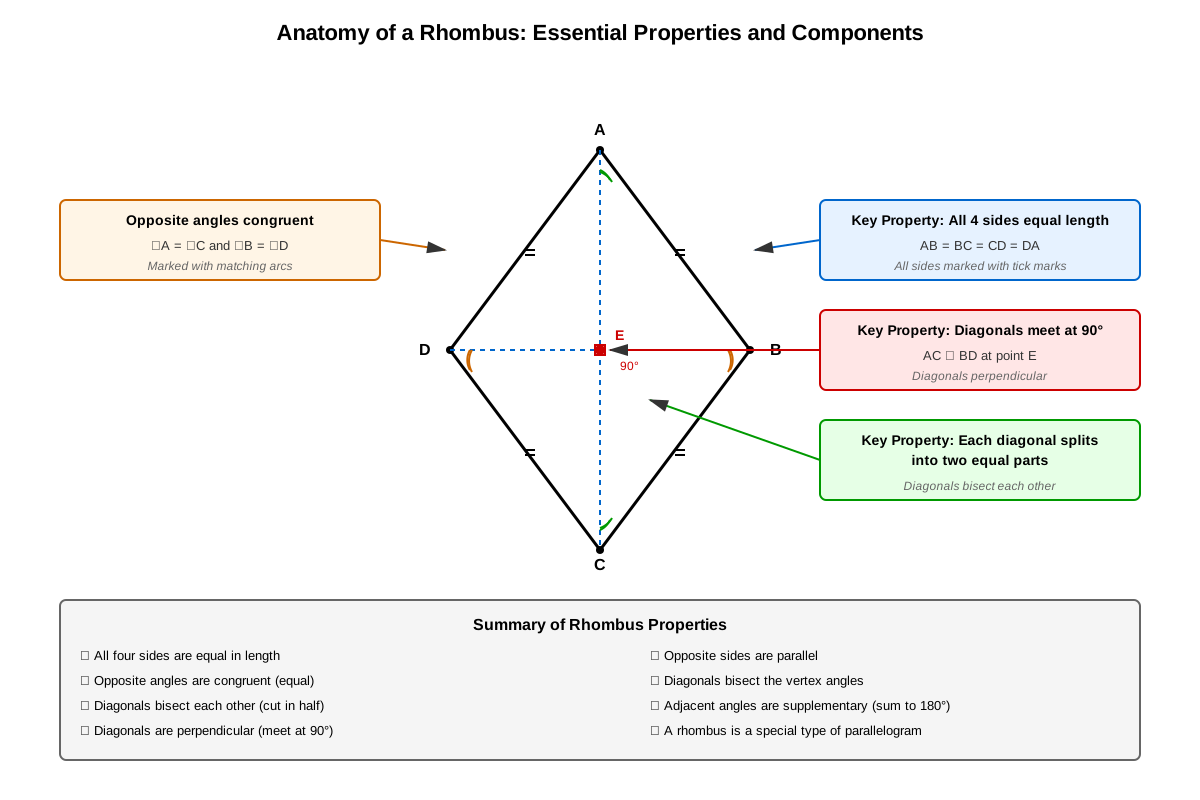
A rhombus is a quadrilateral with four congruent sides. This single defining characteristic—that all sides have equal length—generates all other rhombus properties. Because a rhombus has two pairs of parallel sides (making it a parallelogram), it inherits all parallelogram properties while possessing additional special characteristics.
The fundamental properties of every rhombus include:
- All four sides are congruent (equal in length)
- Opposite angles are congruent
- Consecutive angles are supplementary (sum to 180°)
- Diagonals bisect each other
- Diagonals are perpendicular to each other
- Diagonals bisect the vertex angles
- The rhombus has two lines of symmetry (along its diagonals)
Relationship to Other Quadrilaterals
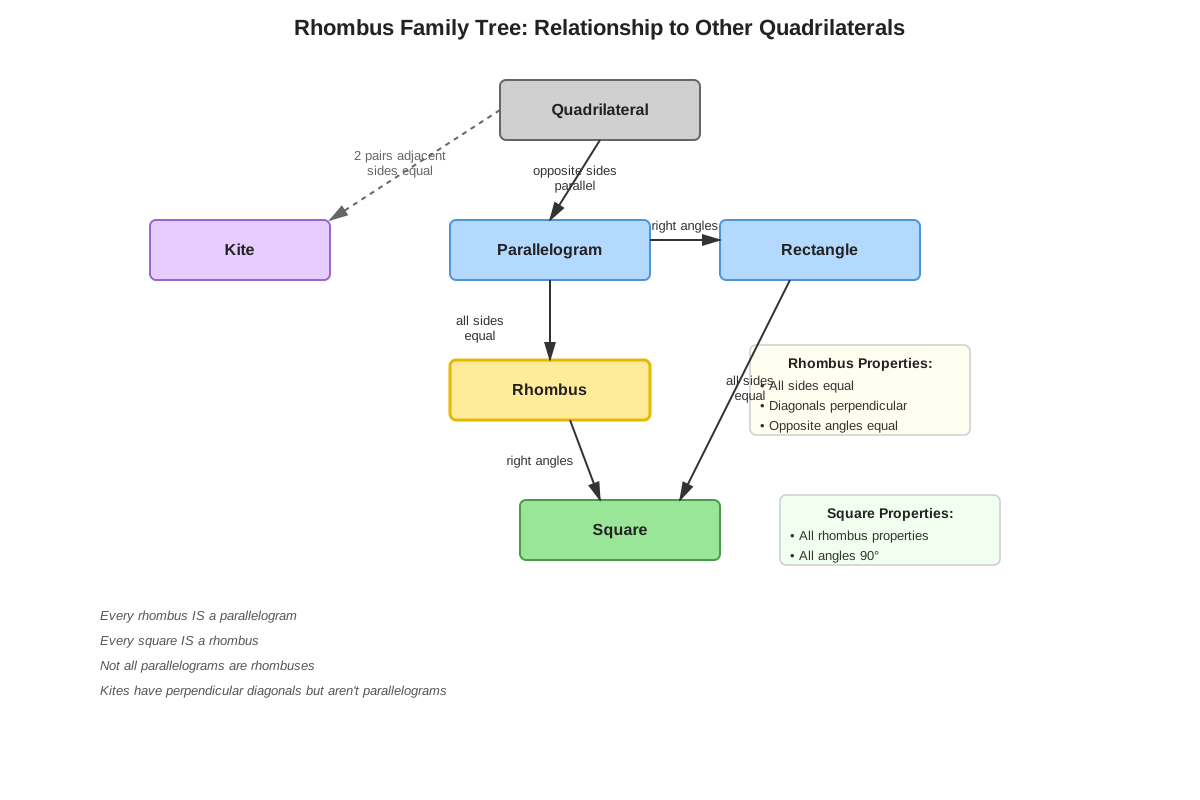
Understanding where rhombuses fit within the quadrilateral family hierarchy clarifies which properties apply:
| Quadrilateral Type | Properties | Relationship to Rhombus |
|---|---|---|
| Parallelogram | Opposite sides parallel and congruent | Every rhombus is a parallelogram |
| Rectangle | Four right angles | A rhombus with right angles is a square |
| Square | Four congruent sides AND four right angles | Every square is a rhombus |
| Kite | Two pairs of consecutive congruent sides | A rhombus is a kite with all sides equal |
This hierarchy means that any property true for parallelograms automatically applies to rhombuses, but rhombuses have additional constraints that don't apply to all parallelograms.
Diagonal Properties and Right Triangles
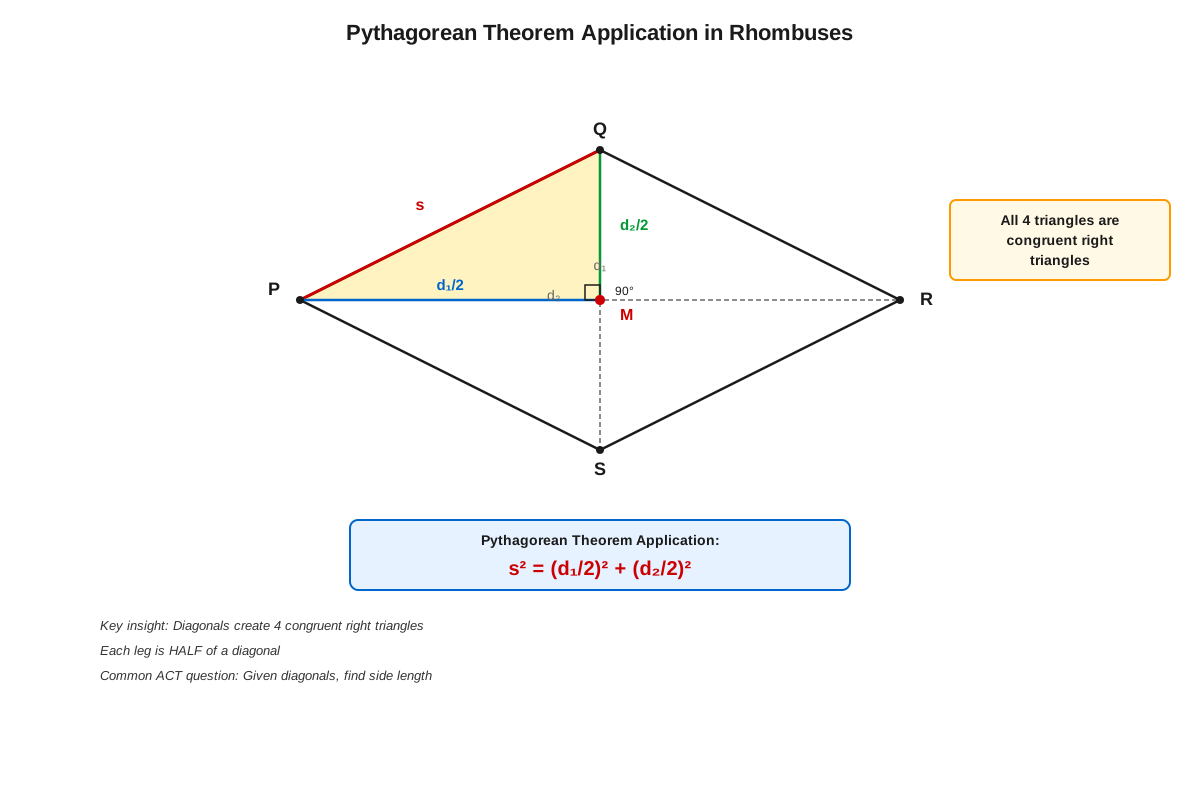
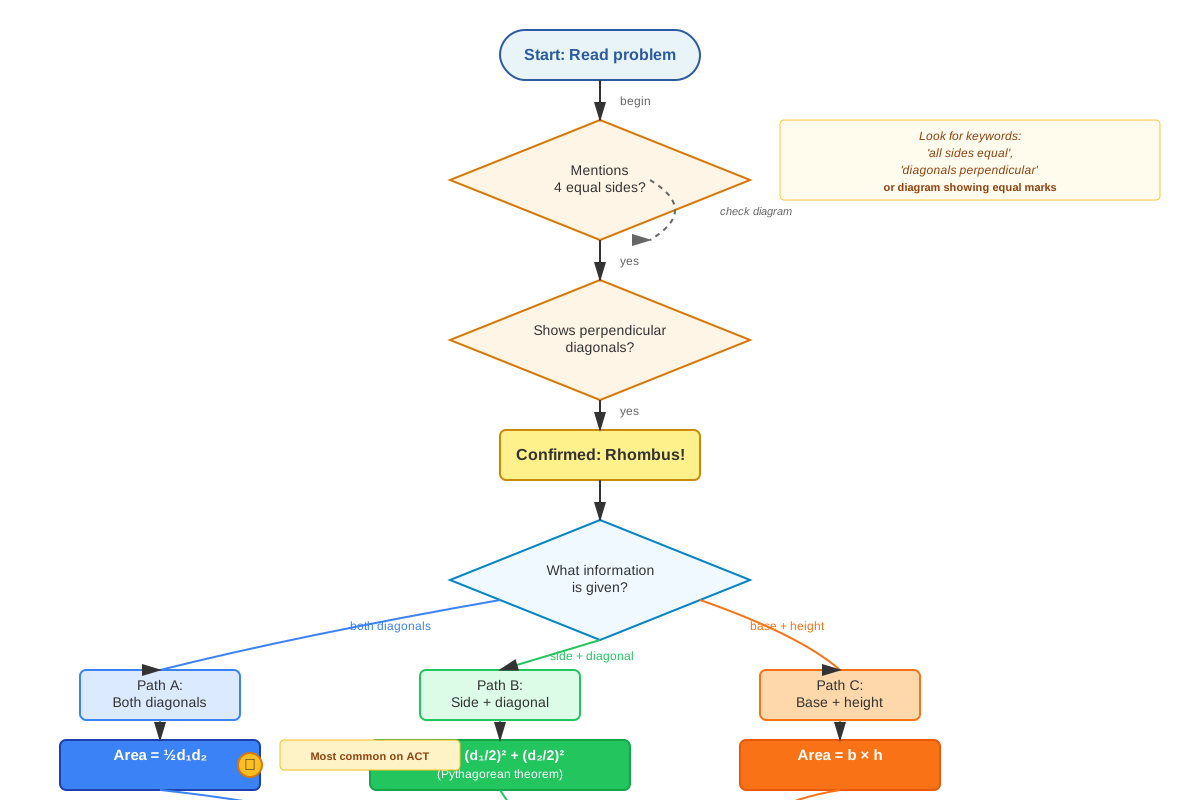
The most powerful property for solving ACT rhombus problems is that the diagonals of a rhombus are perpendicular bisectors of each other. This creates four congruent right triangles within the rhombus. If the diagonals have lengths d₁ and d₂, each right triangle has legs of length d₁/2 and d₂/2.
This perpendicular bisector property enables the Pythagorean theorem to relate the side length (s) to the diagonal lengths:
s² = (d₁/2)² + (d₂/2)²For example, if a rhombus has diagonals of length 6 and 8, each right triangle has legs of 3 and 4, making each side length 5 (since 3² + 4² = 5²).
Area Formulas
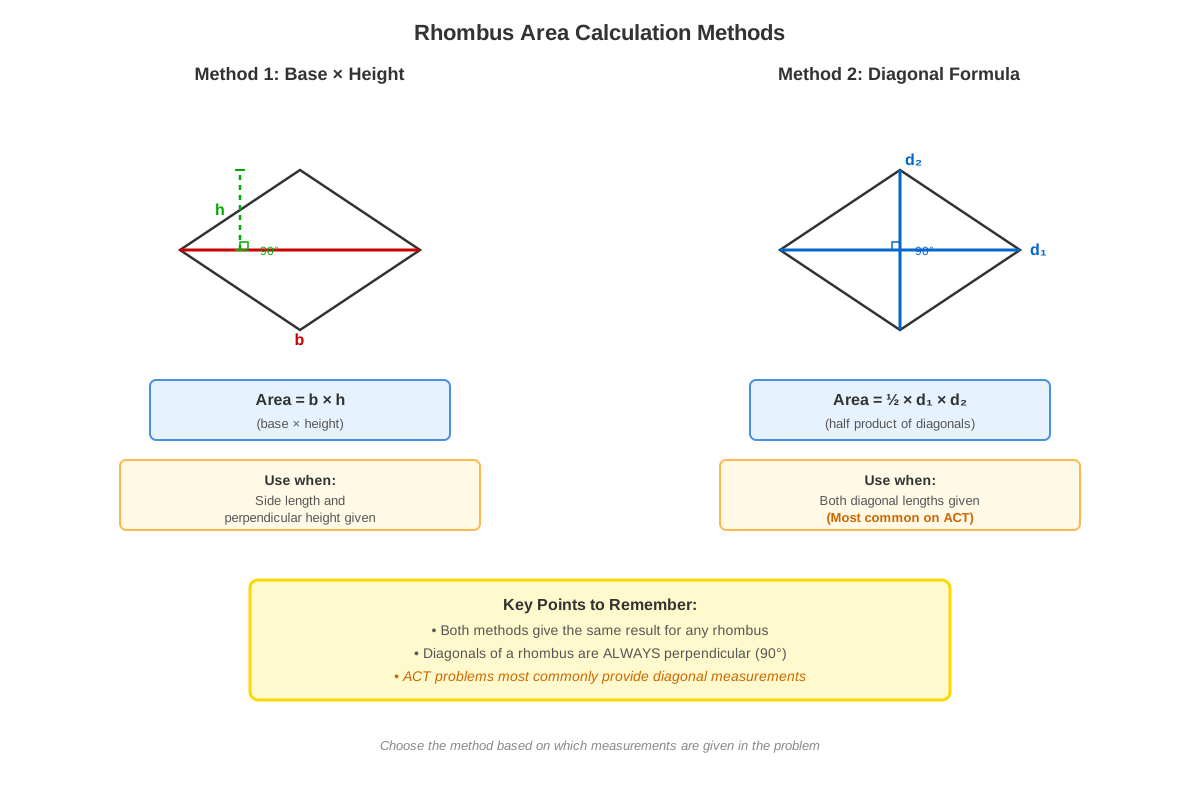
The ACT tests two distinct methods for calculating rhombus area:
Method 1: Base × Height Formula
Like any parallelogram, area equals base times height:
Area = base × heightThe "height" is the perpendicular distance between opposite sides, not the length of a diagonal.
Method 2: Diagonal Formula
The most commonly tested formula on the ACT:
Area = (d₁ × d₂)/2where d₁ and d₂ are the diagonal lengths. This formula works because the diagonals divide the rhombus into four triangles, each with area (d₁/2 × d₂/2)/2, and four such triangles sum to (d₁ × d₂)/2.
ACT Tip: The diagonal formula is usually faster and more direct for ACT problems. When a question provides diagonal lengths or information that allows you to find them, use this formula.
Angle Relationships
In a rhombus, opposite angles are congruent, and consecutive angles are supplementary. If one angle measures θ, the adjacent angles measure (180° - θ). The diagonals bisect the vertex angles, meaning each diagonal splits a vertex angle into two equal parts.
For ACT problems, remember that knowing one angle determines all four angles. If one angle is 60°, the opposite angle is also 60°, and the other two angles are each 120°.
Perimeter Calculations
Since all four sides are congruent, the perimeter formula is straightforward:
Perimeter = 4swhere s is the side length. ACT questions often provide diagonal lengths and ask for perimeter, requiring students to use the Pythagorean theorem to find the side length first.
Concept Relationships
The core concepts within rhombus geometry form an interconnected web of relationships. The defining property (four congruent sides) → establishes that the shape is a special parallelogram → which means it inherits parallelogram properties (opposite sides parallel, opposite angles congruent) → while adding the perpendicular diagonal property → which creates four congruent right triangles → enabling use of the Pythagorean theorem → to relate side lengths to diagonal lengths → which connects to area calculations through the diagonal formula.
The relationship to prerequisite topics is equally important. Knowledge of parallelogram properties provides the foundation, while triangle properties become essential when working with the four triangles created by the diagonals. The Pythagorean theorem bridges the gap between linear measurements (sides) and the two-dimensional diagonal structure. Angle relationships from basic geometry (supplementary angles, angle bisectors) explain how angles behave within the rhombus structure.
Rhombus mastery also connects forward to more advanced topics. Understanding rhombuses strengthens coordinate geometry skills when vertices are given as coordinate pairs. The perpendicular diagonal property relates to perpendicular lines and slope relationships (perpendicular lines have negative reciprocal slopes). The symmetry properties connect to transformational geometry and line symmetry concepts.
High-Yield Facts
⭐ All four sides of a rhombus are congruent (equal in length)
⭐ The diagonals of a rhombus are perpendicular to each other
⭐ The area of a rhombus equals (d₁ × d₂)/2, where d₁ and d₂ are the diagonal lengths
⭐ The diagonals bisect each other, creating four congruent right triangles
⭐ Opposite angles in a rhombus are congruent; consecutive angles are supplementary
- The diagonals of a rhombus bisect the vertex angles
- Every rhombus is a parallelogram, but not every parallelogram is a rhombus
- A square is a special rhombus where all angles are 90°
- The perimeter of a rhombus equals 4s, where s is the side length
- The side length of a rhombus can be found using s² = (d₁/2)² + (d₂/2)²
- A rhombus has exactly two lines of symmetry (along its diagonals)
- The diagonals of a rhombus divide it into four congruent triangles
- If one angle of a rhombus is 90°, then all angles are 90° and the rhombus is a square
Quick check — test yourself on Rhombuses so far.
Try Flashcards →Common Misconceptions
Misconception: All rhombuses are squares. → Correction: A square is a special type of rhombus where all angles are 90°. Most rhombuses have angles that are not right angles. A rhombus only needs four equal sides; the angles can be any measure (as long as opposite angles are equal and consecutive angles are supplementary).
Misconception: The diagonals of a rhombus are equal in length. → Correction: The diagonals of a rhombus are generally NOT equal in length. They are perpendicular bisectors of each other, but they typically have different lengths. Only in a square (a special rhombus) are the diagonals equal.
Misconception: The height of a rhombus is the same as the length of a diagonal. → Correction: The height is the perpendicular distance between two opposite sides, which is different from the diagonal length. The diagonal connects opposite vertices, while the height is measured perpendicular to a side.
Misconception: The area formula base × height doesn't apply to rhombuses. → Correction: Since a rhombus is a parallelogram, the formula Area = base × height applies perfectly. However, the diagonal formula Area = (d₁ × d₂)/2 is often more convenient for ACT problems because diagonal information is more commonly provided.
Misconception: If a quadrilateral has perpendicular diagonals, it must be a rhombus. → Correction: Perpendicular diagonals alone don't guarantee a rhombus. Kites also have perpendicular diagonals. For a rhombus, the diagonals must be perpendicular AND bisect each other, OR all four sides must be congruent.
Misconception: Adjacent angles in a rhombus are equal. → Correction: Adjacent (consecutive) angles in a rhombus are supplementary, meaning they sum to 180°, but they are not equal unless the rhombus is a square. Opposite angles are the ones that are congruent.
Worked Examples
Example 1: Finding Area and Perimeter from Diagonal Lengths
Problem: A rhombus has diagonals of length 12 cm and 16 cm. Find (a) the area of the rhombus and (b) the perimeter of the rhombus.
Solution:
Part (a): Finding the area
The most direct approach uses the diagonal formula:
Area = (d₁ × d₂)/2 = (12 × 16)/2 = 192/2 = 96 cm²Part (b): Finding the perimeter
To find the perimeter, we need the side length. The diagonals of a rhombus bisect each other at right angles, creating four congruent right triangles. Each right triangle has legs of length:
- d₁/2 = 12/2 = 6 cm
- d₂/2 = 16/2 = 8 cm
Using the Pythagorean theorem to find the hypotenuse (which is a side of the rhombus):
s² = 6² + 8² = 36 + 64 = 100
s = 10 cm
Therefore, the perimeter is:
Perimeter = 4s = 4(10) = 40 cmConnection to Learning Objectives: This problem demonstrates applying rhombus properties to ACT-style questions by using both the diagonal area formula and the relationship between diagonals and sides through the Pythagorean theorem.
Example 2: Working with Angles and Coordinates
Problem: In rhombus ABCD, angle A measures 120°. The diagonals intersect at point E. What is the measure of angle AEB?
Solution:
First, recognize what we know about rhombus angles and diagonals:
- The diagonals of a rhombus are perpendicular to each other
- This means they intersect at 90°
Since the diagonals are perpendicular, angle AEB = 90°.
We can verify this makes sense with the given information. If angle A = 120°, then:
- Angle C (opposite to A) = 120°
- Angles B and D (consecutive to A) = 180° - 120° = 60° each
The diagonal from A to C bisects angle A, creating two 60° angles. The diagonal from B to D bisects angle B, creating two 30° angles. These diagonals meet at right angles at point E.
Answer: Angle AEB = 90°
Connection to Learning Objectives: This problem tests the ability to identify when rhombus properties are being tested (recognizing that perpendicular diagonals is the key property) and to explain the core rule (diagonals of a rhombus are always perpendicular).
Exam Strategy
When approaching ACT rhombus questions, follow this systematic process:
Step 1: Identify that the shape is a rhombus
Look for these trigger phrases and clues:
- "All sides are equal" or "equilateral quadrilateral"
- A diagram showing four tick marks (indicating equal sides)
- "The diagonals are perpendicular"
- A parallelogram with one additional constraint about equal sides
Step 2: Determine what information is given
Categorize the given information:
- Diagonal lengths → use diagonal area formula and Pythagorean theorem
- One side length → can find perimeter immediately
- One angle → can find all angles using supplementary relationship
- Coordinates of vertices → may need to use distance formula first
Step 3: Choose the most efficient formula or property
Time-Saving Tip: If diagonal lengths are given or easily found, the diagonal area formula Area = (d₁ × d₂)/2 is almost always faster than finding base and height.
Step 4: Watch for multi-step problems
Many ACT rhombus questions require 2-3 steps:
- Use given information to find an intermediate value (like a diagonal length)
- Apply a rhombus property (like perpendicular diagonals)
- Calculate the final answer (like area or perimeter)
Process of Elimination Tips:
- If a question asks for area and provides diagonal lengths, eliminate any answer that doesn't equal (d₁ × d₂)/2
- If asked for perimeter and you know one side length, eliminate any answer that isn't exactly 4 times that length
- For angle questions, remember consecutive angles must sum to 180°—eliminate answers that violate this
- If a problem states "rhombus ABCD" and asks about diagonals AC and BD, remember they must be perpendicular—eliminate answers assuming they're not
Time Allocation:
Rhombus problems typically take 45-90 seconds. Budget:
- 10-15 seconds: Identify the shape and given information
- 20-40 seconds: Apply formulas and calculate
- 10-20 seconds: Check reasonableness and select answer
If a rhombus problem is taking more than 2 minutes, mark it and return later—you may be missing a key property that simplifies the solution.
Memory Techniques
RHOMBUS Mnemonic for Key Properties:
- Right angles between diagonals
- Halves (diagonals bisect each other)
- Opposite angles congruent
- Must have four equal sides
- Bisect vertex angles (diagonals do this)
- Unique area formula: (d₁ × d₂)/2
- Supplementary consecutive angles
Visualization Strategy: Picture a rhombus as a "pushed-over square." This mental image helps remember:
- It still has four equal sides (like a square)
- But the angles are no longer 90° (unlike a square)
- The diagonals are still perpendicular (like a square)
- But the diagonals are different lengths (unlike a square)
"Diagonal Cross" Memory Aid: Draw a large plus sign (+) to represent perpendicular diagonals. This visual reminds you that:
- The diagonals meet at 90°
- They bisect each other at the center
- They create four right triangles
- You can use the Pythagorean theorem with half-diagonal lengths
Area Formula Acronym: "Diagonals Divided by Two" (DDT) for Area = (d₁ × d₂)/2
Summary
Rhombuses are special parallelograms characterized by four congruent sides, making them high-yield shapes for ACT Math questions. The most critical properties for test success are that the diagonals are perpendicular bisectors of each other, creating four congruent right triangles that enable Pythagorean theorem applications. The diagonal area formula, Area = (d₁ × d₂)/2, provides the fastest solution method for most ACT problems. Understanding that opposite angles are congruent while consecutive angles are supplementary allows quick angle calculations. Every rhombus inherits parallelogram properties while adding constraints that make certain calculations more straightforward. Success on ACT rhombus questions requires recognizing when these special properties apply, choosing the most efficient formula for the given information, and connecting multiple geometric concepts in multi-step problems. The relationship between side lengths and diagonal lengths through the Pythagorean theorem is particularly important, as ACT questions frequently provide one type of measurement and ask for another.
Key Takeaways
- A rhombus is defined by having four congruent sides and is a special type of parallelogram with additional properties
- The diagonals of a rhombus are always perpendicular to each other and bisect each other, creating four congruent right triangles
- The area formula Area = (d₁ × d₂)/2 is the most efficient method for ACT problems when diagonal lengths are known or can be found
- Use the Pythagorean theorem with half-diagonal lengths as legs to find the side length: s² = (d₁/2)² + (d₂/2)²
- Opposite angles are congruent, consecutive angles are supplementary, and diagonals bisect vertex angles
- Not all rhombuses are squares, but all squares are rhombuses (a square is a rhombus with 90° angles)
- Recognizing trigger words like "equal sides," "perpendicular diagonals," or seeing four tick marks on a diagram signals a rhombus problem
Related Topics
Parallelograms: Understanding general parallelogram properties provides the foundation for rhombus mastery, as every rhombus is a parallelogram with the additional constraint of equal sides.
Squares: Squares are special rhombuses where all angles are 90°, making them the intersection of rectangles and rhombuses in the quadrilateral hierarchy.
Kites: Kites share the perpendicular diagonal property with rhombuses but have only two pairs of consecutive congruent sides rather than all four sides equal.
Coordinate Geometry with Quadrilaterals: Applying rhombus properties to shapes defined by coordinate points extends these concepts to the coordinate plane, requiring distance formula and slope calculations.
Pythagorean Theorem Applications: The relationship between rhombus sides and diagonals provides excellent practice for Pythagorean theorem applications in non-standard contexts.
Practice CTA
Now that you've mastered the properties and problem-solving strategies for rhombuses, it's time to solidify your understanding through practice. Work through the practice questions to apply these concepts to ACT-style problems, and use the flashcards to reinforce the key properties and formulas. Remember, rhombus questions often appear in the medium-to-difficult range on the ACT, so mastering this topic can significantly boost your score. Focus especially on problems involving the diagonal area formula and the relationship between sides and diagonals—these are the highest-yield concepts for test day. You've got this!
Sign up free to keep reading
Create a free AnvayaPrep account to finish this ACT guide on Rhombuses — plus flashcards and practice questions.