Overview
The triangle inequality is one of the most fundamental principles in plane geometry and appears regularly on the ACT Math test. This theorem establishes the relationship between the lengths of the three sides of any triangle, stating that the sum of any two sides must be greater than the third side. While this concept may seem simple at first glance, the ACT frequently tests students' ability to apply this principle in various contexts, including determining whether three given lengths can form a triangle, finding the range of possible values for an unknown side, and solving complex geometric problems that require multiple steps of reasoning.
Understanding the ACT triangle inequality is essential because it serves as a gateway to more advanced geometric reasoning. Questions involving this topic often appear 2-3 times per ACT Math section, and they can range from straightforward identification problems to multi-step questions that combine triangle inequality with other geometric principles. The ACT test writers favor this topic because it efficiently assesses both conceptual understanding and problem-solving ability within a single question.
The triangle inequality theorem connects to broader mathematical concepts including distance relationships, optimization problems, and coordinate geometry. It provides the foundation for understanding why certain geometric configurations are possible while others are impossible. Mastering this topic not only helps students answer direct triangle inequality questions but also strengthens their ability to eliminate impossible answer choices in other geometry problems, making it a high-yield topic that pays dividends across multiple question types.
Learning Objectives
- [ ] Identify when Triangle inequality is being tested in ACT questions
- [ ] Explain the core rule or strategy behind Triangle inequality
- [ ] Apply Triangle inequality to ACT-style questions accurately
- [ ] Determine the range of possible values for an unknown side of a triangle given two known sides
- [ ] Recognize when three given lengths cannot form a valid triangle
- [ ] Combine triangle inequality with other geometric principles to solve multi-step problems
Prerequisites
- Basic arithmetic operations: Required to add, subtract, and compare side lengths when applying the triangle inequality theorem
- Understanding of geometric figures: Necessary to visualize triangles and understand what constitutes a valid triangle
- Inequality notation and manipulation: Essential for expressing and working with the mathematical relationships between side lengths
- Number line concepts: Helpful for visualizing the range of possible values for unknown sides
Why This Topic Matters
The triangle inequality theorem has practical applications in fields ranging from architecture to computer graphics to navigation. Engineers use this principle when designing stable structures, ensuring that support beams can actually connect at the specified angles. In computer science, triangle inequality helps optimize pathfinding algorithms and validate geometric data. Urban planners apply these concepts when determining whether direct routes between locations are feasible or when indirect paths must be considered.
On the ACT Math test, triangle inequality questions appear with high frequency—typically 2-3 questions per exam. These questions account for approximately 3-5% of the Plane Geometry subsection, which itself comprises about 23% of the entire Math test. The ACT favors this topic because it efficiently tests multiple skills: geometric reasoning, algebraic manipulation, and logical thinking. Questions may appear as straightforward "Can these sides form a triangle?" problems, but more commonly, they're embedded within larger geometric scenarios or combined with other concepts like perimeter, coordinate geometry, or similar triangles.
Common question formats include: determining which set of three lengths can form a triangle from multiple choices; finding the range of possible values for a third side given two sides; identifying the longest or shortest possible side; and solving word problems where triangle inequality provides a constraint. The ACT also tests this concept indirectly by presenting impossible geometric configurations among answer choices, rewarding students who can quickly eliminate these options using triangle inequality reasoning.
Core Concepts
The Triangle Inequality Theorem
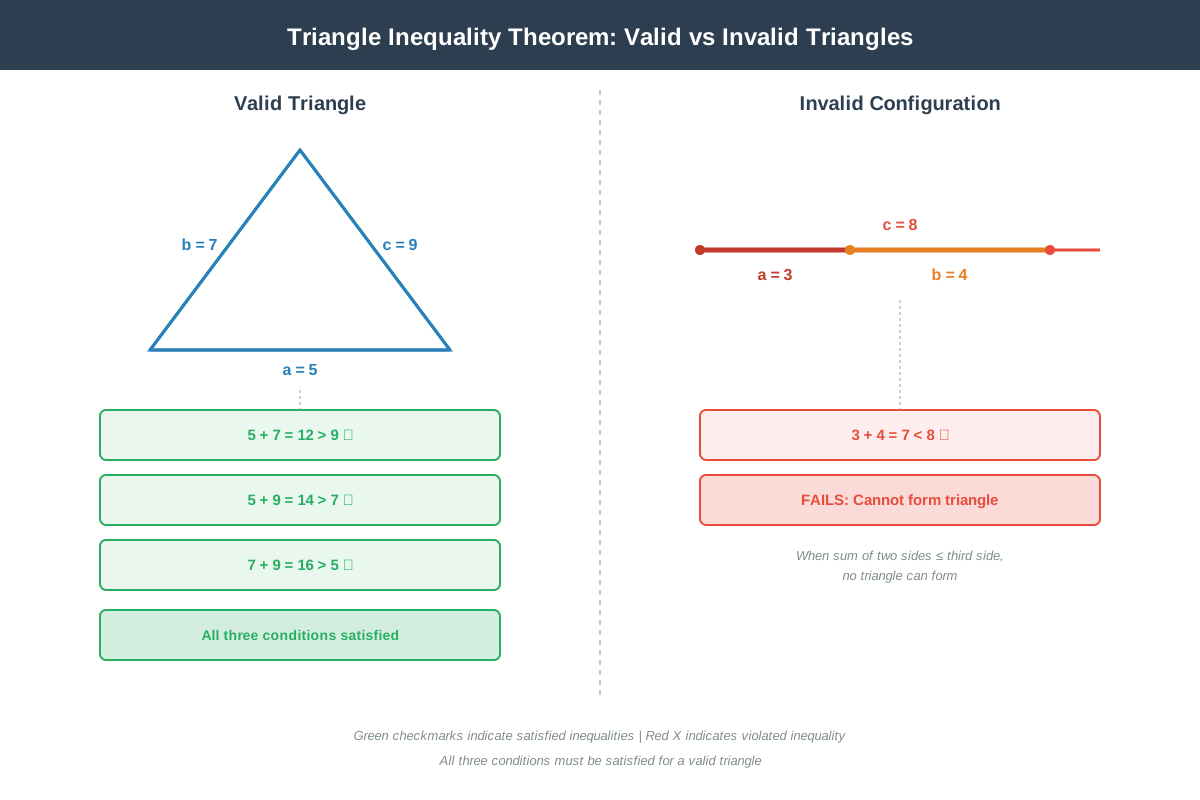
The triangle inequality theorem states that for any triangle with sides of lengths a, b, and c, the following three conditions must all be true:
- a + b > c
- a + c > b
- b + c > a
In words: the sum of the lengths of any two sides of a triangle must be greater than the length of the third side. This is not merely a "greater than or equal to" relationship—the sum must be strictly greater. If any of these three inequalities fails, the three lengths cannot form a triangle.
The geometric intuition behind this theorem is straightforward: imagine trying to connect three line segments end-to-end to form a triangle. If one segment is too long relative to the other two, the shorter segments cannot "reach" to close the triangle. For example, if you have segments of length 3, 4, and 10, the segments of length 3 and 4 can only span a maximum distance of 7 when stretched in a straight line, which falls short of the 10-unit segment.
Finding the Range of Possible Values
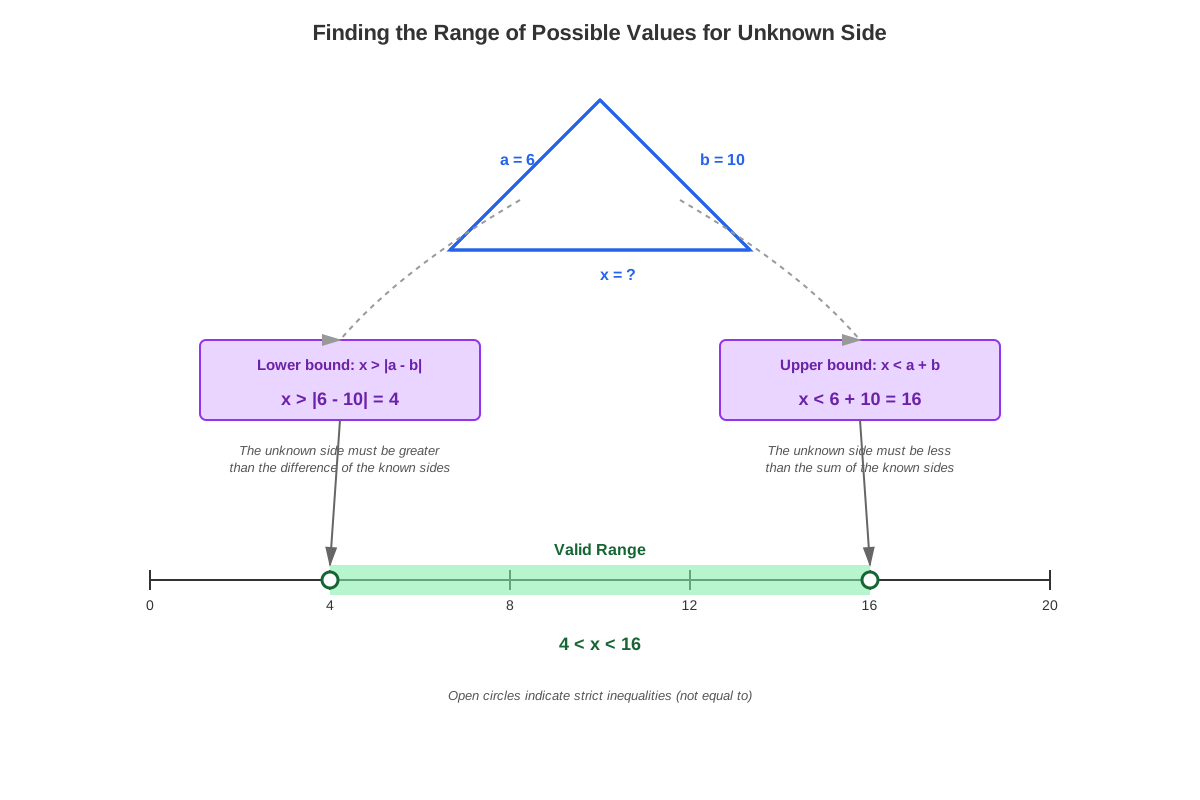
One of the most common ACT applications involves finding the range of possible values for an unknown third side when two sides are known. If a triangle has sides of length a and b, and the third side has length x, then:
|a - b| < x < a + bThis compound inequality tells us that x must be:
- Greater than the absolute difference between a and b
- Less than the sum of a and b
For example, if two sides of a triangle measure 5 and 8, the third side x must satisfy:
- x > |5 - 8| = 3
- x < 5 + 8 = 13
Therefore: 3 < x < 13
The third side must be greater than 3 but less than 13. Note that x cannot equal 3 or 13—these boundary values would create a degenerate triangle (a straight line), not a valid triangle.
Testing Whether Three Lengths Form a Triangle
To determine whether three given lengths can form a triangle, check all three inequality conditions. However, there's an efficient shortcut: only check whether the sum of the two smaller sides is greater than the largest side. If this single condition is satisfied, the other two conditions are automatically satisfied.
| Given Sides | Check | Result |
|---|---|---|
| 3, 4, 5 | 3 + 4 = 7 > 5 ✓ | Valid triangle |
| 2, 3, 6 | 2 + 3 = 5 < 6 ✗ | Not a triangle |
| 5, 5, 9 | 5 + 5 = 10 > 9 ✓ | Valid triangle |
| 1, 2, 3 | 1 + 2 = 3 = 3 ✗ | Not a triangle (equality fails) |
Special Cases and Edge Conditions
Equilateral triangles: When all three sides are equal (a = b = c), the triangle inequality is satisfied because 2a > a for any positive value of a.
Isosceles triangles: When two sides are equal, special care must be taken. If the two equal sides each have length a and the third side has length b, then 2a > b must be true. This means b < 2a, placing an upper limit on the base of an isosceles triangle.
Nearly degenerate triangles: As one side approaches the sum of the other two, the triangle becomes increasingly "flat," with the angle opposite the longest side approaching 180°. While these triangles are theoretically valid, they're practically difficult to distinguish from straight lines.
Combining with Other Geometric Principles
The triangle inequality often appears in ACT questions combined with:
- Perimeter constraints: If the perimeter is fixed, the triangle inequality limits the possible side lengths
- Coordinate geometry: When vertices are given as coordinates, the distance formula provides side lengths that must satisfy triangle inequality
- Similar triangles: Corresponding sides of similar triangles maintain proportional relationships while still obeying triangle inequality
- Triangle classification: Determining whether a triangle is acute, right, or obtuse requires first confirming the sides satisfy triangle inequality
Concept Relationships
The triangle inequality theorem serves as a foundational constraint that governs all valid triangles. It connects directly to the distance formula in coordinate geometry: when three points are given, their pairwise distances must satisfy triangle inequality to form a triangle. This relationship flows into triangle classification, where after confirming sides satisfy triangle inequality, students can apply the Pythagorean theorem or its variations to determine triangle type.
The theorem relates to perimeter problems through additive constraints: if P = a + b + c is the perimeter, and two sides are known, triangle inequality restricts the possible values of the third side beyond what perimeter alone would suggest. This creates a system of constraints that students must navigate.
Optimization problems frequently invoke triangle inequality as a constraint. For instance, when finding the maximum or minimum possible perimeter given certain conditions, the triangle inequality defines the feasible region. Similarly, in coordinate geometry path problems, the triangle inequality establishes that the direct distance between two points is always less than any indirect path, a principle that helps solve shortest-distance questions.
The conceptual flow follows this pattern:
Basic inequality understanding → Triangle inequality theorem → Range determination for unknown sides → Validation of geometric configurations → Integration with coordinate geometry and optimization → Complex multi-step problem solving
High-Yield Facts
⭐ The sum of any two sides of a triangle must be strictly greater than (not equal to) the third side
⭐ For a triangle with sides a and b, the third side x must satisfy: |a - b| < x < a + b
⭐ To quickly check if three lengths form a triangle, verify that the sum of the two smallest sides exceeds the largest side
- The triangle inequality applies to all triangles: scalene, isosceles, and equilateral
⭐ The third side of a triangle must be less than the sum of the other two sides and greater than their difference
- If three lengths satisfy a + b = c (equality), they form a straight line, not a triangle
⭐ The range of possible values for an unknown side is an open interval, meaning the endpoints are excluded
- In an isosceles triangle with equal sides of length a, the base b must satisfy 0 < b < 2a
- The triangle inequality is equivalent to stating that the shortest path between two points is a straight line
⭐ On the ACT, triangle inequality questions often appear disguised as "which of the following could be..." or "what is the range of possible values" questions
- The maximum perimeter occurs when the triangle is as "spread out" as possible while still satisfying triangle inequality
- The minimum value of the third side approaches (but never equals) the absolute difference of the other two sides
Quick check — test yourself on Triangle inequality so far.
Try Flashcards →Common Misconceptions
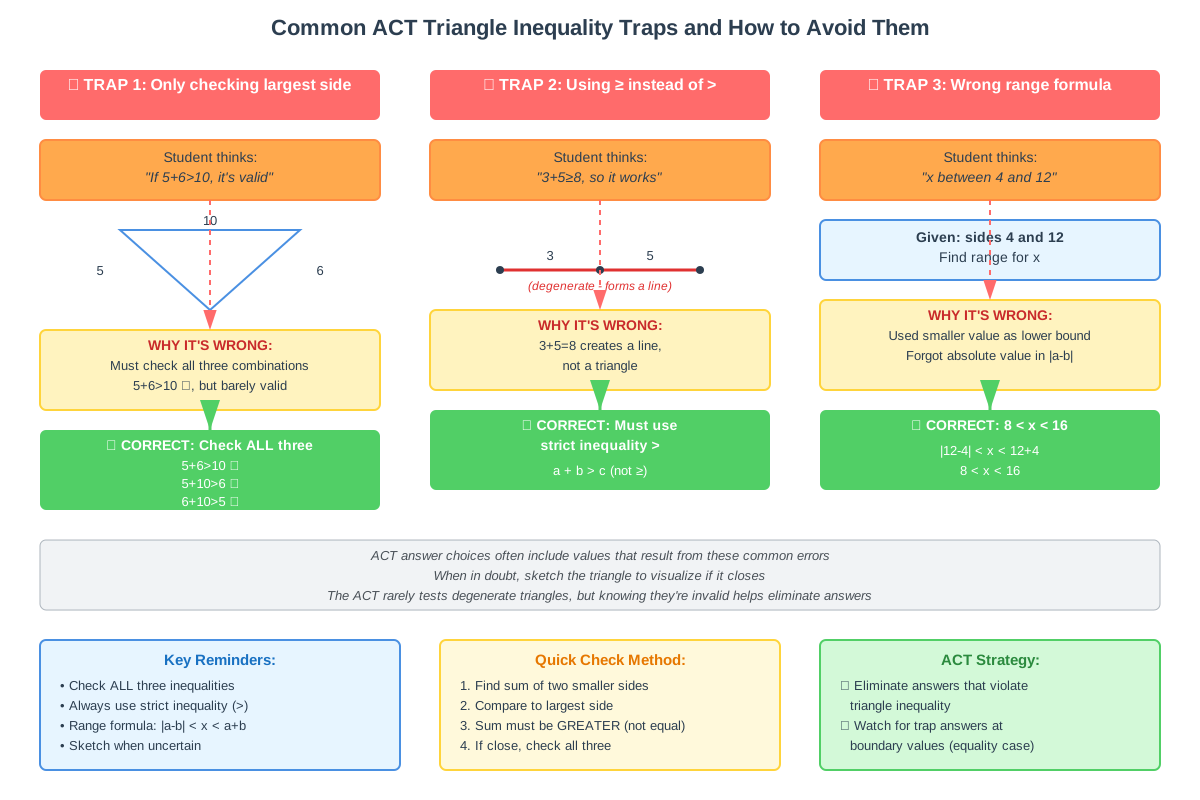
Misconception: The sum of two sides must be greater than or equal to the third side.
Correction: The sum must be strictly greater than (not equal to) the third side. Equality produces a degenerate case (straight line), not a valid triangle.
Misconception: Only one inequality needs to be checked (e.g., just a + b > c).
Correction: All three inequalities must be satisfied, though checking that the sum of the two smaller sides exceeds the largest side is sufficient to verify all three conditions simultaneously.
Misconception: The range formula |a - b| < x < a + b includes the endpoints.
Correction: The endpoints are excluded. The third side must be strictly between these values, not equal to them. Use open interval notation: (|a - b|, a + b).
Misconception: If two sides of a triangle are 5 and 8, the third side can be 13.
Correction: The third side must be less than 13, not equal to it. The valid range is 3 < x < 13, so x could be 12.9 or 12.99, but not 13.
Misconception: Triangle inequality only applies to triangles drawn on paper, not to coordinate geometry problems.
Correction: Triangle inequality applies to all triangles regardless of how they're represented. In coordinate geometry, after calculating distances using the distance formula, those distances must satisfy triangle inequality.
Misconception: The longest side of a triangle can equal the sum of the other two sides if the triangle is very flat.
Correction: No matter how flat a triangle appears, if it's a valid triangle, the longest side must be strictly less than the sum of the other two. A "flat" triangle that violates this is actually a line segment.
Misconception: In an isosceles triangle, any value can be chosen for the base as long as the two equal sides are fixed.
Correction: The base is constrained by triangle inequality. If the equal sides have length a, the base b must satisfy 0 < b < 2a.
Worked Examples
Example 1: Determining Valid Triangle Configurations
Problem: Which of the following sets of lengths could represent the sides of a triangle?
- A) 2, 3, 5
- B) 4, 7, 10
- C) 5, 5, 11
- D) 6, 8, 15
- E) 3, 4, 5
Solution:
For each option, check if the sum of the two smaller sides exceeds the largest side.
Option A: 2, 3, 5
- Sum of smaller sides: 2 + 3 = 5
- Largest side: 5
- Check: 5 > 5? No (equality fails)
- Result: Not a valid triangle
Option B: 4, 7, 10
- Sum of smaller sides: 4 + 7 = 11
- Largest side: 10
- Check: 11 > 10? Yes ✓
- Result: Valid triangle
Option C: 5, 5, 11
- Sum of smaller sides: 5 + 5 = 10
- Largest side: 11
- Check: 10 > 11? No
- Result: Not a valid triangle
Option D: 6, 8, 15
- Sum of smaller sides: 6 + 8 = 14
- Largest side: 15
- Check: 14 > 15? No
- Result: Not a valid triangle
Option E: 3, 4, 5
- Sum of smaller sides: 3 + 4 = 7
- Largest side: 5
- Check: 7 > 5? Yes ✓
- Result: Valid triangle
Both B and E are valid triangles. If the question asks for all possible answers, both would be correct. If it asks for one answer, the context would clarify. This example demonstrates Learning Objective 3 (applying triangle inequality accurately) and shows how to efficiently eliminate impossible configurations.
Example 2: Finding the Range of Possible Values
Problem: Two sides of a triangle measure 7 inches and 12 inches. If the length of the third side is x inches, what are all possible integer values of x?
Solution:
Step 1: Apply the range formula for the third side.
The third side must satisfy: |a - b| < x < a + b
Step 2: Calculate the bounds.
- Lower bound: |7 - 12| = |-5| = 5
- Upper bound: 7 + 12 = 19
Step 3: Express the inequality.
5 < x < 19
Step 4: Identify integer values.
Since x must be strictly greater than 5 and strictly less than 19, the possible integer values are:
6, 7, 8, 9, 10, 11, 12, 13, 14, 15, 16, 17, 18
Step 5: Count the values.
There are 13 possible integer values for x.
Important note: The endpoints 5 and 19 are excluded because the inequality is strict (not "greater than or equal to"). If x = 5, then 7 + 5 = 12, which equals (not exceeds) the third side. If x = 19, then 7 + 12 = 19, which equals (not exceeds) the third side.
This example addresses Learning Objective 4 (determining the range of possible values) and demonstrates the critical distinction between strict and non-strict inequalities that the ACT frequently tests.
Exam Strategy
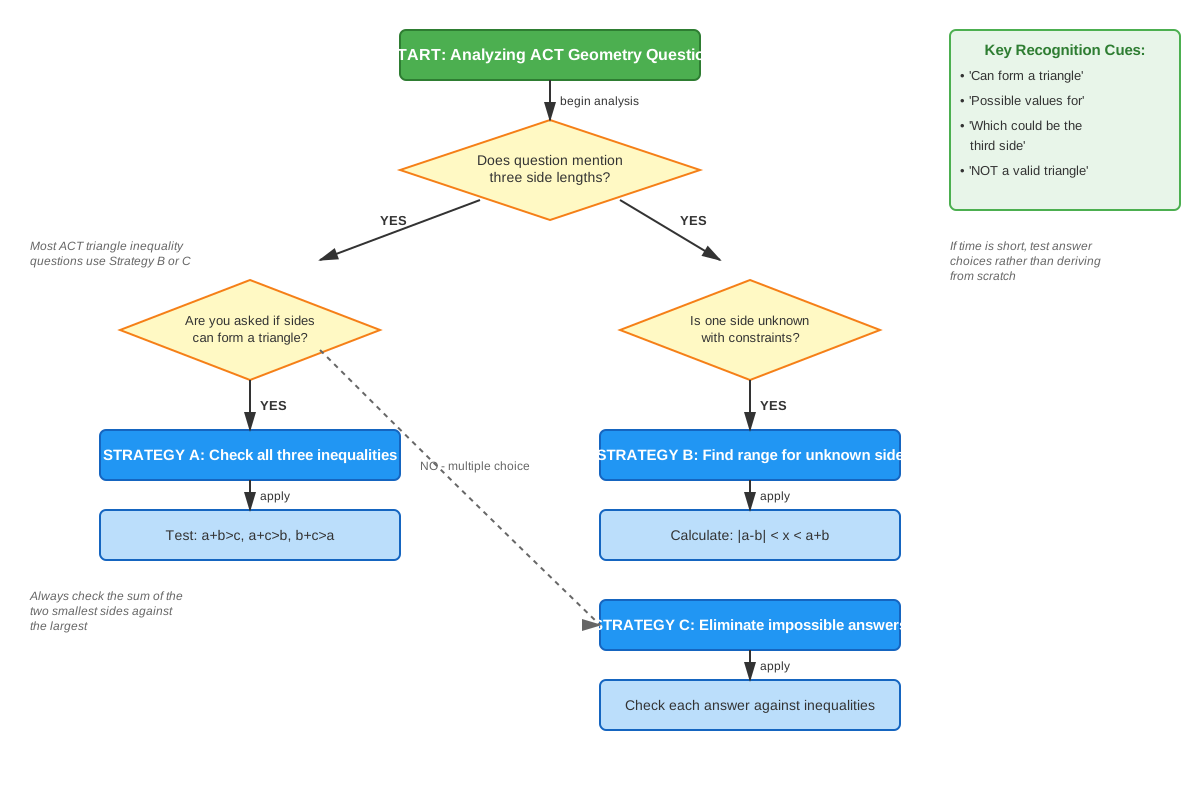
When approaching ACT triangle inequality questions, begin by identifying the question type. Look for trigger phrases such as "could be the length," "possible values," "which of the following cannot," or "what is the range." These phrases signal that triangle inequality is being tested.
For "can these form a triangle" questions: Immediately identify the three lengths, order them from smallest to largest, and check whether the sum of the two smaller values exceeds the largest. This single check is sufficient and saves time compared to checking all three inequalities.
For "find the range" questions: Write down the formula |a - b| < x < a + b before doing any calculations. This prevents errors and provides a clear framework. Calculate both bounds carefully, paying special attention to whether the question asks for integer values, which affects your final answer.
Process of elimination tips:
- Eliminate any answer choice where a side length equals the sum of the other two sides
- Eliminate choices where a side length exceeds the sum of the other two sides
- For range questions, eliminate any answer that includes the boundary values as possibilities
- If a question provides coordinates, calculate all three distances first, then apply triangle inequality
Time allocation: Triangle inequality questions typically require 30-60 seconds. If a question takes longer, you may be overcomplicating it. The ACT rarely requires more than one or two calculations for these problems. If you find yourself doing extensive algebra, reconsider your approach.
Common traps to avoid:
- Don't assume that "nearly equal" to the sum is acceptable—strict inequality is required
- Don't forget to check all answer choices in "which of the following" questions
- Don't include boundary values when expressing ranges
- Don't confuse the absolute value in |a - b| with simple subtraction
Exam Tip: If you're unsure whether three lengths form a triangle, try visualizing it. Can you imagine connecting three segments of those lengths end-to-end to close a triangle? If the longest segment seems too long compared to the others, it probably violates triangle inequality.
Memory Techniques
The "Two Against One" Rule: Remember that in any triangle, any two sides must "team up" to beat the third side. The sum of any two must be greater than the one left out. Visualize two sides joining forces to overcome the third.
The Range Rhyme: "More than the difference, less than the sum—that's where the third side must come from." This rhyme encapsulates the formula |a - b| < x < a + b in memorable language.
The "No Equality" Reminder: Think "GET" (Greater than, Excludes Ties). The triangle inequality requires strictly greater than relationships, excluding equality.
The Shortcut Acronym "STSL" (Sum of Two Smallest exceeds Largest): When checking three lengths quickly, remember to add the two smallest and compare to the largest.
Visualization Technique: Picture three sticks of different lengths. If one stick is too long, the other two can't reach around to connect with it. This physical intuition reinforces why the sum of two sides must exceed the third.
The Boundary Exclusion Reminder: Think of the boundaries as "electric fences"—the third side can get close but can't touch them. This helps remember that endpoints are excluded from the valid range.
Summary
The triangle inequality theorem is a fundamental principle stating that the sum of any two sides of a triangle must be strictly greater than the third side. This concept appears regularly on the ACT Math test, typically 2-3 times per exam, in various forms including direct validation questions, range-finding problems, and embedded applications within larger geometric scenarios. The most efficient approach to checking whether three lengths form a triangle is to verify that the sum of the two smallest sides exceeds the largest side. When finding the range of possible values for an unknown third side given two known sides a and b, apply the formula |a - b| < x < a + b, remembering that the boundaries are excluded. Mastery of this topic requires understanding both the conceptual basis (why certain configurations are impossible) and the procedural skills (quickly checking inequalities and calculating ranges). Success on ACT triangle inequality questions depends on recognizing trigger phrases, avoiding the common misconception that equality is acceptable, and efficiently applying the appropriate strategy based on question type.
Key Takeaways
- The triangle inequality theorem requires that a + b > c, a + c > b, and b + c > a for any triangle with sides a, b, and c
- The quickest validation method is checking whether the sum of the two smallest sides exceeds the largest side
- For an unknown third side x with known sides a and b, the range is |a - b| < x < a + b, with boundaries excluded
- Equality (where the sum equals the third side) creates a straight line, not a valid triangle
- Triangle inequality questions appear 2-3 times per ACT Math test and often use phrases like "could be," "possible values," or "what is the range"
- The theorem applies universally to all triangle problems, including those in coordinate geometry and optimization contexts
- Efficient problem-solving requires recognizing question types and applying the appropriate shortcut or formula immediately
Related Topics
Pythagorean Theorem and Triangle Classification: After confirming that three sides satisfy triangle inequality, the Pythagorean theorem determines whether the triangle is acute, right, or obtuse. Mastering triangle inequality provides the foundation for these classification problems.
Coordinate Geometry and Distance Formula: When triangle vertices are given as coordinate points, the distance formula calculates side lengths that must then satisfy triangle inequality. This integration appears frequently on the ACT.
Triangle Congruence and Similarity: Understanding which side length combinations are valid (via triangle inequality) is prerequisite knowledge for proving triangles congruent or similar using SSS, SAS, or other criteria.
Optimization in Geometry: Many ACT problems ask for maximum or minimum perimeters, areas, or side lengths. Triangle inequality provides essential constraints for these optimization problems.
Absolute Value and Inequalities: The mathematical notation and manipulation skills developed through triangle inequality transfer directly to algebraic inequality problems, strengthening overall problem-solving ability.
Practice CTA
Now that you've mastered the triangle inequality theorem, it's time to cement your understanding through practice. Attempt the practice questions to test your ability to identify question types, apply the appropriate strategies, and avoid common traps. Use the flashcards to reinforce the key formulas and concepts until they become automatic. Remember, the ACT rewards both accuracy and speed—consistent practice with these materials will help you recognize triangle inequality questions instantly and solve them confidently within the time constraints. Every practice problem you complete builds the pattern recognition and procedural fluency that translates directly to points on test day. You've got this!
Sign up free to keep reading
Create a free AnvayaPrep account to finish this ACT guide on Triangle inequality — plus flashcards and practice questions.