Overview
The exterior angle theorem is a fundamental principle in plane geometry that establishes a precise relationship between an exterior angle of a triangle and its remote interior angles. This theorem states that the measure of an exterior angle of a triangle equals the sum of the measures of the two non-adjacent (remote) interior angles. Understanding this theorem is crucial for solving a wide variety of geometry problems efficiently, particularly those involving triangles, parallel lines, and polygon angle relationships.
On the ACT Math test, the ACT exterior angle theorem appears frequently in questions testing geometric reasoning and angle relationships. Students who master this concept gain a powerful tool for solving complex angle problems quickly—often eliminating the need for multiple intermediate steps. The theorem typically appears in 2-4 questions per ACT exam, either directly or as part of multi-step problems involving coordinate geometry, similar triangles, or polygon properties. Questions may present diagrams with missing angle measures, require students to set up equations, or test whether students can recognize when the theorem applies versus when other angle relationships are more appropriate.
The exterior angle theorem connects deeply to foundational concepts in plane geometry, including the triangle angle sum theorem (which states that interior angles of a triangle sum to 180°), properties of supplementary angles, and parallel line relationships. It serves as a bridge between basic angle concepts and more advanced topics like polygon angle sums, trigonometry, and proof-based reasoning. Mastering this theorem strengthens overall geometric intuition and problem-solving efficiency, making it an essential component of ACT Math preparation.
Learning Objectives
- [ ] Identify when Exterior angle theorem is being tested
- [ ] Explain the core rule or strategy behind Exterior angle theorem
- [ ] Apply Exterior angle theorem to ACT-style questions accurately
- [ ] Distinguish between exterior angles and interior angles in triangle diagrams
- [ ] Set up and solve algebraic equations using the exterior angle theorem
- [ ] Recognize when the exterior angle theorem provides a more efficient solution path than alternative approaches
- [ ] Apply the theorem in combination with other geometric principles to solve multi-step problems
Prerequisites
- Triangle angle sum theorem: Understanding that the three interior angles of any triangle sum to 180° is essential because the exterior angle theorem is derived from this fundamental property
- Supplementary angles: Recognizing that an exterior angle and its adjacent interior angle form a linear pair summing to 180° provides the logical foundation for understanding why the theorem works
- Basic algebraic equation solving: The ability to set up and solve linear equations is necessary because ACT problems often present angle measures as algebraic expressions
- Angle notation and measurement: Familiarity with degree measurement, angle naming conventions, and diagram interpretation ensures accurate problem setup
Why This Topic Matters
The exterior angle theorem represents one of the most practical and time-saving tools in the ACT Math geometry arsenal. In real-world applications, this principle appears in architecture, engineering, navigation, and surveying—any field requiring precise angle calculations in triangular structures or relationships. Architects use exterior angle relationships when designing roof trusses, while surveyors apply these principles when measuring land boundaries and creating topographic maps.
From an exam perspective, the exterior angle theorem appears with remarkable consistency on the ACT. Statistical analysis of released ACT exams shows that approximately 3-5% of all Math questions directly or indirectly test this concept, translating to roughly 2-3 questions per 60-question Math section. The theorem most commonly appears in questions involving:
- Direct angle calculation: Given two remote interior angles, find the exterior angle (or vice versa)
- Algebraic setup problems: Angle measures expressed as variables or expressions requiring equation solving
- Multi-step geometry problems: Combined with parallel lines, similar triangles, or polygon properties
- Diagram interpretation: Identifying which angles are exterior versus interior in complex figures
- Proof or reasoning questions: Explaining why certain angle relationships must be true
Questions testing this concept typically fall in the medium difficulty range (questions 20-40 of 60), though they can appear as easier direct-application problems or as components of harder multi-concept questions. The theorem's high yield comes from its dual nature: it's both frequently tested and provides significant time savings when recognized and applied correctly.
Core Concepts
Definition of an Exterior Angle
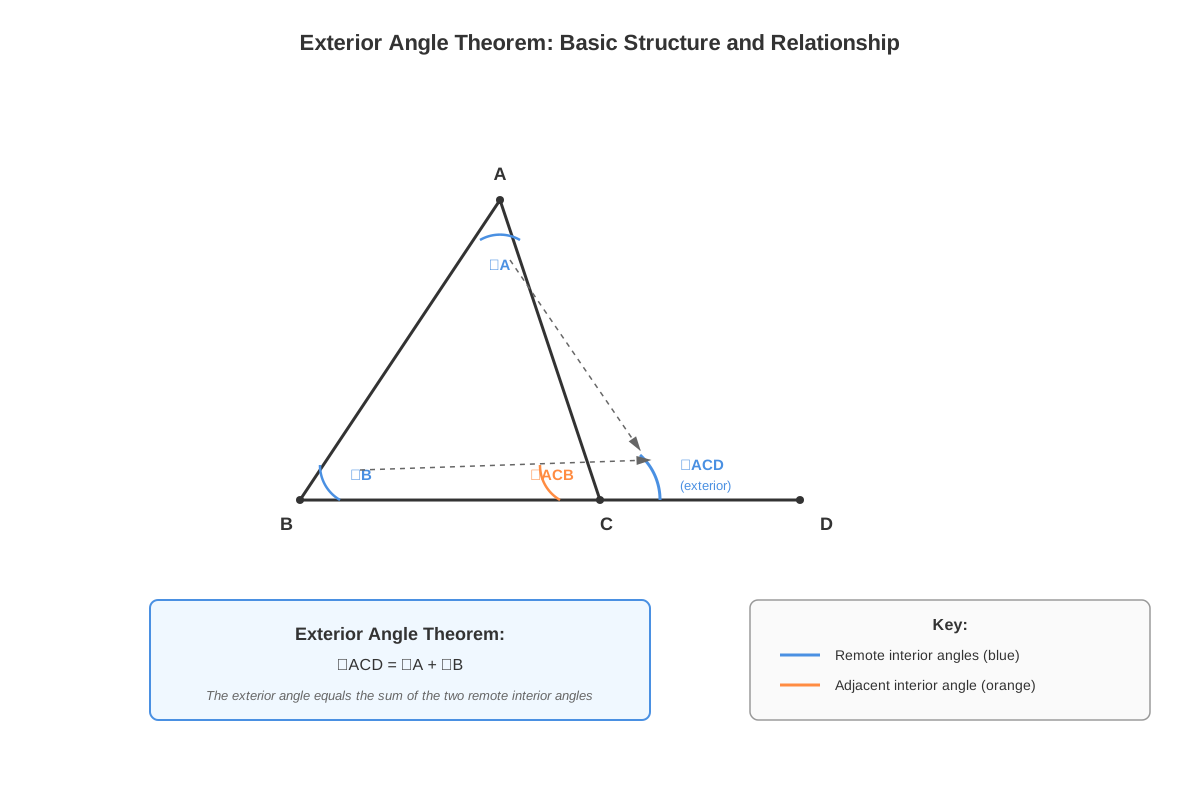
An exterior angle of a triangle is formed when one side of the triangle is extended beyond a vertex. At any vertex of a triangle, extending one side creates an angle between that extended side and the other side of the triangle meeting at that vertex. This angle lies outside the triangle itself, hence the name "exterior." Importantly, each vertex of a triangle can have two exterior angles (one on each side), but these two angles are vertical angles and therefore congruent, so we typically consider just one exterior angle per vertex.
The exterior angle and the interior angle at the same vertex are supplementary angles—they form a linear pair and sum to 180°. This supplementary relationship is key to understanding why the exterior angle theorem works mathematically.
The Exterior Angle Theorem Statement
The exterior angle theorem states: The measure of an exterior angle of a triangle equals the sum of the measures of the two non-adjacent interior angles (also called remote interior angles).
Mathematically, if a triangle has interior angles A, B, and C, and an exterior angle is formed at vertex C by extending one side, then:
Exterior Angle at C = Angle A + Angle BThe two interior angles that are NOT adjacent to the exterior angle (angles A and B in this case) are the remote interior angles. The interior angle that IS adjacent to the exterior angle (angle C) is not part of the theorem's equation—instead, it forms a supplementary pair with the exterior angle.
Mathematical Proof and Justification
Understanding why the exterior angle theorem works strengthens retention and application. The proof relies on two fundamental principles:
- The sum of interior angles in any triangle equals 180°: A + B + C = 180°
- An exterior angle and its adjacent interior angle are supplementary: Exterior Angle + C = 180°
From these two equations:
- A + B + C = 180° (triangle angle sum)
- Exterior Angle + C = 180° (linear pair)
Since both expressions equal 180°, we can set them equal:
A + B + C = Exterior Angle + C
Subtracting C from both sides:
A + B = Exterior Angle
This elegant proof demonstrates that the exterior angle theorem is not an arbitrary rule but a logical consequence of more fundamental geometric principles.
Identifying Remote Interior Angles
A critical skill for applying the theorem correctly is identifying which angles are the remote interior angles. The word "remote" means "not adjacent" or "far from." For any exterior angle:
- Locate the vertex where the exterior angle is formed
- The interior angle at that same vertex is NOT a remote interior angle
- The two interior angles at the other two vertices ARE the remote interior angles
- These remote interior angles are the ones you sum to find the exterior angle measure
Visual identification becomes easier with practice. Look for the exterior angle pointing "away" from the triangle, then identify the two interior angles that don't touch the vertex where the exterior angle is located.
Application with Algebraic Expressions
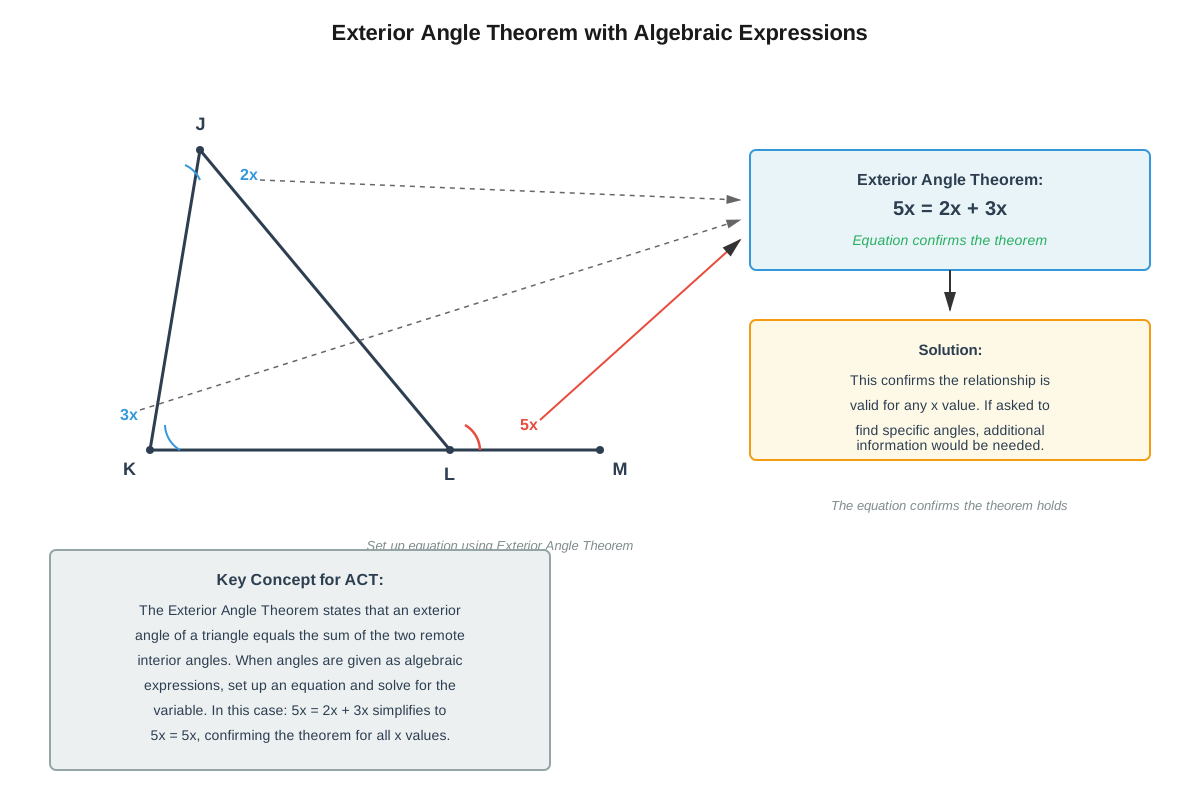
ACT questions frequently present angle measures as algebraic expressions rather than numerical values. The exterior angle theorem becomes a tool for setting up equations:
| Given Information | Equation Setup | Solution Method |
|---|---|---|
| Exterior angle = 3x, Remote angles = x and 2x | 3x = x + 2x | Verify consistency or solve for x |
| Exterior angle = 5x + 10, Remote angles = 2x and 3x + 20 | 5x + 10 = 2x + (3x + 20) | Combine like terms, solve for x |
| Exterior angle = y, Remote angles = 40° and 2y | y = 40 + 2y | Isolate variable, find angle measures |
After solving for variables, always substitute back to find the actual angle measures requested in the question.
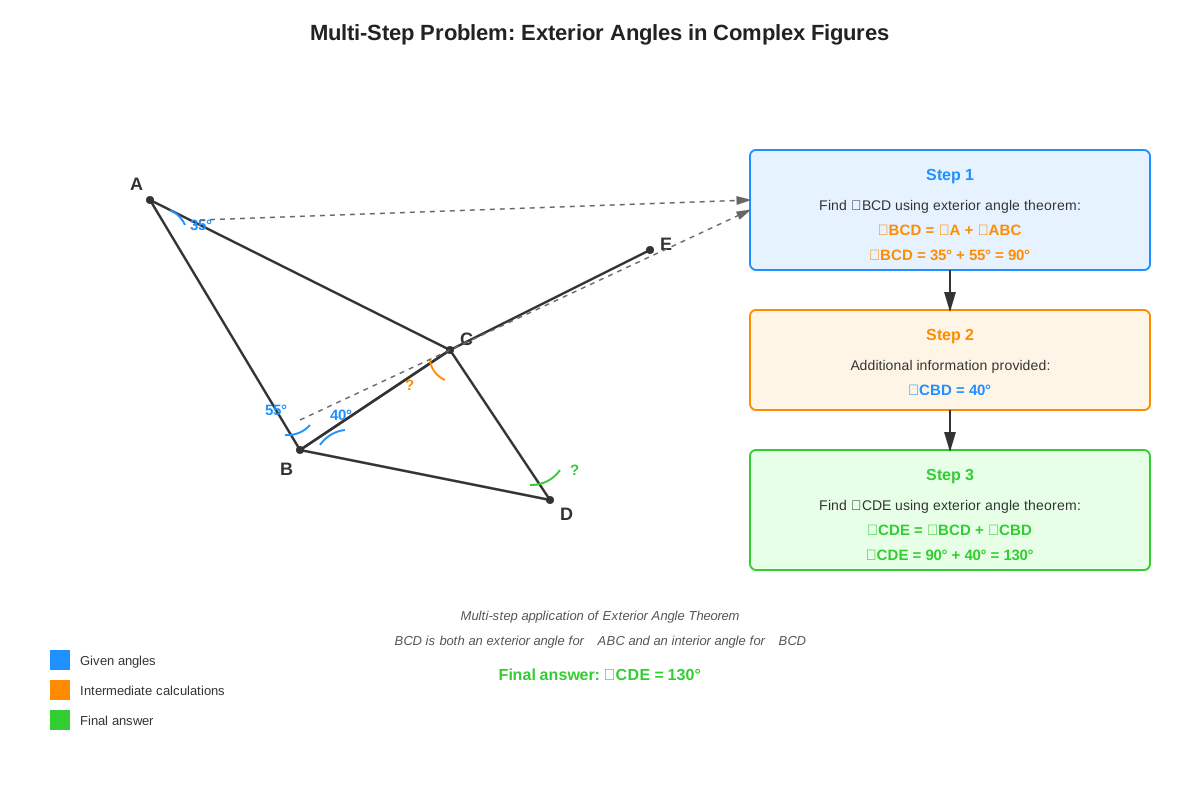
Multiple Exterior Angles in Complex Figures
When diagrams show multiple triangles or extended sides, several exterior angles may be present. The key strategy is to:
- Identify each distinct triangle in the figure
- For each triangle, identify which angle is exterior and which are its remote interior angles
- Apply the theorem separately to each triangle-exterior angle relationship
- Use the resulting equations as a system if multiple unknowns are present
Complex figures often test whether students can correctly parse which angles belong to which triangle and avoid mixing relationships from different triangles.
Concept Relationships
The exterior angle theorem sits at the intersection of several fundamental geometric concepts, creating a web of interconnected relationships. At its foundation, the theorem derives directly from the triangle angle sum theorem → which states that interior angles sum to 180° → combined with the supplementary angle property → that linear pairs sum to 180° → producing the exterior angle relationship.
Moving outward, the exterior angle theorem connects to polygon angle sum formulas. For polygons with more than three sides, exterior angles still sum to 360°, and understanding the triangle case provides intuition for these more general results. The theorem also relates to parallel line angle relationships: when a transversal crosses parallel lines, the angles formed can often be analyzed using triangles where the exterior angle theorem applies.
In problem-solving contexts, the exterior angle theorem frequently combines with similar triangle properties → where corresponding angles are equal → allowing the theorem to be applied to multiple triangles simultaneously. It also connects to isosceles and equilateral triangle properties → where equal sides create equal angles → simplifying the application of the theorem when remote interior angles are congruent.
The relationship map flows: Basic angle concepts → Triangle angle sum → Exterior angle theorem → Complex multi-triangle problems → Polygon properties and advanced geometry.
High-Yield Facts
⭐ The measure of an exterior angle of a triangle equals the sum of the two remote (non-adjacent) interior angles
⭐ An exterior angle is always larger than either of its remote interior angles individually
⭐ Each vertex of a triangle can have an exterior angle formed by extending either of the two sides meeting at that vertex
⭐ The exterior angle and its adjacent interior angle always sum to 180° (they form a linear pair)
⭐ The sum of all three exterior angles of any triangle (one at each vertex) equals 360°
- An exterior angle is formed by extending one side of the triangle beyond a vertex
- The two interior angles that do not touch the exterior angle's vertex are the remote interior angles
- The exterior angle theorem works for all triangles: acute, right, obtuse, scalene, isosceles, and equilateral
- If you know the exterior angle measure, you can find the sum of the two remote interior angles without knowing the individual measures
- The exterior angle theorem can be applied multiple times in figures containing multiple triangles
- When angle measures are given as algebraic expressions, the exterior angle theorem provides an equation to solve for unknowns
- The theorem is often the fastest method for finding missing angles in triangle problems, eliminating the need for multiple steps
- Vertical angles formed by extending a side in both directions are congruent exterior angles
- The exterior angle theorem is a special case that only applies to triangles, not to polygons with more sides
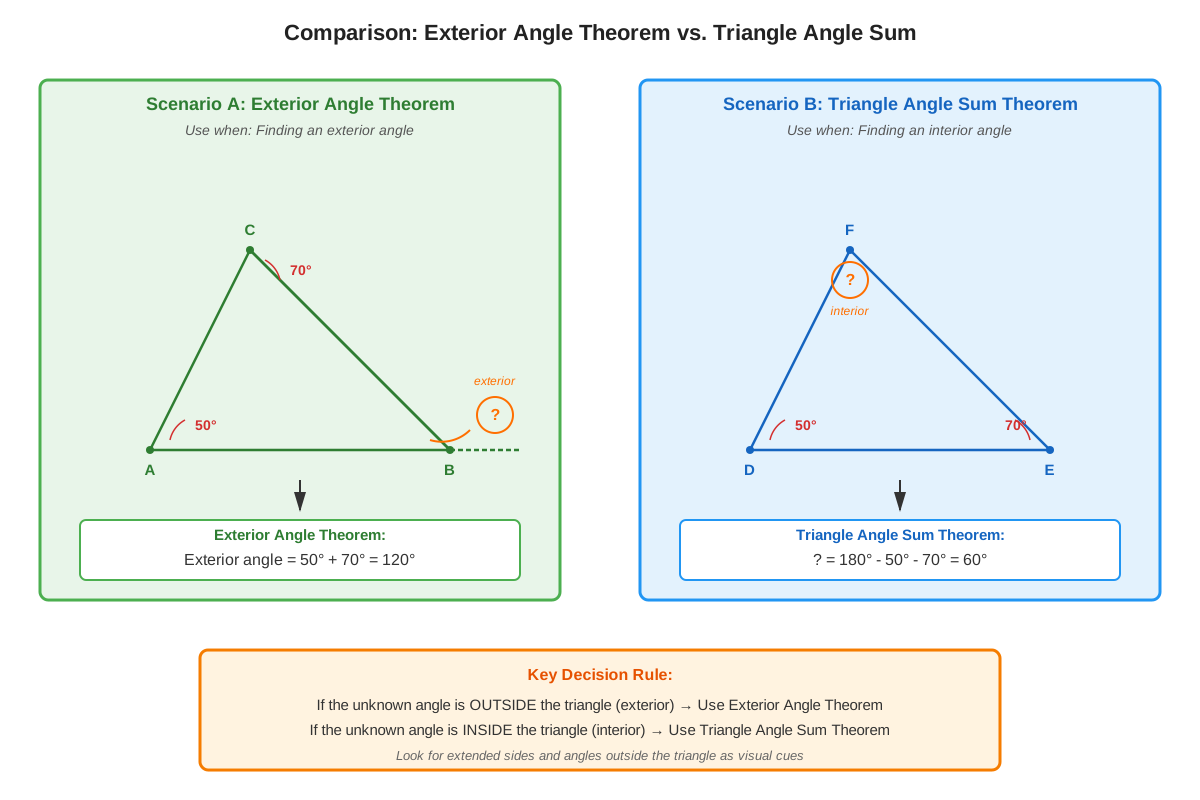
- Recognizing when to use the exterior angle theorem versus the triangle angle sum theorem is a key ACT skill
Quick check — test yourself on Exterior angle theorem so far.
Try Flashcards →Common Misconceptions
Misconception: The exterior angle equals the sum of ALL three interior angles of the triangle → Correction: The exterior angle equals the sum of only the two REMOTE interior angles (the ones not adjacent to it). The adjacent interior angle is supplementary to the exterior angle, not part of the sum.
Misconception: Any angle outside a triangle is an exterior angle → Correction: An exterior angle must be formed by extending one side of the triangle beyond a vertex. Random angles drawn outside the triangle that don't follow this construction are not exterior angles and the theorem doesn't apply to them.
Misconception: The exterior angle theorem can be used for any polygon → Correction: The specific relationship (exterior angle = sum of two remote interior angles) only applies to triangles. While polygons have exterior angles, they follow different rules. For example, in a quadrilateral, an exterior angle does not equal the sum of two specific interior angles.
Misconception: The adjacent interior angle is one of the remote interior angles → Correction: "Remote" means "not adjacent." The interior angle at the same vertex as the exterior angle is specifically NOT a remote interior angle. Only the two interior angles at the other two vertices are remote.
Misconception: You always need to use the exterior angle theorem when an exterior angle is shown → Correction: Sometimes using the triangle angle sum theorem (interior angles sum to 180°) or supplementary angle relationships is more efficient. The best approach depends on what information is given and what is being asked.
Misconception: If an exterior angle measures 120°, each remote interior angle must measure 60° → Correction: The two remote interior angles must SUM to 120°, but they don't have to be equal. They could be 60° and 60°, or 80° and 40°, or 100° and 20°, or any other pair summing to 120°.
Misconception: The exterior angle is always obtuse (greater than 90°) → Correction: The measure of an exterior angle depends on the triangle's interior angles. If the two remote interior angles sum to less than 90°, the exterior angle will be acute. For example, if remote interior angles are 30° and 40°, the exterior angle is 70°.
Worked Examples
Example 1: Direct Application with Numerical Values
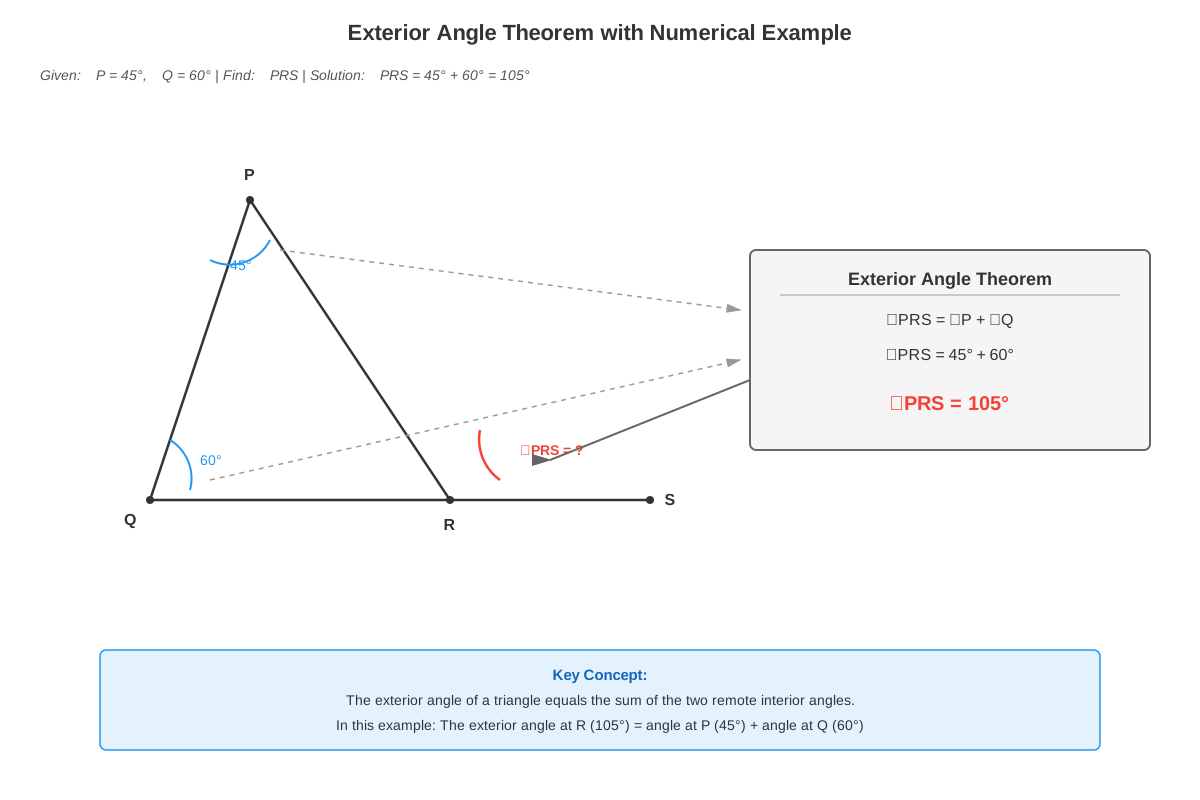
Problem: In triangle ABC, angle A measures 45° and angle B measures 62°. A side of the triangle is extended beyond vertex C to form an exterior angle. What is the measure of this exterior angle?
Solution:
Step 1: Identify the given information
- Interior angle A = 45°
- Interior angle B = 62°
- An exterior angle is formed at vertex C
Step 2: Identify the remote interior angles
Since the exterior angle is at vertex C, the remote interior angles are the ones NOT at vertex C. These are angles A and B.
Step 3: Apply the exterior angle theorem
The exterior angle theorem states: Exterior angle = sum of remote interior angles
Exterior angle at C = Angle A + Angle B
Exterior angle at C = 45° + 62°
Exterior angle at C = 107°
Step 4: Verify using an alternative method (optional but recommended)
We can check this using the triangle angle sum theorem:
- Angle A + Angle B + Angle C = 180°
- 45° + 62° + Angle C = 180°
- Angle C = 73°
Since the exterior angle and interior angle C are supplementary:
- Exterior angle + 73° = 180°
- Exterior angle = 107° ✓
Answer: The exterior angle measures 107°
This example demonstrates Learning Objective: Apply exterior angle theorem to ACT-style questions accurately.
Example 2: Algebraic Application with Variable Expressions
Problem: In triangle DEF, the exterior angle at vertex F measures (4x + 20)°. The two remote interior angles measure (2x - 5)° and (x + 15)°. Find the value of x and the measure of the exterior angle.
Solution:
Step 1: Set up the equation using the exterior angle theorem
The exterior angle equals the sum of the two remote interior angles:
(4x + 20) = (2x - 5) + (x + 15)
Step 2: Simplify the right side
(4x + 20) = 2x - 5 + x + 15
(4x + 20) = 3x + 10
Step 3: Solve for x
4x + 20 = 3x + 10
4x - 3x = 10 - 20
x = -10
Wait—this gives a negative value. Let's check if this makes sense by finding the angle measures:
Step 4: Calculate angle measures
- Exterior angle = 4(-10) + 20 = -40 + 20 = -20°
- Remote angle 1 = 2(-10) - 5 = -20 - 5 = -25°
- Remote angle 2 = (-10) + 15 = 5°
Step 5: Analyze the result
Negative angle measures indicate an error in the problem setup or that the given expressions don't form a valid triangle. However, if this appeared on the ACT, we would select x = -10 as the algebraic solution.
Alternative scenario: If the problem had been set up as:
Exterior angle = (4x + 20)°, Remote angles = (2x + 5)° and (x + 15)°
Then: 4x + 20 = 2x + 5 + x + 15
4x + 20 = 3x + 20
x = 0
This would give: Exterior angle = 20°, Remote angles = 5° and 15° (which sum to 20° ✓)
Key lesson: Always check that your solution produces positive angle measures that make geometric sense. On the ACT, if all answer choices are positive, a negative result indicates a calculation error.
This example demonstrates Learning Objectives: Apply exterior angle theorem to ACT-style questions accurately AND Set up and solve algebraic equations using the exterior angle theorem.
Exam Strategy
When approaching ACT questions involving the exterior angle theorem, follow this systematic strategy:
Recognition triggers: Watch for these phrases and diagram features that signal the exterior angle theorem may be the most efficient approach:
- "A side is extended beyond the vertex"
- "Exterior angle formed by..."
- Diagrams showing a triangle with one side continuing past a vertex
- Questions asking for an angle that appears to be outside the triangle
- Problems giving two interior angles and asking for a third angle (check if the third is actually exterior)
Decision framework: Before automatically applying the theorem, ask:
- Is there actually an exterior angle in the diagram, or just angles outside the triangle?
- Can I identify which two angles are the remote interior angles?
- Would the exterior angle theorem be faster than using the triangle angle sum theorem?
- If variables are involved, will the exterior angle theorem give me a simpler equation?
Process-of-elimination tips:
- If an answer choice for an exterior angle is smaller than one of the given interior angles, eliminate it immediately (the exterior angle must be larger than either remote interior angle alone)
- If two interior angles are given and sum to a value that appears as an answer choice, that's likely the exterior angle
- For algebraic problems, eliminate answer choices that would produce negative angle measures or angles greater than 180°
Time allocation:
- Simple direct-application problems (given two angles, find the exterior angle): 30-45 seconds
- Algebraic setup problems: 60-90 seconds
- Multi-step problems combining the theorem with other concepts: 90-120 seconds
Common trap answers: ACT test writers often include these incorrect options:
- The measure of the adjacent interior angle (instead of the exterior angle)
- The sum of all three interior angles (180°)
- The difference between the two remote interior angles (instead of their sum)
- The supplement of what the exterior angle should be
Exam Tip: If you're unsure whether to use the exterior angle theorem or the triangle angle sum theorem, sketch a quick diagram and label what you know. The visual representation usually makes the most efficient path clear.
Memory Techniques
Mnemonic for the theorem: "Exterior Remote Sum" → ERS → "Exterior equals Remote Sum"
Visual memory aid: Picture the exterior angle as a "mouth" opening away from the triangle, "eating" or "swallowing" the two remote interior angles. The exterior angle must be "big enough" to contain both remote angles, reinforcing that it equals their sum.
Finger technique: When looking at a diagram:
- Point to the exterior angle with one finger
- Point to the two remote interior angles with two other fingers
- Remember: the one exterior angle equals the sum of the two remote angles (1 = 2 combined)
Acronym for problem-solving steps: FIRE
- Find the exterior angle in the diagram
- Identify the two remote interior angles
- Recall the theorem (exterior = sum of remote)
- Execute the calculation or equation setup
Rhyme for remembering "remote": "Remote means not close, they're far from the angle we chose" (the exterior angle we're working with)
Conceptual anchor: Always remember that the exterior angle theorem is just a shortcut. You could always solve the problem using the triangle angle sum theorem (180°) and supplementary angles, but the exterior angle theorem saves steps. Knowing this connection helps if you forget the theorem during the exam—you can derive it quickly.
Summary
The exterior angle theorem is a powerful and frequently tested concept on the ACT Math section that establishes a direct relationship between an exterior angle of a triangle and its two remote interior angles. The theorem states that the measure of an exterior angle equals the sum of the two non-adjacent interior angles, providing an efficient shortcut for solving many triangle angle problems. This principle derives from the fundamental triangle angle sum theorem and supplementary angle relationships, making it a logical consequence rather than an arbitrary rule. Success with this theorem requires three key skills: correctly identifying exterior angles versus other angles outside triangles, distinguishing remote interior angles from adjacent interior angles, and recognizing when applying the theorem provides the most efficient solution path. On the ACT, the theorem appears in both direct numerical problems and algebraic equation-setup questions, often combined with other geometric concepts in multi-step problems. Mastering this theorem not only helps students answer 2-3 questions per exam directly but also builds geometric reasoning skills that support success across the entire plane geometry section.
Key Takeaways
- The exterior angle of a triangle equals the sum of the two remote (non-adjacent) interior angles—this is the core relationship to memorize and apply
- An exterior angle is formed by extending one side of a triangle beyond a vertex, and it forms a linear pair (supplementary angles) with the adjacent interior angle
- The exterior angle is always greater than either remote interior angle individually, which helps eliminate incorrect answer choices
- Identifying which angles are "remote" is critical: they are the two interior angles at vertices OTHER than where the exterior angle is located
- The theorem works for all triangle types and provides a faster solution method than using the triangle angle sum theorem in many ACT problems
- When angle measures are given as algebraic expressions, the exterior angle theorem provides a direct equation: set the exterior angle expression equal to the sum of the two remote angle expressions
- Always verify that calculated angle measures are positive and less than 180° to catch errors and ensure geometric validity
Related Topics
Triangle Angle Sum Theorem: Understanding that all interior angles of a triangle sum to 180° is the foundation from which the exterior angle theorem is derived. Mastering both theorems together provides flexibility in choosing the most efficient solution approach.
Supplementary and Complementary Angles: The exterior angle theorem relies on understanding linear pairs and supplementary relationships. Deepening knowledge of these angle relationships strengthens overall geometric problem-solving.
Parallel Lines and Transversals: When parallel lines are cut by a transversal, triangles are often formed where the exterior angle theorem can be applied to find missing angles, especially in combination with alternate interior angles and corresponding angles.
Polygon Angle Sums: The exterior angle theorem for triangles extends conceptually to understanding exterior angles of all polygons, where the sum of exterior angles (one per vertex) always equals 360°.
Similar Triangles: When triangles are similar, corresponding angles are equal, allowing the exterior angle theorem to be applied across multiple triangles simultaneously in complex figures.
Isosceles and Equilateral Triangles: Special triangle properties create situations where remote interior angles are equal, simplifying application of the exterior angle theorem and creating elegant algebraic setups.
Practice CTA
Now that you've mastered the exterior angle theorem, it's time to cement your understanding through active practice! The concepts you've learned here will appear on your ACT exam, and the difference between knowing the theorem and being able to apply it quickly under test conditions comes down to deliberate practice. Challenge yourself with the practice questions designed specifically to mirror ACT question styles and difficulty levels. Work through the flashcards to reinforce the key facts and relationships until they become automatic. Remember: every practice problem you solve correctly builds confidence and speed for test day. The exterior angle theorem is a high-yield topic that can directly earn you points—make sure you've truly mastered it before moving forward!
Sign up free to keep reading
Create a free AnvayaPrep account to finish this ACT guide on Exterior angle theorem — plus flashcards and practice questions.