Overview
The complement rule is one of the most powerful and frequently tested probability concepts on the ACT Math section. This elegant principle provides a shortcut for calculating probabilities by focusing on what doesn't happen rather than what does happen. When faced with complex probability scenarios involving multiple outcomes or "at least one" conditions, the complement rule transforms difficult calculations into simple subtraction problems. Understanding this rule can save precious time on test day and unlock solutions to problems that would otherwise require tedious case-by-case analysis.
On the ACT, the ACT complement rule appears in approximately 1-2 questions per test, typically within the Statistics and Probability content area. These questions often involve scenarios where calculating the probability of an event directly would require adding multiple probabilities together, but using the complement makes the solution immediate. The rule states that the probability of an event occurring equals one minus the probability of that event not occurring: P(A) = 1 - P(not A). This simple formula becomes invaluable when dealing with "at least one" scenarios, such as finding the probability that at least one person in a group has a certain characteristic.
The complement rule connects fundamentally to basic probability principles, set theory, and logical reasoning. It builds upon understanding that all possible outcomes in a probability space must sum to 1 (or 100%). This topic serves as a bridge between simple probability calculations and more complex combinatorial problems, making it essential for students aiming to master the full range of ACT Math probability questions.
Learning Objectives
- [ ] Identify when Complement rule is being tested in ACT questions
- [ ] Explain the core rule or strategy behind Complement rule
- [ ] Apply Complement rule to ACT-style questions accurately
- [ ] Recognize "at least one" language as a trigger for complement rule application
- [ ] Convert between complement and direct probability calculations fluently
- [ ] Determine when using the complement rule provides computational advantage over direct calculation
- [ ] Solve multi-step probability problems that combine complement rule with other probability concepts
Prerequisites
- Basic probability concepts: Understanding that probability ranges from 0 to 1 and represents the likelihood of an event occurring is essential for grasping why complements sum to 1
- Fraction and decimal operations: The complement rule requires subtracting probabilities, often involving fractions or decimals, making computational fluency necessary
- Understanding of sample spaces: Recognizing all possible outcomes in a scenario helps identify what constitutes an event and its complement
- Set notation basics: Familiarity with concepts like "and," "or," and "not" in logical contexts aids in understanding complementary events
Why This Topic Matters
The complement rule has profound real-world applications across numerous fields. Insurance companies use complement probabilities to calculate risk—determining the likelihood that at least one claim will be filed rather than calculating each individual scenario. Quality control engineers apply the complement rule to assess the probability that at least one defective item exists in a batch. Medical researchers use it to determine the probability that at least one patient in a trial will respond to treatment. Weather forecasters employ complement thinking when stating there's a 30% chance of rain (meaning a 70% chance of no rain).
On the ACT Math section, complement rule questions appear with high regularity, typically 1-2 times per test. These questions most commonly appear in two formats: (1) direct probability scenarios asking for "at least one" outcomes, and (2) word problems involving games, selections, or repeated trials. The ACT favors complement rule questions because they efficiently test both conceptual understanding and computational skills within a single problem. Questions often combine the complement rule with independent events, conditional probability, or counting principles.
Common ACT question patterns include: calculating the probability that at least one of several independent events occurs; finding the probability that something happens at least once in multiple trials; determining the likelihood that not all items in a group share a characteristic; and scenarios involving games where you need to find the probability of winning at least one round. The complement rule frequently appears in questions numbered 40-60 on the ACT Math section, indicating medium to high difficulty levels.
Core Concepts
The Fundamental Complement Rule
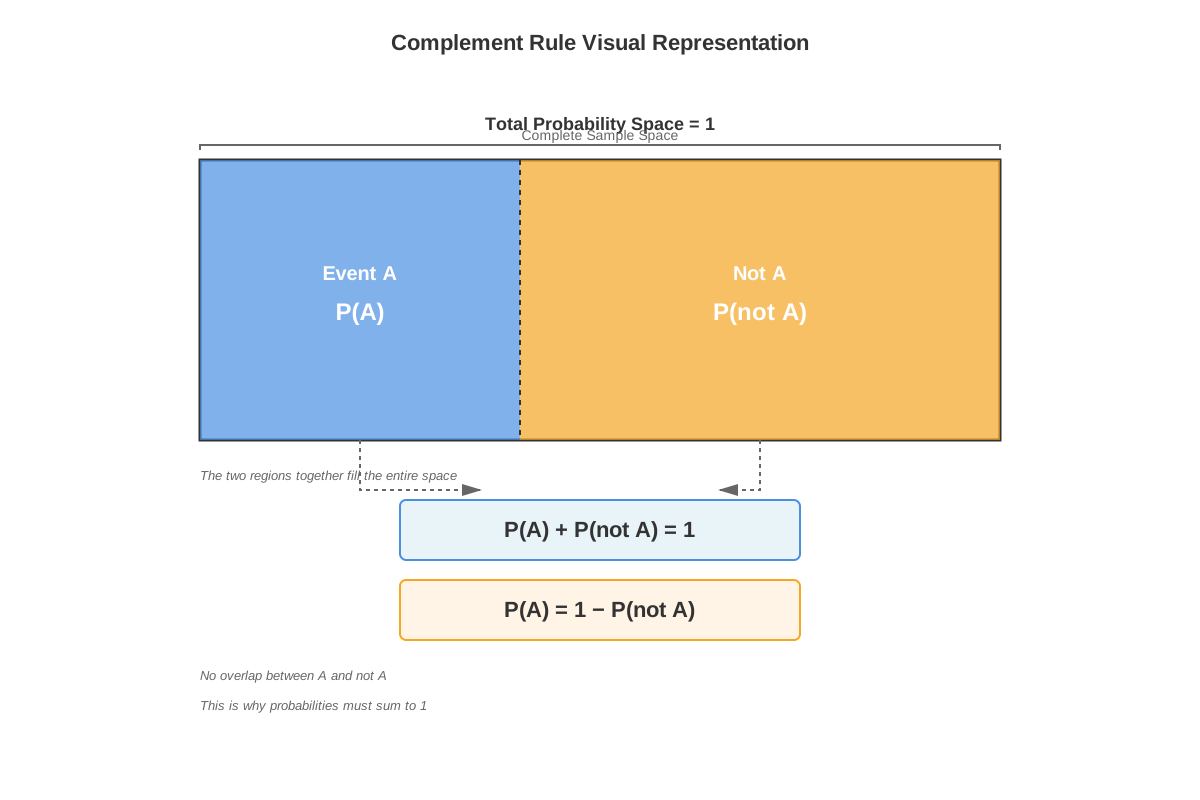
The complement rule states that for any event A, the probability of A occurring plus the probability of A not occurring equals 1. Mathematically expressed:
P(A) + P(not A) = 1This can be rearranged to solve for either probability:
P(A) = 1 - P(not A)
P(not A) = 1 - P(A)
The complement of an event A, denoted as A' or Ā or "not A," consists of all outcomes in the sample space that are not in A. Since every outcome must either be in A or not in A (but never both), these probabilities must sum to exactly 1. This principle derives from the fundamental axiom that the probability of the entire sample space equals 1.
When to Use the Complement Rule
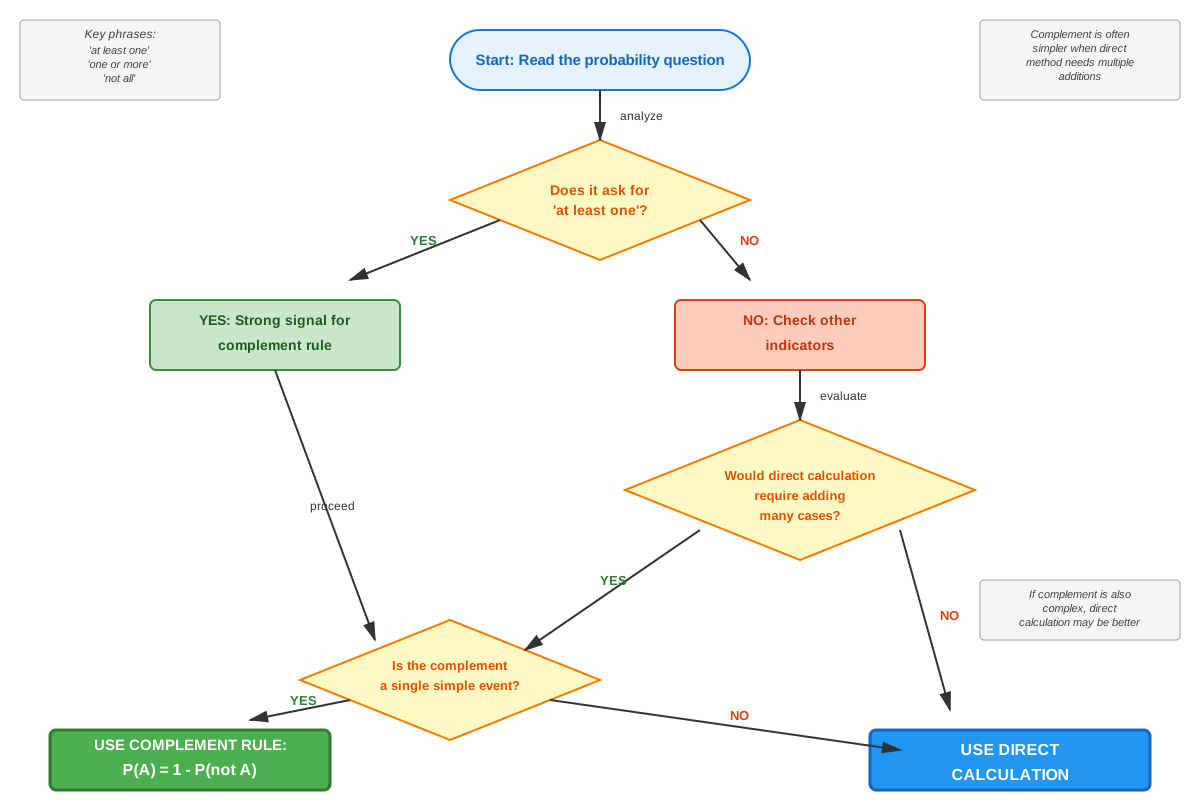
The complement rule becomes particularly valuable in three specific scenarios:
- "At least one" problems: When asked to find the probability that something happens at least once, the complement (none happen) is usually simpler to calculate
- Multiple independent events: When calculating the probability that at least one of several independent events occurs
- Complex direct calculations: When finding P(A) directly requires adding many individual probabilities, but P(not A) is a single calculation
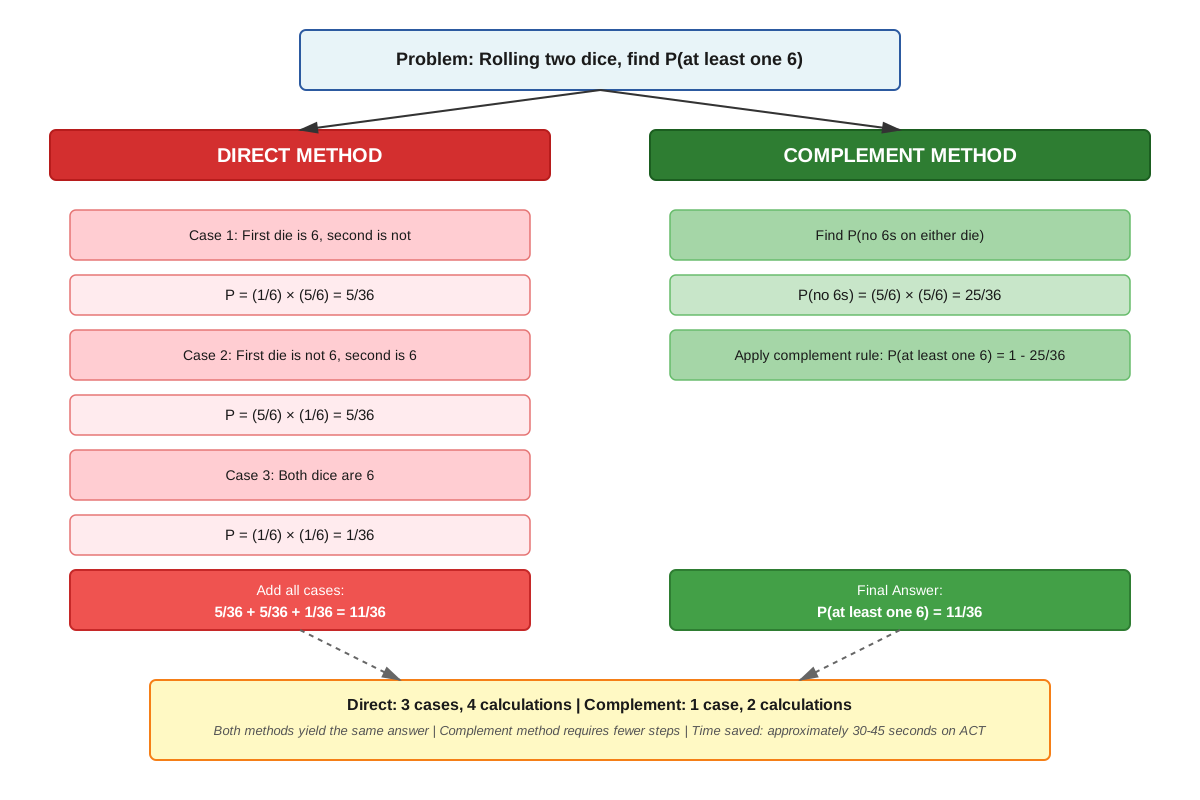
Consider the difference in complexity: Finding the probability of getting at least one head in three coin flips directly requires calculating P(exactly 1 head) + P(exactly 2 heads) + P(exactly 3 heads), involving three separate calculations. Using the complement, you only need to find P(zero heads) = (1/2)³ = 1/8, then calculate 1 - 1/8 = 7/8.
Identifying Complementary Events
Two events are complementary when they satisfy three conditions:
| Condition | Explanation | Example |
|---|---|---|
| Mutually exclusive | Both events cannot occur simultaneously | Rolling a 5 and not rolling a 5 on a die |
| Exhaustive | Together they cover all possible outcomes | Passing a test and not passing a test |
| Binary relationship | One is defined as the negation of the other | Raining today and not raining today |
Common complementary pairs on the ACT include:
- At least one / none
- All / at least one failure
- Success / failure
- Selected / not selected
- Winning / not winning
The "At Least One" Strategy
The phrase "at least one" is the strongest trigger for applying the complement rule. "At least one" means one or more, which includes many possible outcomes. However, the complement of "at least one" is simply "none," which is typically a single, easily calculated outcome.
The strategic approach follows these steps:
- Identify that the question asks for "at least one"
- Recognize that the complement is "none" or "zero"
- Calculate P(none) using multiplication for independent events
- Subtract from 1 to get P(at least one)
For example, if three independent events each have a 0.4 probability of occurring, finding P(at least one occurs) directly requires calculating three separate scenarios. Using the complement: P(none occur) = (0.6)(0.6)(0.6) = 0.216, so P(at least one) = 1 - 0.216 = 0.784.
Independent Events and Complements
When events are independent (one outcome doesn't affect another), the probability that all events fail to occur equals the product of their individual failure probabilities. This multiplication principle makes complement calculations particularly efficient.
For independent events A and B:
P(neither A nor B) = P(not A) × P(not B)
P(at least one of A or B) = 1 - P(not A) × P(not B)
This extends to any number of independent events. For n independent events with individual probabilities p₁, p₂, ..., pₙ:
P(at least one occurs) = 1 - [(1-p₁)(1-p₂)...(1-pₙ)]Complement Rule with Percentages
The ACT frequently presents probabilities as percentages rather than decimals or fractions. The complement rule works identically with percentages, but students must remember that complements sum to 100% rather than 1.
If P(A) = 35%, then P(not A) = 100% - 35% = 65%
When working with percentages in multi-step problems, convert to decimals for multiplication, then convert back to percentages for the final answer if required.
Concept Relationships
The complement rule serves as a central hub connecting multiple probability concepts. At its foundation, the complement rule depends on the axiom that total probability equals 1, which itself derives from the definition of a complete sample space. This fundamental principle → enables → the complement rule → which simplifies → "at least one" probability calculations.
The complement rule connects directly to independent events because calculating P(none occur) requires multiplying individual failure probabilities, which only works when events don't influence each other. This relationship flows: independent events → allow multiplication of probabilities → which makes complement calculations efficient → especially for "at least one" scenarios.
Within the broader probability framework, the complement rule relates to mutually exclusive events (events that cannot both occur) and exhaustive events (events that cover all possibilities). An event and its complement are both mutually exclusive AND exhaustive, making them a special case: mutually exclusive events → can be added → exhaustive events → must sum to 1 → complementary events → satisfy both conditions → enabling the complement rule.
The complement rule also connects to conditional probability in more advanced problems. Sometimes the complement of a conditional probability is easier to calculate than the conditional probability itself. This relationship appears in problems where P(A|B) is complex but P(not A|B) is straightforward.
Looking forward, mastering the complement rule prepares students for combinatorics and counting principles, where complement thinking helps solve complex selection problems. The logic of "count what you don't want, then subtract from the total" mirrors the complement rule's approach.
High-Yield Facts
⭐ The complement rule states P(A) = 1 - P(not A), where P(A) + P(not A) always equals 1
⭐ The phrase "at least one" is the strongest signal to use the complement rule
⭐ The complement of "at least one" is "none" or "zero," which is typically easier to calculate
⭐ For independent events, P(none occur) equals the product of individual failure probabilities
⭐ When probabilities are given as percentages, complements sum to 100% instead of 1
- An event and its complement are mutually exclusive (cannot both occur) and exhaustive (cover all possibilities)
- The complement rule saves time when direct calculation requires adding multiple probabilities
- For n independent events with equal probability p, P(at least one) = 1 - (1-p)ⁿ
- The complement of "all" is "at least one failure," and vice versa
- Complement rule questions on the ACT typically appear in the latter half of the test (questions 40-60)
- Converting between fractions, decimals, and percentages is essential for complement rule calculations
- The complement rule can be applied repeatedly in multi-step problems
- Drawing a probability tree or Venn diagram can help visualize complementary events
Quick check — test yourself on Complement rule so far.
Try Flashcards →Common Misconceptions
Misconception: The complement of "at least two" is "none" → Correction: The complement of "at least two" is "zero or one" (fewer than two). Only "at least one" has the simple complement of "none." Each "at least n" statement has the complement "fewer than n."
Misconception: Complement rule only works with independent events → Correction: The complement rule P(A) = 1 - P(not A) works for any event, independent or not. However, calculating P(not A) for multiple events using multiplication only works when events are independent.
Misconception: P(A) + P(B) = 1 means A and B are complements → Correction: Events are complements only when one is the negation of the other and together they cover all possibilities. Two unrelated events might have probabilities that happen to sum to 1 without being complements (e.g., P(rolling 1-3 on a die) = 1/2 and P(flipping heads) = 1/2, but these aren't complements).
Misconception: The complement of "A and B" is "not A and not B" → Correction: The complement of "A and B" is "not A or not B" (at least one fails). This follows De Morgan's Laws from logic. Similarly, the complement of "A or B" is "not A and not B" (both fail).
Misconception: When using percentages, subtract from 1 instead of 100 → Correction: If working with percentages throughout a problem, complements sum to 100%. If P(A) = 35%, then P(not A) = 65%, not -34%. Convert to decimals if mixing percentage and decimal calculations.
Misconception: The complement rule gives a different answer than direct calculation → Correction: Both methods must yield identical results when done correctly. The complement rule is simply a computational shortcut. If answers differ, an error occurred in one approach.
Misconception: You can use the complement rule when events are dependent without adjustment → Correction: For dependent events, calculating P(none occur) requires conditional probabilities, not simple multiplication. The complement rule formula P(A) = 1 - P(not A) still holds, but finding P(not A) becomes more complex.
Worked Examples
Example 1: Basketball Free Throws
Problem: A basketball player makes 70% of her free throws. If she attempts 3 free throws, what is the probability she makes at least one?
Solution:
Step 1: Identify the trigger phrase
"At least one" signals we should use the complement rule.
Step 2: Define the complement
The complement of "makes at least one" is "makes none" (misses all three).
Step 3: Calculate P(makes none)
- Probability of missing one free throw = 1 - 0.70 = 0.30
- Since free throws are independent events:
- P(misses all 3) = 0.30 × 0.30 × 0.30 = 0.027
Step 4: Apply the complement rule
P(makes at least one) = 1 - P(makes none)
P(makes at least one) = 1 - 0.027 = 0.973
Answer: 0.973 or 97.3%
Connection to learning objectives: This problem demonstrates identifying when the complement rule is being tested (the "at least one" phrase), explaining the strategy (finding the complement is simpler than adding three separate probabilities), and applying the rule accurately to reach the correct answer.
Example 2: Quality Control
Problem: A factory produces light bulbs, and 5% are defective. If a customer purchases 4 light bulbs, what is the probability that at least one is defective?
Solution:
Step 1: Recognize the complement opportunity
Finding P(at least one defective) directly would require:
P(exactly 1 defective) + P(exactly 2 defective) + P(exactly 3 defective) + P(all 4 defective)
This involves complex combinations. The complement is much simpler.
Step 2: Identify the complement
The complement of "at least one defective" is "none defective" (all working).
Step 3: Calculate P(none defective)
- P(one bulb works) = 1 - 0.05 = 0.95
- Assuming independence (reasonable for factory production):
- P(all 4 work) = 0.95 × 0.95 × 0.95 × 0.95 = (0.95)⁴
Step 4: Compute the power
(0.95)⁴ = 0.8145 (approximately)
Step 5: Apply complement rule
P(at least one defective) = 1 - 0.8145 = 0.1855
Answer: Approximately 0.186 or 18.6%
Alternative approach verification: If we wanted to verify using direct calculation for just one defective bulb: C(4,1) × (0.05)¹ × (0.95)³ = 4 × 0.05 × 0.857 = 0.171. Adding the other cases would eventually reach 0.186, confirming our complement approach was both faster and accurate.
Connection to learning objectives: This example shows determining when the complement provides computational advantage (avoiding complex combinations), applying the rule with exponents, and demonstrating the efficiency of complement thinking.
Exam Strategy
Recognition Triggers
ACT questions testing the complement rule typically include specific trigger words and phrases:
- "At least one" (strongest trigger)
- "At least" followed by any number
- "One or more"
- "Not all"
- "What is the probability that [event] occurs?" when direct calculation is complex
When you see these phrases, immediately consider whether the complement approach would be simpler than direct calculation.
Step-by-Step Approach
- Read carefully for "at least" language: Underline or circle these phrases
- Ask: "What's the complement?": Write down the opposite event
- Check for independence: Verify events don't affect each other before multiplying
- Calculate the complement probability: Usually involves multiplication
- Subtract from 1 (or 100%): Apply the complement rule
- Verify reasonableness: Does your answer make logical sense?
Process of Elimination Tips
When answer choices are provided:
- Eliminate answers greater than 1 or less than 0: Probabilities must fall in the range [0, 1]
- Eliminate answers that ignore the complement: If you calculated P(none) = 0.2, eliminate 0.2 as a final answer for P(at least one)
- Check extreme cases: If probability of individual success is very high, P(at least one success) should be close to 1
- Look for complement pairs: Sometimes answer choices include both P(A) and P(not A); they should sum to 1
Time Management
Complement rule questions typically require 45-60 seconds when approached correctly. If you find yourself:
- Writing out more than 3-4 separate probability calculations
- Drawing complex probability trees with many branches
- Spending more than 90 seconds on the problem
Stop and reconsider whether the complement approach would be faster. The ACT rewards efficient problem-solving, and the complement rule is specifically designed to save time.
Common Traps
Trap 1: Calculating the complement probability but forgetting to subtract from 1. Always complete the final step.
Trap 2: Multiplying probabilities when events are dependent. Check for independence before using multiplication.
Trap 3: Confusing "at least one" with "exactly one." These are different events requiring different approaches.
Trap 4: Using the wrong base (subtracting from 1 when working with percentages, or from 100 when working with decimals). Stay consistent with your units.
Memory Techniques
The "COMPLEMENT" Acronym
Check for "at least one" language
Opposite event is usually simpler
Multiply failure probabilities (if independent)
Probabilities must sum to one
Look for independence before multiplying
Evaluate P(not A) first
Minus from 1 gives P(A)
Examine answer reasonableness
None is the complement of at least one
Take the shortcut when possible
Visual Memory Aid
Imagine a pie chart representing all possible outcomes (the sample space). The event A takes up part of the pie, and "not A" takes up the rest. Together, they form the complete pie (probability = 1). When you need P(A) but P(not A) is easier to find, you're simply calculating the "leftover" portion of the pie.
The "Opposite Day" Technique
Think of the complement rule as "Opposite Day" in probability. When the question asks for something complex, declare "Opposite Day" and calculate the opposite scenario instead. Then remember to flip back to reality by subtracting from 1.
Rhyme for "At Least One"
"When you see 'at least one,' think 'none' and you're done!"
This reminds you that "at least one" has the simple complement of "none," making calculation straightforward.
The 1-Minus Mantra
Before starting any "at least one" problem, say: "One minus none equals at least one." This reinforces the relationship between the complement and the desired probability.
Summary
The complement rule is an essential probability shortcut that transforms complex "at least one" calculations into simple subtraction problems. By recognizing that P(A) = 1 - P(not A), students can avoid tedious case-by-case analysis and solve problems efficiently. The rule works because an event and its complement are mutually exclusive and exhaustive, meaning they cannot both occur but together cover all possibilities, so their probabilities must sum to exactly 1. The most common ACT application involves "at least one" scenarios, where calculating the probability that none of several independent events occur (through multiplication) is far simpler than adding multiple individual probabilities. Success with the complement rule requires three key skills: recognizing trigger phrases like "at least one," identifying complementary events correctly, and verifying independence before multiplying probabilities. Mastering this concept provides both computational efficiency and conceptual understanding that extends to more advanced probability topics.
Key Takeaways
- The complement rule states P(A) = 1 - P(not A), providing a shortcut when P(not A) is easier to calculate than P(A)
- "At least one" is the strongest trigger phrase for applying the complement rule, with "none" as its simple complement
- For independent events, P(none occur) equals the product of individual failure probabilities
- An event and its complement are mutually exclusive (cannot both happen) and exhaustive (cover all possibilities)
- Always verify independence before multiplying probabilities in complement calculations
- The complement rule saves significant time on ACT questions that would otherwise require multiple separate calculations
- Remember to complete the final step: subtract the complement probability from 1 (or 100% for percentages)
Related Topics
Independent vs. Dependent Events: Understanding when events influence each other is crucial for correctly applying the complement rule, as multiplication of probabilities only works for independent events. Mastering the complement rule provides foundation for recognizing when independence assumptions are valid.
Conditional Probability: Advanced problems may combine complement thinking with conditional probability, where P(A|B) and P(not A|B) are complements that sum to 1. The complement rule extends naturally into conditional scenarios.
Combinations and Permutations: The complement principle appears in counting problems where calculating unwanted arrangements and subtracting from total arrangements is easier than counting desired arrangements directly. This represents complement thinking applied to combinatorics.
Probability Distributions: In binomial and other discrete distributions, complement calculations help find cumulative probabilities, particularly for "at least" and "at most" scenarios. The complement rule becomes a tool for working with probability distribution tables.
Set Theory and Venn Diagrams: The complement rule connects to set operations, where the complement of set A contains all elements not in A. Visual representation through Venn diagrams reinforces the relationship between events and their complements.
Practice CTA
Now that you understand the complement rule's power and applications, it's time to cement your mastery through practice. The concept becomes intuitive only through repeated application to varied problems. Challenge yourself with the practice questions designed specifically to test complement rule recognition and application. Work through each problem methodically, identifying trigger phrases and determining when the complement approach offers advantage. Use the flashcards to reinforce key facts and formulas until they become automatic. Remember: every ACT point counts, and mastering this high-yield topic can be the difference between a good score and a great score. You've learned the strategy—now make it yours through practice!
Sign up free to keep reading
Create a free AnvayaPrep account to finish this ACT guide on Complement rule — plus flashcards and practice questions.