Overview
Mutually exclusive events represent a fundamental concept in probability theory that appears regularly on the ACT Math test. Understanding this concept is essential for correctly solving probability questions, which typically account for 2-3 questions per exam. When two events are mutually exclusive, they cannot occur simultaneously—the occurrence of one event completely prevents the other from happening. For example, when flipping a coin, getting heads and getting tails are mutually exclusive because both outcomes cannot happen on the same flip.
The ACT frequently tests students' ability to recognize when events are mutually exclusive and apply the appropriate probability rules. This topic connects directly to broader probability concepts including independent events, conditional probability, and the addition rule for probabilities. Students who master mutually exclusive events gain a significant advantage because these questions often appear as straightforward point-earning opportunities when the underlying principle is understood, yet they can be confusing traps for unprepared test-takers.
Beyond the ACT, understanding mutually exclusive events builds critical thinking skills for analyzing real-world scenarios involving risk assessment, decision-making, and statistical reasoning. This concept forms the foundation for more advanced statistical topics students will encounter in college-level mathematics and science courses, making it a high-value investment of study time.
Learning Objectives
- [ ] Identify when mutually exclusive events is being tested in ACT questions
- [ ] Explain the core rule or strategy behind mutually exclusive events
- [ ] Apply mutually exclusive events to ACT-style questions accurately
- [ ] Distinguish between mutually exclusive and non-mutually exclusive events in various contexts
- [ ] Calculate probabilities using the addition rule for mutually exclusive events
- [ ] Recognize when events are NOT mutually exclusive and adjust probability calculations accordingly
- [ ] Solve multi-step probability problems involving combinations of mutually exclusive events
Prerequisites
- Basic probability concepts: Understanding that probability represents the likelihood of an event occurring, expressed as a fraction, decimal, or percentage between 0 and 1, is essential for working with any probability problem.
- Fraction operations: Adding, subtracting, and simplifying fractions is necessary because probabilities are frequently expressed as fractions that must be combined.
- Set theory basics: Familiarity with the concepts of union (combining sets) and intersection (overlap between sets) helps visualize mutually exclusive relationships.
- Sample space understanding: Knowing how to identify all possible outcomes in a given scenario provides the foundation for calculating individual event probabilities.
Why This Topic Matters
ACT mutually exclusive events questions appear with high frequency on the exam, typically showing up in 2-3 questions per test administration. These questions are considered medium difficulty, meaning they separate students scoring in the mid-20s from those achieving scores in the upper 20s and low 30s. The questions usually appear in straightforward probability contexts (dice, cards, spinners) or in word problems involving real-world scenarios (selecting students, choosing items, scheduling conflicts).
In real-world applications, mutually exclusive events help us understand situations where choices or outcomes are incompatible. Business decisions often involve mutually exclusive options—investing in Project A versus Project B with limited resources. Medical diagnoses may involve mutually exclusive conditions where having one disease rules out another. Sports outcomes, election results, and quality control scenarios all involve mutually exclusive possibilities.
On the ACT, this topic commonly appears as: (1) direct probability calculations asking for the probability that "either Event A or Event B" occurs, (2) word problems requiring students to first identify whether events are mutually exclusive before calculating, (3) questions involving Venn diagrams or set notation, and (4) multi-step problems where recognizing mutually exclusive relationships simplifies complex calculations. The ability to quickly identify mutually exclusive situations and apply the correct formula can save valuable time and prevent calculation errors.
Core Concepts
Definition of Mutually Exclusive Events
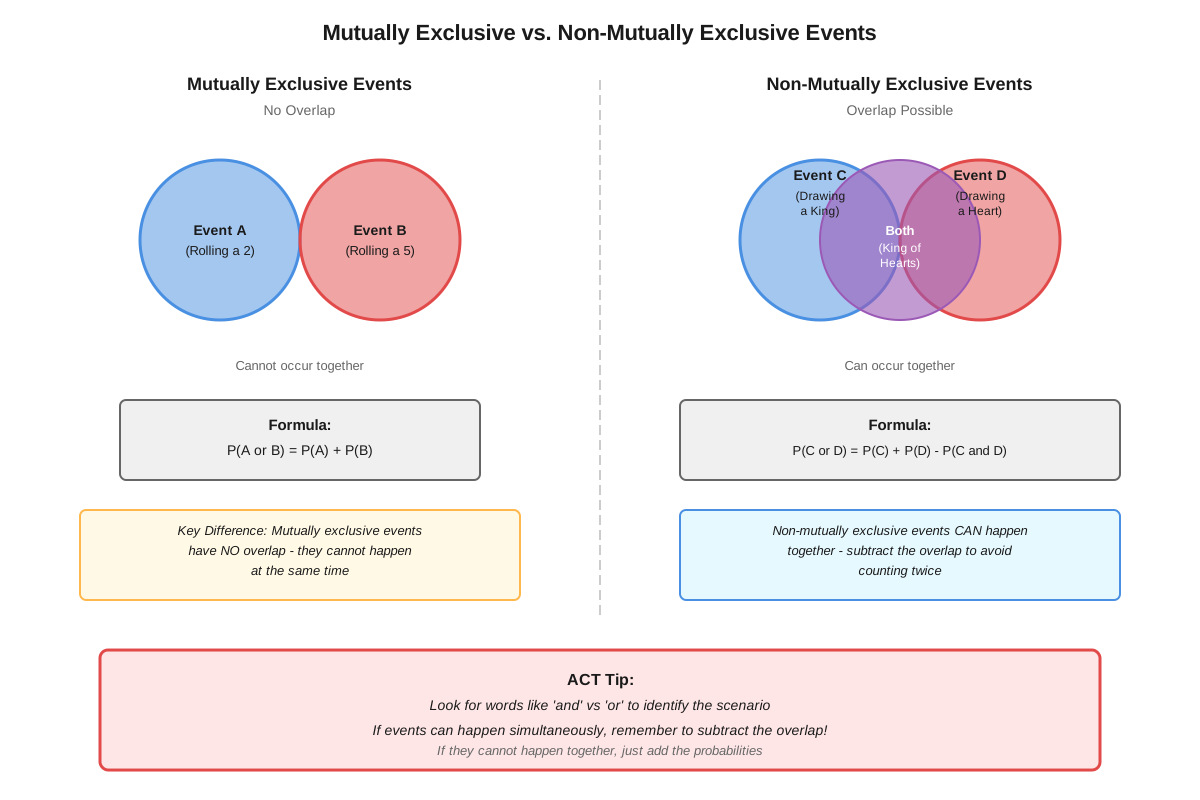
Mutually exclusive events are two or more events that cannot occur at the same time. In mathematical terms, if events A and B are mutually exclusive, then the probability of both occurring simultaneously is zero: P(A and B) = 0. The events have no overlap—they are completely separate outcomes within the same probability experiment.
Consider rolling a single six-sided die. The event "rolling a 2" and the event "rolling a 5" are mutually exclusive because a single roll cannot produce both numbers simultaneously. However, the event "rolling an even number" and the event "rolling a number less than 4" are NOT mutually exclusive because rolling a 2 satisfies both conditions.
The Addition Rule for Mutually Exclusive Events
When events are mutually exclusive, calculating the probability that one OR the other occurs follows a simple addition rule:
P(A or B) = P(A) + P(B)This formula works because there is no overlap to account for—since the events cannot happen together, we simply add their individual probabilities. For example, when drawing one card from a standard deck, the probability of drawing a heart OR a club equals:
P(heart or club) = P(heart) + P(club) = 13/52 + 13/52 = 26/52 = 1/2This straightforward addition only applies when events are mutually exclusive. When events can overlap, we must use the general addition rule that subtracts the overlap.
Identifying Mutually Exclusive Events
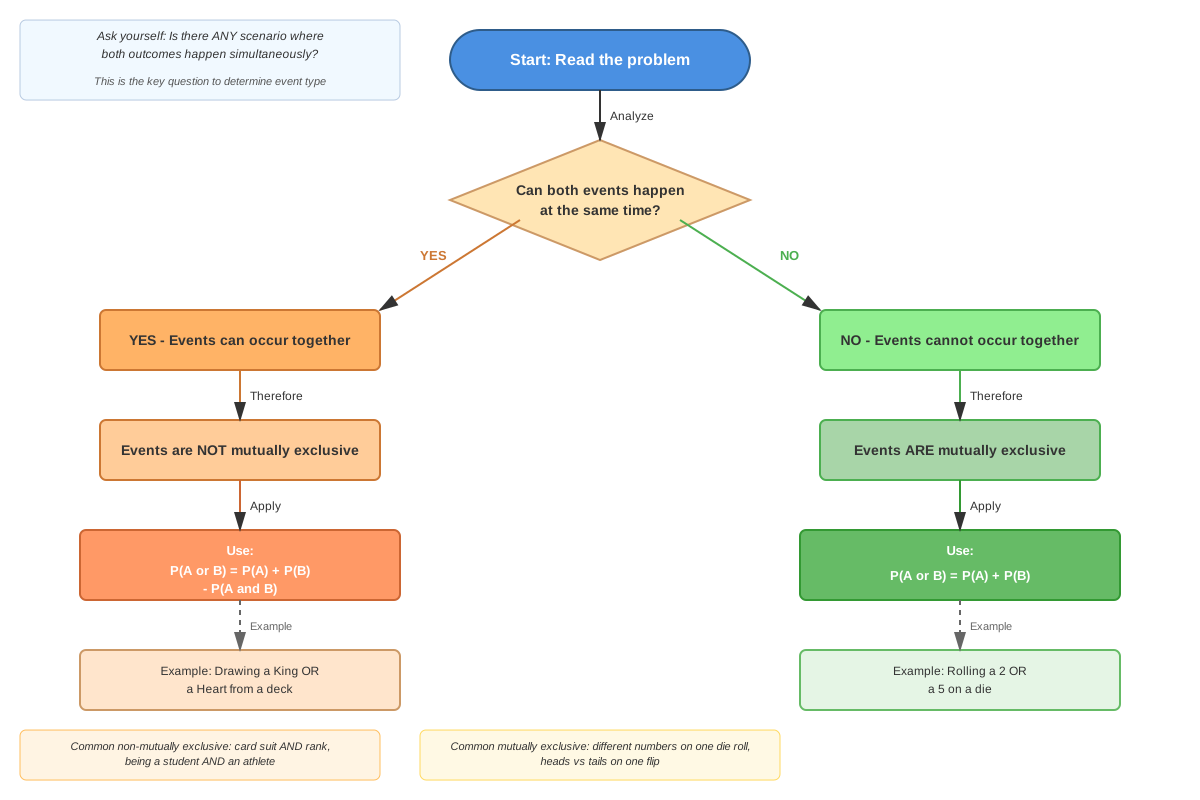
The key to solving ACT problems correctly lies in accurately identifying whether events are mutually exclusive. Ask these diagnostic questions:
- Can both events happen at the same time? If yes, they are NOT mutually exclusive.
- Do the events share any common outcomes? If yes, they are NOT mutually exclusive.
- Does one event's occurrence prevent the other? If yes, they ARE mutually exclusive.
Consider these examples:
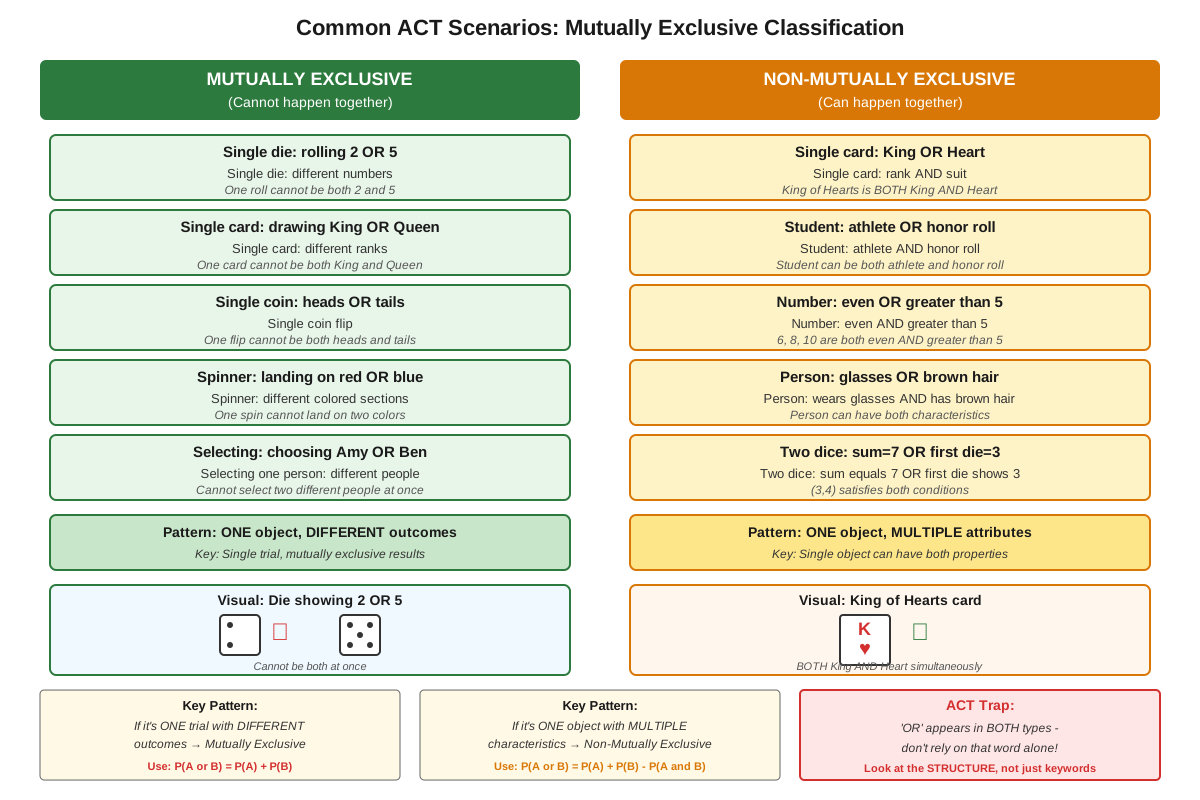
| Scenario | Event A | Event B | Mutually Exclusive? | Reason |
|---|---|---|---|---|
| Single die roll | Rolling a 3 | Rolling an odd number | NO | Rolling a 3 satisfies both events |
| Single die roll | Rolling a 3 | Rolling a 4 | YES | Cannot roll both on one die |
| Drawing one card | Drawing a King | Drawing a Heart | NO | King of Hearts satisfies both |
| Drawing one card | Drawing a King | Drawing a Queen | YES | A card cannot be both ranks |
| Student selection | Selecting a senior | Selecting a junior | YES | A student cannot be in both grades |
The General Addition Rule (Non-Mutually Exclusive)
Understanding what happens when events are NOT mutually exclusive reinforces the concept. The general addition rule accounts for overlap:
P(A or B) = P(A) + P(B) - P(A and B)We subtract P(A and B) because when we add P(A) and P(B), we count the overlapping outcomes twice. For mutually exclusive events, P(A and B) = 0, so this formula reduces to the simple addition rule. This relationship helps students verify their identification of mutually exclusive events.
Multiple Mutually Exclusive Events
The addition rule extends to more than two events. If events A, B, and C are all mutually exclusive from each other:
P(A or B or C) = P(A) + P(B) + P(C)For example, when rolling a die, the probability of rolling a 1, 2, or 3 equals:
P(1 or 2 or 3) = 1/6 + 1/6 + 1/6 = 3/6 = 1/2This principle applies to any number of mutually exclusive events, making it powerful for solving complex probability problems by breaking them into simpler, non-overlapping cases.
Complementary Events as a Special Case
Complementary events represent a special type of mutually exclusive relationship. An event and its complement are always mutually exclusive (they cannot both occur) and exhaustive (one must occur). If A is an event, its complement A' satisfies:
P(A) + P(A') = 1This relationship is particularly useful for ACT problems asking for "the probability that something does NOT happen," which can often be calculated more easily as 1 minus the probability it does happen.
Concept Relationships
The concept of mutually exclusive events sits at the intersection of several probability principles. Understanding basic probability (calculating the likelihood of single events) provides the foundation → which enables recognition of mutually exclusive events (identifying when events cannot co-occur) → which determines the correct application of the addition rule (combining probabilities appropriately) → which connects to complementary events (a special mutually exclusive case) → and contrasts with independent events (a different relationship where events don't affect each other).
Mutually exclusive events must be distinguished from independent events—a common source of confusion. Two events are independent if the occurrence of one does not affect the probability of the other, but independent events can still occur simultaneously. For example, flipping a coin and rolling a die are independent events, and both can happen at the same time. However, getting heads and getting tails on the same coin flip are mutually exclusive.
The relationship to set theory provides a visual framework: mutually exclusive events correspond to disjoint sets with no intersection, while non-mutually exclusive events correspond to overlapping sets. This connection helps students visualize problems and verify their reasoning using Venn diagrams.
High-Yield Facts
⭐ Mutually exclusive events cannot occur simultaneously; P(A and B) = 0 for mutually exclusive events A and B
⭐ For mutually exclusive events, P(A or B) = P(A) + P(B)—simply add the probabilities
⭐ Events involving different outcomes from a single trial (rolling a 2 vs. rolling a 5) are typically mutually exclusive
⭐ Complementary events are always mutually exclusive and their probabilities sum to 1
⭐ If events can overlap (share common outcomes), they are NOT mutually exclusive and require the general addition rule
- Mutually exclusive does NOT mean independent; these are different concepts that students frequently confuse
- When drawing one card, different ranks (King vs. Queen) are mutually exclusive, but rank and suit (King vs. Heart) are not
- Multiple events can all be mutually exclusive from each other, allowing simple addition of all their probabilities
- The phrase "either...or" in ACT questions often signals the need to add probabilities, but verify mutual exclusivity first
- If P(A or B) ≠ P(A) + P(B), the events are definitely NOT mutually exclusive
Quick check — test yourself on Mutually exclusive events so far.
Try Flashcards →Common Misconceptions
Misconception: Mutually exclusive and independent mean the same thing. → Correction: These are completely different concepts. Mutually exclusive means events cannot happen together (if one occurs, the other cannot). Independent means one event's occurrence doesn't affect the probability of the other (they can both occur). In fact, non-trivial mutually exclusive events are never independent because if A occurs, the probability of B becomes 0.
Misconception: All probability problems involving "or" require simple addition of probabilities. → Correction: Only mutually exclusive events follow P(A or B) = P(A) + P(B). When events can overlap, you must use P(A or B) = P(A) + P(B) - P(A and B) to avoid counting shared outcomes twice.
Misconception: If two events involve different objects (like two different dice), they must be mutually exclusive. → Correction: Mutually exclusive refers to whether events can occur simultaneously in the same probability experiment, not whether they involve different physical objects. Rolling a 3 on die #1 and rolling a 4 on die #2 can both happen at the same time, so they are NOT mutually exclusive.
Misconception: Events with different probabilities cannot be mutually exclusive. → Correction: Mutually exclusive events can have any probabilities as long as they don't overlap. Rolling a 1 (probability 1/6) and rolling an even number (probability 3/6) are mutually exclusive despite different probabilities.
Misconception: When calculating P(A or B or C), you can always just add all three probabilities. → Correction: This only works if all three events are mutually exclusive from each other. If any pair can overlap, you need to account for those intersections using the general addition rule.
Misconception: Complementary events are just another name for mutually exclusive events. → Correction: While complementary events are mutually exclusive, they have an additional property: they are exhaustive (one must occur). Complementary events always sum to probability 1. Rolling a 2 and rolling a 5 are mutually exclusive but not complementary because other outcomes exist.
Worked Examples
Example 1: Card Selection
Problem: A standard deck of 52 cards contains 4 suits (hearts, diamonds, clubs, spades) with 13 cards each. If you draw one card at random, what is the probability that you draw either a diamond or a spade?
Solution:
Step 1: Identify the events
- Event A: Drawing a diamond
- Event B: Drawing a spade
Step 2: Determine if events are mutually exclusive
Ask: Can a single card be both a diamond AND a spade? No—each card has exactly one suit. Therefore, these events are mutually exclusive.
Step 3: Calculate individual probabilities
- P(diamond) = 13/52 (13 diamonds in 52 total cards)
- P(spade) = 13/52 (13 spades in 52 total cards)
Step 4: Apply the addition rule for mutually exclusive events
P(diamond or spade) = P(diamond) + P(spade)
P(diamond or spade) = 13/52 + 13/52 = 26/52 = 1/2Answer: The probability is 1/2 or 0.5 or 50%.
Connection to learning objectives: This example demonstrates identifying mutually exclusive events (different suits cannot overlap) and applying the core addition rule accurately.
Example 2: Classroom Selection
Problem: A class has 30 students: 12 seniors, 10 juniors, and 8 sophomores. If the teacher randomly selects one student to present first, what is the probability that the selected student is either a senior or a sophomore?
Solution:
Step 1: Identify the events
- Event A: Selecting a senior
- Event B: Selecting a sophomore
Step 2: Determine if events are mutually exclusive
Ask: Can one student be both a senior AND a sophomore? No—a student belongs to exactly one grade level. These events are mutually exclusive.
Step 3: Calculate individual probabilities
- P(senior) = 12/30 (12 seniors out of 30 total students)
- P(sophomore) = 8/30 (8 sophomores out of 30 total students)
Step 4: Apply the addition rule
P(senior or sophomore) = P(senior) + P(sophomore)
P(senior or sophomore) = 12/30 + 8/30 = 20/30 = 2/3Answer: The probability is 2/3 (approximately 0.667 or 66.7%).
Alternative approach using complement: We could also calculate this as 1 - P(junior) = 1 - 10/30 = 20/30 = 2/3, which demonstrates how complementary events (also mutually exclusive) provide an alternative solution path.
Connection to learning objectives: This example shows how to identify mutually exclusive events in word problems and demonstrates the relationship to complementary events.
Exam Strategy
When approaching ACT mutually exclusive events questions, follow this systematic process:
Step 1: Identify the trigger language
Watch for phrases like "either...or," "one or the other," "cannot both occur," or questions asking for the probability of multiple distinct outcomes. These signal potential mutually exclusive situations.
Step 2: Apply the mutual exclusivity test
Before calculating anything, explicitly ask: "Can these events happen at the same time?" Visualize the scenario or draw a quick diagram if needed. This single question prevents the most common errors.
Step 3: Choose the correct formula
- If mutually exclusive: P(A or B) = P(A) + P(B)
- If NOT mutually exclusive: P(A or B) = P(A) + P(B) - P(A and B)
Step 4: Calculate carefully
Find each individual probability, then combine using the appropriate rule. Keep fractions in their simplest form and verify your answer makes sense (probabilities must be between 0 and 1).
Exam Tip: If a question asks for P(A or B) and provides P(A), P(B), and P(A and B), it's signaling that the events are NOT mutually exclusive. If only P(A) and P(B) are given or easily calculated, the events are likely mutually exclusive.
Time allocation: Spend 30-45 seconds identifying whether events are mutually exclusive, then 30-45 seconds on calculations. Don't rush the identification phase—getting this wrong wastes all subsequent work.
Process of elimination tips:
- Eliminate answer choices greater than 1 or less than 0 (impossible probabilities)
- If you added P(A) + P(B) and got an answer choice, but the events aren't mutually exclusive, that answer is a trap
- Check if the complement approach (1 - P(not what you want)) gives an answer choice—this often provides a faster path
Common trap answers: ACT test writers frequently include P(A) + P(B) as a trap answer when events are NOT mutually exclusive, and P(A) + P(B) - P(A and B) when events ARE mutually exclusive. Always verify mutual exclusivity first.
Memory Techniques
Mnemonic for Mutually Exclusive: "ME = Must Exclude" — Mutually Exclusive events Must Exclude each other from happening simultaneously.
Visual memory aid: Picture two circles that don't touch at all (disjoint sets). If you can draw the events as completely separate circles with no overlap, they're mutually exclusive. If the circles must overlap, they're not.
The "One Die Rule": For quick identification, remember that different outcomes from a single random trial (one die roll, one card draw, one student selection) are almost always mutually exclusive. You can't roll both a 3 AND a 5 on one die.
Addition Rule Acronym: "MEA" = Mutually Exclusive → Add
When events are ME, just A(dd) the probabilities.
The "Both Test": Before any calculation, ask "Can BOTH happen?" If no → mutually exclusive → add. If yes → not mutually exclusive → use general rule.
Complementary Connection: Remember "C-ME" (see me) — Complementary events are always ME (mutually exclusive) and sum to 1. This connects two concepts in one memorable phrase.
Summary
Mutually exclusive events represent situations where two or more outcomes cannot occur simultaneously—the occurrence of one completely prevents the others. This fundamental probability concept appears regularly on the ACT Math test and requires students to first identify whether events can overlap, then apply the appropriate probability rule. For mutually exclusive events, the addition rule is straightforward: P(A or B) = P(A) + P(B), simply adding individual probabilities without adjustment. However, when events are not mutually exclusive (they can occur together), the general addition rule must be used to subtract the overlap. Success on ACT questions requires distinguishing mutually exclusive events from related concepts like independent events, recognizing trigger language in word problems, and systematically verifying mutual exclusivity before calculating. Complementary events represent a special case where events are both mutually exclusive and exhaustive, always summing to probability 1. Mastering this topic provides a foundation for more complex probability scenarios and represents high-yield material for exam success.
Key Takeaways
- Mutually exclusive events cannot occur simultaneously; they have zero probability of both happening (P(A and B) = 0)
- The addition rule for mutually exclusive events is simple: P(A or B) = P(A) + P(B)—just add the probabilities
- Always verify mutual exclusivity before calculating; ask "Can both events happen at the same time?"
- Different outcomes from a single trial (one die roll, one card draw) are typically mutually exclusive
- Mutually exclusive is different from independent; don't confuse these concepts
- Complementary events are always mutually exclusive and sum to probability 1, providing an alternative solution method
- ACT questions often include trap answers that assume incorrect mutual exclusivity—careful identification prevents these errors
Related Topics
Independent Events: While mutually exclusive events cannot occur together, independent events can occur together but don't affect each other's probabilities. Understanding the distinction between these concepts is crucial for advanced probability questions.
Conditional Probability: This topic builds on mutually exclusive events by examining how the probability of one event changes given that another has occurred. Mastering mutually exclusive events provides the foundation for understanding when conditional probabilities equal zero.
Venn Diagrams and Set Theory: Visual representations of mutually exclusive events as disjoint sets connect probability to set theory, providing powerful problem-solving tools for complex scenarios involving multiple events.
Counting Principles and Combinations: Many probability problems require first counting favorable outcomes and total outcomes. Mutually exclusive events often involve adding counts of distinct, non-overlapping cases.
The General Addition Rule: After mastering mutually exclusive events, students can extend their understanding to overlapping events, learning to account for intersections and apply the complete addition rule for any events.
Practice CTA
Now that you understand mutually exclusive events, it's time to solidify your mastery through practice! Work through the practice questions to test your ability to identify mutually exclusive situations and apply the addition rule accurately. The flashcards will help you memorize key definitions and formulas for quick recall during the exam. Remember, probability questions are high-yield opportunities on the ACT—students who master this topic consistently earn these points. You've built a strong foundation; now practice applying it to achieve your target score!
Sign up free to keep reading
Create a free AnvayaPrep account to finish this ACT guide on Mutually exclusive events — plus flashcards and practice questions.