Overview
The line of best fit, also known as a trend line or regression line, is a fundamental concept in statistics that appears regularly on the ACT Math test. This straight line represents the general direction and relationship between two variables in a scatter plot, allowing students to make predictions and identify patterns in data. Understanding how to interpret, create, and use a line of best fit is crucial for success on the ACT, as questions involving this concept test both algebraic reasoning and data interpretation skills.
On the ACT, the line of best fit typically appears in 1-3 questions per test, making it a high-yield topic that deserves focused attention. These questions often combine multiple mathematical skills: reading scatter plots, understanding linear equations in slope-intercept form, making predictions using the line equation, and interpreting the meaning of slope and y-intercept in context. The ACT frequently presents real-world scenarios where students must analyze data trends, such as the relationship between study time and test scores, temperature and ice cream sales, or years and population growth.
This topic bridges several important mathematical domains on the ACT. It connects coordinate geometry (understanding points and lines on a graph), algebra (working with linear equations), and statistics (analyzing data patterns). Mastery of the line of best fit also reinforces understanding of functions, rates of change, and mathematical modeling—all concepts that appear throughout the ACT Math section. Students who develop strong skills with trend lines gain a significant advantage in both the statistics questions and the broader problem-solving sections of the exam.
Learning Objectives
- [ ] Identify when line of best fit is being tested in ACT questions
- [ ] Explain the core rule or strategy behind line of best fit
- [ ] Apply line of best fit to ACT-style questions accurately
- [ ] Determine whether a line of best fit shows positive, negative, or no correlation
- [ ] Use the equation of a line of best fit to make predictions for given x or y values
- [ ] Interpret the real-world meaning of slope and y-intercept in context
- [ ] Evaluate which line among multiple options best fits a given scatter plot
Prerequisites
- Linear equations in slope-intercept form (y = mx + b): Essential for understanding and working with the equation of a line of best fit
- Coordinate plane and plotting points: Necessary for visualizing scatter plots and understanding how data points relate to the trend line
- Basic understanding of slope: Required to interpret the direction and steepness of the relationship between variables
- Reading and interpreting graphs: Fundamental skill for analyzing scatter plots and identifying patterns in data
- Substitution in algebraic equations: Needed to make predictions using the line of best fit equation
Why This Topic Matters
In real-world applications, the line of best fit is an indispensable tool for making predictions and identifying trends across countless fields. Scientists use trend lines to predict climate patterns, economists forecast market trends, medical researchers identify correlations between lifestyle factors and health outcomes, and businesses project future sales based on historical data. The ability to analyze data visually and mathematically is a critical skill in our data-driven world, making this topic relevant far beyond the ACT exam.
On the ACT Math test, line of best fit questions appear with notable frequency—typically 1-3 questions per exam, representing approximately 2-5% of the total Math section. These questions are considered medium difficulty and often appear in the middle to later portions of the test. The ACT testing organization consistently includes these questions because they assess multiple competencies simultaneously: data interpretation, algebraic manipulation, and practical reasoning. Questions may ask students to identify which equation represents a given line, predict values using the equation, interpret slope or y-intercept in context, or determine correlation strength.
Common question formats include: presenting a scatter plot with a line drawn through it and asking for the equation; providing an equation and asking students to predict a value; showing multiple trend lines and asking which best fits the data; or presenting a real-world scenario and asking students to interpret what the slope or y-intercept represents. The ACT particularly favors questions that combine visual interpretation with algebraic calculation, testing whether students can move fluidly between graphical and symbolic representations of linear relationships.
Core Concepts
What is a Line of Best Fit?
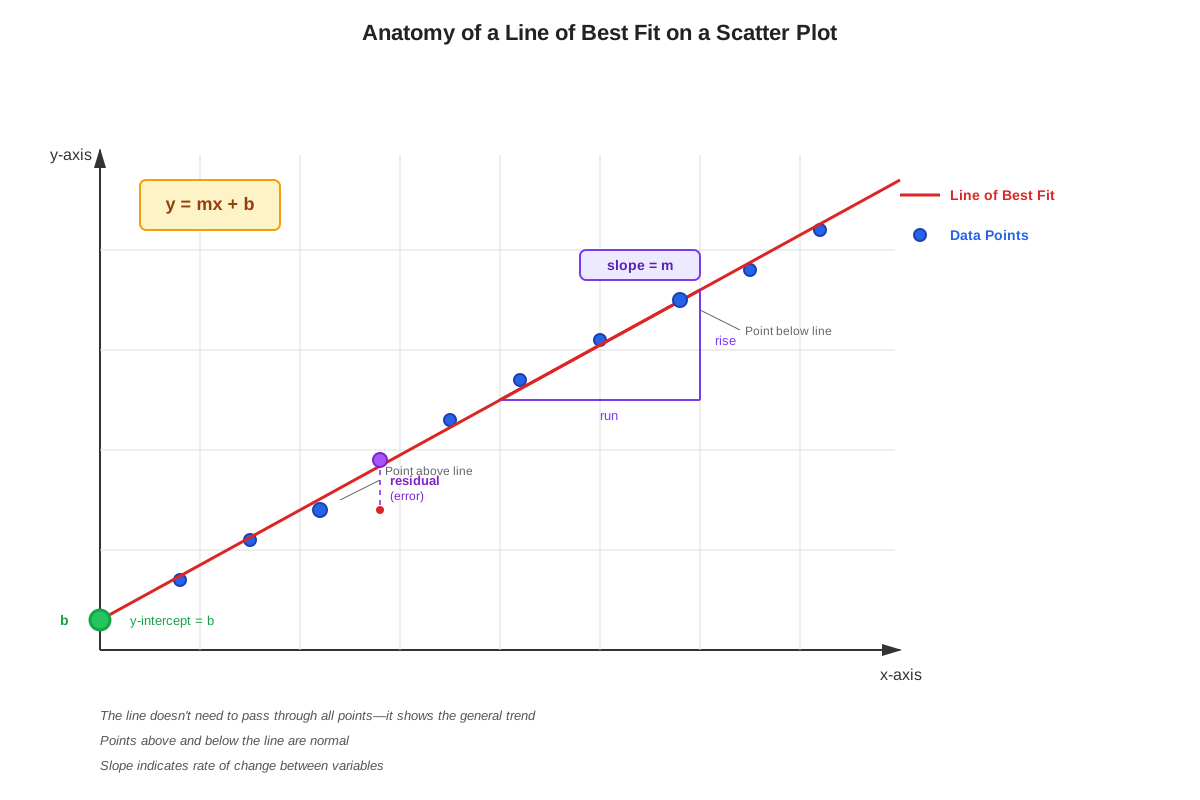
A line of best fit is a straight line drawn through a scatter plot of data points that best represents the overall trend or relationship between two variables. This line doesn't necessarily pass through any specific data points; instead, it minimizes the total distance between itself and all the points, with roughly equal numbers of points above and below the line. The mathematical method for finding this line is called linear regression, though the ACT doesn't require students to calculate it—the line or its equation is typically provided.
The line of best fit serves as a mathematical model that simplifies complex data into a single, interpretable relationship. When examining a scatter plot, the line helps answer questions like: "As one variable increases, what happens to the other?" and "What value would we expect for one variable given a specific value of the other?" This predictive power makes the line of best fit an essential tool in data analysis.
Components of the Line of Best Fit Equation
The ACT line of best fit is expressed using the slope-intercept form of a linear equation:
y = mx + bWhere:
- y represents the dependent variable (the outcome being predicted)
- x represents the independent variable (the input or predictor)
- m represents the slope (the rate of change)
- b represents the y-intercept (the value of y when x = 0)
Understanding each component is crucial for ACT success:
The Slope (m): This value indicates how much y changes for every one-unit increase in x. A positive slope means both variables increase together (positive correlation), while a negative slope means as one increases, the other decreases (negative correlation). The magnitude of the slope indicates the steepness of the relationship—larger absolute values mean steeper lines and stronger rates of change.
The Y-Intercept (b): This value represents the starting point or baseline value when the independent variable equals zero. In real-world contexts, the y-intercept often has meaningful interpretation, such as "the initial temperature before heating began" or "the base cost before any items are purchased."
Types of Correlation
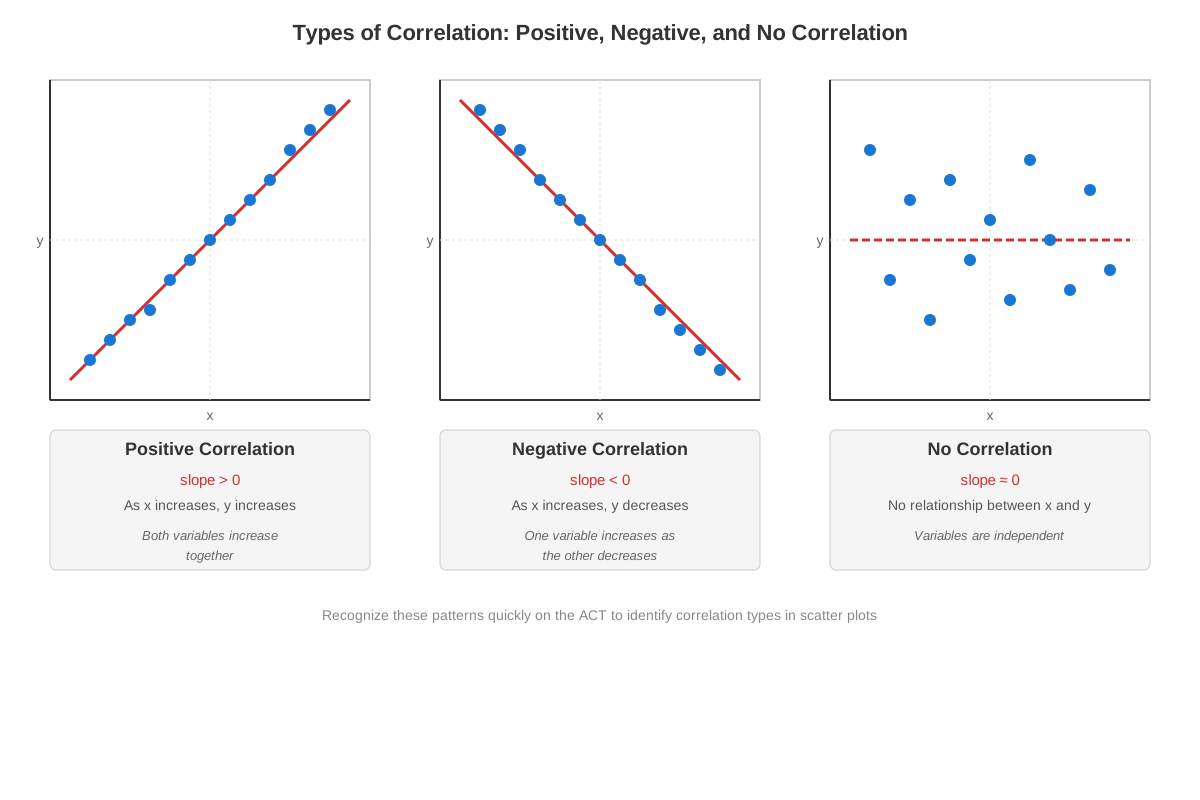
The line of best fit reveals the correlation between variables—the degree and direction of their relationship:
| Correlation Type | Slope Direction | Visual Pattern | Example |
|---|---|---|---|
| Positive | Positive (m > 0) | Points trend upward from left to right | Hours studied vs. test score |
| Negative | Negative (m < 0) | Points trend downward from left to right | Age of car vs. resale value |
| No correlation | Zero or near-zero (m ≈ 0) | Points scattered randomly with no clear pattern | Shoe size vs. test score |
The strength of correlation is indicated by how closely the data points cluster around the line. Points tightly grouped near the line indicate strong correlation, while widely scattered points suggest weak correlation. The ACT may ask students to identify correlation type or strength based on visual inspection of a scatter plot.
Making Predictions Using the Line of Best Fit
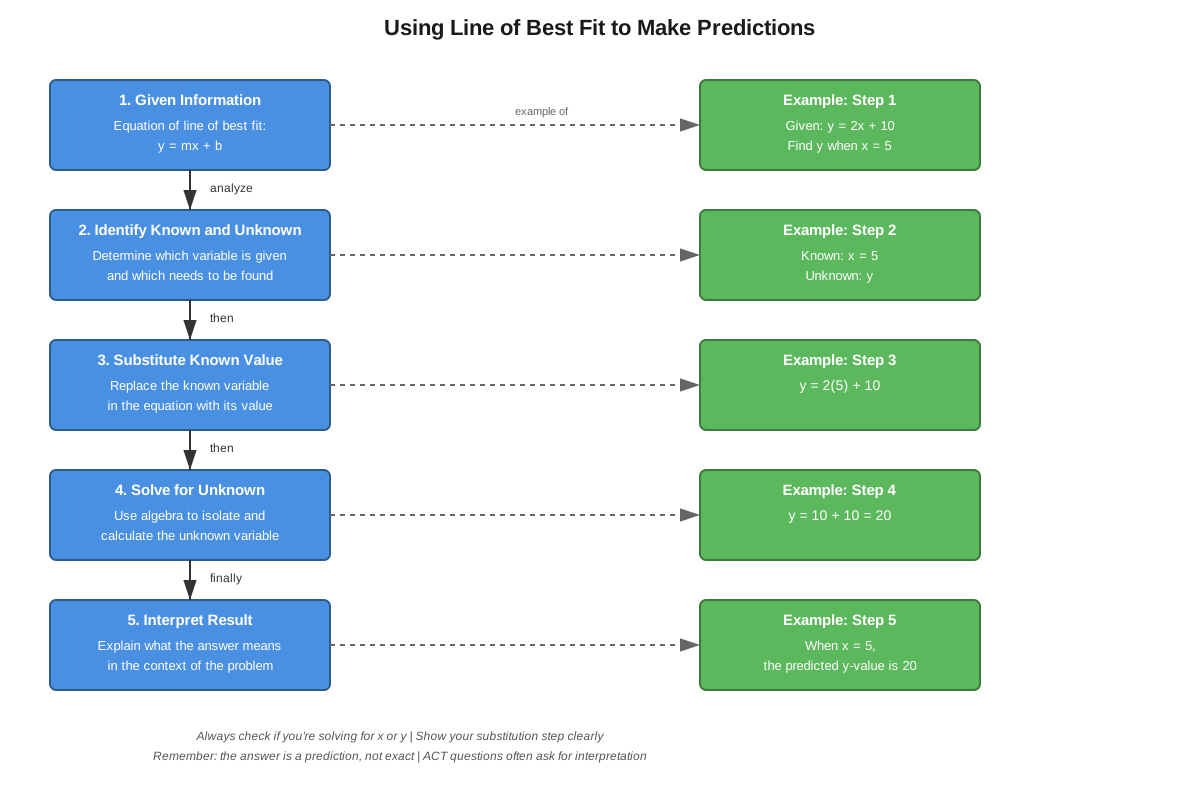
One of the most common ACT applications involves using the line equation to predict values. This process involves simple substitution:
To predict y given x: Substitute the x-value into the equation and solve for y.
To predict x given y: Substitute the y-value into the equation and solve for x.
Two types of predictions exist:
- Interpolation: Predicting within the range of existing data (generally more reliable)
- Extrapolation: Predicting beyond the range of existing data (less reliable, but still tested on the ACT)
Interpreting Slope and Y-Intercept in Context
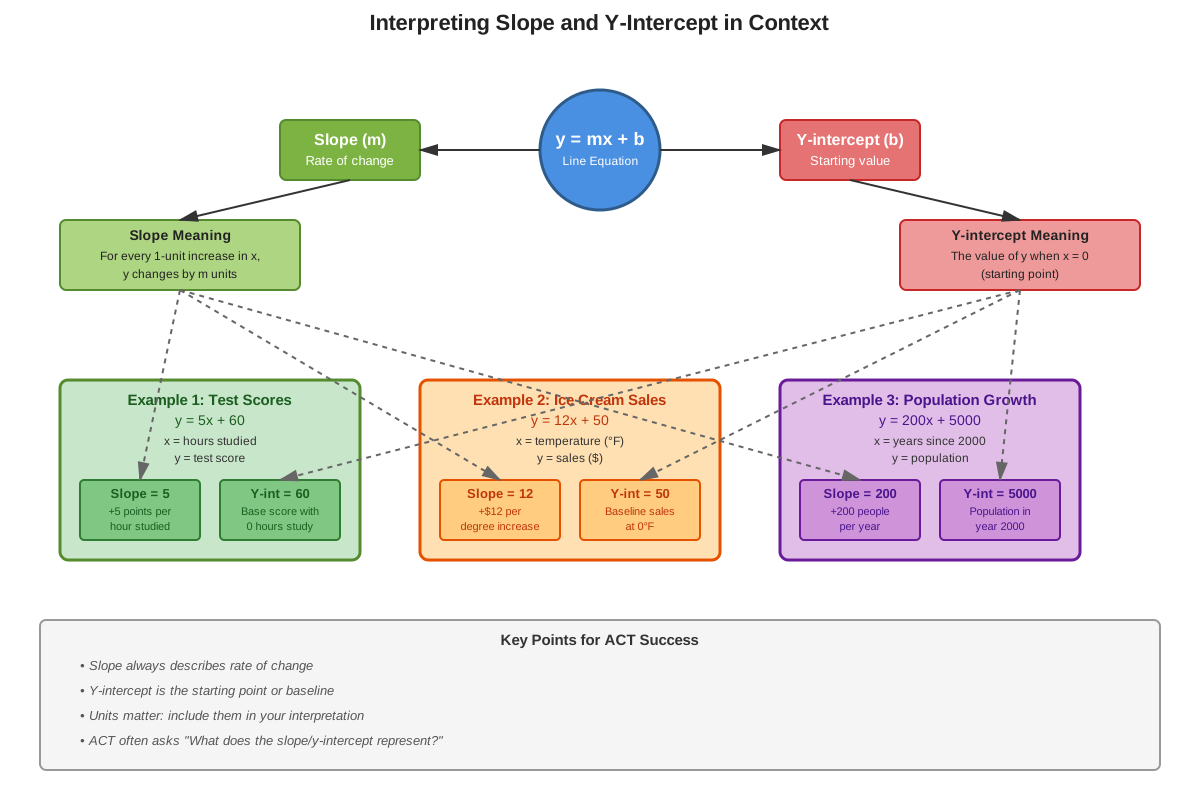
The ACT frequently tests whether students can translate mathematical components into real-world meaning. When given a context:
Slope interpretation: "For every [one unit increase in x], [y changes by m units]." Always include units and direction.
Example: If y = 15x + 200 represents cost (y) based on number of items (x), the slope 15 means "each additional item costs $15."
Y-intercept interpretation: "When [x = 0], [y = b]" or "The starting/initial value is b."
Example: In the same equation, the y-intercept 200 means "there is a $200 base fee before any items are purchased."
Identifying the Best Fit Line
When multiple lines are presented, the best fit line has these characteristics:
- Approximately equal numbers of points above and below the line
- Minimizes the total vertical distance from points to the line
- Follows the general direction of the data trend
- Passes through or near the center of the data cluster
The ACT may show four different lines on a scatter plot and ask which best represents the data. Students should look for the line that balances the points and matches the overall trend direction.
Concept Relationships
The line of best fit concept builds directly upon foundational algebra skills, particularly linear equations and slope-intercept form. Understanding y = mx + b is the gateway to working with trend lines, as every line of best fit is simply a linear equation applied to real data. The relationship flows: coordinate geometry → linear equations → slope and y-intercept → line of best fit → data prediction.
Within the topic itself, concepts are hierarchically connected. First, students must recognize correlation type (positive, negative, or none), which determines slope direction. Next, understanding the equation components (slope and y-intercept) enables making predictions through substitution. Finally, contextual interpretation requires synthesizing all previous concepts to translate mathematical results into meaningful real-world statements. The progression is: visual pattern recognition → equation identification → algebraic manipulation → contextual interpretation.
The line of best fit also connects forward to more advanced statistical concepts. While the ACT doesn't test correlation coefficients or residuals explicitly, understanding trend lines provides the foundation for these topics in higher-level statistics courses. Additionally, the concept reinforces function notation and the relationship between independent and dependent variables, which appear throughout the ACT Math section. The skill of making predictions using equations transfers directly to questions involving direct variation, linear modeling, and rate problems.
High-Yield Facts
⭐ The line of best fit is always a straight line, expressed in the form y = mx + b
⭐ Positive slope indicates positive correlation; negative slope indicates negative correlation
⭐ To predict y, substitute the given x-value into the equation; to predict x, substitute the given y-value
⭐ The slope represents the rate of change: how much y changes per one-unit increase in x
⭐ The y-intercept represents the value of y when x equals zero
- The line of best fit doesn't need to pass through any actual data points
- A good line of best fit has roughly equal numbers of points above and below it
- Interpolation (predicting within the data range) is more reliable than extrapolation (predicting outside the range)
- The steeper the line, the larger the absolute value of the slope
- A horizontal line (slope = 0) indicates no relationship between the variables
- The ACT provides the equation or line; students never need to calculate it from scratch
- Context matters: always include units when interpreting slope or y-intercept
- Correlation does not imply causation, though the ACT rarely tests this distinction directly
Quick check — test yourself on Line of best fit so far.
Try Flashcards →Common Misconceptions
Misconception: The line of best fit must pass through specific data points on the scatter plot.
Correction: The line of best fit represents the overall trend and typically doesn't pass through most (or any) individual points. It minimizes total distance to all points collectively, not to specific ones.
Misconception: A steeper line always indicates a stronger correlation.
Correction: Steepness (slope magnitude) indicates the rate of change, not correlation strength. Correlation strength is shown by how tightly points cluster around the line, regardless of its steepness.
Misconception: The y-intercept is always meaningful in real-world contexts.
Correction: Sometimes the y-intercept represents an impossible or meaningless scenario (like "height when age is zero years" for adult data). Always consider whether x = 0 makes sense in context before interpreting the y-intercept.
Misconception: If the line of best fit has a positive slope, all data points must show increases.
Correction: Individual points may vary; some might show decreases. The line represents the overall trend, and positive slope means the general tendency is for both variables to increase together.
Misconception: The equation y = mx + b means m is always the first number in the equation.
Correction: The coefficient of x is the slope, regardless of how the equation is written. In y = 3 + 2x, the slope is 2 (the coefficient of x), not 3.
Misconception: Extrapolation is just as reliable as interpolation.
Correction: Predictions made outside the data range (extrapolation) are less reliable because the relationship might change beyond the observed values. The ACT may still ask for extrapolated predictions, but they're inherently less certain.
Misconception: A line of best fit with many points far from it is wrong.
Correction: Real data often has significant scatter. A line can still be the "best fit" even if points are widely dispersed, as long as it minimizes total distance and follows the general trend.
Worked Examples
Example 1: Making Predictions and Interpreting Components
Problem: A researcher studying plant growth creates a scatter plot showing the relationship between days of growth (x) and plant height in centimeters (y). The line of best fit for the data is given by the equation y = 2.5x + 8.
(a) What is the predicted height of the plant after 12 days?
(b) What does the slope represent in this context?
(c) What does the y-intercept represent in this context?
Solution:
(a) To find the predicted height after 12 days, substitute x = 12 into the equation:
y = 2.5x + 8
y = 2.5(12) + 8
y = 30 + 8
y = 38
The predicted height after 12 days is 38 centimeters.
(b) The slope is 2.5. In context, this means: "For every additional day of growth, the plant height increases by 2.5 centimeters." The slope represents the rate of growth per day.
(c) The y-intercept is 8. In context, this means: "When the number of days is zero (at the start of the study), the plant height is 8 centimeters." This represents the initial height of the plant before the growth period began.
Connection to Learning Objectives: This example demonstrates applying the line of best fit to make predictions (objective 3) and interpreting slope and y-intercept in real-world context (objective 6).
Example 2: Identifying Correlation and Selecting the Best Line
Problem: A scatter plot shows the relationship between the number of hours students spent watching television per week (x-axis) and their grade point average (y-axis). Four lines are drawn on the plot:
- Line A: passes through points (0, 4.0) and (20, 2.0)
- Line B: passes through points (0, 2.0) and (20, 4.0)
- Line C: horizontal line at y = 3.0
- Line D: passes through points (0, 3.5) and (20, 2.5)
The data points show a general downward trend from left to right, with most points clustered between 5-15 hours of TV and GPAs between 2.5-3.5.
(a) What type of correlation does this data show?
(b) Which line best represents the line of best fit?
(c) What is the slope of the best fit line?
Solution:
(a) The data shows a negative correlation because as TV watching hours increase, GPA tends to decrease (downward trend from left to right).
(b) Line D best represents the line of best fit. Here's why:
- Line A has too steep a negative slope (drops from 4.0 to 2.0), which is more extreme than the data suggests
- Line B has a positive slope, which contradicts the downward trend
- Line C is horizontal (no correlation), which doesn't match the clear downward pattern
- Line D has a moderate negative slope that matches the general downward trend and passes through the middle of the data cluster
(c) For Line D, calculate the slope using points (0, 3.5) and (20, 2.5):
m = (y₂ - y₁)/(x₂ - x₁)
m = (2.5 - 3.5)/(20 - 0)
m = -1.0/20
m = -0.05
The slope is -0.05, meaning for each additional hour of TV per week, GPA decreases by 0.05 points.
Connection to Learning Objectives: This example demonstrates identifying correlation type (objective 4), selecting the best fit line from multiple options (objective 7), and explaining the strategy behind line of best fit selection (objective 2).
Exam Strategy
When approaching ACT line of best fit questions, follow this systematic process:
Step 1: Identify the question type. Determine whether you need to: (a) find a predicted value, (b) interpret slope or y-intercept, (c) identify correlation type, or (d) select the best line from options. This determines your approach.
Step 2: Extract the equation. If given a scatter plot with a line, look for the equation in the question or answer choices. If multiple equations are provided, eliminate those with incorrect slope direction first (positive vs. negative).
Step 3: For prediction questions, use direct substitution. Write out the equation, substitute the given value, and solve carefully. Double-check which variable you're solving for—the ACT often includes answer choices that result from solving for the wrong variable.
Step 4: For interpretation questions, translate mathematical components into complete sentences with units. The ACT rewards precise language: "increases by 5 units per hour" is better than just "5."
Trigger words and phrases to watch for:
- "Best represents" or "best modeled by" → selecting the correct equation or line
- "Predict" or "estimate" → use substitution to find a value
- "What does the slope represent" → interpret rate of change in context
- "Initial value" or "starting amount" → refers to y-intercept
- "For every increase of" → describes slope
- "Positive/negative relationship" → identifies correlation type
Process of elimination tips:
- Eliminate equations with wrong slope sign immediately (if trend is clearly positive or negative)
- Eliminate lines that don't pass through the center of the data cluster
- Eliminate y-intercepts that don't make sense in context (negative heights, impossible starting values)
- For prediction questions, eliminate unreasonable answers (negative values when only positive makes sense)
Time allocation: Line of best fit questions typically require 45-75 seconds. Spend 10-15 seconds understanding the context and identifying the question type, 20-30 seconds on calculations or analysis, and 10-15 seconds checking your answer against the context. Don't spend excessive time trying to perfectly visualize the line—trust the given equation and focus on accurate calculation.
Exam Tip: If a scatter plot question seems to require complex calculations to find the line equation, you're overthinking it. The ACT always provides the equation or enough information to identify it from answer choices. Focus on using the equation, not deriving it.
Memory Techniques
Mnemonic for equation components - "My Brother":
- My = M (slope comes first, represents "my" rate)
- Brother = B (y-intercept comes second, represents "brother's" starting point)
- In y = mx + b, think "My rate times x, plus Brother's start"
Slope direction memory - "Positive = Pals go up together":
- Positive slope: both variables increase together (like pals climbing a hill together)
- Negative slope: one goes up while the other goes down (like a seesaw)
Visualization for y-intercept: Picture the y-axis as a "starting line" in a race. The y-intercept is where you begin before any x-movement happens—your starting position at x = 0.
Acronym for interpretation - SURE:
- Slope = Speed of change
- Units = Use them always
- Rate = Rate per one unit
- Explain = Explain in complete context
Memory phrase for best fit line: "Equal above, equal below, follows the flow" (equal points above and below the line, following the data's directional flow)
Summary
The line of best fit is a fundamental statistical tool that models the relationship between two variables using a linear equation in the form y = mx + b. On the ACT, students must be able to identify when this concept is being tested, typically through scatter plots with trend lines or real-world scenarios requiring predictions. The core strategy involves understanding that the slope (m) represents the rate of change between variables, while the y-intercept (b) represents the starting value when x equals zero. Positive slopes indicate positive correlation (both variables increase together), negative slopes indicate negative correlation (one increases as the other decreases), and slopes near zero indicate no correlation. To apply this concept accurately, students must make predictions by substituting values into the equation, interpret slope and y-intercept in context with appropriate units, and identify which line best fits a data set by ensuring it follows the general trend with balanced points above and below. Mastery requires connecting visual pattern recognition in scatter plots with algebraic manipulation of linear equations and translating mathematical results into meaningful real-world interpretations.
Key Takeaways
- The line of best fit equation y = mx + b contains all information needed for predictions and interpretations on the ACT
- Slope direction (positive or negative) immediately reveals correlation type, which can eliminate wrong answer choices
- Making predictions requires simple substitution—identify which variable is given and which you're solving for
- Always interpret slope and y-intercept with complete context and units: "per day," "dollars per item," etc.
- The best fit line balances points above and below while following the general data trend—it doesn't need to pass through specific points
- The ACT never requires calculating the line equation from scratch; focus on using provided equations effectively
- Context matters: evaluate whether y-intercept interpretations make real-world sense before selecting them as answers
Related Topics
Scatter Plots and Data Representation: Understanding how to read and interpret scatter plots is foundational to working with lines of best fit. Mastering trend lines naturally leads to deeper analysis of data visualization techniques.
Systems of Linear Equations: The skills used to work with line of best fit equations transfer directly to solving systems, where multiple linear relationships interact.
Functions and Function Notation: Lines of best fit are functions that map input values to predicted outputs, reinforcing the broader concept of functional relationships tested throughout the ACT.
Rate of Change and Slope: The slope concept in lines of best fit connects to rate problems, distance-rate-time questions, and other proportional relationships on the ACT.
Statistical Measures: After mastering trend lines, students can progress to understanding measures of central tendency, variability, and more advanced statistical analysis that occasionally appears on the ACT.
Practice CTA
Now that you've mastered the core concepts of line of best fit, it's time to cement your understanding through practice! Work through the practice questions to apply these strategies to ACT-style problems, and use the flashcards to reinforce key definitions and formulas. Remember, the line of best fit appears on nearly every ACT Math test—your investment in mastering this topic will pay dividends on test day. Approach each practice problem systematically, check your work against the context, and build confidence in your ability to tackle any trend line question the ACT throws at you. You've got this!
Sign up free to keep reading
Create a free AnvayaPrep account to finish this ACT guide on Line of best fit — plus flashcards and practice questions.