Overview
Scatterplots are graphical representations that display the relationship between two quantitative variables by plotting individual data points on a coordinate plane. Each point represents a single observation, with one variable determining the horizontal position (x-axis) and the other determining the vertical position (y-axis). On the ACT Math test, scatterplot questions assess a student's ability to interpret visual data, identify patterns and trends, understand correlation versus causation, and make predictions based on graphical information.
Understanding ACT scatterplots is essential because these questions appear consistently on every administration of the exam, typically comprising 2-4 questions in the Statistics and Probability content area. These questions test multiple skills simultaneously: reading graphs accurately, understanding statistical relationships, interpreting slopes and intercepts in context, and distinguishing between different types of correlations. Mastery of scatterplots directly impacts performance on approximately 3-7% of the entire Math section.
Scatterplots connect to broader mathematical concepts including linear equations, functions, coordinate geometry, and data analysis. The skills developed through studying scatterplots—pattern recognition, trend analysis, and data interpretation—transfer directly to questions involving line of best fit, residuals, correlation coefficients, and predictive modeling. Additionally, scatterplot interpretation requires integrating knowledge of the coordinate plane, slope concepts, and basic statistical reasoning, making it a high-yield topic that reinforces multiple mathematical domains simultaneously.
Learning Objectives
- [ ] Identify when Scatterplots is being tested
- [ ] Explain the core rule or strategy behind Scatterplots
- [ ] Apply Scatterplots to ACT-style questions accurately
- [ ] Distinguish between positive, negative, and no correlation from visual inspection
- [ ] Interpret the meaning of outliers and clusters within scatterplot contexts
- [ ] Predict values using trend lines and understand limitations of extrapolation
- [ ] Evaluate the strength of relationships between variables based on point distribution
Prerequisites
- Coordinate plane fundamentals: Understanding x and y axes, ordered pairs, and plotting points is essential for reading any scatterplot accurately
- Basic slope concepts: Recognizing whether lines rise or fall helps identify positive versus negative correlations quickly
- Reading graphs and charts: General graph literacy enables efficient extraction of information from visual data representations
- Understanding variables: Distinguishing between independent and dependent variables clarifies which axis represents which quantity
Why This Topic Matters
Scatterplots appear in real-world contexts across numerous fields including economics (price versus demand), medicine (dosage versus response), education (study time versus test scores), and environmental science (temperature versus ice melt). The ability to interpret scatterplots enables informed decision-making based on data patterns, making this skill valuable far beyond standardized testing.
On the ACT Math test, scatterplot questions appear with high frequency—typically 2-4 questions per exam administration. These questions account for approximately 3-7% of the total Math score and often appear in the medium-to-difficult range (questions 30-50 out of 60). The ACT tests scatterplots through multiple question formats: identifying correlation type, selecting appropriate trend lines, making predictions from existing data, identifying outliers, and interpreting real-world contexts represented graphically.
Common ACT question types include: determining which scatterplot matches a described relationship, selecting the line of best fit from multiple options, predicting y-values for given x-values using trend analysis, identifying which data point represents a specific scenario, and explaining what correlation patterns suggest about variable relationships. Questions frequently embed scatterplots within real-world scenarios involving sports statistics, business data, scientific measurements, or social science research, requiring students to translate between mathematical representations and contextual meanings.
Core Concepts
Understanding Scatterplot Structure
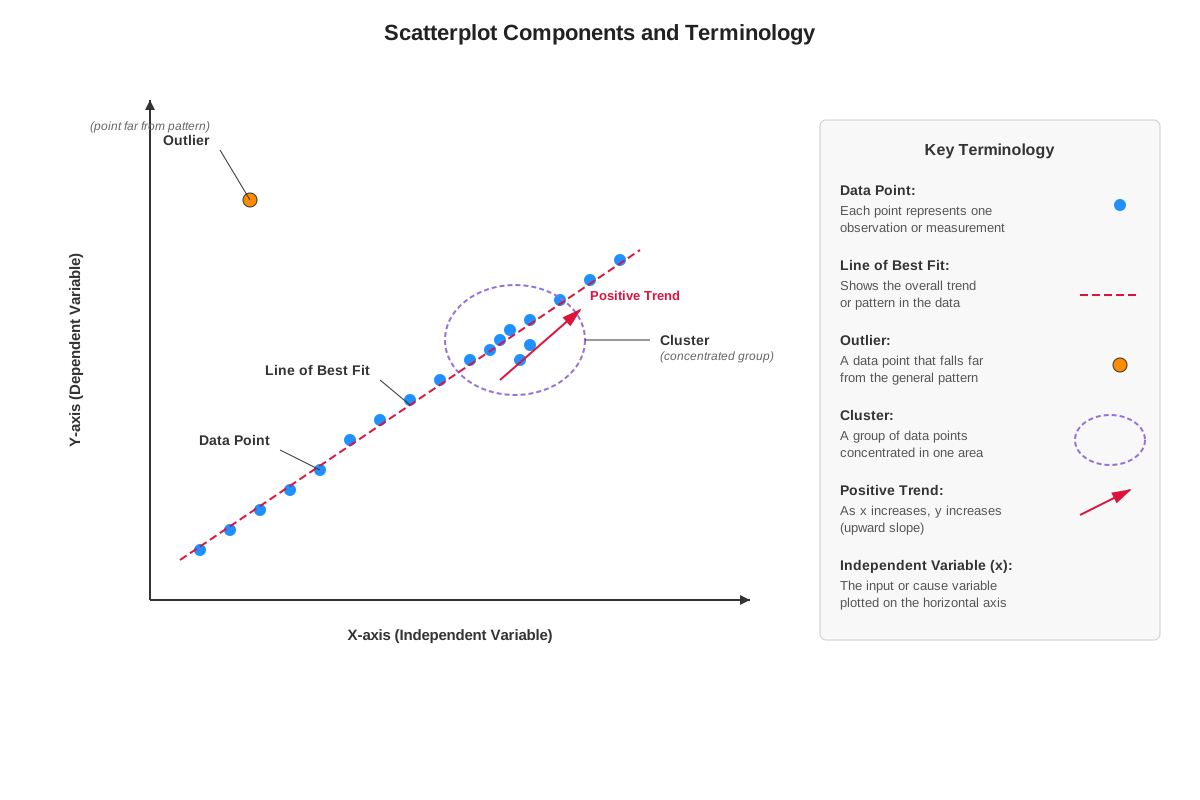
A scatterplot displays bivariate data—information involving two variables—on a Cartesian coordinate system. The horizontal axis (x-axis) typically represents the independent variable (the variable that is controlled or comes first chronologically), while the vertical axis (y-axis) represents the dependent variable (the variable that responds or is measured as an outcome). Each plotted point corresponds to one observation or data pair, with coordinates (x, y) representing the values of both variables for that specific case.
The fundamental purpose of creating a scatterplot is to visualize whether a relationship exists between two variables and, if so, to characterize that relationship's direction, form, and strength. Unlike bar graphs or histograms that display single-variable distributions, scatterplots reveal how two variables change together, making patterns of association visible at a glance.
Types of Correlation
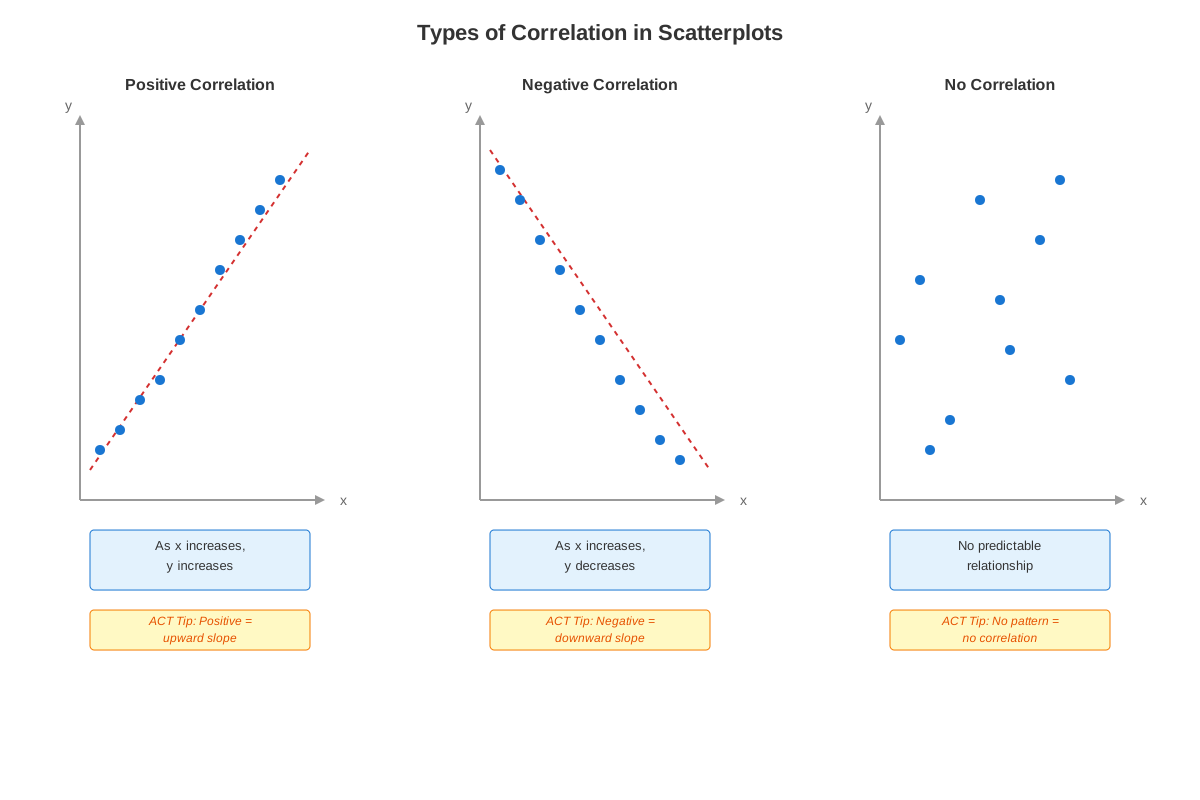
Correlation describes the relationship between two variables as displayed in a scatterplot. The ACT tests three primary correlation types:
Positive correlation occurs when both variables increase together—as x-values increase, y-values also tend to increase. Visually, points cluster around an imaginary line that slopes upward from left to right. Examples include the relationship between study hours and test scores, or between height and weight in adolescents. The stronger the positive correlation, the more tightly points cluster around an upward-sloping line.
Negative correlation (also called inverse correlation) occurs when one variable increases while the other decreases—as x-values increase, y-values tend to decrease. Points cluster around an imaginary line that slopes downward from left to right. Examples include the relationship between vehicle age and resale value, or between altitude and temperature. Strong negative correlations show tight clustering around a downward-sloping line.
No correlation (zero correlation) occurs when no consistent pattern exists between the variables—knowing one variable's value provides no information about the other. Points appear randomly scattered across the graph with no discernible upward or downward trend. Examples might include shoe size and test scores, or birth month and height.
| Correlation Type | Visual Pattern | Slope Direction | Example |
|---|---|---|---|
| Positive | Points rise from left to right | Upward | Hours studied vs. test score |
| Negative | Points fall from left to right | Downward | Car age vs. value |
| None | Random scatter | No clear direction | Shoe size vs. GPA |
Strength of Correlation
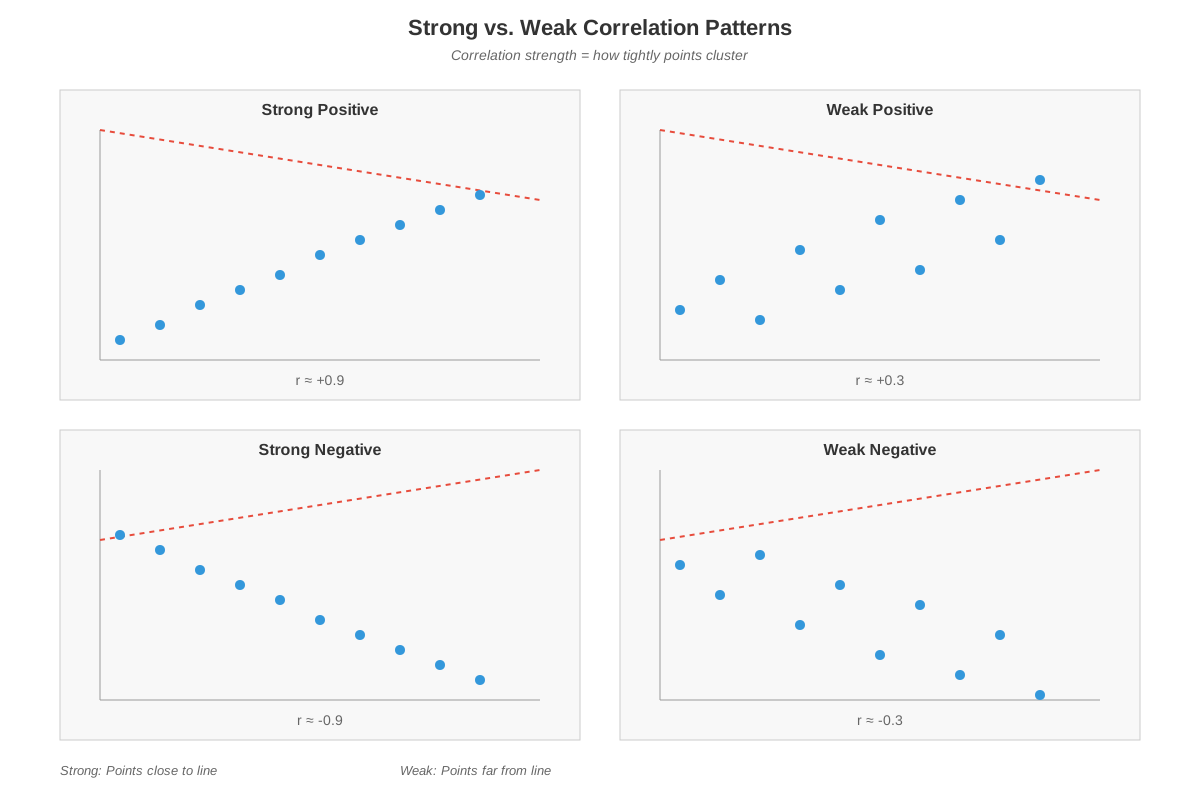
Beyond direction, correlations vary in strength—how closely points cluster around a trend line. Strong correlations show points tightly clustered along a clear linear path, indicating that one variable reliably predicts the other. Weak correlations show points loosely scattered with only a general trend visible, indicating that while a relationship exists, predictions are less reliable. Moderate correlations fall between these extremes.
On the ACT, students must visually assess correlation strength by examining point dispersion. Tighter clustering indicates stronger correlation; wider scatter indicates weaker correlation. This assessment doesn't require calculating correlation coefficients—visual inspection suffices for ACT questions.
Line of Best Fit
The line of best fit (also called a trend line or regression line) is a straight line drawn through a scatterplot that best represents the overall pattern of the data. This line minimizes the total distance between itself and all data points, providing a mathematical model of the relationship. On the ACT, students must identify which line best fits a given scatterplot or use a provided line to make predictions.
Key characteristics of appropriate lines of best fit:
- The line follows the general direction of the data (upward for positive correlation, downward for negative)
- Roughly equal numbers of points fall above and below the line
- The line passes through or near the center of the data cluster
- Extreme outliers don't disproportionately influence the line's position
Making Predictions
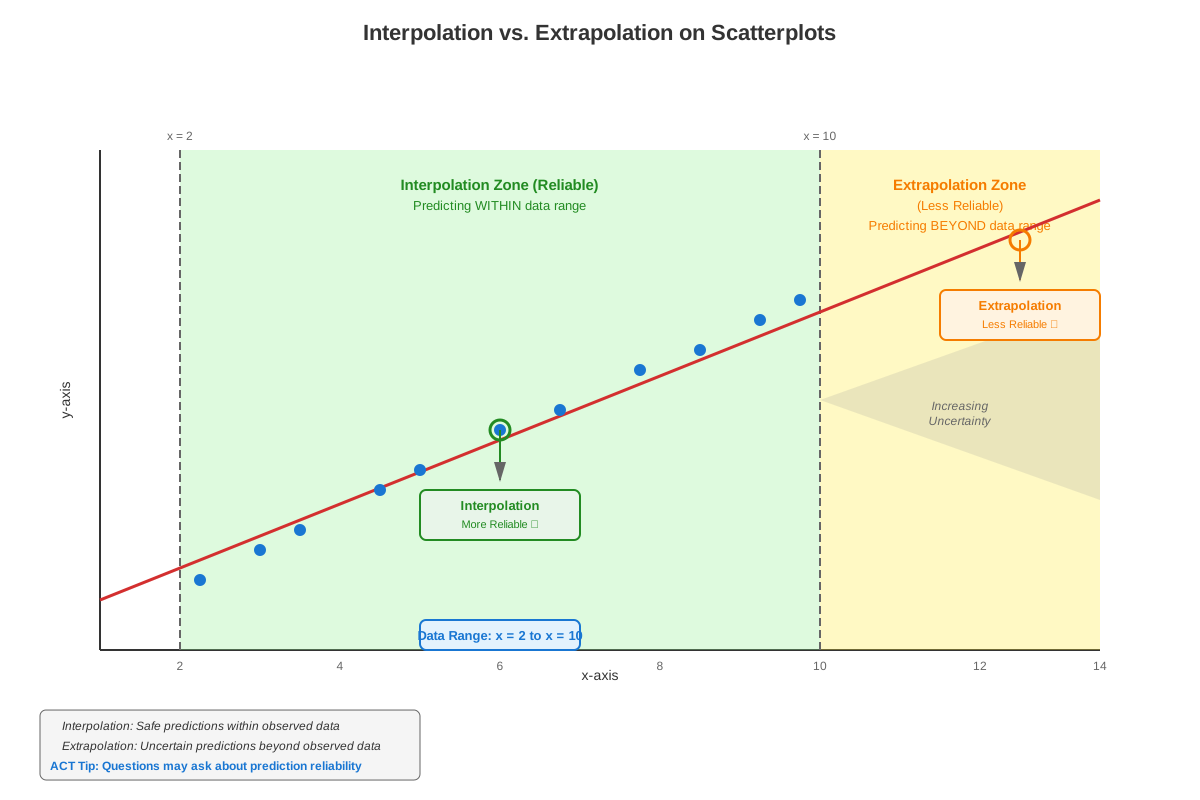
Once a line of best fit is established, it can be used for interpolation (predicting values within the range of existing data) or extrapolation (predicting values outside the existing data range). Interpolation is generally more reliable because it stays within observed patterns. Extrapolation carries greater uncertainty because it assumes the relationship continues unchanged beyond observed data—an assumption that may not hold.
ACT questions frequently ask students to use a trend line to predict a y-value for a given x-value, or vice versa. This requires reading the graph carefully, locating the appropriate position on one axis, tracing to the trend line, and reading the corresponding value on the other axis.
Outliers and Clusters
Outliers are data points that fall far from the general pattern established by other points. They may represent measurement errors, unusual circumstances, or genuinely exceptional cases. On the ACT, students must identify outliers visually and sometimes explain what they might represent in context.
Clusters are groups of points that appear close together, separated from other groups. Clusters might indicate subgroups within the data or different conditions affecting the relationship. Recognizing clusters helps students understand that not all scatterplots show simple linear patterns—some reveal more complex relationships.
Correlation vs. Causation
A critical concept tested on the ACT is understanding that correlation does not imply causation. Just because two variables show a relationship in a scatterplot doesn't mean one causes the other. Both might be influenced by a third variable (confounding variable), the relationship might be coincidental, or causation might run in the opposite direction from what's assumed.
For example, ice cream sales and drowning deaths show positive correlation, but ice cream doesn't cause drowning. Instead, both increase during summer months (the confounding variable is warm weather). ACT questions may ask students to identify which statements about causation are justified based on scatterplot data—typically, only correlation can be concluded, not causation.
Concept Relationships
The concepts within scatterplots build hierarchically: understanding scatterplot structure → identifying correlation type → assessing correlation strength → interpreting lines of best fit → making predictions → recognizing outliers and limitations. Each concept depends on those before it.
Scatterplots connect to prerequisite knowledge of coordinate planes (providing the framework for plotting points) and slope concepts (determining correlation direction). They extend to more advanced topics including linear regression equations, correlation coefficients (r-values), residual analysis, and statistical modeling.
The relationship map flows as follows:
Coordinate plane knowledge → enables → Plotting individual data points → reveals → Correlation patterns → characterized by → Direction (positive/negative/none) and Strength (strong/weak) → modeled by → Line of best fit → used for → Predictions (interpolation/extrapolation) → complicated by → Outliers and clusters → requiring → Careful interpretation distinguishing correlation from causation
Understanding scatterplots also connects to function concepts (each x-value can correspond to multiple y-values, so scatterplots don't always represent functions) and to data analysis more broadly (scatterplots are one tool among many for exploring relationships in data).
High-Yield Facts
⭐ Positive correlation: both variables increase together; points slope upward from left to right
⭐ Negative correlation: as one variable increases, the other decreases; points slope downward from left to right
⭐ No correlation: no consistent pattern exists; points appear randomly scattered
⭐ Line of best fit: should have roughly equal numbers of points above and below it
⭐ Correlation does not prove causation: a relationship between variables doesn't mean one causes the other
- Strong correlations show tight clustering around a trend line; weak correlations show loose scatter
- Outliers are points that fall far from the general pattern of other data points
- Interpolation (predicting within the data range) is more reliable than extrapolation (predicting beyond it)
- The independent variable typically appears on the x-axis; the dependent variable on the y-axis
- Clusters indicate subgroups or different conditions within the data
- A horizontal trend line (slope = 0) indicates no relationship between variables
- The steeper the trend line, the stronger the rate of change between variables
- Multiple scatterplots can be compared to determine which shows the strongest correlation
- Context matters: always interpret scatterplot patterns in terms of what the variables represent
- Removing an outlier can significantly change the line of best fit, especially with small datasets
Quick check — test yourself on Scatterplots so far.
Try Flashcards →Common Misconceptions
Misconception: All scatterplots show linear relationships → Correction: While ACT questions typically focus on linear patterns, scatterplots can display non-linear relationships (curved patterns). The absence of a linear pattern doesn't mean no relationship exists—it might be exponential, quadratic, or another form.
Misconception: A line of best fit must pass through specific data points → Correction: The line of best fit represents the overall trend and may not pass through any actual data points. It minimizes total distance to all points collectively, not distance to individual points.
Misconception: Correlation strength is determined solely by slope steepness → Correction: Correlation strength depends on how tightly points cluster around the trend line, not how steep the line is. A steep line with widely scattered points shows weak correlation; a gentle slope with tightly clustered points shows strong correlation.
Misconception: If a scatterplot shows correlation, one variable causes the other → Correction: Correlation only indicates that variables change together in a pattern. Causation requires additional evidence beyond the scatterplot itself, such as controlled experiments or theoretical mechanisms.
Misconception: Extrapolation is as reliable as interpolation → Correction: Extrapolation assumes the observed relationship continues unchanged beyond the data range, which may not be true. Predictions become less reliable the further they extend beyond observed data.
Misconception: Every scatterplot needs a line of best fit → Correction: Lines of best fit are only meaningful when a linear relationship exists. For scatterplots showing no correlation or non-linear patterns, a straight line doesn't appropriately model the data.
Misconception: The variable on the x-axis always causes changes in the y-axis variable → Correction: While the x-axis typically represents the independent variable, this is convention, not proof of causation. The axes could be reversed without changing the correlation pattern.
Worked Examples
Example 1: Identifying Correlation and Making Predictions
Question: A scatterplot shows the relationship between hours spent practicing piano (x-axis, ranging from 0 to 10 hours) and performance scores (y-axis, ranging from 0 to 100 points). The points generally rise from lower left to upper right, with most points clustered near a line that passes through approximately (2, 40) and (8, 80). One point at (3, 95) appears far above the others.
(a) What type of correlation does this scatterplot show?
(b) Estimate the performance score for a student who practices 5 hours.
(c) What might the outlier at (3, 95) represent?
Solution:
(a) The scatterplot shows positive correlation because as practice hours increase (moving right on the x-axis), performance scores also increase (moving up on the y-axis). The points rising from lower left to upper right is the defining visual characteristic of positive correlation.
(b) To predict the score for 5 hours of practice, we use the line of best fit. First, find the slope:
- The line passes through (2, 40) and (8, 80)
- Slope = (80 - 40)/(8 - 2) = 40/6 ≈ 6.67 points per hour
Using point-slope form with point (2, 40):
- y - 40 = 6.67(x - 2)
- For x = 5: y - 40 = 6.67(3) = 20
- y = 60 points
Alternatively, visual inspection: 5 hours is halfway between 2 and 8 hours, so the predicted score should be halfway between 40 and 80, which is 60 points.
(c) The outlier at (3, 95) represents a student who practiced only 3 hours but achieved a score of 95—far higher than the trend predicts. This might represent a student with exceptional natural talent, prior musical training, or perhaps measurement error in recording practice hours. Outliers often indicate special circumstances that don't follow the general pattern.
Connection to Learning Objectives: This example demonstrates identifying correlation type (positive), applying scatterplot concepts to make predictions using the line of best fit, and interpreting outliers in context.
Example 2: Comparing Scatterplots and Selecting Best Fit Lines
Question: Four scatterplots (A, B, C, D) each show 20 data points with different patterns:
- Plot A: Points tightly clustered along a line rising from (0, 10) to (10, 60)
- Plot B: Points loosely scattered with a general downward trend from (0, 50) to (10, 20)
- Plot C: Points randomly distributed across the graph with no clear pattern
- Plot D: Points moderately clustered along a line falling from (0, 80) to (10, 20)
Three trend lines are proposed for Plot D:
- Line 1: Passes through (0, 85) and (10, 15)
- Line 2: Passes through (0, 80) and (10, 20)
- Line 3: Passes through (0, 75) and (10, 25)
(a) Which plot shows the strongest correlation?
(b) Which plot shows no correlation?
(c) Which line best fits Plot D?
Solution:
(a) Plot A shows the strongest correlation because points are "tightly clustered" along the trend line. Strength of correlation is determined by how closely points follow the trend, not by the slope's steepness. Even though Plot D has a steeper decline, Plot A's tighter clustering indicates stronger correlation.
(b) Plot C shows no correlation because points are "randomly distributed with no clear pattern." The absence of any upward or downward trend indicates the variables are unrelated.
(c) Line 2 best fits Plot D because it passes through (0, 80) and (10, 20), which matches the description that points fall "from (0, 80) to (10, 20)." A good line of best fit should pass through or near the center of the data cluster at both ends. Line 1 is too high at the start and too low at the end; Line 3 is too low at the start and too high at the end. Line 2 follows the actual data pattern most closely.
Connection to Learning Objectives: This example requires distinguishing between correlation types and strengths, evaluating multiple trend lines to select the most appropriate fit, and applying visual analysis skills essential for ACT scatterplot questions.
Exam Strategy
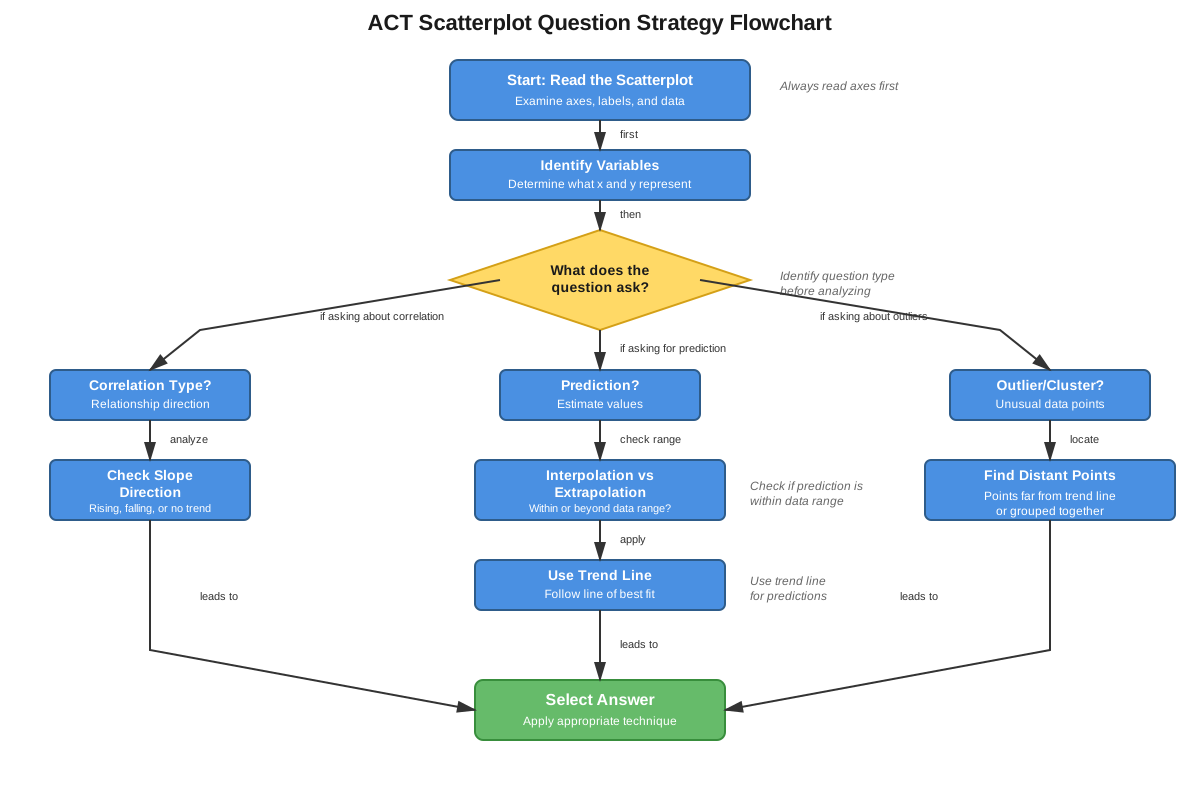
When approaching ACT scatterplot questions, follow this systematic process:
Step 1: Identify what the axes represent. Read axis labels carefully and note units. Understanding what each variable means contextually helps interpret patterns correctly and avoid careless errors.
Step 2: Determine correlation type quickly. Scan the overall pattern: upward slope = positive, downward slope = negative, no pattern = no correlation. This takes 2-3 seconds and eliminates wrong answers immediately.
Step 3: Assess correlation strength if asked. Look at clustering tightness, not slope steepness. Tight cluster = strong; loose scatter = weak.
Step 4: Locate and evaluate the line of best fit. Check that roughly equal points fall above and below, and that it follows the data's general direction. If multiple lines are shown, eliminate those that clearly miss the data center.
Step 5: For prediction questions, trace carefully. Find the given value on the appropriate axis, move to the trend line, then read the corresponding value on the other axis. Use a finger or pencil edge to trace if needed.
Exam Tip: Watch for trigger phrases like "based on the scatterplot," "according to the trend line," "which point represents," and "best modeled by." These signal that you need to extract information directly from the graph rather than calculate.
Time allocation: Spend 30-45 seconds on straightforward correlation identification questions, 60-90 seconds on prediction or line-fitting questions. If a question requires extensive calculation, mark it and return if time permits—many scatterplot questions reward visual analysis over computation.
Process of elimination strategies:
- Eliminate correlation types that clearly don't match the visual pattern (if points rise, eliminate "negative correlation")
- Eliminate trend lines that pass far from the data center or have the wrong slope direction
- Eliminate predictions that fall far outside the reasonable range suggested by the data
- For causation questions, eliminate any answer claiming one variable causes the other unless additional evidence is provided
Common trigger words:
- "Positive/negative/no correlation" → identify pattern direction
- "Strong/weak relationship" → assess clustering tightness
- "Line of best fit" → evaluate trend line appropriateness
- "Predict" or "estimate" → use trend line for interpolation/extrapolation
- "Outlier" → find points far from the pattern
- "Suggests" or "indicates" → correlation is justified; "proves" or "causes" → typically incorrect
Memory Techniques
PUNS for Correlation Types:
- Positive = Points go Up
- Negative = Nose-dives down
- Scattered = Shows nothing
"TIDE" for Line of Best Fit Evaluation:
- Trend direction matches data (up/down)
- In the middle (equal points above/below)
- Doesn't chase outliers
- Ends near data center
Visualization Strategy: Picture correlation types as ski slopes:
- Positive correlation = uphill climb (both you and elevation increase)
- Negative correlation = downhill run (you advance but elevation decreases)
- No correlation = flat terrain (moving forward doesn't change elevation)
"ICE" for Prediction Reliability:
- Interpolation = Inside the data = more reliable
- Extrapolation = Extending beyond = less reliable
- Caution increases with distance from observed data
Acronym for Outlier Analysis - "FAME":
- Far from the pattern
- Atypical case
- Might be measurement error
- Exceptional circumstances
Summary
Scatterplots are graphical representations displaying relationships between two quantitative variables through plotted points on a coordinate plane. Mastery requires identifying correlation types (positive, negative, or none) by observing whether points trend upward, downward, or show no pattern. Correlation strength is assessed by how tightly points cluster around a trend line—tighter clustering indicates stronger relationships. The line of best fit models the overall pattern and enables predictions through interpolation (within data range) or extrapolation (beyond data range), with interpolation being more reliable. Students must recognize outliers as points far from the general pattern and understand that clusters may indicate subgroups. Critically, correlation does not prove causation—scatterplots reveal associations but cannot establish cause-and-effect relationships without additional evidence. ACT questions test these concepts through correlation identification, trend line evaluation, prediction tasks, and contextual interpretation, making scatterplots a high-yield topic that integrates graph reading, pattern recognition, and statistical reasoning.
Key Takeaways
- Positive correlation shows both variables increasing together (upward slope); negative correlation shows one increasing as the other decreases (downward slope); no correlation shows random scatter
- Correlation strength depends on clustering tightness around the trend line, not on slope steepness
- The line of best fit should have roughly equal points above and below it and follow the data's general direction
- Interpolation (predicting within the data range) is more reliable than extrapolation (predicting beyond it)
- Correlation does not imply causation—scatterplots show associations but cannot prove one variable causes another
- Outliers are points far from the general pattern and may represent exceptional cases or measurement errors
- ACT scatterplot questions reward careful visual analysis and contextual interpretation over complex calculations
Related Topics
Linear Equations and Functions: Understanding slope-intercept form (y = mx + b) enables students to write equations for lines of best fit and make algebraic predictions. Scatterplot mastery provides visual intuition for abstract linear relationships.
Correlation Coefficients (r-values): Advanced statistics courses quantify correlation strength numerically using values between -1 and +1. Understanding scatterplots visually prepares students for interpreting these numerical measures.
Residual Analysis: Residuals measure the vertical distance between actual data points and predicted values on the line of best fit. This concept extends scatterplot analysis to evaluate prediction accuracy.
Regression Analysis: Multiple regression examines relationships among three or more variables simultaneously. Mastering two-variable scatterplots provides the foundation for understanding these more complex models.
Experimental Design and Causation: Understanding why correlation doesn't prove causation connects to broader scientific reasoning about controlled experiments, confounding variables, and establishing cause-and-effect relationships.
Practice CTA
Now that you've mastered the core concepts of scatterplots, it's time to solidify your understanding through active practice. Attempt the practice questions to apply these strategies to ACT-style problems, and use the flashcards to reinforce high-yield facts and trigger words. Remember: scatterplot questions reward careful visual analysis and pattern recognition—skills that improve rapidly with focused practice. Each question you work through builds the confidence and speed you need to excel on test day. You've got this!
Sign up free to keep reading
Create a free AnvayaPrep account to finish this ACT guide on Scatterplots — plus flashcards and practice questions.