Overview
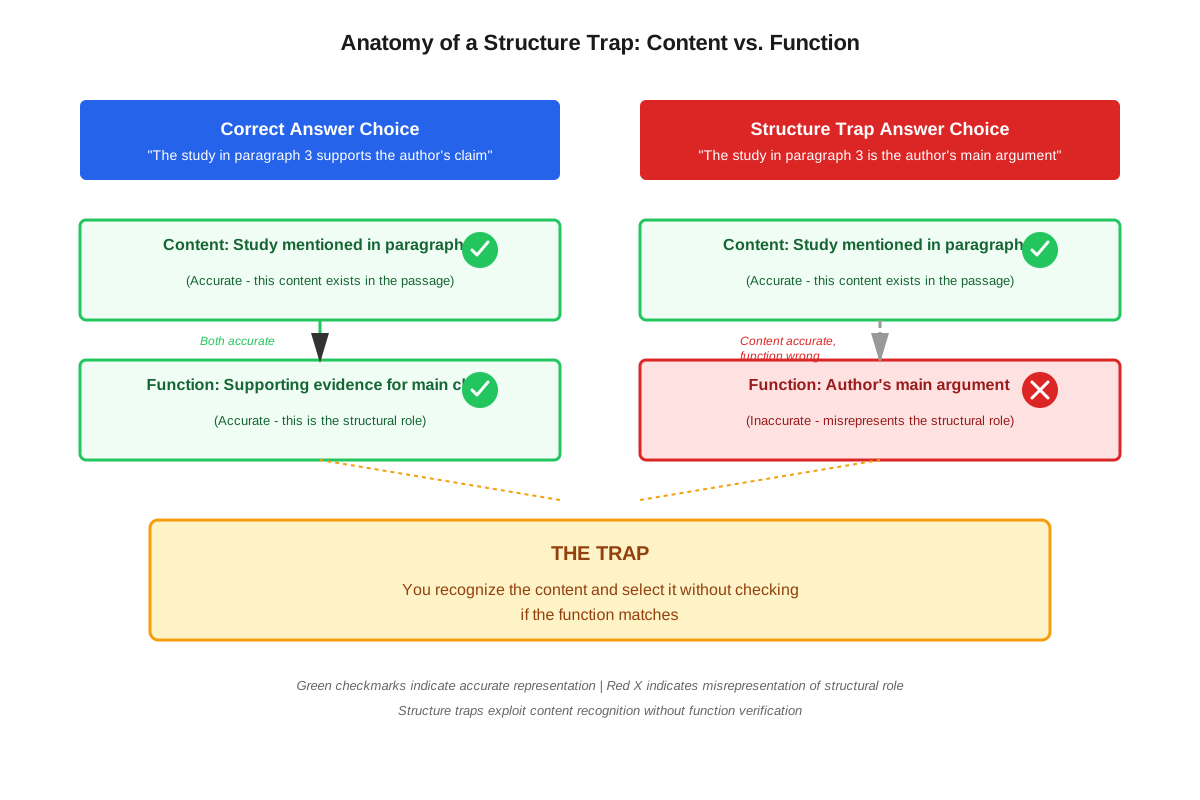
ACT structure traps represent one of the most insidious categories of wrong answer choices on the ACT Reading test. These deceptive options contain information that genuinely appears in the passage but misrepresents how that information functions within the passage's organizational framework. Unlike simple factual errors or complete fabrications, structure traps exploit a student's surface-level comprehension by presenting accurate details in misleading contexts. A structure trap might correctly identify that an author mentions a scientific study, for example, but falsely claim that study serves as the main argument when it actually functions as supporting evidence for a broader claim.
Understanding and avoiding these traps is essential for achieving a top ACT Reading score because they appear with remarkable frequency—typically in 30-40% of all Reading questions, particularly those asking about purpose, function, or organizational structure. Students who read carefully and remember passage details often fall victim to structure traps precisely because they recognize the familiar information and select it without analyzing whether the answer choice accurately represents the structural role of that information. The ACT deliberately designs these wrong answers to reward not just comprehension, but analytical reading that distinguishes between what information appears and how that information functions.
Mastering ACT structure traps connects directly to broader Reading skills including identifying main ideas versus supporting details, understanding authorial purpose and tone, recognizing organizational patterns, and distinguishing between explicit statements and implied meanings. This topic serves as a bridge between basic comprehension and advanced critical analysis, requiring students to move beyond passive reading toward active evaluation of textual architecture.
Learning Objectives
- [ ] Identify when ACT structure traps is being tested in question stems and answer choices
- [ ] Explain the core rule or strategy behind ACT structure traps and why they effectively deceive test-takers
- [ ] Apply ACT structure traps recognition to ACT-style questions accurately and consistently
- [ ] Distinguish between accurate content and accurate structural representation in answer choices
- [ ] Analyze the hierarchical relationship between main ideas, supporting details, and examples in passages
- [ ] Evaluate answer choices by mapping them back to specific passage functions rather than just passage content
- [ ] Predict common structure trap patterns based on question type and passage organization
Prerequisites
- Basic passage comprehension skills: Students must be able to understand the literal meaning of ACT Reading passages, as structure trap recognition builds upon accurate content comprehension.
- Familiarity with ACT Reading question types: Understanding the difference between detail questions, inference questions, and function questions helps identify when structure traps are most likely to appear.
- Knowledge of passage organizational patterns: Recognizing common structures (chronological, compare-contrast, problem-solution, cause-effect) provides the framework for understanding how information functions within passages.
- Ability to identify main ideas and supporting details: This foundational skill is essential because structure traps often misrepresent the hierarchical relationship between these elements.
Why This Topic Matters
Structure traps represent a critical testing mechanism that separates high-scoring students (30+) from mid-range performers (24-29) on the ACT Reading section. While students at all levels can identify basic factual errors, only those who understand textual architecture can consistently avoid structure traps. This skill directly impacts performance on approximately 8-12 questions per Reading test, potentially affecting scores by 3-5 points.
In real-world applications, the analytical skills required to avoid structure traps translate directly to college-level reading, where students must distinguish between an author's thesis and supporting evidence, recognize when sources are used to support versus challenge claims, and understand how individual paragraphs function within larger arguments. These same skills prove essential in professional contexts requiring critical evaluation of reports, proposals, and research documents.
On the ACT, structure traps most commonly appear in questions asking about:
- The purpose or function of a paragraph, sentence, or detail
- Why an author includes specific information
- How a passage is organized or structured
- The relationship between different parts of the passage
- What role an example, anecdote, or quotation plays
- The main idea or primary purpose of the passage
These questions typically use trigger phrases like "in order to," "primarily serves to," "functions as," "the author mentions X to," or "the main purpose of paragraph 3 is to." Recognizing these triggers helps students activate their structure trap awareness before evaluating answer choices.
Core Concepts
What Are Structure Traps?
ACT structure traps are incorrect answer choices that contain accurate information from the passage but misrepresent the structural role, function, or purpose of that information within the passage's organization. These traps exploit the natural tendency to recognize familiar content without analyzing whether the answer choice correctly describes how that content operates in context.
Consider this distinction: If a passage discusses climate change and mentions rising sea levels as one of three consequences, a structure trap might claim "the passage's main focus is rising sea levels" or "the author introduces climate change to explain rising sea levels." Both statements reference real passage content, but both reverse or distort the actual structural relationship—climate change is the main topic, and rising sea levels is a supporting detail, not vice versa.
The Anatomy of Structure Traps
Structure traps typically operate through four primary mechanisms:
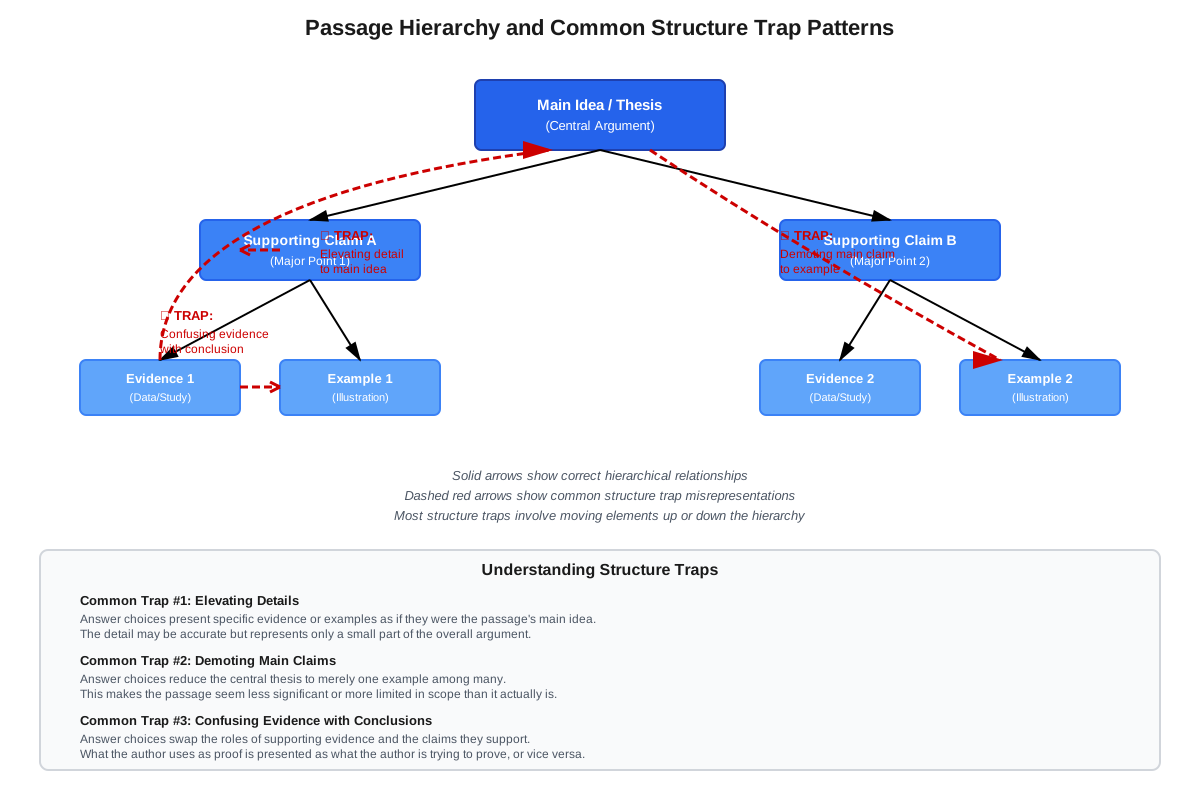
1. Hierarchy Distortion: These traps elevate supporting details to main idea status or demote main ideas to supporting detail status. The ACT knows students often remember specific, vivid details better than abstract main points, so they create wrong answers that treat memorable examples as if they were the passage's primary focus.
2. Purpose Misrepresentation: These traps correctly identify what information appears but incorrectly state why the author included it. For example, if an author mentions a counterargument to acknowledge and refute it, a structure trap might claim the author mentions it to support their own position.
3. Relationship Reversal: These traps flip cause-and-effect relationships, reverse the order of comparison elements, or invert which concept explains which. If Concept A is presented to explain Concept B, the trap claims Concept B explains Concept A.
4. Scope Manipulation: These traps take information that applies to one part of the passage and claim it applies to the whole passage, or take a passage-wide theme and claim it only applies to one section.
Recognizing Structure Trap Indicators
Several textual and contextual clues signal potential structure traps:
| Indicator Type | What to Watch For | Why It Matters |
|---|---|---|
| Question stem language | "primarily," "main purpose," "in order to," "functions as" | These phrases explicitly ask about structure, not just content |
| Answer choice absolutes | "only," "solely," "exclusively," "entirely" | Structure traps often overstate the scope or importance of details |
| Familiar but peripheral details | Specific names, dates, examples you remember | Memorable details are often used in hierarchy distortion traps |
| Reversed causal language | "to explain," "because," "as a result of" | Watch for cause-effect reversals |
| Scope words | "throughout," "primarily," "mainly," "overall" | These indicate claims about passage-wide structure |
The Core Strategy: Function Over Content
The fundamental approach to avoiding structure traps requires a mental shift from asking "Is this information in the passage?" to asking "Does this answer correctly describe how this information functions in the passage?" This distinction represents the single most important concept for mastering structure traps.
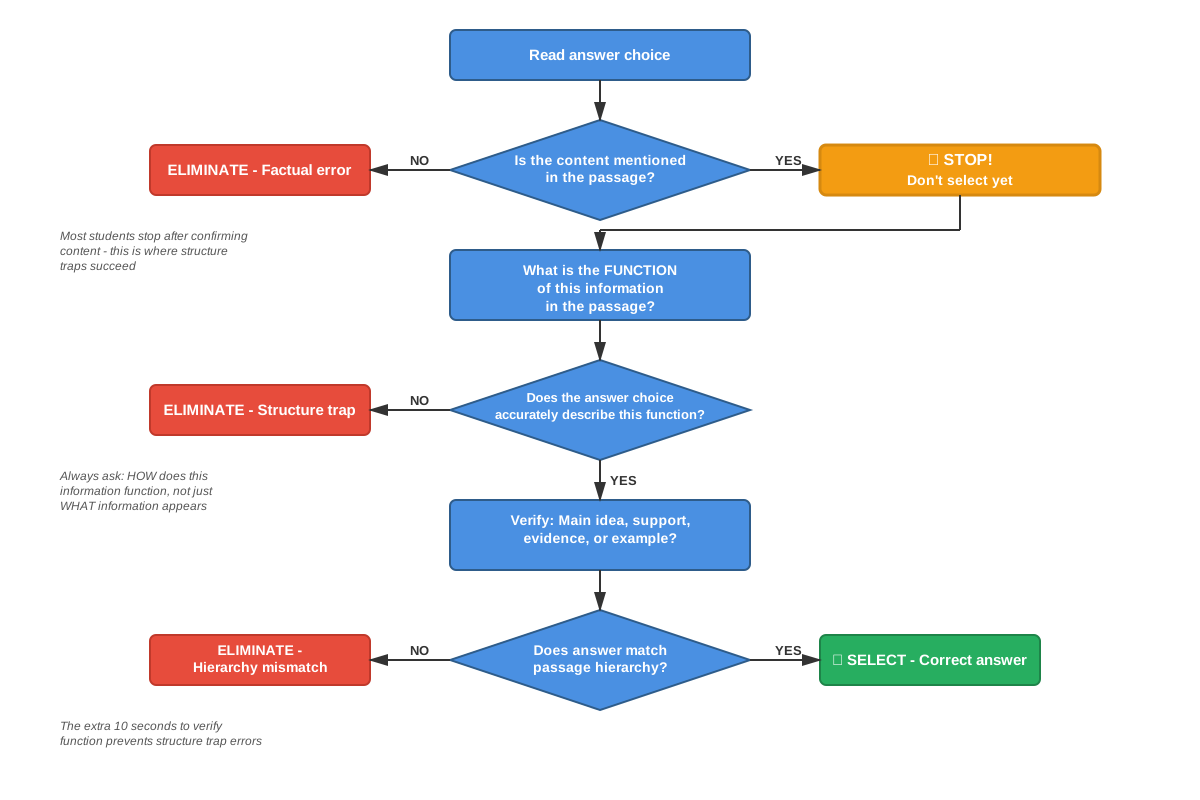
The Three-Step Verification Process:
- Locate: Find where in the passage the answer choice references information
- Analyze: Determine what structural role that information plays (main idea? supporting detail? counterargument? example? transition?)
- Match: Verify that the answer choice accurately describes that structural role
This process must become automatic, particularly for questions explicitly asking about purpose, function, or organization. Students should develop the habit of mentally labeling passage components as they read: "This paragraph introduces the main argument," "This sentence provides a contrasting example," "This detail supports the previous claim."
Common Structure Trap Patterns by Question Type
Main Idea/Primary Purpose Questions: Structure traps present supporting details or specific examples as if they were the passage's central focus. The correct answer captures the passage's overarching theme, while traps zoom in on memorable but subordinate information.
Function Questions ("The author mentions X in order to..."): Structure traps misidentify why information appears. If the author mentions a study to support a claim, traps might say the study is mentioned to introduce a new topic, to contradict the claim, or to provide the passage's main focus.
Organization/Structure Questions: Structure traps misrepresent the passage's organizational pattern or the relationship between sections. They might claim a passage moves from specific to general when it actually moves from general to specific, or claim two concepts are contrasted when they're actually presented as complementary.
Relationship Questions: Structure traps reverse or distort how ideas relate to each other. They might flip which concept is the cause and which is the effect, or claim two ideas are in opposition when the passage presents them as mutually reinforcing.
The Hierarchy Principle
Understanding textual hierarchy is essential for avoiding structure traps. Every passage operates on multiple levels:
Level 1 - Passage-Level: The overall main idea, thesis, or primary purpose that governs the entire passage
Level 2 - Section-Level: The main point of each paragraph or major section, which supports the passage-level idea
Level 3 - Detail-Level: Specific facts, examples, quotations, or data points that support section-level points
Level 4 - Sub-Detail Level: Minor clarifications, parenthetical information, or elaborations on details
Structure traps frequently operate by taking information from Level 3 or 4 and presenting it as if it were Level 1 or 2. The correct answer to a main idea question will be Level 1 information, while structure traps offer Level 2 or 3 information disguised as Level 1.
Concept Relationships
The concepts within structure trap recognition form an interconnected system. Hierarchy Distortion serves as the foundation, as understanding textual levels enables recognition of all other trap types. Purpose Misrepresentation builds on hierarchy awareness by requiring students to understand not just what level information occupies, but why it appears at that level. Relationship Reversal extends this analysis to connections between ideas, while Scope Manipulation applies hierarchy understanding to questions about how broadly claims apply.
These concepts connect to prerequisite knowledge of passage organization patterns—recognizing a compare-contrast structure, for example, helps identify relationship reversal traps that might flip which element is being compared to which. Similarly, main idea identification skills directly enable hierarchy distortion recognition, as students who can distinguish main ideas from details can more easily spot when answer choices confuse the two.
The relationship map flows as follows:
Basic Comprehension → Hierarchy Recognition → Function Analysis → Structure Trap Identification → Accurate Answer Selection
Additionally, structure trap mastery enables progression to more advanced skills like recognizing subtle shifts in authorial tone, identifying implicit organizational patterns, and evaluating complex multi-paragraph arguments—all skills tested on the most challenging ACT Reading questions.
High-Yield Facts
⭐ Structure traps contain accurate passage information but misrepresent how that information functions within the passage's organization
⭐ Approximately 30-40% of ACT Reading questions include at least one structure trap among the wrong answers
⭐ Questions using "primarily," "main purpose," "in order to," or "functions as" are most likely to feature structure traps
⭐ The most common structure trap elevates a supporting detail or example to main idea status
⭐ Structure traps frequently reverse cause-and-effect relationships or flip which concept explains which
- Structure traps exploit the tendency to recognize familiar content without analyzing structural function
- Answer choices containing specific, memorable details (names, dates, vivid examples) are often structure traps in main idea questions
- The correct answer to a function question describes why information appears, not just what information appears
- Scope manipulation traps take information about one paragraph and claim it applies to the entire passage
- Structure traps in organization questions often reverse the actual order or pattern (claiming specific-to-general when the passage moves general-to-specific)
- Questions asking about the purpose of a paragraph require identifying that paragraph's role in the larger passage structure, not just summarizing its content
- Structure traps may correctly identify that an author mentions a counterargument but incorrectly claim the author supports rather than refutes it
- The phrase "in order to" in a question stem signals that the correct answer must identify purpose/function, making structure traps highly likely
- Eliminating structure traps often requires returning to the passage to verify not just that information appears, but how it's framed and what role it plays
Quick check — test yourself on ACT structure traps so far.
Try Flashcards →Common Misconceptions
Misconception: If an answer choice contains information from the passage, it must be correct.
Correction: Structure traps deliberately include accurate passage information while misrepresenting its structural role. Correct answers must be both factually accurate AND structurally accurate—they must correctly describe how information functions, not just what information appears.
Misconception: The most detailed or specific answer choice is usually correct.
Correction: For main idea and primary purpose questions, the correct answer is typically more general and abstract, while structure traps often present specific, memorable details. Specificity is a red flag in questions asking about overall purpose or main ideas.
Misconception: If you remember reading something in the passage, the answer choice mentioning it is probably right.
Correction: Structure traps exploit memory recognition by featuring memorable details. The most vivid, specific information you recall is often used in wrong answers to distract from the correct, more general main idea.
Misconception: Structure traps only appear in questions explicitly asking about passage organization.
Correction: While structure traps are most common in function and organization questions, they appear across all question types, including inference questions, detail questions, and vocabulary-in-context questions. Any question can include wrong answers that misrepresent structural relationships.
Misconception: The correct answer to "Why does the author mention X?" is always found in the same sentence as X.
Correction: The purpose of information is often revealed in surrounding context—the sentence before might state a claim that X supports, or the sentence after might explain why X matters. Understanding function requires reading beyond the specific reference point.
Misconception: If two concepts are discussed in the same paragraph, they must have equal importance.
Correction: Proximity doesn't indicate equal hierarchical status. One concept might be the main point while the other is a supporting example, even if they appear in consecutive sentences. Structure traps exploit this assumption by treating examples as if they were main ideas.
Misconception: Longer answer choices are more likely to be correct because they're more detailed.
Correction: Length doesn't correlate with correctness. Structure traps are often longer because they include accurate details to seem plausible. The correct answer may be concise because it focuses on function rather than elaborating on content.
Worked Examples
Example 1: Main Idea Structure Trap
Passage Excerpt (simplified for illustration):
"The development of jazz music in early 20th century America represented a revolutionary fusion of African and European musical traditions. This synthesis emerged primarily in New Orleans, where diverse cultural influences converged. Musicians like Louis Armstrong pioneered improvisational techniques that became jazz's defining characteristic. Armstrong's innovative trumpet playing, particularly his use of scat singing and complex melodic variations, influenced generations of musicians. Beyond its musical innovations, jazz served as a powerful force for social change, breaking down racial barriers in performance venues and recording studios."
Question: The primary purpose of the passage is to:
Answer Choices:
A) Explain how Louis Armstrong's trumpet playing influenced later musicians
B) Describe the origins and significance of jazz music in American culture
C) Trace the development of improvisational techniques in New Orleans
D) Analyze the role of scat singing in jazz performance
Analysis:
Step 1 - Identify the question type: "Primary purpose" signals this is asking about passage-level structure (Level 1 in our hierarchy). Structure traps will likely present Level 2 or 3 information.
Step 2 - Evaluate each choice:
Choice A: This references Louis Armstrong's trumpet playing and influence—both accurate passage details. However, Armstrong appears in the middle of the passage as a specific example of jazz innovation. This is Level 3 information (a specific detail supporting the broader point about jazz development). This is a structure trap using hierarchy distortion—it elevates a supporting example to main idea status.
Choice B: This captures both major themes: jazz's origins (the fusion of traditions, emergence in New Orleans) and its significance (musical innovations, social change). This is Level 1 information that encompasses the entire passage. This is the correct answer.
Choice C: Improvisational techniques are mentioned as jazz's "defining characteristic," and New Orleans is mentioned as where jazz emerged. Both facts are accurate, but improvisation is one aspect of jazz development, not the passage's primary focus. This is a structure trap using scope manipulation—it takes one element and presents it as the whole focus.
Choice D: Scat singing appears as one specific technique Armstrong used. This is Level 4 information (a sub-detail of a detail). This is a structure trap using extreme hierarchy distortion—it takes a minor detail and presents it as the passage's main purpose.
Key Lesson: The correct answer to a primary purpose question must be broad enough to encompass the entire passage. Structure traps present accurate but overly specific information. Notice how choices A, C, and D all reference real passage content—that's what makes them effective traps.
Example 2: Function Structure Trap
Passage Excerpt:
"Many scientists argue that renewable energy sources can fully replace fossil fuels within three decades. Solar and wind power have become increasingly cost-competitive, with installation costs dropping 80% since 2010. However, critics point out that renewable sources face significant storage challenges, as batteries capable of storing grid-scale energy remain prohibitively expensive. Despite these concerns, recent advances in lithium-ion technology suggest that storage costs may decrease substantially by 2030, potentially resolving the primary obstacle to renewable energy adoption."
Question: The author mentions critics' concerns about storage challenges primarily in order to:
Answer Choices:
A) Support the argument that renewable energy cannot replace fossil fuels
B) Acknowledge a counterargument before presenting evidence that addresses it
C) Introduce the main focus of the passage
D) Explain why battery technology has not advanced sufficiently
Analysis:
Step 1 - Locate the reference: Critics' concerns appear in the third sentence, discussing storage challenges and battery costs.
Step 2 - Analyze the structural context:
- The passage opens with a claim (renewables can replace fossil fuels)
- Provides supporting evidence (cost decreases)
- Introduces a counterargument (storage challenges)
- Refutes the counterargument (advances in lithium-ion technology)
Step 3 - Evaluate choices:
Choice A: Critics do raise concerns about storage, but the passage immediately counters these concerns with evidence about lithium-ion advances. The author mentions critics not to support their position but to acknowledge and refute it. This is a structure trap using purpose misrepresentation—it correctly identifies that critics are mentioned but incorrectly states why.
Choice B: This accurately describes the structural function. The author presents the counterargument ("However, critics point out...") and then refutes it ("Despite these concerns, recent advances..."). This is the correct answer.
Choice C: Storage challenges are one element discussed in the passage, but the passage opens with the claim about renewable energy replacing fossil fuels—that's the main focus. Storage is a subordinate issue addressed within the larger argument. This is a structure trap using hierarchy distortion and scope manipulation.
Choice D: While the passage does discuss battery technology, it's mentioned to show that advances ARE occurring, not to explain why they haven't occurred. This is a structure trap using relationship reversal—it flips the passage's actual point about battery technology.
Key Lesson: Function questions require identifying why information appears in context. The correct answer must account for what comes before and after the reference point. Structure traps often ignore this context, presenting the information as if it stands alone.
Exam Strategy
Pre-Reading Strategy
Before reading the passage, quickly scan questions to identify which ones are most likely to feature structure traps. Questions containing "primarily," "main purpose," "in order to," "functions as," or "the author mentions X to" should trigger heightened awareness. Mark these questions mentally as requiring extra verification.
Active Reading Approach
While reading, actively label the structural function of each paragraph in the margin or mentally:
- "Introduces main argument"
- "Provides supporting example"
- "Presents counterargument"
- "Offers evidence"
- "Concludes/synthesizes"
This real-time structural analysis makes it much easier to identify structure traps later, as you've already determined how information functions.
The Answer Choice Evaluation Process
For questions likely to contain structure traps, use this systematic approach:
- Read the question stem carefully to determine what structural element it's asking about (purpose, function, organization, relationship)
- Predict the answer before looking at choices, based on your structural understanding of the passage
- Evaluate each choice by asking: "Does this describe what information appears, or does it describe how that information functions?" Eliminate choices that only address content.
- Verify the remaining choices by returning to the passage and reading the relevant section plus surrounding context
- Check for hierarchy accuracy: If the question asks about main ideas, eliminate choices presenting supporting details, and vice versa
Trigger Words and Phrases
In Question Stems (indicating high structure trap probability):
- "primarily serves to"
- "main purpose"
- "in order to"
- "functions as"
- "the author mentions X to"
- "the passage is best described as"
- "the organization of the passage"
In Answer Choices (red flags for potential structure traps):
- Specific names, dates, or examples (in main idea questions)
- "only," "solely," "exclusively" (scope manipulation)
- "to introduce," "to explain," "because" (watch for purpose misrepresentation)
- References to memorable, vivid details (hierarchy distortion)
Time Allocation
Don't rush through questions with high structure trap probability. These questions reward careful verification. Budget an extra 15-20 seconds for questions asking about purpose, function, or main ideas to properly verify that answer choices accurately represent structural relationships, not just content. This small time investment prevents careless errors on questions you have the knowledge to answer correctly.
Process of Elimination Specific to Structure Traps
- First pass: Eliminate choices that are factually inaccurate or not mentioned in the passage
- Second pass: Eliminate choices that are factually accurate but structurally inaccurate (the structure traps)
- Final verification: Confirm the remaining choice accurately describes both content AND function
For main idea questions specifically, eliminate any choice that:
- References only one paragraph's content
- Focuses on a specific example rather than the broader concept
- Contains proper nouns or specific data points (unless the entire passage is about that person/data)
Memory Techniques
The FLIPS Acronym
Remember that structure traps often FLIPS the passage's actual meaning:
- Function misrepresented (claims wrong purpose)
- Levels confused (detail presented as main idea)
- Inversion of relationships (cause becomes effect)
- Part claimed as whole (scope manipulation)
- Specific detail elevated (hierarchy distortion)
The "Zoom" Visualization
Visualize passage structure like a camera zoom:
- Zoomed out (wide angle): Main idea, primary purpose, overall organization
- Medium zoom: Paragraph-level main points, section purposes
- Zoomed in (close-up): Specific details, examples, data points
Structure traps often show you a "zoomed in" image when the question asks for a "zoomed out" view. When you see specific details in answer choices to main idea questions, visualize yourself zooming out to find the broader concept.
The "Because Test"
For function questions, use this mental test: Complete the sentence "The author includes [information X] BECAUSE..."
The correct answer will logically complete this sentence based on passage context. Structure traps will not complete it logically:
- Correct: "The author mentions critics' concerns BECAUSE he wants to acknowledge and refute counterarguments"
- Structure trap: "The author mentions critics' concerns BECAUSE he supports their position" (doesn't match the passage's actual argument)
The Hierarchy Pyramid
Visualize passage information as a pyramid:
- Top (smallest): Main idea/primary purpose (1 concept)
- Middle: Supporting points (3-5 concepts)
- Bottom (largest): Details and examples (many concepts)
Questions asking about the top require top-level answers. Structure traps offer middle or bottom-level information. This visual helps you quickly assess whether an answer choice matches the hierarchical level the question asks about.
Summary
ACT structure traps represent a sophisticated category of wrong answer choices that contain accurate passage information while misrepresenting how that information functions within the passage's organizational structure. These traps appear in approximately 30-40% of Reading questions, particularly those asking about purpose, function, main ideas, or organization. The four primary mechanisms—hierarchy distortion, purpose misrepresentation, relationship reversal, and scope manipulation—all exploit the natural tendency to recognize familiar content without analyzing structural roles. Mastering structure traps requires shifting from content-focused reading to function-focused analysis, consistently asking not just "Is this information in the passage?" but "Does this answer correctly describe how this information functions?" The three-step verification process (locate, analyze, match) provides a systematic approach to avoiding these traps, while understanding textual hierarchy enables students to distinguish between main ideas, supporting points, and specific details. Success requires active reading that labels structural functions, careful attention to question stem language, and disciplined verification of answer choices against passage structure rather than just passage content.
Key Takeaways
- Structure traps contain accurate passage information but misrepresent its structural function, purpose, or hierarchical level
- Questions using "primarily," "main purpose," "in order to," or "functions as" have the highest probability of structure traps
- The most common structure trap elevates supporting details or examples to main idea status (hierarchy distortion)
- Correct answers must be both factually accurate AND structurally accurate—they must correctly describe how information functions
- The three-step verification process (locate, analyze, match) prevents structure trap errors by requiring analysis of function, not just recognition of content
- Understanding textual hierarchy (passage-level, section-level, detail-level, sub-detail-level) enables quick identification of hierarchy distortion traps
- Active reading that labels structural functions while reading makes structure trap identification significantly easier during question answering
Related Topics
Main Idea vs. Supporting Detail Identification: Mastering structure traps builds directly on the ability to distinguish between main ideas and supporting details, as hierarchy distortion traps specifically exploit confusion between these levels. Further study of this topic enhances structure trap recognition.
Authorial Purpose and Tone: Understanding why authors include information and how they feel about it connects closely to avoiding purpose misrepresentation traps. Advanced study of authorial intent deepens structure trap mastery.
Passage Organization Patterns: Recognizing compare-contrast, cause-effect, problem-solution, and chronological structures helps identify relationship reversal and scope manipulation traps. This topic provides the framework for understanding how passages are built.
Inference Questions: While structure traps most commonly appear in function questions, they also appear in inference questions where wrong answers misrepresent the relationship between stated information and implied conclusions.
Rhetoric and Argumentation: Advanced analysis of how authors construct arguments, use evidence, and address counterarguments directly applies to identifying structure traps in complex argumentative passages.
Practice CTA
Now that you understand how ACT structure traps operate and how to avoid them, it's time to apply this knowledge! Attempt the practice questions to test your ability to identify structure traps in realistic ACT contexts. Pay special attention to questions asking about purpose, function, and main ideas—these are where your new skills will have the greatest impact. Use the flashcards to reinforce the key concepts, particularly the four trap mechanisms and the three-step verification process. Remember: recognizing structure traps is a skill that improves dramatically with deliberate practice. Each practice question you analyze strengthens your ability to distinguish between content accuracy and structural accuracy, bringing you closer to your target ACT Reading score. You've got this!
Sign up free to keep reading
Create a free AnvayaPrep account to finish this ACT guide on ACT structure traps — plus flashcards and practice questions.