Overview
Understanding cause and effect structure is fundamental to success on the ACT Reading test. This organizational pattern appears in passages across all content areas—prose fiction, social science, humanities, and natural science—and forms the basis for numerous question types. When authors use cause and effect structure, they explain why events happen (causes) and what results from those events (effects), creating logical chains of reasoning that students must trace and analyze.
The ACT frequently tests whether students can identify these causal relationships, distinguish between direct and indirect causes, recognize multiple causes leading to single effects (or vice versa), and understand how authors signal these connections through specific transitional words and phrases. Questions may ask students to identify what caused a particular outcome, predict effects based on stated causes, or analyze how the author structures an argument using causal reasoning. Mastering this skill is not merely about finding isolated facts; it requires understanding how ideas connect and flow throughout a passage.
ACT cause and effect structure questions represent a significant portion of the Craft and Structure question category, which accounts for approximately 25-30% of all Reading questions. This topic connects directly to other essential reading skills including main idea identification, author's purpose analysis, and text structure recognition. Students who excel at recognizing cause and effect patterns can more quickly comprehend complex passages, anticipate where arguments are heading, and eliminate incorrect answer choices that confuse causes with effects or introduce relationships not supported by the text.
Learning Objectives
- [ ] Identify when cause and effect structure is being tested in ACT Reading questions
- [ ] Explain the core rule or strategy behind cause and effect structure analysis
- [ ] Apply cause and effect structure recognition to ACT-style questions accurately
- [ ] Distinguish between direct causes, indirect causes, and contributing factors in passages
- [ ] Recognize signal words and transitional phrases that indicate causal relationships
- [ ] Trace complex causal chains involving multiple causes and effects
- [ ] Differentiate between temporal sequence (chronological order) and true causation
Prerequisites
- Basic reading comprehension skills: Understanding literal meaning is necessary before analyzing structural relationships between ideas
- Familiarity with transitional words: Recognizing connective language helps identify how sentences and paragraphs relate to each other
- Understanding of main idea and supporting details: Causal relationships often explain why main ideas are true or how supporting details connect
- Knowledge of passage types on the ACT: Different genres (fiction, science, humanities, social science) employ cause and effect structure in distinct ways
Why This Topic Matters
Cause and effect reasoning forms the backbone of logical thinking in academic, professional, and everyday contexts. Scientists use it to explain phenomena, historians employ it to interpret events, authors utilize it to develop plots and character motivations, and social scientists apply it to understand human behavior and societal trends. Recognizing these patterns enables deeper comprehension of complex texts and strengthens critical thinking skills applicable far beyond standardized testing.
On the ACT Reading test, cause and effect structure appears in approximately 15-20% of all questions, making it one of the most frequently tested organizational patterns. These questions appear in multiple formats: some directly ask about causes or effects ("According to the passage, what caused X?"), while others test this skill indirectly through inference questions, author's purpose questions, or detail questions that require understanding causal connections. Natural science passages particularly favor this structure when explaining processes or phenomena, but it appears across all passage types.
Common manifestations include: scientific explanations of natural processes (what causes weather patterns, how diseases develop), historical analyses (factors leading to wars or social movements), character motivation in fiction (why characters make specific choices), and argumentative structures in humanities passages (how evidence supports claims). Students who quickly recognize these patterns save valuable time and avoid the common trap of selecting answer choices that reverse cause and effect or introduce unsupported causal claims.
Core Concepts
Defining Cause and Effect Relationships
A cause and effect structure organizes information by explaining why something happens (the cause) and what happens as a result (the effect). The cause is the reason, source, or origin that makes something occur, while the effect is the outcome, result, or consequence. In ACT passages, these relationships may be explicitly stated with clear signal words, or they may be implied, requiring readers to infer connections from context.
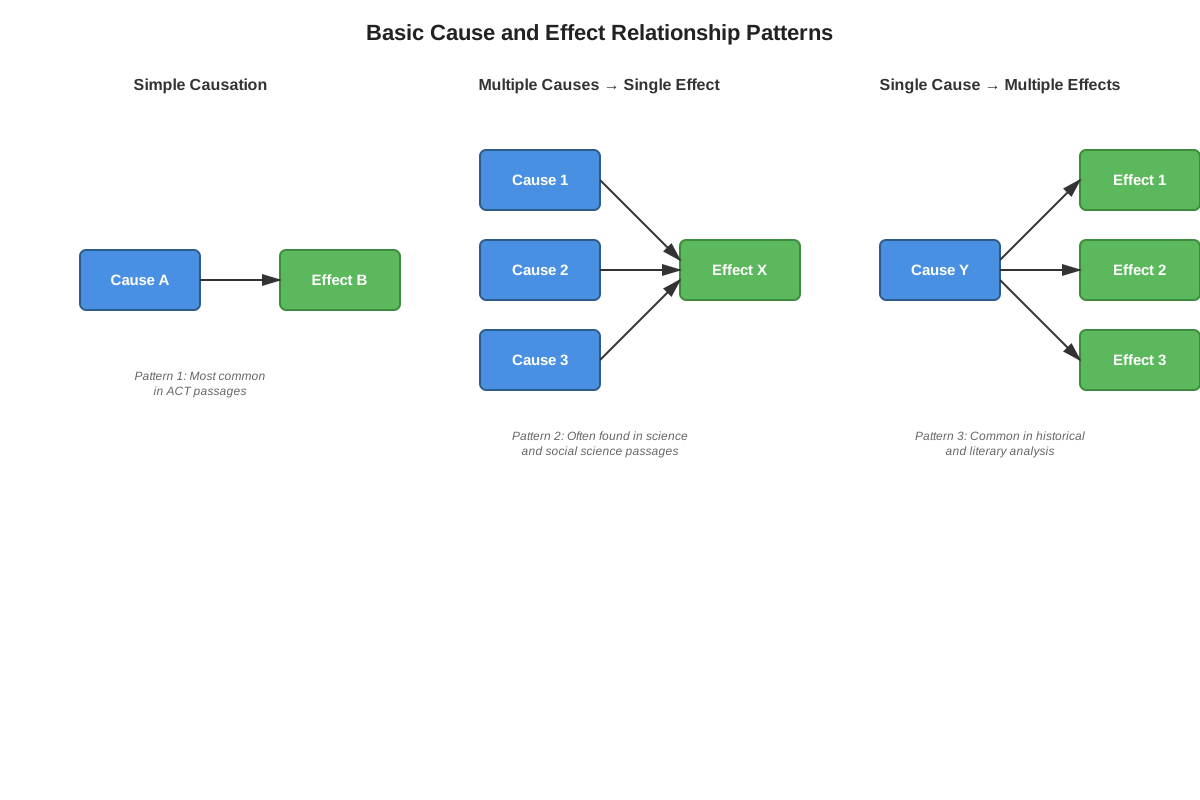
Causes answer the question "Why did this happen?" or "What made this occur?" Effects answer "What happened because of this?" or "What was the result?" A single cause may produce multiple effects, multiple causes may combine to produce a single effect, and effects can themselves become causes in causal chains. Understanding these variations is crucial for ACT success.
Types of Causal Relationships
Direct causation occurs when one event or factor immediately produces another with no intervening steps. For example: "The sudden temperature drop caused the water to freeze." The relationship is straightforward and immediate.
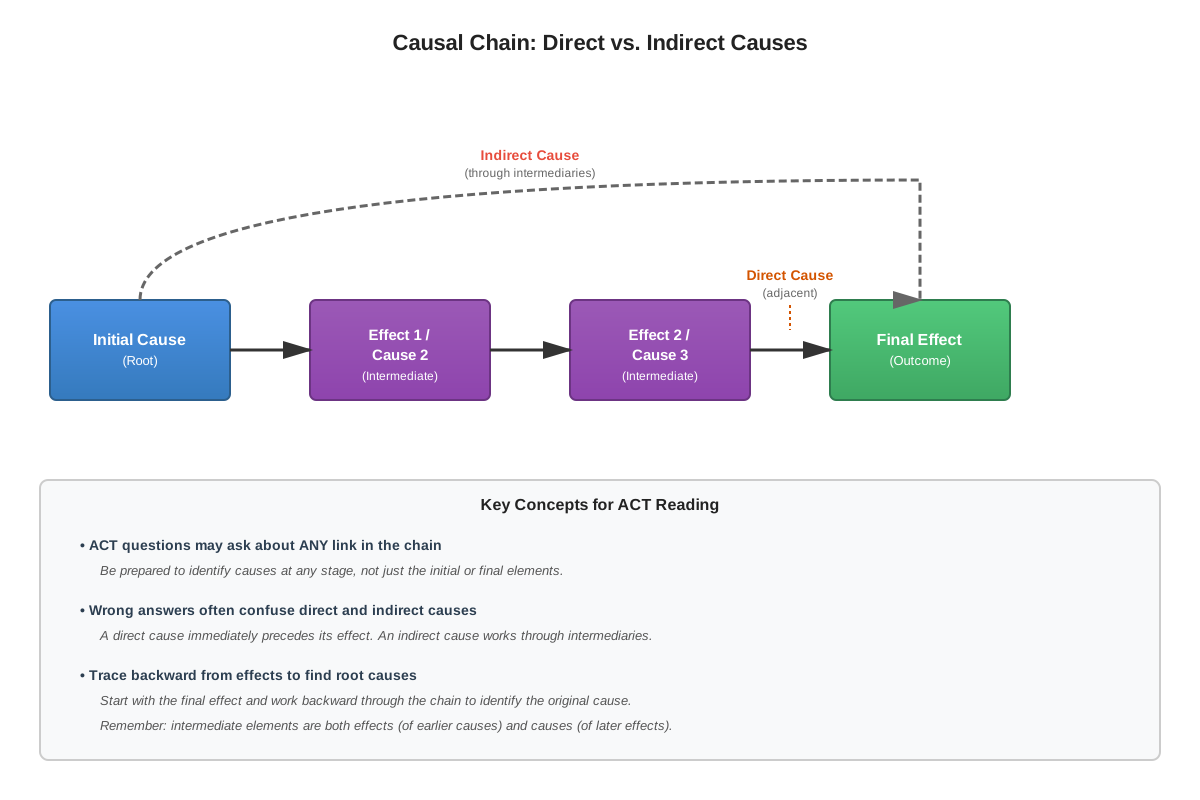
Indirect causation involves intermediate steps between the initial cause and final effect. For example: "The factory closure led to unemployment, which resulted in decreased consumer spending, ultimately causing local businesses to struggle." Here, the factory closure is the root cause, but its effect on local businesses operates through intermediate causes.
Contributing factors are elements that help produce an effect but may not be sufficient alone. Multiple contributing factors often work together. For example: "The combination of drought, poor farming practices, and economic depression contributed to the Dust Bowl." No single factor fully explains the outcome.
Necessary vs. sufficient causes represent an important distinction. A necessary cause must be present for an effect to occur, but its presence alone doesn't guarantee the effect. A sufficient cause, when present, will produce the effect. Understanding this distinction helps eliminate incorrect answer choices that overstate or understate causal relationships.
Signal Words and Phrases
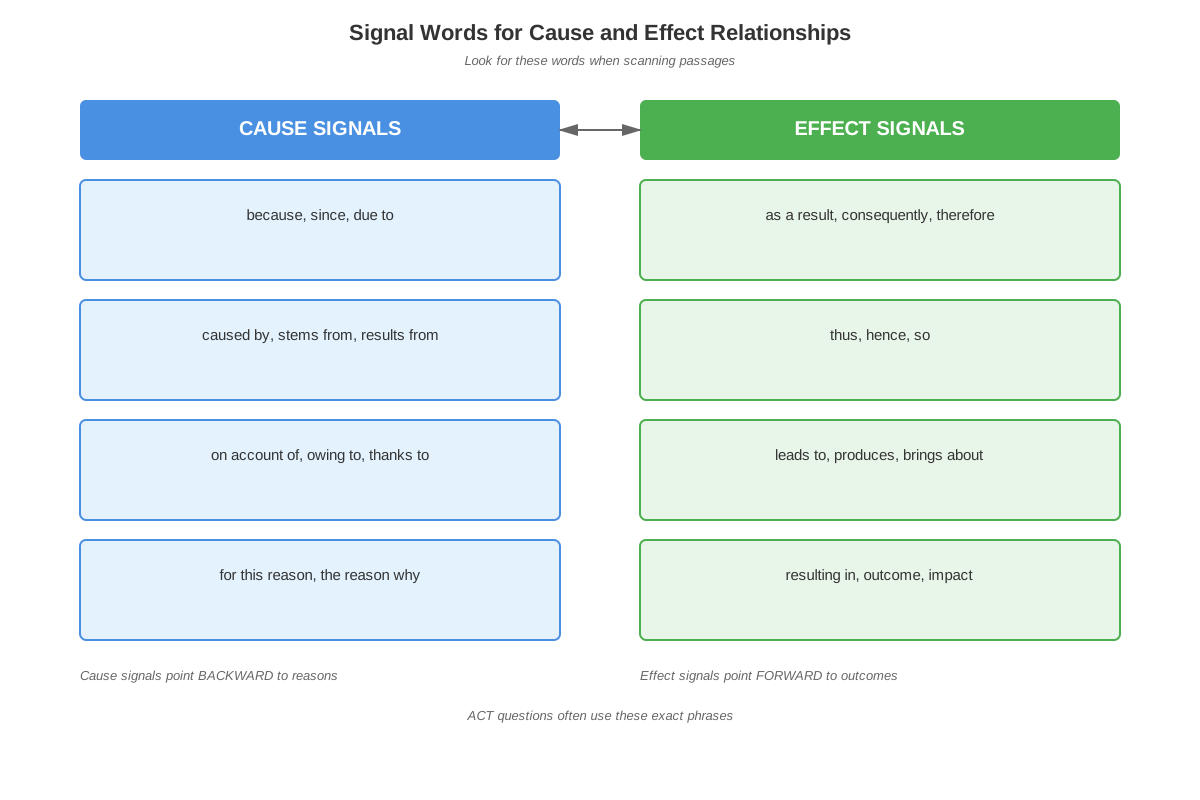
The ACT uses specific language to indicate causal relationships. Recognizing these signal words helps students quickly identify when cause and effect structure is relevant:
| Cause Indicators | Effect Indicators | General Causal Connectors |
|---|---|---|
| because, since, as | therefore, thus, hence | as a result, consequently |
| due to, owing to | so, so that | accordingly, for this reason |
| caused by, stems from | leads to, results in | if...then, when...then |
| on account of, thanks to | produces, creates | this is why, the reason that |
However, not all causal relationships use explicit signals. Authors may imply causation through sentence structure, paragraph organization, or logical flow. For example: "The drought lasted three years. Crop yields fell by 40%." The causal relationship is implied by juxtaposition and logical connection, even without explicit signal words.
Causal Chains and Complex Relationships
Many ACT passages present causal chains where one effect becomes the cause of subsequent effects. These chains require careful tracking: A causes B, B causes C, C causes D. Questions may ask about any link in this chain or about the relationship between non-adjacent elements (how A ultimately relates to D).
Multiple causes leading to one effect appear frequently in social science and natural science passages. For example, a passage might explain how genetic predisposition, environmental factors, and lifestyle choices all contribute to a disease. Questions may ask students to identify all contributing factors or to recognize which factor the author emphasizes most.
One cause leading to multiple effects also appears regularly. A historical event might produce political, economic, and social consequences. Students must track all effects and avoid selecting answer choices that mention only one when the question asks about overall impact.
Distinguishing Causation from Correlation and Sequence
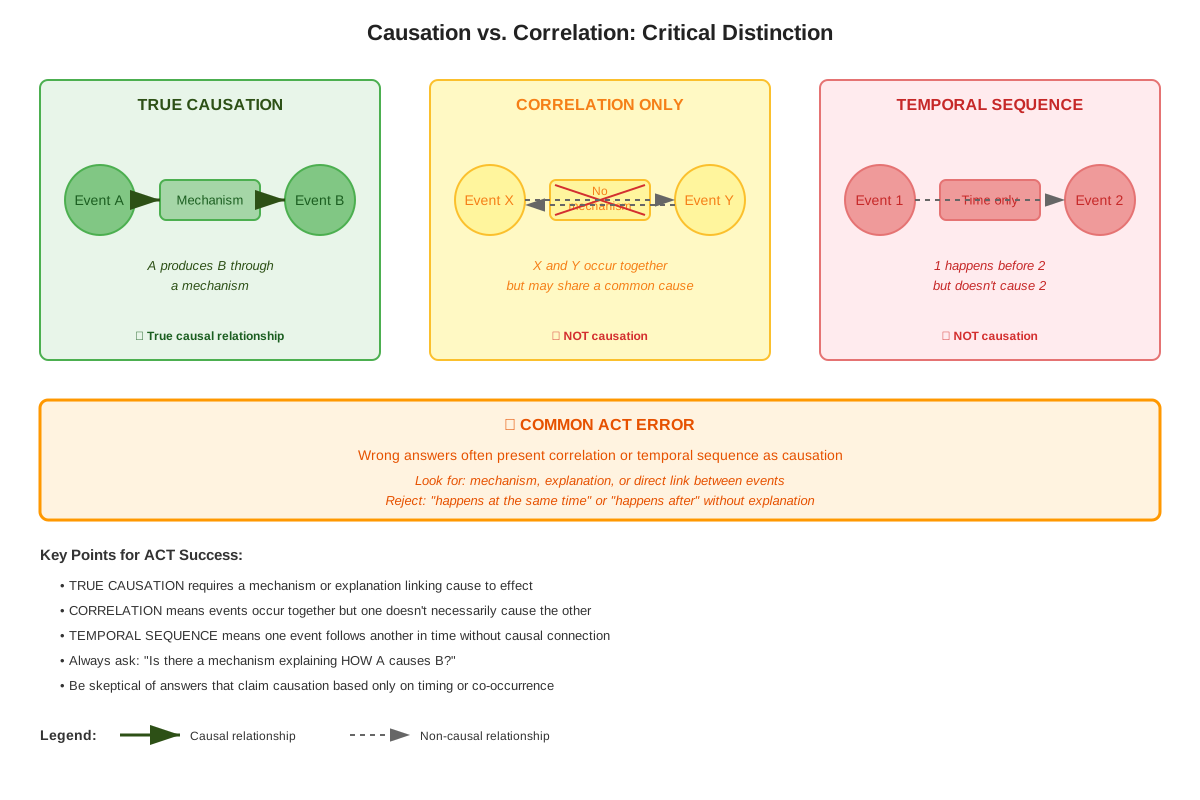
A critical skill for ACT success involves recognizing what is NOT causation. Temporal sequence (one event following another chronologically) does not automatically indicate causation. Just because B happened after A doesn't mean A caused B. The ACT includes wrong answer choices that exploit this confusion.
Correlation (two things occurring together) also differs from causation. Two phenomena may be associated without one causing the other; both might result from a third factor. Sophisticated ACT passages, particularly in natural science, may discuss this distinction explicitly, and questions may test whether students understand it.
Analyzing Author's Use of Causal Structure
Beyond identifying individual cause-effect relationships, the ACT tests understanding of how authors use this structure to organize entire passages or major sections. An author might structure a passage around explaining causes (why did the Renaissance occur?), exploring effects (what were the consequences of industrialization?), or analyzing both directions of causation.
Questions about author's purpose or passage structure often require recognizing that the author has organized information causally. Answer choices might contrast causal organization with chronological, compare-contrast, problem-solution, or descriptive structures. Students must recognize the dominant organizational pattern.
Concept Relationships
The concepts within cause and effect structure build upon each other hierarchically. Understanding basic cause-effect relationships (single cause → single effect) provides the foundation for recognizing more complex patterns. Once students can identify direct causation, they can progress to analyzing indirect causation and causal chains, which require tracking multiple steps. Recognizing signal words supports all other skills by making implicit relationships explicit.
The distinction between causation and mere sequence or correlation represents a higher-order skill that depends on solid understanding of what causation actually means. This critical thinking ability then enables students to evaluate author's claims about causation and identify when passages discuss causal relationships versus other organizational patterns.
Cause and effect structure connects to prerequisite knowledge of main ideas because causal relationships often explain or support the passage's central claim. It relates to understanding supporting details because effects serve as evidence for causes (or vice versa). The skill also connects to inference questions, as students must sometimes infer unstated causal links from presented information.
Relationship map: Signal word recognition → Identification of basic cause-effect pairs → Tracking causal chains → Distinguishing causation from sequence/correlation → Analyzing overall passage structure → Evaluating author's causal claims
High-Yield Facts
- ⭐ Cause and effect questions appear in 15-20% of ACT Reading passages, making this one of the most frequently tested structural patterns
- ⭐ Signal words like "because," "therefore," "as a result," and "consequently" explicitly indicate causal relationships, but many causal connections are implied without signal words
- ⭐ The ACT frequently includes wrong answers that reverse cause and effect—what the passage presents as a cause, the wrong answer presents as an effect
- Multiple causes can combine to produce a single effect, and a single cause can produce multiple effects—questions may test either pattern
- ⭐ Temporal sequence (one event following another) does not automatically indicate causation; the ACT includes distractors that confuse chronological order with causal relationships
- Causal chains involve effects that become causes of subsequent effects; questions may ask about non-adjacent links in these chains
- ⭐ Natural science passages most frequently employ cause and effect structure when explaining processes, phenomena, or experimental results
- Contributing factors help produce an effect but may not be sufficient alone; questions may ask students to identify all contributing factors
- Authors may organize entire passages around causal structure, using it as the dominant organizational pattern rather than chronological or compare-contrast structures
- ⭐ Correlation (two things occurring together) differs from causation (one thing producing another); sophisticated passages may explicitly discuss this distinction
Quick check — test yourself on Cause and effect structure so far.
Try Flashcards →Common Misconceptions
Misconception: If event B happens after event A in a passage, then A must have caused B.
Correction: Temporal sequence does not prove causation. The ACT specifically includes wrong answers that assume chronological order indicates cause and effect. Authors may present events in sequence for narrative flow without implying causal connection. Look for explicit causal language or logical necessity, not just time order.
Misconception: Cause and effect questions always use obvious signal words like "because" or "therefore."
Correction: While signal words help identify causal relationships, many ACT passages imply causation through context, logical structure, or juxtaposition without explicit markers. Students must infer causal connections from the relationship between ideas, not just from transitional words.
Misconception: Each effect has only one cause, and identifying that cause is sufficient.
Correction: Real-world phenomena typically result from multiple contributing factors. ACT passages, especially in social science and natural science, often present complex causation involving several factors working together. Questions may ask about the "primary" cause or "all factors that contributed," requiring students to recognize multiple causes.
Misconception: The cause always appears before the effect in the passage text.
Correction: Authors frequently present effects before explaining their causes, especially when using a problem-solution structure or when building suspense in fiction. Students must identify the logical relationship (what caused what) regardless of presentation order in the text.
Misconception: If two things are correlated or associated, one must cause the other.
Correction: Correlation does not prove causation. Two phenomena may occur together because both result from a third factor, because of coincidence, or because of a complex relationship that isn't simple causation. The ACT tests whether students can distinguish correlation from causation, particularly in science passages.
Worked Examples
Example 1: Natural Science Passage
Passage excerpt: "The Industrial Revolution transformed manufacturing processes throughout Europe and North America. Factories replaced cottage industries, drawing workers from rural areas into rapidly growing cities. This urbanization created overcrowded living conditions with inadequate sanitation systems. Consequently, infectious diseases such as cholera and typhoid spread rapidly through dense urban populations. The high disease rates eventually prompted public health reforms, including the development of modern sewage systems and clean water supplies."
Question: According to the passage, what was a direct result of urbanization during the Industrial Revolution?
A) The development of modern sewage systems
B) The transformation of manufacturing processes
C) Overcrowded living conditions with poor sanitation
D) The replacement of cottage industries with factories
Analysis: This question tests the ability to identify direct cause-effect relationships within a causal chain. Let's trace the relationships:
- Industrial Revolution → factories replaced cottage industries (cause → effect)
- Factories in cities → workers moved from rural to urban areas (cause → effect)
- Urban migration → overcrowded conditions with poor sanitation (cause → effect)
- Overcrowding/poor sanitation → disease spread (cause → effect)
- Disease → public health reforms including sewage systems (cause → effect)
The question asks specifically about a direct result of urbanization (the movement to cities). Looking at our chain, urbanization directly produced overcrowded conditions with inadequate sanitation.
Answer choice analysis:
- A) Modern sewage systems were a result of disease, which was itself a result of urbanization—this is an indirect effect, not a direct one
- B) Manufacturing transformation caused urbanization, not the reverse—this reverses the cause-effect relationship
- C) CORRECT - This is the immediate, direct effect of urbanization stated in the passage
- D) Factory replacement of cottage industries caused urbanization, not the reverse—another reversal
Key strategy demonstrated: Trace the causal chain carefully, distinguish between direct and indirect effects, and watch for answer choices that reverse cause and effect.
Example 2: Social Science Passage
Passage excerpt: "Historians have long debated the causes of the French Revolution. Economic hardship certainly played a role; poor harvests in the 1780s led to food shortages and rising bread prices, creating widespread hunger among the lower classes. However, economic distress alone cannot explain the Revolution's timing and character. Enlightenment ideas about individual rights and democratic governance had been circulating for decades, creating an intellectual climate receptive to radical change. Additionally, the American Revolution demonstrated that colonial subjects could successfully overthrow monarchical rule, providing both inspiration and a practical model. The combination of these factors—economic crisis, intellectual ferment, and international example—created conditions ripe for revolutionary change."
Question: The passage suggests that the French Revolution resulted from:
F) primarily economic factors, with other elements playing minor roles
G) a single cause that historians have identified with certainty
H) multiple contributing factors working together
J) the direct influence of the American Revolution alone
Analysis: This question tests understanding of complex causation involving multiple contributing factors. The passage explicitly states that economic hardship "played a role" but "cannot explain the Revolution's timing and character" alone. It then introduces two additional factors (Enlightenment ideas and the American example) before concluding that "the combination of these factors" created revolutionary conditions.
Signal words to notice: "certainly played a role," "However," "Additionally," "combination of these factors"—these indicate multiple causes working together rather than a single cause.
Answer choice analysis:
- F) The passage explicitly rejects this by stating economic distress "alone cannot explain" the Revolution
- G) The passage begins by noting historians "have long debated" causes, indicating uncertainty, not certainty about a single cause
- H) CORRECT - The passage presents three distinct factors and emphasizes their "combination" created revolutionary conditions
- J) The American Revolution is presented as one of three factors, not the sole cause
Key strategy demonstrated: Recognize when passages present multiple contributing factors rather than single causes, pay attention to qualifying language ("played a role," "cannot explain alone"), and notice concluding statements that synthesize multiple causes.
Exam Strategy
When approaching ACT Reading questions involving cause and effect structure, follow this systematic process:
Step 1: Identify trigger language in the question stem. Questions testing causation typically include words like "caused," "resulted in," "led to," "because," "reason," "consequence," "effect," or "outcome." Questions asking "why" something happened test understanding of causes, while questions asking "what happened because" test understanding of effects.
Step 2: Return to the passage and locate the relevant section. Don't rely on memory alone. Find where the passage discusses the event, phenomenon, or relationship mentioned in the question. Read 2-3 sentences before and after to understand the full context.
Step 3: Map the causal relationship explicitly. Write or mentally note: "X caused Y" or "Y resulted from X." If multiple causes or effects are involved, list them. This prevents confusion when evaluating answer choices.
Step 4: Watch for common traps in answer choices:
- Reversal traps: Answer choices that flip cause and effect (presenting the cause as the effect or vice versa)
- Correlation traps: Choices that mention things associated with the cause/effect but not causally related
- Temporal traps: Choices that mention events that occurred around the same time but weren't causally connected
- Partial traps: Choices that mention one cause when multiple causes combined, or one effect when multiple effects occurred
- Indirect traps: Choices that present indirect causes/effects when the question asks for direct relationships
Exam Tip: If you're stuck between two answer choices, check whether one reverses the cause-effect relationship. This is the most common trap in cause and effect questions.
Time allocation: Spend 30-45 seconds locating and understanding the causal relationship in the passage, then 15-30 seconds evaluating answer choices. Don't rush the passage analysis—understanding the relationship correctly makes answer selection quick and confident.
Process of elimination strategy: First eliminate any choices that reverse causation. Next eliminate choices that mention events or factors not discussed in the relevant passage section. Then eliminate choices that confuse correlation with causation or temporal sequence with causation. The remaining choice is likely correct.
Memory Techniques
CREST mnemonic for analyzing cause and effect questions:
- Check for signal words (because, therefore, as a result)
- Read context around the relationship (2-3 sentences before and after)
- Explicitly map the relationship (X causes Y)
- Separate cause from effect clearly
- Test answer choices against your map
Visualization technique: Picture causal relationships as arrows. Simple causation: A → B. Multiple causes: A + B + C → D. Causal chain: A → B → C → D. When reading passages, mentally draw these arrows to track relationships.
The "Because-Therefore Test": To verify a causal relationship, insert "because" before the cause and "therefore" before the effect. If the sentence makes logical sense, you've identified the relationship correctly. Example: "Because the temperature dropped, therefore the water froze."
REVERSE acronym for avoiding common traps:
- Read carefully—don't assume
- Eliminate reversals first
- Verify with passage text
- Examine all factors (multiple causes/effects)
- Reject correlation without causation
- Separate sequence from causation
- Evaluate direct vs. indirect relationships
Summary
Cause and effect structure represents one of the most frequently tested organizational patterns on the ACT Reading test, appearing in 15-20% of questions across all passage types. Mastering this topic requires understanding that causes explain why events occur while effects describe what results from those events. Students must recognize both explicit causal relationships signaled by words like "because," "therefore," and "consequently," and implicit relationships that require inference from context. The ACT tests multiple dimensions of causal reasoning: identifying direct versus indirect causation, tracking causal chains where effects become causes of subsequent effects, recognizing multiple causes combining to produce single effects or single causes producing multiple effects, and distinguishing true causation from mere temporal sequence or correlation. Success requires systematic analysis—locating relevant passage sections, explicitly mapping causal relationships, and carefully evaluating answer choices for common traps including cause-effect reversals, correlation-causation confusion, and incomplete representations of complex causation. Students who develop these skills can quickly comprehend passage structure, anticipate question types, and confidently eliminate incorrect answers.
Key Takeaways
- Cause and effect structure explains why events happen (causes) and what results from them (effects), appearing in approximately 15-20% of ACT Reading questions
- Signal words like "because," "therefore," "as a result," and "consequently" indicate causal relationships, but many connections are implied without explicit markers
- The most common trap in cause and effect questions is answer choices that reverse the relationship, presenting causes as effects or effects as causes
- Distinguish between direct causation (immediate relationships), indirect causation (relationships with intermediate steps), and contributing factors (multiple elements working together)
- Temporal sequence (chronological order) and correlation (co-occurrence) do not prove causation—the ACT specifically tests whether students confuse these concepts
- Causal chains involve effects that become causes of subsequent effects; questions may ask about any link in the chain or about relationships between non-adjacent elements
- Systematic analysis—locating passage text, mapping relationships explicitly, and checking for common traps—leads to accurate, confident answers on cause and effect questions
Related Topics
Text Structure and Organization: Understanding cause and effect structure provides foundation for recognizing other organizational patterns including compare-contrast, problem-solution, chronological, and descriptive structures. Mastering causal relationships enables students to identify when authors shift between organizational patterns within passages.
Author's Purpose and Point of View: Recognizing how authors use causal structure to support arguments or explain phenomena connects directly to understanding author's purpose. Authors may employ cause and effect structure to persuade, inform, or analyze, and identifying this structure helps determine their intent.
Inference and Implicit Meaning: Many causal relationships require inference rather than explicit statement. Skills developed in cause and effect analysis transfer directly to inference questions, particularly those asking students to draw conclusions about unstated relationships.
Supporting Details and Evidence: Causes and effects often function as supporting details for main ideas. Understanding causal relationships helps students recognize how authors use evidence to support claims and how details connect to central arguments.
Practice CTA
Now that you've mastered the core concepts of cause and effect structure, it's time to apply these skills to authentic ACT-style questions. The practice questions and flashcards will reinforce your ability to identify causal relationships quickly, distinguish between direct and indirect causation, avoid common traps, and confidently select correct answers. Remember: recognizing cause and effect structure isn't just about finding isolated facts—it's about understanding how ideas connect and flow throughout passages. Each practice question you complete strengthens these neural pathways, making pattern recognition faster and more automatic. Approach the practice with the systematic strategies you've learned, and you'll see your accuracy and confidence soar. You've got this!
Sign up free to keep reading
Create a free AnvayaPrep account to finish this ACT guide on Cause and effect structure — plus flashcards and practice questions.