Overview
Structural shifts represent one of the most sophisticated reading comprehension skills tested on the ACT Reading section. These shifts occur when an author changes the direction, focus, tone, perspective, or organizational pattern within a passage. Recognizing these pivotal moments is essential because they often signal the author's most important ideas, mark transitions between contrasting viewpoints, or indicate a change in the passage's purpose. The ability to identify and understand ACT structural shifts separates high-scoring students from those who struggle to grasp the passage's architecture.
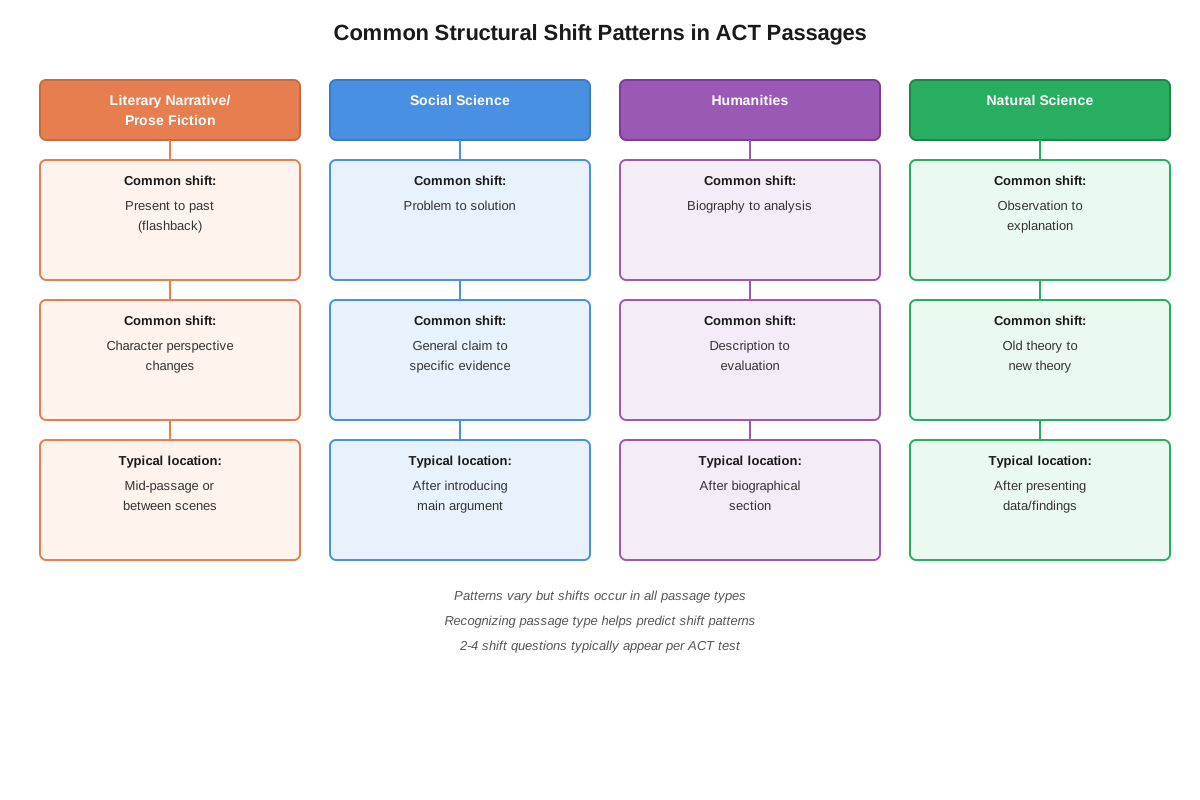
On the ACT Reading test, structural shifts appear in all four passage types: Literary Narrative/Prose Fiction, Social Science, Humanities, and Natural Science. Questions about these shifts may ask students to identify where a passage changes direction, explain why an author introduces a new perspective, or determine how different sections of a passage relate to one another. These questions test whether students can see beyond individual sentences to understand the passage's overall organization and the author's strategic choices in constructing their argument or narrative.
Understanding structural shifts connects directly to other critical reading skills tested on the ACT, including identifying main ideas, understanding author's purpose, analyzing point of view, and recognizing rhetorical strategies. When students master structural shifts, they develop a more sophisticated understanding of how texts are constructed, which improves their ability to answer questions about organization, function, and purpose—question types that frequently appear on the exam and often challenge even well-prepared test-takers.
Learning Objectives
- [ ] Identify when Structural shifts is being tested in ACT Reading questions
- [ ] Explain the core rule or strategy behind recognizing structural shifts in passages
- [ ] Apply structural shift recognition to ACT-style questions accurately
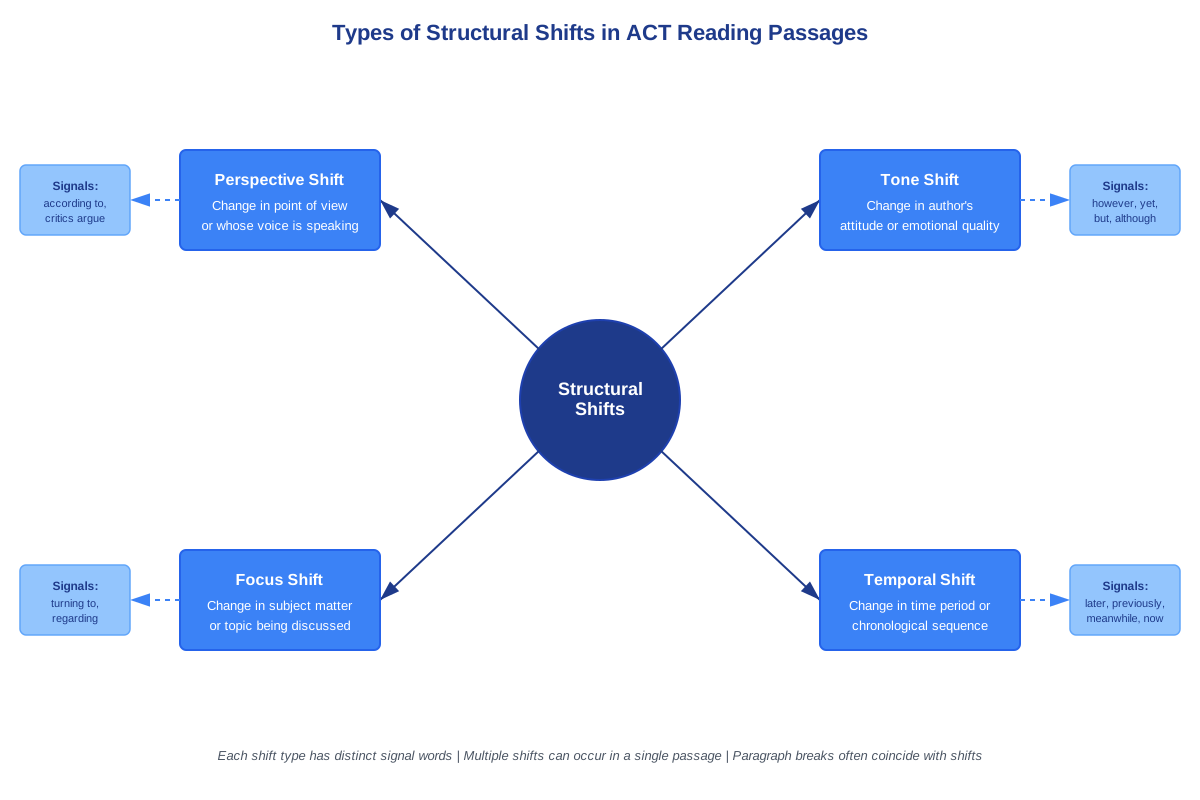
- [ ] Distinguish between different types of structural shifts (tone, perspective, focus, temporal)
- [ ] Predict where structural shifts are likely to occur based on transition words and paragraph breaks
- [ ] Analyze the function and purpose of structural shifts within a passage's overall argument or narrative
Prerequisites
- Basic paragraph structure understanding: Students must recognize topic sentences, supporting details, and concluding statements to identify when a paragraph's focus changes
- Transition word knowledge: Familiarity with words like "however," "although," "meanwhile," and "in contrast" helps signal upcoming shifts
- Main idea identification: Recognizing the central point of paragraphs and passages provides the foundation for noticing when that focus changes
- Author's purpose awareness: Understanding why authors write (to inform, persuade, entertain, describe) helps identify when that purpose shifts within a text
Why This Topic Matters
Structural shifts matter because they reveal how authors organize their thinking and guide readers through complex ideas. In academic and professional contexts, recognizing these shifts helps readers follow arguments, understand nuanced positions, and identify when writers are presenting counterarguments, introducing new evidence, or drawing conclusions. This skill transfers directly to college-level reading, where texts frequently present multiple perspectives or shift between theoretical frameworks and practical applications.
On the ACT Reading section, structural shift questions appear with high frequency—typically 2-4 questions per test across the four passages. These questions often carry significant weight because they test higher-order thinking skills rather than simple recall. Common question formats include: "The passage shifts from X to Y in order to...", "The function of the third paragraph is to...", "The author's discussion changes in line X when...", and "Compared to the first half of the passage, the second half..."
Structural shifts appear most commonly at paragraph boundaries, after transition words or phrases, when quotation marks introduce a new speaker, when time markers indicate temporal changes, and when the author explicitly signals a change with phrases like "on the other hand" or "turning now to." In Literary Narrative passages, shifts often involve changes in time, setting, or character focus. In argumentative passages (Social Science, Humanities, Natural Science), shifts typically involve moving from problem to solution, from general to specific, from one perspective to a contrasting view, or from description to analysis.
Core Concepts
What Are Structural Shifts?
A structural shift occurs when an author deliberately changes one or more key elements of their writing within a passage. These changes are not random but serve specific rhetorical purposes—to introduce complexity, present multiple viewpoints, show development over time, or guide readers through a logical progression of ideas. Understanding these shifts requires readers to step back from individual details and observe the passage's architecture from a higher vantage point.
Structural shifts differ from simple topic changes. While a passage might discuss multiple related topics, a structural shift involves a fundamental change in how the author approaches the subject matter. For example, a passage might discuss three different species of birds without any structural shift if the author maintains the same descriptive tone and organizational pattern throughout. However, if the author shifts from describing birds to arguing for their conservation, a structural shift has occurred because the purpose and approach have changed.
Types of Structural Shifts
Tonal Shifts
A tonal shift occurs when the author's attitude toward the subject changes. The passage might begin with an objective, neutral tone and shift to a more critical or enthusiastic tone. For example, a passage might start by neutrally describing a historical event, then shift to a more passionate tone when discussing its contemporary relevance. Tonal shifts often signal the author's true position or the passage's ultimate purpose.
Key indicators of tonal shifts include:
- Changes in word choice from neutral to emotionally charged language
- Introduction of evaluative language (good/bad, important/trivial, beneficial/harmful)
- Shift from factual statements to opinion statements
- Changes in sentence structure (from complex, formal sentences to shorter, more emphatic ones)
Perspective Shifts
Perspective shifts involve changes in whose viewpoint the passage presents. These shifts are particularly common in Social Science and Humanities passages where authors present multiple stakeholders' positions. A passage might begin by presenting a traditional historical interpretation, then shift to present revisionist historians' perspectives, and finally offer the author's own synthesis.
In Literary Narrative passages, perspective shifts might involve:
- Changes in narrative point of view (though less common on the ACT)
- Shifts between different characters' experiences or thoughts
- Movement between a character's internal thoughts and external actions
- Transitions between past and present perspectives of the same character
Focus Shifts
A focus shift occurs when the passage's subject matter or level of specificity changes. Common patterns include:
| Shift Pattern | Description | Example |
|---|---|---|
| General → Specific | Moves from broad overview to detailed example | Discussing democracy generally, then focusing on one election |
| Specific → General | Moves from particular case to broader principle | Describing one experiment, then discussing its implications |
| Problem → Solution | Identifies an issue, then proposes remedies | Climate change effects, then mitigation strategies |
| Description → Analysis | Presents facts, then interprets their meaning | Historical events, then their significance |
| Concrete → Abstract | Moves from tangible examples to theoretical concepts | Specific behaviors, then psychological theories |
Temporal Shifts
Temporal shifts involve changes in time frame, particularly common in Literary Narrative and Humanities passages. These shifts might include:
- Flashbacks to earlier events
- Flash-forwards to future consequences
- Movement between historical periods
- Transitions from past to present to future
- Changes in narrative pacing (from detailed moment-by-moment to summarized years)
Signaling Devices for Structural Shifts
Authors use various devices to signal structural shifts, and recognizing these markers helps students anticipate and identify shifts quickly:
Explicit transition words and phrases:
- Contrast: however, nevertheless, on the other hand, conversely, yet, but, although
- Addition/Continuation: moreover, furthermore, additionally, similarly
- Causation: therefore, consequently, as a result, thus
- Temporal: meanwhile, subsequently, previously, now, then
- Exemplification: for instance, specifically, in particular
Paragraph breaks: New paragraphs often signal shifts, especially when combined with transition words. The ACT frequently places structural shifts at paragraph boundaries.
Punctuation markers:
- Colons introducing explanations or lists
- Semicolons connecting related but distinct ideas
- Dashes setting off contrasting information
- Quotation marks introducing new voices or perspectives
Rhetorical questions: When authors pose questions, they often signal a shift to addressing that question or exploring a new dimension of the topic.
Direct announcements: Phrases like "turning now to," "another perspective suggests," "in contrast to this view," or "the consequences of this were" explicitly signal shifts.
Functions of Structural Shifts
Understanding why authors create structural shifts helps students answer function questions on the ACT:
- To present multiple perspectives: Showing different viewpoints creates a more comprehensive, balanced discussion
- To develop complexity: Moving from simple to complex understanding mirrors how readers naturally process information
- To create emphasis: Shifting tone or focus draws attention to particularly important ideas
- To show causation: Moving from cause to effect or problem to solution demonstrates logical relationships
- To maintain reader engagement: Variety in approach prevents monotony and sustains interest
- To mirror chronological or logical progression: Shifts can reflect natural sequences in time or reasoning
Concept Relationships
Structural shifts connect intimately with several other reading comprehension skills. Main idea identification depends on recognizing structural shifts because the passage's central argument often emerges from how different sections relate to one another. A passage that shifts from describing a problem to proposing solutions has a main idea that encompasses both parts, not just one or the other.
Author's purpose becomes clearer when students track structural shifts. If a passage begins descriptively but shifts to argumentative, the author's ultimate purpose is likely persuasive, with the initial description serving as foundation for the argument. Similarly, tone analysis requires attention to tonal shifts—the author's final tone often carries more weight than the initial tone.
The relationship map for structural shifts looks like this:
Transition words → signal → Structural shifts → reveal → Author's purpose
↓
Paragraph organization → contains → Structural shifts → clarify → Main idea
↓
Multiple perspectives → create → Structural shifts → support → Argument complexity
Understanding point of view helps identify perspective shifts, while recognizing rhetorical strategies helps explain why authors create particular shifts. For example, an author might shift from emotional appeal to logical argument as a deliberate rhetorical choice to reach different audiences or strengthen credibility.
High-Yield Facts
⭐ Structural shifts most commonly occur at paragraph boundaries, making paragraph breaks critical markers to notice during active reading.
⭐ Transition words like "however," "yet," "but," and "although" signal contrast shifts, indicating the author is about to present an opposing view or contradictory information.
⭐ The ACT frequently asks about the function of specific paragraphs, which requires understanding how that paragraph relates to surrounding sections through structural shifts.
⭐ Shifts from general to specific or specific to general are among the most common patterns on ACT Reading passages across all subject areas.
⭐ Temporal shifts in Literary Narrative passages often serve to reveal character development or explain motivations by showing past events that influenced present actions.
- Structural shift questions often use phrases like "the passage shifts from," "the function of paragraph X is to," or "compared to the earlier discussion."
- Quotation marks frequently signal perspective shifts, introducing a new voice or viewpoint distinct from the author's.
- The middle of passages (paragraphs 3-5 in a typical 7-paragraph passage) often contain the most significant structural shifts.
- Shifts in verb tense can indicate temporal shifts, particularly in narrative passages.
- Rhetorical questions often precede structural shifts, with the question introducing a new focus that subsequent paragraphs address.
- Passages that present problems typically shift to solutions or consequences in later paragraphs.
- The final paragraph often shifts to broader implications, future directions, or synthesis of earlier ideas.
- Colons and semicolons can signal micro-shifts within paragraphs, introducing explanations or contrasts.
- Shifts from passive to active voice (or vice versa) can indicate changes in focus or emphasis.
- Natural Science passages frequently shift from describing phenomena to explaining mechanisms or from observation to theory.
Quick check — test yourself on Structural shifts so far.
Try Flashcards →Common Misconceptions
Misconception: Every new paragraph represents a structural shift. → Correction: New paragraphs often continue the same focus or perspective with additional supporting details. True structural shifts involve fundamental changes in approach, tone, perspective, or focus, not merely the introduction of new but related information.
Misconception: Structural shifts only occur once per passage. → Correction: Passages frequently contain multiple structural shifts. A typical ACT passage might shift from description to analysis, then from one perspective to another, then from specific examples to general principles—three distinct shifts serving different purposes.
Misconception: Identifying where a shift occurs is sufficient for answering questions. → Correction: ACT questions typically ask about the function or purpose of shifts, not just their location. Students must understand why the author created the shift and how it serves the passage's overall purpose.
Misconception: Transition words always signal major structural shifts. → Correction: Some transition words (like "also," "additionally," "furthermore") signal continuation rather than shift. Only contrastive, temporal, or causal transitions reliably indicate structural shifts.
Misconception: Structural shifts are unique to argumentative passages. → Correction: All passage types contain structural shifts. Literary narratives shift in time, setting, or character focus; descriptive passages shift in level of detail or aspect being described; argumentative passages shift in perspective or from problem to solution.
Misconception: The author's main point appears before any structural shifts. → Correction: Authors often build toward their main point through structural shifts. The most important idea frequently appears after a shift that moves from setup to payoff, from evidence to conclusion, or from multiple perspectives to synthesis.
Worked Examples
Example 1: Social Science Passage
Passage Excerpt:
"For decades, economists viewed consumer behavior through the lens of rational choice theory, which assumes individuals make decisions by carefully weighing costs and benefits to maximize their utility. This framework dominated economic thought and policy-making throughout the mid-twentieth century, providing elegant mathematical models that predicted market behavior with reasonable accuracy.
However, beginning in the 1970s, psychologists Daniel Kahneman and Amos Tversky challenged this assumption through a series of groundbreaking experiments. Their research revealed systematic patterns of irrational decision-making that contradicted rational choice predictions. People consistently overvalued losses compared to equivalent gains, made different choices depending on how options were framed, and relied on mental shortcuts that led to predictable errors."
Question: The passage shifts from the first paragraph to the second paragraph in order to:
A) Provide historical context for an economic theory
B) Introduce a challenge to an established viewpoint
C) Explain the methodology of psychological research
D) Compare two competing economic frameworks
Analysis:
First, identify the structural shift. The first paragraph presents rational choice theory as the dominant framework, using neutral, descriptive language. The second paragraph begins with "However," a key contrast transition word, immediately signaling a structural shift.
Next, determine the type of shift. This is a perspective shift (from one theoretical viewpoint to a challenging viewpoint) combined with a tonal shift (from neutral description to implicit criticism through words like "challenged" and "contradicted").
Finally, analyze the function. The shift serves to introduce opposition to the established theory. The first paragraph sets up the traditional view, and the second paragraph presents the challenge to that view.
Answer: B - The passage shifts to introduce a challenge to the established rational choice theory viewpoint. Option A is incorrect because historical context appears in the first paragraph, not as the function of the shift. Option C is too narrow, focusing on methodology rather than the broader function of challenging the theory. Option D is incorrect because the second paragraph presents a challenge, not a competing framework of equal standing.
Connection to Learning Objectives: This example demonstrates how to identify when structural shifts are being tested (the phrase "shifts from...to" is a clear trigger), explains the strategy of identifying transition words and analyzing the relationship between sections, and shows how to apply this understanding to select the correct answer.
Example 2: Literary Narrative Passage
Passage Excerpt:
"Marcus stood at the edge of the dock, watching the ferry disappear into the fog. The summer stretched before him like an empty canvas—three months in his grandmother's coastal town, far from his friends and the city life he knew. He kicked a loose board, sending it clattering into the water below.
Twenty years later, Marcus would return to that same dock, this time with his own daughter. The town had changed little, but everything looked different through his adult eyes. The isolation he had resented as a teenager now seemed like a gift—those quiet months had taught him to observe, to think, to find contentment in his own company. He smiled, remembering the boy who had stood here, unable to see the value in what surrounded him."
Question: The shift from the first paragraph to the second paragraph primarily serves to:
A) Contrast Marcus's teenage and adult perspectives on the same experience
B) Describe the physical changes in the town over two decades
C) Explain why Marcus decided to return to his grandmother's town
D) Illustrate the passage of time through descriptive details
Analysis:
Identify the shift: The passage moves from present-tense narration of teenage Marcus to future-tense narration of adult Marcus, a clear temporal shift spanning twenty years.
Determine the additional dimensions: Beyond the temporal shift, there's a perspective shift (teenage viewpoint to adult viewpoint) and a tonal shift (from resentful/negative to appreciative/positive).
Analyze the function: The shift doesn't merely show time passing; it demonstrates how Marcus's understanding of the same experience changed. The phrase "everything looked different through his adult eyes" explicitly states this purpose. The contrast between "empty canvas" (negative connotation) and "gift" (positive connotation) reinforces the shift in perspective.
Answer: A - The shift primarily contrasts Marcus's teenage and adult perspectives. Option B is incorrect because the passage explicitly states "the town had changed little"—physical changes aren't the focus. Option C is wrong because the passage doesn't explain his decision to return. Option D is too general; while time passes, the function is specifically about contrasting perspectives, not merely illustrating temporal change.
Connection to Learning Objectives: This example shows how temporal shifts often serve deeper purposes than simply moving through time. It demonstrates the importance of analyzing not just what shifts but why the author created that shift, connecting to the objective of explaining the core strategy behind structural shifts.
Exam Strategy
Approaching Structural Shift Questions
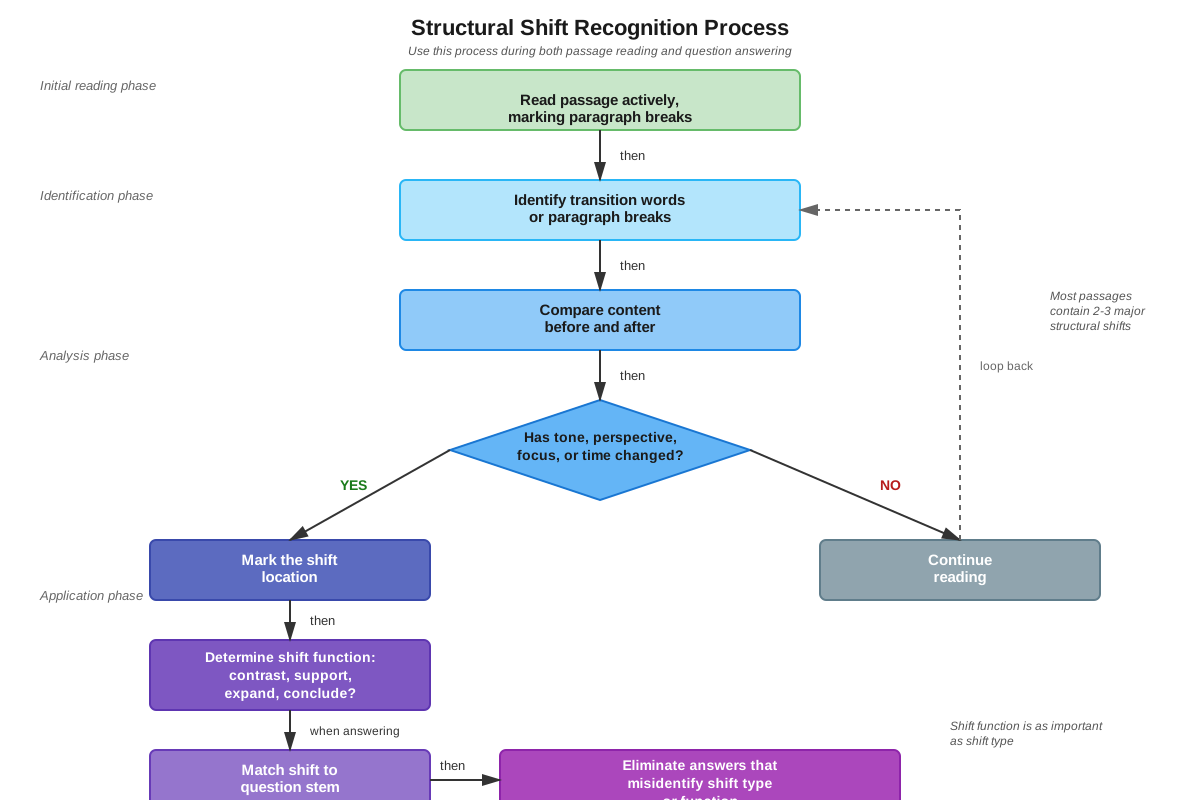
When encountering questions about structural shifts, follow this systematic approach:
- Identify trigger language: Look for phrases like "shifts from," "the function of," "serves to," "compared to," "the author moves from," or "the passage changes." These phrases signal structural shift questions.
- Locate the shift: Find the exact point where the change occurs. This is usually at a paragraph break, after a transition word, or where you notice a change in tone, focus, or perspective.
- Characterize both sides: Clearly identify what comes before the shift and what comes after. Use specific labels: descriptive vs. analytical, past vs. present, Problem A vs. Solution B, Perspective 1 vs. Perspective 2.
- Determine the function: Ask "Why did the author make this change?" The answer usually relates to the passage's overall purpose—to show complexity, present multiple views, develop an argument, or create emphasis.
- Eliminate answers that describe content rather than function: Wrong answers often describe what the passage discusses rather than why the shift occurs or what it accomplishes.
Trigger Words and Phrases
In questions:
- "shifts from...to"
- "the function of [paragraph/section] is to"
- "serves primarily to"
- "the author moves from"
- "compared to the earlier/later discussion"
- "the passage changes when"
- "the primary purpose of [section] is to"
In passages (signaling shifts):
- Contrast: however, yet, but, although, nevertheless, on the other hand, conversely, in contrast
- Temporal: meanwhile, subsequently, later, previously, now, then, at that time
- Causation: therefore, thus, consequently, as a result
- Addition with shift: moreover (adding new dimension), furthermore (extending scope)
Process of Elimination Tips
Eliminate answers that:
- Focus on minor details rather than the shift's overall function
- Describe only one side of the shift (before or after) without addressing the relationship
- Are too broad or could apply to the entire passage rather than the specific shift
- Confuse the shift's location with its function
- Mischaracterize the tone or perspective of either section
Favor answers that:
- Use functional language (to contrast, to introduce, to challenge, to illustrate, to support)
- Accurately describe both what comes before and after the shift
- Connect the shift to the passage's main idea or author's purpose
- Match the scope of the shift (don't overstate or understate its significance)
Time Allocation
Structural shift questions typically require 45-60 seconds to answer—slightly more than detail questions but less than main idea questions. Invest time in:
- Carefully reading the question to identify exactly what shift is being asked about (15 seconds)
- Locating and characterizing the shift in the passage (20 seconds)
- Evaluating answer choices systematically (20-25 seconds)
If you're unsure, mark the question and return to it after completing easier questions. Structural shift questions often become clearer after you've thoroughly read and understood the entire passage.
Memory Techniques
The SHIFT Acronym
Use SHIFT to remember the steps for analyzing structural shifts:
- Signal words: Look for transition words and paragraph breaks
- Halves: Identify what comes before and after the shift
- Intent: Determine the author's purpose for creating the shift
- Function: Articulate what the shift accomplishes
- Test: Check your understanding against answer choices
The Five Common Shift Patterns
Remember GPS-TC for the five most common structural shift patterns:
- General to Specific (or reverse)
- Problem to Solution
- Single perspective to Multiple perspectives
- Time changes (past to present, flashback, flash-forward)
- Contrast (opposing viewpoints, different tones)
Visualization Strategy
Picture a passage as a journey with distinct segments. When you encounter a structural shift, visualize a fork in the road, a bridge to a new island, or a door opening to a new room. This mental image helps you recognize that something fundamental has changed, not just a minor detail.
The "However" Rule
Remember: "However" = High-value shift marker. When you see "however," "yet," "but," or "although," slow down and pay extra attention. These words signal that the author is about to present contrasting information, which often leads to structural shift questions.
Summary
Structural shifts represent fundamental changes in how authors approach their subject matter within a passage, including shifts in tone, perspective, focus, or time frame. Mastering structural shifts requires students to read actively for organizational patterns, recognize signal words and paragraph breaks that indicate shifts, and understand the functional purpose these shifts serve in advancing the author's overall argument or narrative. On the ACT Reading section, structural shift questions appear frequently and test higher-order comprehension skills by asking students to analyze relationships between passage sections rather than recall isolated details. Success requires identifying where shifts occur, characterizing what changes, and determining why the author created that shift. The most common patterns include general-to-specific movements, problem-to-solution progressions, perspective changes, temporal transitions, and tonal shifts. Students who master structural shifts gain a sophisticated understanding of passage architecture that improves performance across all question types, as recognizing how passages are organized enhances comprehension of main ideas, author's purpose, and rhetorical strategies.
Key Takeaways
- Structural shifts occur when authors fundamentally change their approach, tone, perspective, focus, or time frame within a passage—these are not simple topic changes but architectural changes in how the passage is constructed.
- Paragraph breaks and transition words (especially "however," "yet," "although") are the most reliable signals that a structural shift may be occurring and deserve careful attention during active reading.
- ACT questions about structural shifts typically ask about function, not just location—understanding why the author created a shift is more important than simply identifying where it occurs.
- The five most common shift patterns are general-to-specific, problem-to-solution, single-to-multiple perspectives, temporal changes, and contrasting viewpoints—recognizing these patterns helps predict and identify shifts quickly.
- Structural shift questions connect to nearly every other reading skill tested on the ACT, including main idea, author's purpose, tone, and organization, making this a high-value topic for improving overall Reading scores.
- Effective analysis requires characterizing both sides of the shift—what comes before and what comes after—and articulating the relationship between them.
- Wrong answers often describe content rather than function—eliminate choices that tell you what the passage discusses rather than what the shift accomplishes or why it exists.
Related Topics
Author's Purpose and Rhetorical Strategies: Understanding structural shifts deepens comprehension of why authors make specific organizational choices. Mastering shifts enables more sophisticated analysis of how authors construct arguments and narratives to achieve their purposes.
Main Idea and Theme: Structural shifts often reveal the passage's central argument by showing how different perspectives or ideas relate to one another. The main idea frequently emerges from the relationship between sections divided by structural shifts.
Tone and Attitude: Tonal shifts represent one specific type of structural shift. Mastering general structural shift recognition provides the foundation for more nuanced tone analysis throughout passages.
Comparative Passages: Some ACT Reading sections include paired passages that present different perspectives on the same topic. Understanding structural shifts within single passages prepares students for analyzing relationships between entire passages.
Organization and Structure Questions: Beyond identifying shifts, students can progress to analyzing overall passage organization, including how multiple shifts work together to create coherent arguments or narratives.
Practice CTA
Now that you understand structural shifts—one of the most sophisticated and high-yield topics on the ACT Reading section—it's time to apply this knowledge. Work through the practice questions to test your ability to identify shifts, analyze their functions, and select correct answers under timed conditions. Use the flashcards to reinforce key concepts, signal words, and common shift patterns until recognizing these structures becomes automatic. Remember: structural shifts appear on every ACT Reading test, often in multiple questions per passage. The time you invest in mastering this topic will pay dividends across all passage types and question formats. You've built the foundation—now strengthen it through deliberate practice!
Sign up free to keep reading
Create a free AnvayaPrep account to finish this ACT guide on Structural shifts — plus flashcards and practice questions.