Overview
Broad inference questions represent one of the most challenging and frequently tested question types on the ACT Reading section. Unlike detail-oriented questions that ask about specific facts stated directly in the passage, broad inference questions require students to synthesize information from multiple parts of a passage, understand implicit meanings, and draw logical conclusions that extend beyond what is explicitly stated. These questions assess a student's ability to "read between the lines" and understand the larger implications, themes, and purposes that underlie a text.
Mastering ACT broad inference questions is essential because they typically account for 20-30% of all Reading questions on any given test. These questions often carry higher difficulty ratings and serve as discriminators between average and high-scoring students. They require not just comprehension of individual sentences or paragraphs, but a holistic understanding of how ideas connect throughout an entire passage. Students who excel at these questions demonstrate sophisticated reading skills that colleges value highly.
Within the broader framework of ACT Reading skills, broad inference questions sit at the intersection of literal comprehension and critical analysis. They build upon foundational skills like identifying main ideas and understanding explicit details, while also connecting to more advanced skills like analyzing author's purpose and evaluating rhetorical strategies. Success with these questions indicates that a student has moved beyond surface-level reading to achieve genuine textual understanding and analytical thinking.
Learning Objectives
- [ ] Identify when Broad inference questions is being tested
- [ ] Explain the core rule or strategy behind Broad inference questions
- [ ] Apply Broad inference questions to ACT-style questions accurately
- [ ] Distinguish between broad inferences and narrow detail-based inferences
- [ ] Evaluate answer choices to eliminate options that are too specific, too extreme, or unsupported
- [ ] Synthesize information from multiple paragraphs to form valid conclusions
- [ ] Recognize common question stems and trigger phrases that signal broad inference questions
Prerequisites
- Main idea identification: Understanding how to determine the central point of a passage is essential because broad inferences often extend from or relate to the main idea
- Paragraph-level comprehension: The ability to understand individual paragraphs is necessary before synthesizing information across multiple sections
- Basic inference skills: Students must already be comfortable making simple, localized inferences before tackling passage-wide conclusions
- Understanding of passage structure: Recognizing how passages are organized helps identify where supporting evidence for broad inferences can be found
Why This Topic Matters
Broad inference questions test real-world reading skills that extend far beyond standardized testing. In college coursework, students must constantly draw conclusions from academic texts, synthesize information across multiple sources, and understand implicit arguments that authors make without stating them directly. Professional contexts—from analyzing business reports to understanding legal documents—require the same inferential reasoning skills. The ability to "read between the lines" and understand what an author implies, suggests, or assumes is fundamental to sophisticated literacy.
On the ACT Reading section, broad inference questions appear with remarkable consistency. Students can expect to encounter 5-8 broad inference questions per test, distributed across all four passage types (Literary Narrative/Prose Fiction, Social Science, Humanities, and Natural Science). These questions typically appear in the middle-to-end portion of each passage's question set, after more straightforward detail questions have established basic comprehension. The ACT deliberately places these questions strategically to assess whether students have achieved deep understanding of the passage.
Common manifestations of broad inference questions include asking about the passage's overall tone or mood, the author's underlying assumptions or beliefs, what can be concluded about a character's personality or motivations across the entire narrative, the general relationship between concepts discussed throughout the passage, or the likely audience for whom the passage was written. These questions require students to consider the passage as a unified whole rather than focusing on isolated details.
Core Concepts
What Defines a Broad Inference Question
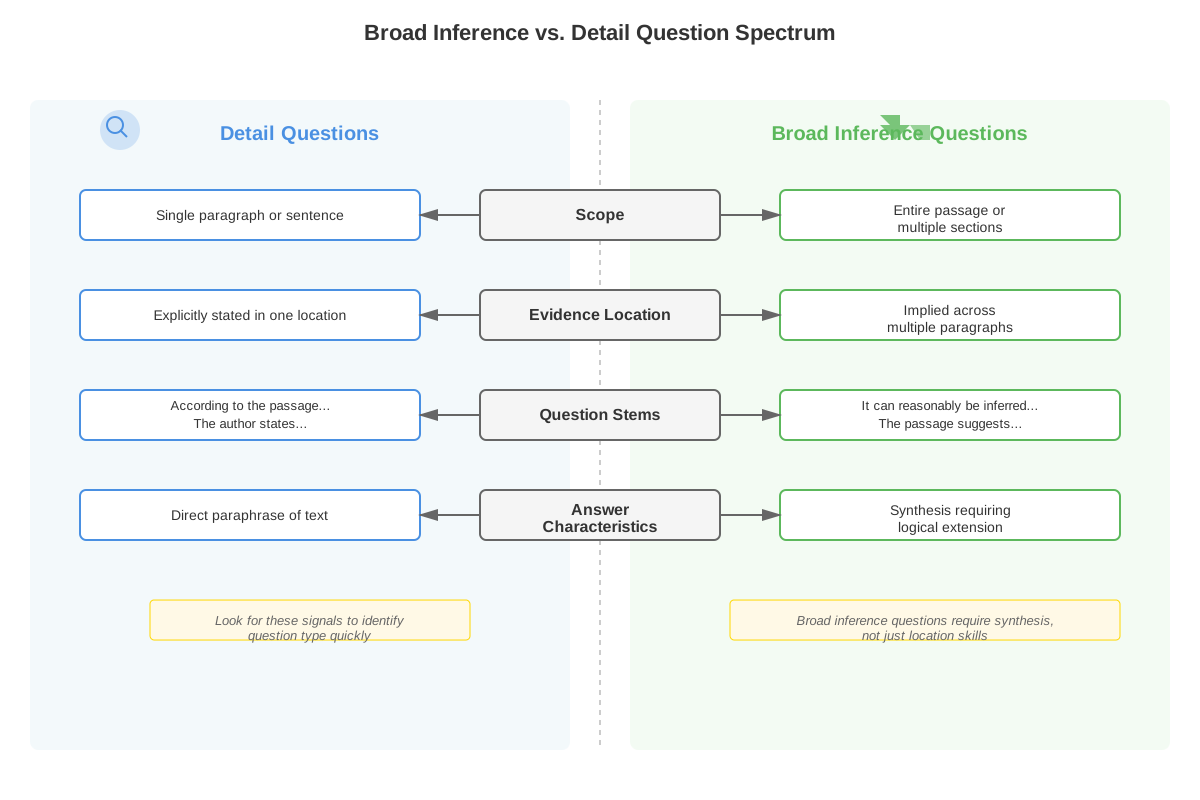
A broad inference question asks students to draw a conclusion that applies to the passage as a whole or to major portions of it, rather than to a single detail or specific line. The key distinguishing feature is scope: these questions require synthesizing information from multiple paragraphs or sections. The correct answer will be supported by evidence throughout the passage, not just in one location. Broad inferences are logical conclusions that must be true based on the passage content, even though they are never explicitly stated.
The ACT designs these questions to test whether students can move beyond literal comprehension to understand implicit meanings, underlying themes, and logical extensions of the text. A broad inference represents something that the author strongly suggests or that necessarily follows from the information provided, but that requires the reader to connect multiple pieces of evidence and think critically about their combined implications.
Identifying Broad Inference Questions
Recognition is the first critical skill. ACT broad inference questions typically use specific question stems that signal their nature:
- "It can reasonably be inferred from the passage that..."
- "The passage suggests that..."
- "Based on the passage, which of the following can be concluded about..."
- "The author would most likely agree that..."
- "The passage as a whole indicates that..."
- "Which of the following statements best describes..."
- "The overall tone of the passage can best be described as..."
The presence of words like "suggests," "implies," "indicates," "inferred," "concluded," or "most likely" signals that the answer will not be stated directly. Additionally, phrases like "the passage as a whole," "throughout the passage," or "overall" indicate broad rather than narrow scope.
The Core Strategy: Evidence-Based Synthesis
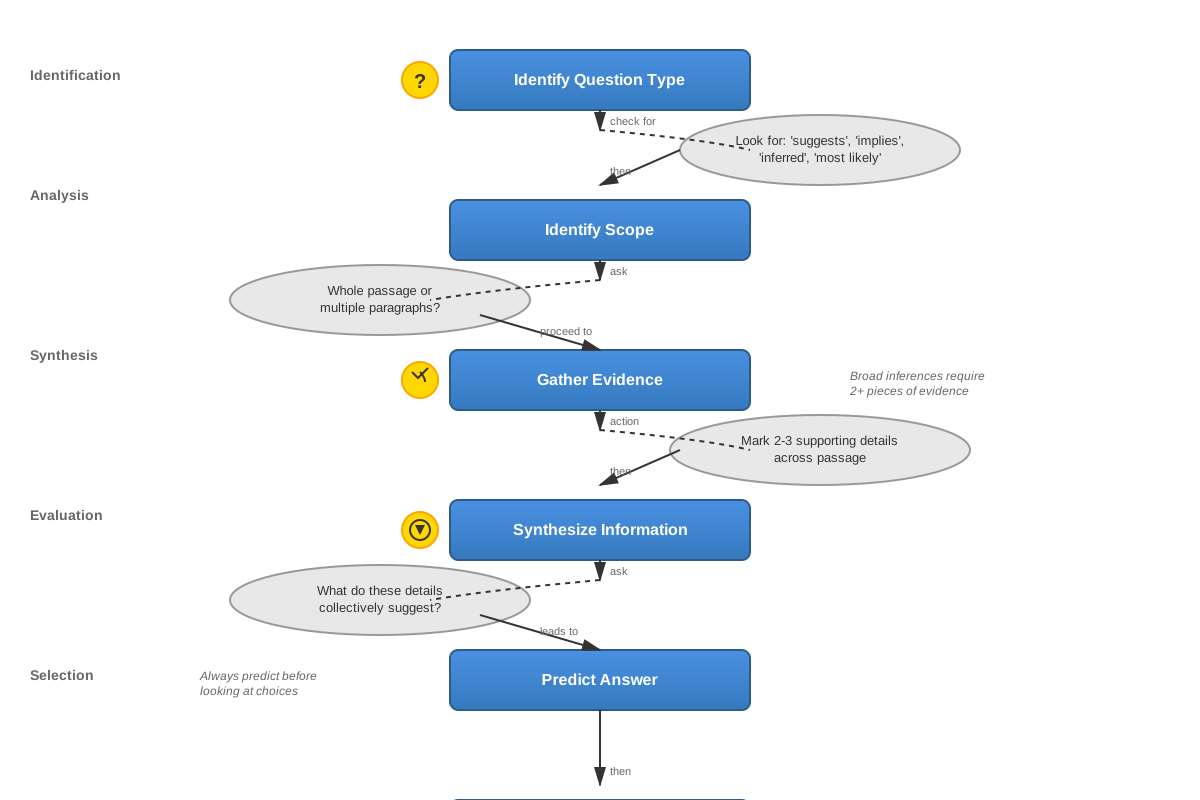
The fundamental approach to broad inference questions involves a three-step process:
- Identify the scope: Determine what portion of the passage the question addresses (usually the entire passage or multiple major sections)
- Gather evidence: Locate 2-4 pieces of supporting information from different parts of the passage that relate to the question
- Synthesize and conclude: Combine this evidence to determine what must logically follow
This strategy differs markedly from detail questions, where students can often find the answer in a single sentence or paragraph. Broad inferences require triangulation—using multiple data points to establish a conclusion that no single piece of evidence could support alone.
Characteristics of Correct Answers
Correct answers to broad inference questions share several consistent features:
| Feature | Description | Example Context |
|---|---|---|
| Supported throughout | Evidence appears in multiple paragraphs | Character traits demonstrated in three different scenes |
| Moderate in tone | Avoids extreme language like "always," "never," "only" | "The author is generally skeptical" rather than "completely rejects" |
| Logically necessary | Must be true given the passage information | If passage shows repeated failures, can infer persistence was challenged |
| Passage-focused | Stays within the scope of what the passage discusses | Doesn't introduce outside knowledge or tangential topics |
| Appropriately general | Broad enough to encompass the question's scope | "The process is complex" rather than "Step 3 is difficult" |
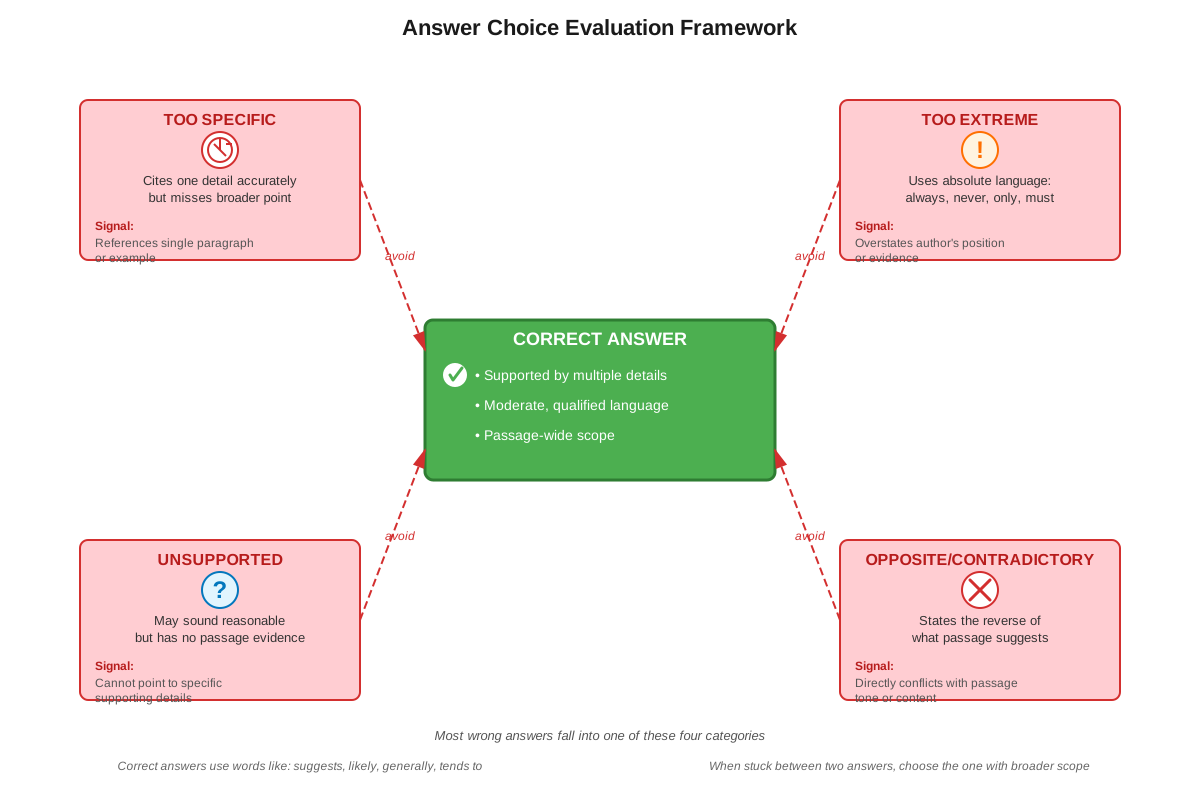
Characteristics of Incorrect Answers
Understanding wrong answer patterns is equally important for efficient elimination:
Too specific: The answer focuses on a single detail or example rather than addressing the broader question. These answers might be factually accurate but fail to capture the scope required.
Too extreme: The answer uses absolute language or makes claims that go beyond what the passage supports. Words like "always," "never," "impossible," "only," "completely," or "entirely" often signal this trap.
Unsupported: The answer might sound plausible or even be true in the real world, but lacks sufficient evidence in the passage itself. The ACT tests reading comprehension, not outside knowledge.
Contradicted: The answer directly conflicts with information stated or implied in the passage, even if only in one section.
Too narrow or too broad: The answer either addresses only a small portion of what the question asks about, or makes claims that extend beyond the passage's scope entirely.
The Relationship Between Evidence and Inference
A critical concept for mastering broad inference questions is understanding the evidence-inference continuum. At one end are explicit statements—facts directly stated in the passage. At the other end are wild speculations—conclusions with no textual support. Correct broad inferences occupy the middle ground: they are not explicitly stated, but they are strongly supported by combining multiple pieces of explicit evidence.
Think of it as a mathematical proof: if the passage states A, B, and C, and these facts logically lead to conclusion D, then D is a valid inference even though it's never mentioned. The ACT expects students to make this logical leap, but only when the evidence clearly supports it.
Passage-Wide vs. Section-Specific Inferences
Not all broad inference questions cover the entire passage. Some ask about major sections or recurring themes. The key distinction is that even section-specific broad inferences require synthesizing multiple pieces of information rather than pointing to a single detail. A question about "the author's attitude toward technology throughout paragraphs 3-5" is still a broad inference question because it requires combining evidence from multiple paragraphs, even though it doesn't cover the entire passage.
Concept Relationships
The concepts within broad inference questions form an interconnected system. Question identification serves as the entry point—students must first recognize they're dealing with a broad inference question before applying appropriate strategies. This recognition then triggers the evidence-gathering process, which requires understanding passage scope to know where to look for supporting information. The evidence gathered must then undergo synthesis, where students combine multiple pieces of information to form a conclusion.
This synthesis process directly connects to understanding answer choice characteristics. Knowing what makes correct answers work (moderate tone, passage-wide support, logical necessity) and what makes incorrect answers fail (too specific, too extreme, unsupported) allows students to efficiently evaluate options. The evidence-inference continuum concept underlies all of this, helping students calibrate how far they can reasonably extend beyond explicit statements.
These concepts build upon prerequisite skills in a clear progression: Basic comprehension → Main idea identification → Simple inferences → Broad inferences → Complex analytical reasoning. Students who struggle with broad inference questions often have gaps in earlier stages of this progression, particularly in synthesizing information across multiple paragraphs or distinguishing between what is stated and what is implied.
Broad inference questions also connect forward to more advanced Reading skills. Mastering them prepares students for author's purpose questions (which often require inferring intent from patterns of evidence), tone and mood questions (which require synthesizing emotional indicators throughout a passage), and comparative reasoning questions (which require inferring relationships between ideas or perspectives).
High-Yield Facts
⭐ Broad inference questions account for 20-30% of ACT Reading questions, making them one of the most frequently tested question types.
⭐ Correct answers are always supported by evidence from multiple parts of the passage, never just a single sentence or paragraph.
⭐ Question stems containing "suggests," "implies," "indicates," or "can be inferred" signal inference questions rather than detail questions.
⭐ Extreme language in answer choices ("always," "never," "only," "completely") usually indicates incorrect answers because passages rarely support absolute claims.
⭐ The correct answer must be true based on the passage, not just possibly true or true in the real world—ACT tests reading comprehension, not outside knowledge.
- Broad inference questions typically appear in the middle-to-end of each passage's question set, after establishing basic comprehension.
- Incorrect answers often focus on a single detail or example rather than addressing the broader scope of the question.
- The phrase "the passage as a whole" or "throughout the passage" explicitly signals that evidence must come from multiple sections.
- Moderate, qualified language ("generally," "suggests," "tends to") characterizes correct answers more often than absolute statements.
- Time pressure makes students prone to selecting answers based on a single memorable detail rather than synthesizing evidence—this is a designed trap.
- Natural Science and Social Science passages tend to have more broad inference questions about processes and relationships, while Literary Narrative passages focus more on character and thematic inferences.
- Eliminating clearly wrong answers first (too extreme, contradicted, too specific) is more efficient than trying to prove the right answer immediately.
Quick check — test yourself on Broad inference questions so far.
Try Flashcards →Common Misconceptions
Misconception: Broad inference questions ask for educated guesses or speculation about what might be true. → Correction: Broad inferences must be firmly supported by passage evidence; they are logical conclusions that necessarily follow from the text, not speculative possibilities. The ACT never rewards guessing beyond what the passage supports.
Misconception: If an answer choice is factually true in the real world, it's correct. → Correction: Correct answers must be supported by the specific passage provided, regardless of outside knowledge. The ACT tests reading comprehension, not general knowledge. An answer can be true in reality but wrong for the question if the passage doesn't support it.
Misconception: The correct answer will be stated somewhere in the passage, just paraphrased. → Correction: By definition, broad inferences are NOT explicitly stated anywhere in the passage. They require combining multiple pieces of evidence to reach a conclusion that the author implies but never directly states.
Misconception: Broad inference questions are just harder detail questions. → Correction: These are fundamentally different question types requiring different strategies. Detail questions ask "what does the passage say?" while broad inference questions ask "what does the passage suggest or imply?" The former requires locating information; the latter requires synthesizing and reasoning.
Misconception: You need to read the entire passage carefully before attempting broad inference questions. → Correction: While understanding the passage is important, efficient test-takers often skim first, then read more carefully when answering questions. For broad inference questions specifically, you should identify the question type, predict what kind of evidence you'll need, then strategically locate that evidence rather than re-reading everything.
Misconception: If you can find one sentence that supports an answer choice, it's correct. → Correction: Broad inference questions require evidence from multiple parts of the passage. A single supporting sentence is insufficient; you need a pattern of evidence that, when combined, leads to the conclusion.
Misconception: The longest or most complex answer choice is usually correct. → Correction: Answer length has no correlation with correctness on the ACT. In fact, incorrect answers are sometimes deliberately made longer or more complex to appear more sophisticated. Focus on evidence and logic, not length or complexity.
Worked Examples
Example 1: Literary Narrative Passage
Passage Context (summarized): A passage describes Maria's experiences over several years as she transitions from a corporate job to starting her own business. Paragraph 1 shows her feeling unfulfilled at work. Paragraph 3 describes her initial excitement about her business idea. Paragraph 5 details early setbacks and financial struggles. Paragraph 7 shows her persisting despite difficulties. Paragraph 9 ends with her business beginning to succeed, and she reflects on the journey.
Question: Based on the passage as a whole, which of the following best describes Maria's character?
Answer Choices:
A) She is impulsive and makes decisions without considering consequences.
B) She is determined and willing to endure hardship to achieve her goals.
C) She is primarily motivated by financial success and wealth.
D) She is cautious and prefers to avoid taking risks.
Step 1 - Identify Question Type: The phrase "based on the passage as a whole" and "describes Maria's character" signals a broad inference question requiring synthesis of information about Maria throughout the entire passage.
Step 2 - Gather Evidence:
- Paragraph 1: Maria feels unfulfilled (suggests she values meaningful work)
- Paragraph 3: She gets excited about her business idea (shows initiative)
- Paragraph 5: She faces setbacks and financial struggles (establishes obstacles)
- Paragraph 7: She persists despite difficulties (demonstrates determination)
- Paragraph 9: She reflects on the journey, not just the success (suggests process matters to her)
Step 3 - Evaluate Choices:
- Choice A: "Impulsive" is contradicted by the passage showing she left her job for meaningful reasons and persisted through difficulties—this suggests thoughtfulness, not impulsiveness. ELIMINATE.
- Choice B: "Determined" is supported by paragraph 7's persistence. "Willing to endure hardship" is supported by paragraph 5's struggles and paragraph 7's continuation despite them. "Achieve her goals" is supported by the overall arc. This synthesizes evidence from multiple paragraphs. STRONG CANDIDATE.
- Choice C: While financial struggles are mentioned, the passage emphasizes her unfulfillment and the journey itself, not wealth as primary motivation. This is too narrow and not well-supported. ELIMINATE.
- Choice D: "Cautious" and "avoid taking risks" directly contradicts her leaving a stable job to start a business. ELIMINATE.
Answer: B - This answer synthesizes evidence from throughout the passage (unfulfillment → initiative → obstacles → persistence → success) to draw a broad inference about Maria's character that is never explicitly stated but is strongly supported by the pattern of her actions across the entire narrative.
Example 2: Natural Science Passage
Passage Context (summarized): A passage discusses coral reef ecosystems. Paragraph 2 explains the symbiotic relationship between coral and zooxanthellae algae. Paragraph 4 describes how rising ocean temperatures disrupt this relationship. Paragraph 5 details the cascading effects on reef fish populations. Paragraph 6 discusses how reef degradation affects coastal protection. Paragraph 8 mentions current conservation efforts but notes their limited scope.
Question: The passage suggests that the relationship between ocean temperature and coral reef health can best be characterized as:
Answer Choices:
A) A minor factor that affects only certain coral species in isolated regions.
B) A complex issue with far-reaching consequences beyond the coral itself.
C) An easily reversible problem that conservation efforts are successfully addressing.
D) A purely biological phenomenon with no implications for human communities.
Step 1 - Identify Question Type: "The passage suggests" signals an inference question. "Can best be characterized as" indicates we need a broad conclusion about the overall relationship, not a specific detail.
Step 2 - Gather Evidence:
- Paragraph 2: Establishes the foundational coral-algae relationship
- Paragraph 4: Temperature disrupts this relationship (direct effect)
- Paragraph 5: Reef fish populations affected (secondary effect)
- Paragraph 6: Coastal protection compromised (tertiary effect, human impact)
- Paragraph 8: Conservation efforts are limited in scope (problem not easily solved)
Step 3 - Evaluate Choices:
- Choice A: "Minor factor" and "isolated regions" contradicts the passage's discussion of multiple, cascading effects across paragraphs 4-6. Too narrow. ELIMINATE.
- Choice B: "Complex issue" is supported by the multiple interconnected effects (paragraphs 4-6). "Far-reaching consequences" is supported by effects on fish, coastal protection, and human communities. "Beyond the coral itself" is supported by paragraphs 5-6. This synthesizes evidence from multiple sections. STRONG CANDIDATE.
- Choice C: "Easily reversible" contradicts paragraph 8's indication that conservation efforts are limited. "Successfully addressing" is too extreme and unsupported. ELIMINATE.
- Choice D: "Purely biological" contradicts paragraph 6's discussion of coastal protection and human implications. ELIMINATE.
Answer: B - This answer requires synthesizing information from paragraphs 2, 4, 5, 6, and 8 to draw a broad inference about the nature of the temperature-coral relationship. No single paragraph states this conclusion directly, but the pattern of evidence throughout the passage strongly supports it. The answer appropriately captures the scope and complexity discussed across the entire passage.
Exam Strategy
When approaching broad inference questions on the ACT, implement a systematic process that maximizes accuracy while managing time pressure. First, identify the question type immediately by scanning for trigger words like "suggests," "implies," "infers," or phrases like "as a whole" or "throughout the passage." This identification determines your strategy—you'll need to think synthetically rather than locate a single detail.
Read the question stem carefully to determine the exact scope. Does it ask about the entire passage, a major section, a character's overall traits, or the author's general attitude? Understanding scope prevents the common error of selecting answers that are too narrow or too broad. If the question asks about "the passage as a whole," your evidence must come from multiple sections; if it asks about "paragraphs 3-5," focus your evidence gathering there.
Before looking at answer choices, predict the general type of answer you're seeking. If the question asks about the author's attitude, think: "Based on what I've read, does the author seem positive, negative, neutral, or mixed?" This prediction acts as an anchor, preventing you from being swayed by attractive but incorrect options.
Use the process of elimination aggressively. Broad inference questions often have 2-3 clearly wrong answers that you can eliminate quickly:
- Cross out answers with extreme language first ("always," "never," "only," "completely")
- Eliminate answers that focus on a single detail when the question asks about the whole passage
- Remove answers that contradict any part of the passage
- Eliminate answers that require outside knowledge not provided in the passage
For remaining choices, actively seek evidence. Don't just ask "Could this be true?" but rather "What specific evidence from multiple parts of the passage supports this?" The correct answer should have 2-4 clear pieces of supporting evidence from different sections. If you can only find one supporting detail, the answer is likely too narrow.
Watch for "half-right" trap answers—these contain some accurate information but include one element that's unsupported or extreme. Read the entire answer choice carefully; every part must be supported by the passage.
Time allocation: Spend 45-60 seconds on broad inference questions, slightly more than detail questions but less than complex analytical questions. If you're stuck between two answers after 60 seconds, mark your best guess and flag the question to return to if time permits. Don't let one difficult question consume 2-3 minutes.
Trigger phrases to watch for in answer choices:
- Moderate qualifiers ("generally," "often," "suggests," "tends to") → usually good signs
- Extreme absolutes ("always," "never," "impossible," "only") → usually wrong
- Scope indicators ("throughout," "overall," "primarily") → should match question scope
- Certainty levels ("must be," "proves," "demonstrates") → require very strong evidence
Memory Techniques
BROAD Acronym for evaluating answer choices:
- Backed by multiple pieces of evidence
- Reasonable in tone (not extreme)
- Overall scope matches the question
- Aligns with passage content (not outside knowledge)
- Derived logically from synthesis
The "Three-Point Rule": For any answer choice you're considering, identify at least three different places in the passage that support it. If you can't find three supporting points, it's likely too narrow or unsupported. This forces you to think broadly and synthesize evidence.
Visualization Strategy: Picture the passage as a puzzle where individual pieces (paragraphs or details) must fit together to create a complete picture (the broad inference). The correct answer describes the complete picture, not just one puzzle piece.
The "Goldilocks Principle": Correct answers are "just right"—not too specific (focusing on one detail), not too broad (extending beyond the passage), not too extreme (using absolute language), but appropriately general and moderate. When evaluating answers, ask: "Is this too hot, too cold, or just right?"
SWEEP Method for systematic elimination:
- Specific? (Too narrow for the question scope?)
- Wild? (Too extreme in language or claims?)
- Evidence? (Lacking support from multiple sections?)
- Extraneous? (Requires outside knowledge?)
- Passage-contradicted? (Conflicts with any passage information?)
Summary
Broad inference questions represent a critical ACT Reading skill that requires students to synthesize information from multiple parts of a passage to draw logical conclusions that are strongly implied but never explicitly stated. These questions, which account for 20-30% of Reading questions, test whether students can move beyond literal comprehension to understand implicit meanings, underlying themes, and logical extensions of the text. Success requires a systematic approach: identifying the question type through trigger words like "suggests" or "implies," determining the appropriate scope, gathering evidence from multiple paragraphs, and synthesizing this evidence to reach a conclusion. Correct answers are always supported by multiple pieces of passage evidence, use moderate rather than extreme language, and stay within the scope of what the passage discusses. Common traps include answers that are too specific (focusing on single details), too extreme (using absolute language), unsupported (lacking sufficient evidence), or that require outside knowledge. Mastering these questions requires understanding the evidence-inference continuum—knowing how far to extend beyond explicit statements while remaining firmly grounded in textual support.
Key Takeaways
- Broad inference questions require synthesizing information from multiple parts of the passage, not just locating a single detail
- Trigger words like "suggests," "implies," "indicates," and "can be inferred" signal these question types
- Correct answers must be supported by evidence from at least 2-3 different sections of the passage
- Extreme language ("always," "never," "only") in answer choices usually indicates incorrect options
- The correct answer is never explicitly stated in the passage but must be logically necessary based on the evidence provided
- Eliminate answers that are too specific, too extreme, unsupported, or that require outside knowledge
- These questions account for 20-30% of ACT Reading questions, making them essential for achieving high scores
Related Topics
Author's Purpose and Perspective: Building on broad inference skills, these questions ask students to infer why an author wrote a passage or what viewpoint they hold. Mastering broad inferences provides the foundation for understanding implicit authorial intent.
Tone and Mood Questions: These require synthesizing emotional indicators throughout a passage to infer the overall atmosphere or author's attitude—a direct application of broad inference skills to emotional and stylistic elements.
Comparative Reasoning: Some ACT passages include dual perspectives or compare concepts, requiring students to infer relationships between ideas—an advanced application of synthesis skills developed through broad inference practice.
Main Idea and Theme: While more explicit than broad inferences, identifying themes requires similar synthesis skills, making these topics mutually reinforcing.
Detail and Evidence Questions: Understanding how to locate and evaluate specific evidence strengthens the foundation needed for gathering support for broad inferences.
Practice CTA
Now that you've mastered the concepts behind broad inference questions, it's time to put your knowledge into practice! Complete the practice questions to test your ability to identify question types, gather evidence from multiple sources, and synthesize information to draw valid conclusions. Use the flashcards to reinforce key concepts and trigger words. Remember: broad inference questions are highly learnable skills, not innate abilities. With systematic practice using the strategies you've learned, you can master this question type and significantly boost your ACT Reading score. Every practice question you complete strengthens your pattern recognition and builds the confidence you need for test day success!
Sign up free to keep reading
Create a free AnvayaPrep account to finish this ACT guide on Broad inference questions — plus flashcards and practice questions.