Overview
Evaluating claims is a critical skill tested in the ACT Reading section that requires students to assess the validity, strength, and support for arguments presented in passages. This skill goes beyond simple comprehension—it demands that test-takers analyze how authors construct arguments, identify the evidence used to support assertions, and determine whether conclusions logically follow from the premises provided. On the ACT, evaluating claims falls under the Integration of Knowledge and Ideas category, which accounts for approximately 13-18% of Reading questions.
The ability to evaluate claims is fundamental to academic success and critical thinking. When reading ACT passages, students must distinguish between well-supported arguments and unsupported assertions, recognize when evidence is relevant or irrelevant, and assess whether an author's reasoning is sound. This skill applies across all four passage types on the ACT Reading test: Literary Narrative/Prose Fiction, Social Science, Humanities, and Natural Science. Each passage type presents claims differently—from character motivations in fiction to scientific hypotheses in natural science passages—but the underlying evaluation process remains consistent.
ACT evaluating claims questions connect directly to other reading skills such as identifying main ideas, understanding author's purpose, and analyzing text structure. While main idea questions ask "what does the author say," evaluating claims questions ask "how well does the author support what they say." This skill also relates to inference questions, as students must often infer the strength of evidence or identify unstated assumptions underlying an argument. Mastering claim evaluation enhances overall reading comprehension and prepares students for the analytical thinking required in college-level coursework.
Learning Objectives
- [ ] Identify when Evaluating claims is being tested in ACT Reading questions
- [ ] Explain the core rule or strategy behind Evaluating claims on the ACT
- [ ] Apply Evaluating claims to ACT-style questions accurately
- [ ] Distinguish between supported and unsupported claims in passages
- [ ] Recognize different types of evidence and assess their relevance to specific claims
- [ ] Identify logical fallacies and weaknesses in argumentative reasoning
- [ ] Evaluate the sufficiency of evidence provided for multiple claims within a single passage
Prerequisites
- Basic reading comprehension: Understanding literal meaning is necessary before evaluating the quality of arguments presented
- Identifying main ideas and supporting details: Recognizing what constitutes a claim versus what constitutes evidence is foundational to evaluation
- Understanding author's purpose: Knowing why an author makes certain claims helps assess whether their evidence appropriately supports their goals
- Vocabulary in context: Precise understanding of language helps identify subtle differences between strong and weak claims
Why This Topic Matters
In real-world contexts, evaluating claims is essential for informed citizenship, academic research, and professional decision-making. Students encounter claims daily in news articles, advertisements, social media, and academic texts. The ability to assess whether these claims are well-supported protects against misinformation and enables sound judgment. In academic settings, this skill is crucial for writing research papers, participating in debates, and engaging with scholarly literature across disciplines.
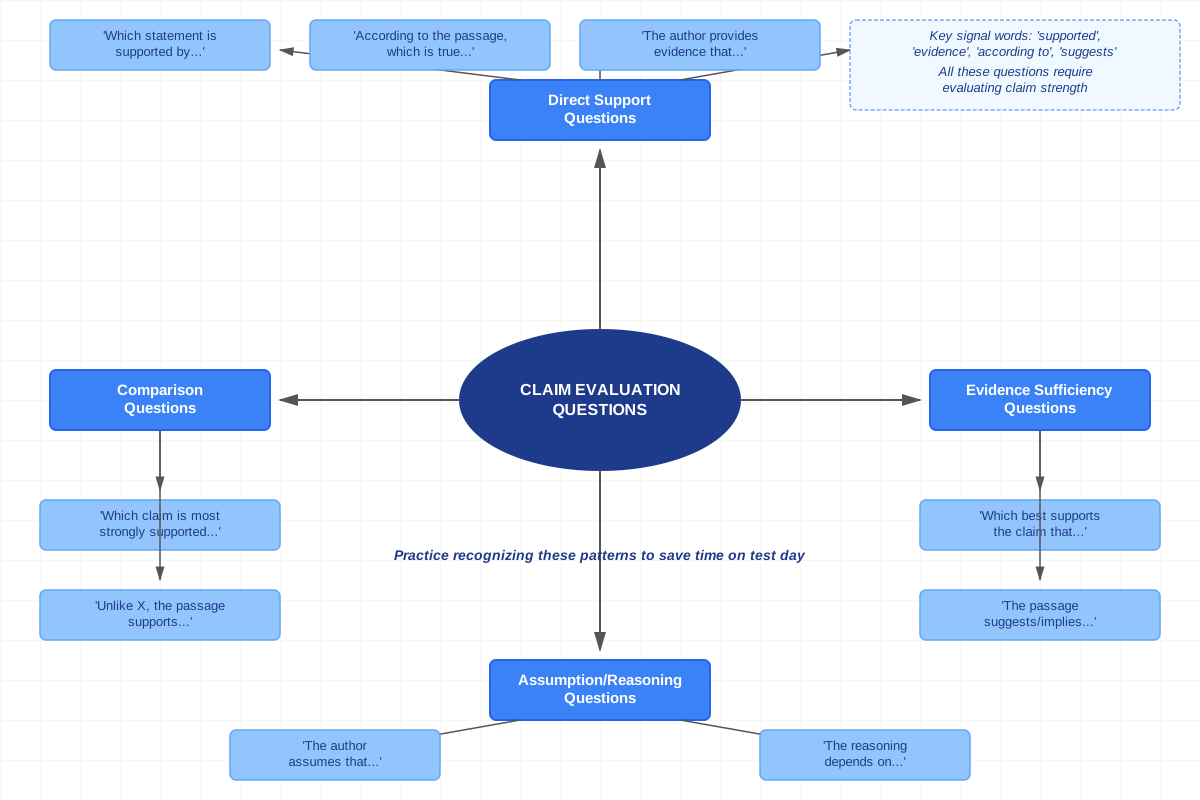
On the ACT Reading test, claim evaluation questions appear with high frequency, typically comprising 2-4 questions per test (approximately 5-10% of all Reading questions). These questions often carry significant weight because they test higher-order thinking skills rather than simple recall. The ACT specifically assesses this skill through questions that ask students to identify which statement is supported by the passage, determine what evidence strengthens or weakens an argument, or recognize assumptions underlying a claim.
Common question formats include: "Which of the following claims is best supported by the passage?", "The author's argument in lines X-Y is strengthened by which of the following?", "According to the passage, which statement about [topic] is most accurate?", and "The author supports the claim that [X] primarily by..." These questions appear across all passage types but are especially prevalent in Social Science and Natural Science passages where argumentative structures are more explicit. In Humanities passages, claim evaluation often focuses on interpretive arguments about art, culture, or historical significance. Even in Literary Narrative passages, students may need to evaluate claims about character motivations or thematic interpretations.
Core Concepts
What Constitutes a Claim
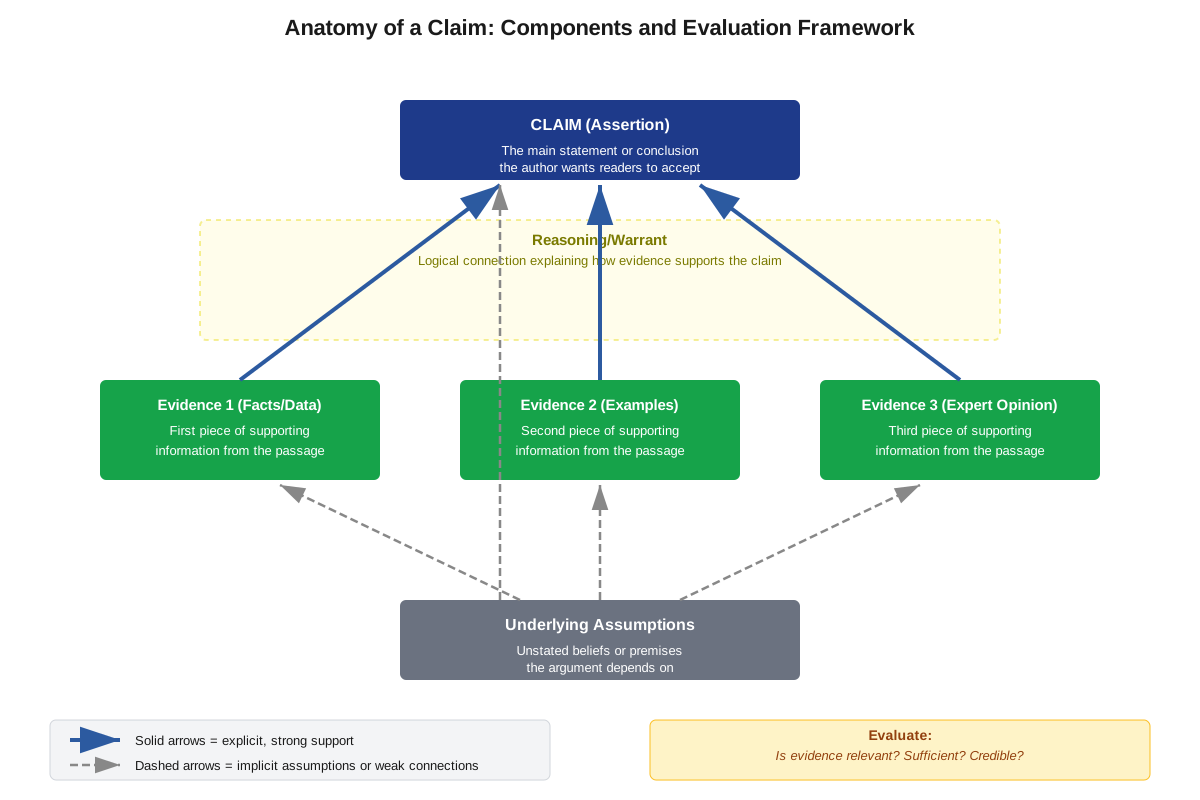
A claim is an assertion that something is true, an argument that requires support, or a conclusion drawn from evidence. Claims can be explicit (directly stated) or implicit (suggested but not directly stated). On the ACT, claims range from factual assertions ("The population increased by 20%") to interpretive judgments ("This painting represents the artist's most mature work") to causal arguments ("Climate change has accelerated species extinction").
Understanding the difference between claims and facts is crucial. A fact is objectively verifiable and requires no support (though it may serve as evidence for a claim). A claim, however, represents a position that could be disputed and therefore requires evidence. For example, "Shakespeare wrote Hamlet in 1600" is a fact, while "Hamlet represents Shakespeare's greatest achievement" is a claim requiring support.
Types of Evidence Used to Support Claims
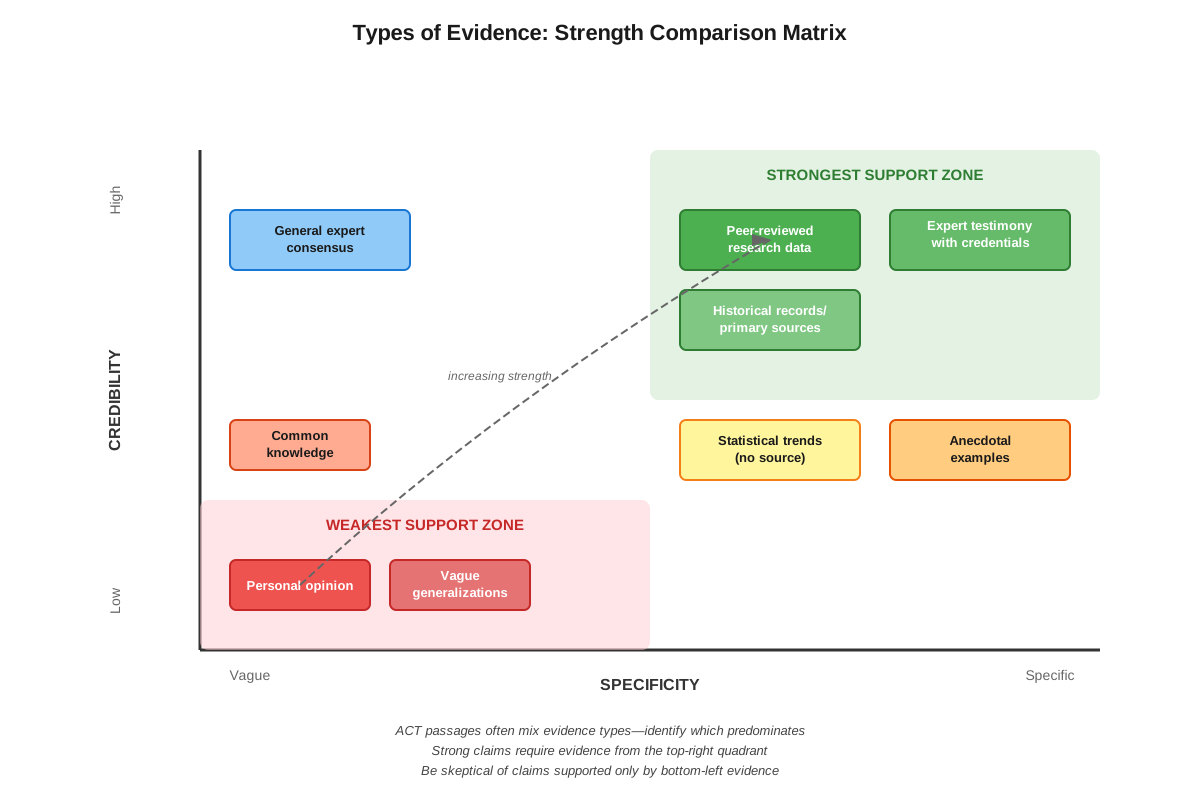
Evidence comes in multiple forms, and recognizing these types helps evaluate claim strength:
| Evidence Type | Description | Strength Considerations |
|---|---|---|
| Statistical data | Numerical information, percentages, measurements | Strong when from reliable sources and relevant to the claim |
| Expert testimony | Statements from authorities in a field | Strong when expert credentials are established |
| Examples and anecdotes | Specific instances or stories | Weaker unless multiple examples establish a pattern |
| Logical reasoning | Deductive or inductive arguments | Strong when premises are sound and logic is valid |
| Experimental results | Data from controlled studies | Very strong when methodology is sound |
| Historical evidence | Documentation from past events | Strong when sources are primary and reliable |
The ACT frequently tests whether students can identify which type of evidence an author uses and whether that evidence appropriately supports the claim being made.
Evaluating Evidence Quality
Not all evidence equally supports a claim. When evaluating claims, students must assess evidence along several dimensions:
Relevance: Does the evidence directly relate to the claim? Irrelevant evidence, no matter how interesting, does not strengthen an argument. For example, if an author claims that a particular teaching method improves math scores, evidence about student satisfaction is less relevant than evidence about actual test performance.
Sufficiency: Is there enough evidence to support the claim? A single example rarely proves a general claim. The ACT often includes passages where authors make broad claims based on limited evidence, and students must recognize this weakness.
Credibility: Is the source of evidence trustworthy? Evidence from peer-reviewed studies carries more weight than personal opinions. The ACT may present passages where authors cite questionable sources or fail to establish their credentials.
Recency: For certain claims, particularly in science and social science, the timeliness of evidence matters. Outdated studies may not reflect current understanding.
Identifying Assumptions
An assumption is an unstated premise that must be true for a claim to be valid. Recognizing assumptions is crucial for evaluating claims because weak or false assumptions undermine even well-evidenced arguments. For example, if an author claims "We should increase funding for public transportation because ridership has increased," the assumption is that increased ridership justifies increased funding—an assumption that could be questioned.
On the ACT, questions may ask students to identify what an author assumes or what would strengthen/weaken an argument by addressing an underlying assumption. These questions test deep comprehension of argumentative structure.
Recognizing Logical Fallacies
While the ACT rarely asks students to name specific fallacies, recognizing flawed reasoning helps evaluate claims. Common logical weaknesses include:
- Correlation vs. causation: Assuming that because two things occur together, one causes the other
- Hasty generalization: Drawing broad conclusions from insufficient examples
- False dichotomy: Presenting only two options when more exist
- Appeal to emotion: Using feelings rather than logic to support a claim
- Circular reasoning: Using the claim itself as evidence for the claim
Distinguishing Between Strong and Weak Claims
Strong claims on the ACT are characterized by:
- Specific, precise language rather than vague generalizations
- Appropriate qualifiers (some, many, often) rather than absolute terms (all, never, always) when discussing complex topics
- Direct support from passage evidence
- Logical consistency with other information in the passage
Weak claims often:
- Overgeneralize from limited evidence
- Contradict information elsewhere in the passage
- Rely on unsupported assumptions
- Use extreme language without justification
Concept Relationships
The skill of evaluating claims builds directly on identifying main ideas and supporting details. Students must first recognize what the author's central claims are (main ideas) before they can evaluate how well those claims are supported (details serve as evidence). This relationship flows in one direction: comprehension → evaluation.
Evaluating claims connects bidirectionally with understanding author's purpose. An author's purpose influences what claims they make and how they support them, while recognizing the strength of claims helps students better understand whether the author achieves their purpose. For example, if an author's purpose is to persuade, evaluating whether their claims are well-supported reveals how effectively they accomplish that goal.
The relationship between evaluating claims and making inferences is complementary. Sometimes students must infer what claim an author is making (when it's implicit), and other times they must infer the strength of evidence or identify unstated assumptions. Both skills require reading between the lines, but inference focuses on what is suggested while evaluation focuses on how well it's supported.
Textual relationship map:
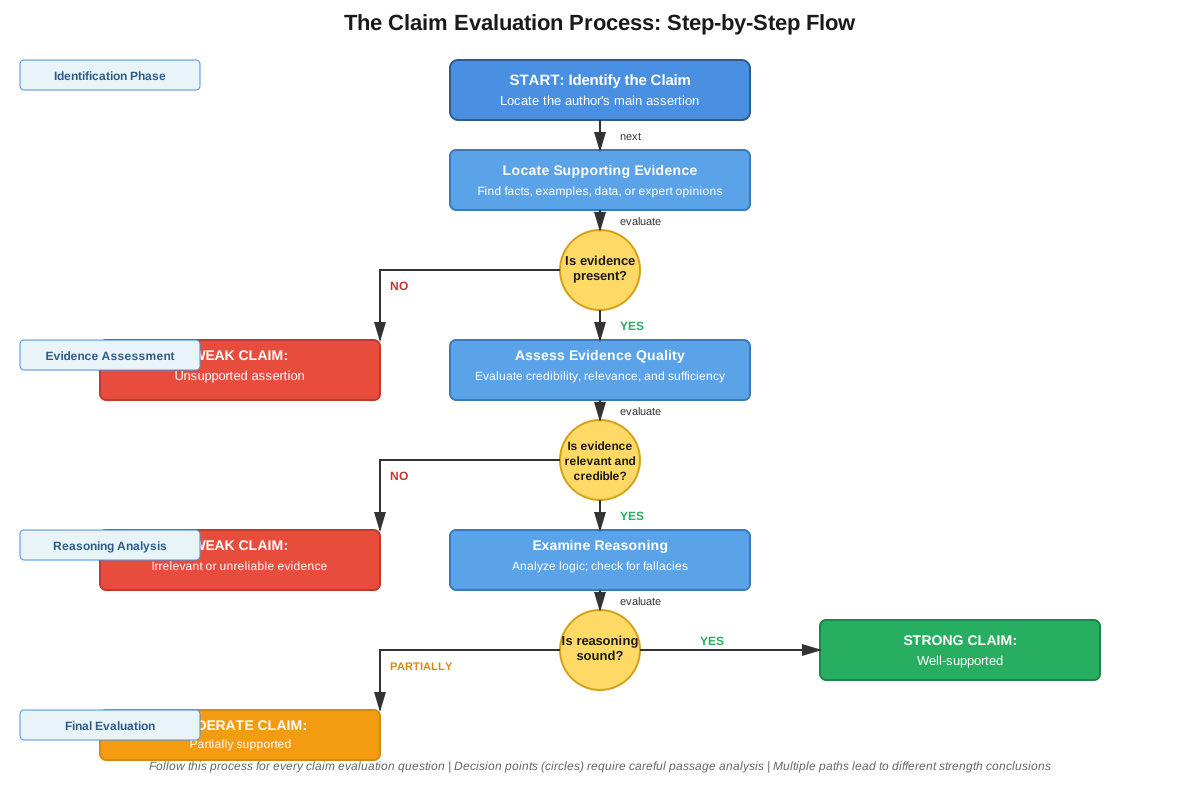
Reading Comprehension → Identifying Claims → Gathering Evidence → Evaluating Evidence Quality → Assessing Claim Strength → Drawing Conclusions about Argument Validity
This process also connects to analyzing text structure because how an author organizes information affects claim strength. For instance, a compare-contrast structure might support a claim about differences between two concepts, while a cause-effect structure supports causal claims.
High-Yield Facts
⭐ Claims require evidence; facts do not—distinguishing between these is the first step in evaluation
⭐ The ACT tests whether evidence directly supports a specific claim, not whether the evidence is generally true—relevance matters more than truth
⭐ Extreme language (all, never, always, none) in answer choices usually indicates unsupported claims unless the passage explicitly uses such language
⭐ Multiple pieces of evidence supporting a claim make it stronger than a single piece of evidence
⭐ The correct answer to "which claim is supported" questions must have direct textual evidence, not just be plausible
- Statistical evidence is generally stronger than anecdotal evidence for general claims
- Authors sometimes present opposing views before refuting them—don't confuse views the author mentions with views the author supports
- Assumptions are unstated premises that must be true for an argument to work
- Evidence can be accurate but irrelevant to the specific claim being evaluated
⭐ Questions asking what would "strengthen" or "weaken" an argument test understanding of assumptions and evidence gaps
- Correlation between two factors does not prove causation—the ACT frequently includes passages where this distinction matters
- Expert testimony is only strong evidence when the expert's credentials are established in the passage
- The most recent evidence in a passage is not automatically the strongest evidence
- Claims about author's intent or meaning must be supported by textual evidence, not reader assumptions
- Qualifying language (may, might, suggests, often) typically indicates more defensible claims than absolute statements
Quick check — test yourself on Evaluating claims so far.
Try Flashcards →Common Misconceptions
Misconception: If a statement appears in the passage, it must be a claim the author supports.
Correction: Authors frequently present opposing viewpoints, historical beliefs, or hypothetical scenarios they don't personally endorse. Always identify whether the author is presenting their own claim or describing someone else's position.
Misconception: Strong evidence makes a claim true.
Correction: On the ACT, the question is whether the passage supports a claim, not whether the claim is objectively true. Even if you know something to be true from outside knowledge, if the passage doesn't provide evidence for it, it's not the correct answer.
Misconception: Longer explanations or more details always indicate stronger support.
Correction: Quality of evidence matters more than quantity. One highly relevant statistic can support a claim better than three irrelevant anecdotes. Evaluate evidence based on relevance, credibility, and sufficiency, not just volume.
Misconception: Personal opinions about a topic should influence evaluation of claims.
Correction: The ACT tests objective evaluation of what the passage says and how well it's supported. Personal agreement or disagreement with a claim is irrelevant. Focus solely on the relationship between claims and evidence within the passage.
Misconception: If evidence is mentioned near a claim in the passage, it automatically supports that claim.
Correction: Proximity doesn't guarantee relevance. Authors sometimes discuss multiple ideas in sequence without each piece of information supporting every nearby claim. Carefully assess whether evidence logically connects to the specific claim in question.
Misconception: All types of evidence are equally strong for all types of claims.
Correction: Different claims require different types of evidence. Scientific claims need experimental data, historical claims need documentation, and interpretive claims need textual analysis. Match the evidence type to the claim type when evaluating support.
Worked Examples
Example 1: Social Science Passage
Passage excerpt: "Urban planners have long debated the impact of green spaces on city residents' mental health. A 2019 study by the Metropolitan Health Institute surveyed 5,000 residents across ten major cities, finding that those living within a quarter-mile of a park reported 23% lower stress levels than those living farther away. Dr. Sarah Chen, lead researcher, noted that 'access to nature provides measurable psychological benefits.' However, the study did not control for income levels, and wealthier neighborhoods typically have more parks. Some researchers argue that the correlation may reflect socioeconomic factors rather than the direct impact of green spaces themselves."
Question: Which of the following claims is most strongly supported by the passage?
A) Green spaces directly cause reduced stress in all urban residents.
B) Wealthy neighborhoods have better mental health outcomes than poor neighborhoods.
C) There is a correlation between proximity to parks and reported stress levels.
D) The 2019 study proves that cities should invest more in parks.
Analysis:
Step 1: Identify the claims made in the passage. The passage presents: (1) a correlation between park proximity and stress levels, (2) a researcher's interpretation about nature's benefits, and (3) a limitation regarding confounding variables.
Step 2: Evaluate the evidence for each answer choice.
Choice A uses extreme language ("directly cause," "all") that the passage doesn't support. The passage explicitly mentions that the correlation "may reflect socioeconomic factors rather than the direct impact," undermining any causal claim.
Choice B introduces a claim about wealthy vs. poor neighborhoods that, while related to information in the passage, isn't directly stated or supported. The passage mentions wealth and parks but doesn't make claims about mental health outcomes by neighborhood wealth.
Choice C accurately reflects what the study found: people living near parks reported lower stress. This is a correlation (two things occurring together) without claiming causation. The passage directly supports this with specific data: "23% lower stress levels."
Choice D uses the word "proves" which is too strong. The passage presents one study with acknowledged limitations, insufficient to prove what cities "should" do.
Answer: C
Connection to learning objectives: This example demonstrates identifying when claim evaluation is tested (the question asks what is "most strongly supported"), applying the core strategy of matching claims to evidence, and distinguishing between correlation and causation.
Example 2: Natural Science Passage
Passage excerpt: "The extinction of the woolly mammoth has puzzled scientists for decades. Climate change at the end of the last Ice Age certainly played a role, as warming temperatures reduced the mammoth's tundra habitat. Archaeological evidence also shows increased human hunting during this period. Dr. James Morrison argues that 'human predation was the primary driver of extinction,' citing mammoth remains found with spear marks at sites across Siberia. Yet mammoths survived previous warming periods, suggesting climate alone cannot explain their disappearance. The combination of environmental stress and hunting pressure likely proved fatal to a species already struggling to adapt."
Question: The author's argument that both climate change and human hunting contributed to mammoth extinction is supported primarily by:
A) Dr. Morrison's expert testimony about human predation
B) The observation that mammoths survived earlier warming periods
C) Archaeological evidence of spear marks on mammoth remains
D) The acknowledgment that climate change reduced tundra habitat
Analysis:
Step 1: Identify the author's claim. The author claims that "the combination of environmental stress and hunting pressure likely proved fatal"—a claim that both factors contributed.
Step 2: Determine what type of evidence would support a claim about two contributing factors. Evidence for a combined-cause claim must address why neither factor alone is sufficient.
Step 3: Evaluate each answer choice.
Choice A presents Dr. Morrison's view, but Morrison argues for human predation as the "primary driver," not a combined cause. This actually contradicts the author's more nuanced position.
Choice B provides crucial evidence for the combined-cause argument. If mammoths survived previous warming periods (climate alone wasn't fatal), but didn't survive when warming coincided with human hunting, this supports the claim that both factors together caused extinction. This evidence addresses why climate alone is insufficient.
Choice C provides evidence that humans hunted mammoths but doesn't support the claim that both factors were necessary. Hunting evidence alone doesn't prove the combination was required.
Choice D provides evidence for climate's role but, like choice C, doesn't support the combined-cause claim. It only establishes one factor.
Answer: B
Connection to learning objectives: This example shows how to identify the specific claim being evaluated (combined causation, not single causation), recognize that evidence must match the claim's structure, and understand that the strongest evidence addresses potential counterarguments (why single factors are insufficient).
Exam Strategy
When approaching ACT questions that test evaluating claims, follow this systematic process:
Step 1: Identify the claim being evaluated. Read the question carefully to determine whether you're evaluating a claim from the passage or evaluating answer choices against passage evidence. Questions like "Which claim is supported?" require evaluating answer choices. Questions like "The author supports their claim by..." require identifying evidence for a passage claim.
Step 2: Locate relevant passage sections. Use line references when provided, but also scan for keywords from the question. Don't rely on memory—return to the passage to verify evidence.
Step 3: Match evidence to claims precisely. The correct answer will have direct, specific support. Avoid answers that are generally related to the passage topic but lack specific evidence. Ask: "Where exactly does the passage say this?"
Exam Tip: Trigger words that signal claim evaluation questions include "supported by," "strengthened by," "evidence for," "according to the passage," "the author argues," "best supported," and "most accurate."
Step 4: Eliminate answers with extreme language unless the passage uses equally extreme language. Words like "always," "never," "all," "none," "proves," "must," and "only" often indicate unsupported claims. The ACT rewards careful, qualified claims over absolute statements.
Step 5: Watch for scope mismatches. An answer choice might be supported by the passage but be too broad or too narrow for the specific claim in question. For example, evidence about "some cities" doesn't support a claim about "all cities."
Process-of-elimination tips:
- Eliminate answers that contradict passage information
- Eliminate answers that require outside knowledge not in the passage
- Eliminate answers that confuse claims the author presents with claims the author supports
- Eliminate answers where the evidence is irrelevant to the specific claim, even if both appear in the passage
Time allocation: Spend 30-45 seconds locating the relevant passage section, then 20-30 seconds evaluating each answer choice against the evidence. If you're uncertain, mark the question and return after completing easier questions. Don't spend more than 90 seconds total on any single question.
For "strengthen/weaken" questions: Identify what assumption or evidence gap exists in the argument, then find the answer choice that addresses that gap. Strengthening answers provide missing evidence or confirm assumptions; weakening answers introduce contradictory evidence or challenge assumptions.
Memory Techniques
CARES - Remember the four dimensions of evidence quality:
- Credibility: Is the source trustworthy?
- Amount: Is there sufficient evidence?
- Relevance: Does it directly relate to the claim?
- Exactness: Is it specific rather than vague?
- Source: Where does the evidence come from?
The "PASS" Test for evaluating answer choices:
- Passage-based: Is there direct textual support?
- Accurate: Does it correctly represent passage information?
- Specific: Does it match the precise claim being evaluated?
- Scope: Does it match the breadth of the claim (not too broad or narrow)?
Visualization strategy: Picture a bridge between claim and evidence. Strong support is a solid, direct bridge. Weak support is a rickety bridge with gaps. No support means no bridge at all—the claim and evidence are on separate islands.
For remembering evidence types, use SEEHEL:
- Statistics
- Expert testimony
- Examples
- Historical documentation
- Experimental results
- Logical reasoning
Acronym for common logical weaknesses: CHAFE
- Correlation assumed to be causation
- Hasty generalization
- Assumptions unstated
- False dichotomy
- Emotional appeals replacing logic
Summary
Evaluating claims on the ACT Reading test requires students to assess the relationship between assertions and evidence within passages. This skill involves identifying what constitutes a claim versus a fact, recognizing different types of evidence, and determining whether evidence adequately supports specific claims. Strong claims are characterized by relevant, sufficient, and credible evidence, while weak claims rely on irrelevant information, insufficient examples, or unstated assumptions. The ACT tests this skill through questions asking which claims are supported, what evidence strengthens arguments, and what assumptions underlie reasoning. Success requires returning to the passage to verify evidence, matching the scope and specificity of claims to their support, and avoiding extreme language unless explicitly warranted. Students must distinguish between what the passage actually supports and what might be generally true or personally believable. The key to mastering claim evaluation is systematic analysis: identify the claim, locate relevant evidence, assess evidence quality along dimensions of relevance and sufficiency, and select answers with direct textual support rather than plausible inferences.
Key Takeaways
- Evaluating claims means assessing whether passage evidence adequately supports specific assertions, not determining whether claims are objectively true
- Evidence must be relevant, sufficient, and credible to strongly support a claim—proximity in the passage doesn't guarantee relevance
- Distinguish between claims the author makes and claims the author merely presents or refutes
- Extreme language (all, never, always, proves) in answer choices usually indicates unsupported claims unless the passage uses equally strong language
- The correct answer to claim evaluation questions requires direct textual evidence, not outside knowledge or personal opinion
- Different types of claims require different types of evidence—match evidence type to claim type
- Always return to the passage to verify evidence rather than relying on memory or general impressions
Related Topics
Analyzing Author's Purpose and Perspective: Understanding why an author makes certain claims and what biases might influence their arguments deepens claim evaluation skills. This topic explores how purpose shapes evidence selection and presentation.
Identifying Main Ideas and Supporting Details: This foundational skill directly enables claim evaluation by helping students distinguish between central assertions and the evidence used to support them.
Making Inferences and Drawing Conclusions: While claim evaluation focuses on explicit support, inference skills help identify unstated assumptions and implicit evidence that strengthen or weaken arguments.
Comparing and Contrasting Viewpoints: Many ACT passages present multiple perspectives on an issue. Evaluating competing claims requires assessing the relative strength of evidence for different positions.
Analyzing Text Structure and Organization: How authors organize information affects argument strength. Understanding structure helps identify where evidence appears and how it relates to claims.
Mastering evaluating claims provides the foundation for advanced critical reading skills and prepares students for the analytical demands of college-level coursework across disciplines.
Practice CTA
Now that you've learned the strategies for evaluating claims on the ACT Reading test, it's time to apply these skills! Work through the practice questions to reinforce your ability to identify well-supported claims, assess evidence quality, and eliminate unsupported answer choices. Use the flashcards to memorize key concepts like evidence types and evaluation criteria. Remember: claim evaluation is a skill that improves with practice. Each question you analyze strengthens your ability to think critically about arguments—a skill that will serve you not just on test day, but throughout your academic career. You've got this!
Sign up free to keep reading
Create a free AnvayaPrep account to finish this ACT guide on Evaluating claims — plus flashcards and practice questions.