Overview
Cause and effect relationships form one of the most fundamental reasoning patterns tested on the ACT Reading section. These relationships describe how one event, action, or condition (the cause) leads to or produces another event, action, or condition (the effect). Understanding these connections is essential because the ACT frequently asks students to identify why something happened, what resulted from a particular action, or how different elements within a passage influence one another.
On the ACT Reading test, ACT cause and effect relationships appear across all passage types—prose fiction, social science, humanities, and natural science. Questions may ask directly about causation using phrases like "as a result of," "because," or "led to," but they can also test this concept indirectly by asking about motivations, consequences, outcomes, or the relationships between ideas. Mastering this skill enables students to move beyond surface-level comprehension and understand the deeper logical structure of passages, which is crucial for answering inference and detail questions accurately.
This topic connects directly to other Key Ideas and Details concepts, particularly main idea identification and supporting detail recognition. Cause and effect relationships often serve as the organizational backbone of passages, helping authors develop arguments, explain processes, or narrate events. By recognizing these patterns, students can better predict passage structure, locate relevant information quickly, and eliminate incorrect answer choices that confuse causes with effects or introduce relationships not supported by the text.
Learning Objectives
- [ ] Identify when cause and effect relationships are being tested in ACT Reading questions
- [ ] Explain the core rule or strategy behind analyzing cause and effect relationships
- [ ] Apply cause and effect relationship analysis to ACT-style questions accurately
- [ ] Distinguish between direct and indirect causal connections in complex passages
- [ ] Recognize signal words and phrases that indicate causal relationships
- [ ] Differentiate between correlation and causation in passage content
- [ ] Trace multiple-step causal chains across paragraph boundaries
Prerequisites
- Basic reading comprehension: Understanding literal meaning of sentences and paragraphs is necessary before analyzing relationships between ideas
- Vocabulary knowledge: Recognizing transition words and causal signal phrases requires familiarity with common academic vocabulary
- Paragraph structure awareness: Understanding topic sentences and supporting details helps locate cause and effect information efficiently
- Inference skills: Many causal relationships are implied rather than explicitly stated, requiring basic inferential reasoning
Why This Topic Matters
Understanding cause and effect relationships extends far beyond standardized testing into everyday critical thinking, scientific reasoning, historical analysis, and decision-making. In academic contexts, students must trace how historical events influenced one another, how scientific variables interact, or how characters' motivations drive plot developments. In professional settings, analyzing causation helps with problem-solving, strategic planning, and understanding complex systems.
On the ACT Reading section, cause and effect questions appear with remarkable frequency—typically 3-5 questions per test, representing approximately 7-12% of all Reading questions. These questions appear in multiple formats: direct cause-effect identification, consequence prediction, motivation analysis, and relationship explanation. The ACT particularly favors questions that require students to synthesize information from multiple sentences or paragraphs, making this a medium-to-high difficulty skill that separates average scorers from top performers.
Common manifestations include: narrative passages asking why characters made specific decisions; science passages explaining how one phenomenon produces another; social science passages tracing how policies or movements led to particular outcomes; and humanities passages analyzing how artistic or philosophical influences shaped creative works. The ACT often tests whether students can distinguish between temporal sequence (one thing happening after another) and true causation (one thing happening because of another), making this a nuanced and high-yield topic for focused study.
Core Concepts
Understanding Cause and Effect Structure
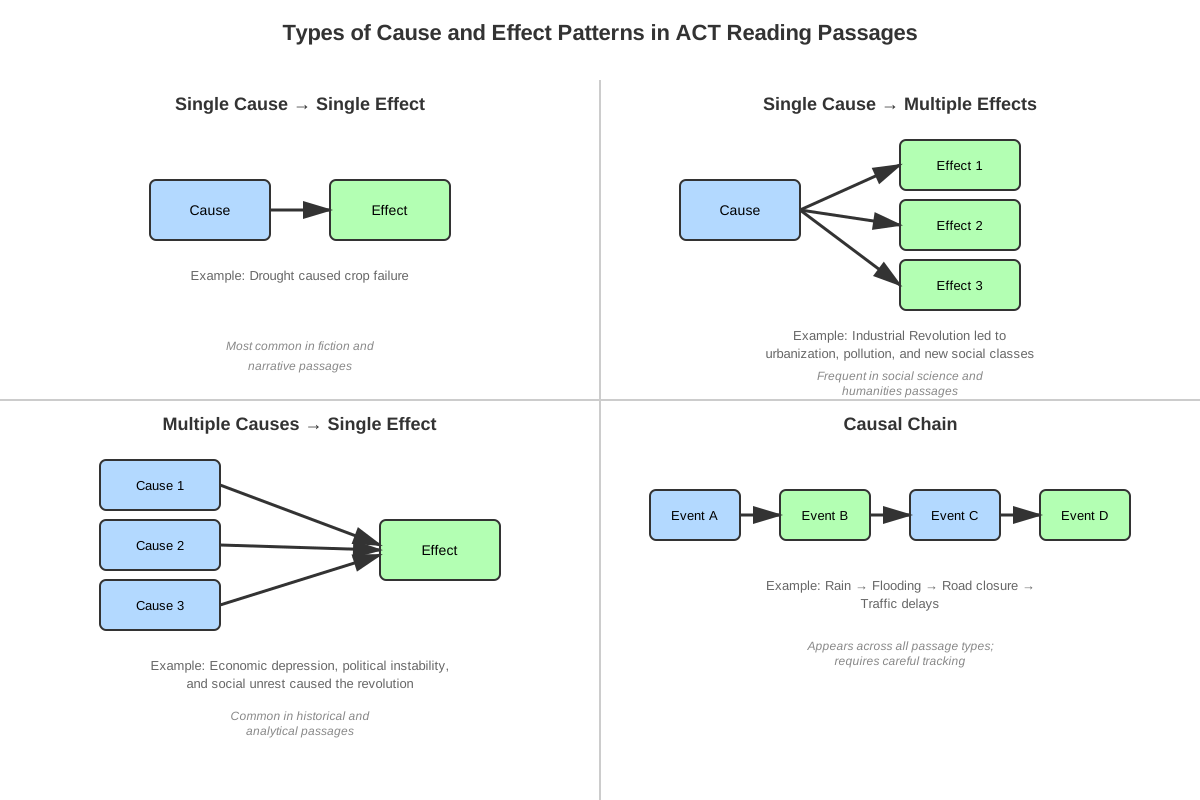
A cause is any event, action, condition, or factor that makes something happen or influences an outcome. An effect is the result, consequence, or outcome that occurs because of the cause. This relationship can be simple (single cause → single effect) or complex (multiple causes → single effect, single cause → multiple effects, or causal chains where one effect becomes the cause of another effect).
The ACT Reading section tests three primary types of causal relationships:
| Relationship Type | Structure | Example |
|---|---|---|
| Simple Causation | One cause → One effect | The drought (cause) killed the crops (effect) |
| Multiple Causes | Several causes → One effect | Poor diet + lack of exercise + genetics (causes) → disease (effect) |
| Multiple Effects | One cause → Several effects | The invention (cause) → increased productivity + job displacement + social change (effects) |
| Causal Chain | Cause → Effect/Cause → Effect | Rain → flooding → road closure → traffic delays |
Signal Words and Phrases
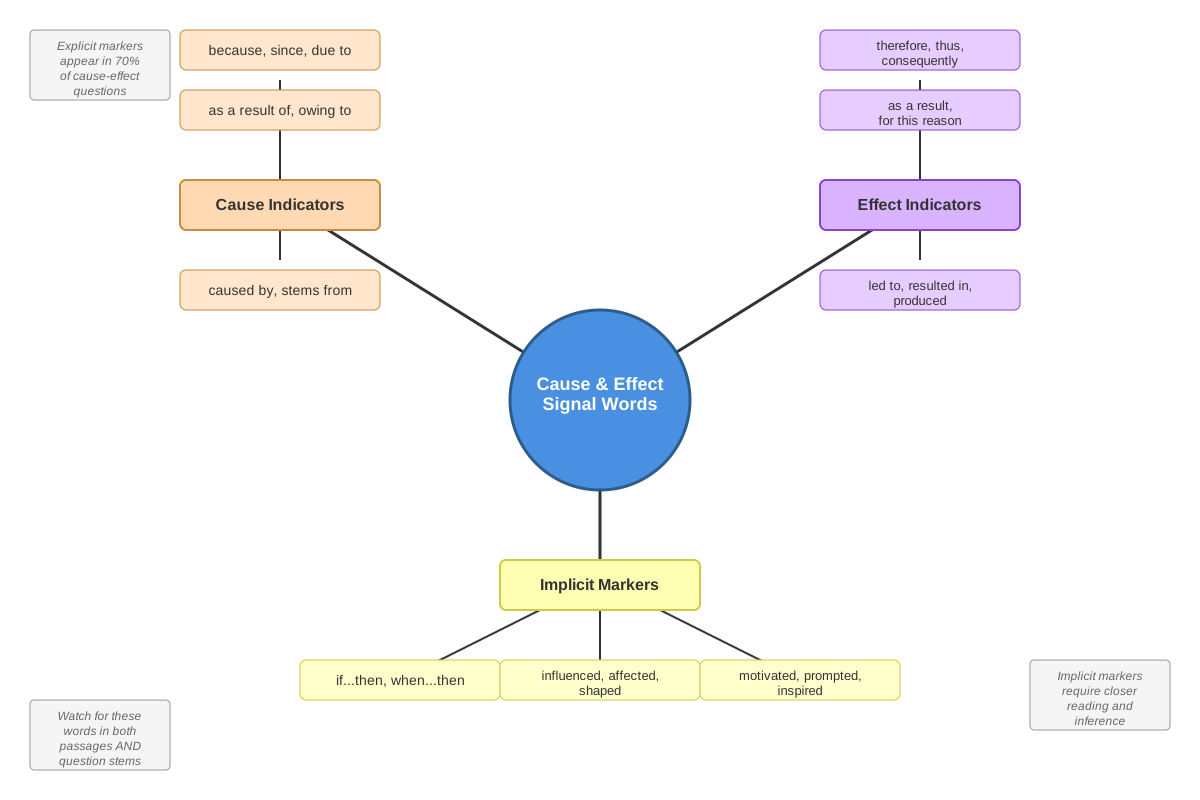
Recognizing causal signal words dramatically improves efficiency and accuracy. These linguistic markers explicitly indicate cause and effect relationships:
Cause indicators (these introduce the reason):
- Because, since, as, due to, owing to
- On account of, as a result of, thanks to
- Caused by, stems from, results from
- The reason for, attributable to
Effect indicators (these introduce the result):
- Therefore, thus, consequently, hence
- As a result, accordingly, so
- Led to, resulted in, produced, created
- The effect of, the outcome was
However, the ACT frequently tests implicit causal relationships where no signal words appear. Students must infer causation from context, logical flow, and the relationship between ideas.
Direct vs. Indirect Causation
Direct causation occurs when one factor immediately and obviously produces an effect with no intervening steps. In passages, these relationships are typically stated explicitly: "The storm destroyed the bridge" clearly shows direct causation.
Indirect causation involves intermediate steps or contributing factors. For example: "The economic downturn led to reduced consumer spending, which caused many retailers to close, ultimately transforming the downtown landscape." Here, the economic downturn doesn't directly transform the landscape—it works through a chain of intermediate effects.
The ACT particularly tests indirect causation because it requires deeper comprehension and the ability to trace logical connections across multiple sentences or paragraphs. Students must follow the thread of causation without losing track of the original cause or ultimate effect.
Correlation vs. Causation
A critical distinction that appears frequently on the ACT is the difference between correlation (two things occurring together) and causation (one thing causing another). Just because two events happen simultaneously or sequentially doesn't mean one caused the other.
The ACT tests this by including answer choices that confuse temporal sequence with causation or that suggest causal relationships not supported by passage evidence. For example, a passage might state that ice cream sales and drowning rates both increase in summer, but this correlation doesn't mean ice cream causes drowning—both are effects of warm weather.
Necessary vs. Sufficient Causes
Advanced ACT passages sometimes distinguish between:
- Necessary causes: Conditions that must be present for an effect to occur (but alone may not guarantee it)
- Sufficient causes: Conditions that, by themselves, will produce the effect
For example, oxygen is necessary for fire but not sufficient (you also need fuel and heat). Understanding this distinction helps with complex science and social science passages.
Causal Chains and Networks
Many ACT passages present causal chains where effects become causes for subsequent effects. Tracing these chains requires careful attention to logical flow:
Event A → causes Event B → which causes Event C → which causes Event D
Questions may ask about any link in this chain or about the relationship between non-adjacent elements (how Event A ultimately relates to Event D). Students must maintain awareness of the entire sequence while focusing on specific relationships.
Concept Relationships
Cause and effect relationships serve as the logical connective tissue linking other reading comprehension skills. Main idea identification often depends on recognizing the primary causal relationship an author explores—what caused what, and why does it matter? Supporting details frequently function as causes or effects that develop the central argument.
The relationship flows as follows: Signal word recognition → enables causal relationship identification → which supports inference making → leading to main idea comprehension → ultimately enabling synthesis and analysis.
Cause and effect analysis also connects to author's purpose and tone. Authors who emphasize causal relationships often aim to explain, persuade, or analyze rather than simply describe. Recognizing this helps predict passage structure and question types.
Within the topic itself, concepts build hierarchically: Basic signal word recognition → Simple cause-effect identification → Multiple cause/effect analysis → Causal chain tracing → Correlation vs. causation distinction → Complex causal network analysis. Each level requires mastery of the previous one.
High-Yield Facts
⭐ Cause and effect questions appear 3-5 times per ACT Reading test, making them one of the most frequently tested relationship types
⭐ Signal words like "because," "therefore," "as a result," and "consequently" explicitly mark causal relationships, but many ACT questions test implicit causation without signal words
⭐ The ACT frequently asks about indirect causation requiring students to trace effects across multiple paragraphs or through intermediate steps
⭐ Wrong answer choices often reverse cause and effect or confuse temporal sequence (happening after) with causation (happening because of)
⭐ Multiple causes can produce a single effect, and a single cause can produce multiple effects—the ACT tests both patterns regularly
- Causal chains (where one effect becomes the cause of another effect) appear most frequently in science and social science passages
- The ACT tests whether students can distinguish between correlation (two things occurring together) and causation (one thing causing another)
- Questions about character motivation in fiction passages are fundamentally cause and effect questions (what caused the character to act this way?)
- Process descriptions in science passages are essentially causal chains explaining how one step leads to the next
- Historical passages often present complex causal networks where multiple factors interact to produce significant outcomes
- The phrase "as a result of" in a question stem is a strong indicator that you're being tested on cause and effect relationships
- Causal relationships can be stated explicitly in the passage or require inference from context and logical flow
Quick check — test yourself on Cause and effect relationships so far.
Try Flashcards →Common Misconceptions
Misconception: If one event happens after another, the first event caused the second event.
Correction: Temporal sequence (post hoc) doesn't prove causation. The ACT includes wrong answers that confuse "after" with "because of." Two events can occur sequentially without any causal relationship, or both might be effects of a third, unstated cause.
Misconception: Cause and effect questions always use signal words like "because" or "therefore."
Correction: While signal words help identify causal relationships, the ACT frequently tests implicit causation where students must infer the relationship from context, logical flow, and the meaning of the passage. Many high-difficulty questions deliberately omit signal words.
Misconception: There's always just one cause for any effect described in the passage.
Correction: Real-world phenomena typically result from multiple contributing factors, and ACT passages reflect this complexity. Students must recognize when several causes combine to produce an effect and avoid answer choices that oversimplify by identifying only one factor.
Misconception: The cause always appears before the effect in the passage text.
Correction: Authors frequently present effects first to create interest or suspense, then explain causes later. Some passages describe an outcome in the opening paragraph and spend subsequent paragraphs exploring what led to it. Students must track causal relationships regardless of presentation order.
Misconception: If the passage says two things are related, one must cause the other.
Correction: Passages often describe correlations, associations, or relationships without establishing causation. The ACT tests whether students can distinguish between "X and Y are connected" versus "X causes Y." Both might be effects of a common cause, or they might simply co-occur without any causal link.
Misconception: Cause and effect questions only appear in science passages.
Correction: While science passages frequently explore causal mechanisms, cause and effect relationships appear across all ACT passage types. Fiction passages explore how characters' motivations cause actions, humanities passages trace how influences shaped artistic movements, and social science passages analyze how policies or events produced outcomes.
Worked Examples
Example 1: Fiction Passage Analysis
Passage excerpt: "Maria had always dreamed of becoming a doctor, inspired by her grandmother's stories of working as a nurse during the war. However, after volunteering at the local hospital during her junior year, she discovered that direct patient care left her feeling drained rather than energized. She found herself drawn instead to the research laboratory, where she could lose herself in data analysis for hours. By senior year, she had changed her intended major from pre-med to biomedical engineering."
Question: According to the passage, what primarily caused Maria to change her career plans?
A) Her grandmother's influence on her childhood dreams
B) Her experience volunteering at the hospital
C) Her natural talent for data analysis
D) The difficulty of pre-med coursework
Analysis:
Step 1: Identify what we're looking for—the primary cause of Maria changing from pre-med to biomedical engineering.
Step 2: Locate the effect—"she had changed her intended major from pre-med to biomedical engineering."
Step 3: Trace backward to find causes. The passage presents a causal chain:
- Grandmother's stories → inspired dream of becoming a doctor (initial cause)
- Hospital volunteering → discovered patient care was draining (pivotal cause)
- Laboratory work → found it energizing (confirming cause)
- These discoveries → changed major (effect)
Step 4: Evaluate answer choices:
- A) This caused her initial dream but not the change
- B) This is the pivotal experience that revealed her true preferences ✓
- C) This is mentioned as something she discovered, but it's an effect of trying laboratory work, not the primary cause of her decision
- D) This is never mentioned in the passage
Answer: B. The hospital volunteering experience is the primary cause because it directly led to her discovery that patient care wasn't right for her, which prompted her to explore alternatives. This demonstrates how the ACT tests causal chains and requires distinguishing between initial causes and pivotal causes.
Example 2: Science Passage Analysis
Passage excerpt: "The Industrial Revolution dramatically increased atmospheric carbon dioxide levels through the burning of fossil fuels. This rise in CO₂ enhanced the greenhouse effect, trapping more heat in Earth's atmosphere. Consequently, global average temperatures have risen approximately 1.1°C since pre-industrial times. This warming has accelerated the melting of polar ice caps, which in turn has contributed to rising sea levels. Coastal communities worldwide now face increased flooding risks, forcing many to consider relocation or invest heavily in protective infrastructure."
Question: According to the passage, which of the following is a direct effect of increased atmospheric carbon dioxide?
A) Rising sea levels
B) Enhanced greenhouse effect
C) Coastal flooding
D) Melting of polar ice caps
Analysis:
Step 1: Map the causal chain presented:
- Fossil fuel burning → increased CO₂
- Increased CO₂ → enhanced greenhouse effect
- Enhanced greenhouse effect → trapped heat
- Trapped heat → temperature rise
- Temperature rise → ice cap melting
- Ice cap melting → sea level rise
- Sea level rise → coastal flooding
Step 2: Identify what the question asks—a DIRECT effect of increased CO₂ (not an indirect effect through intermediate steps).
Step 3: Evaluate each choice:
- A) Rising sea levels: This is 4 steps removed (CO₂ → greenhouse → warming → melting → sea level rise)
- B) Enhanced greenhouse effect: This is the immediate, direct effect stated in the passage ✓
- C) Coastal flooding: This is 5 steps removed
- D) Melting ice caps: This is 3 steps removed (CO₂ → greenhouse → warming → melting)
Answer: B. This example demonstrates how the ACT tests understanding of direct versus indirect causation within complex causal chains. All four options are effects of increased CO₂, but only B is a direct effect. The others are indirect effects that occur through intermediate steps.
Exam Strategy
Question Recognition
Identify cause and effect questions through these trigger phrases:
- "What caused...?" / "Why did...?"
- "As a result of..." / "Because of..."
- "What led to...?" / "What produced...?"
- "The effect of..." / "The consequence of..."
- "What explains...?" / "What accounts for...?"
- "What motivated..." (in fiction passages)
Exam Tip: If a question asks about relationships between events, ideas, or actions, treat it as a potential cause and effect question even without explicit signal words.
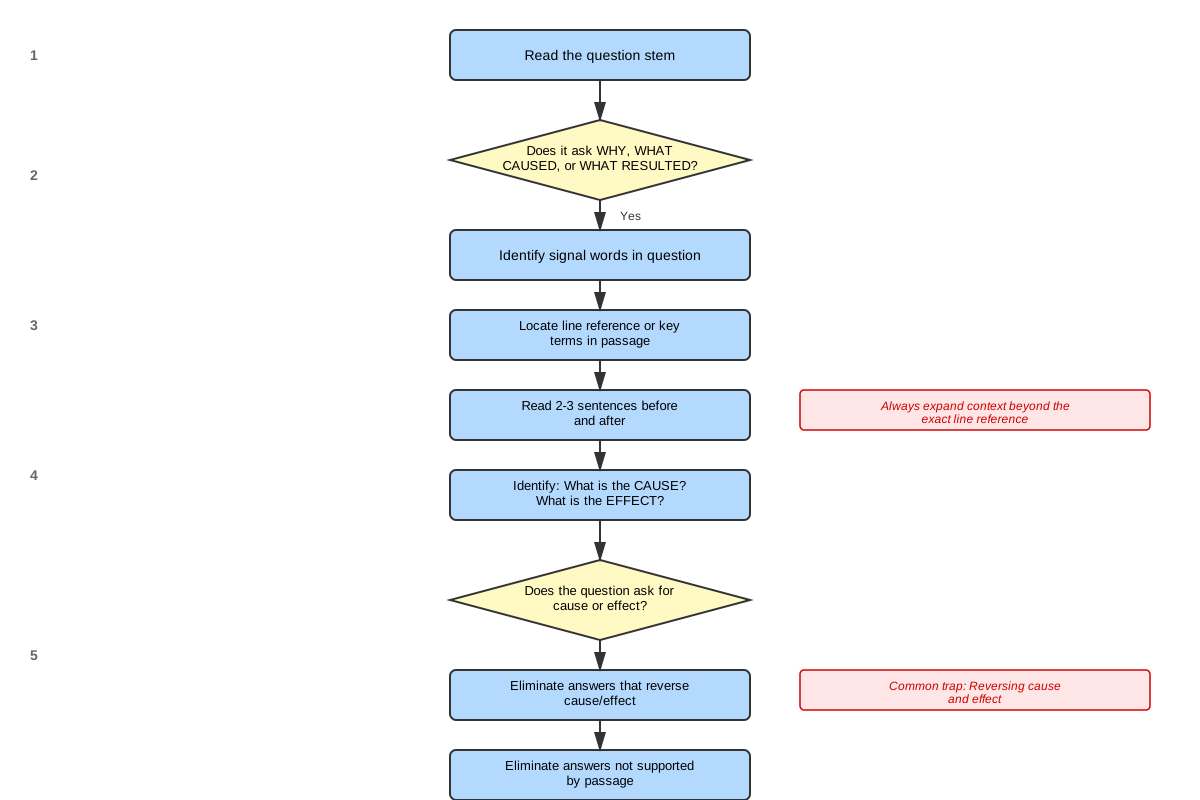
Systematic Approach
- Locate the effect first: Find what happened or what resulted
- Search backward for causes: Look in preceding sentences for what led to this outcome
- Check for signal words: But don't rely on them exclusively
- Map the relationship: Mentally note whether it's simple, multiple, or a chain
- Verify with passage evidence: Ensure the causal relationship is explicitly stated or clearly implied
Elimination Strategies
Eliminate answers that:
- Reverse cause and effect (stating the effect as the cause)
- Confuse temporal sequence with causation
- Introduce causal relationships not mentioned in the passage
- Identify a correlation without establishing causation
- Select a minor contributing factor when a major cause is available
- Choose an indirect cause when the question asks for a direct cause
Time Management
Cause and effect questions typically require 45-60 seconds:
- 15-20 seconds: Read and understand the question
- 20-30 seconds: Locate relevant passage section and trace the relationship
- 10-15 seconds: Eliminate wrong answers and confirm the correct choice
For complex causal chains, allow up to 75 seconds. If you're spending more time, mark the question and return to it after completing easier questions.
Common Traps
The "Also True" Trap: An answer choice states something true from the passage but doesn't answer the causal question asked. Always verify that your answer specifically addresses the cause-effect relationship in question.
The Reversal Trap: Answer choices that flip cause and effect are extremely common. Always double-check which element is the cause and which is the effect.
The Partial Chain Trap: When a passage presents a causal chain (A→B→C→D), wrong answers might correctly identify one link but not the one the question asks about. Pay attention to whether the question asks for direct, indirect, initial, or ultimate causes.
Memory Techniques
The TRACE Method for Cause and Effect Questions
Target the effect (what happened?)
Rewind to find causes (what led to it?)
Analyze signal words (because, therefore, etc.)
Check the chain (direct or indirect?)
Eliminate reversals (cause vs. effect)
Signal Word Categories Mnemonic
BECAUSE for cause indicators:
- Because, Explains, Caused by, As, Underlying, Since, Enabled by
RESULTS for effect indicators:
- Resulted in, Effect, So, Ultimately, Led to, Therefore, Subsequently
Visualization Strategy
Picture cause and effect relationships as arrows: Cause → Effect. For complex passages, mentally sketch the causal network:
Cause A ↘
          → Effect X → Effect Y (which becomes Cause B) → Effect Z
Cause B ↗
This visualization helps track multiple causes, effects, and chains without losing the logical thread.
The "Why-What" Pair
Remember: Causes answer "WHY did it happen?" and Effects answer "WHAT happened as a result?" When confused, ask yourself both questions about the relationship in question.
Summary
Cause and effect relationships represent one of the most frequently tested concepts on the ACT Reading section, appearing across all passage types and requiring students to understand how events, actions, and conditions influence one another. Mastery involves recognizing both explicit causal relationships marked by signal words (because, therefore, as a result) and implicit relationships that must be inferred from context and logical flow. The ACT tests simple causation (one cause producing one effect), complex causation (multiple causes or effects), and causal chains (where effects become causes of subsequent effects). Success requires distinguishing between direct and indirect causation, avoiding the trap of confusing temporal sequence with true causation, and carefully tracking causal relationships across paragraph boundaries. Students must also differentiate between correlation and causation, recognize when answer choices reverse cause and effect, and identify the specific causal relationship asked about rather than selecting any true statement from the passage. By systematically locating effects, tracing backward to causes, and verifying relationships with passage evidence, students can consistently answer these high-yield questions accurately.
Key Takeaways
- Cause and effect questions appear 3-5 times per ACT Reading test and are identifiable through trigger phrases like "what caused," "as a result of," and "what led to"
- Signal words explicitly mark many causal relationships, but the ACT frequently tests implicit causation requiring inference from context
- Always distinguish between direct causation (immediate relationship) and indirect causation (relationship through intermediate steps or causal chains)
- The most common wrong answer trap is reversing cause and effect—always verify which element is the cause and which is the effect
- Temporal sequence (one thing happening after another) does not prove causation; the ACT includes wrong answers that confuse "after" with "because of"
- Multiple causes can produce single effects, and single causes can produce multiple effects—recognize both patterns in passages
- Use the TRACE method (Target, Rewind, Analyze, Check, Eliminate) to systematically approach cause and effect questions
Related Topics
Main Idea and Theme: Understanding cause and effect relationships helps identify the central argument or point of passages, as authors often organize content around key causal relationships they want to explain or prove.
Supporting Details and Evidence: Causes and effects frequently serve as supporting details that develop main ideas, making the ability to identify these relationships essential for understanding passage structure.
Inference and Implication: Many cause and effect relationships are implied rather than stated explicitly, requiring inference skills to recognize unstated causal connections from context.
Author's Purpose and Technique: Recognizing how authors use causal relationships to explain, persuade, or analyze helps predict passage organization and question types.
Sequence and Chronology: While distinct from causation, understanding temporal sequence helps avoid confusing "what happened when" with "what caused what," a key skill for eliminating wrong answers.
Practice CTA
Now that you've mastered the core concepts of cause and effect relationships, it's time to apply this knowledge! Work through the practice questions to test your ability to identify causal relationships, distinguish between direct and indirect causation, and avoid common traps like reversed cause-effect pairs. The flashcards will help reinforce signal words and key concepts for quick recall during the actual exam. Remember: cause and effect questions are high-yield and highly learnable—consistent practice with these strategies will significantly boost your ACT Reading score. You've got this!
Sign up free to keep reading
Create a free AnvayaPrep account to finish this ACT guide on Cause and effect relationships — plus flashcards and practice questions.