Overview
Literal comprehension forms the foundation of all reading skills tested on the ACT Reading section. This fundamental ability involves understanding exactly what a passage explicitly states—the facts, details, and information directly presented by the author without requiring inference or interpretation. When engaging in ACT literal comprehension, students must locate and accurately identify information that appears word-for-word or in paraphrased form within the passage.
Mastering literal comprehension is essential for ACT success because approximately 30-40% of Reading questions directly test this skill. These questions ask "what" the passage says rather than "why" or "how" the author presents information. Students who excel at literal comprehension can quickly locate specific details, understand explicit statements, and distinguish between what is directly stated versus what must be inferred. This skill serves as the gateway to more complex reading tasks: without accurately understanding what a text explicitly says, students cannot successfully analyze implicit meanings, author's purpose, or rhetorical strategies.
Within the broader ACT Reading framework, literal comprehension represents the first tier of the Key Ideas and Details domain. It connects directly to supporting detail questions, main idea identification, and sequence of events questions. Strong literal comprehension skills enable students to build a solid mental model of the passage, which then supports higher-order thinking tasks like drawing inferences, analyzing arguments, and evaluating author's craft. Think of literal comprehension as the concrete foundation upon which all other reading analysis skills are constructed.
Learning Objectives
- [ ] Identify when literal comprehension is being tested in ACT Reading questions
- [ ] Explain the core rule or strategy behind literal comprehension questions
- [ ] Apply literal comprehension skills to ACT-style questions accurately
- [ ] Distinguish between literal comprehension questions and inference questions
- [ ] Locate specific textual evidence efficiently using line references and paragraph markers
- [ ] Recognize paraphrased information that matches explicit passage content
- [ ] Eliminate answer choices that introduce information not stated in the passage
Prerequisites
- Basic reading fluency: The ability to read grade-level texts at a reasonable pace is necessary to complete ACT passages within time constraints.
- Vocabulary knowledge: Understanding common academic vocabulary enables accurate comprehension of passage content without getting stuck on individual words.
- Paragraph structure awareness: Recognizing topic sentences and supporting details helps locate information quickly within passage organization.
- Skimming and scanning techniques: These foundational skills allow students to navigate passages efficiently when searching for specific details.
Why This Topic Matters
Literal comprehension questions appear in every ACT Reading passage across all four content areas: Literary Narrative/Prose Fiction, Social Science, Humanities, and Natural Science. Research on ACT question distribution shows that 12-16 questions per test (out of 40 total) directly assess literal comprehension, making it the single most frequently tested reading skill. These questions typically appear as "according to the passage" or "the passage states that" questions, and they offer the highest accuracy potential because the answer exists explicitly in the text.
In real-world contexts, literal comprehension skills translate to professional reading tasks like understanding contracts, following technical instructions, comprehending research findings, and extracting key information from reports. Medical professionals must accurately understand patient charts, lawyers must comprehend legal documents precisely, and engineers must follow specifications exactly—all applications of literal comprehension.
On the ACT, literal comprehension questions commonly appear in several formats: direct detail questions ("According to the passage, what year did X occur?"), explicit statement questions ("The author states that..."), sequence questions ("Which of the following events happened first?"), and vocabulary-in-context questions that test understanding of how words are used in specific sentences. These questions often include line references or paragraph numbers, making them strategic targets for students who can efficiently locate and verify information.
Core Concepts
Definition and Scope of Literal Comprehension
Literal comprehension refers to the reader's ability to understand and recall information that is explicitly stated in a text. This skill involves recognizing facts, details, sequences, and explicit statements without adding interpretation, inference, or outside knowledge. When the ACT tests literal comprehension, the correct answer will always have direct textual support—meaning a student could point to specific words or sentences that prove the answer correct.
The scope of literal comprehension includes several specific tasks: identifying stated facts and details, understanding explicit cause-and-effect relationships when directly stated, recognizing sequences of events as presented, comprehending definitions provided in the text, and understanding explicit comparisons or contrasts the author makes. Importantly, literal comprehension does NOT include drawing conclusions, making inferences, analyzing tone, or determining implicit meanings—these fall under different reading skills.
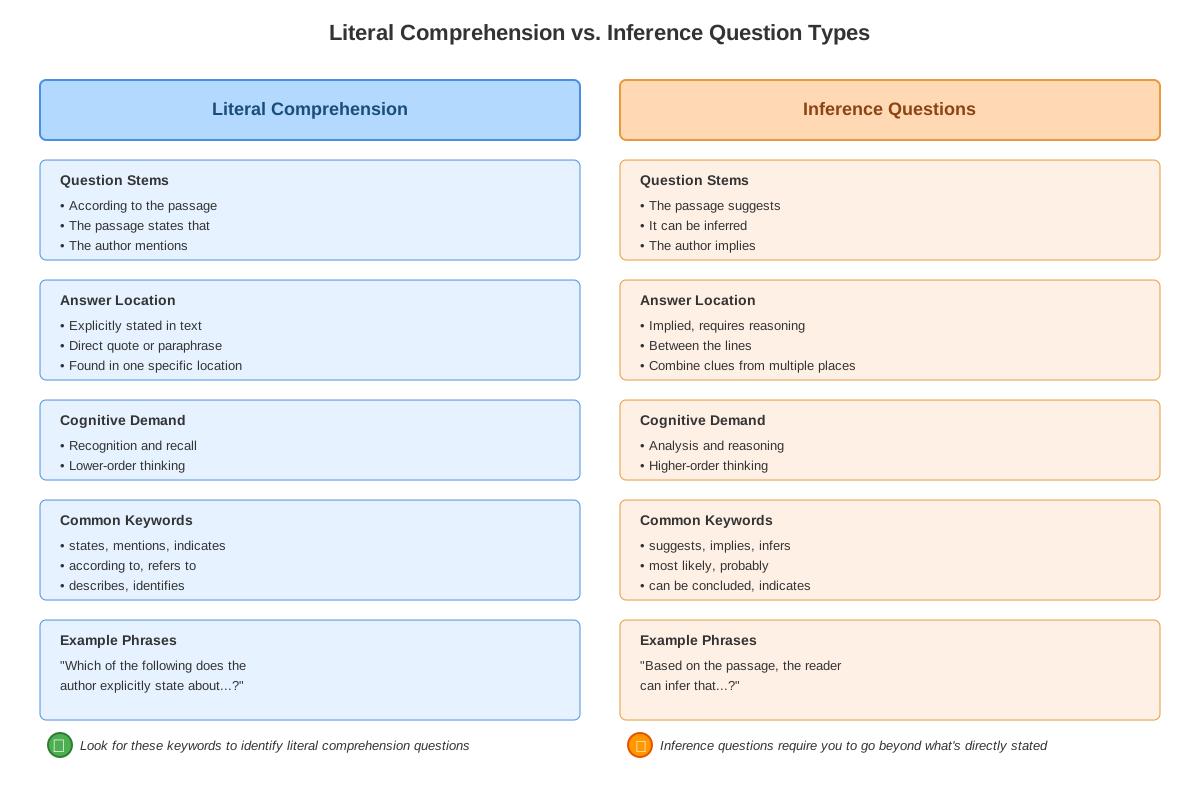
The "Stated vs. Implied" Distinction
The most critical concept in mastering literal comprehension is distinguishing between what is stated (explicit) and what is implied (requires inference). Stated information appears directly in the passage, either in exact words or clear paraphrasing. Implied information requires the reader to combine textual clues with reasoning to reach a conclusion not directly written.
Consider this example: If a passage states, "Maria studied for six hours before the exam," that's explicit information. A literal comprehension question might ask, "How long did Maria study?" The answer "six hours" is directly stated. However, if a question asks, "Was Maria well-prepared for the exam?" that requires inference—the passage doesn't explicitly state her preparation level, though studying for six hours might suggest it.
| Stated (Literal) | Implied (Inference) |
|---|---|
| Information appears in the text | Reader must combine clues |
| Can point to specific words/sentences | Requires reasoning beyond text |
| "According to the passage" questions | "It can be inferred" questions |
| Direct textual evidence | Indirect textual support |
| No interpretation needed | Interpretation required |
Paraphrasing Recognition
ACT literal comprehension questions rarely use the exact wording from the passage in correct answer choices. Instead, they paraphrase—expressing the same idea using different words. Students must recognize when an answer choice conveys the same meaning as passage content, even when vocabulary differs.
For example, if a passage states, "The industrial revolution transformed manufacturing processes," a correct answer might say, "Manufacturing methods changed during the industrial revolution." The words differ, but the meaning remains identical. Recognizing accurate paraphrasing requires understanding synonyms (transformed/changed), grammatical restructuring (active to passive voice), and conceptual equivalence (processes/methods).
Location Strategies for Explicit Information
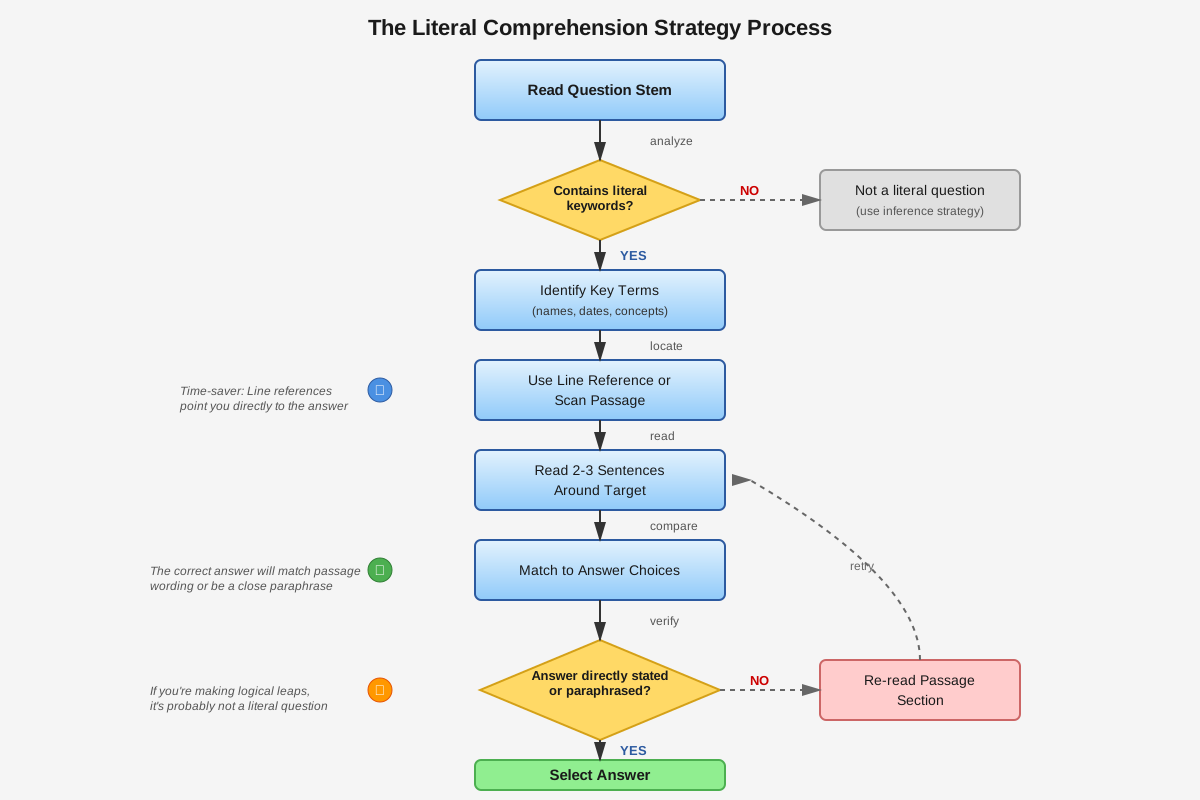
Efficient literal comprehension depends on quickly locating relevant passage sections. The ACT provides several navigation aids: line numbers in brackets, paragraph numbers, and proper nouns or dates that serve as landmarks. Successful students develop a systematic approach to finding information:
- Read the question stem carefully to identify what specific information is needed
- Note any line references, paragraph numbers, or keywords mentioned in the question
- Scan the passage for the referenced location or keywords
- Read 2-3 sentences before and after the target location for context
- Match passage content to answer choices by identifying accurate paraphrasing
Types of Literal Comprehension Questions
The ACT employs several question formats to test literal comprehension:
Direct Detail Questions: These ask for specific facts, dates, names, or descriptions explicitly mentioned in the passage. Example: "According to the passage, in what year was the organization founded?"
Explicit Statement Questions: These questions ask what the author or a character directly states or believes. Example: "The author states that the primary cause of the phenomenon was:"
Sequence Questions: These test understanding of the order in which events occurred as presented in the passage. Example: "Which of the following events happened first?"
Definition Questions: These ask for the meaning of a term as explicitly defined or used in the passage. Example: "As it is used in line 23, the term 'catalyst' most nearly means:"
Explicit Relationship Questions: These test understanding of cause-and-effect or comparison relationships when directly stated. Example: "According to the passage, what was the direct result of the policy change?"
The Role of Context in Literal Comprehension
While literal comprehension focuses on explicit information, understanding context remains important. A detail's meaning often depends on surrounding sentences. When locating information, students should read enough context to ensure they understand how the detail functions within the passage's larger discussion. A date mentioned in passing has different significance than a date emphasized as a turning point. Both are literal details, but context clarifies their importance and accurate interpretation.
Concept Relationships
Literal comprehension serves as the foundational skill that enables all other ACT Reading competencies. The relationship flows hierarchically: Literal Comprehension → Supporting Details → Main Ideas → Inferences → Author's Purpose → Rhetorical Analysis.
Students must first accurately understand what a passage explicitly states (literal comprehension) before they can identify which details support key points (supporting details). These supporting details collectively reveal the passage's main ideas. Once main ideas are clear, students can draw reasonable inferences by combining explicit information with logical reasoning. Understanding both explicit content and inferences enables analysis of the author's purpose and rhetorical strategies.
Within literal comprehension itself, concepts connect sequentially: Reading Question → Identifying Keywords → Locating Passage Section → Reading Context → Recognizing Paraphrasing → Selecting Answer. Each step depends on the previous one, creating a systematic approach to answering questions.
Literal comprehension also connects to prerequisite skills: vocabulary knowledge enables understanding of explicit statements, while paragraph structure awareness helps locate information efficiently. These foundational skills support literal comprehension, which in turn supports advanced reading analysis.
High-Yield Facts
⭐ Literal comprehension questions account for 30-40% of all ACT Reading questions, making them the most frequently tested reading skill.
⭐ Correct answers to literal comprehension questions always have direct textual support—students should be able to point to specific passage sentences that prove the answer.
⭐ The ACT rarely uses exact passage wording in correct answers; instead, correct choices paraphrase passage content using synonyms and restructured sentences.
⭐ Line references and paragraph numbers are strategic gifts—they tell students exactly where to look, making these questions faster to answer than those requiring full passage comprehension.
⭐ Reading 2-3 sentences before and after a line reference provides essential context for understanding how a detail functions within the passage.
- Literal comprehension questions typically use trigger phrases like "according to the passage," "the author states that," "the passage indicates," or "as described in the passage."
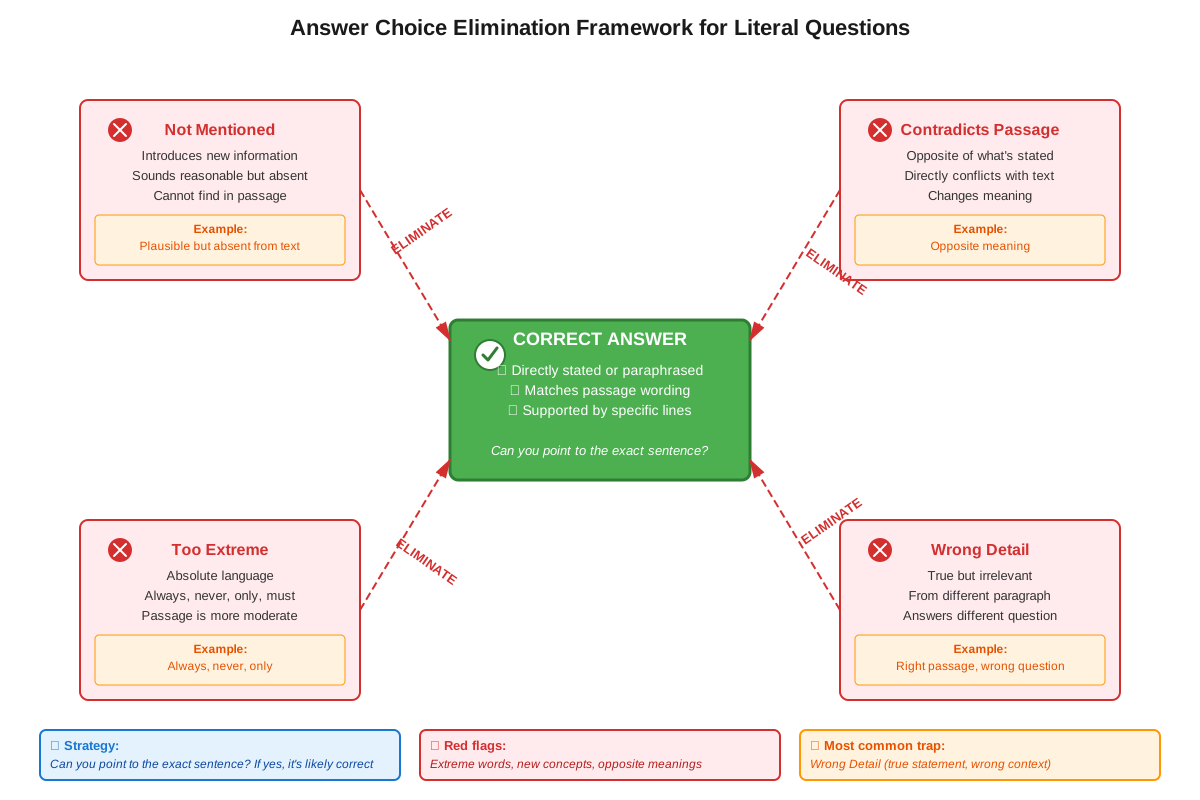
- Wrong answers to literal comprehension questions often include information that requires inference, contradicts the passage, or introduces details not mentioned in the text.
- Proper nouns, dates, and specific numbers serve as excellent "landmarks" for quickly scanning and locating relevant passage sections.
- Sequence questions test literal comprehension of chronology—students must track the order of events as explicitly presented, not as they might logically occur.
- Vocabulary-in-context questions are literal comprehension questions when they ask how a word is used in a specific sentence, requiring students to understand the explicit meaning in that context.
- Literal comprehension questions are typically faster to answer than inference questions because the answer location is more predictable and verification is more straightforward.
- Students should answer literal comprehension questions with high confidence—these questions have objectively correct answers with clear textual evidence.
Quick check — test yourself on Literal comprehension so far.
Try Flashcards →Common Misconceptions
Misconception: Literal comprehension questions are "easy" and don't require careful reading.
Correction: While literal comprehension questions test explicit information, they require precise reading and careful attention to detail. The ACT designs wrong answers to trap students who skim carelessly or rely on memory rather than verifying information in the passage. Success requires systematic location of information and careful matching to answer choices.
Misconception: If an answer choice contains words from the passage, it must be correct.
Correction: The ACT frequently creates wrong answers using passage vocabulary in incorrect contexts or combinations. Just because words appear in the passage doesn't mean the answer choice accurately represents what the passage states. Students must verify that the complete meaning of the answer choice matches passage content, not just individual words.
Misconception: Literal comprehension questions can be answered from memory after reading the passage once.
Correction: Even strong readers should return to the passage to verify answers to literal comprehension questions. Memory is unreliable under test pressure, and the ACT designs wrong answers to match common misrememberings. The most efficient strategy involves using line references and keywords to quickly locate and verify information rather than relying on memory.
Misconception: All details in the passage are equally important for literal comprehension questions.
Correction: The ACT strategically selects which details to test. Not every fact mentioned in a passage will appear in questions. Students should focus on details that relate to main ideas, turning points, explicit cause-and-effect relationships, and information emphasized through repetition or positioning. However, any detail could potentially be tested, which is why systematic location strategies matter more than trying to predict which details are "important."
Misconception: Literal comprehension questions always include line references or paragraph numbers.
Correction: While many literal comprehension questions provide location clues, some require students to remember where information appeared or to scan the passage for keywords. Students should develop both skills: efficiently using provided references and quickly scanning for information when no reference is given.
Misconception: If I understand the main idea, I can answer literal comprehension questions without checking details.
Correction: Main idea understanding and literal comprehension are related but distinct skills. A student might grasp the passage's overall point while misremembering specific details. Literal comprehension questions test precise understanding of explicit information, requiring verification of specific facts, dates, names, or statements regardless of main idea comprehension.
Worked Examples
Example 1: Direct Detail Question
Passage Excerpt (lines 34-42):
"The Harlem Renaissance, which flourished during the 1920s and early 1930s, represented a cultural, social, and artistic explosion centered in Harlem, New York. This movement saw African American writers, artists, musicians, and intellectuals produce works that celebrated Black culture and challenged racial stereotypes. Langston Hughes emerged as one of the movement's most influential poets, publishing his first poetry collection, The Weary Blues, in 1926. His work incorporated jazz rhythms and vernacular speech, creating a distinctive voice that resonated with both Black and white audiences."
Question: According to the passage, when did Langston Hughes publish his first poetry collection?
A. During the early 1930s
B. In 1926
C. At the beginning of the Harlem Renaissance
D. After the Harlem Renaissance ended
Solution Process:
Step 1: Identify the question type. The phrase "According to the passage" signals a literal comprehension question asking for explicitly stated information.
Step 2: Locate keywords. The question asks about "Langston Hughes" and "first poetry collection." Scan the passage for these terms.
Step 3: Find the relevant sentence. Line 39 states: "Langston Hughes emerged as one of the movement's most influential poets, publishing his first poetry collection, The Weary Blues, in 1926."
Step 4: Extract the explicit answer. The passage directly states "in 1926."
Step 5: Match to answer choices. Choice B ("In 1926") exactly matches the explicit information.
Step 6: Verify wrong answers:
- Choice A ("early 1930s") contradicts the explicit date
- Choice C ("beginning of the Harlem Renaissance") requires inference about when the movement began; the passage states it "flourished during the 1920s" but doesn't explicitly state when Hughes published relative to the movement's beginning
- Choice D contradicts the passage, which indicates Hughes published during the Renaissance
Correct Answer: B
Connection to Learning Objectives: This example demonstrates identifying literal comprehension testing (objective 1), applying the core strategy of locating explicit information (objective 2), and accurately selecting the answer with direct textual support (objective 3).
Example 2: Paraphrasing Recognition
Passage Excerpt (lines 56-64):
"Traditional farming methods in the region relied heavily on seasonal rainfall patterns. Farmers planted crops at the onset of the rainy season and harvested before the dry period began. However, climate variability increasingly disrupted these predictable patterns. Unpredictable rainfall timing forced farmers to adapt their agricultural practices. Many began investing in irrigation systems, allowing them to water crops independently of natural precipitation. This technological shift reduced farmers' vulnerability to weather fluctuations and enabled more consistent crop yields throughout the year."
Question: The passage indicates that irrigation systems provided farmers with which of the following benefits?
F. The ability to grow crops without depending on rainfall timing
G. Higher crop prices at local markets
H. Reduced labor requirements during harvest season
J. Protection from all weather-related agricultural challenges
Solution Process:
Step 1: Identify the question type. "The passage indicates" signals literal comprehension—the answer must be explicitly stated.
Step 2: Locate the relevant section. The question asks about irrigation system benefits. Lines 61-64 discuss irrigation: "Many began investing in irrigation systems, allowing them to water crops independently of natural precipitation. This technological shift reduced farmers' vulnerability to weather fluctuations and enabled more consistent crop yields."
Step 3: Identify explicit benefits stated:
- "water crops independently of natural precipitation"
- "reduced farmers' vulnerability to weather fluctuations"
- "enabled more consistent crop yields"
Step 4: Match to answer choices through paraphrasing recognition:
- Choice F: "grow crops without depending on rainfall timing" accurately paraphrases "water crops independently of natural precipitation" and "reduced farmers' vulnerability to weather fluctuations"
- Choice G: The passage never mentions crop prices—this introduces new information
- Choice H: The passage doesn't discuss labor requirements—this introduces new information
- Choice J: "Protection from all weather-related challenges" is too extreme; the passage says irrigation "reduced vulnerability," not eliminated it entirely
Step 5: Verify the paraphrasing. "Independently of natural precipitation" = "without depending on rainfall timing." Both express the same concept using different words.
Correct Answer: F
Connection to Learning Objectives: This example demonstrates recognizing paraphrased information (objective 6), distinguishing between stated and unstated information (objective 4), and eliminating choices that introduce content not in the passage (objective 7).
Exam Strategy
Question Identification Strategy
Quickly identify literal comprehension questions by recognizing trigger phrases: "according to the passage," "the passage states," "the author indicates," "as described in the passage," "the passage mentions," or "the passage explicitly states." These phrases signal that the answer exists directly in the text without requiring inference.
Systematic Approach to Literal Comprehension Questions
- Read the question stem carefully to understand exactly what information is needed
- Identify and circle keywords (names, dates, specific terms) that will help locate the relevant passage section
- Use line references or paragraph numbers if provided—these are strategic gifts that save time
- If no reference is provided, scan the passage for keywords using proper nouns, dates, or distinctive terms as landmarks
- Read the relevant section plus surrounding context (2-3 sentences before and after) to ensure full understanding
- Return to the question and answer choices with the passage content fresh in mind
- Eliminate wrong answers that contradict the passage, introduce unstated information, or require inference
- Select the answer that accurately paraphrases the explicit passage content
Process of Elimination Tips
Eliminate answers that:
- Contradict explicit passage statements
- Introduce information not mentioned in the passage
- Require inference or interpretation rather than stating explicit content
- Use passage vocabulary but combine it incorrectly
- Are too extreme (using words like "always," "never," "all," "none") when the passage uses qualified language
- Confuse the sequence of events or cause-and-effect relationships
Keep answers that:
- Can be directly supported by pointing to specific passage sentences
- Accurately paraphrase passage content using synonyms
- Match the scope and specificity of passage statements
- Align with the context surrounding the referenced information
Time Allocation Advice
Literal comprehension questions should be among the fastest to answer—typically 30-45 seconds each when line references are provided, 45-60 seconds when scanning is required. These questions offer high accuracy potential with efficient execution. Prioritize literal comprehension questions when initially working through a passage, as they build confidence and often clarify passage content, making inference questions easier to answer subsequently.
Exam Tip: If you're unsure between two answer choices on a literal comprehension question, return to the passage and verify each choice against the text. The correct answer will have direct textual support, while the wrong answer will have a subtle mismatch—perhaps introducing a detail not stated, using passage words in the wrong context, or requiring a small inference.
Common Trap Patterns
The ACT uses predictable wrong answer patterns for literal comprehension questions:
- The Memory Trap: Wrong answers that seem familiar because they use passage vocabulary but misrepresent what the passage actually states
- The Inference Trap: Answers that are probably true based on passage information but aren't explicitly stated
- The Extreme Trap: Answers that overstate passage claims using absolute language
- The Reversal Trap: Answers that reverse cause-and-effect relationships or sequence of events
- The Scope Trap: Answers that are too broad or too narrow compared to what the passage explicitly states
Memory Techniques
The LOCATE Method
Use this acronym to systematically approach literal comprehension questions:
Look for trigger phrases ("according to the passage")
Observe keywords and line references in the question
Circle or note the specific information needed
Access the relevant passage section quickly
Track down the explicit statement with context
Eliminate wrong answers and select the paraphrased match
Visualization Strategy
When reading passages initially, create mental "bookmarks" for key information categories: names and dates go in one mental folder, cause-and-effect relationships in another, sequences of events in a third. This mental organization helps you quickly recall where different types of information appeared when questions ask for explicit details.
The "Point and Prove" Technique
For every literal comprehension answer you select, mentally (or physically, if time permits) point to the specific passage sentence that proves the answer correct. If you cannot point to direct textual support, reconsider your answer choice. This technique reinforces the fundamental principle: literal comprehension answers must have explicit passage support.
Paraphrase Recognition Practice
Develop synonym awareness by mentally paraphrasing key passage sentences as you read. If a passage states "The scientist discovered," think "found" or "uncovered." If it says "rapidly increased," think "quickly grew" or "rose swiftly." This mental practice trains your brain to recognize paraphrased content in answer choices.
Summary
Literal comprehension represents the foundational reading skill tested on the ACT, accounting for 30-40% of all Reading questions. This skill involves accurately understanding and locating information explicitly stated in passages without requiring inference or interpretation. Success with literal comprehension questions depends on recognizing question types through trigger phrases like "according to the passage," efficiently locating relevant passage sections using line references and keywords, reading sufficient context to understand how details function within the passage, and recognizing accurate paraphrasing in answer choices. The most critical distinction students must master is differentiating between stated information (which appears explicitly in the text) and implied information (which requires inference). Correct answers to literal comprehension questions always have direct textual support—students should be able to point to specific sentences that prove their answer. By developing systematic location strategies, practicing paraphrase recognition, and learning to eliminate wrong answers that introduce unstated information or require inference, students can achieve high accuracy on these questions while building the foundation for more complex reading tasks.
Key Takeaways
- Literal comprehension questions test explicitly stated information and account for 30-40% of ACT Reading questions, making them the most frequently tested skill
- Correct answers always have direct textual support—develop the habit of verifying answers by pointing to specific passage sentences
- The ACT rarely uses exact passage wording in correct answers; instead, correct choices paraphrase content using synonyms and restructured sentences
- Use line references and paragraph numbers strategically—they tell you exactly where to look and make questions faster to answer
- Distinguish between stated information (explicit in the text) and implied information (requires inference)—literal comprehension questions only test the former
- Read 2-3 sentences before and after line references to understand context, not just the isolated sentence
- Eliminate wrong answers that contradict the passage, introduce unstated information, or require inference beyond explicit content
Related Topics
Supporting Details and Evidence: After mastering literal comprehension, students progress to identifying which explicit details support main ideas and claims. This skill builds directly on the ability to locate and understand stated information.
Main Idea and Theme: Understanding explicit details enables students to synthesize these details into broader main ideas. Literal comprehension provides the building blocks from which main ideas emerge.
Inference and Implicit Meaning: Once students accurately understand what a passage explicitly states, they can progress to drawing logical conclusions based on combining explicit information with reasoning.
Sequence and Chronology: This specialized application of literal comprehension focuses specifically on understanding the order of events as explicitly presented in passages.
Author's Purpose and Perspective: After mastering what a passage explicitly states, students can analyze why the author chose to present information in particular ways and what perspective emerges from explicit statements.
Practice CTA
Now that you understand the core concepts and strategies for literal comprehension, it's time to apply these skills! Complete the practice questions to reinforce your ability to identify literal comprehension questions, locate explicit information efficiently, and recognize accurate paraphrasing in answer choices. Use the flashcards to memorize key trigger phrases and common wrong answer patterns. Remember: literal comprehension questions offer high accuracy potential when you approach them systematically. Master this foundational skill, and you'll build confidence while establishing the groundwork for all other ACT Reading competencies. You've got this!
Sign up free to keep reading
Create a free AnvayaPrep account to finish this ACT guide on Literal comprehension — plus flashcards and practice questions.