Overview
Understanding the sequence of events is a fundamental skill tested extensively on the ACT Reading section. This concept requires students to track the chronological order of actions, developments, and occurrences within a passage, even when the author presents information in a non-linear fashion. The ACT frequently challenges test-takers by presenting narratives with flashbacks, flash-forwards, or thematic organization rather than strict chronological order, making it essential to mentally reconstruct the actual timeline of events.
The ACT sequence of events questions appear across all passage types—prose fiction, social science, humanities, and natural science—though they are particularly common in literary narratives and historical accounts. These questions assess whether students can distinguish between the order in which information is presented versus the order in which events actually occurred. Mastery of this skill directly impacts performance on approximately 15-20% of ACT Reading questions, making it one of the highest-yield topics for score improvement.
This topic connects intimately with other Key Ideas and Details concepts, particularly main idea identification and detail recognition. Understanding event sequences provides the structural framework that supports comprehension of cause-and-effect relationships, character development, and thematic progression. Students who excel at tracking sequences demonstrate superior overall reading comprehension and can more efficiently navigate complex passages under timed conditions.
Learning Objectives
- [ ] Identify when Sequence of events is being tested in ACT Reading questions
- [ ] Explain the core rule or strategy behind Sequence of events analysis
- [ ] Apply Sequence of events strategies to ACT-style questions accurately
- [ ] Distinguish between narrative order (how events are presented) and chronological order (when events actually occurred)
- [ ] Recognize temporal transition words and phrases that signal sequence relationships
- [ ] Reconstruct accurate timelines from passages that present events out of order
- [ ] Eliminate incorrect answer choices that misrepresent the order of events
Prerequisites
- Basic reading comprehension: Understanding literal meaning of sentences and paragraphs is necessary before analyzing their sequential relationships
- Familiarity with narrative structure: Recognizing exposition, rising action, climax, and resolution helps contextualize when events occur
- Understanding of verb tenses: Past perfect, simple past, and present tenses signal temporal relationships between events
- Ability to identify main ideas: Distinguishing major events from minor details ensures focus on the most important sequential elements
Why This Topic Matters
In real-world contexts, the ability to track sequences of events is crucial for understanding historical accounts, following procedural instructions, analyzing cause-and-effect relationships in scientific processes, and comprehending narrative literature. This skill transfers directly to academic success across disciplines, from understanding the progression of historical movements to following the steps of experimental methodology.
On the ACT Reading section, sequence questions appear with remarkable consistency. Statistical analysis of released ACT exams reveals that 2-4 questions per test explicitly ask about the order of events, while an additional 3-5 questions require implicit understanding of sequence to answer correctly. These questions typically appear in formats such as: "Which of the following events happened first?" "According to the passage, which event occurred immediately after...?" or "The passage indicates that X happened before Y primarily to..."
Sequence questions commonly appear in passages featuring biographical narratives, historical accounts, scientific processes, and literary fiction with non-linear storytelling. The ACT deliberately selects passages where the presentation order differs from chronological order, testing whether students can mentally reorganize information. Prose fiction passages frequently employ flashbacks or begin in medias res (in the middle of action), while social science passages might discuss effects before causes to emphasize contemporary relevance before historical context.
Core Concepts
Understanding Narrative vs. Chronological Order
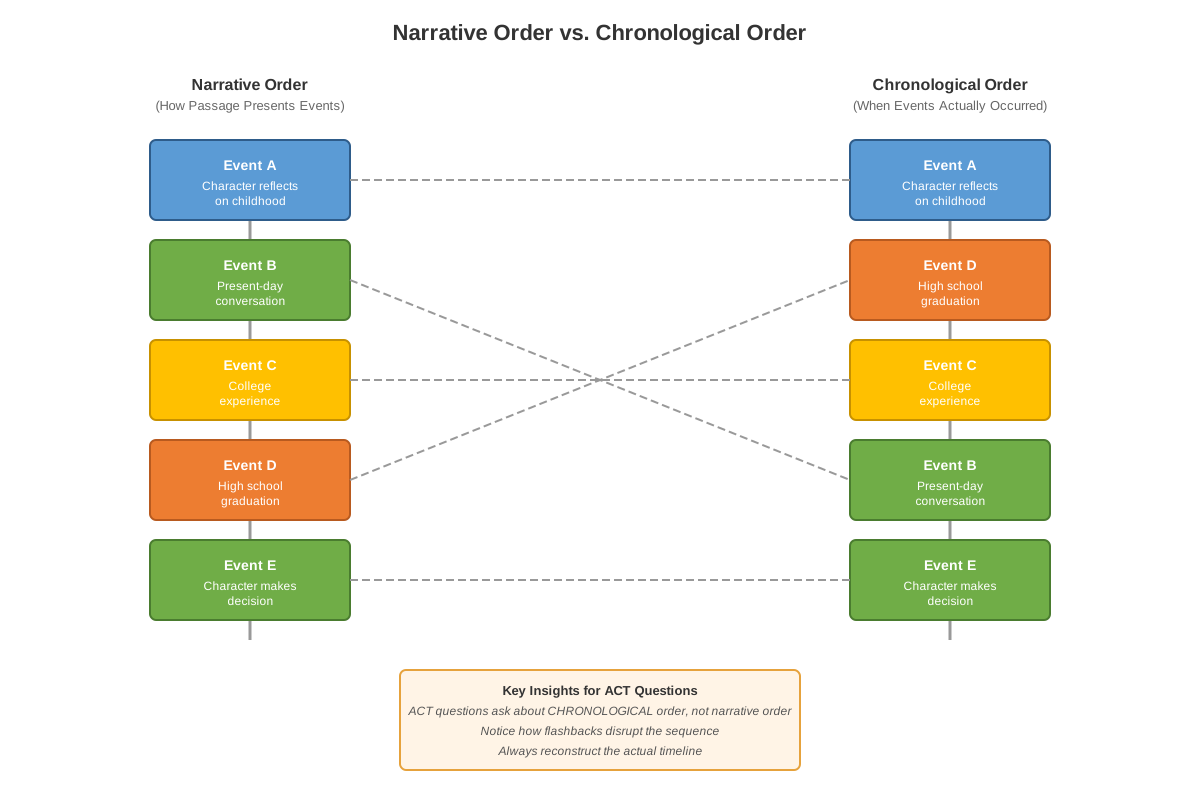
The fundamental distinction in sequence analysis is between narrative order (the order in which the author presents information) and chronological order (the actual temporal sequence of events). The ACT exploits this difference by crafting passages where these two orders diverge significantly.
Narrative order refers to the structural organization chosen by the author for rhetorical effect. An author might begin with a dramatic moment, then flash back to explain how characters arrived at that situation. Alternatively, a scientific passage might describe current understanding before explaining the historical experiments that led to that knowledge.
Chronological order represents the actual timeline of events as they occurred in the story world or historical reality. When answering sequence questions, students must reconstruct this chronological order regardless of how the passage presents information.
Consider this example: A passage might open with a scientist's breakthrough discovery (Event C), then explain her childhood inspiration (Event A) and years of failed experiments (Event B). The narrative order is C-A-B, but the chronological order is A-B-C. ACT questions will test whether students recognize that her childhood inspiration came first chronologically, even though it appears second in the passage.
Temporal Transition Words and Phrases
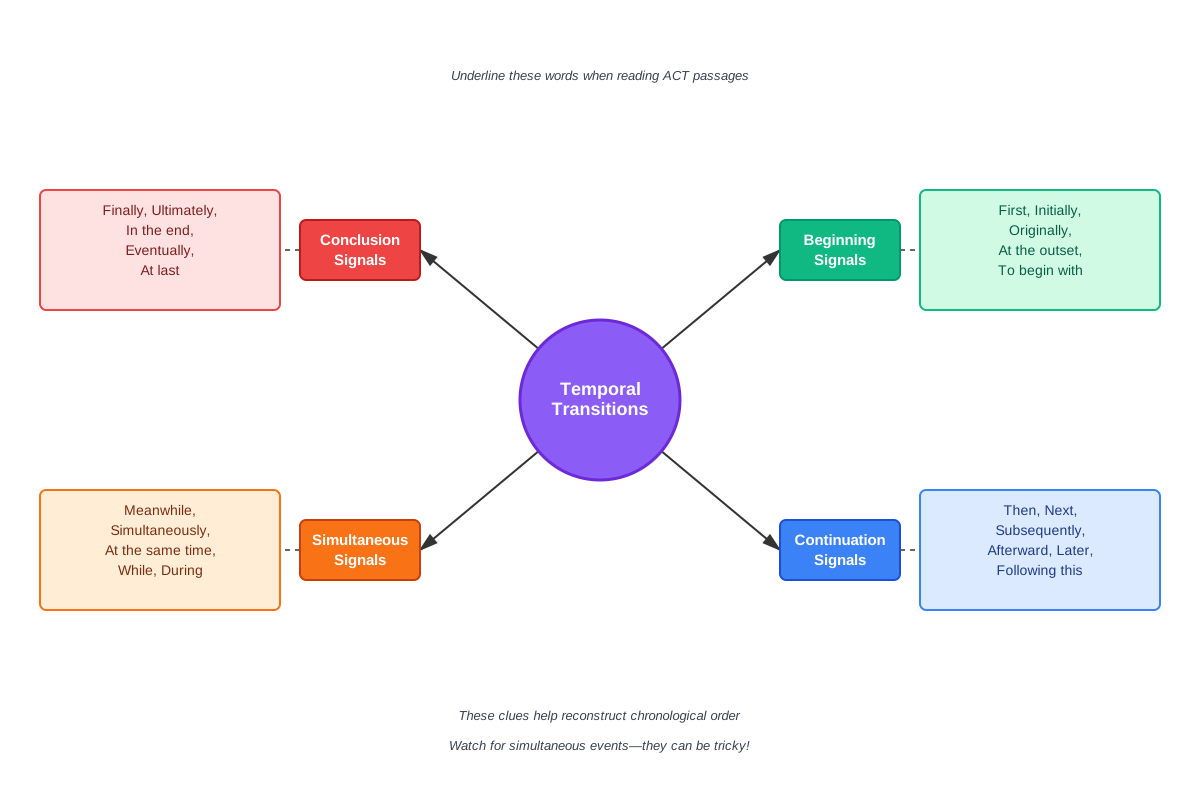
Temporal transition words serve as signposts indicating sequence relationships. Recognizing these markers is essential for tracking event order efficiently. These transitions fall into several categories:
| Category | Examples | Function |
|---|---|---|
| Beginning indicators | initially, first, originally, at the outset | Signal the start of a sequence |
| Continuation markers | then, next, subsequently, afterward, following this | Indicate progression forward in time |
| Simultaneous events | meanwhile, simultaneously, at the same time, during | Show events occurring concurrently |
| Prior events | previously, earlier, before, prior to, formerly | Reference events that happened earlier |
| Concluding markers | finally, ultimately, eventually, in the end | Signal the conclusion of a sequence |
| Specific time references | in 1995, three years later, the following month | Provide concrete temporal anchors |
Advanced temporal markers include phrases like "looking back," "in retrospect," "years before," and "not until later did," which explicitly signal that the narrative is departing from chronological order. When these phrases appear, students should immediately recognize that careful sequence tracking is required.
Verb Tense as a Sequence Indicator
Verb tenses provide crucial clues about temporal relationships between events. The past perfect tense (had + past participle) specifically indicates that an action occurred before another past action, making it a powerful sequence indicator.
Example: "She graduated in 2010. She had studied abroad three years earlier." The past perfect "had studied" signals that studying abroad (2007) preceded graduation (2010), even though graduation is mentioned first.
The simple past tense typically indicates the main timeline of events, while past perfect reaches further back. When a passage shifts from simple past to past perfect, it's signaling a flashback or reference to earlier events.
Reconstructing Timelines from Non-Linear Narratives
Many ACT passages deliberately present events out of chronological order to test reconstruction skills. Effective students develop a mental or physical timeline as they read, placing events in their actual temporal order.
The reconstruction process involves:
- Identifying all significant events mentioned in the passage
- Noting temporal markers (transition words, dates, verb tenses) associated with each event
- Determining relative positions (which events are described as happening before or after others)
- Creating a mental timeline that orders events chronologically
- Cross-referencing when answering questions to ensure accuracy
For complex passages, brief marginal notes can help track sequence. Writing "1st," "2nd," "3rd" next to events as they're identified chronologically (not as they appear) creates a quick reference guide.
Distinguishing Major Events from Minor Details
Not all actions mentioned in a passage carry equal weight for sequence questions. Major events are significant developments that advance the narrative, argument, or explanation, while minor details provide supporting information but don't constitute key sequential elements.
Major events typically:
- Represent turning points or significant changes
- Are referenced multiple times in the passage
- Connect to the passage's main idea or theme
- Have clear causes or effects discussed in the passage
Minor details typically:
- Provide background or contextual information
- Appear only once without elaboration
- Serve descriptive rather than narrative functions
ACT sequence questions focus on major events. An answer choice that references minor details in sequence is likely a distractor designed to trap students who didn't distinguish between significant and trivial information.
Handling Simultaneous and Overlapping Events
Some passages describe events that occur simultaneously or overlap in time rather than following a strict linear sequence. The ACT tests whether students recognize these temporal relationships.
Simultaneous events occur at exactly the same time: "While the Senate debated the bill, protesters gathered outside." Both actions happen concurrently, and neither precedes the other.
Overlapping events have different start and end points but share some temporal space: "During the three-year construction project, the architect also designed two other buildings." The construction spans three years, while the other designs occur within that period but don't necessarily last the entire duration.
Questions about simultaneous or overlapping events often use language like "during," "while," "at the same time," or "throughout." Correct answers will reflect the concurrent nature rather than imposing a false sequential relationship.
Concept Relationships
The concepts within sequence of events analysis form an interconnected system. Temporal transition words serve as the primary textual evidence for determining narrative versus chronological order. When these transitions are absent or ambiguous, verb tense analysis provides secondary evidence for sequence relationships. Both transition words and verb tenses help students reconstruct timelines from non-linear narratives.
The ability to distinguish major events from minor details operates as a filtering mechanism, allowing students to focus reconstruction efforts on the most important sequential elements. This distinction becomes particularly crucial when handling simultaneous and overlapping events, as students must determine which concurrent actions are significant enough to warrant attention in sequence questions.
These sequence concepts connect to prerequisite knowledge of narrative structure by providing the temporal framework within which exposition, rising action, and climax occur. Understanding verb tenses (prerequisite knowledge) directly enables the use of tense as a sequence indicator. The relationship flows: Prerequisite Knowledge → Sequence Analysis Tools → Timeline Reconstruction → Accurate Question Response.
Sequence of events also connects forward to more advanced reading skills like cause-and-effect analysis (understanding that causes precede effects requires sequence knowledge) and character development tracking (recognizing how characters change requires knowing the order of experiences that shaped them).
Quick check — test yourself on Sequence of events so far.
Try Flashcards →High-Yield Facts
⭐ The ACT frequently presents events in non-chronological order to test whether students can reconstruct the actual timeline
⭐ Past perfect tense (had + past participle) always indicates an event that occurred before another past event
⭐ Temporal transition words like "previously," "earlier," and "before" signal that the passage is referencing events out of chronological order
⭐ Sequence questions often appear in formats asking "which happened first," "immediately after," or "before X occurred"
⭐ The order in which events are mentioned in the passage does not necessarily reflect the order in which they occurred
- Approximately 15-20% of ACT Reading questions require understanding of event sequences
- Prose fiction passages most frequently test sequence through flashbacks and non-linear narratives
- Dates, ages, and specific time references provide concrete anchors for timeline reconstruction
- Simultaneous events are often indicated by "while," "during," "meanwhile," or "at the same time"
- Answer choices that confuse narrative order with chronological order are common distractors
- Creating brief marginal notes with sequence numbers can prevent confusion in complex passages
- Events described in hypothetical or conditional language (would have, might have) are not part of the actual sequence
- The introduction and conclusion of passages often reference different time periods than the body paragraphs
Common Misconceptions
Misconception: Events are always presented in the order they occurred. → Correction: Authors frequently use non-chronological organization for rhetorical effect. The ACT specifically selects passages where narrative order differs from chronological order to test reconstruction skills.
Misconception: The first event mentioned in a passage is always the first event chronologically. → Correction: Many passages begin in medias res or with a dramatic moment, then flash back to earlier events. Students must use temporal markers and verb tenses to determine actual chronological order.
Misconception: All events mentioned in a passage are equally important for sequence questions. → Correction: ACT sequence questions focus on major events that advance the narrative or argument. Minor details and background information are typically not tested in sequence questions.
Misconception: If two events are described in the same paragraph, they must have occurred close together in time. → Correction: Paragraphs are organized by theme, topic, or rhetorical purpose, not necessarily by chronological proximity. Events separated by years might be discussed in the same paragraph if they relate to the same theme.
Misconception: Temporal transition words always appear when the sequence changes. → Correction: While transition words are helpful markers, authors don't always include them. Students must also rely on verb tenses, dates, and logical inference to determine sequence.
Misconception: "After" always means immediately after. → Correction: "After" indicates sequence but not necessarily immediate succession. "Three years after graduating, she started her business" shows a significant time gap between events.
Worked Examples
Example 1: Literary Narrative with Flashback
Passage Excerpt: "Maria stood at the podium, her acceptance speech trembling in her hands. She had never imagined this moment during those early years in the laboratory, when experiments failed more often than they succeeded. Her mentor, Dr. Chen, had retired two years before this award ceremony, but his encouragement had sustained her through the difficult period. Just last month, the journal published her breakthrough findings."
Question: According to the passage, which of the following events occurred first?
A) Maria's experiments frequently failed
B) Dr. Chen retired
C) Maria's findings were published
D) Maria gave her acceptance speech
Solution Process:
Step 1: Identify all events and their temporal markers
- "stood at the podium" - present moment of the narrative (simple past)
- "had never imagined" - past perfect, referencing earlier time
- "early years in the laboratory, when experiments failed" - past perfect context, earliest period
- "Dr. Chen had retired two years before this award ceremony" - past perfect with specific time reference
- "Just last month, the journal published" - recent past with time marker
Step 2: Reconstruct chronological order
- Early laboratory years with frequent failures (earliest, indicated by past perfect)
- Dr. Chen's retirement (two years before the speech)
- Journal publication (last month)
- Award ceremony speech (present moment of narrative)
Step 3: Match to answer choices
The earliest event is Maria's experiments frequently failing during her early laboratory years.
Answer: A
Connection to Learning Objectives: This example demonstrates identifying when sequence is tested (the question explicitly asks "which occurred first"), applying the strategy of using verb tenses (past perfect signals earliest events), and accurately answering an ACT-style question by reconstructing the timeline despite non-chronological presentation.
Example 2: Scientific Process Description
Passage Excerpt: "Today's understanding of plate tectonics emerged from decades of research. Alfred Wegener proposed continental drift in 1912, though the scientific community initially rejected his theory. During the 1950s, oceanographic studies revealed mid-ocean ridges. These discoveries, combined with paleomagnetic evidence gathered throughout the 1960s, finally provided the mechanism Wegener's theory had lacked. By 1968, the theory of plate tectonics had gained widespread acceptance."
Question: The passage indicates that paleomagnetic evidence was gathered:
A) before Wegener proposed continental drift
B) after the theory of plate tectonics gained acceptance
C) during the same decade that mid-ocean ridges were discovered
D) after mid-ocean ridges were discovered but before widespread acceptance of plate tectonics
Solution Process:
Step 1: Create a timeline with specific dates
- 1912: Wegener proposed continental drift
- 1950s: Mid-ocean ridges discovered
- 1960s: Paleomagnetic evidence gathered
- 1968: Plate tectonics theory gained acceptance
Step 2: Determine the relationship of paleomagnetic evidence to other events
- Paleomagnetic evidence (1960s) came after Wegener's proposal (1912) - eliminates A
- Paleomagnetic evidence (1960s) came before acceptance (1968) - eliminates B
- Paleomagnetic evidence (1960s) came after mid-ocean ridge discovery (1950s) - consistent with D
- Paleomagnetic evidence (1960s) was NOT in the same decade as mid-ocean ridges (1950s) - eliminates C
Step 3: Verify the correct answer
Option D accurately states that paleomagnetic evidence was gathered after the 1950s discoveries but before the 1968 acceptance.
Answer: D
Connection to Learning Objectives: This example shows how to identify sequence testing in questions asking about temporal relationships ("was gathered"), apply the strategy of using specific dates as timeline anchors, and eliminate incorrect answers that misrepresent the sequence.
Exam Strategy
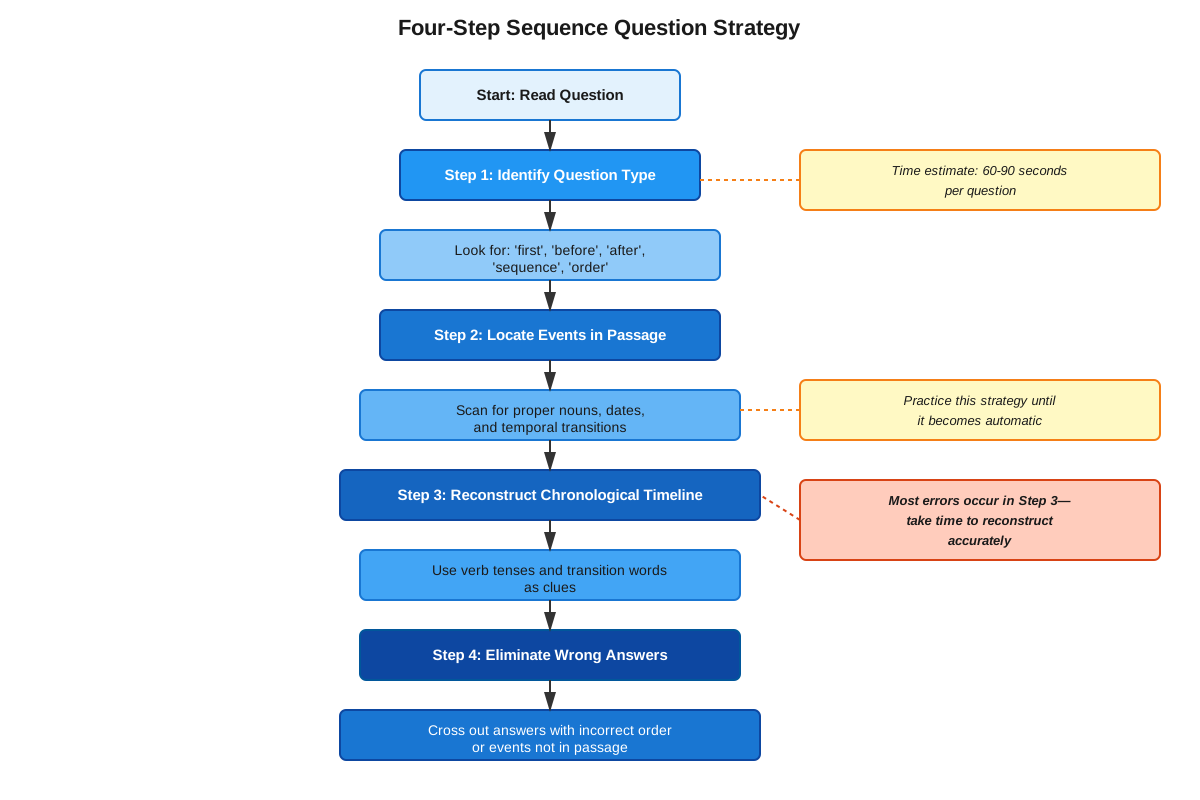
When approaching ACT sequence questions, implement this systematic process:
Recognition Phase: Identify sequence questions through trigger words and phrases:
- "Which happened first/last?"
- "Before X occurred..."
- "Immediately after..."
- "The passage indicates that X happened prior to..."
- "In what order did the following events occur?"
- "Which of the following sequences is correct?"
Analysis Phase: As you read the passage initially, mark temporal indicators:
- Circle or underline dates, ages, and specific time references
- Note transition words that signal sequence (previously, later, meanwhile)
- Pay special attention to verb tense shifts, particularly past perfect
- For complex passages, jot brief sequence numbers in margins
Question-Answering Phase:
- Return to the passage and locate each event mentioned in the question
- Identify the temporal markers associated with each event
- Reconstruct the chronological order using your marked indicators
- Eliminate answer choices that contradict the established sequence
- Verify your answer by checking that it's consistent with all temporal markers
Process-of-Elimination Tips:
- Eliminate choices that confuse narrative order with chronological order
- Remove options that place events with clear temporal markers (dates, "before," "after") in impossible positions
- Discard answers that ignore verb tense signals, especially past perfect
- Watch for distractors that correctly sequence some events but misplace one critical event
Time Allocation: Sequence questions typically require 45-60 seconds once you've read the passage. If you find yourself spending more than 75 seconds, you may be overthinking. Trust your initial timeline reconstruction and move forward.
Exam Tip: If a passage seems to jump around in time, it's likely setting up sequence questions. Invest an extra 15-20 seconds during your initial reading to track the timeline, which will save time when answering multiple sequence questions about that passage.
Memory Techniques
PAST Acronym for Sequence Analysis:
- Perfect tense = Previous events (past perfect indicates earlier actions)
- Anchor dates = Absolute timeline markers
- Signal words = Transition words indicating sequence
- Track major events = Focus on significant developments, not minor details
Visualization Strategy: Picture events as beads on a string. As you read, mentally place each major event as a bead in chronological position, regardless of when it's mentioned. This creates a visual timeline you can reference when answering questions.
The "Flashback Flag" Technique: When you encounter past perfect tense or words like "previously" or "earlier," mentally raise a red flag. This signals that the passage is moving backward in time, and you need to place this information earlier on your mental timeline.
Temporal Transition Hierarchy: Remember that some transitions are stronger sequence indicators than others:
- Strongest: Specific dates, ages, time periods ("in 1995," "three years later")
- Strong: Past perfect tense, explicit sequence words ("before," "after," "previously")
- Moderate: General transition words ("then," "next," "meanwhile")
- Weakest: Paragraph breaks, thematic shifts
Summary
Mastering sequence of events is essential for ACT Reading success, as 15-20% of questions directly or indirectly test this skill. The core challenge lies in distinguishing between narrative order (how the author presents information) and chronological order (when events actually occurred). Students must recognize temporal transition words, analyze verb tenses (especially past perfect), and use specific dates as timeline anchors to reconstruct accurate chronological sequences. The ACT deliberately selects passages with non-linear organization, particularly in prose fiction and historical accounts, making active sequence tracking crucial. Effective strategies include marking temporal indicators during initial reading, focusing on major events rather than minor details, and systematically eliminating answer choices that misrepresent event order. Success requires both careful attention to textual evidence and the ability to mentally reorganize information into coherent timelines.
Key Takeaways
- The order in which events are presented in a passage often differs from the order in which they actually occurred chronologically
- Past perfect tense (had + past participle) is the strongest grammatical indicator that an event occurred before another past event
- Temporal transition words like "previously," "earlier," "meanwhile," and "subsequently" serve as critical signposts for sequence relationships
- Specific dates, ages, and time periods provide concrete anchors for reconstructing accurate timelines
- ACT sequence questions focus on major events that advance the narrative or argument, not minor background details
- Creating brief marginal notes with sequence numbers during reading prevents confusion when answering multiple sequence questions
- Effective process of elimination involves identifying answer choices that confuse narrative order with chronological order
Related Topics
Cause and Effect Relationships: Understanding sequence is foundational for analyzing cause and effect, as causes must precede effects. Mastering sequence enables more sophisticated analysis of causal chains in ACT passages.
Character Development and Motivation: Tracking the sequence of events that shape characters helps explain their motivations and decisions, particularly in prose fiction passages where character analysis questions are common.
Main Idea and Supporting Details: Recognizing the sequence of major events helps distinguish main ideas from supporting details, as main ideas often represent the most significant developments in a chronological progression.
Author's Purpose and Rhetorical Strategy: Understanding why an author chose to present events in a particular narrative order (rather than chronologically) reveals rhetorical strategies and helps answer questions about author's purpose.
Comparative Relationships: Some passages compare events or developments across different time periods, requiring both sequence tracking and comparative analysis skills.
Practice CTA
Now that you've mastered the strategies for tracking sequence of events, it's time to apply these skills to authentic ACT-style passages. Complete the practice questions to reinforce your ability to distinguish narrative from chronological order, recognize temporal markers, and accurately reconstruct timelines. Review the flashcards to cement your understanding of key transition words and sequence indicators. Remember: sequence questions are among the most predictable on the ACT—with focused practice, you can consistently answer them correctly and boost your Reading score. Your investment in mastering this high-yield topic will pay dividends on test day!
Sign up free to keep reading
Create a free AnvayaPrep account to finish this ACT guide on Sequence of events — plus flashcards and practice questions.