Overview
Reading for structure is one of the most critical yet underappreciated skills tested on the ACT Reading section. While many students focus exclusively on content comprehension—understanding what a passage says—the ACT frequently tests whether students can identify how a passage is organized, how ideas relate to one another, and why an author chose a particular organizational pattern. This skill, known as ACT reading for structure, requires students to step back from the details and recognize the architectural blueprint of a text.
Understanding structural elements is essential because approximately 20-25% of ACT Reading questions directly or indirectly assess structural awareness. These questions ask about the function of paragraphs, the purpose of specific sections, transitions between ideas, the overall organization of the passage, and how different parts of the text work together to support the author's purpose. Students who can quickly identify structural patterns gain a significant advantage: they can predict where information will appear, understand why certain details are included, and eliminate wrong answers that misrepresent the passage's organization.
Reading for structure connects intimately with other ACT Reading skills, particularly identifying main ideas, understanding author's purpose, and making inferences. The structure of a passage reveals the author's priorities and reasoning process. A chronological structure suggests narrative or historical development; a compare-contrast structure highlights differences and similarities; a problem-solution structure emphasizes causation and remedies. By recognizing these patterns, students can better anticipate question types, locate relevant information efficiently, and understand the passage at a deeper level than surface content alone would allow.
Learning Objectives
- [ ] Identify when Reading for structure is being tested in ACT questions
- [ ] Explain the core rule or strategy behind Reading for structure
- [ ] Apply Reading for structure to ACT-style questions accurately
- [ ] Recognize the five most common organizational patterns in ACT passages
- [ ] Determine the function of individual paragraphs within the overall passage structure
- [ ] Distinguish between questions testing content versus questions testing structure
- [ ] Use structural awareness to predict information location and improve reading efficiency
Prerequisites
- Basic paragraph structure understanding: Recognizing topic sentences, supporting details, and concluding sentences helps identify how individual paragraphs function within larger organizational patterns
- Familiarity with main idea identification: Understanding the central point of a passage provides the foundation for recognizing how structural elements support that main idea
- Knowledge of the four ACT passage types: Awareness of Prose Fiction, Social Science, Humanities, and Natural Science passages helps anticipate likely structural patterns in each genre
- Basic transition word recognition: Understanding how words like "however," "furthermore," and "in contrast" signal relationships between ideas is fundamental to tracking structural shifts
Why This Topic Matters
Reading for structure represents a sophisticated reading skill that extends far beyond standardized testing. In academic settings, recognizing organizational patterns helps students take better notes, write more coherent essays, and understand complex textbook chapters. In professional contexts, structural awareness enables efficient processing of reports, proposals, and technical documents. The ability to quickly grasp how information is organized—rather than getting lost in details—distinguishes strong readers from struggling ones.
On the ACT specifically, structural questions appear with remarkable consistency. Approximately 8-10 questions per test (out of 40 total Reading questions) directly assess structural understanding. These questions use distinctive language patterns: "The main purpose of the third paragraph is to...", "The passage is best described as...", "The author organizes the discussion by...", or "The function of lines 45-52 is to..." Additionally, many inference and detail questions become significantly easier when students understand the passage's organizational framework, making structural awareness valuable for 50% or more of all Reading questions.
ACT passages employ structure in predictable ways. Prose Fiction passages typically use chronological or flashback structures, with shifts in time or perspective marking major structural divisions. Social Science passages often employ problem-solution, cause-effect, or compare-contrast patterns. Humanities passages frequently use biographical chronology or thematic organization. Natural Science passages commonly present a phenomenon followed by explanation, or describe competing theories followed by evidence. Recognizing these patterns within the first minute of reading provides a roadmap for the entire passage.
Core Concepts
What Reading for Structure Means
Reading for structure involves analyzing how a passage is organized rather than merely what it says. This means identifying the relationship between parts of the text, understanding why information appears in a particular sequence, and recognizing the function each section serves in supporting the author's overall purpose. Structure operates at multiple levels: the overall organizational pattern of the entire passage, the function of individual paragraphs, the relationship between sentences within paragraphs, and the purpose of specific details or examples.
When reading for structure, students must ask different questions than when reading for content. Instead of "What happened?" ask "Why does the author tell us this now?" Instead of "What does this mean?" ask "How does this section relate to what came before and what follows?" This shift in perspective transforms passive reading into active analysis.
The Five Primary Organizational Patterns
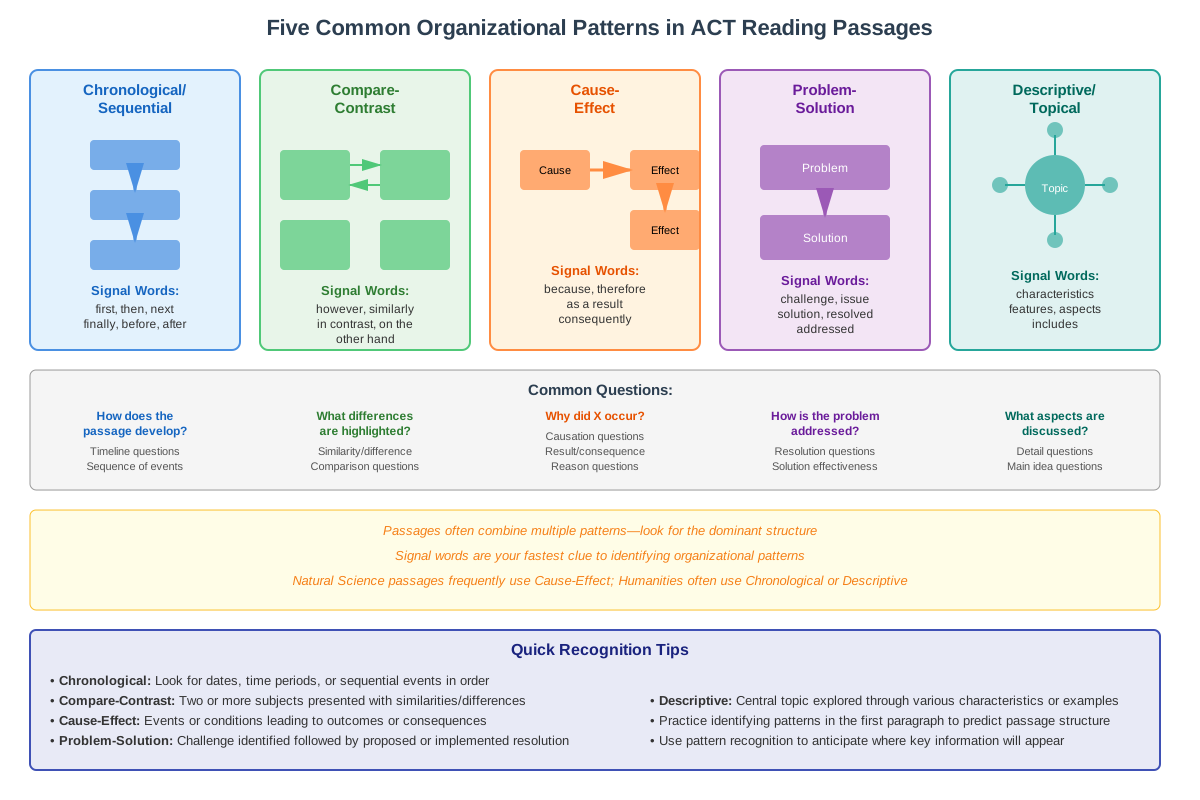
ACT passages consistently employ five major structural patterns, each with distinctive characteristics:
| Pattern | Characteristics | Common Indicators | Typical Passage Types |
|---|---|---|---|
| Chronological/Sequential | Events or ideas presented in time order | Dates, time markers, "first," "then," "finally" | Prose Fiction, Humanities (biography) |
| Compare-Contrast | Two or more subjects examined for similarities and differences | "Similarly," "however," "in contrast," "on the other hand" | Social Science, Humanities |
| Cause-Effect | Explains why something happened or what resulted from an event | "Because," "therefore," "as a result," "consequently" | Natural Science, Social Science |
| Problem-Solution | Presents a difficulty followed by proposed remedies | "The challenge," "to address this," "one solution" | Social Science, Natural Science |
| Descriptive/Topical | Explores multiple aspects of a single subject | "Another feature," "additionally," "also important" | All passage types |
Understanding these patterns allows students to predict information flow and recognize structural shifts. Many passages combine multiple patterns—for example, a Natural Science passage might use chronological structure to trace the history of a discovery, then shift to cause-effect to explain the scientific phenomenon.
Paragraph Function Within Overall Structure
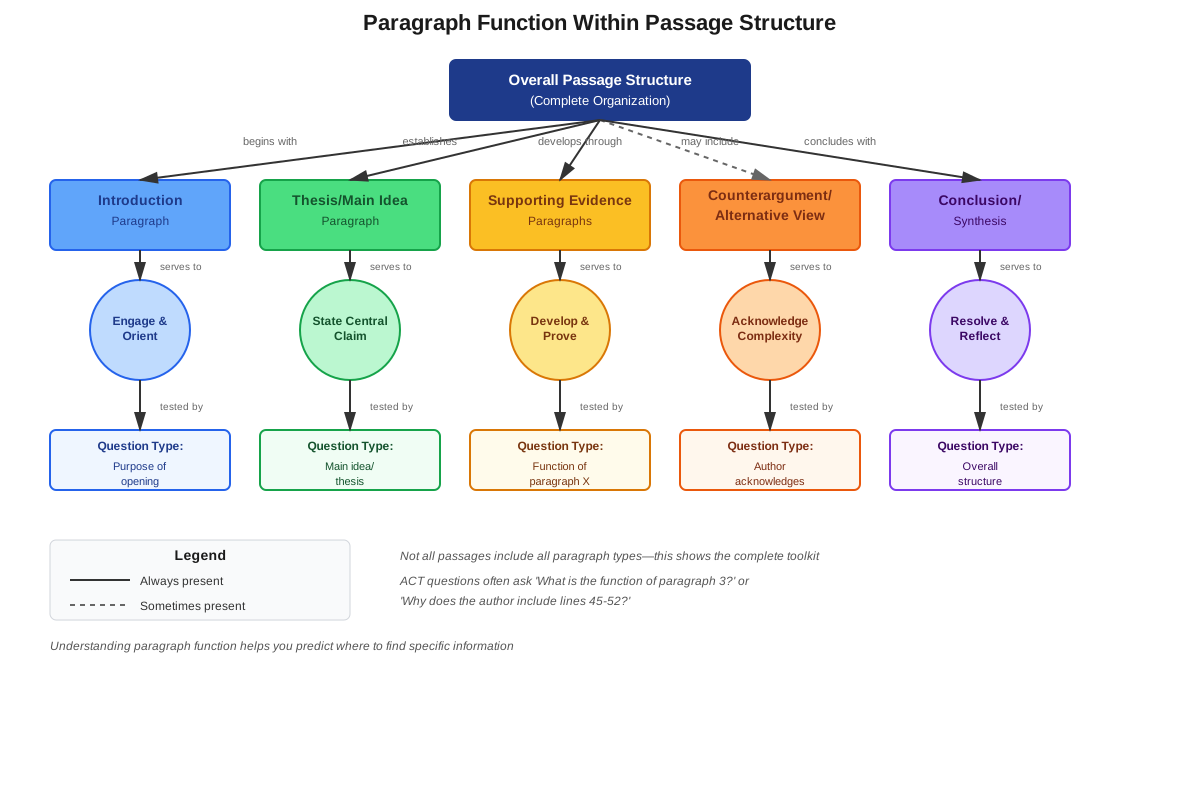
Each paragraph in an ACT passage serves a specific structural function. Recognizing these functions helps students understand why information appears where it does:
- Introduction paragraphs establish context, present the main subject, or pose a central question
- Background/context paragraphs provide necessary historical, biographical, or explanatory information
- Development paragraphs present main arguments, evidence, examples, or narrative events
- Transition paragraphs shift between major sections or perspectives
- Contrast/counterpoint paragraphs present alternative views or opposing information
- Conclusion paragraphs synthesize information, reflect on significance, or return to opening themes
Strong readers mentally label paragraphs as they read: "This paragraph introduces the scientist," "This paragraph explains the problem," "This paragraph presents the solution." This active labeling creates a mental outline that makes question-answering significantly faster.
Structural Markers and Transition Language
Authors use specific linguistic signals to indicate structural relationships. Recognizing these markers helps readers track organizational patterns:
Addition/Continuation markers: furthermore, moreover, additionally, also, in addition
Contrast markers: however, nevertheless, conversely, on the other hand, despite, although
Cause-effect markers: because, since, therefore, thus, consequently, as a result
Example markers: for instance, for example, to illustrate, specifically
Sequence markers: first, second, finally, subsequently, meanwhile, previously
Emphasis markers: indeed, in fact, notably, significantly, most importantly
These transitions function as structural signposts, alerting readers to shifts in the organizational pattern. A "however" signals that the author is about to contrast with previous information; a "for example" indicates that supporting evidence follows a general claim.
The Relationship Between Structure and Purpose
Structure and purpose are intimately connected. Authors choose organizational patterns that best serve their communicative goals. A chronological structure suits narrative storytelling or historical explanation. A compare-contrast structure effectively highlights differences between theories or approaches. A problem-solution structure naturally leads readers toward the author's proposed remedy.
Understanding this relationship helps students answer purpose questions. If a passage uses problem-solution structure, the author's purpose likely involves advocating for change or explaining how difficulties were overcome. If a passage employs compare-contrast structure, the purpose probably involves analyzing similarities and differences to reach a conclusion about which option is superior or how they complement each other.
Structural Questions: Recognition and Approach
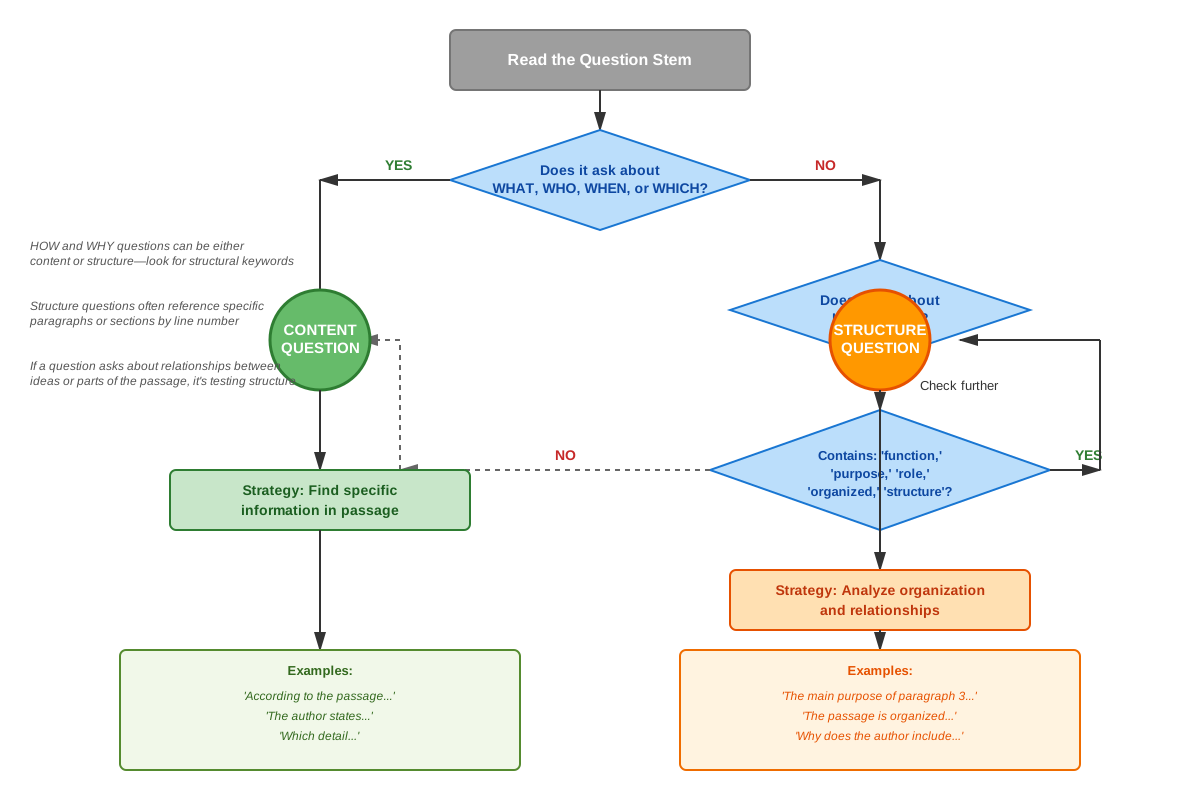
ACT structural questions use distinctive language patterns that signal they're testing organization rather than content:
- "The main function of the [X] paragraph is to..."
- "The passage is best described as..."
- "The author organizes the discussion by..."
- "The structure of the passage can best be described as..."
- "The author mentions [X] primarily to..."
- "The [X] paragraph serves mainly to..."
- "In relation to the passage as a whole, the [X] paragraph provides..."
These questions require students to think about the role information plays rather than the information itself. The correct answer describes function, purpose, or relationship—not content details.
Concept Relationships
The concepts within reading for structure form an interconnected system. The five organizational patterns represent the macro-level structure—the overall blueprint of the passage. Within this framework, individual paragraph functions serve as building blocks, each contributing to the larger pattern. Structural markers and transitions act as the connective tissue, explicitly signaling relationships between these building blocks. The entire structural system serves the author's purpose, which determines why a particular organizational pattern was chosen.
This creates a hierarchical relationship: Purpose → Overall Pattern → Paragraph Functions → Transition Markers → Specific Details
Understanding this hierarchy helps students navigate from big picture to specific details and vice versa. When answering a question about a specific paragraph's function, students should consider: What is the overall organizational pattern? Where does this paragraph fit within that pattern? What transitions lead into and out of this paragraph? How does this paragraph advance the author's purpose?
Reading for structure connects to prerequisite knowledge in important ways. Main idea identification provides the foundation—students must understand what the passage is about before analyzing how it's organized. Passage type awareness helps predict likely structures (Natural Science passages favor cause-effect; Prose Fiction favors chronological). Transition word recognition enables tracking of structural relationships at the sentence level.
Reading for structure also enables progression to more advanced skills. Understanding structure improves inference ability because students can predict what information logically follows. It enhances author's craft analysis because organizational choices reveal rhetorical strategies. It strengthens synthesis skills because recognizing how parts relate makes integrating information easier.
High-Yield Facts
⭐ Approximately 20-25% of ACT Reading questions directly test structural understanding through questions about paragraph function, passage organization, or the purpose of specific sections
⭐ The five most common organizational patterns are chronological/sequential, compare-contrast, cause-effect, problem-solution, and descriptive/topical
⭐ Structural questions use distinctive language: "function," "purpose," "organized," "serves to," "mainly to," and "in relation to the passage as a whole"
⭐ The first and last paragraphs of ACT passages disproportionately contain structural clues about overall organization and author's purpose
⭐ Transition words and phrases serve as structural signposts that indicate relationships between ideas and signal organizational shifts
- Natural Science passages most frequently employ cause-effect and problem-solution structures
- Prose Fiction passages typically use chronological structure, sometimes with flashbacks or time shifts
- Each paragraph in an ACT passage serves a specific structural function: introduction, background, development, transition, contrast, or conclusion
- Understanding structure helps predict where information will appear, making detail questions faster to answer
- Many passages combine multiple organizational patterns, often shifting structure between major sections
- The middle paragraphs of passages typically contain the most detailed development of the main idea
- Structural awareness reduces the need for re-reading because students remember where different types of information appeared
- Questions asking about "the passage as a whole" almost always test structural understanding
- Recognizing paragraph function helps eliminate wrong answers that accurately describe content but misidentify purpose
- Authors often use parallel structure—repeating organizational patterns—within different sections of the same passage
Quick check — test yourself on Reading for structure so far.
Try Flashcards →Common Misconceptions
Misconception: Reading for structure means ignoring content and only focusing on organization
Correction: Effective reading integrates both content and structure simultaneously. Understanding what the passage says and how it's organized are complementary skills. Structure provides the framework for organizing content in memory.
Misconception: All passages follow a single, consistent organizational pattern throughout
Correction: Many ACT passages combine multiple structural patterns, often shifting between sections. A passage might begin with chronological background, shift to compare-contrast for the main discussion, and conclude with cause-effect analysis. Recognizing these shifts is part of structural awareness.
Misconception: Structural questions are just asking for the main idea of a paragraph
Correction: Main idea describes what a paragraph says; structural function describes what role it plays in the passage. A paragraph might have the main idea "Einstein's early education" but serve the structural function of "providing background context for understanding his later achievements."
Misconception: Only questions with the word "structure" or "organization" test structural understanding
Correction: Many questions test structure indirectly through phrases like "primarily to," "serves to," "function of," or "in order to." Additionally, understanding structure helps answer many detail and inference questions more efficiently.
Misconception: Reading for structure takes too much time and slows down reading speed
Correction: Initially, conscious attention to structure may feel slower, but with practice, structural awareness becomes automatic and actually increases reading efficiency. Students who understand structure spend less time searching for information and re-reading passages.
Misconception: Structural patterns are arbitrary and unpredictable
Correction: ACT passages use predictable structural patterns that correlate with passage type and subject matter. Natural Science passages favor certain structures; Prose Fiction favors others. Recognizing these patterns becomes easier with practice.
Misconception: The correct answer to a structural question will always use the same words as the passage
Correction: Structural questions typically require paraphrasing and abstract thinking. The correct answer describes function or purpose using different language than the passage itself. Students must think conceptually about what role information plays.
Worked Examples
Example 1: Identifying Paragraph Function
Passage Excerpt (Natural Science):
Paragraph 1: For decades, scientists believed that the deep ocean floor was a barren, lifeless environment. The absence of sunlight, they reasoned, made photosynthesis impossible, eliminating the foundation of any food chain.
Paragraph 2: This assumption was shattered in 1977 when researchers exploring the Galápagos Rift discovered hydrothermal vents surrounded by thriving ecosystems. Giant tube worms, white crabs, and unusual clams clustered around these underwater geysers, surviving in complete darkness.
Paragraph 3: The key to these ecosystems lies in chemosynthesis, a process by which bacteria convert chemicals from the vents into energy. These bacteria form the base of the food chain, replacing the photosynthetic organisms found in sunlit environments.
Question: The main function of the second paragraph is to:
A) Explain the process of chemosynthesis in detail
B) Present evidence that contradicted previous scientific assumptions
C) Describe the physical characteristics of hydrothermal vents
D) Argue that deep ocean exploration should receive more funding
Solution Process:
Step 1: Identify the overall structure. This passage follows a problem-solution or old belief-new discovery pattern. Paragraph 1 presents the old belief; paragraph 2 introduces the discovery that challenged it; paragraph 3 explains the mechanism.
Step 2: Determine what paragraph 2 actually says (content): It describes the 1977 discovery of life around hydrothermal vents.
Step 3: Determine what paragraph 2 does (function): It presents evidence that contradicted the belief stated in paragraph 1. The phrase "This assumption was shattered" explicitly signals this contradictory relationship.
Step 4: Evaluate answer choices:
- A) Incorrect—chemosynthesis is explained in paragraph 3, not paragraph 2
- B) Correct—this accurately describes the paragraph's structural function
- C) Incorrect—while some description appears, this isn't the primary function; the paragraph focuses on the discovery's significance
- D) Incorrect—no argument about funding appears; this misidentifies both content and function
Key Insight: The correct answer describes the paragraph's role in the passage structure (contradicting previous assumptions) rather than merely summarizing its content (describing the discovery). The transition phrase "This assumption was shattered" is a crucial structural marker.
Example 2: Recognizing Overall Organizational Pattern
Passage Excerpt (Social Science):
Paragraph 1: The debate over universal basic income (UBI) has intensified in recent years as automation threatens traditional employment.
Paragraph 2: Proponents argue that UBI would provide economic security, reduce poverty, and give people freedom to pursue education or entrepreneurship. Finland's 2017-2018 pilot program showed modest improvements in well-being among recipients.
Paragraph 3: Critics, however, contend that UBI would be prohibitively expensive, reduce work incentive, and fail to address underlying economic inequalities. They point to the high cost of Alaska's Permanent Fund Dividend as evidence of fiscal challenges.
Paragraph 4: Despite these opposing views, both sides agree that technological change requires new approaches to economic security, though they differ sharply on whether UBI represents the best solution.
Question: The passage is best described as:
A) A chronological account of UBI's development
B) A comparison of different UBI programs worldwide
C) A presentation of contrasting perspectives on a policy proposal
D) An argument advocating for immediate UBI implementation
Solution Process:
Step 1: Identify structural markers. Paragraph 2 begins with "Proponents argue"; paragraph 3 begins with "Critics, however, contend." The word "however" is a key contrast marker. Paragraph 4 uses "opposing views" and "both sides," explicitly acknowledging the compare-contrast structure.
Step 2: Map the paragraph functions:
- Paragraph 1: Introduction of topic
- Paragraph 2: Presentation of pro-UBI arguments
- Paragraph 3: Presentation of anti-UBI arguments
- Paragraph 4: Synthesis noting areas of agreement despite disagreement
Step 3: Identify the overall pattern: This is clearly a compare-contrast structure, specifically presenting opposing viewpoints on a controversial issue.
Step 4: Evaluate answer choices:
- A) Incorrect—no chronological progression; the passage doesn't trace UBI's history
- B) Incorrect—while Finland and Alaska are mentioned, they're examples within arguments, not the focus of comparison
- C) Correct—this accurately describes the compare-contrast structure presenting pro and con perspectives
- D) Incorrect—the passage presents both sides neutrally rather than advocating for one position
Key Insight: The overall structure is compare-contrast, signaled by parallel paragraph organization (proponents/critics), transition words ("however"), and explicit acknowledgment of opposing views. Recognizing this structure helps predict that the passage will present balanced perspectives rather than advocate for one side.
Exam Strategy
Approaching Structural Questions
When encountering a question that tests reading for structure, follow this systematic approach:
- Identify the question type: Look for trigger words like "function," "purpose," "organized," "serves to," or "mainly to"
- Locate the relevant section: Find the paragraph or lines referenced in the question
- Read before and after: Understanding context is crucial—read the preceding and following paragraphs to see how the section fits into the flow
- Ask "what does this do?" not "what does this say?": Focus on role and purpose rather than content summary
- Consider the overall structure: How does this section contribute to the passage's organizational pattern?
- Eliminate content-focused answers: Wrong answers often accurately describe content but misidentify function
Trigger Words and Phrases
Recognize these question stems that signal structural testing:
- "The main function of..."
- "The primary purpose of..."
- "The author mentions [X] in order to..."
- "The [X] paragraph serves mainly to..."
- "In relation to the passage as a whole..."
- "The passage is best described as..."
- "The author organizes the discussion by..."
- "The structure of the passage can best be described as..."
When you see these phrases, immediately shift to structural thinking mode.
Process of Elimination Tips
For structural questions, eliminate answers that:
- Describe content without identifying function: "Discusses Einstein's education" vs. "Provides background for understanding his later work"
- Are too specific: Structural answers typically describe broader purposes rather than narrow details
- Misidentify the scope: An answer about "the entire passage" is wrong if the question asks about one paragraph
- Use extreme language: Words like "only," "always," "never" are rarely correct for structural questions
- Contradict the passage's tone: If the passage is neutral, eliminate answers suggesting the author "argues" or "advocates"
Time Allocation Advice
Structural awareness actually saves time rather than consuming it. Invest 30-45 seconds at the beginning of each passage to:
- Read the first paragraph carefully to identify the topic and likely organizational pattern
- Skim the first sentence of each subsequent paragraph to confirm the structure
- Note any major transition words that signal structural shifts
- Read the last paragraph to understand the conclusion
This initial investment creates a mental map that makes answering all questions—not just structural ones—significantly faster. Students who skip this step often waste 2-3 minutes re-reading and searching for information.
Exam Tip: If you're unsure about a structural question, return to the first and last paragraphs. These sections disproportionately contain clues about overall organization and purpose.
Memory Techniques
The FUNCTION Acronym
Remember what structural questions ask about using FUNCTION:
- Flow: How does information flow through the passage?
- Unity: How do parts unite to support the whole?
- Necessity: Why is this section necessary?
- Connection: How does this connect to surrounding sections?
- Transition: What transitions signal structural relationships?
- Intent: What is the author's intent in organizing this way?
- Organization: What organizational pattern is used?
- Navigation: How does structure help navigate the passage?
The Five Patterns Mnemonic
Remember the five primary organizational patterns with "CCCPD":
- Chronological
- Compare-Contrast
- Cause-Effect
- Problem-Solution
- Descriptive
Visualization Strategy
Visualize passage structure as a building:
- Foundation: Introduction and context (first paragraph)
- Supporting pillars: Main development paragraphs
- Connecting beams: Transition paragraphs and transition words
- Roof: Conclusion (last paragraph)
When answering structural questions, ask: "What part of the building is this? What does it support? What does it connect?"
The "What vs. Why" Reminder
Create a mental split-screen:
- Left side: WHAT the passage says (content)
- Right side: WHY it's organized this way (structure)
For structural questions, focus on the right side. For detail questions, focus on the left side.
Summary
Reading for structure is a high-yield ACT Reading skill that involves analyzing how passages are organized rather than merely what they say. The five primary organizational patterns—chronological, compare-contrast, cause-effect, problem-solution, and descriptive—appear consistently across all passage types, with certain patterns correlating with specific genres. Each paragraph serves a distinct structural function within the overall organizational framework, and transition words act as signposts indicating relationships between ideas. Structural questions use distinctive language ("function," "purpose," "organized," "serves to") and require students to think about the role information plays rather than its content. Understanding structure provides a mental map of the passage that accelerates question-answering across all question types, not just those explicitly testing organization. Students should invest 30-45 seconds at the beginning of each passage to identify the organizational pattern by reading the first paragraph carefully and skimming the opening sentences of subsequent paragraphs. This initial investment pays dividends throughout the question set. The key distinction in structural thinking is asking "What does this section do?" rather than "What does this section say?"—a shift from content to function that transforms passive reading into active analysis.
Key Takeaways
- Reading for structure means analyzing how a passage is organized and what function each section serves within that organization
- Approximately 20-25% of ACT Reading questions directly test structural understanding, making this a high-yield skill
- The five primary organizational patterns (chronological, compare-contrast, cause-effect, problem-solution, descriptive) appear predictably across passage types
- Structural questions use distinctive trigger language: "function," "purpose," "organized," "serves to," and "in relation to the passage as a whole"
- Each paragraph serves a specific structural function: introduction, background, development, transition, contrast, or conclusion
- Transition words and phrases act as structural signposts that signal relationships between ideas and organizational shifts
- Understanding structure creates a mental map that accelerates all question-answering, not just structural questions specifically
Related Topics
Author's Purpose and Tone: Understanding why an author wrote a passage and the attitude conveyed connects directly to structural choices—authors select organizational patterns that best serve their communicative goals.
Main Idea and Supporting Details: Recognizing how supporting details are organized to develop the main idea requires structural awareness; the relationship between these concepts is bidirectional and mutually reinforcing.
Inference and Implication Questions: Strong structural understanding enables better inferences because students can predict what information logically follows based on organizational patterns.
Comparative Reading: When the ACT presents paired passages, structural analysis becomes even more critical for identifying similarities and differences in how authors approach the same topic.
Rhetorical Strategy: Advanced analysis of how authors use organizational choices as persuasive techniques builds directly on foundational structural awareness.
Practice CTA
Now that you understand the principles of reading for structure, it's time to apply these concepts to actual ACT-style passages and questions. The practice questions and flashcards will help you recognize structural patterns quickly, identify paragraph functions accurately, and distinguish between content and structure in question stems. Remember: structural awareness is a skill that improves rapidly with deliberate practice. Each passage you analyze with structural thinking strengthens your ability to see organizational patterns automatically. Approach the practice materials with confidence—you now have the framework to master one of the ACT Reading section's most valuable skills. Your investment in understanding structure will pay dividends not just on test day, but in all your academic reading.
Sign up free to keep reading
Create a free AnvayaPrep account to finish this ACT guide on Reading for structure — plus flashcards and practice questions.