Overview
The ACT Science section frequently presents students with passages containing multiple competing theories, hypotheses, or explanations for the same phenomenon. Comparing explanations is a critical skill that involves analyzing two or more scientific viewpoints, identifying their similarities and differences, and understanding how each perspective interprets the same data or observations. This skill appears most prominently in the Conflicting Viewpoints passages, which typically comprise one of the seven passages on the ACT Science test.
Mastering ACT comparing explanations questions is essential because these questions test higher-order thinking skills rather than simple recall of scientific facts. Students must evaluate competing scientific arguments, distinguish between shared assumptions and divergent claims, and recognize how different scientists might interpret identical evidence in contrasting ways. This skill mirrors authentic scientific discourse, where researchers often propose alternative explanations for experimental results or natural phenomena.
Within the broader ACT Science curriculum, comparing explanations builds upon foundational skills in reading comprehension, data interpretation, and scientific reasoning. Unlike Research Summaries passages that focus on experimental design and data analysis, or Data Representation passages that emphasize graph interpretation, Conflicting Viewpoints passages require students to engage with scientific argumentation at a conceptual level. Success in this area directly translates to improved performance on approximately 15-20% of all ACT Science questions, making it a high-impact topic for score improvement.
Learning Objectives
- [ ] Identify when Comparing explanations is being tested in ACT Science passages
- [ ] Explain the core rule or strategy behind Comparing explanations
- [ ] Apply Comparing explanations to ACT-style questions accurately
- [ ] Distinguish between points of agreement and disagreement among multiple scientific viewpoints
- [ ] Evaluate which explanation best accounts for specific pieces of evidence or data
- [ ] Synthesize information across multiple viewpoints to answer complex comparison questions
- [ ] Recognize the underlying assumptions that differentiate competing explanations
Prerequisites
- Basic reading comprehension skills: Essential for understanding complex scientific arguments presented in dense paragraph form
- Familiarity with scientific terminology: Necessary to follow technical discussions without getting confused by vocabulary
- Understanding of hypothesis formation: Required to recognize what constitutes a testable scientific explanation
- Ability to identify main ideas and supporting details: Critical for distinguishing central claims from supporting evidence in each viewpoint
Why This Topic Matters
In real-world scientific practice, researchers regularly encounter situations where multiple explanations exist for the same phenomenon. From debates about climate change mechanisms to competing theories about disease causation, the ability to compare and evaluate different explanations is fundamental to scientific literacy. This skill extends beyond science into everyday decision-making, where individuals must weigh competing claims about health, technology, and policy.
On the ACT Science test, Conflicting Viewpoints passages appear exactly once per exam, containing 6-7 questions that heavily emphasize comparing explanations. These questions typically account for 15-20% of the total Science section score. Research on ACT performance indicates that students who master comparing explanations skills show disproportionate score improvements because these questions often separate mid-range scorers from high achievers. The College Board reports that questions requiring comparison of viewpoints have among the lowest average accuracy rates, making them high-value targets for strategic preparation.
Comparing explanations appears in ACT passages through several common formats: two scientists presenting alternative hypotheses about a natural phenomenon, multiple students debating the interpretation of an experiment, or competing theories about historical events in Earth science. Questions may ask students to identify what all viewpoints agree upon, determine which viewpoint is supported by new evidence, or recognize fundamental differences in underlying assumptions. The ability to quickly map out the structure of competing arguments and track their key differences is essential for efficient test-taking.
Core Concepts
Understanding the Structure of Conflicting Viewpoints Passages
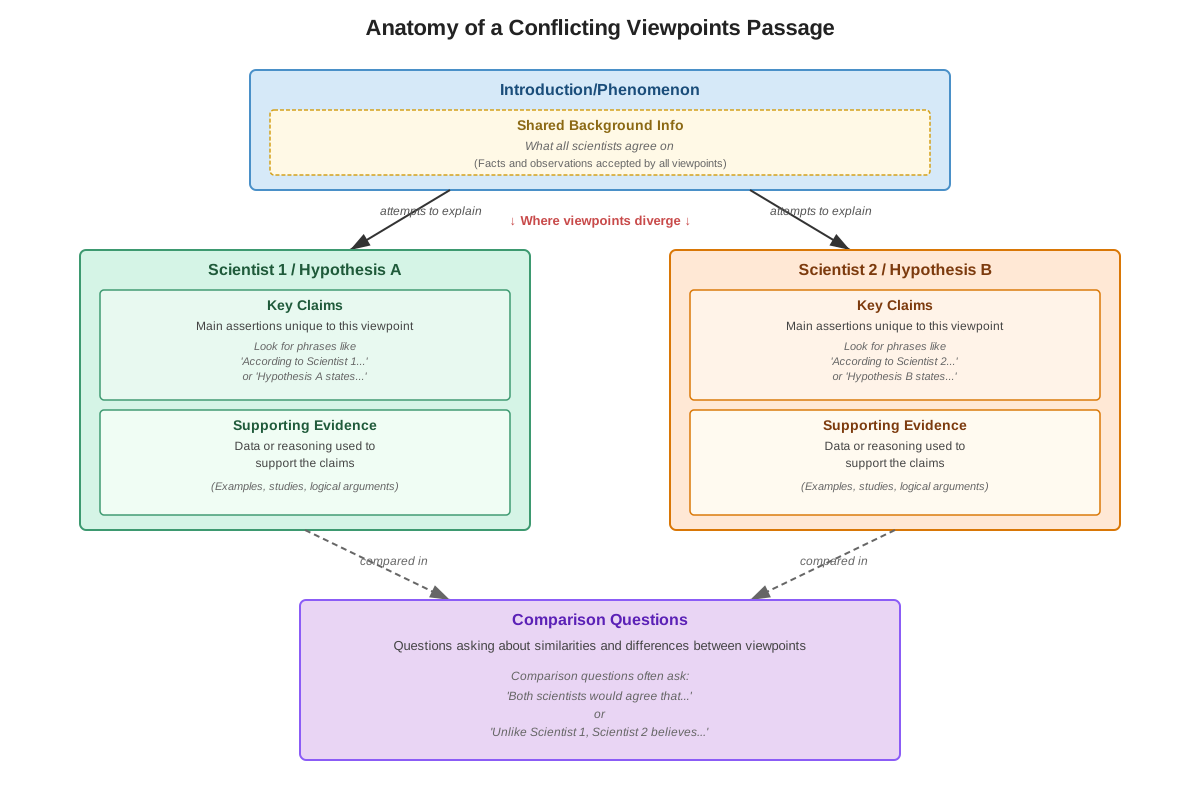
Conflicting Viewpoints passages follow a predictable structure that students can leverage for efficient analysis. These passages typically begin with a brief introduction (2-4 sentences) that establishes the phenomenon or question under investigation. This introduction provides context that all subsequent viewpoints accept as factual. Following the introduction, the passage presents 2-3 distinct viewpoints, each labeled clearly (e.g., "Scientist 1," "Student 2," "Hypothesis A"). Each viewpoint consists of 4-8 sentences that articulate a specific explanation, the reasoning behind it, and sometimes predictions or implications.
The key to success lies in recognizing that these passages are not testing scientific knowledge but rather the ability to track and compare arguments. Students should read the introduction carefully to understand the shared foundation, then approach each viewpoint systematically, identifying its central claim, supporting reasoning, and any unique assumptions or mechanisms proposed.
Identifying Points of Agreement vs. Disagreement
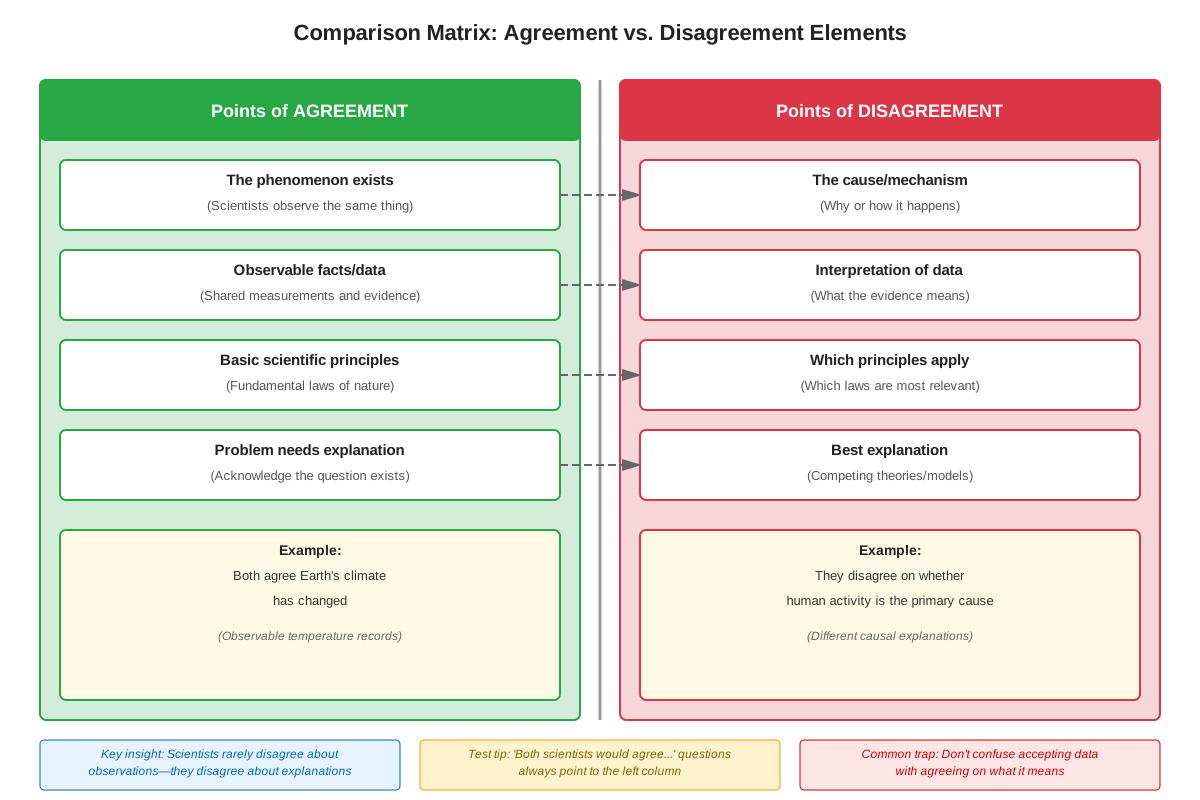
A fundamental skill in comparing explanations involves distinguishing what competing viewpoints share from what separates them. Points of agreement typically include:
- The basic phenomenon or observation being explained
- Fundamental scientific principles (e.g., laws of physics, chemical properties)
- Experimental procedures or data collection methods
- The existence of certain evidence or observations
Points of disagreement usually involve:
- The mechanism or process causing the phenomenon
- The interpretation of ambiguous data
- Predictions about future observations or experimental outcomes
- The relative importance of different causal factors
- Underlying assumptions about unmeasured variables
| Aspect | Points of Agreement | Points of Disagreement |
|---|---|---|
| Nature | Factual observations, established principles | Interpretations, mechanisms, predictions |
| Question Types | "Both scientists would agree that..." | "Unlike Scientist 1, Scientist 2 believes..." |
| Strategic Value | Helps eliminate wrong answers quickly | Core focus of most passage questions |
Mapping the Core Claims of Each Viewpoint
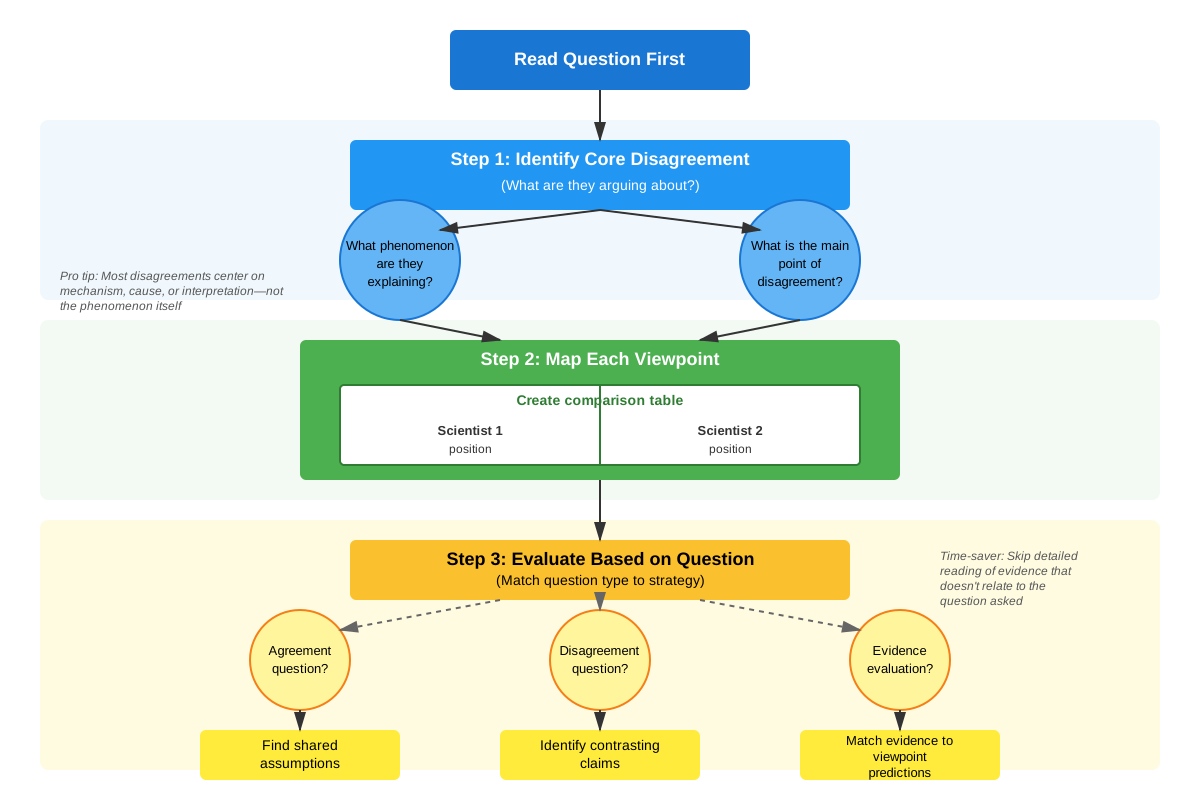
Effective comparison requires creating a mental (or physical) map of each viewpoint's essential elements. For each explanation presented, students should identify:
- The central claim: What is the main explanation being proposed?
- The primary mechanism: How does this viewpoint explain the phenomenon occurs?
- Key supporting evidence: What observations or data does this viewpoint emphasize?
- Unique assumptions: What does this viewpoint assume to be true that others might not?
- Testable predictions: What would this viewpoint predict about future observations?
This systematic approach transforms a potentially overwhelming passage into a structured comparison chart. Students who practice this mapping technique report significantly improved accuracy and speed on Conflicting Viewpoints questions.
Recognizing Question Types in Comparing Explanations
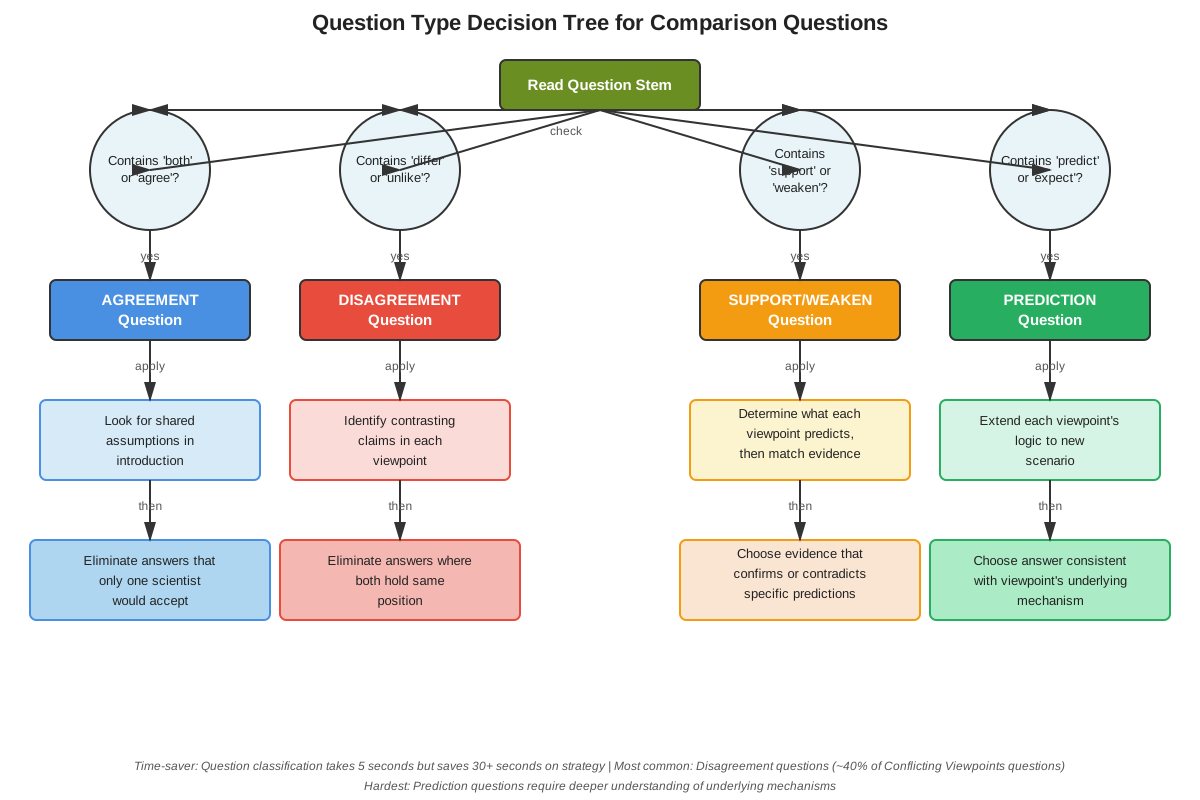
ACT questions about comparing explanations fall into several predictable categories:
Direct Comparison Questions ask students to identify specific differences or similarities between viewpoints. These questions use phrases like "Unlike Scientist 1, Scientist 2 would claim..." or "Both students would agree that..."
Evidence Evaluation Questions present new information and ask which viewpoint it supports or contradicts. These questions test whether students understand the logical implications of each explanation.
Assumption Identification Questions require students to recognize unstated premises underlying each viewpoint. These often use phrases like "Scientist 1's explanation assumes that..." or "Which of the following is presupposed by Hypothesis A?"
Prediction Questions ask what each viewpoint would expect to observe under specific conditions, testing whether students grasp the logical consequences of each explanation.
Strategic Reading Techniques for Conflicting Viewpoints
Unlike other ACT Science passages where students might skip to questions first, Conflicting Viewpoints passages require careful initial reading. The most effective approach involves:
Active annotation: As students read each viewpoint, they should note the main claim in the margin or mentally summarize it in 5-7 words. This creates reference points for quickly locating information when answering questions.
Comparative reading: Rather than treating each viewpoint in isolation, students should actively compare as they read. After finishing Viewpoint 1, they should approach Viewpoint 2 asking "How is this different from what I just read?"
Focus on mechanisms: The heart of most disagreements lies in the proposed mechanisms or processes. Students should pay particular attention to verbs and causal language (e.g., "causes," "results from," "leads to") that reveal how each viewpoint explains the phenomenon.
Handling Three-Viewpoint Passages
Occasionally, ACT passages present three competing explanations rather than two. These passages require additional organizational skill but follow the same principles. The key strategy involves:
- Creating a three-column mental comparison chart
- Identifying which viewpoints share similarities (sometimes two viewpoints are more similar to each other than to the third)
- Recognizing that questions may ask about any combination of the three viewpoints
- Paying extra attention to the introduction, as it becomes even more critical for establishing common ground
Concept Relationships
The skill of comparing explanations builds directly upon prerequisite abilities in reading comprehension and argument analysis. Students must first understand individual scientific arguments before they can effectively compare them. This relationship flows as: Reading Comprehension → Understanding Individual Arguments → Comparing Multiple Arguments → Evaluating Evidence Against Arguments.
Within the topic itself, the concepts connect hierarchically. Understanding passage structure enables efficient identification of main claims, which facilitates systematic comparison of viewpoints, which then allows accurate prediction of what each viewpoint would say about new evidence. This progression means that students who struggle with later steps should return to earlier foundational skills.
Comparing explanations also connects forward to broader scientific reasoning skills tested throughout the ACT Science section. The ability to evaluate competing hypotheses relates directly to experimental design questions (which hypothesis would an experiment test?) and data interpretation questions (which hypothesis does this data support?). Thus: Comparing Explanations → Hypothesis Testing → Experimental Design → Data Interpretation forms an integrated skill chain.
The relationship to other ACT Science passage types is complementary rather than hierarchical. While Research Summaries emphasize experimental methodology and Data Representation focuses on quantitative analysis, Conflicting Viewpoints emphasizes qualitative reasoning and argumentation. Success across all passage types requires recognizing which skill set each passage demands and switching approaches accordingly.
High-Yield Facts
⭐ Conflicting Viewpoints passages always appear exactly once per ACT Science test, containing 6-7 questions
⭐ The introduction to a Conflicting Viewpoints passage contains information that all viewpoints accept as true
⭐ Questions asking what viewpoints "agree" on are typically easier and should be answered first for confidence building
⭐ The central disagreement between viewpoints almost always concerns the mechanism or process, not the basic observations
⭐ Each viewpoint is self-contained; students do not need outside scientific knowledge to understand the arguments
- New evidence questions can be answered by determining which viewpoint's mechanism best explains the new observation
- Viewpoints are typically labeled clearly (Scientist 1, Student A, Hypothesis 1) and should be referenced by these labels in notes
- The passage introduction typically ranges from 2-4 sentences and establishes the phenomenon being explained
- Questions about assumptions require identifying what must be true for a viewpoint's logic to work
- Prediction questions test understanding of logical implications rather than memorized scientific facts
- Three-viewpoint passages are less common but follow the same analytical principles as two-viewpoint passages
- The most challenging questions typically ask about subtle differences in underlying assumptions rather than explicit claims
- Viewpoints may share some supporting evidence while disagreeing on interpretation
- Questions rarely require mathematical calculations in Conflicting Viewpoints passages
- Time management is critical; students should allocate approximately 5-6 minutes per Conflicting Viewpoints passage
Quick check — test yourself on Comparing explanations so far.
Try Flashcards →Common Misconceptions
Misconception: Students must have prior knowledge of the scientific topic to answer Conflicting Viewpoints questions correctly.
Correction: All necessary information is contained within the passage. The ACT tests reading comprehension and logical reasoning, not content knowledge. Students should rely exclusively on what the passage states, not on outside scientific knowledge which may actually conflict with passage information.
Misconception: All viewpoints are equally valid and the ACT won't favor one over another.
Correction: While the passage presents multiple viewpoints neutrally, questions often ask which viewpoint is supported by specific evidence or which makes certain assumptions. The ACT does test the ability to evaluate which explanation better accounts for particular observations.
Misconception: The longer or more complex viewpoint is usually correct.
Correction: Passage length and complexity have no correlation with which viewpoint questions will favor. Each viewpoint receives roughly equal treatment, and questions are distributed across all viewpoints regardless of their length or sophistication.
Misconception: Students should read all questions before reading the passage to save time.
Correction: Unlike other ACT Science passages where this strategy can work, Conflicting Viewpoints passages require understanding the overall argument structure first. Reading questions first leads to fragmented comprehension and actually wastes time through repeated re-reading.
Misconception: If two viewpoints mention the same evidence, they must agree about it.
Correction: Competing explanations frequently cite the same observations or data but interpret them differently. The key is understanding how each viewpoint uses the evidence to support its distinct mechanism or conclusion.
Misconception: The viewpoints presented represent the only possible explanations for the phenomenon.
Correction: The passage presents selected viewpoints for comparison purposes. Questions may ask about these specific viewpoints' predictions or assumptions, but students should not assume these are the only possible scientific explanations.
Misconception: Agreement questions are asking for opinions rather than factual commonalities.
Correction: When questions ask what viewpoints "would agree" on, they seek factual statements that logically follow from all viewpoints, not subjective opinions. These are typically observations, established principles, or logical necessities that all viewpoints must accept.
Worked Examples
Example 1: Two-Viewpoint Passage on Dinosaur Extinction
Passage Summary:
Introduction: Dinosaurs dominated Earth for 165 million years before going extinct 66 million years ago. Scientists have proposed various explanations for this mass extinction.
Scientist 1: A massive asteroid impact caused the extinction. Evidence includes a layer of iridium (rare on Earth but common in asteroids) in rock layers from 66 million years ago, and a large impact crater in Mexico from the same period. The impact would have thrown dust into the atmosphere, blocking sunlight for months, causing plant death and subsequent starvation of herbivores and carnivores.
Scientist 2: Massive volcanic eruptions in India caused the extinction. These eruptions released enormous amounts of sulfur dioxide and carbon dioxide over hundreds of thousands of years. The sulfur dioxide would have caused acid rain and cooling, while carbon dioxide would have caused long-term warming. This gradual environmental stress better explains why some species survived while others didn't.
Question: Both scientists would agree that:
A) An asteroid struck Earth 66 million years ago
B) Dinosaurs went extinct 66 million years ago
C) Atmospheric changes caused plant death
D) The extinction occurred gradually over thousands of years
Solution Process:
- Identify what the question asks: points of agreement between both viewpoints
- Check each answer against both viewpoints:
- A: Only Scientist 1 mentions the asteroid; Scientist 2 doesn't address this
- B: Both the introduction and both scientists accept this as established fact
- C: Both mention atmospheric changes, but Scientist 1 emphasizes dust blocking sunlight while Scientist 2 emphasizes chemical changes—they agree on atmospheric involvement
- D: Scientist 1 suggests rapid extinction (months), while Scientist 2 suggests gradual (hundreds of thousands of years)—they disagree
- Evaluate remaining options: Both B and C seem possible. However, C makes a specific claim about mechanism (atmospheric changes causing plant death) that both viewpoints support. B is more fundamental—it's stated in the introduction as accepted fact.
- Answer: B - This is stated in the introduction, which establishes facts all viewpoints accept. While C is also true, B is more directly and explicitly agreed upon.
Learning Objective Connection: This example demonstrates identifying points of agreement and applying the strategy that introduction information represents shared ground.
Example 2: Evidence Evaluation Question
Continuing the dinosaur passage:
Question: Suppose scientists discovered that the iridium layer appears in rock formations worldwide but that the timing of dinosaur fossil disappearance varies by up to 100,000 years across different locations. This finding would most weaken which scientist's viewpoint?
A) Scientist 1, because it suggests the asteroid impact didn't cause immediate extinction
B) Scientist 1, because it contradicts the existence of the iridium layer
C) Scientist 2, because it proves volcanic eruptions didn't occur
D) Scientist 2, because it shows extinction happened too rapidly for volcanic causes
Solution Process:
- Analyze the new evidence:
- Iridium layer is worldwide (supports asteroid impact)
- Dinosaur disappearance varies by 100,000 years across locations (suggests gradual, not sudden extinction)
- Determine what each viewpoint predicts:
- Scientist 1 (asteroid): Would predict sudden, simultaneous extinction worldwide
- Scientist 2 (volcanoes): Would predict gradual extinction, possibly varying by location
- Evaluate which viewpoint the evidence contradicts:
- The worldwide iridium supports Scientist 1
- The variable timing (100,000 year range) contradicts Scientist 1's mechanism of rapid extinction
- The gradual, variable pattern supports Scientist 2's explanation
- Eliminate wrong answers:
- B: The evidence confirms the iridium layer exists
- C: The evidence doesn't address volcanic eruptions
- D: 100,000 years is consistent with gradual volcanic effects
- Answer: A - The evidence weakens Scientist 1 because the asteroid impact hypothesis predicts immediate, simultaneous extinction, but the evidence shows extinction occurred over 100,000 years.
Learning Objective Connection: This example demonstrates applying comparing explanations to evaluate new evidence and determining which viewpoint it supports or weakens.
Exam Strategy
Approaching Conflicting Viewpoints Passages Systematically
When encountering a Conflicting Viewpoints passage, follow this proven sequence:
- Read the introduction carefully (30 seconds): This establishes the shared foundation and often contains information needed for "agreement" questions.
- Read Viewpoint 1 actively (60-90 seconds): Identify and mentally note the main claim and primary mechanism. Don't worry about memorizing details.
- Read Viewpoint 2 comparatively (60-90 seconds): Actively ask "How is this different from Viewpoint 1?" as you read. Note the contrasting mechanism.
- If present, read Viewpoint 3 (60-90 seconds): Identify how it differs from both previous viewpoints.
- Approach questions strategically (2-3 minutes): Start with "agreement" questions and direct fact questions before tackling complex comparison or evidence evaluation questions.
Trigger Words and Phrases to Watch For
Questions containing these phrases signal specific question types:
- "Both/All scientists would agree...": Agreement question—look to the introduction and logical necessities
- "Unlike Scientist X, Scientist Y...": Direct comparison—focus on the specific difference mentioned
- "According to Scientist X...": Single-viewpoint question—only that viewpoint matters
- "Which viewpoint is supported by...": Evidence evaluation—determine which mechanism explains the new information
- "Scientist X's explanation assumes...": Assumption identification—find unstated premises
- "Scientist X would predict...": Prediction question—follow the logical implications of that viewpoint's mechanism
Process of Elimination Strategies
For agreement questions, eliminate any answer that:
- Appears in only one viewpoint without being logically necessary for others
- Contradicts information in the introduction
- Makes specific mechanistic claims that viewpoints disagree about
For evidence evaluation questions, eliminate answers that:
- Describe evidence that doesn't connect to any viewpoint's mechanism
- Claim evidence supports a viewpoint when it actually contradicts that viewpoint's predictions
- Confuse correlation with causation in ways the viewpoint doesn't
For comparison questions, eliminate answers that:
- Reverse which scientist holds which position
- Describe similarities when the question asks for differences
- Introduce information not mentioned in either viewpoint
Time Allocation Advice
Allocate approximately 5-6 minutes total for the Conflicting Viewpoints passage:
- 2.5-3 minutes for initial reading
- 2.5-3 minutes for answering 6-7 questions (approximately 25-30 seconds per question)
This passage type typically allows slightly more reading time than Data Representation passages because the questions require less time to answer once the arguments are understood. Students who invest adequate time in careful initial reading find questions much faster to answer than those who rush through the passage.
Exam Tip: If running short on time, Conflicting Viewpoints passages are often better to complete than Research Summaries because the questions are more self-contained and less dependent on complex data analysis.
Memory Techniques
The CLAIM Acronym for Analyzing Each Viewpoint
Central explanation: What's the main idea?
Logic/mechanism: How does it work?
Assumptions: What must be true?
Implications: What does it predict?
Main evidence: What supports it?
Use CLAIM as a mental checklist while reading each viewpoint to ensure comprehensive understanding.
The "Agreement Triangle" Visualization
Visualize three sources of agreement between viewpoints:
- Base (Introduction): Facts established before viewpoints begin
- Sides (Logical necessities): Things all viewpoints must accept for internal consistency
- Overlap (Shared observations): Evidence all viewpoints acknowledge
When answering agreement questions, mentally check all three areas of this triangle.
The "Mechanism Focus" Mantra
Remember: "Mechanisms divide, observations unite"
This phrase captures the pattern that viewpoints typically agree on what is observed but disagree on why or how it occurs. When confused about whether viewpoints agree or disagree, focus on whether the question asks about observations (likely agreement) or explanations (likely disagreement).
The "New Evidence Test" Procedure
For evidence evaluation questions, use this mental procedure:
State what the new evidence shows
Predict what each viewpoint would expect
Oppose predictions to evidence
Track which viewpoint matches
SPOT helps systematically work through evidence evaluation questions without getting confused.
Summary
Comparing explanations is a critical ACT Science skill that involves analyzing multiple competing scientific viewpoints, identifying their similarities and differences, and evaluating how each interprets evidence. This skill appears primarily in Conflicting Viewpoints passages, which present 2-3 alternative explanations for a phenomenon. Success requires understanding that these passages test logical reasoning and argument analysis rather than scientific content knowledge. The key strategy involves careful initial reading to map each viewpoint's central claim and mechanism, then systematically comparing these elements when answering questions. Students must distinguish between points of agreement (typically observations and established facts) and points of disagreement (usually mechanisms and interpretations). Questions fall into predictable categories: agreement questions, direct comparisons, evidence evaluation, assumption identification, and predictions. The most effective approach involves reading the introduction carefully to establish shared ground, actively comparing viewpoints while reading, and approaching questions strategically by starting with simpler agreement questions before tackling complex comparisons. Mastering this skill significantly impacts ACT Science scores because these questions separate mid-range from high-achieving students.
Key Takeaways
- Conflicting Viewpoints passages appear exactly once per ACT Science test and account for approximately 15-20% of Science section questions
- The passage introduction contains information all viewpoints accept as true and is critical for answering agreement questions
- Viewpoints typically agree on observations but disagree on mechanisms—focus on identifying the "how" and "why" of each explanation
- All information needed to answer questions is contained in the passage; outside scientific knowledge is unnecessary and potentially misleading
- Systematic reading that maps each viewpoint's central claim and mechanism is more efficient than rushing through the passage
- Evidence evaluation questions require determining which viewpoint's mechanism best explains new observations
- Time investment in careful initial reading pays off through faster, more accurate question answering
Related Topics
Research Summaries Passages: After mastering comparing explanations, students should develop skills in analyzing experimental design and methodology, which appear in 3 of the 7 ACT Science passages. Understanding how experiments test competing hypotheses builds directly on the ability to compare explanations.
Data Interpretation Across Viewpoints: Some advanced Conflicting Viewpoints passages include graphs or tables that different viewpoints interpret differently. This combines comparing explanations skills with data analysis abilities.
Scientific Argumentation and Reasoning: The broader skill of evaluating scientific arguments extends beyond ACT preparation into college-level science courses and scientific literacy in everyday life.
Hypothesis Testing and Experimental Design: Understanding how scientists design experiments to distinguish between competing explanations deepens comprehension of the scientific method and connects to Research Summaries passages.
Practice CTA
Now that you've mastered the strategies for comparing explanations, it's time to apply these skills to authentic ACT-style questions. The practice questions and flashcards will reinforce your ability to quickly identify viewpoint differences, evaluate evidence, and answer comparison questions accurately. Remember that comparing explanations is a high-yield skill—mastering it can significantly boost your Science section score. Approach each practice question systematically using the CLAIM framework and evidence evaluation strategies you've learned. With focused practice, you'll develop the speed and accuracy needed to excel on Conflicting Viewpoints passages. Start practicing now to transform this challenging passage type into a reliable source of points on test day!
Sign up free to keep reading
Create a free AnvayaPrep account to finish this ACT guide on Comparing explanations — plus flashcards and practice questions.