Overview
Evaluating claims is a critical skill tested in the ACT Science section, particularly within the Conflicting Viewpoints passages. This topic requires students to analyze competing scientific hypotheses, theories, or viewpoints presented by different scientists or researchers, then determine which claims are supported by evidence, which are contradicted by data, and which remain unresolved. Unlike data representation or research summaries passages, Conflicting Viewpoints passages present multiple perspectives on a scientific phenomenon, requiring students to think critically about the logical structure of arguments and the relationship between evidence and conclusions.
The ability to evaluate claims is essential for ACT success because it appears in approximately 15-20% of all Science questions, with one guaranteed Conflicting Viewpoints passage per test containing 6-7 questions. This skill goes beyond simple data reading—it demands that students understand the fundamental differences between hypotheses, identify supporting and contradicting evidence, recognize assumptions underlying each viewpoint, and apply new information to determine which claims would be strengthened or weakened. Students who master this topic gain a significant advantage because these questions often separate high scorers from average performers.
Within the broader ACT Science curriculum, evaluating claims builds upon foundational skills in data interpretation and experimental design while preparing students for higher-order analytical thinking. This topic connects directly to understanding scientific methodology, recognizing valid reasoning patterns, and distinguishing between correlation and causation. The skills developed here transfer to all other Science passage types, as every scientific investigation ultimately involves making and testing claims about natural phenomena.
Learning Objectives
- [ ] Identify when Evaluating claims is being tested in ACT Science passages
- [ ] Explain the core rule or strategy behind Evaluating claims
- [ ] Apply Evaluating claims to ACT-style questions accurately
- [ ] Distinguish between claims that are directly supported, contradicted, or unaddressed by presented evidence
- [ ] Analyze how new information would strengthen or weaken specific viewpoints
- [ ] Compare and contrast the fundamental assumptions underlying competing scientific claims
- [ ] Synthesize information from multiple viewpoints to answer questions requiring integration of perspectives
Prerequisites
- Basic scientific vocabulary: Understanding terms like hypothesis, theory, evidence, and conclusion is essential for comprehending the structure of scientific arguments
- Reading comprehension skills: The ability to extract main ideas and supporting details from complex passages enables identification of each viewpoint's central claims
- Data interpretation fundamentals: Recognizing patterns in graphs, tables, and figures allows students to connect evidence to claims
- Logical reasoning: Understanding cause-and-effect relationships and conditional statements helps evaluate whether evidence truly supports a given claim
Why This Topic Matters
Evaluating claims represents one of the most intellectually demanding skills tested on the ACT Science section, reflecting real-world scientific practice where researchers must critically assess competing explanations for observed phenomena. In professional science, the ability to evaluate claims determines which hypotheses receive funding, which theories gain acceptance, and which experimental approaches prove most productive. This skill underlies peer review, scientific debate, and the advancement of knowledge across all disciplines.
On the ACT, Conflicting Viewpoints passages appear exactly once per test, typically as the final passage in the Science section. These passages contain 6-7 questions worth approximately 10-12% of the total Science score. Questions testing claim evaluation appear with high frequency, including:
- Direct support/contradiction questions (40% of Conflicting Viewpoints questions): "According to Scientist 1, which of the following observations would support her hypothesis?"
- Comparison questions (30%): "On which point would Scientists 2 and 3 agree?"
- New information questions (20%): "If it were discovered that X, this finding would weaken the viewpoint of..."
- Assumption identification questions (10%): "Scientist 1's hypothesis assumes that..."
Common passage contexts include evolutionary biology debates, geological formation theories, astronomical phenomena explanations, climate change mechanisms, and chemical reaction pathways. The ACT deliberately selects topics where multiple plausible explanations exist, ensuring that no single viewpoint is obviously correct or incorrect based on general knowledge alone.
Core Concepts
Understanding Claims vs. Evidence
A claim is an assertion about how the natural world works—a statement that can be tested, supported, or refuted through observation and experimentation. In ACT evaluating claims passages, each scientist presents a central claim (often called a hypothesis or viewpoint) along with reasoning and evidence to support it. The fundamental distinction students must master is recognizing that claims are conclusions drawn from evidence, not the evidence itself.
Evidence consists of observations, experimental results, measurements, or established facts that scientists use to support their claims. For example, if Scientist 1 claims "Dinosaurs were warm-blooded," the evidence might include fossil bone structure, growth rates, or predator-prey ratios. The claim interprets what the evidence means; the evidence provides the factual foundation.
Key distinction table:
| Claims | Evidence |
|---|---|
| Interpretations or conclusions | Observations or measurements |
| Can be disputed or debated | Factual data points |
| Answer "why" or "how" | Answer "what" or "how much" |
| Example: "The canyon formed gradually" | Example: "The canyon is 1 mile deep" |
Structure of Conflicting Viewpoints Passages
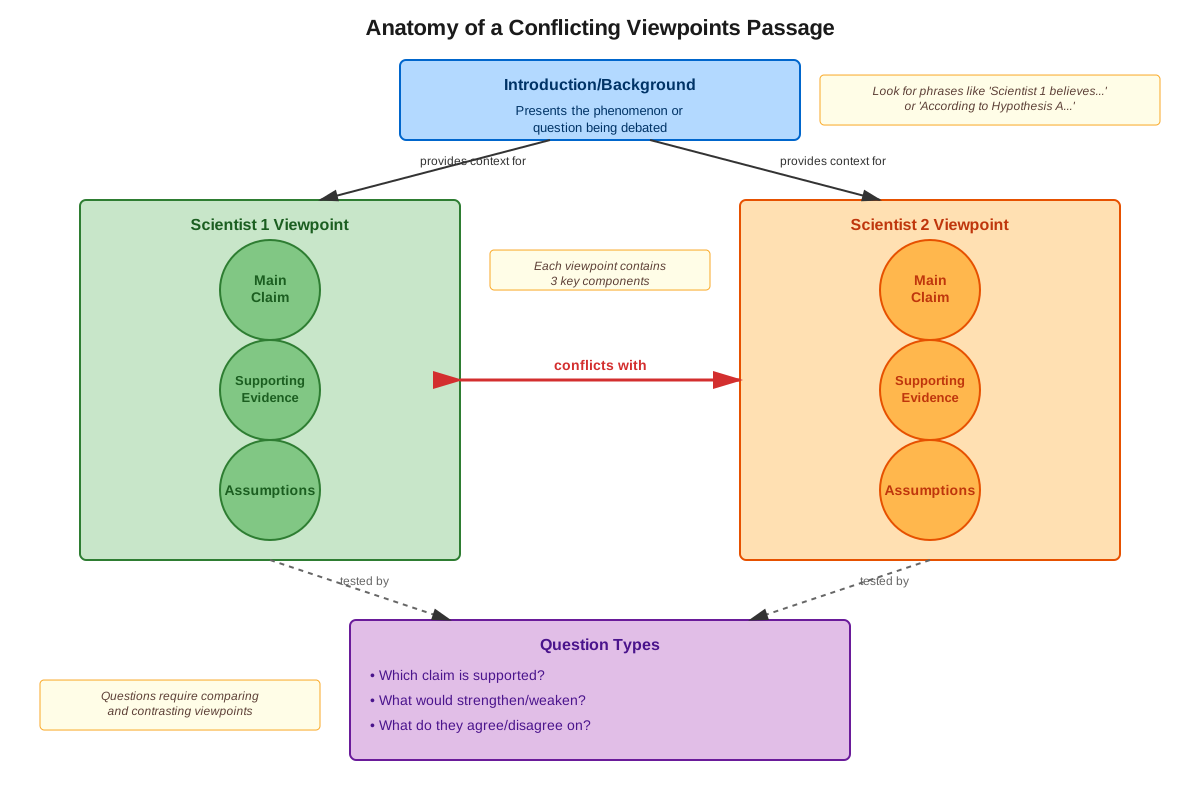
ACT Conflicting Viewpoints passages follow a predictable structure that students can exploit for efficient reading. The passage begins with an introductory paragraph providing background information and context—this section is neutral and presents facts both scientists accept. Following this introduction, each scientist's viewpoint appears in a separate paragraph or section, typically labeled "Scientist 1," "Scientist 2," and occasionally "Scientist 3."
Each viewpoint section contains three essential components:
- The central claim: Usually stated in the first sentence or two of each scientist's section
- Supporting reasoning: The logical argument explaining why the claim makes sense
- Evidence cited: Specific observations, data, or established facts the scientist uses to support the claim
Understanding this structure allows students to quickly locate information when answering questions. The central claim answers "What does this scientist believe?" The supporting reasoning answers "Why does this scientist believe it?" The evidence answers "What facts support this belief?"
Types of Claims Questions
The ACT tests claim evaluation through several distinct question types, each requiring a specific approach:
Direct Support Questions ask students to identify which piece of evidence, if true, would strengthen a particular viewpoint. These questions test whether students understand what kind of evidence logically supports a given claim. The correct answer will provide new information that aligns with the scientist's reasoning and makes their conclusion more likely to be true.
Contradiction Questions require identifying evidence that would weaken or refute a viewpoint. Students must recognize what observations would be inconsistent with a scientist's claim or would require the scientist to revise their hypothesis. The correct answer presents information that cannot be easily explained by the scientist's theory.
Agreement/Disagreement Questions ask students to identify points of consensus or conflict between scientists. These questions test whether students can distinguish between areas where scientists share common ground (often in the introductory paragraph) versus areas where their claims diverge. The correct answer must be explicitly addressed by both scientists, not merely implied.
Assumption Questions probe the unstated premises underlying each viewpoint. Every scientific claim rests on certain assumptions—conditions that must be true for the claim to be valid. Students must identify what each scientist takes for granted without explicitly stating it.
Analyzing Supporting Evidence
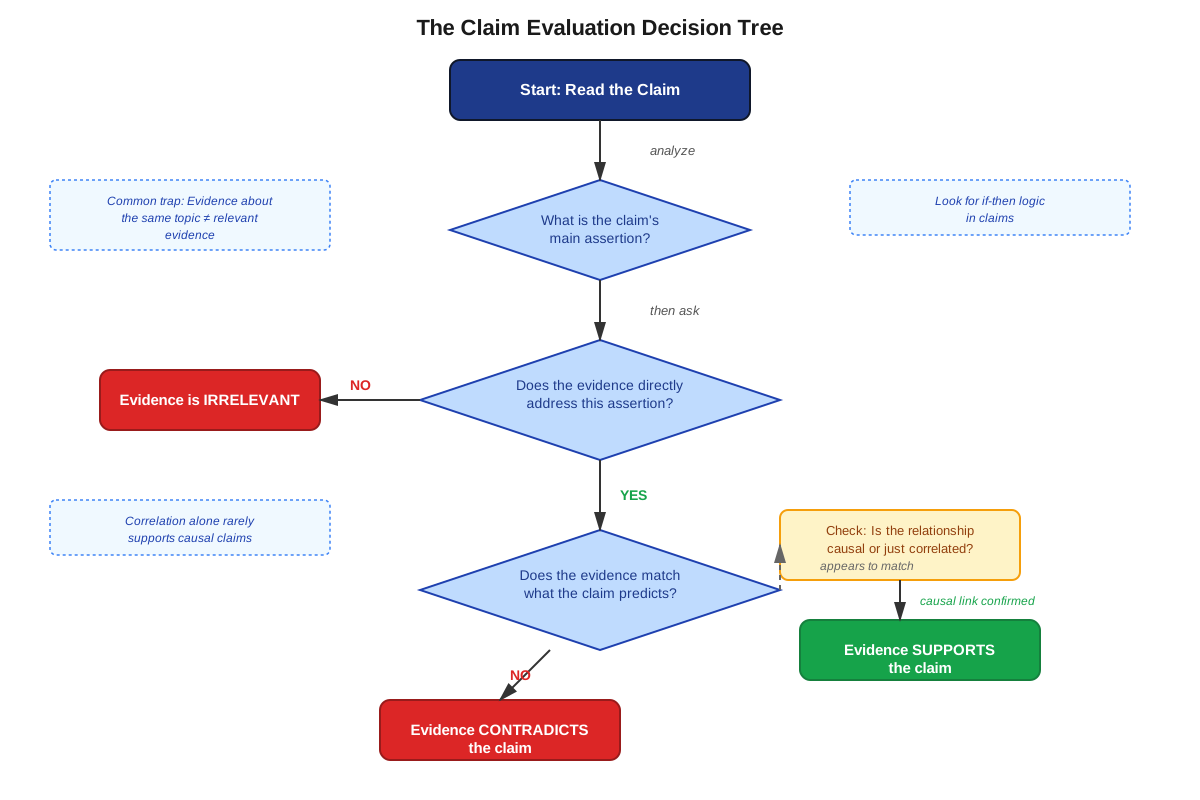
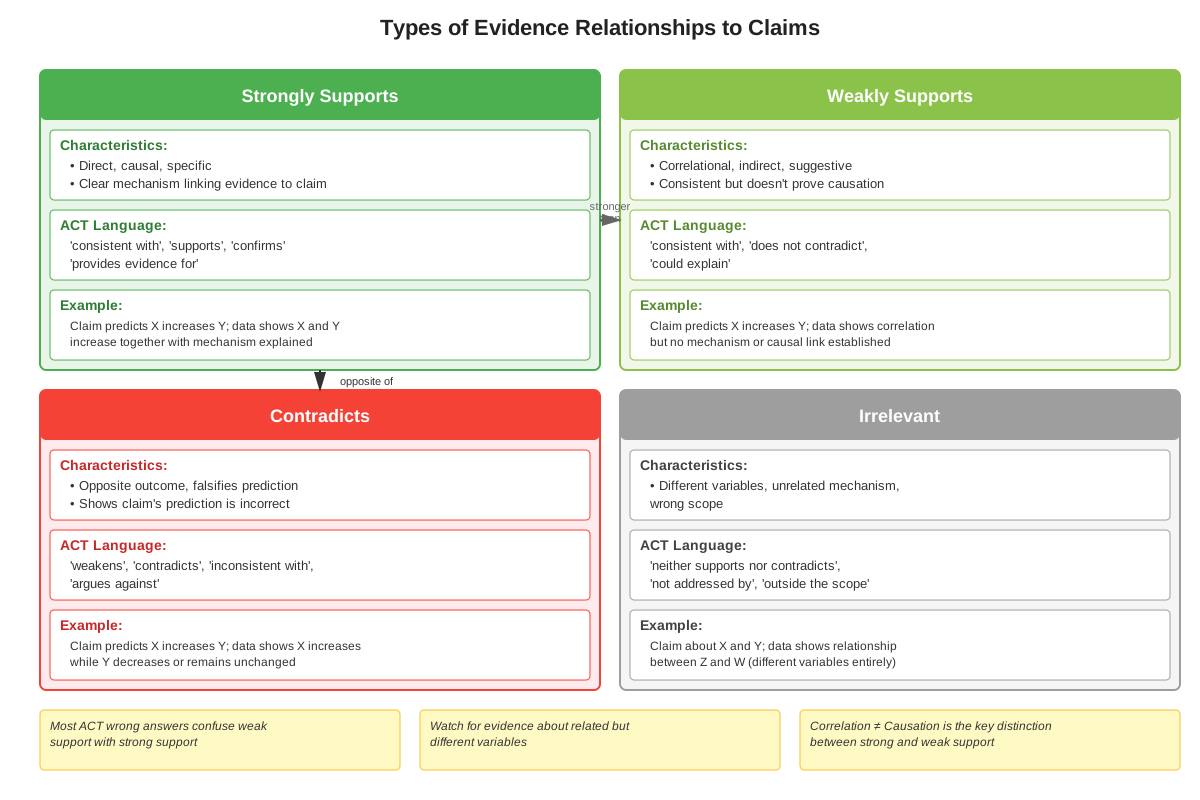
When evaluating claims, students must assess whether evidence genuinely supports a conclusion or merely correlates with it. Strong supporting evidence has three characteristics:
- Relevance: The evidence directly relates to the claim being made
- Sufficiency: The evidence is substantial enough to justify the conclusion
- Necessity: The claim requires this type of evidence to be credible
For example, if a scientist claims "Volcanic activity caused the mass extinction," relevant evidence would include volcanic deposits dated to the extinction period, climate changes consistent with volcanic effects, and extinction patterns matching volcanic impact predictions. Irrelevant evidence might include the existence of volcanoes today or volcanic activity at other time periods.
Students should also recognize that scientists in these passages often cite the same evidence but interpret it differently. This is a crucial insight: the facts themselves may not be in dispute, but their meaning is. When two scientists reference the same observation but draw different conclusions, questions often test whether students understand how each scientist's interpretation aligns with their broader claim.
Applying New Information
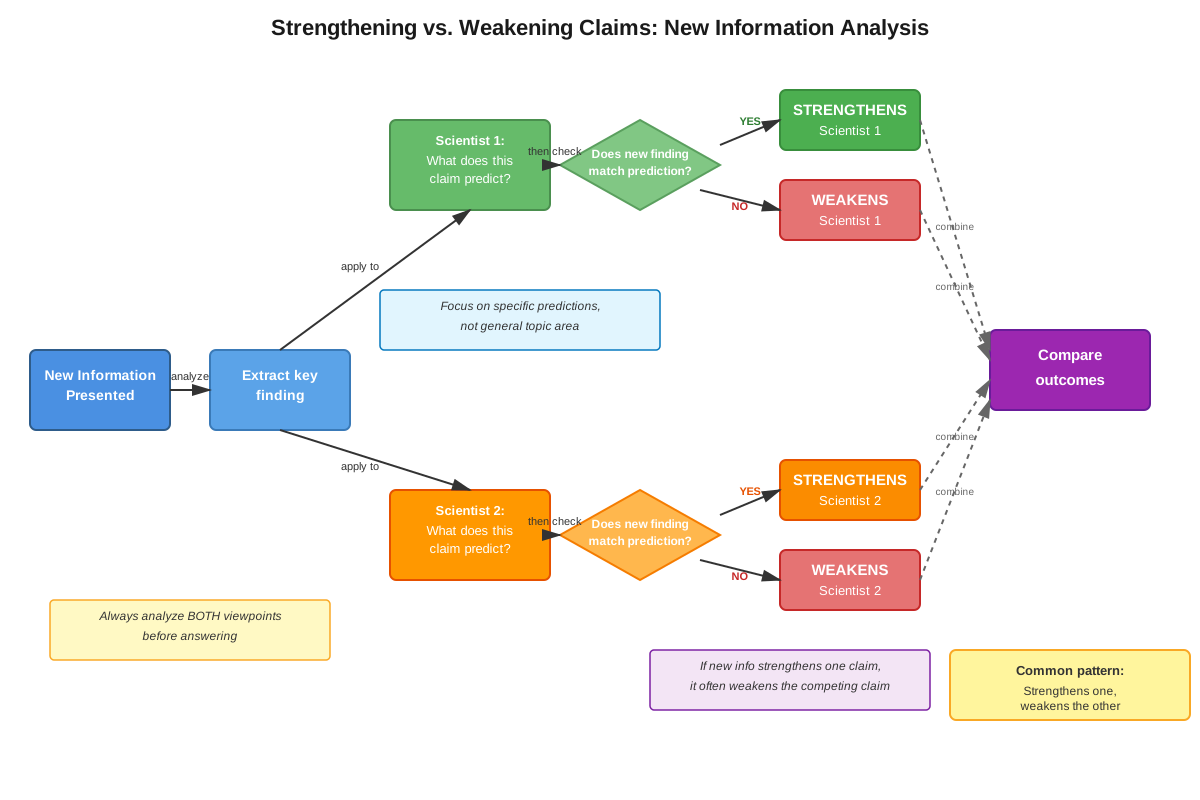
A particularly challenging question type presents new information and asks how it affects each viewpoint. These questions require students to:
- Understand the new information presented in the question stem
- Recall each scientist's central claim and reasoning
- Determine whether the new information aligns with, contradicts, or is irrelevant to each viewpoint
- Select the answer that accurately describes these relationships
The key strategy is recognizing that new information strengthens a viewpoint if it provides additional evidence for that scientist's reasoning pattern, and weakens a viewpoint if it contradicts predictions that scientist's theory would make. Information that is simply consistent with a viewpoint but doesn't provide additional support is neutral, not strengthening.
Identifying Implicit vs. Explicit Claims
Scientists in ACT passages make both explicit claims (directly stated) and implicit claims (logically necessary but unstated). Explicit claims appear in clear declarative sentences: "The structure formed through rapid cooling." Implicit claims are logical consequences of the stated position: if a scientist argues for rapid cooling, they implicitly claim that slow cooling did NOT occur.
Questions testing implicit claims often use phrases like "would agree with" or "is consistent with" rather than "states" or "mentions." Students must extend the scientist's reasoning to its logical conclusions without adding information the scientist wouldn't support.
Concept Relationships
The concepts within evaluating claims form a hierarchical structure where foundational understanding enables progressively sophisticated analysis. Understanding claims vs. evidence serves as the base—students cannot evaluate claims without first distinguishing assertions from observations. This foundational concept leads directly to analyzing supporting evidence, where students assess whether specific evidence genuinely supports particular claims.
Structure of Conflicting Viewpoints passages provides the organizational framework that makes efficient information retrieval possible. Recognizing this structure enables students to quickly locate relevant information when answering types of claims questions. Each question type (support, contradiction, agreement, assumption) requires applying the foundational understanding of claims and evidence in a specific way.
Identifying implicit vs. explicit claims represents an advanced application that builds on all previous concepts—students must understand claims, recognize evidence, know the passage structure, and apply logical reasoning to determine what scientists would necessarily believe based on their stated positions. Finally, applying new information synthesizes all concepts, requiring students to integrate novel data with existing viewpoints using the full range of claim evaluation skills.
The relationship map flows as follows:
Claims vs. Evidence → Analyzing Supporting Evidence → Structure Recognition → Question Type Identification → Implicit Claim Recognition → New Information Application
This topic connects to prerequisite knowledge of data interpretation (evidence often appears in graphical form) and experimental design (understanding what evidence would test a hypothesis). It prepares students for advanced scientific thinking required in college-level coursework where evaluating competing theories is fundamental to learning.
High-Yield Facts
⭐ Conflicting Viewpoints passages always present 2-3 distinct scientific perspectives on a single phenomenon, with each scientist's viewpoint appearing in a separate, labeled section
⭐ The introductory paragraph contains information that ALL scientists agree upon—this shared foundation often answers "agreement" questions
⭐ Claims are interpretations or conclusions, while evidence consists of observations or measurements—questions frequently test whether students can distinguish between these
⭐ When new information is presented in a question stem, it strengthens a viewpoint only if it provides additional support for that scientist's specific reasoning pattern, not merely if it's consistent with their claim
⭐ Scientists can cite identical evidence but interpret it differently—the disagreement lies in what the evidence means, not whether it exists
- Questions asking what would "weaken" or "contradict" a viewpoint require identifying information that cannot be explained by that scientist's theory
- Assumption questions test unstated premises that must be true for a scientist's argument to be valid
- "According to Scientist X" questions require information explicitly stated in that scientist's section, not logical extensions
- Agreement questions must identify points where both scientists explicitly address the same issue, not where their views happen to align on unstated matters
- The correct answer to support/contradict questions often involves reasoning one step beyond the passage—applying the scientist's logic to new situations
- Scientists' viewpoints typically differ in mechanism, timing, or causation rather than in basic observations
- Questions rarely require outside scientific knowledge—all necessary information appears in the passage
- The most common wrong answers on claim evaluation questions are statements that are true but irrelevant to the specific scientist's reasoning
- Extreme language ("always," "never," "only") in answer choices is often incorrect unless the scientist explicitly uses such absolute terms
- When scientists disagree, they typically represent genuinely plausible alternatives, not obviously wrong vs. obviously right positions
Quick check — test yourself on Evaluating claims so far.
Try Flashcards →Common Misconceptions
Misconception: If evidence is consistent with a scientist's viewpoint, it automatically supports that viewpoint.
Correction: Evidence supports a viewpoint only if it provides specific confirmation of that scientist's reasoning or predictions. Mere consistency is not sufficient—the evidence must make the claim more likely to be true than alternative explanations.
Misconception: Scientists in Conflicting Viewpoints passages disagree about the basic facts or observations.
Correction: Scientists typically agree on the factual observations (presented in the introduction) but disagree about how to interpret those facts. The conflict lies in explanation, mechanism, or causation, not in what was observed.
Misconception: To answer questions about Scientist 1, students should read only Scientist 1's section.
Correction: Many questions require comparing viewpoints or understanding how Scientist 1's position differs from others. Reading all viewpoints provides essential context, and the introduction contains shared information that may be relevant to any scientist's argument.
Misconception: The ACT expects students to determine which scientist is actually correct based on outside knowledge.
Correction: Questions never ask students to judge which viewpoint is objectively true. All questions can be answered using only information in the passage, and both viewpoints are typically scientifically plausible. The task is evaluating claims based on presented evidence, not determining absolute truth.
Misconception: If a scientist doesn't mention something, they must disagree with it.
Correction: Absence of mention does not equal disagreement. Scientists may simply not address certain points because they're irrelevant to their argument. Only explicit contradictions or logical incompatibilities constitute disagreement.
Misconception: Longer, more detailed viewpoints are more likely to be "correct" or favored by the test.
Correction: The ACT presents viewpoints with varying levels of detail, but length does not indicate correctness or importance. Questions are distributed equally across all viewpoints regardless of passage length.
Misconception: New information questions always strengthen one viewpoint and weaken another.
Correction: New information might strengthen one viewpoint without affecting others, weaken multiple viewpoints, or even be neutral to all viewpoints. Students must evaluate each viewpoint independently against the new information.
Worked Examples
Example 1: Direct Support Question
Passage Context: Two scientists debate how the Grand Canyon formed. Scientist 1 claims gradual erosion over millions of years by the Colorado River carved the canyon. Scientist 2 claims a catastrophic flood event rapidly carved the canyon in a much shorter timeframe.
Question: Which of the following discoveries would most support Scientist 1's viewpoint?
A) Evidence that the Colorado River changed course multiple times
B) Rock layers showing consistent, slow deposition over millions of years
C) Fossils of aquatic organisms found at various depths in the canyon
D) Sediment deposits at the canyon bottom matching upstream river composition
Solution Process:
Step 1: Identify Scientist 1's central claim and reasoning. Scientist 1 argues for gradual erosion over millions of years. This claim assumes continuous, slow processes rather than rapid, catastrophic events.
Step 2: Determine what type of evidence would specifically support gradual processes. We need evidence of slow, continuous action over extended time periods.
Step 3: Evaluate each answer choice:
- Choice A: River course changes don't specifically support gradual vs. catastrophic formation—rivers can change course in either scenario. This is neutral or potentially weakening.
- Choice B: Consistent, slow deposition over millions of years directly supports the timeframe and gradual nature of Scientist 1's claim. This provides evidence for the extended time period required by gradual erosion.
- Choice C: Fossils at various depths might indicate different time periods but don't specifically distinguish between gradual and catastrophic formation mechanisms.
- Choice D: Matching sediment composition shows the river transported material but doesn't address whether this happened gradually or rapidly.
Step 4: Select the answer that provides the most direct support for the specific mechanism (gradual) and timeframe (millions of years) that distinguish Scientist 1's viewpoint.
Answer: B
This question tests whether students understand that supporting evidence must address the specific distinguishing features of a viewpoint. Choice B is correct because it provides evidence for both the gradual nature and extended timeframe that define Scientist 1's position, directly contrasting with Scientist 2's rapid catastrophic model.
Example 2: New Information Application
Passage Context: Three scientists debate why certain bird species migrate. Scientist 1 claims migration is triggered by decreasing day length. Scientist 2 claims migration is triggered by decreasing temperature. Scientist 3 claims migration is triggered by decreasing food availability.
Question: Researchers discover that birds kept in controlled environments with constant temperature and abundant food still begin migration behavior when day length decreases. This finding would most weaken the viewpoint of:
A) Scientist 1 only
B) Scientist 2 only
C) Scientists 2 and 3 only
D) Scientists 1, 2, and 3
Solution Process:
Step 1: Understand the new information. Birds migrate when day length decreases EVEN WHEN temperature and food remain constant. This is a controlled experiment isolating day length as a variable.
Step 2: Analyze how this affects each viewpoint:
- Scientist 1 (day length trigger): This finding SUPPORTS Scientist 1 because birds migrate when day length decreases, confirming day length as a sufficient trigger.
- Scientist 2 (temperature trigger): This finding WEAKENS Scientist 2 because birds migrate even when temperature remains constant, suggesting temperature is not necessary for triggering migration.
- Scientist 3 (food availability trigger): This finding WEAKENS Scientist 3 because birds migrate even when food remains abundant, suggesting food availability is not necessary for triggering migration.
Step 3: Identify which viewpoints are weakened. The experiment shows that temperature and food availability are not necessary triggers since migration occurs without changes in these factors. However, it confirms day length as a sufficient trigger.
Step 4: Select the answer identifying only the weakened viewpoints.
Answer: C
This question demonstrates how new information questions require careful analysis of what the information proves and disproves. The controlled experiment eliminates temperature and food as necessary triggers (weakening Scientists 2 and 3) while confirming day length as sufficient (supporting Scientist 1). Students must recognize that "weakening" means showing a viewpoint is less likely to be correct, which occurs when the viewpoint's proposed mechanism is shown to be unnecessary.
Exam Strategy
When approaching Conflicting Viewpoints passages, implement a systematic reading strategy that maximizes efficiency while ensuring comprehension. First, read the introductory paragraph carefully—this contains the shared factual foundation and often provides definitions or context essential for understanding all viewpoints. Underline or mentally note what all scientists agree upon, as this information frequently answers agreement questions.
Next, read each scientist's viewpoint with a specific focus: identify and mark the central claim (usually in the first sentence), note the key reasoning or mechanism, and observe what evidence each scientist cites. Create a simple mental or written summary: "Scientist 1: Claims X because of Y, citing evidence Z." This active reading prevents confusion when questions reference specific viewpoints.
Trigger words and phrases to watch for:
- "According to Scientist X" → Answer must come directly from that scientist's section, no inference
- "Would support/strengthen" → Find evidence that makes the claim more likely true
- "Would weaken/contradict" → Find evidence incompatible with the claim
- "Would agree" → Both scientists must explicitly address this point
- "Assumes" → Identify unstated premises necessary for the argument
- "Is consistent with" → May require extending the scientist's reasoning to new situations
- "Based on the description" → Use only information from the specified viewpoint
Process-of-elimination strategies:
- Eliminate answers that confuse which scientist holds which view—these are common wrong answers
- Eliminate answers that are true but irrelevant to the specific scientist's reasoning
- Eliminate answers containing information not addressed by the specified scientist
- For support/weaken questions, eliminate answers that are neutral (merely consistent but not providing additional evidence)
- For agreement questions, eliminate answers where only one scientist addresses the issue
Time allocation: Conflicting Viewpoints passages typically require 5-6 minutes total (2-3 minutes reading, 3 minutes answering 6-7 questions). This is slightly more reading time than other passage types because understanding the viewpoints thoroughly makes questions much faster to answer. Resist the temptation to rush through the reading—investing time upfront pays dividends when answering questions.
If a question seems confusing, return to the passage and reread the relevant scientist's section. The answer is always supported by passage information, so confusion usually indicates missing a key detail during initial reading. For new information questions, write out how the new information affects each viewpoint before looking at answer choices—this prevents being misled by plausible-sounding but incorrect options.
Memory Techniques
CASE - Remember the four components to analyze in each viewpoint:
- Claim: What does the scientist believe?
- Argument: Why do they believe it?
- Support: What evidence do they cite?
- Exceptions: What would contradict their view?
INTRO = AGREE - The INTROductory paragraph contains what scientists AGREE upon. When you see an agreement question, check the introduction first.
SWANS - For evaluating whether evidence supports a claim, check if it's:
- Specific to the claim's mechanism
- Weakens alternatives
- Aligns with the reasoning
- Necessary for the conclusion
- Sufficient to justify the claim
Visualization Strategy: Picture each scientist standing on a different platform, each platform built on different foundation blocks (their evidence). When new information arrives, visualize whether it adds blocks to a platform (support), removes blocks (weaken), or lands between platforms (neutral). This spatial metaphor helps track how information affects different viewpoints.
The "Because Chain": For each scientist, create a mental chain: "Scientist X claims [conclusion] BECAUSE [reasoning] BECAUSE [evidence]." This chain helps identify assumptions (unstated links) and evaluate support (whether new evidence adds links).
Summary
Evaluating claims on the ACT Science section requires students to analyze competing scientific viewpoints by distinguishing claims from evidence, identifying supporting and contradicting information, and applying new data to determine which hypotheses are strengthened or weakened. The Conflicting Viewpoints passage appears once per test with 6-7 questions worth approximately 10-12% of the Science score. Success depends on recognizing passage structure (shared introduction followed by labeled viewpoints), understanding that scientists typically agree on observations but disagree on interpretations, and systematically evaluating whether evidence genuinely supports specific claims or merely correlates with them. Students must master multiple question types including direct support, contradiction, agreement/disagreement, assumptions, and new information application. The key to high performance is careful initial reading to identify each scientist's central claim and reasoning, followed by strategic question analysis that distinguishes between relevant supporting evidence and irrelevant but true statements. This skill synthesizes data interpretation, logical reasoning, and critical thinking—representing the highest level of scientific analysis tested on the ACT.
Key Takeaways
- Conflicting Viewpoints passages present 2-3 scientific perspectives with shared observations but different interpretations—the disagreement is about meaning, not facts
- The introductory paragraph contains information all scientists accept and frequently provides answers to agreement questions
- Claims are conclusions or interpretations; evidence consists of observations or measurements—distinguishing these is fundamental to evaluating support
- Evidence supports a viewpoint only when it specifically confirms that scientist's reasoning pattern, not merely when it's consistent with their conclusion
- New information strengthens a viewpoint if it provides additional evidence for that scientist's mechanism and weakens a viewpoint if it contradicts predictions that theory would make
- Read all viewpoints before answering questions—comparison and context are essential for accurate evaluation
- Questions never require determining which scientist is objectively correct; all answers derive from passage information alone
Related Topics
Data Representation Passages: While Conflicting Viewpoints focuses on competing interpretations, Data Representation passages emphasize extracting information from graphs and tables. Mastering claim evaluation enhances data interpretation by helping students understand what conclusions can legitimately be drawn from presented data.
Research Summaries Passages: These passages describe experimental procedures and results, requiring students to understand experimental design and data analysis. The claim evaluation skills developed here transfer directly to assessing whether experimental results support researchers' conclusions.
Scientific Method and Hypothesis Testing: Understanding how scientists formulate, test, and revise hypotheses provides deeper context for why Conflicting Viewpoints passages present competing theories. This broader understanding of scientific inquiry enhances critical analysis skills.
Logical Reasoning and Argumentation: The formal logic underlying claim evaluation—including concepts like necessary vs. sufficient conditions, valid inference patterns, and logical fallacies—strengthens students' ability to assess scientific arguments systematically.
Practice CTA
Now that you've mastered the fundamentals of evaluating claims, it's time to apply these strategies to authentic ACT-style questions. Complete the practice questions for this topic, focusing on identifying question types, locating relevant information efficiently, and systematically eliminating wrong answers. Use the flashcards to reinforce key concepts like distinguishing claims from evidence and recognizing common question triggers. Remember: evaluating claims is a high-yield skill that appears on every ACT Science test—your investment in practice will directly translate to points on test day. Approach each practice question as an opportunity to refine your systematic approach, and review both correct and incorrect answers to understand the reasoning patterns the ACT rewards. You've got this!
Sign up free to keep reading
Create a free AnvayaPrep account to finish this ACT guide on Evaluating claims — plus flashcards and practice questions.