Overview
The scientist viewpoints section represents one of the most distinctive and challenging components of the ACT Science test. Unlike data representation or research summaries passages, the Conflicting Viewpoints passage format presents students with multiple scientific perspectives on a single phenomenon, theory, or observation. This passage type typically features 2-4 scientists, students, or hypotheses that offer competing explanations for the same set of observations or data. Understanding how to navigate these passages efficiently is crucial because they appear consistently on every ACT Science test, comprising approximately 15-20% of all Science questions.
Mastering ACT scientist viewpoints questions requires a unique skill set that differs from traditional science knowledge recall. Students must quickly identify the core claim of each viewpoint, recognize points of agreement and disagreement between scientists, and understand the logical structure of scientific argumentation. These passages test critical thinking, reading comprehension within a scientific context, and the ability to distinguish between evidence and interpretation—skills that extend far beyond memorizing facts.
The Conflicting Viewpoints passage connects to broader scientific literacy by modeling how real scientific discourse operates. Scientists regularly debate interpretations of data, propose competing theories, and build upon or challenge existing models. By learning to analyze these viewpoints systematically, students develop transferable skills in evaluating arguments, identifying assumptions, and understanding how evidence supports or refutes claims—competencies essential for success in college-level science courses and informed citizenship.
Learning Objectives
- [ ] Identify when Scientist viewpoints is being tested
- [ ] Explain the core rule or strategy behind Scientist viewpoints
- [ ] Apply Scientist viewpoints to ACT-style questions accurately
- [ ] Distinguish between points of agreement and disagreement among multiple scientific perspectives
- [ ] Recognize the relationship between evidence presented and conclusions drawn by each scientist
- [ ] Evaluate which new information would strengthen or weaken a particular viewpoint
- [ ] Synthesize information across multiple viewpoints to answer comparative questions
Prerequisites
- Basic reading comprehension skills: Essential for understanding scientific arguments presented in paragraph form rather than data tables or graphs
- Familiarity with scientific terminology: Enables faster processing of passage content without getting stuck on vocabulary
- Understanding of hypothesis and theory: Necessary to recognize when scientists are proposing explanations versus stating observations
- Ability to identify cause-and-effect relationships: Critical for following the logical structure of each scientist's argument
Why This Topic Matters
In real-world scientific practice, conflicting viewpoints drive progress and innovation. Major scientific breakthroughs—from plate tectonics to the nature of light—emerged from debates between competing theories. The ability to evaluate multiple perspectives, identify strengths and weaknesses in arguments, and synthesize information from diverse sources represents a cornerstone of scientific literacy that extends into medicine, engineering, environmental policy, and technology development.
On the ACT Science test, the Conflicting Viewpoints passage appears exactly once per exam, typically as the seventh and final passage. This passage consistently generates 6-7 questions worth approximately 15-18% of the total Science score. Unlike Data Representation and Research Summaries passages that may require graph interpretation or experimental design analysis, Conflicting Viewpoints passages focus almost exclusively on reading comprehension and logical reasoning within a scientific context. Students who master this passage type often find it becomes their fastest and most reliable section, as it requires minimal scientific background knowledge and follows predictable patterns.
Common manifestations of this topic include debates about geological processes (competing theories for mountain formation), astronomical phenomena (different explanations for planetary features), biological mechanisms (alternative hypotheses for evolutionary adaptations), or physical processes (conflicting models of atomic structure). Questions typically ask students to identify what each scientist believes, determine points of agreement or disagreement, predict how new evidence would affect each viewpoint, or recognize which data supports or contradicts specific claims.
Core Concepts
Structure of Conflicting Viewpoints Passages
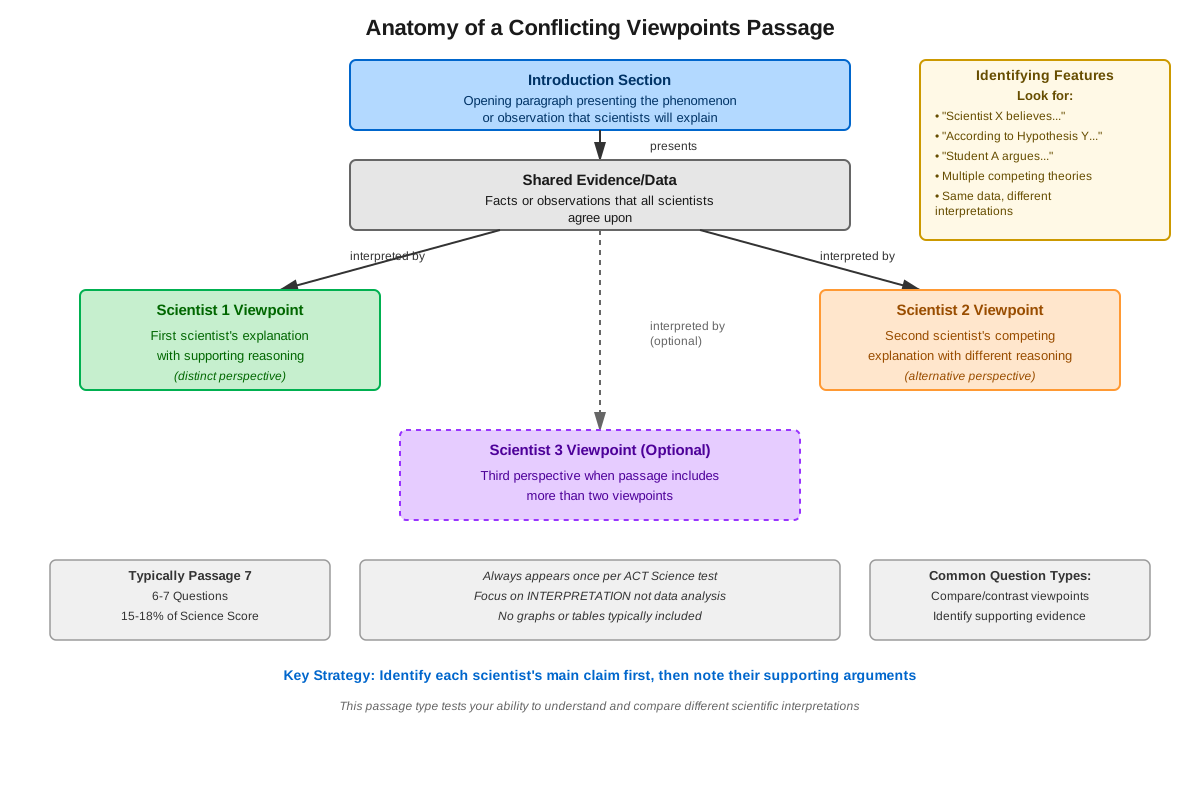
Scientist viewpoints passages follow a consistent organizational structure that students can leverage for efficient reading. The passage begins with an introductory paragraph providing background information, observations, or data that all scientists accept as factual. This introduction establishes the phenomenon requiring explanation. Following this setup, the passage presents 2-4 distinct viewpoints, each labeled clearly (Scientist 1, Student 1, Hypothesis A, etc.). Each viewpoint typically spans 1-3 paragraphs explaining that scientist's interpretation, theory, or model.
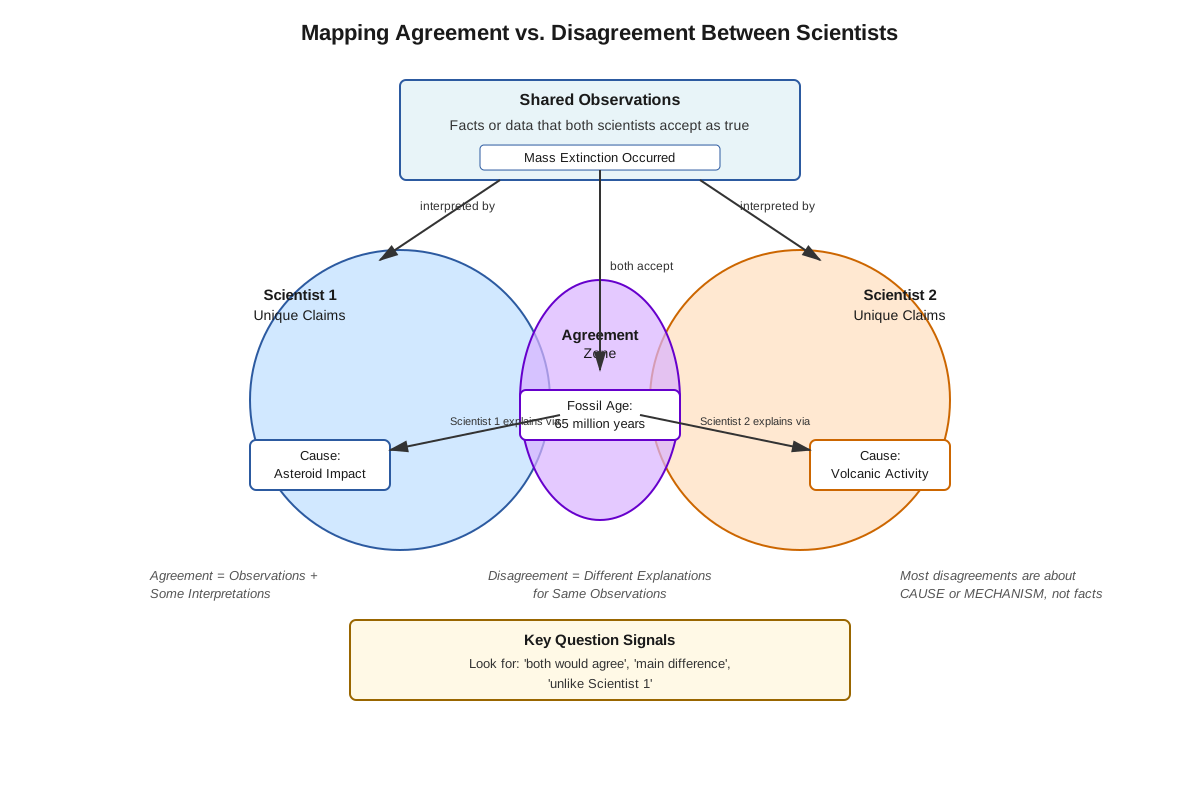
The key distinction in these passages lies between observations (facts all scientists agree upon) and interpretations (explanations that differ among scientists). The introduction presents shared observations, while individual viewpoint sections present competing interpretations. Recognizing this distinction enables students to quickly identify what scientists agree about versus what they debate.
Anatomy of a Scientific Viewpoint
Each scientist's argument contains several identifiable components that students should recognize:
- Central claim or thesis: The main explanation or theory the scientist proposes
- Supporting evidence: Observations, data, or established facts the scientist uses to support their claim
- Reasoning: The logical connections between evidence and conclusions
- Predictions or implications: What the theory suggests should be true if the viewpoint is correct
- Assumptions: Underlying beliefs or conditions the scientist takes as given (often unstated)
Understanding these components allows students to map each viewpoint systematically rather than trying to remember every detail. The central claim represents the "what" (what does this scientist believe?), while supporting evidence and reasoning represent the "why" (why does this scientist hold this belief?).
Types of Conflicting Viewpoints Questions
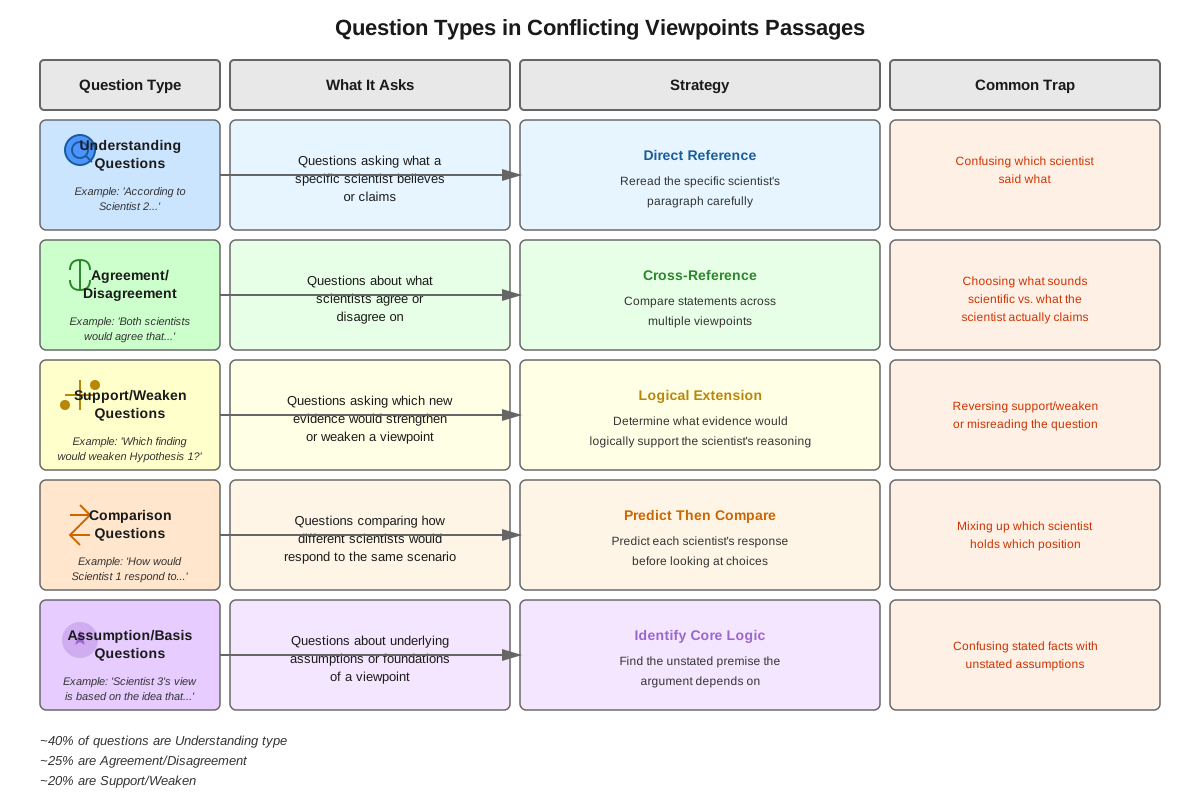
ACT questions about scientist viewpoints fall into predictable categories:
| Question Type | What It Asks | Strategy |
|---|---|---|
| Direct lookup | What does Scientist X believe about Y? | Scan that scientist's section for explicit statements |
| Agreement/disagreement | On what point do the scientists agree/disagree? | Compare specific claims across viewpoints |
| New evidence | How would finding Z affect Scientist X's viewpoint? | Determine if Z supports or contradicts X's central claim |
| Comparison | How do the viewpoints differ regarding mechanism A? | Identify what each scientist says about A specifically |
| Prediction | What would Scientist X predict about situation B? | Apply the scientist's logic to a new scenario |
| Assumption identification | Which assumption underlies Scientist X's argument? | Identify unstated beliefs necessary for the argument to work |
Reading Strategy for Maximum Efficiency
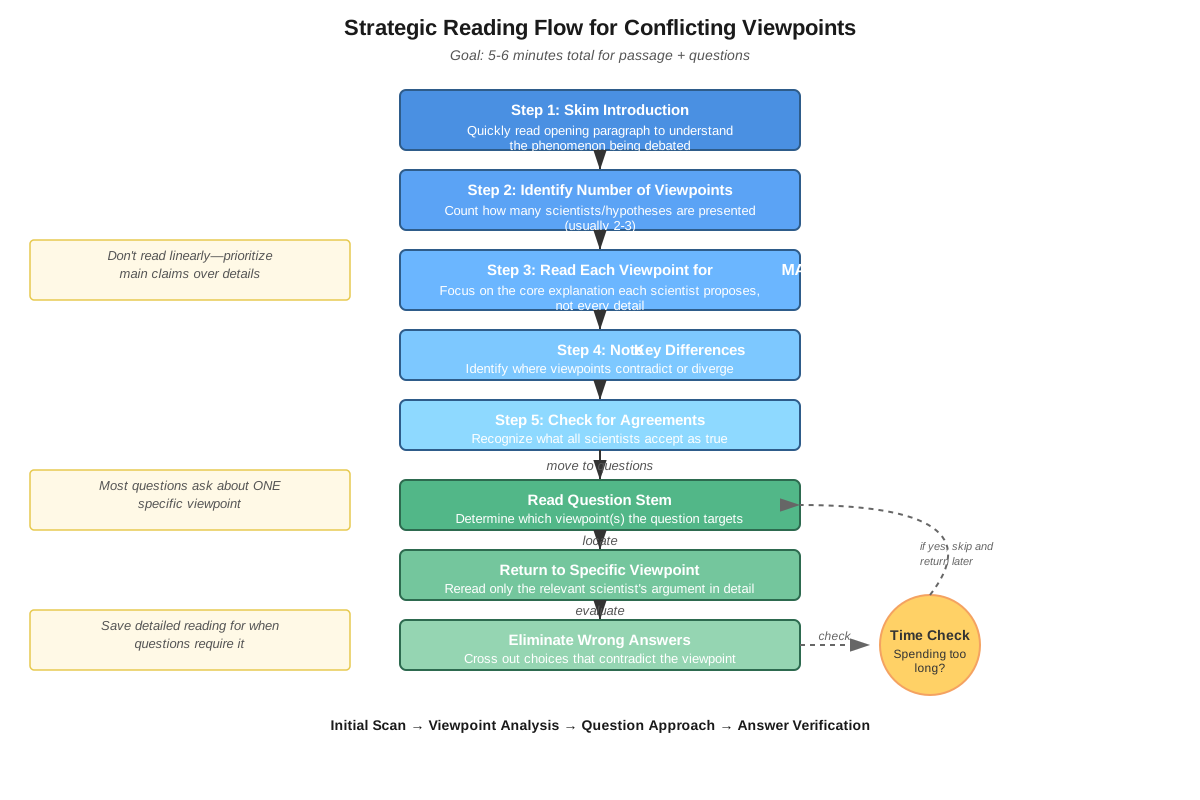
Effective navigation of ACT scientist viewpoints passages requires a strategic reading approach distinct from other passage types. Students should employ a three-phase process:
Phase 1: Introduction (30-45 seconds) - Read the introductory paragraph carefully to understand the phenomenon being explained and identify facts all scientists accept. Note any data, observations, or background information presented here, as questions may ask what scientists agree upon.
Phase 2: Viewpoint Mapping (90-120 seconds) - For each scientist's section, identify and briefly note the central claim. Avoid getting bogged down in supporting details during the first read. The goal is to create a mental map: "Scientist 1 thinks X causes Y; Scientist 2 thinks Z causes Y."
Phase 3: Question-Driven Detail Reading (as needed) - Return to specific viewpoint sections when questions require detailed information. Most questions can be answered by understanding central claims; only a few require careful reading of supporting evidence.
Identifying Points of Agreement and Disagreement
A critical skill for scientist viewpoints questions involves distinguishing what scientists agree about from what they debate. Scientists typically agree on:
- Observations and data presented in the introduction
- The existence of the phenomenon requiring explanation
- Basic scientific principles or laws
- The need for an explanation
Scientists typically disagree on:
- The mechanism or process causing the phenomenon
- The relative importance of different factors
- Predictions about future observations or experiments
- Interpretations of ambiguous evidence
- The timeline or sequence of events
Questions asking about agreement often test whether students can separate shared observations from competing interpretations. For example, all scientists might agree that "mountain ranges exist along continental margins" (observation) while disagreeing about whether "plate collision" or "volcanic activity" caused their formation (interpretation).
Evaluating New Evidence
Many questions present hypothetical new discoveries and ask how they would affect a particular viewpoint. To answer these questions effectively:
- Identify the scientist's central claim
- Determine whether the new evidence supports or contradicts that claim
- Consider whether the evidence is directly relevant to the scientist's argument
- Recognize that evidence supporting one viewpoint often weakens opposing viewpoints
Evidence strengthens a viewpoint when it confirms predictions made by that theory, provides examples consistent with the mechanism proposed, or rules out alternative explanations. Evidence weakens a viewpoint when it contradicts predictions, provides counterexamples, or supports alternative mechanisms.
Logical Structure and Argumentation
Understanding the logical structure of scientific arguments helps students evaluate viewpoints critically. Scientists construct arguments using:
- Deductive reasoning: If theory X is true, then Y must follow; Y is observed; therefore X is supported
- Inductive reasoning: Multiple observations of pattern Y suggest general principle X
- Analogical reasoning: Process Y is similar to known process X; therefore Y likely operates like X
- Elimination reasoning: Possibilities A, B, and C exist; evidence rules out A and B; therefore C is most likely
Recognizing these reasoning patterns helps students predict how scientists would respond to new information and understand the logical connections within each viewpoint.
Concept Relationships
The concepts within scientist viewpoints passages form an interconnected hierarchy. At the foundation lie shared observations and data (the introduction), which all scientists accept. From this common ground, each scientist constructs an interpretation or theory (their central claim) supported by reasoning and evidence. These interpretations lead to predictions and implications that can be tested against new information.
The relationship between viewpoints is typically one of mutual exclusivity or partial overlap. Mutually exclusive viewpoints propose fundamentally different mechanisms (e.g., "mountains form from plate collision" vs. "mountains form from volcanic activity"). Partially overlapping viewpoints might agree on some aspects while disagreeing on others (e.g., both scientists agree plate movement occurs but disagree on what drives that movement).
Understanding scientist viewpoints connects to prerequisite knowledge of hypothesis formation and scientific method. Each viewpoint represents a hypothesis attempting to explain observations. The passage structure mirrors the scientific process: observations lead to questions, questions lead to competing hypotheses, and hypotheses make predictions that can be tested.
The skill of analyzing conflicting viewpoints also relates to other ACT Science passage types. In Research Summaries passages, students might encounter experiments designed to test competing hypotheses. In Data Representation passages, students might need to determine which interpretation of data is most supported. Thus, mastering Conflicting Viewpoints passages strengthens overall Science reasoning abilities.
Relationship map: Shared observations → Individual interpretations → Supporting reasoning → Predictions → Evaluation against new evidence → Strengthening or weakening of viewpoints
Quick check — test yourself on Scientist viewpoints so far.
Try Flashcards →High-Yield Facts
⭐ Every ACT Science test contains exactly one Conflicting Viewpoints passage with 6-7 questions
⭐ The introduction presents facts and observations that all scientists agree upon
⭐ Each scientist's central claim appears in their first paragraph, usually in the first 1-2 sentences
⭐ Questions asking what scientists "agree" about typically refer to information in the introduction
⭐ New evidence that confirms a prediction made by a viewpoint strengthens that viewpoint
- Scientists may agree on observations while disagreeing on interpretations or mechanisms
- Conflicting Viewpoints passages require minimal outside scientific knowledge compared to other passage types
- The passage typically appears as the seventh (final) passage on the ACT Science test
- Most questions can be answered by understanding central claims without memorizing supporting details
- Evidence that contradicts a scientist's prediction weakens that viewpoint
- Questions often ask students to apply a scientist's logic to new scenarios not explicitly discussed
- Assumptions underlying arguments are often unstated but can be inferred from the reasoning presented
- Comparative questions require identifying specific differences between viewpoints on particular aspects
- The number of viewpoints ranges from 2-4, with 2-3 being most common
Common Misconceptions
Misconception: Students must understand all scientific terminology and background information to answer questions correctly → Correction: Conflicting Viewpoints passages are designed to be answerable with minimal outside knowledge. The passage provides all necessary information, and questions test reading comprehension and logical reasoning rather than science content knowledge. Focus on understanding the structure of arguments rather than memorizing scientific details.
Misconception: All scientists disagree about everything in the passage → Correction: Scientists typically agree on the observations and data presented in the introduction. They disagree on interpretations, mechanisms, or explanations for those observations. Questions asking about agreement usually refer to shared observations, while disagreement questions focus on competing explanations.
Misconception: Longer, more detailed viewpoints are more likely to be "correct" → Correction: The ACT does not designate any viewpoint as correct or incorrect. All viewpoints are treated as equally valid scientific hypotheses. Questions ask what each scientist believes or how evidence affects viewpoints, not which scientist is right. Length of explanation does not indicate validity.
Misconception: Students should read every word of each viewpoint carefully before attempting questions → Correction: Efficient reading involves identifying central claims first, then returning to specific sections when questions require detailed information. Reading every detail initially wastes time and makes it harder to distinguish main ideas from supporting information.
Misconception: New evidence questions require predicting what would actually happen in reality → Correction: These questions ask how evidence would affect a particular scientist's viewpoint based on their stated logic, not what would actually occur. Even if a viewpoint seems scientifically questionable, students must answer based on that scientist's internal logic and predictions.
Worked Examples
Example 1: Identifying Central Claims and Points of Disagreement
Passage Setup: The introduction states that scientists observe unusual magnetic patterns in rocks along the ocean floor. Scientist 1 argues that these patterns result from periodic reversals of Earth's magnetic field, with new oceanic crust recording the field direction at the time of formation. Scientist 2 argues that the patterns result from varying mineral compositions in the rocks, which create different magnetic properties unrelated to Earth's magnetic field.
Question: The two scientists would most likely disagree about whether:
A) magnetic patterns exist in oceanic rocks
B) Earth has a magnetic field
C) the magnetic patterns reflect changes in Earth's magnetic field over time
D) oceanic crust forms at mid-ocean ridges
Solution Process:
Step 1: Identify what information appears in the introduction (shared observations). The introduction states that "unusual magnetic patterns in rocks along the ocean floor" are observed. Both scientists accept this observation.
Step 2: Identify each scientist's central claim:
- Scientist 1: Patterns result from Earth's magnetic field reversals
- Scientist 2: Patterns result from varying mineral compositions
Step 3: Determine the core disagreement. Both scientists agree patterns exist (eliminating A). The disagreement centers on what causes the patterns—specifically, whether they reflect changes in Earth's magnetic field.
Step 4: Evaluate answer choices:
- A: Both agree patterns exist (introduction)
- B: Scientist 1 explicitly discusses Earth's magnetic field; Scientist 2 doesn't deny its existence, just its relevance to the patterns
- C: This directly addresses the core disagreement—Scientist 1 says yes, patterns reflect field changes; Scientist 2 says no, patterns reflect mineral composition
- D: Neither scientist discusses crust formation at mid-ocean ridges
Answer: C
Connection to Learning Objectives: This example demonstrates identifying points of disagreement by comparing central claims and distinguishing shared observations from competing interpretations.
Example 2: Evaluating New Evidence
Passage Setup: Scientist 1 argues that dinosaur extinction resulted from a massive asteroid impact that created dust clouds blocking sunlight, causing plant death and ecosystem collapse. Scientist 2 argues that dinosaur extinction resulted from gradual climate change over millions of years due to volcanic activity, which slowly altered habitats.
Question: The discovery of a thin layer of iridium (a rare element common in asteroids but rare on Earth) in rock layers corresponding to the time of dinosaur extinction would most likely strengthen the viewpoint of:
A) Scientist 1 only
B) Scientist 2 only
C) both scientists
D) neither scientist
Solution Process:
Step 1: Identify each scientist's central claim and mechanism:
- Scientist 1: Asteroid impact caused extinction
- Scientist 2: Gradual volcanic climate change caused extinction
Step 2: Analyze the new evidence. Iridium is "common in asteroids but rare on Earth." A layer of iridium at the extinction time suggests asteroid material was deposited.
Step 3: Determine which viewpoint this evidence supports:
- Scientist 1's asteroid impact theory predicts asteroid material (including iridium) would be present at the extinction boundary. This evidence confirms that prediction.
- Scientist 2's volcanic activity theory does not predict or require asteroid material. The evidence doesn't support this mechanism.
Step 4: Evaluate whether evidence weakens the opposing view. Finding asteroid material doesn't necessarily rule out volcanic activity, but it strongly supports the asteroid impact explanation that Scientist 1 proposes.
Answer: A
Connection to Learning Objectives: This example demonstrates applying scientist viewpoints to evaluate how new evidence affects specific theories by determining whether evidence confirms predictions made by each viewpoint.
Exam Strategy
When approaching Conflicting Viewpoints passages on the ACT, implement this systematic strategy:
Time Management: Allocate 5-6 minutes total for the passage and its questions (slightly less than other passage types). Spend approximately 2 minutes reading and mapping viewpoints, then 30-45 seconds per question.
Reading Approach:
- Read the introduction carefully to identify shared observations
- For each viewpoint, read the first 1-2 sentences to identify the central claim
- Skim remaining sentences to understand general supporting points
- Create a brief mental or written map: "Scientist 1: X causes Y; Scientist 2: Z causes Y"
Trigger Words to Watch For:
Questions about agreement typically use phrases like:
- "Both scientists would agree that..."
- "Which statement is consistent with both viewpoints?"
- "The scientists agree that..."
Questions about disagreement use phrases like:
- "The two scientists would most likely disagree about whether..."
- "Unlike Scientist 1, Scientist 2 believes..."
- "A major difference between the viewpoints is..."
Questions about new evidence include:
- "The discovery of X would most likely strengthen/weaken..."
- "Which finding would support Scientist 2's viewpoint?"
- "If Y were found to be true, this would most likely..."
Questions requiring prediction or application use:
- "According to Scientist 1, what would happen if...?"
- "Scientist 2 would most likely predict..."
- "Based on Scientist 1's viewpoint, which of the following would be expected?"
Process of Elimination Tips:
For agreement questions, eliminate answers that:
- Appear in only one scientist's section (not shared)
- Represent interpretations rather than observations
- Use absolute language ("always," "never") unless explicitly stated
For disagreement questions, eliminate answers that:
- Appear in the introduction (shared observations)
- Are not addressed by one or more scientists
- Represent minor details rather than core claims
For new evidence questions, eliminate answers that:
- Describe evidence irrelevant to the scientist's mechanism
- Contradict the question stem (if asking what strengthens, eliminate what weakens)
- Apply to the wrong scientist
Strategic Question Order: Consider answering direct lookup questions first (what does Scientist X believe?) to build familiarity with viewpoints before tackling comparative or application questions.
Exam Tip: If stuck between two answer choices, return to each scientist's central claim. The correct answer almost always relates directly to the core argument rather than peripheral details.
Memory Techniques
CLAIM Acronym for analyzing each viewpoint:
- Central thesis (What does this scientist believe?)
- Logic and reasoning (Why do they believe it?)
- Assumptions (What must be true for this to work?)
- Implications (What does this predict?)
- Mechanism (How does the process work?)
The "Introduction = Agreement" Rule: Visualize the introduction as a foundation that all scientists stand on together. Everything in the introduction represents common ground. When scientists present their viewpoints, they're building different structures on the same foundation.
The "First Sentence Focus" Technique: Train yourself to identify that the first 1-2 sentences of each viewpoint contain the central claim. Visualize these sentences highlighted in bright yellow. Everything else provides supporting detail.
Evidence Direction Arrows: When evaluating new evidence, draw mental arrows:
- Evidence pointing toward a viewpoint = strengthens
- Evidence pointing away from a viewpoint = weakens
- Evidence pointing nowhere relevant = no effect
The "Two-Column Comparison" Visualization: For questions about differences, mentally create two columns labeled with each scientist's name. List what each says about the specific topic asked. The difference becomes immediately visible.
Mnemonic for Question Types: "ADNAP"
- Agreement/disagreement questions
- Direct lookup questions
- New evidence questions
- Application/prediction questions
- Point-by-point comparison questions
Summary
Scientist viewpoints passages represent a unique ACT Science challenge that tests reading comprehension and logical reasoning within a scientific context rather than content knowledge. These passages present 2-4 competing explanations for a phenomenon, with all scientists agreeing on observations but disagreeing on interpretations. Success requires efficiently identifying each scientist's central claim, distinguishing shared observations from competing explanations, and evaluating how new evidence affects specific viewpoints. The passage structure follows a predictable pattern: an introduction presenting shared observations, followed by labeled sections for each viewpoint. Questions fall into recognizable categories including agreement/disagreement, direct lookup, new evidence evaluation, and prediction/application. Strategic reading involves mapping central claims quickly rather than memorizing details, then returning to specific sections when questions require detailed information. Understanding that evidence strengthens viewpoints when it confirms predictions and weakens viewpoints when it contradicts predictions enables efficient answering of new evidence questions. Mastering this passage type provides a reliable source of points on every ACT Science test.
Key Takeaways
- The Conflicting Viewpoints passage appears exactly once per ACT Science test, generating 6-7 questions worth approximately 15-18% of the Science score
- The introduction contains observations and facts all scientists agree upon; individual viewpoint sections contain competing interpretations
- Each scientist's central claim typically appears in the first 1-2 sentences of their section—focus on identifying these claims quickly
- Agreement questions usually refer to information in the introduction; disagreement questions focus on competing explanations or mechanisms
- New evidence strengthens a viewpoint when it confirms that scientist's predictions and weakens a viewpoint when it contradicts predictions
- Efficient reading involves mapping central claims first, then returning to details only when specific questions require them
- These passages require minimal outside scientific knowledge—all necessary information appears in the passage itself
Related Topics
Research Summaries Passages: After mastering Conflicting Viewpoints, students can apply similar analytical skills to Research Summaries passages where experiments may be designed to test competing hypotheses. Understanding how to evaluate which hypothesis experimental results support builds directly on Conflicting Viewpoints skills.
Data Representation Passages: The ability to distinguish between observations (data) and interpretations (conclusions) developed through Conflicting Viewpoints passages transfers directly to Data Representation passages where students must determine which conclusions are supported by graphs and tables.
Scientific Method and Hypothesis Testing: Deeper exploration of how scientists formulate, test, and refine hypotheses provides context for understanding why Conflicting Viewpoints passages are structured as they are and how real scientific debates progress.
Logical Reasoning and Argumentation: Studying formal logic, argument structure, and reasoning patterns enhances the ability to analyze scientific viewpoints and identify assumptions, implications, and logical connections.
Practice CTA
Now that you've mastered the strategies for analyzing scientist viewpoints, it's time to put your skills into action! Complete the practice questions to reinforce your ability to identify central claims, distinguish agreement from disagreement, and evaluate how new evidence affects competing viewpoints. Use the flashcards to drill high-yield concepts and question types until recognizing patterns becomes automatic. Remember: Conflicting Viewpoints passages become faster and more reliable with practice, often transforming into students' highest-scoring passage type. Every practice question you complete builds the pattern recognition and strategic thinking that will serve you on test day!
Sign up free to keep reading
Create a free AnvayaPrep account to finish this ACT guide on Scientist viewpoints — plus flashcards and practice questions.