Overview
Theory comparison is one of the most critical skills tested in the ACT Science section, specifically within the Conflicting Viewpoints passage format. Unlike the Data Representation and Research Summaries passages that focus on interpreting graphs and experimental designs, Conflicting Viewpoints passages present multiple scientific perspectives on the same phenomenon, requiring students to analyze, contrast, and evaluate competing theories or hypotheses. This skill mirrors authentic scientific discourse, where researchers must weigh evidence and reasoning to determine which explanations best account for observed phenomena.
The ACT theory comparison questions assess a student's ability to identify the fundamental differences and similarities between scientific viewpoints, recognize supporting and contradicting evidence, and understand the logical structure of scientific arguments. These passages typically present 2-3 theories from different scientists or research groups, each offering distinct explanations for the same observation or problem. Students must navigate through dense scientific prose, extract the essential claims of each theory, and answer questions that require direct comparison, identification of unique predictions, or evaluation of new evidence against each perspective.
Mastering theory comparison is essential because it represents approximately 15-20% of the ACT Science section (typically one full passage with 6-7 questions per test). This topic connects to broader scientific literacy skills including critical thinking, evidence evaluation, and logical reasoning. Unlike other Science passages that rely heavily on graph interpretation, Conflicting Viewpoints passages demand strong reading comprehension combined with the ability to track multiple complex arguments simultaneously. Success in this area often separates high-scoring students from average performers, making it a high-yield focus area for test preparation.
Learning Objectives
- [ ] Identify when Theory comparison is being tested in ACT Science passages
- [ ] Explain the core rule or strategy behind Theory comparison
- [ ] Apply Theory comparison to ACT-style questions accurately
- [ ] Distinguish between the fundamental claims of competing theories within a single passage
- [ ] Recognize which evidence supports or contradicts each theory
- [ ] Predict how each theory would respond to new hypothetical data or scenarios
- [ ] Evaluate the logical consistency and scope of competing scientific explanations
Prerequisites
- Basic reading comprehension skills: Necessary to understand complex scientific prose and extract main ideas from dense paragraphs without visual aids
- Understanding of scientific method: Required to recognize how theories are constructed, tested, and evaluated against evidence
- Familiarity with scientific terminology: Enables faster processing of technical vocabulary across various scientific disciplines (biology, chemistry, physics, Earth science)
- Ability to identify main ideas versus supporting details: Critical for distinguishing core theoretical claims from examples or elaborations
- Experience with ACT Science passage formats: Provides context for recognizing when a Conflicting Viewpoints passage appears and how it differs from other passage types
Why This Topic Matters
Theory comparison represents a fundamental aspect of scientific practice that extends far beyond standardized testing. In real-world science, researchers constantly evaluate competing explanations for phenomena, from debating the mechanisms of climate change to understanding the origins of diseases. The ability to hold multiple perspectives simultaneously, identify their key differences, and evaluate them against evidence is essential for scientific literacy and informed citizenship. Students who master this skill develop critical thinking abilities applicable to evaluating arguments in any field, from policy debates to medical decisions.
On the ACT Science section, theory comparison appears in exactly one passage per test—the Conflicting Viewpoints passage. This passage format is highly predictable in structure but challenging in execution. It typically consists of 6-7 questions worth approximately 15-18% of the total Science score. The passage presents 2-3 theories (most commonly 2) that explain the same phenomenon from different perspectives. Questions fall into several predictable categories: identifying what each theory claims, finding points of agreement or disagreement, determining which theory is supported by specific evidence, and predicting how each theory would interpret new information.
Common manifestations in exam passages include: debates about geological processes (plate tectonics mechanisms, fossil formation), astronomical phenomena (planetary formation, stellar evolution), biological processes (evolutionary mechanisms, ecological relationships), and physical phenomena (states of matter, energy transfer). The theories are always clearly labeled (Theory 1, Theory 2, or Scientist 1, Scientist 2) and presented in separate, self-contained paragraphs or sections. Understanding this predictable structure allows students to develop systematic approaches that dramatically improve accuracy and speed.
Core Concepts
Structure of Conflicting Viewpoints Passages
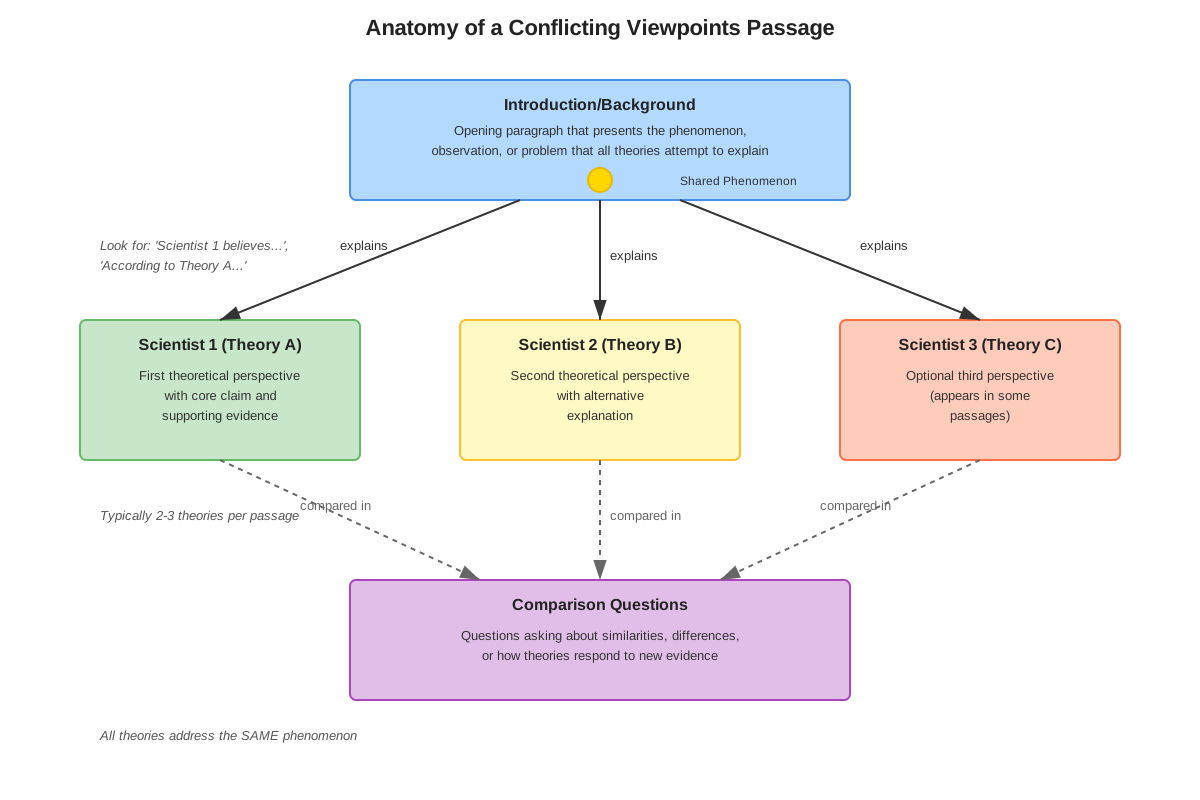
Conflicting Viewpoints passages follow a highly standardized format that students can learn to recognize immediately. The passage begins with an introductory paragraph providing background information about the phenomenon under investigation. This introduction establishes the context and often describes observations that all theories attempt to explain. Following this introduction, the passage presents 2-3 distinct theories, each clearly labeled and separated into its own section. Each theory section typically spans 1-2 paragraphs and presents a coherent explanation for the phenomenon, including the mechanism proposed, supporting reasoning, and sometimes predictions or implications.
The key structural elements include: (1) a shared phenomenon or question that all theories address, (2) distinct explanatory mechanisms that differentiate the theories, (3) supporting evidence or reasoning for each theory, and (4) often implicit or explicit predictions that follow from each theory's assumptions. Unlike Data Representation passages with multiple figures or Research Summaries with experimental procedures, Conflicting Viewpoints passages are text-heavy with minimal or no visual elements. This format requires sustained reading comprehension and the ability to mentally organize competing claims.
Identifying Core Claims vs. Supporting Details
The most critical skill in theory comparison is distinguishing between the fundamental claim of each theory and the supporting details or examples. The core claim represents the essential explanation or mechanism that defines the theory—the "what" and "how" of the theory's explanation. Supporting details include examples, analogies, secondary effects, or elaborations that illustrate or defend the core claim but are not themselves the central thesis.
For example, if Theory 1 claims that "continental drift occurs due to convection currents in the mantle," the core claim is the mechanism (convection currents causing drift). Supporting details might include the temperature of the mantle, the rate of movement, or examples of specific continents that have drifted. Questions asking "According to Theory 1, what causes continental drift?" require the core claim, while questions asking "According to Theory 1, how fast do continents move?" require supporting details.
To identify core claims, students should focus on: (1) the first sentence or two of each theory section, which often states the main thesis, (2) causal language like "because," "due to," "results from," or "is caused by," and (3) the mechanism or process that distinguishes this theory from others. Supporting details typically appear later in each theory section and provide elaboration rather than the fundamental explanation.
Points of Agreement and Disagreement
ACT questions frequently ask students to identify what theories agree or disagree about. Points of agreement represent facts, observations, or claims that all theories accept as true. These often appear in the introductory paragraph before the theories are presented, as they establish the common ground or shared observations that all theories attempt to explain. For example, all theories might agree that "fossils are found in sedimentary rock layers" while disagreeing about how those fossils became fossilized.
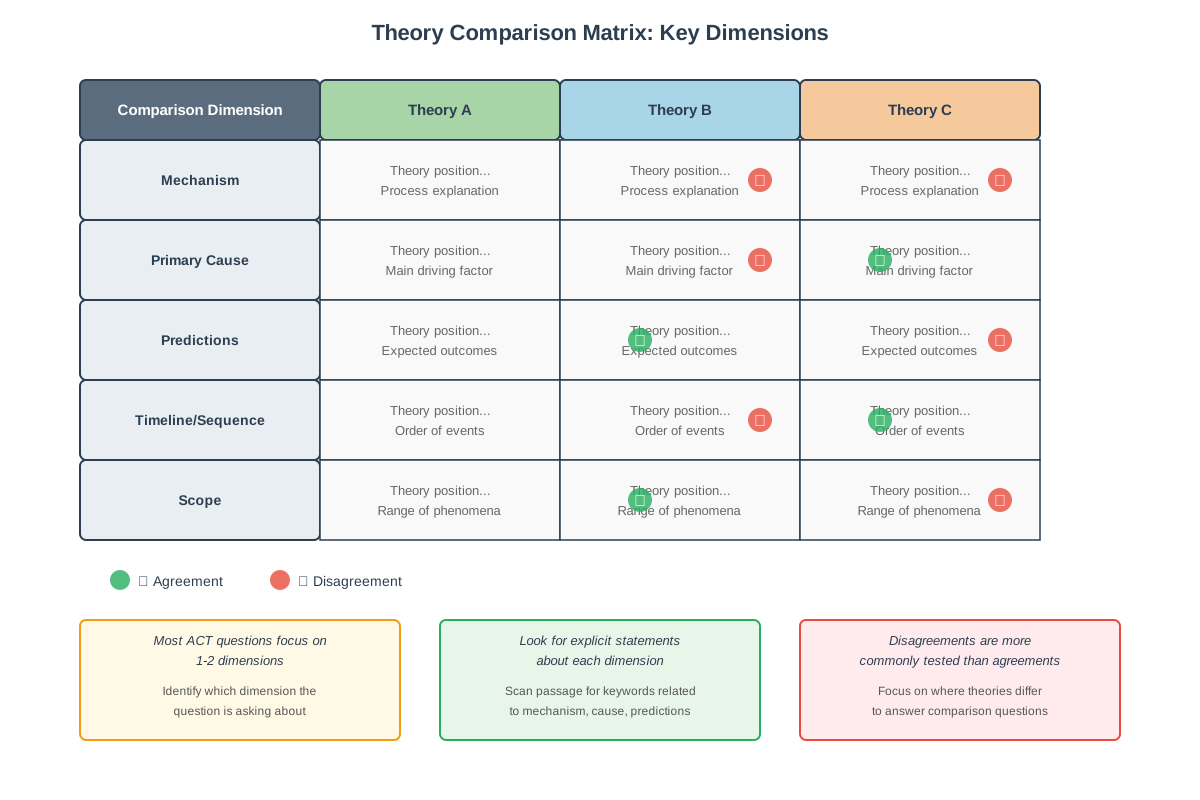
Points of disagreement represent the core differences between theories—the aspects where they offer competing explanations or make contradictory claims. These disagreements typically center on: (1) the mechanism or process causing the phenomenon, (2) the timeline or sequence of events, (3) the primary factors or variables involved, or (4) the predictions about what should be observed under certain conditions.
To systematically identify agreement and disagreement, students should create a mental or written comparison table:
| Aspect | Theory 1 | Theory 2 |
|---|---|---|
| Mechanism | Convection currents | Expanding Earth |
| Timeline | Millions of years | Billions of years |
| Primary cause | Heat from core | Accumulation of cosmic dust |
This organizational strategy makes it immediately clear where theories align and where they diverge, enabling quick and accurate responses to comparison questions.
Evidence Evaluation
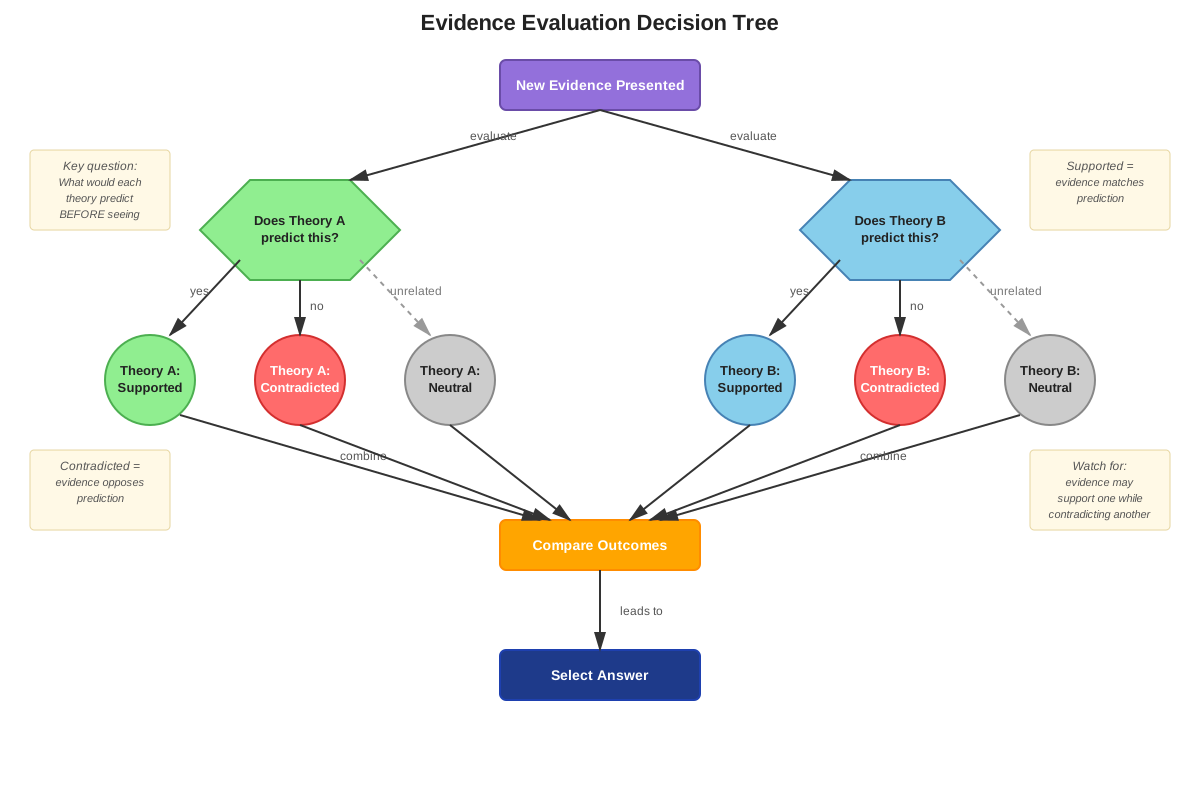
Many ACT theory comparison questions present new evidence or observations and ask which theory is supported or contradicted by this information. These questions test the ability to extend each theory's logic to new scenarios. The key strategy involves asking: "If Theory 1 were true, what would this new evidence mean? Would it fit with or contradict the theory's predictions?"
Evidence evaluation questions require understanding not just what each theory claims, but what each theory implies or predicts. For example, if Theory 1 claims that a process occurs slowly over millions of years, then evidence of rapid change would contradict this theory. If Theory 2 claims that temperature is the primary factor, then evidence showing the process occurs at various temperatures would weaken this theory.
Students should approach these questions by: (1) clearly understanding what the new evidence shows, (2) recalling each theory's core mechanism and predictions, (3) determining whether the evidence aligns with, contradicts, or is neutral to each theory, and (4) eliminating answer choices that misrepresent the relationship between evidence and theory.
Prediction and Application Questions
Advanced theory comparison questions ask students to predict what each theory would say about a hypothetical scenario or how each theory would interpret a new observation. These questions assess deeper understanding of the theories' logical frameworks. Rather than simply recalling stated information, students must apply the theory's reasoning to novel situations.
For example, if Theory 1 claims that "species evolve through gradual accumulation of small changes," a prediction question might ask: "According to Theory 1, what would be observed in the fossil record?" The correct answer would align with gradual change (many intermediate forms), even if this specific prediction wasn't explicitly stated in the passage.
To answer prediction questions effectively: (1) identify the core mechanism or principle of the relevant theory, (2) apply that mechanism logically to the new scenario, (3) eliminate answers that contradict the theory's fundamental claims, and (4) select the answer most consistent with the theory's reasoning, even if not explicitly stated in the passage.
Concept Relationships
The concepts within theory comparison build hierarchically and interconnect systematically. Structure recognition forms the foundation—students must first identify that they're reading a Conflicting Viewpoints passage and recognize its organizational pattern. This recognition enables the next level: core claim identification, where students extract the fundamental thesis of each theory. Core claims then enable comparison analysis, where students can systematically identify points of agreement and disagreement by contrasting the extracted claims.
These comparison skills support higher-order tasks: evidence evaluation requires understanding both the core claims and points of disagreement to determine which theory new evidence supports. Finally, prediction and application represents the highest cognitive level, requiring students to extend the theories' logic beyond what's explicitly stated.
The relationship map flows as follows:
Passage Structure Recognition → Core Claim Identification → Agreement/Disagreement Analysis → Evidence Evaluation → Prediction/Application
This topic connects to prerequisite knowledge of scientific method (theories must be testable and falsifiable) and reading comprehension (extracting main ideas from complex text). It also relates to other ACT Science skills: while Data Representation passages emphasize graph interpretation and Research Summaries focus on experimental design, Conflicting Viewpoints passages emphasize argument analysis. However, all three passage types share the common requirement of careful reading and logical reasoning.
High-Yield Facts
⭐ Conflicting Viewpoints passages always appear exactly once per ACT Science test, typically as the last passage (Passage 7)
⭐ The passage introduction contains information that all theories agree upon—this shared foundation is frequently tested
⭐ Core claims of each theory typically appear in the first 1-2 sentences of each theory section
⭐ Questions asking "According to Theory X" require information stated or directly implied within that theory's section only
⭐ Points of disagreement between theories center on mechanisms, causes, timelines, or primary factors—not minor details
- Conflicting Viewpoints passages contain 6-7 questions, representing approximately 15-18% of the Science section score
- Most passages present exactly 2 theories, though occasionally 3 theories appear
- Evidence evaluation questions require determining whether new information supports, contradicts, or is neutral to each theory
⭐ When theories make different predictions, questions often present hypothetical scenarios to test understanding of these predictions
- The theories presented are always clearly labeled (Theory 1/2, Scientist 1/2, Student 1/2, Hypothesis 1/2)
- Supporting details within each theory elaborate on the core claim but are not themselves the main thesis
- Agreement questions are typically easier than disagreement questions because agreements often appear in the introduction
- Prediction questions require applying the theory's logic to new situations not explicitly discussed in the passage
- Time pressure makes Conflicting Viewpoints passages challenging despite their predictable structure—efficient reading is essential
Quick check — test yourself on Theory comparison so far.
Try Flashcards →Common Misconceptions
Misconception: All information in the introduction paragraph represents what the theories disagree about → Correction: The introduction typically presents background information and observations that all theories accept as true. The disagreements emerge in the individual theory sections where different explanations are proposed for the shared observations.
Misconception: Supporting details and examples within a theory section are as important as the core claim → Correction: The core claim or mechanism is the essential element that defines each theory. Supporting details provide elaboration but are secondary. Questions asking what a theory "claims" or "proposes" require the core mechanism, not the examples used to illustrate it.
Misconception: If new evidence contradicts one theory, it automatically supports the other theory → Correction: Evidence can contradict one theory while being neutral to another, or it can contradict both theories. Each theory must be evaluated independently against the evidence. Only select "supports Theory X" if the evidence actively aligns with that theory's predictions or claims.
Misconception: Theories that share some similarities must agree on most points → Correction: Theories can agree on observations and basic facts while fundamentally disagreeing on mechanisms and causes. The key disagreements often involve the "how" and "why" rather than the "what." Two theories might agree that a phenomenon occurs but completely disagree about what causes it.
Misconception: The longer or more detailed theory is more likely to be correct or supported by evidence → Correction: The ACT does not favor one theory over another in terms of correctness. Both theories are presented as viable scientific perspectives. Length and detail do not indicate which theory is "right"—questions are answered based on logical consistency with stated claims, not on which theory seems more convincing or thorough.
Misconception: You must read and understand every detail of both theories before attempting questions → Correction: While understanding core claims is essential, attempting to memorize every detail before looking at questions wastes time. A more efficient approach involves reading for main ideas first, then referring back to specific theory sections as needed when answering questions.
Worked Examples
Example 1: Identifying Core Claims and Points of Disagreement
Passage Summary: Two scientists debate the formation of the Moon.
Introduction: The Moon is Earth's only natural satellite. Evidence shows the Moon has a similar composition to Earth's mantle but a much smaller iron core.
Scientist 1: The Moon formed when a Mars-sized object collided with early Earth approximately 4.5 billion years ago. The impact ejected material from Earth's mantle into orbit, which eventually coalesced to form the Moon. This explains why the Moon's composition resembles Earth's mantle but lacks a large iron core—the impactor's core and Earth's core remained in Earth while mantle material was ejected.
Scientist 2: The Moon formed alongside Earth from the same cloud of dust and gas in the early solar system approximately 4.6 billion years ago. As materials in this region condensed, they formed both Earth and the Moon as separate but related bodies. The similar composition results from both bodies forming from the same source material in the same region of space.
Question 1: According to Scientist 1, what caused the Moon to form?
Solution Process:
- Identify that this is an "According to [Theory]" question requiring information from Scientist 1 only
- Locate the core claim in Scientist 1's section—typically in the first sentence
- Scientist 1's first sentence states: "The Moon formed when a Mars-sized object collided with early Earth"
- This collision and subsequent ejection of material is the core mechanism
Answer: A collision between early Earth and a Mars-sized object
Question 2: On which point do the two scientists disagree?
Solution Process:
- Create a mental comparison of core claims:
- Scientist 1: Moon formed from impact/collision
- Scientist 2: Moon formed from same dust cloud as Earth
- Identify the fundamental difference: the mechanism of formation (impact vs. co-formation)
- Check other aspects:
- Timeline: Both say approximately 4.5-4.6 billion years ago (agreement)
- Composition: Both acknowledge similar composition (agreement)
- Mechanism: Different (disagreement)
Answer: The mechanism by which the Moon formed
Connection to Learning Objectives: This example demonstrates identifying core claims (Objective 2) and distinguishing between theories (Objective 4). The systematic comparison approach enables accurate identification of disagreement points.
Example 2: Evidence Evaluation
Continuing the Moon Formation Passage:
Question 3: Scientists discover that Moon rocks contain isotopes of oxygen that are nearly identical to those found in Earth's mantle but different from oxygen isotopes found in meteorites from other parts of the solar system. This finding would most strongly support the hypothesis of:
Solution Process:
- Understand the new evidence: Moon and Earth have identical oxygen isotopes, but these differ from other solar system objects
- Evaluate against Scientist 1 (impact hypothesis):
- If Moon formed from Earth's ejected mantle material, Moon and Earth should have identical isotopes ✓
- This matches the evidence
- Evaluate against Scientist 2 (co-formation hypothesis):
- If Moon and Earth formed from the same dust cloud, they should have similar composition
- However, if they formed from the same regional cloud, they might also have similar composition to other objects from that region
- The evidence that Moon/Earth isotopes differ from other solar system objects is less consistent with forming from a general solar system dust cloud
- Determine which theory is more strongly supported:
- Scientist 1's impact theory better explains why Moon and Earth are identical to each other but different from other solar system objects
- The impact specifically transferred Earth material to the Moon, creating the identical match
Answer: Scientist 1, because the identical isotopes indicate the Moon formed from Earth's material rather than from a separate dust cloud
Connection to Learning Objectives: This example demonstrates applying theory comparison to evaluate evidence (Objective 3) and recognizing supporting evidence (Objective 5). The systematic evaluation of how evidence aligns with each theory's predictions is the key strategy.
Exam Strategy
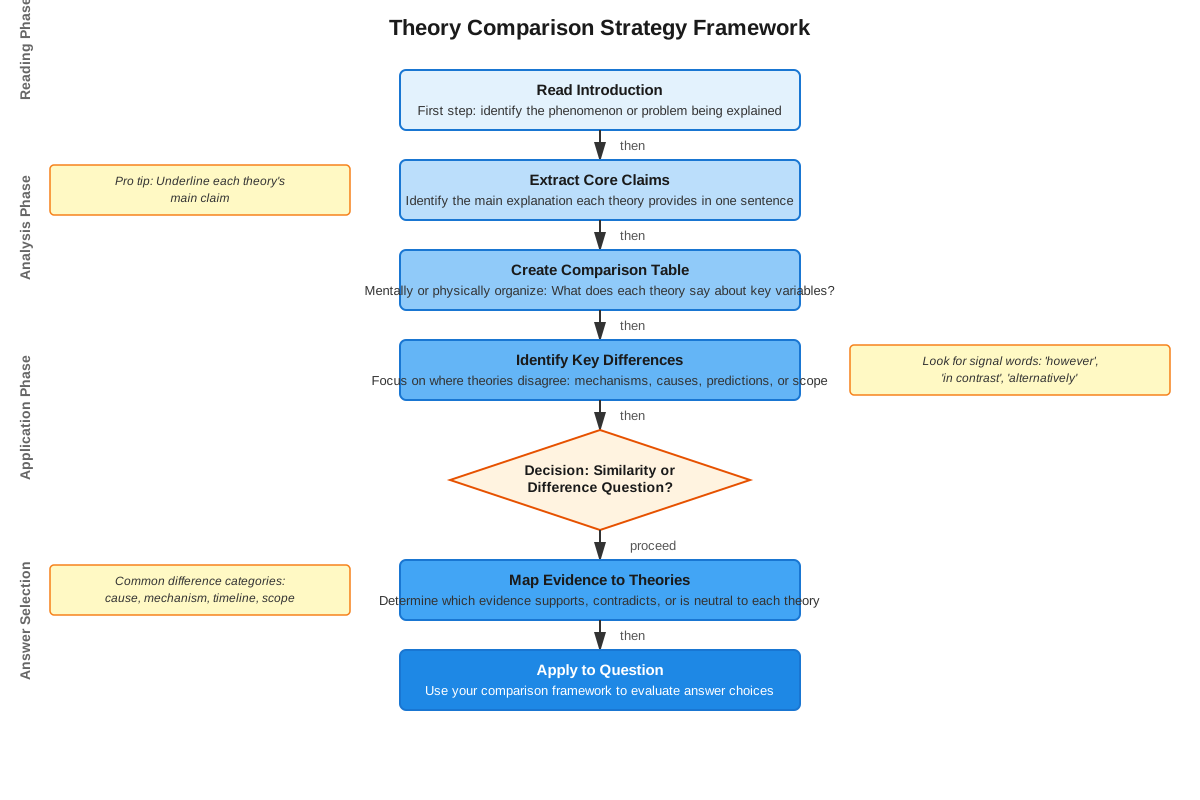
When approaching Conflicting Viewpoints passages on the ACT, implement this systematic strategy:
Step 1: Identify the passage type immediately by scanning for labeled theories (Theory 1/2, Scientist 1/2). This recognition triggers the appropriate reading strategy—focus on arguments rather than data interpretation.
Step 2: Read the introduction carefully to understand the shared phenomenon and identify what all theories agree upon. This information frequently appears in questions asking about points of agreement. Spend 30-45 seconds on this section.
Step 3: Read each theory section for main ideas only, focusing on the first 1-2 sentences where core claims typically appear. Don't attempt to memorize details—you'll return to the passage for specific information. Spend approximately 45-60 seconds per theory section. As you read, mentally note: "What is this theory's main explanation or mechanism?"
Step 4: Approach questions strategically based on type:
- "According to Theory X" questions: Return to that theory's section only; ignore other theories
- Agreement/disagreement questions: Compare core claims across theories
- Evidence evaluation questions: Test the new evidence against each theory's predictions
- Prediction questions: Apply the theory's core mechanism to the new scenario
Trigger words and phrases to watch for:
- "Both scientists would agree/disagree" → Compare theories for common ground or differences
- "According to Scientist X" → Focus only on that scientist's section
- "Which hypothesis is supported by" → Evaluate evidence against each theory
- "Scientist X would most likely predict" → Apply theory's logic to new scenario
- "Unlike Scientist X, Scientist Y claims" → Direct comparison of specific aspects
Process-of-elimination tips:
- Eliminate answers that confuse which scientist said what (common trap)
- Eliminate answers that cite supporting details when the question asks for core claims
- For evidence questions, eliminate answers that claim support when evidence is actually neutral
- For disagreement questions, eliminate points that appear in the introduction (these are agreements)
Time allocation: Allocate 5-6 minutes total for the Conflicting Viewpoints passage (including reading and answering 6-7 questions). This is slightly less time per question than other passage types because the questions are often more straightforward once you understand the theories. If you're spending more than 45 seconds on a single question, mark it and move on—return if time permits.
Exam Tip: The most common error is confusing which theory makes which claim. As you read, consider making brief marginal notes (if allowed) or mental labels like "Scientist 1 = impact" and "Scientist 2 = dust cloud" to maintain clarity.
Memory Techniques
COMPARE mnemonic for approaching Conflicting Viewpoints passages:
- Core claims first—identify the main thesis of each theory
- Observations shared—note what all theories agree upon (usually in introduction)
- Mechanism differences—focus on how theories differ in their explanations
- Predictions—consider what each theory would predict or expect
- Apply to questions—use your understanding to answer systematically
- Refer back—return to passage for specific details as needed
- Eliminate—use process of elimination for uncertain answers
Visualization strategy: Picture each theory as a separate "story" or explanation. As you read, create a mental movie of what each theory describes. For example, if Theory 1 describes a collision forming the Moon, visualize that impact. If Theory 2 describes gradual formation from a dust cloud, visualize that process. These distinct mental images help prevent confusion between theories.
The "Two Columns" technique: Mentally organize information into two columns (or three if there are three theories). As you read:
Theory 1          |  Theory 2
------------------|------------------
Main claim:       |  Main claim:
Impact            |  Dust cloud
------------------|------------------
Timeline:         |  Timeline:
4.5 billion yrs   |  4.6 billion yrs
------------------|------------------
Key detail:       |  Key detail:
Ejected mantle    |  Same source
This mental organization makes comparison questions significantly easier.
Acronym for question types: ACED
- Agreement/disagreement questions
- Core claim identification questions
- Evidence evaluation questions
- Deduction/prediction questions
Recognizing which type you're answering helps trigger the appropriate strategy.
Summary
Theory comparison is a high-yield ACT Science skill that appears in exactly one Conflicting Viewpoints passage per test, representing approximately 15-18% of the Science section score. Success requires recognizing the passage structure (introduction with shared observations, followed by 2-3 clearly labeled theories), identifying core claims versus supporting details, and systematically comparing theories to determine points of agreement and disagreement. The most effective approach involves reading for main ideas rather than memorizing details, then referring back to specific theory sections as questions require. Questions fall into predictable categories: identifying what each theory claims, finding agreements or disagreements, evaluating which theory new evidence supports, and predicting how theories would interpret hypothetical scenarios. The key strategy involves treating each theory as a distinct logical framework and evaluating information against each framework independently. Students who master the systematic comparison approach and avoid common pitfalls—such as confusing which theory makes which claim or treating supporting details as core claims—can answer these questions quickly and accurately, making theory comparison a reliable source of points on the ACT Science section.
Key Takeaways
- Conflicting Viewpoints passages appear exactly once per ACT (typically as Passage 7) and contain 6-7 questions worth approximately 15-18% of the Science score
- The passage introduction contains shared observations and agreements; individual theory sections contain the core claims and points of disagreement
- Core claims (the fundamental mechanism or explanation) appear in the first 1-2 sentences of each theory section and are more important than supporting details
- "According to Theory X" questions require information from that theory only; comparison questions require evaluating both theories systematically
- Evidence evaluation questions demand determining whether new information supports, contradicts, or is neutral to each theory independently
- The most common error is confusing which theory makes which claim—maintain clear mental separation between theories throughout the passage
- Efficient strategy involves reading for main ideas first (2-3 minutes), then referring back to specific sections as questions require, rather than attempting to memorize all details upfront
Related Topics
Data Representation passages: While Conflicting Viewpoints emphasizes argument analysis, Data Representation focuses on interpreting graphs, tables, and figures. Mastering theory comparison provides the reading comprehension foundation needed for understanding the context of data presentations.
Research Summaries passages: These passages present experimental designs and results. Understanding theory comparison helps students evaluate how experimental evidence supports or contradicts hypotheses, a common question type in Research Summaries.
Scientific method and hypothesis testing: Theory comparison directly applies principles of the scientific method, particularly how theories are evaluated against evidence and how competing explanations are compared. Deeper understanding of scientific reasoning enhances theory comparison skills.
Critical reading and argument analysis: The skills developed in theory comparison—identifying main claims, distinguishing evidence from conclusions, and evaluating logical consistency—transfer directly to ACT Reading passages, particularly those presenting opposing viewpoints.
Logical reasoning: Advanced theory comparison requires applying deductive and inductive reasoning to extend theories to new scenarios. Strengthening general logical reasoning skills enhances performance on prediction and application questions.
Practice CTA
Now that you've mastered the core concepts and strategies for theory comparison, it's time to put your knowledge into action! Attempt the practice questions and flashcards designed specifically for this topic. These resources will reinforce your understanding, help you identify any remaining weak areas, and build the speed and confidence you need for test day. Remember: theory comparison is one of the most predictable and high-yield topics on the ACT Science section—consistent practice with these systematic strategies will translate directly into points on your exam. You've got this!
Sign up free to keep reading
Create a free AnvayaPrep account to finish this ACT guide on Theory comparison — plus flashcards and practice questions.