Overview
Comparing data sets is a fundamental skill tested extensively on the ACT Science section, appearing in approximately 30-40% of all Data Representation passages. This skill requires students to analyze multiple graphs, tables, or figures simultaneously, identify patterns and trends across different experimental conditions, and draw meaningful conclusions about relationships between variables. Unlike simple data interpretation that focuses on a single graph or table, comparing data sets demands higher-order thinking as students must synthesize information from multiple sources, recognize similarities and differences, and understand how changes in one variable affect outcomes across different scenarios.
The ACT Science test frequently presents passages containing 2-4 related figures showing experimental results under varying conditions, different time periods, or alternative methodologies. Success on these questions requires systematic comparison strategies rather than random observation. Students must quickly identify which variables remain constant, which change between data sets, and how these changes influence the measured outcomes. This skill bridges pure data interpretation with scientific reasoning, as it mirrors how actual scientists compare control groups to experimental groups, evaluate reproducibility across trials, or assess the impact of different environmental conditions on experimental results.
Mastering ACT comparing data sets questions provides the foundation for more complex scientific reasoning tasks, including evaluating hypotheses, predicting outcomes under new conditions, and understanding experimental design. This topic connects directly to graph interpretation, trend analysis, and quantitative reasoning—all essential components of the ACT Science section. Students who develop strong comparison skills can typically answer these questions in 30-45 seconds each, significantly improving their overall pacing and score potential.
Learning Objectives
- [ ] Identify when Comparing data sets is being tested in ACT Science passages
- [ ] Explain the core rule or strategy behind Comparing data sets
- [ ] Apply Comparing data sets to ACT-style questions accurately
- [ ] Distinguish between independent and dependent variables across multiple data representations
- [ ] Quantify differences between data sets using percentage change, ratios, and relative magnitude
- [ ] Recognize when data sets support or contradict each other
- [ ] Predict trends in unmeasured conditions based on patterns observed across existing data sets
Prerequisites
- Basic graph reading skills: Understanding axes, scales, units, and how to extract specific values from line graphs, bar charts, and scatter plots is essential because comparing data sets requires first interpreting individual representations accurately
- Table interpretation: Ability to read rows, columns, and identify relationships between variables in tabular format, as many comparison questions involve cross-referencing multiple tables
- Understanding of variables: Recognition of independent variables (manipulated by researchers) versus dependent variables (measured outcomes) enables identification of what changes between data sets and what those changes reveal
- Basic mathematical operations: Facility with percentages, ratios, and relative comparisons allows quantitative assessment of differences between data sets
- Scientific notation: Comfort with exponential notation (e.g., 1.5 × 10³) is necessary as ACT Science frequently presents data in this format
Why This Topic Matters
In real-world scientific research, comparing data sets represents the core of experimental methodology. Scientists routinely compare control groups to treatment groups, replicate experiments under different conditions, and analyze how variables interact across multiple trials. Medical researchers compare patient outcomes across different treatment protocols, environmental scientists track pollution levels across geographic regions, and physicists compare particle behavior under varying energy conditions. The ability to systematically compare data sets and draw valid conclusions separates meaningful scientific insight from mere data collection.
On the ACT Science test, comparing data sets appears in approximately 8-12 questions per exam, making it one of the highest-yield topics for score improvement. These questions typically appear in Data Representation passages (which comprise 30-40% of the Science section) but also feature prominently in Research Summaries passages. The ACT specifically tests this skill because it assesses scientific literacy—the ability to evaluate evidence, recognize patterns, and make data-driven decisions. Questions range from straightforward comparisons ("In which trial was temperature highest?") to complex synthesis ("Based on Figures 1 and 2, how does pH affect the relationship between concentration and reaction rate?").
Common question formats include: identifying which data set shows the greatest/least value for a specific variable; determining how a change in one variable affects trends across multiple experiments; recognizing which conditions produce similar or different outcomes; and predicting results under untested conditions by extrapolating from existing patterns. The ACT frequently presents data sets that differ by only one variable, requiring students to isolate that variable's effect—a direct parallel to the scientific method's emphasis on controlling variables.
Core Concepts
Types of Data Set Comparisons
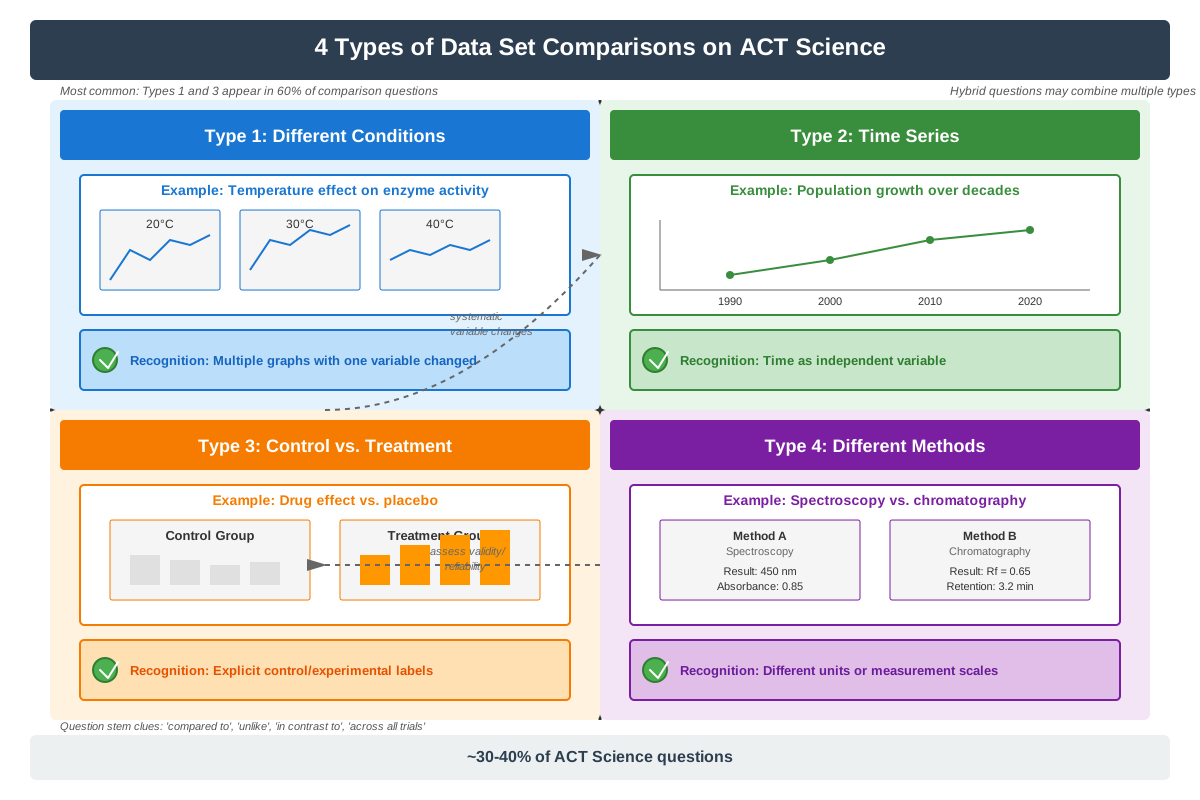
The ACT Science section tests three primary types of comparing data sets: within-figure comparisons, between-figure comparisons, and cross-passage comparisons. Within-figure comparisons involve analyzing multiple data series on a single graph or multiple rows/columns within one table. For example, a graph might display temperature changes over time for three different materials, requiring students to compare which material heated fastest. Between-figure comparisons require synthesizing information from separate graphs or tables, such as comparing enzyme activity from Figure 1 with substrate concentration from Figure 2. Cross-passage comparisons, though less common, ask students to reconcile data from different experiments or studies within the same passage.
Systematic Comparison Strategy
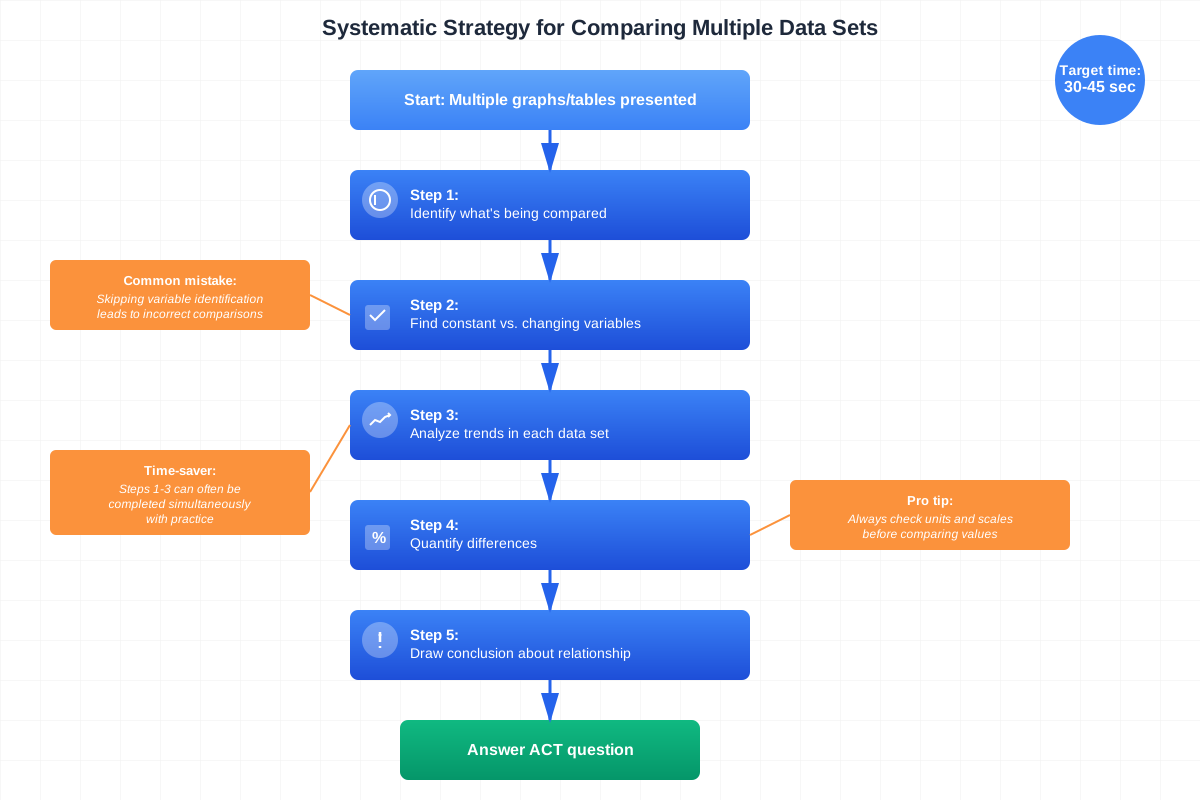
Effective data set comparison follows a structured four-step process. Step 1: Identify the variables by determining what is being measured (dependent variable) and what is being changed (independent variable) in each data set. Step 2: Establish the basis of comparison by identifying which variable differs between the data sets—this is the key to understanding what the comparison reveals. Step 3: Quantify the differences by noting whether changes are increases, decreases, or non-linear relationships, and estimating magnitude when possible. Step 4: Draw conclusions about what the comparison reveals regarding cause-effect relationships, trends, or patterns.
Recognizing Comparison Question Stems
ACT comparison questions use specific trigger language that signals the need to compare data sets. Questions containing phrases like "compared to," "in contrast to," "which trial showed the greatest," "how did X differ between," or "in which experiment was Y highest" explicitly require comparison. More subtle comparison questions use phrases like "based on Figures 1 and 2," "according to both Table 1 and Table 3," or "considering all trials." Questions asking about relationships between variables across conditions ("How does temperature affect the relationship between pressure and volume?") require comparing how one relationship changes under different circumstances.
Quantitative Versus Qualitative Comparisons
The ACT tests both quantitative comparisons (involving specific numerical differences) and qualitative comparisons (involving directional trends or patterns). Quantitative comparisons might ask "How much greater was the pH in Trial 2 than Trial 1?" requiring calculation of the specific difference (e.g., 7.5 - 6.2 = 1.3). Qualitative comparisons ask about general patterns: "As temperature increased, how did solubility change in both solutions?" requiring recognition that both increased, both decreased, or they changed in opposite directions. The ACT more frequently tests qualitative comparisons because they assess pattern recognition and scientific reasoning rather than arithmetic.
Identifying Controlled Variables
A critical aspect of comparing data sets involves recognizing controlled variables—factors held constant across all data sets—versus manipulated variables that differ between sets. When comparing experimental trials, the manipulated variable explains differences in outcomes. For example, if three trials measure plant growth with different fertilizer amounts but identical light, water, and temperature conditions, fertilizer amount is the manipulated variable explaining growth differences. The ACT frequently includes questions asking "Which variable was held constant across all trials?" or "What was the only difference between Experiment 1 and Experiment 2?"
Trend Analysis Across Data Sets
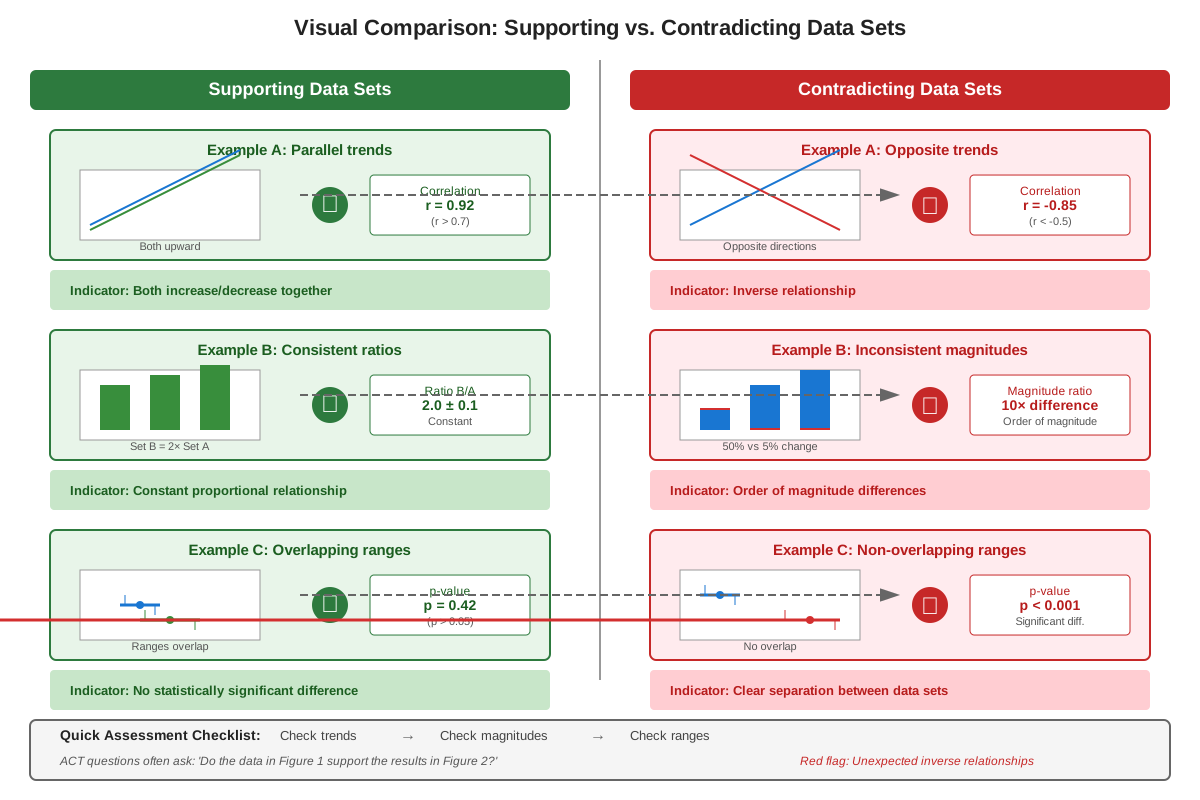
Comparing trends requires identifying whether variables show parallel trends (changing in the same direction across all data sets), divergent trends (changing in opposite directions), or convergent trends (starting different but becoming similar). For instance, if temperature increases cause both reaction rates to increase but one increases faster, the trends are parallel but differ in magnitude. If increasing pH causes one enzyme's activity to increase while another's decreases, the trends are divergent. Recognizing these patterns allows prediction of behavior under untested conditions.
Scale and Unit Considerations
When comparing data sets, careful attention to scales and units prevents errors. The ACT sometimes presents graphs with different y-axis scales, making visual comparison misleading. A line that appears steeper may actually represent a smaller change if its scale is compressed. Similarly, comparing values requires ensuring units match—comparing 2.5 kg to 3000 g requires conversion. Tables may present some values in scientific notation and others in standard form, requiring normalization before comparison.
Concept Relationships
The skill of comparing data sets builds directly upon foundational graph and table interpretation abilities. Students must first accurately read individual data representations before attempting to compare them. This relationship flows as: Basic data reading → Single data set interpretation → Comparing multiple data sets → Synthesizing comparisons to evaluate hypotheses.
Within the topic itself, concepts connect hierarchically. Identifying variables serves as the foundation for all other comparison skills—without knowing what is being measured and what is being changed, meaningful comparison is impossible. This leads to recognizing the basis of comparison (what differs between data sets), which enables quantifying differences and ultimately drawing scientific conclusions. The relationship can be mapped as:
Variable identification → Basis of comparison → Quantitative/qualitative analysis → Pattern recognition → Conclusion formation
Comparing data sets also connects forward to more advanced ACT Science skills. The ability to compare experimental results under different conditions directly supports hypothesis evaluation (determining which hypothesis is supported by comparing predicted versus actual outcomes across conditions) and experimental design analysis (understanding why scientists include multiple trials or vary specific conditions). Additionally, comparison skills enable extrapolation and prediction—using patterns observed across existing data sets to predict outcomes under untested conditions.
The relationship between controlled and manipulated variables in data set comparison mirrors the scientific method's emphasis on isolating variables. This connection reinforces understanding of experimental design: Scientific method → Variable control → Data collection → Data set comparison → Conclusion validity.
High-Yield Facts
⭐ The ACT most frequently tests comparison of trends (increasing/decreasing) rather than specific numerical values—focus on directional relationships first, then quantify if needed.
⭐ When comparing data sets, the variable that differs between them is almost always the key to answering the question—identify what changed, and you've found what the question is testing.
⭐ Questions using "compared to," "in contrast to," or "which trial/experiment" explicitly signal comparison questions—these trigger phrases appear in 90%+ of comparison questions.
⭐ Data sets with identical trends but different magnitudes indicate the same relationship exists under different conditions—the underlying principle remains constant even when absolute values change.
⭐ If two data sets show opposite trends for the same independent variable, they represent fundamentally different systems or mechanisms—divergent trends reveal important differences in how systems respond.
- When the ACT presents multiple graphs with different y-axis scales, visual comparison is unreliable—always check numerical values and scale ranges.
- Comparison questions asking "which was greatest/least" can often be answered by examining only the endpoints or extreme values rather than analyzing entire data sets.
- If a question asks about "all trials" or "both experiments," the answer must be true for every data set mentioned—eliminate options that fail for even one data set.
- Data sets collected at different times, locations, or using different methods may not be directly comparable—the ACT sometimes includes questions testing recognition of when comparison is invalid.
- When comparing tables, the ACT frequently places the key comparison values in non-adjacent rows or columns, requiring careful cross-referencing rather than simple side-by-side reading.
⭐ Percentage change and relative differences are more scientifically meaningful than absolute differences—a change from 2 to 4 (100% increase) is more significant than a change from 100 to 102 (2% increase) despite the same absolute difference.
- Parallel trends across multiple data sets indicate a robust, reproducible relationship—this suggests the relationship is fundamental rather than coincidental.
- When data sets intersect (cross over), the relationship between variables changes at that point—the intersection represents a threshold or transition condition.
- If the ACT provides more data sets than needed to answer a question, identifying which sets are relevant is part of the test—don't waste time analyzing irrelevant data.
- Comparison questions with answer choices like "Trial 1 > Trial 2 > Trial 3" test ordinality (ranking) rather than specific values—focus on relative order.
Quick check — test yourself on Comparing data sets so far.
Try Flashcards →Common Misconceptions
Misconception: Steeper lines on graphs always indicate greater change in the measured variable. → Correction: Steepness depends on both the actual rate of change AND the scale of the axes. A line may appear steeper simply because the y-axis scale is compressed. Always check axis scales and calculate actual rates of change (Δy/Δx) when comparing slopes across different graphs.
Misconception: If two data sets show the same general trend (both increasing or both decreasing), they are essentially identical. → Correction: Data sets can share directional trends while differing significantly in magnitude, rate of change, or starting values. These differences are scientifically meaningful and often represent the focus of ACT questions. For example, two substances might both increase in solubility with temperature, but one might increase 10 times faster—a critical distinction.
Misconception: When comparing data sets, all variables except one must be identical for valid comparison. → Correction: While controlled experiments ideally change only one variable, the ACT frequently presents data sets where multiple variables differ. The key is identifying which variable difference is relevant to the question being asked. Scientists often compare data sets with multiple differences to understand complex interactions.
Misconception: Numerical values that are close together indicate similar relationships or trends. → Correction: Similarity in absolute values does not necessarily indicate similar trends or relationships. Two data sets might have similar starting values but diverge dramatically over time, or they might maintain similar values while responding oppositely to changes in an independent variable. Focus on how values change, not just their magnitude.
Misconception: If data sets come from different figures or tables, they cannot be directly compared. → Correction: The ACT specifically designs passages where information must be synthesized across multiple figures. Different representations often show complementary aspects of the same phenomenon. Questions explicitly asking students to use "Figures 1 and 2" or "Tables 1 and 3" require cross-figure comparison, and this is a high-yield question type.
Misconception: The data set with the highest or lowest values is always the "best" or most important. → Correction: Extreme values are not inherently superior or more significant. The scientific importance depends on the research question. Sometimes intermediate values represent optimal conditions, or the pattern of change across all data sets matters more than any single extreme value.
Misconception: When comparing experiments, the one with more data points or trials is more reliable. → Correction: While replication improves reliability in actual research, on the ACT, the number of data points in a figure does not indicate greater validity. All presented data should be treated as equally reliable unless the passage explicitly states otherwise. Questions test data interpretation, not experimental design critique.
Worked Examples
Example 1: Comparing Trends Across Multiple Trials
Passage Context: A study examined how temperature affects the solubility of three different salts (Salt A, Salt B, and Salt C) in water. Figure 1 shows solubility (g/100 mL water) on the y-axis and temperature (°C) on the x-axis, with three lines representing the three salts. Salt A's line increases from 20 g at 0°C to 80 g at 100°C. Salt B's line increases from 30 g at 0°C to 50 g at 100°C. Salt C's line decreases from 60 g at 0°C to 40 g at 100°C.
Question: Based on Figure 1, as temperature increased from 0°C to 100°C, the solubility of which salt(s) increased?
Step 1 - Identify the variables: The independent variable is temperature (x-axis), and the dependent variable is solubility (y-axis). We're comparing three data sets (three salts).
Step 2 - Establish the basis of comparison: The question asks about the direction of change (increase vs. decrease) as temperature increases. We need to compare the trend for each salt.
Step 3 - Analyze each data set:
- Salt A: Starts at 20 g, ends at 80 g → increased (20 to 80 is an increase of 60 g)
- Salt B: Starts at 30 g, ends at 50 g → increased (30 to 50 is an increase of 20 g)
- Salt C: Starts at 60 g, ends at 40 g → decreased (60 to 40 is a decrease of 20 g)
Step 4 - Draw conclusion: Both Salt A and Salt B showed increased solubility with increasing temperature, though Salt A increased more dramatically. Salt C showed the opposite trend.
Answer: Salts A and B
Key Learning Point: This question tests qualitative comparison of trends. The magnitude of increase (60 g vs. 20 g) is not relevant to answering which salts increased—only the direction matters. This demonstrates why identifying what the question actually asks is crucial before analyzing data.
Example 2: Cross-Figure Quantitative Comparison
Passage Context: An experiment measured plant growth under different conditions. Table 1 shows the initial height (cm) of plants in four trials: Trial 1 = 5 cm, Trial 2 = 5 cm, Trial 3 = 5 cm, Trial 4 = 5 cm. Figure 1 shows final height (cm) after 30 days: Trial 1 = 15 cm, Trial 2 = 25 cm, Trial 3 = 20 cm, Trial 4 = 10 cm. Table 2 shows the amount of fertilizer used (g): Trial 1 = 0 g, Trial 2 = 10 g, Trial 3 = 5 g, Trial 4 = 0 g. All other conditions (light, water, temperature) were identical across trials.
Question: Based on Table 1, Figure 1, and Table 2, which trial showed the greatest growth, and did it receive fertilizer?
Step 1 - Identify what needs to be compared: We need to compare growth (change in height) across trials and then cross-reference with fertilizer data. This requires synthesizing information from three different data representations.
Step 2 - Calculate growth for each trial: Growth = Final height - Initial height
- Trial 1: 15 - 5 = 10 cm growth
- Trial 2: 25 - 5 = 20 cm growth
- Trial 3: 20 - 5 = 15 cm growth
- Trial 4: 10 - 5 = 5 cm growth
Step 3 - Identify the trial with greatest growth: Trial 2 showed 20 cm of growth, which is greater than all other trials.
Step 4 - Cross-reference with Table 2: Trial 2 received 10 g of fertilizer (the highest amount).
Step 5 - Formulate complete answer: Trial 2 showed the greatest growth (20 cm) and yes, it received fertilizer (10 g).
Answer: Trial 2; yes, it received fertilizer
Key Learning Point: This question demonstrates the importance of calculating derived values (growth = final - initial) rather than just comparing raw data. It also shows how ACT questions require synthesizing information across multiple representations. The question tests both quantitative comparison (which trial had greatest growth) and cross-referencing ability (did that trial receive fertilizer). Notice that the passage provides initial heights in a table but final heights in a figure—this deliberate separation tests whether students can integrate information from different formats.
Exam Strategy
When approaching ACT Science questions involving comparing data sets, implement a systematic strategy to maximize accuracy and efficiency. First, read the question stem carefully to identify exactly what is being compared—specific values, trends, rates of change, or relationships between variables. Questions asking "which trial showed the greatest X" require different analysis than questions asking "how did X change compared to Y." Identifying the question type before examining data prevents wasted time analyzing irrelevant information.
Trigger words and phrases that signal comparison questions include: "compared to," "in contrast to," "relative to," "which trial/experiment/study," "greatest/least/highest/lowest," "both," "all," "difference between," "similar to," and "how did X differ." When you encounter these phrases, immediately activate comparison mode—you'll need to examine multiple data sets rather than focusing on a single graph or table.
Use the "identify-locate-compare-conclude" process: (1) Identify which data sets are relevant to the question, (2) Locate the specific values or trends needed from each data set, (3) Compare these values or trends systematically, and (4) Conclude which answer choice matches your comparison. This structured approach prevents the common error of comparing the wrong variables or data sets.
For process-of-elimination, start by eliminating answer choices that are factually incorrect for even one of the data sets being compared. If a question asks about "all trials" and an answer choice is false for Trial 2, eliminate it immediately regardless of whether it's true for other trials. When comparing trends, eliminate choices that describe the opposite direction (increasing vs. decreasing) before worrying about magnitude. When comparing magnitudes, eliminate choices that get the ranking wrong (e.g., claiming Trial 1 > Trial 2 when actually Trial 2 > Trial 1) before considering whether the specific values are precisely correct.
Time allocation for comparison questions should be 30-45 seconds for straightforward comparisons (identifying which of three trials had the highest value) and 45-75 seconds for complex comparisons requiring synthesis across multiple figures or calculation of derived values. If a comparison question requires more than 90 seconds, mark it and return later—you may be overcomplicating the analysis or missing a simpler approach.
Exam Tip: When graphs have different scales, don't trust visual comparison. A line that looks steeper may represent a smaller actual change. Always check axis values and calculate rates when comparing slopes across different graphs.
Exam Tip: If the ACT provides four data sets but the question only mentions two, ignore the irrelevant data sets completely. Part of the test is identifying what information is necessary—don't waste time analyzing everything.
Memory Techniques
VBQC Mnemonic for systematic comparison: Variables (identify what's being measured and changed), Basis (determine what differs between data sets), Quantify (measure the differences), Conclude (determine what the comparison reveals). This four-step process ensures comprehensive analysis without missing critical elements.
"Same Direction, Different Speed" visualization: When comparing trends, picture two cars traveling the same direction (both increasing or both decreasing) but at different speeds. This mental image helps distinguish between parallel trends of different magnitudes—a common ACT question type. If the cars travel opposite directions, the trends are divergent.
The "Controlled vs. Changed" finger technique: When identifying what differs between data sets, hold up your left hand for "controlled" (stays the same) and right hand for "changed" (differs between sets). Physically categorizing variables helps prevent confusion about what the comparison reveals.
SCALE acronym for avoiding graph comparison errors: Scales differ?, Check axis ranges, Actual values matter, Look at numbers not just lines, Examine units. This reminds students to verify that visual comparison matches numerical reality.
"Cross-reference = Cross your fingers": When a question mentions multiple figures or tables (e.g., "Based on Figure 1 and Table 2"), physically cross your fingers as a reminder that you need to look at both representations and synthesize information. This kinesthetic cue prevents the common error of answering based on only one data source.
Summary
Comparing data sets represents a high-yield ACT Science skill that appears in approximately 30-40% of questions, requiring students to systematically analyze multiple graphs, tables, or figures to identify patterns, trends, and relationships. Success depends on implementing a structured approach: identifying relevant variables, establishing the basis of comparison (what differs between data sets), quantifying differences through both qualitative (directional) and quantitative (numerical) analysis, and drawing valid conclusions about what the comparison reveals. The ACT tests this skill through various question formats including within-figure comparisons (multiple data series on one graph), between-figure comparisons (synthesizing information across separate representations), and cross-passage comparisons (reconciling data from different experiments). Critical competencies include recognizing comparison trigger words, distinguishing controlled from manipulated variables, analyzing trends (parallel, divergent, or convergent), and avoiding common pitfalls such as misinterpreting different axis scales or confusing similar absolute values with similar trends. Students who master systematic comparison strategies can typically answer these questions in 30-45 seconds, significantly improving both accuracy and pacing on the ACT Science section.
Key Takeaways
- Comparing data sets questions appear in 8-12 questions per ACT Science test, making this one of the highest-yield topics for score improvement through focused practice
- Trigger phrases like "compared to," "which trial," "greatest/least," and "based on Figures X and Y" signal the need for systematic data set comparison rather than single-source interpretation
- The four-step comparison process—identify variables, establish basis of comparison, quantify differences, draw conclusions—provides a reliable framework for approaching any comparison question
- Trends and directional relationships (increasing vs. decreasing) are tested more frequently than specific numerical values, so prioritize qualitative pattern recognition before detailed quantitative analysis
- Always verify that axis scales, units, and ranges match before comparing data visually across different graphs—different scales can make identical trends appear dramatically different
- The variable that differs between data sets is almost always the key to understanding what the comparison reveals and answering the question correctly
- Cross-figure synthesis questions requiring information from multiple tables or graphs are common and high-value, testing whether students can integrate complementary data sources rather than analyzing representations in isolation
Related Topics
Trend Analysis and Extrapolation: Building on comparison skills, this topic focuses on predicting values beyond the measured range by extending observed patterns. Mastering data set comparison provides the foundation for recognizing reliable trends that can be extrapolated versus irregular patterns that cannot.
Hypothesis Evaluation: Comparing predicted outcomes (from hypotheses) to actual experimental results requires the same systematic comparison skills developed in this topic. Students who excel at comparing data sets can more effectively determine which hypotheses are supported or refuted by evidence.
Experimental Design Analysis: Understanding why scientists include control groups, vary specific conditions, or replicate experiments under different circumstances directly applies comparison skills. Recognizing what differs between experimental conditions and what those differences reveal about causation builds on data set comparison mastery.
Statistical Significance and Variability: Advanced comparison includes determining whether differences between data sets are meaningful or simply due to random variation. This topic extends basic comparison by introducing concepts of error bars, standard deviation, and reproducibility.
Multi-Variable Relationships: Some ACT passages present data sets where multiple variables change simultaneously, requiring students to isolate the effect of individual variables through systematic comparison—a more complex application of the fundamental comparison skills developed here.
Practice CTA
Now that you've mastered the systematic approach to comparing data sets, it's time to apply these strategies to ACT-style practice questions. The flashcards will help you internalize trigger words and common question patterns, while the practice questions will challenge you to implement the four-step comparison process under timed conditions. Remember: comparison questions are high-yield and highly learnable—consistent practice with the systematic strategies outlined in this guide will translate directly to score improvement. Each practice question you complete strengthens your pattern recognition and speeds up your analysis, building the automaticity needed for test-day success. You've got this!
Sign up free to keep reading
Create a free AnvayaPrep account to finish this ACT guide on Comparing data sets — plus flashcards and practice questions.