Overview
Data-based predictions represent one of the most frequently tested skills on the ACT Science section, appearing in approximately 30-40% of all passages. This topic requires students to analyze presented data—whether in tables, graphs, or charts—and extrapolate beyond the given information to make logical predictions about what would happen under different conditions or at unmeasured values. Unlike simple data interpretation that asks students to read values directly from a graph, ACT data-based predictions demand higher-order thinking: recognizing patterns, understanding trends, and applying those patterns to novel situations.
The ability to make accurate predictions from data is fundamental to scientific reasoning and appears across all three passage types on the ACT Science test: Data Representation, Research Summaries, and Conflicting Viewpoints. Students must become comfortable identifying whether a question asks for direct data reading or prediction, as the latter requires analyzing relationships between variables, recognizing linear or non-linear trends, and sometimes interpolating (predicting within the data range) or extrapolating (predicting beyond the data range). This skill bridges pure data interpretation with scientific reasoning, making it a cornerstone competency for achieving scores in the 28-36 range.
Within the broader Data Representation unit, data-based predictions build upon foundational graph-reading skills but elevate them to practical application. While reading a data point from a table requires only location skills, making predictions requires understanding the underlying relationship between variables, recognizing whether that relationship is direct or inverse, linear or exponential, and applying that pattern consistently. This topic connects directly to experimental design concepts, as predictions often relate to what would happen if an experiment were extended, modified, or repeated under different conditions.
Learning Objectives
- [ ] Identify when Data-based predictions is being tested in ACT Science passages
- [ ] Explain the core rule or strategy behind Data-based predictions
- [ ] Apply Data-based predictions to ACT-style questions accurately
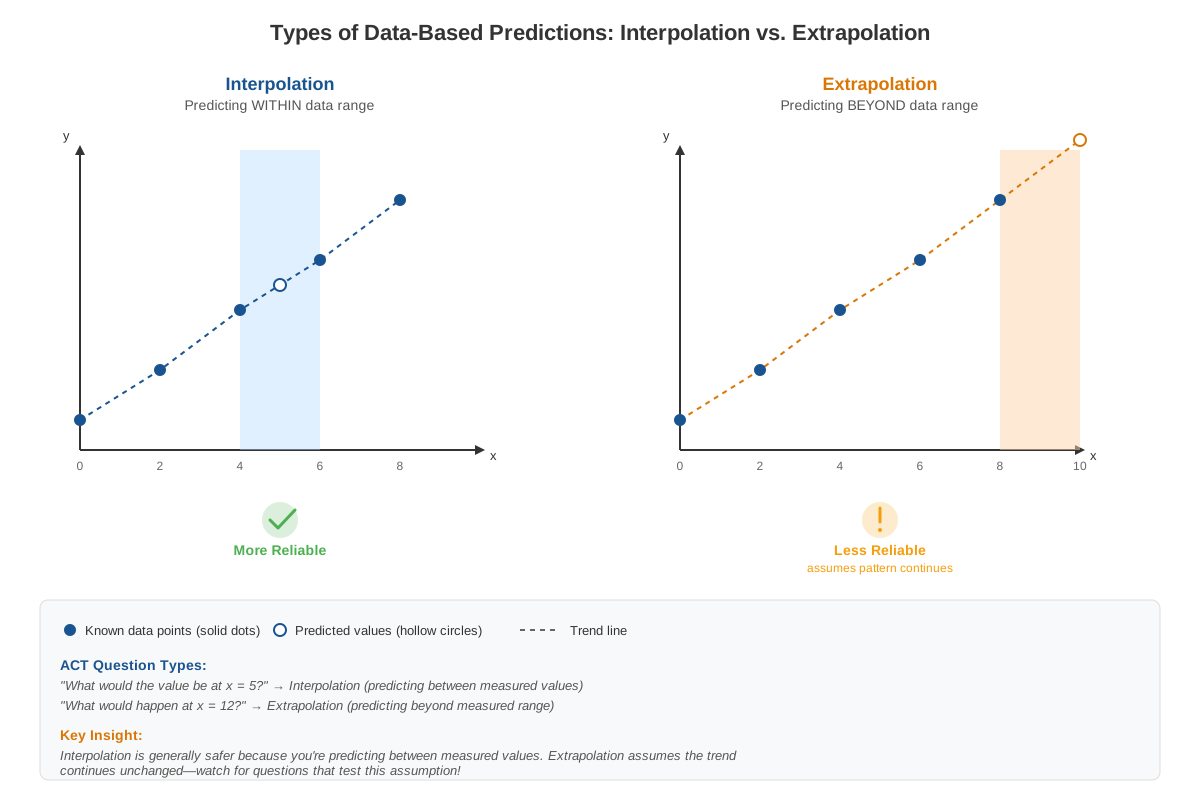
- [ ] Distinguish between interpolation and extrapolation in data analysis
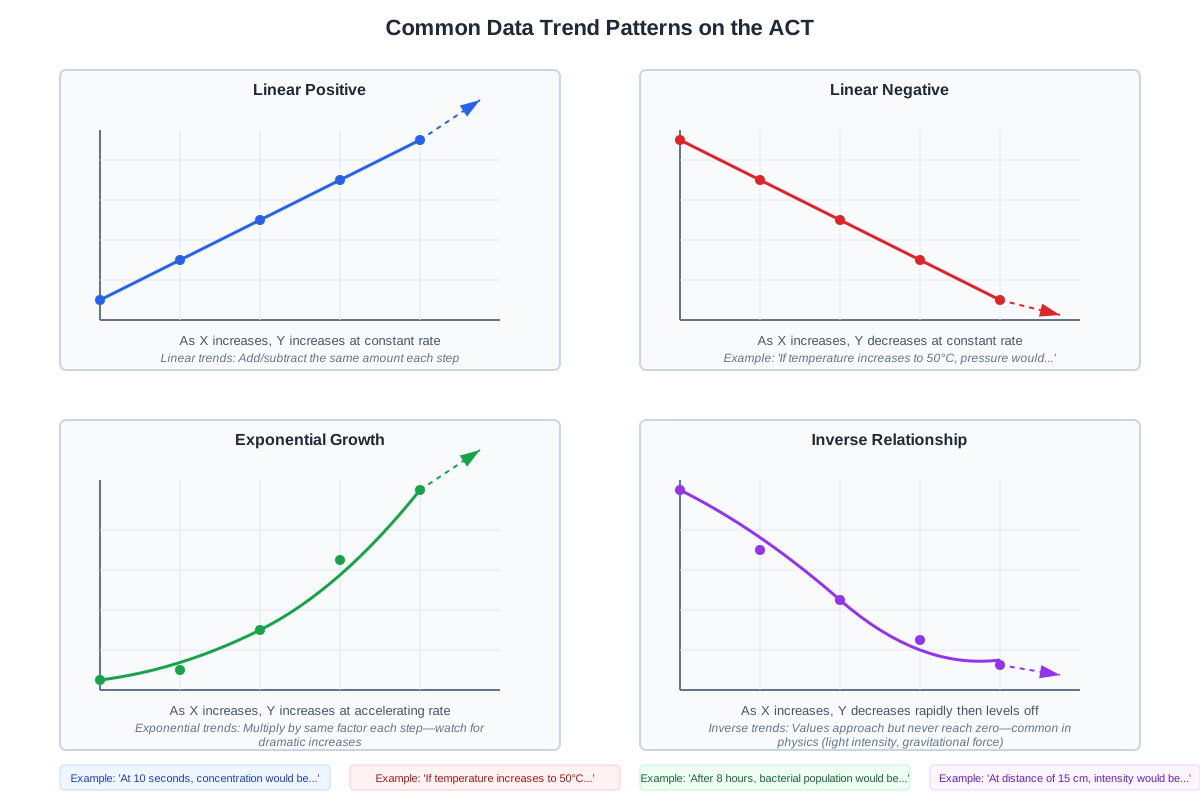
- [ ] Recognize different types of trends (linear, exponential, inverse) in graphical data
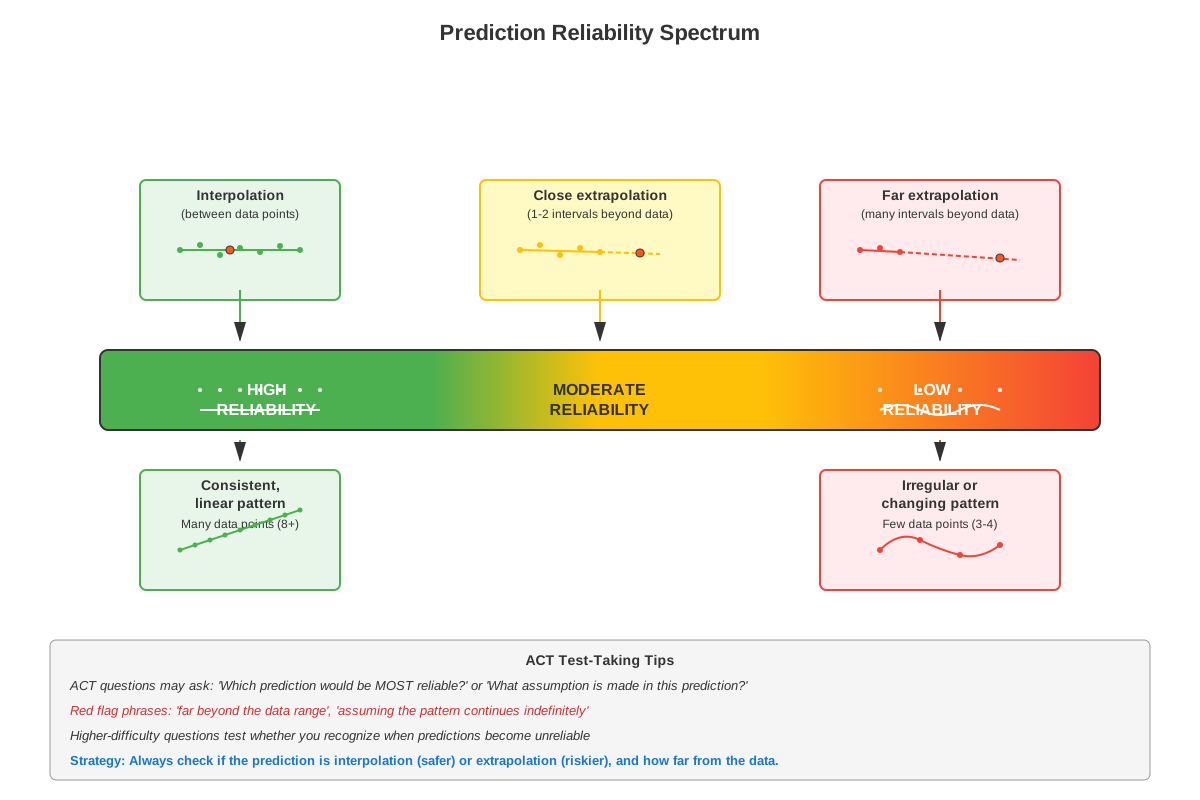
- [ ] Evaluate the reliability and limitations of predictions based on data patterns
- [ ] Synthesize information from multiple data sources to make compound predictions
Prerequisites
- Basic graph reading skills: Understanding x-axis and y-axis values, plotting points, and reading coordinates is essential because predictions require first identifying existing data patterns
- Understanding of variables: Recognizing independent versus dependent variables helps determine which variable changes in response to another, forming the basis for prediction
- Trend recognition: Basic ability to identify whether values are increasing, decreasing, or remaining constant provides the foundation for extending those patterns
- Unit awareness: Knowing how to work with different measurement units ensures predictions maintain appropriate scale and magnitude
Why This Topic Matters
In real-world scientific practice, researchers constantly make predictions based on collected data. Climate scientists predict future temperatures from historical trends, medical researchers predict patient outcomes from clinical trial data, and engineers predict material performance under untested conditions. The ability to make data-based predictions is not merely an academic exercise—it represents the core of hypothesis generation and experimental design that drives scientific progress.
On the ACT Science test, data-based prediction questions appear with remarkable frequency. Research indicates that 8-12 questions per test (out of 40 total) directly assess this skill, making it one of the highest-yield topics for focused study. These questions typically award points to students who can quickly identify patterns and confidently extend them, while students who hesitate or second-guess themselves often lose valuable time. The questions appear in various formats: "According to the data, if Temperature were increased to 100°C, Pressure would most likely..." or "Based on Figure 1, which of the following best predicts the result at pH 8?"
Common manifestations in exam passages include: extending a linear trend on a graph beyond the measured range, predicting intermediate values between two data points, determining outcomes when multiple variables change simultaneously, and identifying which experimental condition would produce a specified result. The ACT particularly favors questions that require students to recognize non-obvious patterns, such as logarithmic relationships or inverse proportions, rather than simple straight-line extrapolations.
Core Concepts
Understanding Data-Based Predictions
A data-based prediction involves using observed patterns in collected data to forecast values, outcomes, or trends that were not directly measured in the original experiment or study. This process requires three fundamental steps: (1) identifying the relationship between variables in the existing data, (2) determining whether that relationship is consistent and reliable, and (3) applying that relationship to new conditions or values.
The ACT tests two primary types of predictions: interpolation and extrapolation. Interpolation involves predicting values that fall within the range of collected data—essentially filling in gaps between measured points. For example, if an experiment measured temperature at 10°C, 20°C, and 30°C, predicting the result at 25°C would be interpolation. Extrapolation, conversely, involves predicting beyond the measured range, such as predicting the result at 40°C when the highest measured temperature was 30°C. Extrapolation carries greater uncertainty because it assumes the observed pattern continues unchanged beyond the data range.
Types of Trends in Data
Recognizing the type of relationship between variables is crucial for accurate predictions. The ACT commonly presents four relationship types:
Linear relationships show a constant rate of change, appearing as straight lines on graphs. If Variable Y increases by 5 units every time Variable X increases by 1 unit, this pattern continues predictably. The key indicator is consistent spacing between data points when plotted.
Exponential relationships show accelerating change, where the rate of increase (or decrease) itself increases over time. These appear as curves that become steeper (or shallower) progressively. Population growth and radioactive decay often follow exponential patterns.
Inverse relationships show that as one variable increases, the other decreases proportionally. These often appear as hyperbolic curves. Pressure and volume in gases (Boyle's Law) exemplify inverse relationships.
Plateau or asymptotic relationships show change that eventually levels off, approaching but never quite reaching a maximum or minimum value. Enzyme saturation and learning curves often display this pattern.
| Relationship Type | Visual Pattern | Prediction Strategy | ACT Frequency |
|---|---|---|---|
| Linear | Straight line | Extend the line at same slope | Very High |
| Exponential | Accelerating curve | Rate of change increases | High |
| Inverse | Hyperbolic curve | Product of variables stays constant | Medium |
| Plateau | Leveling curve | Approaches but doesn't exceed limit | Medium |
Analyzing Data Tables for Predictions
When data appears in table format rather than graphs, prediction requires mentally visualizing the trend. Students should:
- Identify which variable is independent (typically in the leftmost column)
- Calculate the change in the dependent variable for each step in the independent variable
- Determine if the rate of change is constant, increasing, or decreasing
- Apply that pattern to the new condition
For example, if a table shows that at 10°C the rate is 5 units/sec, at 20°C it's 10 units/sec, and at 30°C it's 15 units/sec, the pattern shows a constant increase of 5 units/sec for every 10°C increase. Predicting the rate at 40°C would yield 20 units/sec.
Multiple Variable Predictions
More challenging ACT questions require considering how changes in multiple variables simultaneously affect outcomes. These questions test whether students can synthesize information from different parts of a passage. The strategy involves:
- Identifying how each variable independently affects the outcome
- Determining whether the effects are additive or multiplicative
- Considering whether variables might interact (one variable's effect depends on another's value)
For instance, if increasing temperature increases reaction rate AND increasing concentration increases reaction rate, a question might ask what happens when both increase together. The answer typically involves recognizing that both effects work in the same direction, producing a larger combined effect.
Confidence and Limitations in Predictions
The ACT occasionally tests whether students recognize that predictions have varying reliability. Interpolations are generally more reliable than extrapolations. Predictions based on many data points are more reliable than those based on few points. Predictions that stay close to measured values are more reliable than those far outside the data range. Questions might ask which prediction is "most likely" or "least certain," requiring judgment about prediction confidence.
Concept Relationships
The concepts within data-based predictions form a hierarchical structure. At the foundation lies trend recognition—the ability to identify whether data shows increase, decrease, or stability. This leads directly to relationship classification (linear, exponential, inverse, etc.), which determines the specific prediction strategy to employ. Both interpolation and extrapolation depend on accurate relationship classification, but extrapolation additionally requires understanding prediction limitations since it ventures beyond confirmed data.
Multiple variable predictions represent a synthesis of single-variable prediction skills, requiring students to apply the basic prediction process separately to each variable, then combine the results. This connects to the prerequisite understanding of independent versus dependent variables, as students must track which variables are being manipulated and which respond.
The relationship map flows as follows:
Basic Graph Reading → Trend Recognition → Relationship Classification → Single Variable Prediction (branches into Interpolation and Extrapolation) → Multiple Variable Prediction → Prediction Confidence Assessment
This topic also connects forward to Research Summaries passages, where predictions often involve forecasting results of modified experiments, and to Conflicting Viewpoints passages, where different scientists' theories lead to different predictions that can be tested.
High-Yield Facts
- ⭐ Interpolation (predicting within the data range) is more reliable than extrapolation (predicting beyond the data range)
- ⭐ Linear relationships show constant change: if Y increases by 5 when X increases by 1, this pattern continues throughout
- ⭐ When a graph shows a curve that's getting steeper, the relationship is likely exponential, not linear
- ⭐ If two variables both increase together, they have a direct relationship; if one increases while the other decreases, they have an inverse relationship
- ⭐ The ACT rarely expects predictions that violate physical constraints (negative absolute temperatures, concentrations above 100%, etc.)
- Plateau relationships eventually level off and stop changing, even if the independent variable continues to increase
- When multiple variables change simultaneously, consider each effect separately, then combine them
- Data points that form a straight line on a graph indicate a constant rate of change
- Inverse relationships often appear as hyperbolic curves that approach but never touch the axes
- Questions asking "most likely" or "best predicted by" indicate prediction questions rather than direct data reading
- Extrapolation assumes the observed pattern continues unchanged, which may not always be valid in real systems
- The slope of a line indicates the rate of change: steeper slopes mean faster change
- If data points show increasing spacing, the relationship is accelerating (possibly exponential)
- Predictions should maintain the same units and scale as the original data
- When data shows high variability or scatter, predictions are less certain than with tightly clustered data
Quick check — test yourself on Data-based predictions so far.
Try Flashcards →Common Misconceptions
Misconception: All predictions require drawing or extending lines on graphs → Correction: While visualization helps, many prediction questions involve tables or require mental pattern recognition without physically drawing. The ACT doesn't provide tools for drawing, so students must develop mental visualization skills.
Misconception: Extrapolation and interpolation are equally reliable → Correction: Interpolation is significantly more reliable because it stays within the confirmed data range. Extrapolation assumes patterns continue unchanged beyond measured conditions, which introduces greater uncertainty. The ACT sometimes tests this distinction directly.
Misconception: If a graph curves, the relationship is too complex to predict → Correction: Curved relationships follow predictable patterns (exponential, logarithmic, inverse). Recognizing the curve type allows accurate predictions. The ACT frequently tests exponential and inverse relationships specifically because students often avoid them.
Misconception: Predictions must be mathematically precise → Correction: ACT prediction questions typically ask for qualitative predictions ("increase," "decrease," "remain the same") or provide answer choices with sufficient spacing that approximate predictions work. Exact calculations are rarely necessary.
Misconception: When multiple variables change, their effects cancel out → Correction: Effects combine rather than cancel unless they work in opposite directions. If both temperature and concentration increase reaction rate, increasing both produces an even larger increase. Students must consider the direction of each effect.
Misconception: Data-based predictions require memorizing scientific formulas → Correction: The ACT Science section tests data analysis skills, not content knowledge. All necessary information appears in the passage. Students should focus on pattern recognition rather than formula memorization.
Misconception: Scattered or noisy data cannot support predictions → Correction: Even with variability, overall trends remain identifiable. The ACT expects students to recognize general patterns despite point-to-point variation, focusing on the overall direction rather than individual fluctuations.
Worked Examples
Example 1: Linear Extrapolation from a Table
Passage Context: An experiment measured the distance traveled by a toy car at different time intervals. The data table shows:
| Time (seconds) | Distance (meters) |
|---|---|
| 2 | 10 |
| 4 | 20 |
| 6 | 30 |
| 8 | 40 |
Question: Based on the data, if the car continues at the same rate, what distance would it most likely travel at 12 seconds?
Solution Process:
Step 1: Identify the relationship type. Calculate the change in distance for each time interval:
- From 2 to 4 seconds: distance increases by 10 meters
- From 4 to 6 seconds: distance increases by 10 meters
- From 6 to 8 seconds: distance increases by 10 meters
The constant increase of 10 meters per 2-second interval indicates a linear relationship.
Step 2: Determine the rate of change. The car travels 10 meters every 2 seconds, or 5 meters per second.
Step 3: Apply the pattern to the new condition. From 8 seconds to 12 seconds is a 4-second interval. At 5 meters per second, the car would travel an additional 20 meters (4 × 5 = 20).
Step 4: Calculate the final answer. Starting from 40 meters at 8 seconds, adding 20 meters gives 60 meters at 12 seconds.
Connection to Learning Objectives: This example demonstrates identifying when prediction is being tested (the question asks about an unmeasured time point), explaining the core strategy (recognizing linear relationships and extending them), and applying the strategy accurately to reach the correct answer.
Example 2: Exponential Relationship with Multiple Variables
Passage Context: A biology experiment examined bacterial population growth under different temperature conditions. Figure 1 shows population (in thousands) over time at 25°C:
- Hour 0: 1 thousand
- Hour 2: 2 thousand
- Hour 4: 4 thousand
- Hour 6: 8 thousand
Figure 2 indicates that increasing temperature from 25°C to 30°C doubles the growth rate.
Question: Based on Figures 1 and 2, at 30°C, the bacterial population at Hour 4 would most likely be closest to which of the following?
Solution Process:
Step 1: Analyze the relationship in Figure 1. The population doubles every 2 hours (1→2→4→8), indicating an exponential relationship rather than linear growth.
Step 2: Determine the pattern at 25°C. At Hour 4, the population is 4 thousand (starting from 1 thousand at Hour 0).
Step 3: Apply the temperature effect from Figure 2. Doubling the growth rate means the population doubles twice as frequently. Instead of doubling every 2 hours, it doubles every 1 hour at 30°C.
Step 4: Calculate the prediction at 30°C:
- Hour 0: 1 thousand
- Hour 1: 2 thousand (first doubling)
- Hour 2: 4 thousand (second doubling)
- Hour 3: 8 thousand (third doubling)
- Hour 4: 16 thousand (fourth doubling)
Answer: At 30°C and Hour 4, the population would most likely be 16 thousand.
Connection to Learning Objectives: This example shows distinguishing between relationship types (recognizing exponential rather than linear growth), synthesizing information from multiple data sources (combining Figures 1 and 2), and applying predictions accurately to compound scenarios involving multiple variables.
Exam Strategy
When approaching ACT Science questions involving data-based predictions, employ this systematic strategy:
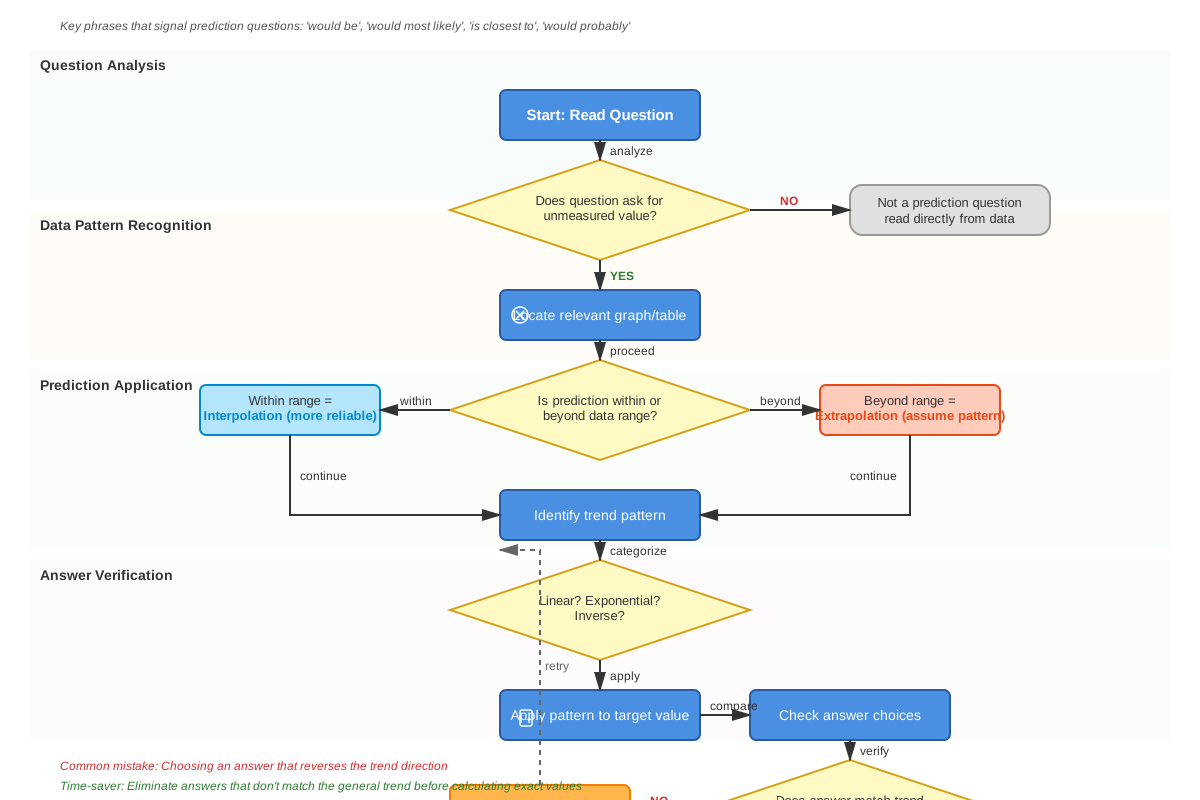
Recognition Phase: Identify prediction questions through trigger phrases such as "most likely," "best predicted," "if [variable] were increased/decreased to [value]," "based on the trend," or "according to the pattern." These phrases signal that the answer doesn't appear directly in the data but must be inferred.
Analysis Phase: Before looking at answer choices, invest 10-15 seconds analyzing the data pattern. Ask: Is this relationship linear (constant change), exponential (accelerating change), inverse (one increases as other decreases), or plateau (leveling off)? This upfront investment prevents choosing answers that violate the established pattern.
Interpolation vs. Extrapolation Recognition: Quickly determine whether the prediction falls within or beyond the data range. If within, you can be more confident in your answer. If beyond, look for answer choices that reasonably extend the pattern without making extreme jumps.
Exam Tip: When extrapolating, the correct answer typically continues the trend but rarely represents the most extreme option. The ACT usually avoids predictions that would require multiple doublings or dramatic changes beyond the data range.
Process of Elimination Strategy: Eliminate answers that:
- Reverse the established trend (if data shows increase, eliminate answers showing decrease)
- Violate physical constraints (negative absolute values, percentages above 100%)
- Require the pattern to change type (if linear in data, eliminate answers requiring exponential change)
- Fall far outside reasonable extrapolation range
Time Management: Allocate 30-45 seconds per prediction question. If you cannot identify the pattern within 20 seconds, make an educated guess based on the general direction (increasing/decreasing) and move forward. Prediction questions should not consume more time than direct data-reading questions.
Multiple Variable Questions: When multiple variables change, use this approach: (1) determine each variable's individual effect, (2) note whether effects work in the same or opposite directions, (3) combine effects logically. If both variables push the outcome higher, the answer will be higher than either effect alone.
Answer Choice Analysis: ACT answer choices for prediction questions typically space values strategically. The correct answer usually falls in the middle range, with extreme values serving as distractors for students who miscalculate or misidentify the pattern type.
Memory Techniques
LITE Mnemonic for Prediction Process:
- Locate the pattern in existing data
- Identify the relationship type (linear, exponential, inverse, plateau)
- Track the rate or direction of change
- Extend the pattern to the new condition
Visualization Strategy: When encountering tables, mentally sketch the approximate graph shape. Even a rough mental image helps identify whether the relationship is linear (straight), exponential (curving up), or inverse (curving down). This takes 3-5 seconds but dramatically improves accuracy.
"Same Direction, Same Effect" Rule: For multiple variable questions, remember that variables affecting the outcome in the same direction (both increase it or both decrease it) produce amplified effects when changed together. Variables working in opposite directions partially offset each other.
Interpolation vs. Extrapolation Memory Aid: "Inter" means "between" (like interstate highways go between states), so interpolation predicts between existing data points. "Extra" means "beyond" (like extraordinary means beyond ordinary), so extrapolation predicts beyond the data range.
Relationship Type Acronym - LEIP:
- Linear: constant spacing between points
- Exponential: spacing increases progressively
- Inverse: one up, one down
- Plateau: levels off at limit
Summary
Data-based predictions represent a critical high-yield skill for ACT Science success, appearing in 20-30% of all questions across passage types. Mastery requires recognizing when questions demand prediction rather than direct data reading, identifying the type of relationship between variables (linear, exponential, inverse, or plateau), and confidently extending observed patterns to new conditions. The distinction between interpolation (predicting within the data range) and extrapolation (predicting beyond it) affects prediction reliability, with interpolation generally more trustworthy. Students must develop rapid pattern recognition skills, analyzing whether data shows constant change, accelerating change, or leveling off. Multiple variable predictions require synthesizing individual effects and determining whether they amplify or offset each other. Success depends on systematic analysis: identify the pattern type, determine the rate or direction of change, apply that pattern to the new condition, and verify the answer maintains physical plausibility. With focused practice on recognizing relationship types and extending patterns logically, students can consistently earn points on these high-frequency questions while managing time effectively.
Key Takeaways
- Data-based predictions appear in 8-12 questions per ACT Science test, making this a top-priority skill for score improvement
- Interpolation (predicting within data range) is more reliable than extrapolation (predicting beyond data range)
- Linear relationships show constant change; exponential relationships show accelerating change; inverse relationships show opposite-direction change
- Trigger phrases like "most likely," "best predicted," and "if [variable] were [value]" signal prediction questions
- Multiple variable predictions require analyzing each variable's effect separately, then combining them based on whether they work in the same or opposite directions
- Pattern recognition should take 10-15 seconds before examining answer choices; this upfront investment improves accuracy
- Extreme answer choices are usually incorrect; the ACT favors reasonable extensions of established patterns rather than dramatic jumps
Related Topics
Trend Analysis and Slope Interpretation: Building on data-based predictions, this topic explores quantitative analysis of rates of change, calculating slopes from data points, and interpreting what different slope values mean in experimental contexts. Mastering predictions provides the foundation for more sophisticated slope analysis.
Experimental Design and Variable Manipulation: Understanding how changing experimental conditions affects outcomes connects directly to prediction skills. Students who can predict data patterns are better equipped to design experiments and hypothesize results.
Statistical Reasoning and Data Reliability: Advanced data analysis includes assessing prediction confidence, understanding error bars, and recognizing when data variability limits prediction accuracy. This builds on basic prediction skills by adding quantitative reliability assessment.
Graphical Data Representation: While predictions extend beyond given data, they depend on solid graph-reading skills. Deeper study of graph types, axis scaling, and data visualization enhances prediction accuracy.
Practice CTA
Now that you've mastered the core concepts of data-based predictions, it's time to cement your understanding through active practice. The practice questions and flashcards designed for this topic will challenge you to apply these strategies under test-like conditions, building the speed and confidence necessary for ACT success. Remember: prediction skills improve dramatically with deliberate practice. Each question you work through strengthens your pattern recognition abilities and reinforces the systematic approach that separates high scorers from average performers. Commit to working through the practice materials, and you'll find these once-challenging questions becoming routine point-earners on test day!
Sign up free to keep reading
Create a free AnvayaPrep account to finish this ACT guide on Data-based predictions — plus flashcards and practice questions.