Overview
Reliability is a fundamental concept in scientific research that measures the consistency and reproducibility of experimental results. In the context of the ACT Science test, reliability questions assess a student's ability to evaluate whether an experiment produces consistent results when repeated under the same conditions, and whether the data collected can be trusted as a basis for drawing conclusions. Understanding reliability is crucial because it forms the foundation of the scientific method—without reliable data, no valid conclusions can be drawn from any experiment.
On the ACT Science test, ACT reliability questions appear frequently in the Research Summaries passages, which typically comprise 3 of the 6 passages on the exam. These questions require students to analyze experimental designs, identify potential sources of error or inconsistency, evaluate whether proper controls were implemented, and determine if sufficient trials were conducted to ensure trustworthy results. Students must be able to distinguish between reliable and unreliable experimental procedures, recognize when additional trials or measurements would improve reliability, and understand how various factors such as sample size, measurement precision, and experimental controls affect the dependability of scientific findings.
The concept of reliability connects directly to other critical Science concepts including experimental design, data interpretation, and scientific reasoning. A reliable experiment provides the foundation for valid conclusions, while unreliable data—no matter how interesting—cannot support meaningful scientific claims. Mastering reliability enables students to critically evaluate any research summary they encounter, making it one of the highest-yield topics for ACT Science preparation.
Learning Objectives
- [ ] Identify when Reliability is being tested in ACT Science passages
- [ ] Explain the core rule or strategy behind Reliability in experimental contexts
- [ ] Apply Reliability concepts to ACT-style questions accurately
- [ ] Evaluate whether an experimental design includes sufficient controls to ensure reliable results
- [ ] Determine when additional trials or measurements would improve experimental reliability
- [ ] Distinguish between reliability issues and validity issues in research design
- [ ] Analyze how sample size, measurement tools, and procedural consistency affect reliability
Prerequisites
- Basic understanding of the scientific method: Reliability is assessed within the context of hypothesis testing and experimental procedures, so students must understand the general flow of scientific investigation.
- Familiarity with experimental variables: Recognizing independent, dependent, and controlled variables is essential because reliability depends on keeping certain factors constant while measuring others.
- Basic statistical concepts: Understanding concepts like averages, ranges, and the idea that multiple measurements provide more confidence than single measurements helps students grasp why reliability matters.
- Reading comprehension of scientific passages: Students must be able to extract key information about experimental procedures from dense technical descriptions.
Why This Topic Matters
In real-world science, reliability determines whether research findings can be trusted and replicated by other scientists. Medical treatments, engineering designs, and environmental policies all depend on reliable data. A medication that produces inconsistent effects across trials cannot be approved for use. An engineering material that shows variable strength in testing cannot be used in construction. Climate data that cannot be consistently measured across different instruments cannot inform policy decisions. Reliability is the bedrock of scientific credibility.
On the ACT Science test, reliability questions appear in approximately 15-20% of all Research Summaries questions, making them one of the most frequently tested concepts. These questions typically appear 2-4 times per exam across different passages. The ACT tests reliability through several common question formats: asking students to identify which modification would improve experimental reliability, determining whether sufficient trials were conducted, evaluating whether proper controls were maintained, assessing whether measurement tools were appropriate, and identifying potential sources of experimental error that could compromise consistency.
Common ways reliability appears in ACT passages include: experiments with varying numbers of trials (students must recognize that more trials generally improve reliability), studies comparing different measurement techniques (students must evaluate which method produces more consistent results), experimental designs with or without proper controls (students must identify when lack of controls compromises reliability), and scenarios where environmental or procedural factors might introduce inconsistency (students must recognize these threats to reliability).
Core Concepts
Definition of Reliability
Reliability refers to the consistency and repeatability of experimental results. A reliable experiment produces similar results when repeated under identical conditions. If a scientist measures the boiling point of water three times and gets 100°C, 99.8°C, and 100.2°C, the measurements are reliable because they cluster closely together. If the measurements were 100°C, 87°C, and 112°C, the experiment would be unreliable because the results are inconsistent.
Reliability differs from accuracy (how close measurements are to the true value) and validity (whether the experiment actually tests what it claims to test). An experiment can be reliable but inaccurate—imagine a thermometer that consistently reads 5 degrees too high. It gives consistent (reliable) results, but they're all wrong (inaccurate). For ACT purposes, reliability questions focus specifically on consistency and repeatability, not on whether results are correct.
Components of Reliable Experiments
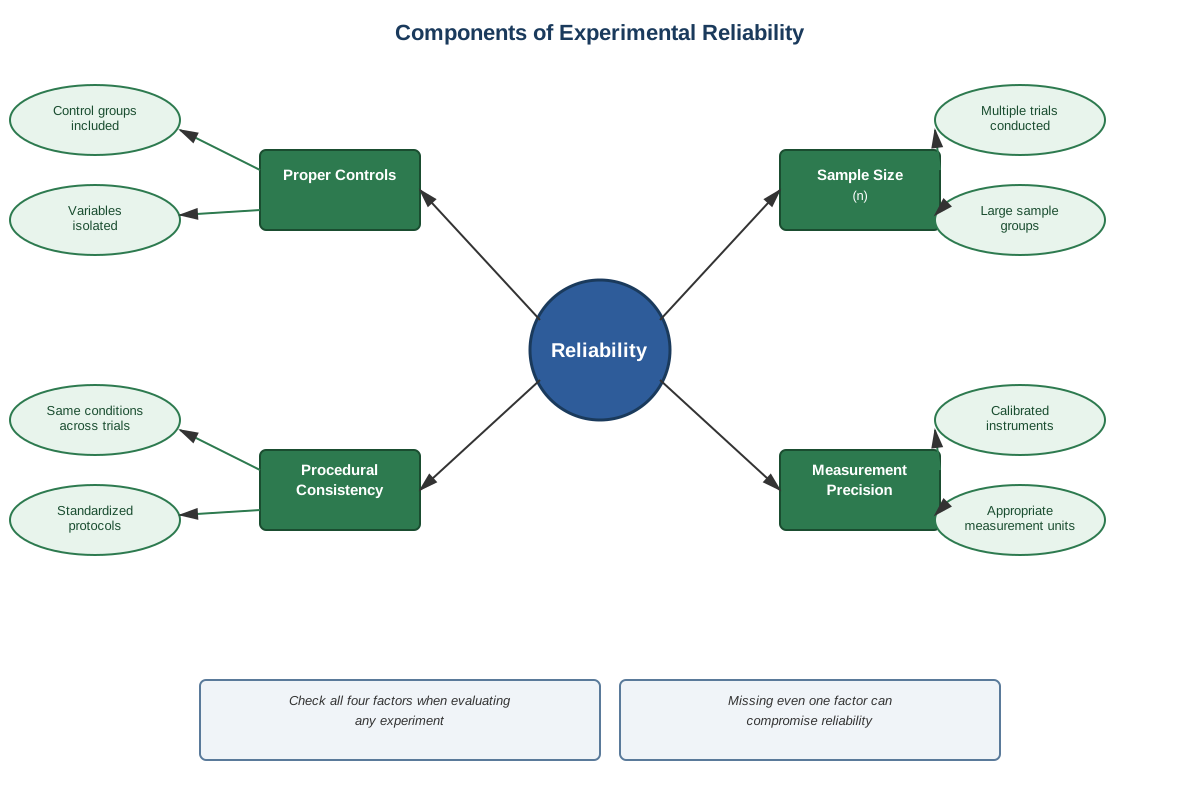
Several key factors contribute to experimental reliability:
Sample Size and Number of Trials: Conducting multiple trials and using larger sample sizes dramatically improves reliability. A single measurement might be affected by random error, but averaging multiple measurements reduces the impact of these random fluctuations. If a student measures the time for a pendulum swing once and gets 2.3 seconds, that single data point is less reliable than averaging ten measurements. The ACT frequently tests whether students recognize that increasing trials improves reliability.
Standardized Procedures: Following the same procedure every time ensures consistency. If one trial uses 50 mL of solution while another uses 55 mL, the inconsistency introduces unreliability. Reliable experiments maintain procedural consistency across all trials. This includes using the same equipment, following the same steps in the same order, maintaining the same environmental conditions, and using the same measurement techniques.
Measurement Precision: The tools used to collect data affect reliability. A ruler marked in centimeters provides less reliable measurements than one marked in millimeters. Digital instruments often provide more reliable measurements than analog ones because they eliminate human reading error. The ACT may present scenarios where students must choose between measurement tools of different precision.
Controlled Variables: Keeping all variables constant except the one being tested ensures that observed changes result from the independent variable, not from uncontrolled factors. If testing how temperature affects reaction rate, all other factors (concentration, volume, pressure) must remain constant across trials. Failure to control variables introduces inconsistency and reduces reliability.
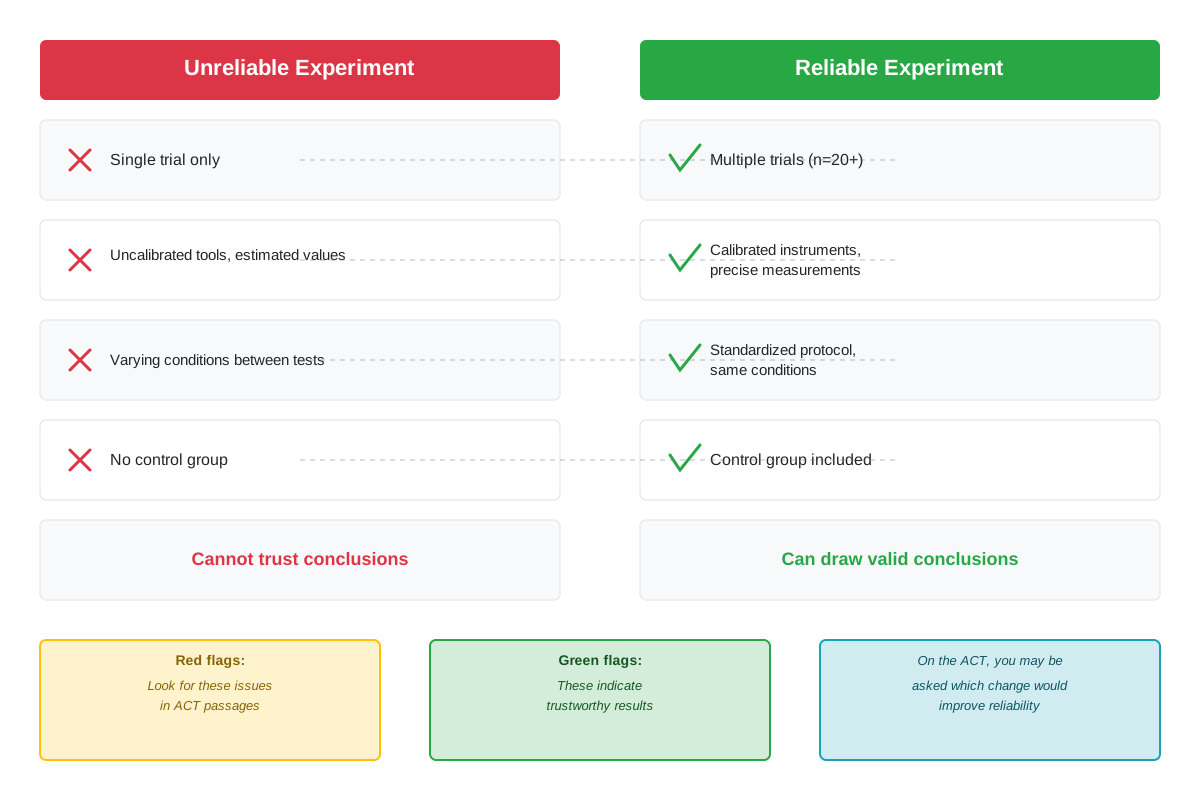
Identifying Reliability Issues
The ACT presents several common scenarios where reliability is compromised:
| Reliability Issue | Example | Impact on Results |
|---|---|---|
| Insufficient trials | Only one measurement taken | Results might be due to random error |
| Inconsistent procedures | Different waiting times between trials | Cannot determine if differences are meaningful |
| Imprecise instruments | Using a kitchen scale instead of analytical balance | Measurements vary too much to detect patterns |
| Uncontrolled variables | Temperature fluctuates during experiment | Cannot isolate effect of independent variable |
| Small sample size | Testing only 3 subjects | Individual variation overwhelms patterns |
| Observer bias | Researcher expectations influence measurements | Systematic inconsistency in data collection |
Improving Reliability
When ACT questions ask how to improve an experiment's reliability, several strategies apply:
- Increase the number of trials: More data points provide better estimates and reduce the impact of random error
- Use more precise measurement tools: Better instruments reduce measurement variability
- Standardize all procedures: Create detailed protocols and follow them exactly for each trial
- Control environmental conditions: Maintain constant temperature, humidity, lighting, etc.
- Use larger sample sizes: More subjects or specimens reduce the impact of individual variation
- Implement blind procedures: Prevent observer expectations from influencing measurements
- Calibrate instruments regularly: Ensure measurement tools maintain consistent performance
- Train all researchers identically: When multiple people collect data, ensure they use identical techniques
Reliability in Different Experimental Contexts
Biological Experiments: Living organisms show natural variation, making reliability particularly challenging. Testing a drug on five patients provides less reliable results than testing on five hundred. Biological experiments often require larger sample sizes and more trials than physical science experiments because organisms vary more than chemical reactions.
Physical Science Experiments: Chemical and physical processes typically show less inherent variation than biological systems, but measurement precision becomes critical. When measuring reaction rates or physical properties, the precision of instruments and consistency of conditions determine reliability.
Observational Studies: When experiments cannot be conducted (such as astronomical observations or ecological field studies), reliability depends on consistent observation methods, multiple observers, and repeated observations over time.
Concept Relationships
Reliability serves as the foundation for all other aspects of experimental science. Without reliable data, no valid conclusions can be drawn, no matter how sophisticated the analysis. The relationship flows as follows:
Experimental Design → Reliability → Data Quality → Valid Conclusions
Proper experimental design (including adequate controls, sufficient trials, and appropriate measurement tools) produces reliable results. Reliable results generate high-quality data that can be trusted. High-quality data enables valid conclusions that advance scientific understanding.
Reliability connects to controlled variables because maintaining constant conditions across trials is essential for consistency. It relates to sample size because larger samples and more trials improve reliability. It links to measurement precision because better instruments produce more consistent results. It connects to experimental controls because proper controls eliminate alternative explanations for observed patterns, making results more trustworthy.
The relationship between reliability and validity is particularly important: Reliability is necessary but not sufficient for validity. An experiment must first be reliable (producing consistent results) before it can be valid (actually testing what it claims to test). However, a reliable experiment might still be invalid if it doesn't properly test the hypothesis.
Quick check — test yourself on Reliability so far.
Try Flashcards →High-Yield Facts
⭐ Reliability refers to the consistency and repeatability of experimental results, not their accuracy or correctness
⭐ Increasing the number of trials always improves reliability by reducing the impact of random error
⭐ Controlled variables must remain constant across all trials to ensure reliable results
⭐ More precise measurement instruments produce more reliable data than less precise instruments
⭐ Larger sample sizes improve reliability by reducing the impact of individual variation
- Reliability can be assessed by comparing results across multiple trials—consistent results indicate high reliability
- Standardized procedures are essential for reliability; any procedural variation introduces inconsistency
- Environmental factors (temperature, humidity, lighting) must be controlled to maintain reliability
- Observer bias can compromise reliability even when procedures are otherwise consistent
- Calibration of instruments ensures they maintain reliable performance over time
- Blind or double-blind procedures improve reliability by preventing expectations from influencing measurements
- Reliability is particularly challenging in biological experiments due to natural organism variation
- Random error affects reliability, while systematic error affects accuracy
- Replication by independent researchers is the ultimate test of reliability
- Insufficient reliability cannot be compensated for by sophisticated statistical analysis
Common Misconceptions
Misconception: Reliability and accuracy are the same thing.
Correction: Reliability refers to consistency of results across trials, while accuracy refers to how close results are to the true value. An experiment can be reliable (consistent) but inaccurate (consistently wrong), or accurate on average but unreliable (inconsistent across trials).
Misconception: One carefully conducted trial is sufficient if the procedure is followed perfectly.
Correction: Even with perfect procedures, random error affects individual measurements. Multiple trials are always necessary to distinguish true patterns from random variation. The ACT frequently tests this by asking whether additional trials would improve an experiment.
Misconception: Using more sophisticated equipment automatically makes an experiment more reliable.
Correction: Equipment sophistication matters only if it provides greater precision or consistency. A complex instrument used inconsistently produces less reliable results than a simple instrument used consistently. Proper technique and standardized procedures are more important than equipment sophistication.
Misconception: If results support the hypothesis, the experiment must be reliable.
Correction: Results that match expectations might still be unreliable if proper controls weren't maintained, sufficient trials weren't conducted, or procedures weren't standardized. Reliability must be evaluated based on experimental design, not on whether results are desirable.
Misconception: Reliability only matters in laboratory experiments, not in field studies or observations.
Correction: All scientific investigations require reliability. Field studies must use consistent observation methods, standardized data collection procedures, and repeated observations. Observational astronomy, ecological surveys, and geological field work all depend on reliable methodology.
Misconception: Averaging results from unreliable trials produces reliable data.
Correction: Averaging can reduce random error when trials are conducted reliably but show natural variation. However, averaging cannot fix fundamental reliability problems such as inconsistent procedures, uncontrolled variables, or imprecise instruments. The underlying methodology must be reliable first.
Worked Examples
Example 1: Evaluating Trial Sufficiency
Passage Context: Students conducted an experiment to determine how fertilizer concentration affects plant growth. They prepared five different fertilizer concentrations (0%, 1%, 2%, 3%, and 4%) and planted one seed in each concentration. After three weeks, they measured plant height.
Question: Which of the following changes would most improve the reliability of this experiment?
A) Use different plant species for each concentration
B) Measure plant height after six weeks instead of three weeks
C) Plant five seeds at each concentration level
D) Use fertilizer concentrations of 0%, 2%, 4%, 6%, and 8%
Solution Process:
First, identify the reliability issue: The experiment uses only one seed per concentration. Individual plants show natural variation in growth, so a single plant cannot reliably represent how that fertilizer concentration affects plant growth in general.
Evaluate each option:
- Option A would introduce additional variation (different species respond differently), reducing reliability
- Option B changes the timing but doesn't address the single-seed problem
- Option C directly addresses the reliability issue by increasing sample size at each concentration
- Option D changes the concentrations tested but doesn't improve consistency of results
Answer: C
This question tests whether students recognize that sample size affects reliability. Using multiple seeds at each concentration allows averaging, which reduces the impact of individual plant variation and produces more reliable results. This is a classic ACT reliability question format.
Example 2: Identifying Procedural Inconsistency
Passage Context: A researcher tested how temperature affects enzyme activity. She prepared enzyme solutions and tested them at 20°C, 30°C, 40°C, and 50°C. For the 20°C trial, she waited 5 minutes before measuring product formation. For the 30°C trial, she waited 10 minutes. For the 40°C and 50°C trials, she waited 5 minutes.
Question: Which aspect of this experimental design most compromises reliability?
A) The temperature range is too narrow
B) The waiting time was inconsistent across trials
C) Only four temperatures were tested
D) The enzyme concentration was not specified
Solution Process:
Identify what reliability requires: Consistent procedures across all trials. Any procedural variation introduces inconsistency that makes it difficult to determine whether observed differences result from the independent variable (temperature) or from procedural differences.
Analyze the design: The waiting time varied—10 minutes for 30°C but 5 minutes for other temperatures. This procedural inconsistency means the 30°C trial is not directly comparable to the others.
Evaluate options:
- Option A addresses the range of values tested, not consistency
- Option B correctly identifies the procedural inconsistency
- Option C addresses the number of trials, not consistency across trials
- Option D mentions missing information but doesn't identify an inconsistency
Answer: B
This question tests whether students can identify procedural inconsistencies that compromise reliability. The inconsistent waiting time means results cannot be reliably compared across temperatures. Even if the researcher followed all other procedures perfectly, this single inconsistency undermines the experiment's reliability.
Exam Strategy
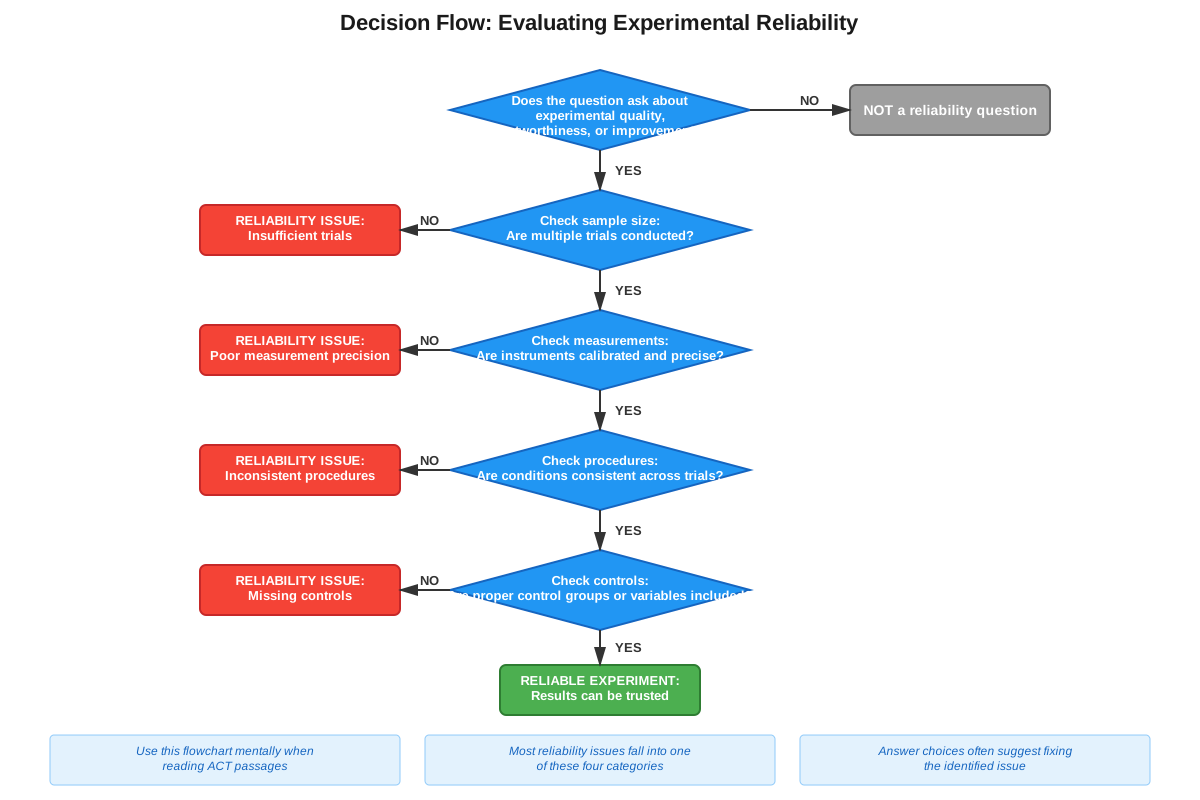
When approaching ACT reliability questions, follow this systematic process:
Step 1: Identify the Question Type
Look for trigger words and phrases that signal reliability questions:
- "improve the reliability"
- "make the results more consistent"
- "ensure the experiment can be repeated"
- "reduce experimental error"
- "make the data more trustworthy"
- "which modification would make the results more dependable"
Step 2: Analyze the Experimental Design
Quickly assess these key reliability factors:
- How many trials were conducted?
- What is the sample size?
- Are procedures standardized across trials?
- Are variables properly controlled?
- Are measurement tools appropriate and precise?
Step 3: Identify the Reliability Weakness
Most ACT reliability questions present an experiment with one clear weakness. Common weaknesses include:
- Too few trials (often just one)
- Small sample size
- Inconsistent procedures
- Uncontrolled variables
- Imprecise measurement tools
Step 4: Evaluate Answer Choices
Eliminate options that:
- Change what is being tested rather than improving consistency
- Add complexity without improving reliability
- Address validity or accuracy rather than reliability
- Introduce additional variation
Select the option that directly addresses the identified weakness by:
- Increasing trials or sample size
- Standardizing procedures
- Improving measurement precision
- Adding proper controls
Exam Tip: When questions ask how to "improve" an experiment, first determine whether they're asking about reliability (consistency), validity (testing what you claim to test), or accuracy (getting correct results). Most improvement questions focus on reliability.
Time Allocation: Reliability questions typically require 30-45 seconds. They're usually straightforward once you identify the reliability weakness. Don't overthink—the correct answer directly addresses the most obvious consistency problem.
Process of Elimination: Quickly eliminate answers that would make the experiment more complex, more expensive, or more time-consuming without improving consistency. The ACT rarely rewards complexity for its own sake.
Memory Techniques
TRIALS Mnemonic for reliability factors:
- Trials: Multiple trials improve reliability
- Repeat: Repeated measurements reduce random error
- Instruments: Precise instruments produce consistent results
- All variables: All variables except the independent variable must be controlled
- Large samples: Larger sample sizes improve reliability
- Standardize: Standardized procedures ensure consistency
The "Three C's" of Reliability:
- Consistency: Same procedures every time
- Controls: Keep variables constant
- Count: More trials = more reliable
Visualization Strategy: Picture reliability as a target. Reliable results cluster tightly together (small spread), even if they're not centered on the bullseye. Unreliable results scatter widely across the target. This visual helps distinguish reliability (tight clustering) from accuracy (hitting the center).
The "More is Better" Rule: When in doubt on reliability questions, the answer that involves more trials, more measurements, larger samples, or more precise instruments is usually correct. Reliability almost always improves with "more."
Summary
Reliability is the cornerstone of trustworthy scientific research, measuring whether experiments produce consistent results when repeated under identical conditions. On the ACT Science test, reliability questions assess whether students can evaluate experimental designs for consistency, identify factors that compromise repeatability, and recognize modifications that would improve dependability of results. The key principles include: multiple trials reduce random error and improve reliability; standardized procedures ensure consistency across trials; controlled variables prevent unwanted variation; precise measurement instruments produce more consistent data; and larger sample sizes reduce the impact of individual variation. Students must distinguish reliability (consistency) from accuracy (correctness) and validity (testing what you claim to test). The most common ACT reliability questions ask students to identify how to improve experimental consistency, typically by increasing trials, standardizing procedures, or improving measurement precision. Mastering reliability enables students to critically evaluate any research summary and forms the foundation for understanding all other aspects of experimental science.
Key Takeaways
- Reliability means consistency and repeatability—experiments should produce similar results when repeated under identical conditions
- Increasing the number of trials is the most common way to improve reliability and appears frequently on ACT questions
- Standardized procedures are essential—any variation in methodology compromises reliability
- Controlled variables must remain constant across all trials to ensure observed differences result from the independent variable
- Sample size matters—larger samples and more measurements reduce the impact of random variation
- Reliability differs from accuracy—consistent results aren't necessarily correct results
- Look for trigger words like "improve reliability," "more consistent," or "reduce error" to identify these questions quickly
Related Topics
Experimental Design: Understanding reliability provides the foundation for evaluating overall experimental design. Well-designed experiments incorporate reliability considerations from the start, including adequate controls, sufficient trials, and appropriate measurement tools.
Data Interpretation: Reliable data is essential for valid interpretation. Students who master reliability can better evaluate whether patterns in data represent true relationships or merely reflect experimental inconsistency.
Scientific Method: Reliability is a core principle of the scientific method. Experiments must be repeatable by other scientists, which requires reliable methodology and consistent results.
Statistical Analysis: While the ACT doesn't require complex statistics, understanding reliability helps students grasp why scientists use averages, ranges, and error bars—all tools for communicating the consistency of results.
Validity and Accuracy: After mastering reliability, students should explore how it relates to validity (whether experiments test what they claim to test) and accuracy (whether results are correct), completing their understanding of experimental quality.
Practice CTA
Now that you understand the principles of reliability and how the ACT tests this crucial concept, it's time to apply your knowledge! Work through the practice questions to reinforce your ability to identify reliability issues, evaluate experimental designs, and select modifications that improve consistency. Use the flashcards to memorize key reliability factors and trigger words that signal these questions on test day. Remember: reliability questions are high-yield and highly predictable—mastering this topic will directly improve your ACT Science score. Every practice question you complete builds the pattern recognition skills that enable quick, confident answers on test day. You've got this!
Sign up free to keep reading
Create a free AnvayaPrep account to finish this ACT guide on Reliability — plus flashcards and practice questions.