Overview
The independent variable is one of the most fundamental concepts tested in the ACT Science section, appearing in approximately 15-20% of all science questions. Understanding independent variables is essential for interpreting experimental designs, analyzing data representations, and making predictions based on scientific studies. The independent variable represents the factor that researchers deliberately manipulate or change in an experiment to observe its effect on other variables. Mastery of this concept enables students to quickly identify experimental structures, understand cause-and-effect relationships, and accurately interpret graphs, tables, and research summaries.
On the ACT Science test, questions about independent variables frequently appear in Data Representation passages, where students must analyze graphs and tables, as well as in Research Summaries passages, where experimental designs are described. The ability to rapidly identify the ACT independent variable in any given scenario is crucial for answering questions about experimental design, predicting outcomes, and understanding how scientists control variables to test hypotheses. This skill forms the foundation for more advanced scientific reasoning, including understanding dependent variables, controlled variables, and the overall structure of scientific investigations.
The concept of independent variables connects directly to broader scientific methodology and critical thinking skills. It relates closely to dependent variables (the outcomes being measured), controlled variables (factors kept constant), and experimental design principles. Understanding independent variables also supports comprehension of correlation versus causation, data analysis, and the interpretation of scientific claims—all high-yield topics on the ACT Science section.
Learning Objectives
- [ ] Identify when Independent variable is being tested in ACT Science passages
- [ ] Explain the core rule or strategy behind Independent variable identification
- [ ] Apply Independent variable concepts to ACT-style questions accurately
- [ ] Distinguish between independent variables, dependent variables, and controlled variables in experimental scenarios
- [ ] Predict how changes in the independent variable will affect experimental outcomes
- [ ] Analyze graphs and tables to determine which axis or column represents the independent variable
- [ ] Evaluate whether an experiment properly manipulates only one independent variable at a time
Prerequisites
- Basic understanding of scientific experiments: Necessary to comprehend how scientists design studies and test hypotheses
- Ability to read and interpret graphs and tables: Required to identify variables represented on different axes and in data columns
- Familiarity with cause-and-effect relationships: Essential for understanding how manipulating one factor can influence another
- Knowledge of the scientific method: Provides context for why scientists isolate and manipulate specific variables
Why This Topic Matters
Understanding independent variables is critical for real-world scientific literacy. Scientists across all disciplines—from biology and chemistry to physics and environmental science—use independent variables to design experiments that test specific hypotheses. When pharmaceutical researchers test a new medication, the dosage is the independent variable they manipulate to observe effects on patient health. When environmental scientists study climate change, they might manipulate temperature as an independent variable to observe effects on plant growth. This concept underlies virtually all experimental science and evidence-based decision-making.
On the ACT Science section, independent variable questions appear with remarkable consistency. Approximately 3-5 questions per test directly or indirectly assess understanding of independent variables. These questions typically appear in several formats: direct identification questions ("Which variable was manipulated by the researchers?"), graph interpretation questions ("According to Figure 1, as [independent variable] increases..."), and experimental design questions ("To test the hypothesis, the scientists varied which factor?"). The topic appears most frequently in Research Summaries passages (40% of Science section) and Data Representation passages (38% of Science section).
Common ACT question patterns include asking students to identify what the experimenter changed, determining which axis of a graph shows the independent variable, predicting what would happen if the independent variable were increased or decreased, and evaluating whether an experiment properly controls for confounding variables. Students who can rapidly identify independent variables gain significant time advantages, as this skill allows them to quickly understand passage structure and anticipate question types.
Core Concepts
Definition and Fundamental Characteristics
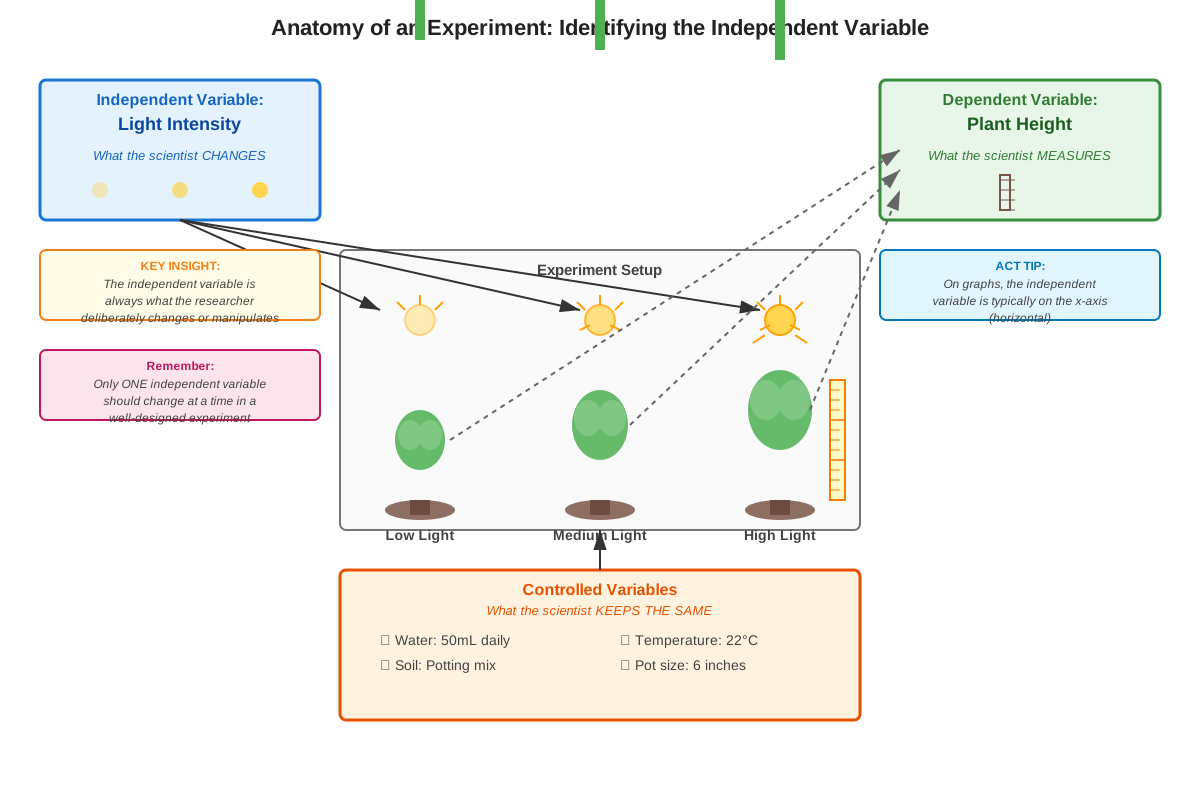
The independent variable is the factor in an experiment that the researcher deliberately manipulates, changes, or selects to observe its effect on other variables. It is called "independent" because its value is not dependent on other variables in the experiment—instead, it is the cause in a cause-and-effect relationship. The independent variable represents the input, treatment, or condition that scientists systematically vary to test a hypothesis.
Key characteristics of independent variables include:
- They are controlled by the experimenter
- They are manipulated before measuring outcomes
- They typically appear on the x-axis of graphs
- They are listed in the first column of data tables
- They represent the presumed cause in a causal relationship
- Only one independent variable should be changed at a time in a well-designed experiment
Independent Variables in Experimental Design
In controlled experiments, researchers must carefully select and manipulate independent variables while keeping all other factors constant. This isolation allows scientists to establish clear cause-and-effect relationships. For example, if a biologist wants to test how temperature affects enzyme activity, temperature becomes the independent variable. The researcher would expose enzyme samples to different temperatures (perhaps 10°C, 20°C, 30°C, 40°C, and 50°C) while keeping all other factors identical—same enzyme concentration, same pH, same substrate concentration, same time period.
The selection of appropriate independent variables requires careful consideration of the research question. Scientists must choose variables that are:
- Measurable and quantifiable
- Controllable within the experimental setup
- Relevant to the hypothesis being tested
- Capable of being varied across a meaningful range
- Independent of other factors in the system
Identifying Independent Variables in Data Representations
On the ACT Science test, independent variables most commonly appear in graphs and tables. Understanding standard conventions for displaying independent variables is crucial for rapid question answering.
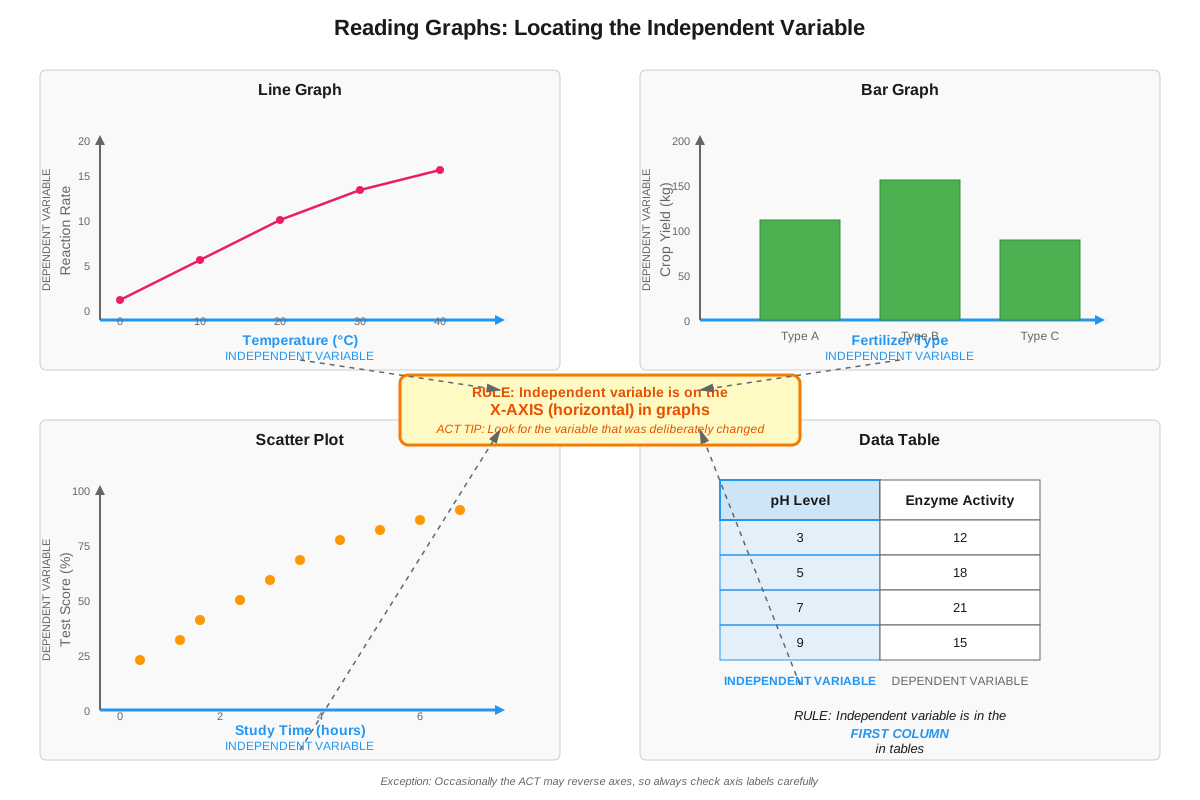
In Graphs:
- Independent variables typically appear on the x-axis (horizontal axis)
- The x-axis shows the range of values the experimenter selected
- Multiple data series may be plotted, but they all share the same independent variable
- The independent variable's units are labeled on the axis
In Tables:
- Independent variables typically appear in the leftmost column or top row
- Column or row headers identify the independent variable
- Values progress systematically (increasing or decreasing)
- Multiple trials may be shown, but the independent variable values remain consistent
| Temperature (°C) | Reaction Rate (mol/s) | Product Yield (%) |
|---|---|---|
| 20 | 0.5 | 45 |
| 40 | 1.2 | 68 |
| 60 | 2.1 | 82 |
| 80 | 1.8 | 71 |
In this example, temperature is clearly the independent variable—it's in the first column, and the researcher selected these specific values to test.
Types of Independent Variables
Independent variables can be classified into several categories based on their nature:
Quantitative Independent Variables: These involve numerical measurements that can be ordered and have meaningful intervals. Examples include temperature, time, concentration, distance, mass, and volume. These are most common on the ACT Science test because they produce clear numerical data.
Categorical Independent Variables: These involve distinct groups or categories without inherent numerical order. Examples include species type, treatment vs. control group, different materials, or different experimental conditions. For instance, comparing plant growth in sandy soil vs. clay soil vs. loamy soil involves a categorical independent variable.
Time as an Independent Variable: Many experiments use time as the independent variable, measuring how a system changes over hours, days, or years. Growth studies, decay experiments, and reaction kinetics all frequently use time as the independent variable.
Multiple Independent Variables and Factorial Designs
While the ideal controlled experiment manipulates only one independent variable at a time, some complex studies examine multiple independent variables simultaneously. These factorial designs allow researchers to study interactions between variables. However, on the ACT Science test, questions typically focus on identifying the primary independent variable or understanding how one specific variable was manipulated.
When encountering passages with multiple variables being changed, students should:
- Identify which variable is being asked about in the specific question
- Recognize that each variable can be considered independently
- Understand that well-designed studies often conduct separate experiments for each variable
- Look for phrases like "in Experiment 1" vs. "in Experiment 2" that indicate different independent variables
Relationship Between Independent and Dependent Variables
The independent variable and dependent variable form a fundamental pair in experimental science. The dependent variable is what the researcher measures or observes—it "depends" on the independent variable. Understanding this relationship is crucial for ACT success:
- Independent variable → what the experimenter changes (the cause)
- Dependent variable → what the experimenter measures (the effect)
For example, in an experiment testing how fertilizer amount affects plant height:
- Independent variable: amount of fertilizer (controlled by researcher)
- Dependent variable: plant height (measured as a result)
Concept Relationships
The concept of independent variables serves as a cornerstone for understanding experimental design and data analysis. The relationship flows as follows:
Scientific Method → leads to → Hypothesis Formation → requires → Experimental Design → necessitates → Independent Variable Selection → produces changes in → Dependent Variables → while maintaining → Controlled Variables
Independent variables connect directly to dependent variables through cause-and-effect relationships. When the independent variable is manipulated, it produces measurable changes in the dependent variable, which is precisely what researchers aim to observe and quantify. This relationship is fundamental to establishing scientific evidence.
The concept also connects to controlled variables (constants), which are factors deliberately kept the same throughout an experiment. Understanding the distinction between independent variables (what changes), dependent variables (what's measured), and controlled variables (what stays constant) forms the complete picture of experimental design.
Within data representation, independent variables connect to graph interpretation skills. Recognizing that independent variables typically occupy the x-axis allows students to quickly orient themselves to any graph and understand what relationship is being displayed. This connects further to trend analysis, where students must describe how the dependent variable changes as the independent variable increases or decreases.
The concept extends to more advanced topics like correlation versus causation, where understanding that correlation between two variables doesn't necessarily mean one is independent and the other dependent helps students evaluate scientific claims critically.
High-Yield Facts
⭐ The independent variable is what the experimenter deliberately changes or manipulates in an experiment
⭐ Independent variables typically appear on the x-axis of graphs and in the first column of tables
⭐ A well-designed experiment changes only ONE independent variable at a time to establish clear cause-and-effect relationships
⭐ The independent variable is the presumed CAUSE in a cause-and-effect relationship, while the dependent variable is the EFFECT
⭐ Common ACT independent variables include time, temperature, concentration, distance, mass, and different treatment groups
- Independent variables are selected by the researcher before the experiment begins, not measured as outcomes
- Multiple trials of an experiment will use the same independent variable values to ensure reproducibility
- When comparing two experiments in a passage, each experiment may have a different independent variable
- The range and intervals of the independent variable should be chosen to adequately test the hypothesis
- Independent variables must be measurable, controllable, and relevant to the research question
- In observational studies (not true experiments), the "independent variable" may be a naturally occurring factor that researchers observe rather than manipulate
- The units of measurement for the independent variable are always specified in properly designed experiments
- Changes in the independent variable should precede changes in the dependent variable temporally
Quick check — test yourself on Independent variable so far.
Try Flashcards →Common Misconceptions
Misconception: The independent variable is always on the x-axis of every graph.
Correction: While this is the standard convention and true in approximately 95% of ACT Science graphs, occasionally graphs may reverse this convention. Always check axis labels to confirm which variable is which. The independent variable is defined by what the experimenter manipulated, not by its position on a graph.
Misconception: The independent variable is the one that depends on other factors.
Correction: This is exactly backward. The independent variable is "independent" because it doesn't depend on other variables in the experiment—it's what the researcher controls. The dependent variable is what depends on (is affected by) the independent variable.
Misconception: An experiment can have multiple independent variables being changed simultaneously.
Correction: While factorial designs do exist, a well-controlled experiment typically changes only ONE independent variable at a time. If multiple factors are changing, it becomes impossible to determine which factor caused any observed effects. The ACT typically presents experiments that follow this single-variable principle.
Misconception: The independent variable is always numerical.
Correction: Independent variables can be categorical (different types, groups, or conditions) rather than numerical. For example, comparing three different species of plants or testing different materials involves categorical independent variables.
Misconception: Time is never an independent variable.
Correction: Time is frequently used as an independent variable in experiments that measure how systems change over time. Growth studies, decay experiments, and reaction rate studies commonly use time as the independent variable.
Misconception: The independent variable is whichever variable has the larger numbers.
Correction: The magnitude of values has nothing to do with whether a variable is independent or dependent. The distinction is based on experimental design—what the researcher manipulates versus what they measure.
Misconception: In observational studies, there are no independent variables.
Correction: Even in observational studies where researchers don't actively manipulate variables, there are still independent and dependent variables. The independent variable is the factor being examined for its potential effect, even if it occurs naturally rather than being experimentally controlled.
Worked Examples
Example 1: Identifying Independent Variables in a Biology Experiment
Passage Summary: Scientists conducted an experiment to determine how light intensity affects the rate of photosynthesis in aquatic plants. They placed identical plants in separate tanks and exposed them to different light intensities: 100 lux, 500 lux, 1000 lux, and 1500 lux. After 2 hours, they measured the amount of oxygen produced by each plant. The results are shown in Table 1.
| Light Intensity (lux) | Oxygen Produced (mL) |
|---|---|
| 100 | 2.3 |
| 500 | 8.7 |
| 1000 | 15.2 |
| 1500 | 16.1 |
Question: In this experiment, what was the independent variable?
Solution Process:
Step 1: Identify what the researchers deliberately changed or manipulated.
- The passage states they "exposed them to different light intensities"
- The researchers selected specific values: 100, 500, 1000, and 1500 lux
Step 2: Confirm by checking the data representation.
- Light intensity appears in the first column of the table
- These values were predetermined by the researchers, not measured as outcomes
Step 3: Verify the cause-and-effect relationship.
- The hypothesis is about how light intensity AFFECTS photosynthesis rate
- Light intensity is the cause (independent variable)
- Oxygen production is the effect (dependent variable)
Answer: The independent variable is light intensity (measured in lux).
Connection to Learning Objectives: This example demonstrates how to identify the independent variable by recognizing what the experimenter manipulated (Objective 1), understanding that it represents the cause in the experimental design (Objective 2), and locating it in the data table structure (Objective 6).
Example 2: Analyzing a Complex Graph with Multiple Data Series
Passage Summary: Researchers investigated how temperature affects the solubility of three different salts: sodium chloride (NaCl), potassium nitrate (KNO₃), and calcium sulfate (CaSO₄). They measured the maximum amount of each salt that could dissolve in 100 mL of water at temperatures ranging from 0°C to 100°C. Figure 1 shows their results.
[Description of Figure 1: A line graph with temperature (°C) on the x-axis ranging from 0 to 100, and solubility (g/100mL) on the y-axis ranging from 0 to 250. Three lines represent the three salts, with KNO₃ showing the steepest increase, NaCl showing a moderate increase, and CaSO₄ showing a slight decrease.]
Question 1: What is the independent variable in this study?
Solution Process:
Step 1: Examine the graph axes.
- X-axis: Temperature (°C)
- Y-axis: Solubility (g/100mL)
Step 2: Determine which variable the researchers controlled.
- The researchers selected specific temperatures at which to measure solubility
- Temperature was manipulated; solubility was measured as a result
Step 3: Apply the standard graphing convention.
- Independent variables typically appear on the x-axis
- This confirms temperature is the independent variable
Answer: Temperature (in degrees Celsius) is the independent variable.
Question 2: Based on the graph, what would likely happen to the solubility of KNO₃ if the temperature were increased to 120°C?
Solution Process:
Step 1: Identify the trend for KNO₃.
- The line shows a steep, consistent increase as temperature increases
- The relationship appears approximately linear or slightly exponential
Step 2: Extrapolate beyond the data range.
- At 100°C, KNO₃ solubility is approximately 240 g/100mL
- The trend suggests continued increase beyond 100°C
Step 3: Make a prediction based on the independent variable change.
- Increasing the independent variable (temperature) from 100°C to 120°C
- Would likely result in continued increase in the dependent variable (solubility)
Answer: The solubility of KNO₃ would likely continue to increase, exceeding 240 g/100mL.
Connection to Learning Objectives: This example demonstrates identifying the independent variable in a graph (Objective 1), applying this knowledge to predict outcomes when the independent variable changes (Objective 5), and analyzing graphs to determine variable placement (Objective 6).
Exam Strategy
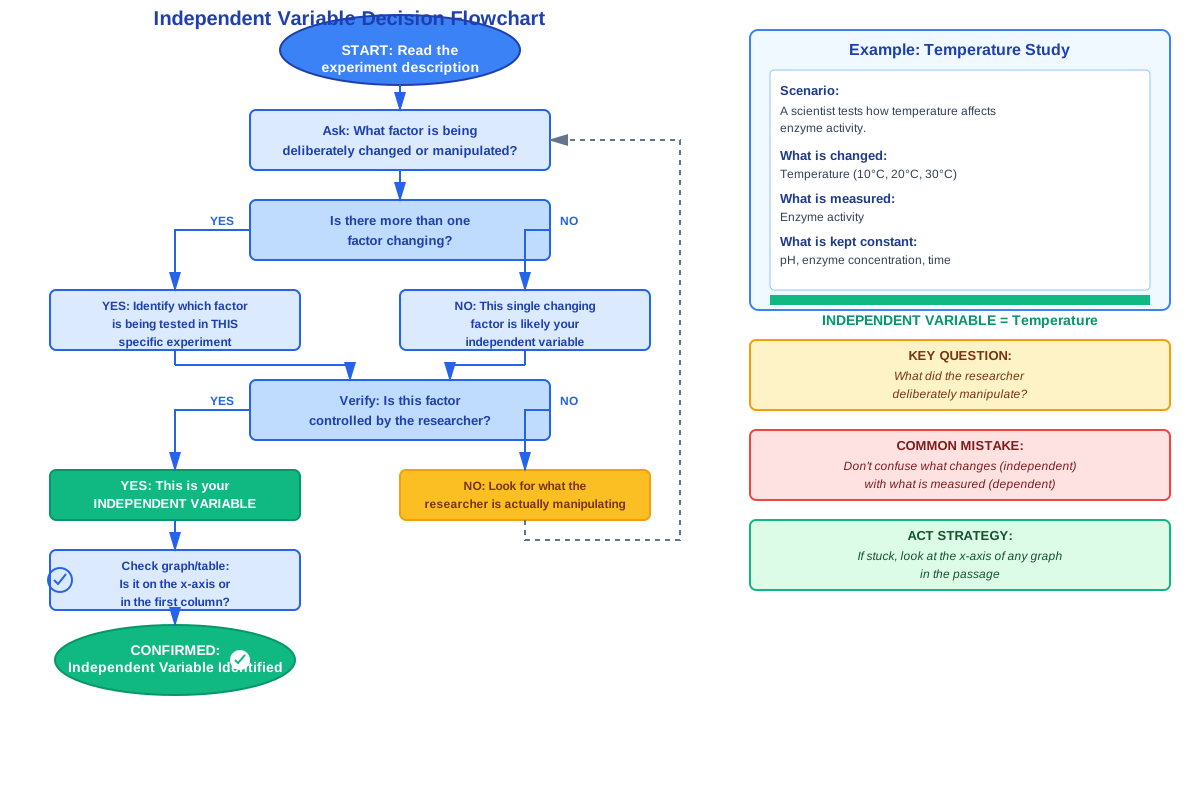
When approaching ACT Science questions involving independent variables, employ this systematic strategy:
Step 1: Rapid Passage Orientation (15-20 seconds)
- Immediately scan all graphs and tables for axis labels and column headers
- Identify what appears on x-axes and in first columns—these are likely independent variables
- Note any phrases in the passage like "researchers varied," "scientists manipulated," or "different conditions were tested"
Step 2: Trigger Word Recognition
Watch for these high-yield phrases that signal independent variable questions:
- "What did the researchers manipulate?"
- "Which factor was varied?"
- "What was changed between experiments?"
- "As [variable] increased..."
- "The effect of [variable] on..."
- "Which variable was the independent variable?"
Step 3: Question-Specific Approach
For direct identification questions: Look for what the experimenter controlled before the experiment began. Ask yourself: "What did they decide to change?"
For graph interpretation questions: Identify the x-axis variable first, then trace how the y-axis variable responds to changes in the x-axis variable.
For experimental design questions: Determine what single factor differs between experimental groups or trials.
For prediction questions: Identify the independent variable, then extrapolate the trend shown in the data.
Step 4: Process of Elimination
- Eliminate any answer choices that describe measured outcomes (these are dependent variables)
- Eliminate choices that describe factors kept constant (these are controlled variables)
- Eliminate choices that describe equipment or procedures rather than variables
- The remaining choice should be what the experimenter deliberately changed
Time Allocation Advice:
Independent variable questions are typically among the fastest to answer (20-30 seconds each) because they require pattern recognition rather than complex calculation. If you find yourself spending more than 45 seconds on an independent variable question, you may be overthinking it. Return to basics: What did the experimenter change?
Exam Tip: If a question asks about "the effect of X on Y," X is almost always the independent variable and Y is the dependent variable. This linguistic pattern appears frequently on the ACT.
Memory Techniques
Mnemonic for Variable Types: "I Choose, D Depends, C Constant"
- Independent = I Choose (what the experimenter chooses to manipulate)
- Dependent = Depends (depends on the independent variable)
- Controlled = Constant (kept constant throughout)
Visualization Strategy: The Cause-Effect Arrow
Visualize an arrow pointing from the independent variable to the dependent variable:
Independent Variable → Dependent Variable
(What I change)      → (What I measure)
(The cause)          → (The effect)
Acronym for Graph Reading: X-MARKS
- X = X-axis
- M = Manipulated variable
- A = Always check labels
- R = Researcher controlled
- K = Key to understanding
- S = Shows independent variable
The "Before and After" Rule
The independent variable is decided BEFORE the experiment starts. The dependent variable is measured AFTER the experiment runs. This temporal sequence helps distinguish between them.
The "Table First Column" Rule
In data tables, the independent variable almost always appears in the first (leftmost) column. Memorize: "First column, first choice—that's what the researcher chose."
Summary
The independent variable represents the factor that researchers deliberately manipulate or control in an experiment to observe its effect on other variables. It is the presumed cause in a cause-and-effect relationship and forms the foundation of experimental design. On the ACT Science test, identifying independent variables is essential for interpreting data representations, understanding experimental procedures, and predicting outcomes. Independent variables typically appear on the x-axis of graphs and in the first column of tables, following standard scientific conventions. A well-designed experiment manipulates only one independent variable at a time while keeping all other factors constant, allowing researchers to establish clear causal relationships. Mastery of this concept enables students to quickly orient themselves to any ACT Science passage, understand the structure of experiments, and accurately answer questions about experimental design, data interpretation, and scientific reasoning. The ability to distinguish independent variables from dependent variables (what's measured) and controlled variables (what's kept constant) is fundamental to achieving high scores on the ACT Science section.
Key Takeaways
- The independent variable is what the experimenter deliberately changes or manipulates—it's the cause in a cause-and-effect relationship
- Independent variables typically appear on the x-axis of graphs and in the first column of tables
- Well-designed experiments change only ONE independent variable at a time to establish clear causation
- Independent variables are selected before the experiment begins; dependent variables are measured after
- Common ACT independent variables include time, temperature, concentration, distance, and different treatment conditions
- To identify the independent variable, ask: "What did the researcher choose to change or vary?"
- Understanding independent variables is essential for approximately 15-20% of ACT Science questions and appears across all passage types
Related Topics
Dependent Variables: The natural complement to independent variables, dependent variables represent what researchers measure as outcomes. Mastering independent variables makes understanding dependent variables straightforward, as they form opposite sides of the cause-effect relationship.
Controlled Variables (Constants): These are factors deliberately kept the same throughout an experiment. Understanding how controlled variables differ from independent variables is crucial for evaluating experimental design quality.
Experimental Design and the Scientific Method: Independent variables are one component of the broader experimental design process. This topic explores how scientists structure entire studies, including hypothesis formation, control groups, and data collection methods.
Graph and Table Interpretation: Since independent variables appear consistently in specific locations on graphs and tables, mastering this topic enhances overall data interpretation skills, which comprise 38% of the ACT Science section.
Correlation vs. Causation: Understanding independent variables helps distinguish between mere correlation (two variables changing together) and causation (one variable causing changes in another), a critical scientific reasoning skill.
Practice CTA
Now that you understand the fundamental concept of independent variables and how they appear on the ACT Science test, it's time to reinforce your learning through active practice. Complete the practice questions associated with this topic to test your ability to identify independent variables in various experimental contexts, interpret graphs and tables accurately, and apply this knowledge to ACT-style questions. Use the flashcards to drill the key definitions and trigger words until recognition becomes automatic. Remember: identifying independent variables quickly and accurately will save you valuable time on test day and form the foundation for understanding more complex experimental designs. You've built a strong conceptual foundation—now strengthen it through deliberate practice!
Sign up free to keep reading
Create a free AnvayaPrep account to finish this ACT guide on Independent variable — plus flashcards and practice questions.