Overview
Reading charts is a fundamental skill tested extensively throughout the ACT Science section, appearing in approximately 40% of all science passages. This skill involves extracting, interpreting, and analyzing quantitative information presented in various graphical formats including bar graphs, line graphs, pie charts, scatter plots, and combination charts. The ACT Science test is not primarily a test of scientific knowledge but rather a test of scientific reasoning and data interpretation skills, making chart reading one of the most critical competencies for achieving a high score.
Mastery of ACT reading charts enables students to quickly identify trends, compare values, recognize relationships between variables, and draw evidence-based conclusions from visual data representations. Unlike traditional science exams that emphasize memorization of facts, the ACT Science section presents students with unfamiliar data sets and expects them to extract relevant information efficiently under time pressure. Students typically have only 5 minutes and 15 seconds per passage, which means chart reading must become an automatic, rapid-fire skill rather than a laborious process.
This topic serves as the foundation for the entire Data Representation category of ACT Science passages, which constitutes approximately 30-40% of the test. Chart reading skills directly support other essential competencies including identifying patterns in data, making predictions based on trends, and evaluating the relationship between multiple variables. These skills also transfer to Research Summaries and Conflicting Viewpoints passages, where charts often supplement experimental descriptions or theoretical arguments. Without strong chart reading abilities, students will struggle with time management and accuracy across all three passage types on the ACT Science section.
Learning Objectives
- [ ] Identify when Reading charts is being tested in ACT Science passages
- [ ] Explain the core rule or strategy behind Reading charts for maximum efficiency
- [ ] Apply Reading charts to ACT-style questions accurately and within time constraints
- [ ] Distinguish between different chart types and select appropriate reading strategies for each
- [ ] Extract specific numerical values from charts with precision, including interpolation between data points
- [ ] Identify trends, patterns, and relationships represented in single and multiple chart formats
- [ ] Recognize common chart features including axes labels, units, legends, and scales that affect interpretation
Prerequisites
- Basic mathematical literacy: Understanding of numerical scales, decimals, fractions, and percentages is essential for interpreting quantitative values on chart axes and data points
- Coordinate system familiarity: Knowledge of x-axis (horizontal) and y-axis (vertical) orientation enables quick identification of independent and dependent variables
- Unit awareness: Recognition that measurements require units (meters, seconds, grams, etc.) prevents misinterpretation of magnitude and scale
- Comparison skills: Ability to determine which values are larger, smaller, increasing, or decreasing forms the basis for trend identification
- Variable concept: Understanding that charts represent relationships between variables (factors that can change) is fundamental to interpreting what the data shows
Why This Topic Matters
Chart reading represents one of the highest-yield study investments for ACT Science preparation because it appears in virtually every passage type. Data Representation passages, which are entirely built around charts and tables, account for 5-6 passages per test. Additionally, Research Summaries passages (which describe experiments) almost always include charts showing experimental results, and even Conflicting Viewpoints passages occasionally incorporate graphical data to support different theoretical positions. Conservative estimates suggest that 25-30 of the 40 ACT Science questions directly require chart reading skills.
In real-world applications, chart reading is an essential literacy skill for the 21st century. Scientists use graphs to communicate research findings in publications and presentations. Medical professionals interpret patient data displayed in charts to make treatment decisions. Business analysts rely on graphical representations to identify market trends and inform strategic planning. Environmental scientists track climate data through complex multi-variable charts. Engineers use graphs to optimize designs and troubleshoot problems. The ability to quickly extract meaning from visual data representations is a transferable skill that extends far beyond standardized testing into academic, professional, and civic contexts.
On the ACT specifically, chart reading questions typically appear in several predictable formats: direct value extraction ("According to Figure 1, what was the temperature at 5 minutes?"), trend identification ("As pressure increased, volume..."), comparison questions ("Which trial had the highest pH?"), interpolation tasks ("Based on the graph, the value at 3.5 would most likely be..."), and extrapolation questions ("If the pattern continues, the value at 12 would be closest to..."). Recognizing these question patterns allows students to develop systematic approaches that maximize speed and accuracy.
Core Concepts
Chart Components and Anatomy
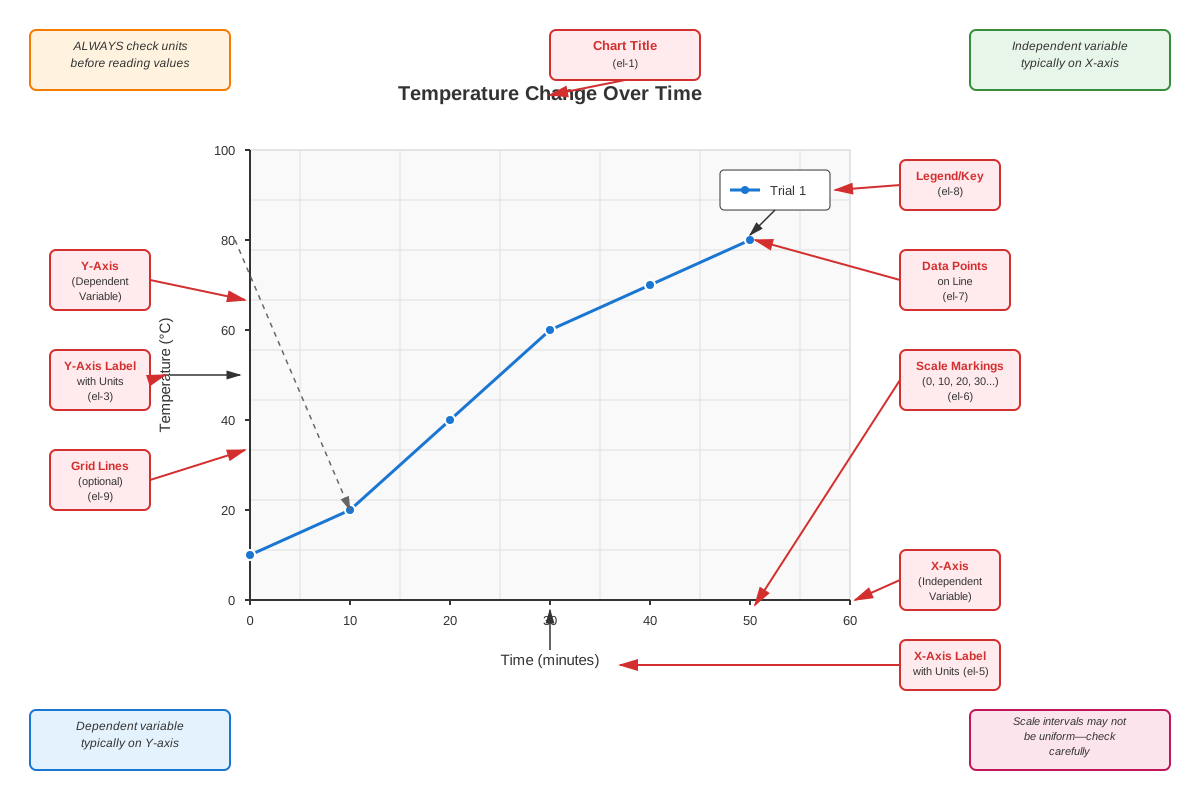
Every chart contains essential components that must be identified before attempting to extract data. The axes form the foundation of most charts, with the horizontal x-axis typically representing the independent variable (the factor being manipulated or controlled) and the vertical y-axis representing the dependent variable (the factor being measured or observed). Each axis must have a label identifying what variable it represents and units specifying how that variable is measured. For example, an axis might be labeled "Temperature (°C)" where "Temperature" is the variable and "°C" (degrees Celsius) is the unit.
The scale of each axis determines how values are distributed along that axis. Scales may be linear (evenly spaced intervals like 0, 10, 20, 30) or logarithmic (exponentially spaced intervals like 1, 10, 100, 1000). The ACT primarily uses linear scales, but recognizing the scale type prevents misinterpretation. The origin is the point where both axes meet, typically (but not always) representing zero for both variables. Some charts use a "broken axis" indicated by a zigzag line, which means the scale jumps to show a relevant range without including all intermediate values.
Legends or keys appear when multiple data sets are displayed on the same chart, using different colors, symbols, or line styles to distinguish between them. For instance, a chart might show temperature data for three different cities using solid, dashed, and dotted lines, with the legend identifying which line represents which city. The title of the chart provides context about what data is being displayed, though ACT passages often integrate this information into the figure caption (e.g., "Figure 1: Effect of fertilizer concentration on plant height").
Types of Charts on the ACT
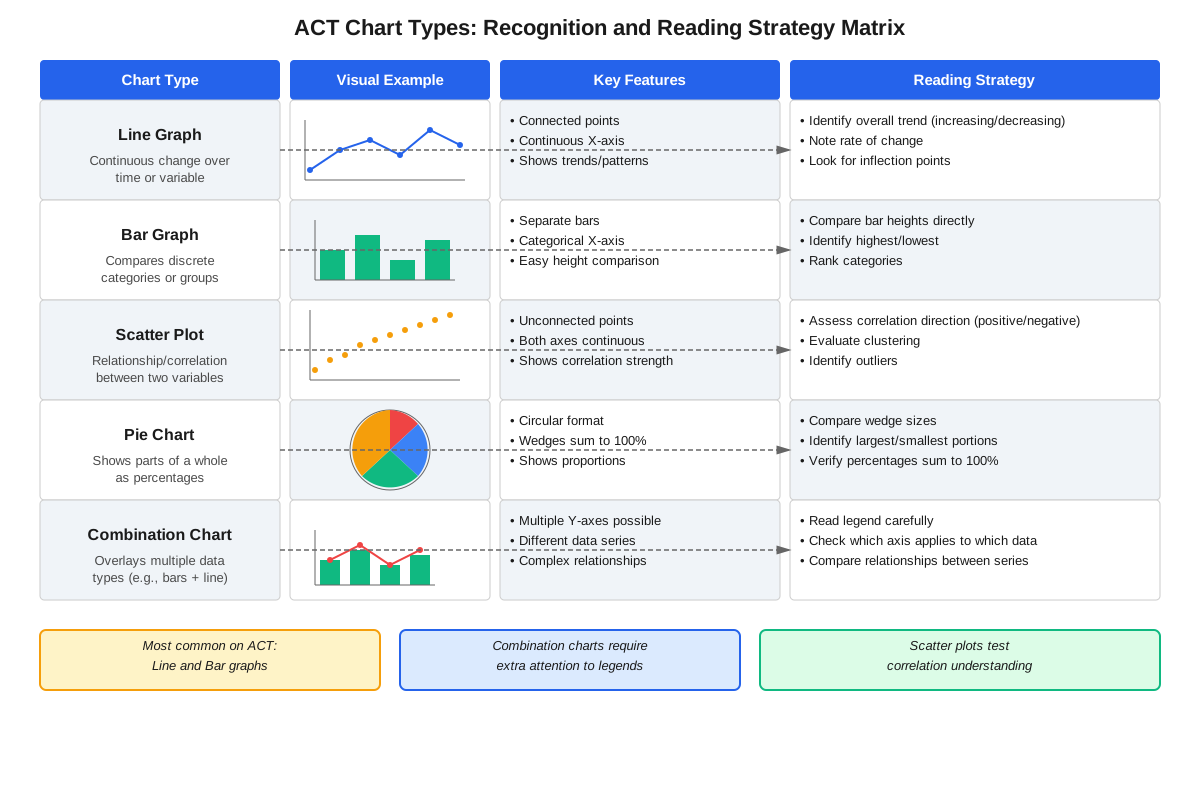
Line graphs display continuous data and are ideal for showing how one variable changes in relation to another, particularly over time. Data points are connected by lines, and the slope of these lines indicates the rate of change. A steep upward slope indicates rapid increase, a gentle slope indicates slow increase, a horizontal line indicates no change, and a downward slope indicates decrease. Multiple lines on the same graph allow for comparison between different conditions or groups.
Bar graphs (or bar charts) use rectangular bars to represent discrete categories or groups. The height or length of each bar corresponds to the value for that category. Bar graphs are particularly useful for comparing values across different groups. Bars may be vertical or horizontal, and grouped bar graphs show multiple related values for each category side-by-side, while stacked bar graphs show component parts that add up to a total.
Scatter plots display individual data points without connecting them, showing the relationship between two continuous variables. Each point represents one observation or measurement. Scatter plots reveal patterns such as positive correlation (as one variable increases, the other increases), negative correlation (as one variable increases, the other decreases), or no correlation (no clear relationship). The ACT may include a "line of best fit" or "trend line" drawn through the points to highlight the overall pattern.
Pie charts (or circle graphs) show parts of a whole, with each slice representing a percentage or proportion of the total. The entire circle represents 100% or the complete data set. While less common on the ACT than other chart types, pie charts appear occasionally to show composition or distribution data.
Combination charts integrate multiple chart types or multiple data sets into a single figure. For example, a chart might display bars for one variable and a line for another variable, using two different y-axes (one on the left, one on the right) with different scales. These require careful attention to which data corresponds to which axis.
Reading Strategies for Accuracy and Speed
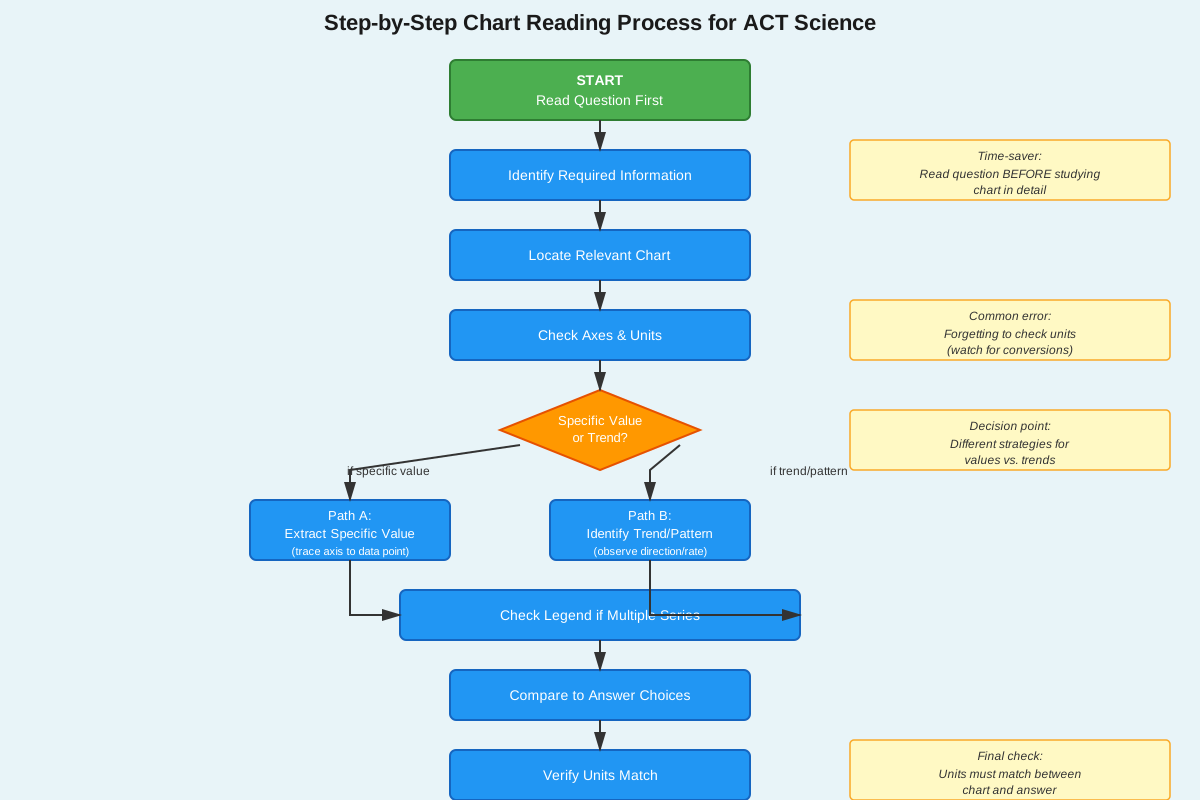
The SALT method provides a systematic approach to chart reading: Scan the structure (identify chart type, axes, labels, units, legend), Analyze what's being asked (locate the specific question requirement), Locate the relevant data (find the appropriate region of the chart), and Trace to the answer (follow from one axis to the data point to the other axis).
For direct value extraction, locate the known value on one axis, trace horizontally or vertically to the data point (line, bar, or point), then trace perpendicular to the other axis to read the corresponding value. Always check units and scale carefully. If the data point falls between marked intervals on the axis, estimate proportionally based on position.
For trend identification, observe the overall pattern of the data rather than focusing on individual points. Ask: Is the general direction upward (positive relationship), downward (negative relationship), or flat (no relationship)? Are there any notable features like peaks, valleys, plateaus, or inflection points where the trend changes direction?
For comparison questions, identify the specific data sets or conditions being compared, then systematically extract the relevant values for each and determine which is greater, lesser, or if they're equal. Create a mental or written note of the values to avoid confusion when multiple comparisons are needed.
For interpolation (estimating values between measured data points), identify the two nearest data points that bracket the target value, observe the pattern between them (linear, curved, etc.), and estimate where the target value would fall along that pattern. For extrapolation (estimating values beyond the measured range), extend the established trend, but recognize that this involves greater uncertainty.
Common Chart Features and Variations
Multiple y-axes appear when two variables with different scales or units are plotted on the same chart. One y-axis appears on the left side and another on the right side. The legend or data labels indicate which data set corresponds to which axis. This requires careful attention to avoid reading values from the wrong scale.
Error bars are small vertical or horizontal lines extending from data points that indicate the range of uncertainty or variability in measurements. While the ACT rarely asks students to calculate using error bars, their presence indicates measurement precision, with larger error bars suggesting greater uncertainty.
Shaded regions or colored zones on charts may indicate specific ranges of interest, such as "normal range," "danger zone," or different experimental conditions. These visual cues help organize the data and often relate directly to question content.
Logarithmic scales compress large ranges of data by using exponential intervals. Each major division represents a multiplication by a constant factor (typically 10) rather than addition of a constant amount. On the ACT, logarithmic scales are uncommon but may appear in passages dealing with pH, earthquake magnitude, or sound intensity.
Concept Relationships
Chart reading skills build hierarchically, with each level depending on mastery of previous levels. Basic component identification (recognizing axes, labels, units, and scales) forms the foundation that enables direct value extraction (reading specific numbers from charts). Direct value extraction then supports trend analysis (recognizing patterns across multiple data points), which in turn enables comparison and relationship identification (understanding how variables interact). These skills collectively support prediction and inference (interpolation and extrapolation), which represents the highest level of chart reading on the ACT.
The relationship between chart reading and other Data Representation skills is direct and essential. Chart reading provides the raw data that students then use for identifying patterns, making predictions, and drawing conclusions. Without accurate chart reading, all subsequent analysis becomes unreliable. Similarly, chart reading connects to Research Summaries passages by providing the results data from experiments, and to Conflicting Viewpoints passages by offering evidence that supports or contradicts different theoretical positions.
Within the broader ACT Science section, chart reading represents the primary mechanism for accessing information. The conceptual flow follows this pattern: Passage context → Chart presentation → Chart reading → Data extraction → Analysis and reasoning → Answer selection. Improving chart reading speed and accuracy creates a cascading positive effect on overall Science section performance because it reduces the time bottleneck at the data extraction stage, allowing more time for reasoning and answer evaluation.
Quick check — test yourself on Reading charts so far.
Try Flashcards →High-Yield Facts
- ⭐ The x-axis (horizontal) typically represents the independent variable, while the y-axis (vertical) represents the dependent variable
- ⭐ Always check axis labels and units before extracting any values from a chart
- ⭐ When a line graph slopes upward from left to right, the two variables have a positive (direct) relationship
- ⭐ When a line graph slopes downward from left to right, the two variables have a negative (inverse) relationship
- ⭐ Interpolation (estimating between data points) is more reliable than extrapolation (estimating beyond the data range)
- Bar height or length directly corresponds to the value being represented, making bar graphs ideal for quick comparisons
- Scatter plots show individual data points and are used to identify correlation patterns between two continuous variables
- Legends or keys are essential when multiple data sets appear on the same chart, distinguishing them by color, symbol, or line style
- A horizontal line on a graph indicates that the y-variable remains constant regardless of changes in the x-variable
- The steepness of a line's slope indicates the rate of change, with steeper slopes representing faster changes
- When axes don't start at zero (broken axis), the visual differences between values may appear exaggerated
- Multiple y-axes (one left, one right) require careful attention to match each data set with its corresponding scale
Common Misconceptions
Misconception: The tallest bar or highest point on a chart always represents the "best" or most desirable outcome.
Correction: Height or position simply represents magnitude of the measured variable. Whether a higher value is better depends entirely on context. For example, higher pollution levels or disease rates are undesirable despite being "higher" values.
Misconception: Lines connecting data points on a line graph mean that data was collected at every point along the line.
Correction: Lines connect discrete data points to show the trend or pattern. Data was only actually collected at the marked points; the line represents interpolation between measurements and suggests continuity.
Misconception: When two lines on a graph cross, it means the variables are equal at that point.
Correction: Crossing lines mean that the y-values for two different data sets are equal at that x-value. The variables themselves (what's being measured) remain distinct; only their measured values coincide at that specific point.
Misconception: All charts use the same scale intervals, so visual distance always represents the same numerical difference.
Correction: Scale intervals vary between charts and even between axes on the same chart. Always check the numerical labels on axes rather than relying on visual spacing. A 1-inch distance might represent 10 units on one chart and 1000 units on another.
Misconception: If a question asks about a value not explicitly marked on the chart, it's a trick question or cannot be answered.
Correction: The ACT frequently requires interpolation (estimating between marked points) or extrapolation (extending trends beyond the data range). These questions test the ability to recognize patterns and make reasonable estimates based on the data provided.
Misconception: The title or caption of a chart contains all necessary information, so axis labels don't need to be checked.
Correction: Axis labels provide essential specific information about what variables are plotted and in what units. The title gives general context, but accurate data extraction requires reading axis labels, scales, and units carefully for every question.
Misconception: Scatter plots with widely dispersed points contain errors or bad data.
Correction: Scatter in data points reflects natural variability in measurements and doesn't necessarily indicate errors. Wide scatter suggests weak correlation between variables, while tight clustering suggests strong correlation. Both patterns provide valid information about the relationship being studied.
Worked Examples
Example 1: Multi-Step Line Graph Analysis
Passage Context: A study examined how temperature affects the rate of a chemical reaction. Figure 1 shows the reaction rate (in moles per second) at different temperatures (in °C).
Figure 1 Description: A line graph with Temperature (°C) on the x-axis ranging from 0 to 100 in intervals of 20, and Reaction Rate (moles/sec) on the y-axis ranging from 0 to 50 in intervals of 10. The plotted line shows points at: (0, 5), (20, 10), (40, 20), (60, 35), (80, 45), and (100, 50).
Question: Based on Figure 1, at approximately what temperature would the reaction rate most likely be 30 moles/sec?
Solution Process:
Step 1 - Scan the structure: Identify that this is a line graph with temperature as the independent variable (x-axis) and reaction rate as the dependent variable (y-axis). Note the units: °C for temperature and moles/sec for reaction rate.
Step 2 - Analyze what's being asked: The question provides a reaction rate value (30 moles/sec) and asks for the corresponding temperature. This is a reverse lookup requiring interpolation since 30 moles/sec is not explicitly plotted.
Step 3 - Locate the relevant data: Find 30 on the y-axis (reaction rate). This value falls between the plotted points at (60, 35) and (40, 20). Since 30 is between 20 and 35, the corresponding temperature must be between 40°C and 60°C.
Step 4 - Trace to the answer: Estimate proportionally. The value 30 is closer to 35 than to 20. Specifically, 30 is 10 units above 20 (out of a 15-unit range from 20 to 35), which is 10/15 = 2/3 of the way from 20 to 35. Therefore, the temperature should be approximately 2/3 of the way from 40°C to 60°C. The temperature range is 20°C, and 2/3 of 20 is approximately 13.3, so 40 + 13.3 ≈ 53°C.
Answer: Approximately 53-55°C (any answer in this range demonstrates proper interpolation)
Connection to Learning Objectives: This example demonstrates applying chart reading to ACT-style questions accurately, specifically using interpolation to estimate values between data points, and shows the systematic SALT method in action.
Example 2: Comparison Across Multiple Data Sets
Passage Context: Three different plant species (A, B, and C) were grown under identical conditions, and their heights were measured weekly for 4 weeks. Figure 2 shows the results.
Figure 2 Description: A line graph with Time (weeks) on the x-axis (0, 1, 2, 3, 4) and Height (cm) on the y-axis (0 to 40 in intervals of 10). Three lines are shown:
- Species A (solid line): (0, 5), (1, 10), (2, 18), (3, 28), (4, 38)
- Species B (dashed line): (0, 8), (1, 12), (2, 16), (3, 20), (4, 24)
- Species C (dotted line): (0, 10), (1, 15), (2, 19), (3, 22), (4, 24)
Question: Which species showed the greatest increase in height between Week 2 and Week 4?
Solution Process:
Step 1 - Scan the structure: Identify the line graph with three distinct data sets differentiated by line style. Note the legend showing which line represents which species. Confirm axes show time (weeks) and height (cm).
Step 2 - Analyze what's being asked: The question requires calculating the change in height (Week 4 value minus Week 2 value) for each species, then comparing to find the greatest increase.
Step 3 - Locate the relevant data: For each species, find the height values at Week 2 and Week 4:
- Species A: Week 2 = 18 cm, Week 4 = 38 cm
- Species B: Week 2 = 16 cm, Week 4 = 24 cm
- Species C: Week 2 = 19 cm, Week 4 = 24 cm
Step 4 - Calculate and compare:
- Species A increase: 38 - 18 = 20 cm
- Species B increase: 24 - 16 = 8 cm
- Species C increase: 24 - 19 = 5 cm
Species A showed the greatest increase at 20 cm.
Answer: Species A
Connection to Learning Objectives: This example demonstrates identifying when chart reading is being tested (comparison question), applying the core strategy of systematic value extraction for multiple data sets, and accurately executing multi-step calculations based on chart data.
Exam Strategy
When approaching ACT Science questions involving charts, implement a strategic sequence that maximizes efficiency. First, quickly scan the entire passage to identify how many charts are present and what types they are (line graphs, bar graphs, etc.). This preview takes only 5-10 seconds but provides crucial orientation. Second, read the questions before studying the charts in detail. This question-first approach allows targeted data extraction rather than attempting to memorize all chart information.
Trigger words and phrases that signal chart reading questions include: "According to Figure X," "Based on the graph," "As shown in the chart," "At what value of [variable]," "Which trial/group/condition," "What was the [variable] when," and "The data indicate that." When these phrases appear, immediately locate the referenced figure and prepare to extract specific information.
For process of elimination, use chart data to definitively rule out incorrect answers. If an answer choice states "the temperature increased throughout the experiment" but the chart clearly shows a decrease after a certain point, eliminate that choice immediately. Quantitative data from charts provides objective evidence that makes elimination highly reliable. When answer choices provide specific numerical values, trace each value on the chart to verify or eliminate it.
Time allocation for chart reading questions should average 45-60 seconds per question, including time to locate the chart, extract data, and select an answer. If a question requires comparing multiple values across different charts or performing calculations, allow up to 75 seconds. If you cannot locate the relevant data within 20 seconds, mark the question and return to it after completing easier questions in the passage. Never spend more than 90 seconds on a single chart reading question during your first pass through a passage.
Common question patterns include: (1) Direct extraction - simply read a value from the chart; (2) Trend identification - describe the relationship between variables; (3) Comparison - determine which value is greater/lesser; (4) Interpolation - estimate a value between data points; (5) Extrapolation - predict a value beyond the data range. Recognizing these patterns allows you to immediately know what type of chart interaction is required.
Exam Tip: When a question asks about a trend or pattern, focus on the overall direction and shape of the data rather than individual data points. The ACT tests big-picture understanding more often than memorization of specific values.
Memory Techniques
SALT Method Mnemonic: Remember "Scientists Always Love Tables" to recall the chart reading sequence: Scan structure, Analyze the question, Locate data, Trace to answer.
Axis Identification: Use "X marks the spot you start" to remember that the x-axis (horizontal) typically represents the independent variable - the starting point or condition you control. The y-axis shows what happens as a result.
Slope Direction Memory: Visualize a person walking along the line from left to right. If they're walking uphill, the relationship is positive (both variables increase together). If they're walking downhill, the relationship is negative (as one increases, the other decreases). If they're walking on flat ground, there's no relationship (one variable doesn't affect the other).
Chart Type Selection: Remember "Lines for Long continuous changes, Bars for Big category comparisons, Scatter for Searching for correlations, Pie for Parts of a whole."
Unit Check Reminder: Before reading any value, touch or point to the axis label and whisper the unit. This physical action creates a habit that prevents unit-related errors. Think "Label Units Before Extracting" (LUBE - keeps your chart reading running smoothly).
Interpolation Visualization: Imagine the data points as stepping stones across a river. When you need a value between two stones, visualize where you would place your foot to step between them - proportionally closer to one stone or the other based on the value you're seeking.
Summary
Reading charts is the foundational skill for success on the ACT Science section, appearing in approximately 40% of all questions across all passage types. Mastery requires systematic identification of chart components (axes, labels, units, scales, legends), recognition of different chart types (line graphs, bar graphs, scatter plots, pie charts), and application of strategic reading methods. The SALT method (Scan, Analyze, Locate, Trace) provides a reliable framework for extracting data accurately and efficiently. Students must develop proficiency in direct value extraction, trend identification, comparison across data sets, interpolation between data points, and extrapolation beyond measured ranges. Success depends not on memorizing scientific content but on developing systematic approaches to visual data interpretation. Time management is critical, with most chart reading questions requiring 45-60 seconds to complete. Common pitfalls include failing to check units and scales, misinterpreting axis labels, and attempting to memorize all chart data rather than using a question-directed approach. By practicing these skills systematically and recognizing the predictable question patterns that appear on the ACT, students can transform chart reading from a potential weakness into a reliable source of quick, accurate points.
Key Takeaways
- Chart reading appears in approximately 40% of ACT Science questions and is essential for success across all passage types
- Always identify and verify axes labels, units, and scales before extracting any data from a chart
- The SALT method (Scan, Analyze, Locate, Trace) provides a systematic approach that maximizes accuracy and speed
- Line graphs show continuous relationships and trends; bar graphs compare discrete categories; scatter plots reveal correlations
- Interpolation (estimating between data points) is frequently tested and more reliable than extrapolation (estimating beyond the data range)
- Read questions before studying charts in detail to enable targeted, efficient data extraction
- The x-axis typically represents the independent variable (what's controlled), while the y-axis represents the dependent variable (what's measured)
Related Topics
Identifying Patterns in Data: Building on chart reading skills, this topic focuses on recognizing trends, cycles, and relationships across multiple data points or data sets, enabling prediction and inference questions.
Tables and Data Tables: While charts present data visually, tables organize data in rows and columns. Mastering both formats ensures comprehensive data interpretation skills for all ACT Science passage types.
Experimental Design and Variables: Understanding how experiments are structured helps interpret what charts are showing and why, connecting the visual data representation to the underlying scientific investigation.
Units and Measurement: Deep knowledge of scientific units, conversions, and measurement precision enhances chart reading accuracy and prevents common errors in data interpretation.
Statistical Concepts: Basic understanding of averages, ranges, and variability supports more sophisticated chart interpretation, particularly when error bars or multiple trials are presented.
Practice CTA
Now that you've mastered the core concepts and strategies for reading charts on the ACT Science section, it's time to put your knowledge into action! Complete the practice questions to reinforce these skills and identify any areas that need additional review. Use the flashcards to drill the high-yield facts and ensure automatic recall of key concepts. Remember, chart reading is a skill that improves dramatically with deliberate practice - each question you work through builds the pattern recognition and systematic thinking that will serve you on test day. You've got this!
Sign up free to keep reading
Create a free AnvayaPrep account to finish this ACT guide on Reading charts — plus flashcards and practice questions.