Overview
Trends in data represent one of the most frequently tested skills on the ACT Science section, appearing in approximately 30-40% of all data representation questions. This topic focuses on the ability to recognize, describe, and predict patterns within scientific data presented through graphs, tables, charts, and figures. Unlike questions that simply ask students to read individual data points, trend questions require analysis of how variables change in relation to one another across multiple measurements or conditions.
The ACT Science test is fundamentally a reading and reasoning test disguised as a science exam. While content knowledge helps, the primary skill being assessed is the ability to interpret scientific information quickly and accurately. ACT trends in data questions test whether students can identify increasing patterns, decreasing patterns, cyclical behaviors, plateaus, and more complex relationships between variables. These questions often use phrases like "as X increases, Y..." or "which statement best describes the relationship between..." Understanding trends is essential because it forms the foundation for making predictions, comparing experimental conditions, and drawing conclusions from scientific investigations.
Mastery of trend identification connects directly to other critical ACT Science skills, including data interpolation and extrapolation, comparing viewpoints across different experiments, and evaluating hypotheses based on experimental results. Students who excel at recognizing trends can move through the Science section more efficiently, spending less time on straightforward data interpretation questions and reserving more time for complex synthesis passages. This topic serves as a gateway skill that, once mastered, dramatically improves overall Science section performance.
Learning Objectives
- [ ] Identify when Trends in data is being tested in ACT Science passages
- [ ] Explain the core rule or strategy behind Trends in data analysis
- [ ] Apply Trends in data concepts to ACT-style questions accurately
- [ ] Distinguish between direct relationships, inverse relationships, and no relationship in data sets
- [ ] Predict values beyond the given data range based on established trends
- [ ] Recognize when trends change or exhibit non-linear patterns across different ranges
- [ ] Compare trends across multiple data sets or experimental conditions
Prerequisites
- Basic graph reading skills: Understanding x-axis, y-axis, data points, and scales is essential for locating information before analyzing trends
- Table interpretation: Ability to read rows and columns systematically ensures accurate data extraction from tabular formats
- Variable identification: Recognizing independent and dependent variables helps determine which direction to analyze trends
- Unit awareness: Understanding that different units measure different quantities prevents confusion when comparing data sets
- Basic mathematical relationships: Familiarity with concepts like "increase," "decrease," "proportional," and "inverse" provides the vocabulary for describing trends
Why This Topic Matters
In real-world scientific research, identifying trends in data represents the first step toward discovering meaningful patterns and relationships in nature. Scientists use trend analysis to predict climate changes, track disease progression, optimize chemical reactions, understand population dynamics, and develop new technologies. The ability to recognize patterns in data transcends any single scientific discipline and represents a fundamental skill for evidence-based decision-making in medicine, engineering, environmental science, and countless other fields.
On the ACT Science test, trend-related questions appear with remarkable consistency. Approximately 8-12 questions per test directly assess trend identification skills, making this one of the highest-yield topics for focused study. These questions typically appear in Data Representation passages (which comprise 30-40% of the Science section) but also frequently appear in Research Summaries passages when comparing experimental results. The ACT favors certain question formats: "As X increases, what happens to Y?" accounts for roughly 40% of trend questions, while "Which statement best describes the relationship..." comprises another 30%.
Common manifestations in exam passages include line graphs showing temperature changes over time, scatter plots displaying correlations between two variables, bar graphs comparing results across different conditions, and tables presenting numerical data across multiple trials. The ACT particularly favors questions that require students to synthesize information from multiple parts of a figure or compare trends across different experimental groups. Understanding how to quickly identify and articulate these patterns provides a significant competitive advantage on test day.
Core Concepts
Types of Relationships in Data
When analyzing trends in data, the first step involves categorizing the relationship between variables. The ACT primarily tests four fundamental relationship types that students must recognize instantly.
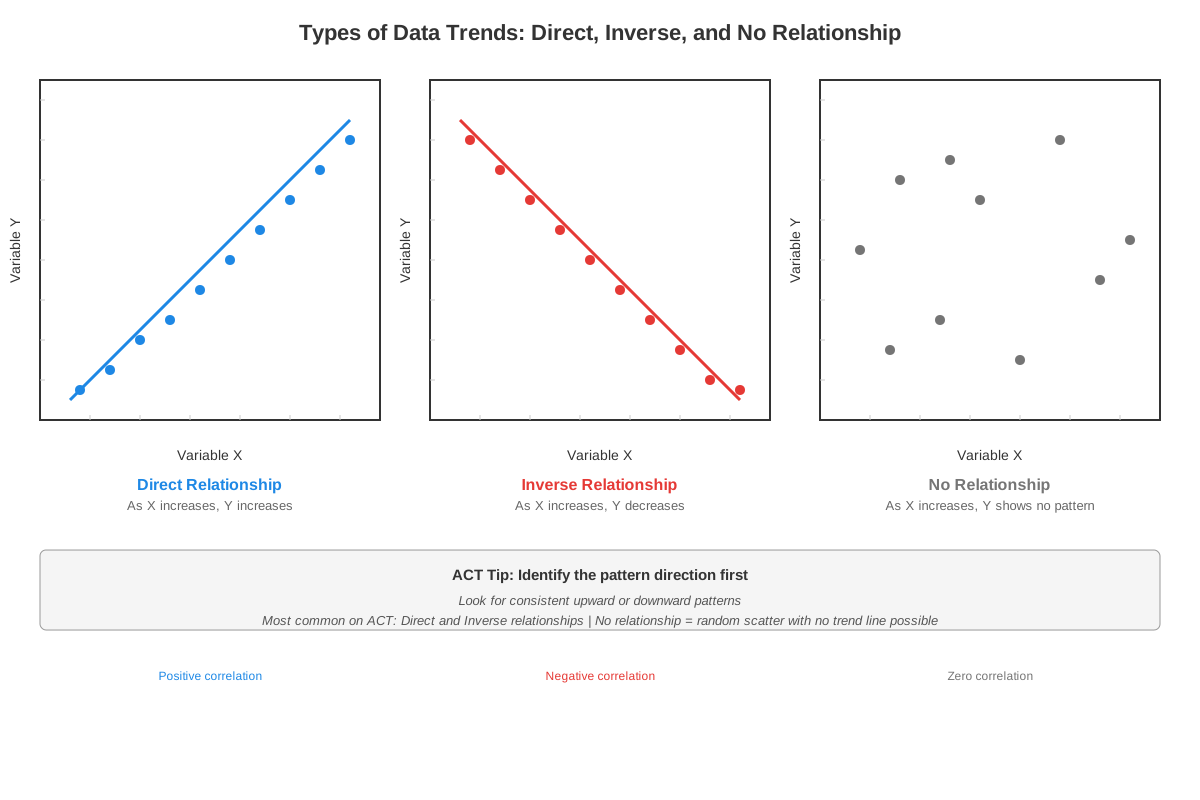
Direct (Positive) Relationships occur when both variables move in the same direction. As the independent variable increases, the dependent variable also increases. On a graph, this appears as an upward-sloping line or curve. For example, as temperature increases, the volume of a gas typically increases (Charles's Law). In tables, both columns show increasing values when read from top to bottom or left to right.
Inverse (Negative) Relationships occur when variables move in opposite directions. As the independent variable increases, the dependent variable decreases. Graphically, this manifests as a downward-sloping line or curve. A classic example is Boyle's Law: as pressure on a gas increases, its volume decreases. In tabular data, one column increases while the corresponding column decreases.
No Relationship (Independence) exists when changes in one variable show no consistent pattern with changes in another variable. On a graph, data points appear scattered with no clear upward or downward trend. In tables, values in one column vary randomly regardless of the other column's values. The ACT occasionally includes these to test whether students can recognize the absence of a relationship.
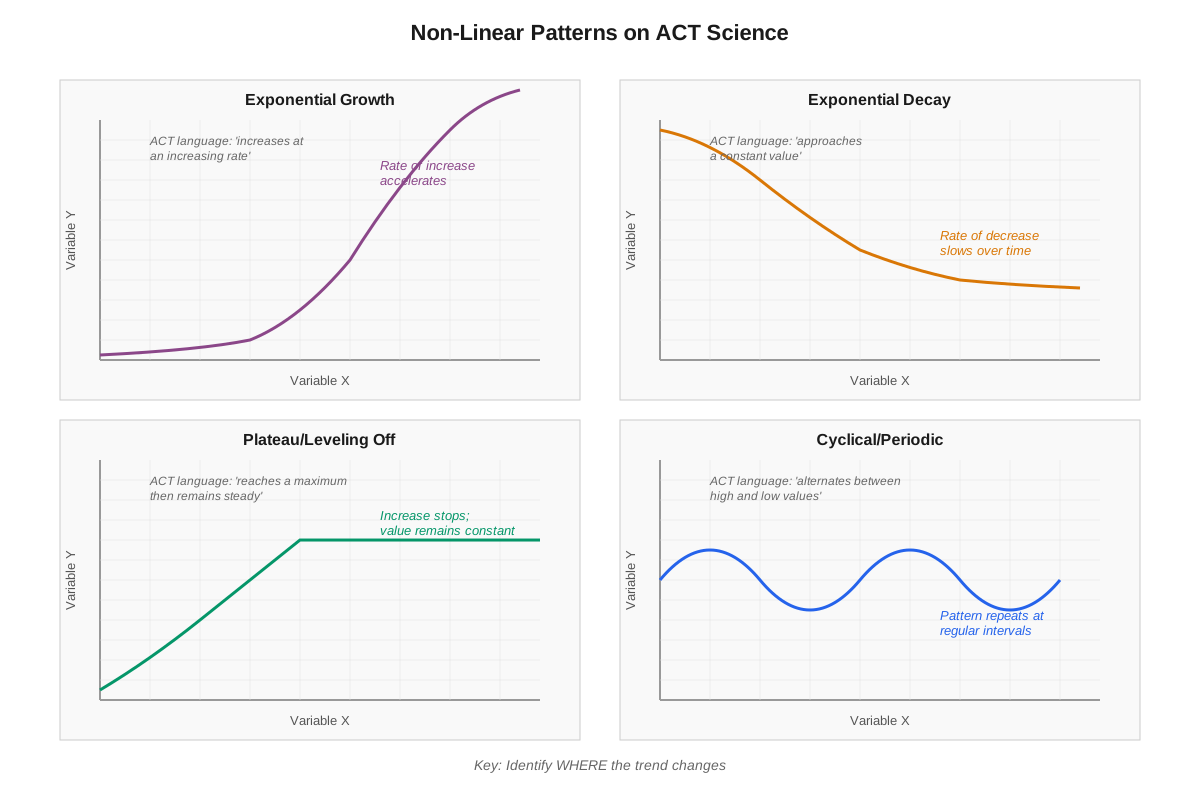
Non-linear Relationships involve more complex patterns where the rate of change varies. These include exponential growth (accelerating increase), exponential decay (decelerating decrease), logarithmic patterns, and cyclical/periodic patterns. The ACT frequently tests whether students can recognize when a relationship changes from one type to another across different ranges of the independent variable.
Analyzing Trends in Graphs
Graphs provide visual representations that make trends immediately apparent to trained observers. The key to rapid trend identification lies in systematic analysis.
Line Graphs show continuous data and are ideal for displaying trends over time or across a continuous range. To analyze: (1) Identify which variable is on each axis, (2) Determine the direction of the line (upward, downward, flat, or changing), (3) Assess whether the slope is constant or changing, (4) Note any points where the trend reverses or plateaus. The ACT often includes multiple lines on a single graph, requiring comparison of trends across different conditions or substances.
Scatter Plots display individual data points and reveal correlations between variables. Look for the overall pattern: do points cluster along an imaginary line (strong relationship) or spread widely (weak or no relationship)? The direction of the cluster indicates whether the relationship is direct or inverse. The ACT may ask about the strength of relationships or require identification of outliers that don't follow the general trend.
Bar Graphs compare discrete categories rather than continuous data. Trend analysis involves comparing bar heights across categories. Look for patterns: are bars consistently increasing, decreasing, or varying without pattern? The ACT often presents bar graphs with multiple series (grouped or stacked bars), requiring comparison of trends across different experimental conditions.
Analyzing Trends in Tables
Tables present numerical data in rows and columns, requiring a more deliberate analytical approach than graphs. Effective table analysis follows a systematic process.
Vertical Trend Analysis involves reading down columns to see how values change as you move through rows. This is the most common approach when the independent variable is listed in the leftmost column. For example, if temperature increases down the first column, read down the second column to see whether reaction rate increases, decreases, or shows no pattern.
Horizontal Trend Analysis involves reading across rows to compare values across different conditions or trials. This approach works when comparing results from different experimental setups presented in different columns.
Magnitude Assessment requires evaluating not just the direction of change but also the size of changes. Does the dependent variable change by similar amounts for each unit change in the independent variable (linear), or do the changes get progressively larger or smaller (non-linear)?
Describing Trends Precisely
The ACT rewards precise language when describing relationships. Vague descriptions like "they're related" are insufficient; specific characterizations are required.
| Trend Type | Precise Description | Example Context |
|---|---|---|
| Strong Direct | "As X increases, Y increases proportionally" | Directly proportional relationships |
| Moderate Direct | "As X increases, Y generally increases" | Positive correlation with variation |
| Strong Inverse | "As X increases, Y decreases proportionally" | Inversely proportional relationships |
| Moderate Inverse | "As X increases, Y generally decreases" | Negative correlation with variation |
| Exponential Growth | "As X increases, Y increases at an accelerating rate" | Population growth, compound interest |
| Exponential Decay | "As X increases, Y decreases at a decelerating rate" | Radioactive decay, cooling curves |
| Plateau | "As X increases, Y initially increases then levels off" | Enzyme saturation, learning curves |
| No Relationship | "Changes in X show no consistent pattern with Y" | Independent variables |
Extrapolation and Prediction
Many ACT questions require extending observed trends beyond the given data range. Extrapolation involves predicting values outside the measured range by assuming the established trend continues. This requires confidence in the trend's consistency.
For linear trends, extrapolation is straightforward: continue the pattern at the same rate. If temperature increases by 5°C for every 10 minutes in the data, predict it will continue increasing at that rate. For non-linear trends, identify the pattern type first. If growth is accelerating, the next value will show an even larger increase than the previous interval.
The ACT occasionally includes questions that test whether students recognize when extrapolation is inappropriate. If data shows a plateau, extrapolating continued increase would be incorrect. If a trend reverses within the data range, simple extrapolation of the initial trend would fail.
Comparing Trends Across Conditions
Advanced ACT questions require comparing how trends differ across experimental conditions, different substances, or different trials. This skill combines trend identification with comparative reasoning.
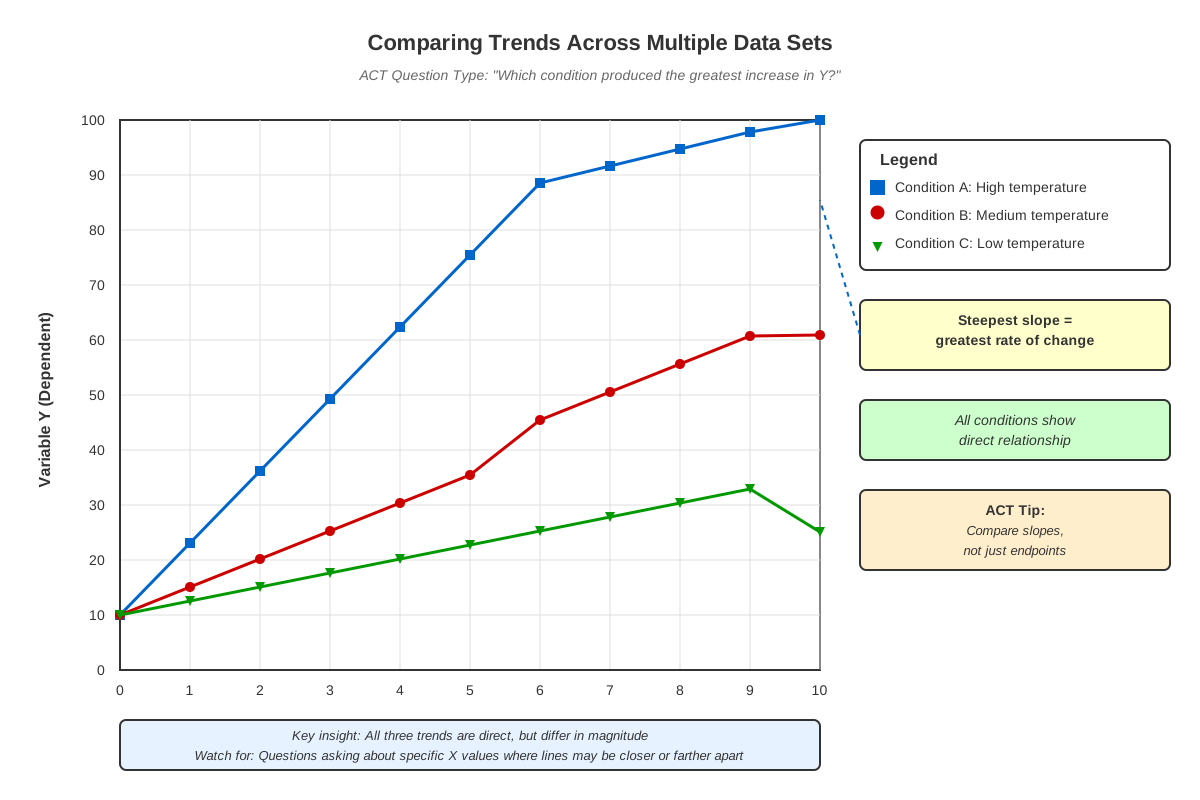
When comparing trends, focus on: (1) Direction: Do both show direct relationships, or does one increase while the other decreases? (2) Magnitude: Which shows larger changes for the same change in the independent variable? (3) Consistency: Is one trend more linear while another is more variable? (4) Range: Do trends hold across the entire data range, or do they differ in different regions?
The ACT often presents graphs with multiple lines or tables with multiple columns specifically to test this comparative skill. Questions might ask "Which substance showed the greatest increase in solubility as temperature increased?" or "For which group was the relationship between exercise and heart rate strongest?"
Concept Relationships
The concepts within trend analysis form a hierarchical structure. Basic relationship identification (direct, inverse, or none) serves as the foundation. Once students can categorize relationships, they progress to quantitative trend analysis, assessing not just direction but magnitude and rate of change. This enables pattern recognition for non-linear relationships like exponential or logarithmic trends.
Trend comparison builds on basic identification by requiring simultaneous analysis of multiple data sets. This skill connects directly to extrapolation and prediction, as comparing trends helps determine which patterns are most reliable for extending beyond measured ranges. All these skills converge in data-based reasoning, where students use identified trends to evaluate hypotheses, support conclusions, or make predictions about unmeasured conditions.
The relationship map flows as follows:
Variable Identification → Basic Relationship Type → Quantitative Trend Analysis → Pattern Recognition → Trend Comparison → Extrapolation → Data-Based Reasoning
This topic connects to prerequisite skills through its dependence on graph and table reading. It enables progression to more advanced topics like experimental design evaluation (using trends to assess whether experiments successfully tested hypotheses) and conflicting viewpoints analysis (using data trends to support or refute different scientific interpretations).
High-Yield Facts
⭐ Direct relationships show both variables moving in the same direction; inverse relationships show variables moving in opposite directions
⭐ On line graphs, upward slopes indicate direct relationships; downward slopes indicate inverse relationships
⭐ The phrase "as X increases" in a question stem signals a trend identification question
⭐ Extrapolation questions require assuming the established trend continues beyond the measured range
⭐ When comparing trends across multiple lines or columns, focus on which shows the greatest magnitude of change
- Non-linear relationships include exponential growth, exponential decay, logarithmic patterns, and cyclical patterns
- Plateau patterns show initial change followed by leveling off, indicating a limiting factor has been reached
- Scatter plots with widely dispersed points indicate weak or no relationship between variables
- Tables require systematic vertical or horizontal reading to identify trends accurately
- The ACT frequently tests whether students can recognize when a trend reverses or changes pattern within the data range
- Questions asking "which statement best describes" typically require precise trend language rather than vague descriptions
- Comparing trends across different experimental groups is one of the most common multi-step question types
- Outliers are data points that don't follow the general trend and may indicate experimental error or special conditions
- The strength of a relationship refers to how consistently the pattern holds across all data points
- Time-series data (measurements over time) almost always appears in at least one passage per ACT Science test
Quick check — test yourself on Trends in data so far.
Try Flashcards →Common Misconceptions
Misconception: A relationship exists whenever two variables are presented together in a graph or table.
Correction: Variables can be independent, showing no consistent pattern. Not all data sets demonstrate meaningful relationships. The ACT specifically includes questions testing whether students can recognize the absence of a trend.
Misconception: Correlation always implies causation.
Correction: Two variables can show a strong trend without one causing the other. Both might be influenced by a third variable, or the correlation might be coincidental. The ACT tests whether students can distinguish between describing a relationship and explaining its cause.
Misconception: Trends must be perfectly linear to be considered direct or inverse relationships.
Correction: Real scientific data often shows variation around a general trend. A relationship can be direct even if some data points deviate from a perfect line, as long as the overall pattern shows both variables moving in the same direction.
Misconception: Extrapolation always produces accurate predictions.
Correction: Extrapolation assumes trends continue unchanged, but many real-world relationships have limits. Enzyme activity plateaus at saturation, populations face resource constraints, and physical systems reach equilibrium. The ACT tests whether students recognize when extrapolation is appropriate versus when trends likely change beyond the measured range.
Misconception: The steeper the line on a graph, the stronger the relationship.
Correction: Steepness (slope) indicates the rate of change, not the strength of the relationship. Strength refers to how consistently data points follow the pattern. A shallow line with all points close to it represents a stronger relationship than a steep line with widely scattered points.
Misconception: Comparing trends only requires looking at starting and ending values.
Correction: The pattern throughout the entire range matters. Two data sets might have the same starting and ending values but show completely different trends in between (one might increase steadily while another increases then decreases). The ACT frequently tests this by including answer choices that focus only on endpoints.
Misconception: All exponential relationships show dramatic, rapidly accelerating changes.
Correction: Exponential patterns can be subtle, especially in early stages or with small growth rates. The defining characteristic is that the rate of change itself changes consistently, not that changes are necessarily large. Students must look for accelerating or decelerating patterns rather than just large magnitudes.
Worked Examples
Example 1: Identifying and Comparing Trends in a Multi-Line Graph
Scenario: A graph shows temperature (°C) on the x-axis (ranging from 0 to 100) and solubility (g/100mL water) on the y-axis. Three lines represent different salts: Salt A, Salt B, and Salt C. Salt A's line rises steeply from 20 g/100mL at 0°C to 80 g/100mL at 100°C. Salt B's line rises gradually from 30 g/100mL at 0°C to 40 g/100mL at 100°C. Salt C's line decreases from 50 g/100mL at 0°C to 30 g/100mL at 100°C.
Question: As temperature increases from 0°C to 100°C, which statement best describes the relationship between temperature and solubility for the three salts?
Step 1 - Identify the trend for each salt individually:
- Salt A: As temperature increases, solubility increases dramatically (strong direct relationship)
- Salt B: As temperature increases, solubility increases slightly (weak direct relationship)
- Salt C: As temperature increases, solubility decreases (inverse relationship)
Step 2 - Analyze the magnitude of changes:
- Salt A: Change of 60 g/100mL over 100°C = 0.6 g/100mL per °C
- Salt B: Change of 10 g/100mL over 100°C = 0.1 g/100mL per °C
- Salt C: Change of -20 g/100mL over 100°C = -0.2 g/100mL per °C
Step 3 - Formulate a comprehensive description:
The correct answer would state: "Solubility increases with temperature for Salts A and B, with Salt A showing a much greater increase, while solubility decreases with temperature for Salt C."
Step 4 - Apply to prediction questions:
If asked to predict solubility at 120°C (extrapolation), we would:
- Salt A: Continue the steep upward trend, predicting approximately 92 g/100mL
- Salt B: Continue the gradual upward trend, predicting approximately 42 g/100mL
- Salt C: Continue the downward trend, predicting approximately 26 g/100mL
Connection to Learning Objectives: This example demonstrates trend identification (recognizing direct vs. inverse relationships), comparison across conditions (analyzing three different salts), and extrapolation (predicting beyond the measured range).
Example 2: Analyzing Non-Linear Trends in Tabular Data
Scenario: A table shows the relationship between substrate concentration (mM) and reaction rate (μmol/min) for an enzyme-catalyzed reaction:
| Substrate Concentration (mM) | Reaction Rate (μmol/min) |
|---|---|
| 0.5 | 10 |
| 1.0 | 18 |
| 2.0 | 28 |
| 4.0 | 38 |
| 8.0 | 42 |
| 16.0 | 44 |
Question: Which statement best describes how reaction rate changes as substrate concentration increases?
Step 1 - Calculate the change in reaction rate for each doubling of substrate concentration:
- 0.5 to 1.0 mM: Rate increases by 8 μmol/min
- 1.0 to 2.0 mM: Rate increases by 10 μmol/min
- 2.0 to 4.0 mM: Rate increases by 10 μmol/min
- 4.0 to 8.0 mM: Rate increases by 4 μmol/min
- 8.0 to 16.0 mM: Rate increases by 2 μmol/min
Step 2 - Identify the pattern:
The reaction rate increases with substrate concentration, BUT the amount of increase gets progressively smaller. This is NOT a linear relationship. The rate of increase is decelerating.
Step 3 - Recognize the biological principle:
This pattern represents enzyme saturation. At low substrate concentrations, adding more substrate significantly increases reaction rate. At high concentrations, the enzyme becomes saturated, and adding more substrate has minimal effect. The trend approaches a plateau.
Step 4 - Formulate the precise description:
The correct answer would state: "Reaction rate increases as substrate concentration increases, but the rate of increase diminishes at higher concentrations, approaching a maximum value."
Step 5 - Apply to extrapolation:
If asked to predict the reaction rate at 32.0 mM, recognize that the trend is approaching a plateau around 44-45 μmol/min. The increase from 16.0 to 32.0 mM would likely be even smaller than the 2 μmol/min increase from 8.0 to 16.0 mM. A reasonable prediction would be approximately 45-46 μmol/min, NOT 46 μmol/min calculated by simply adding 2 (which would ignore the decelerating pattern).
Connection to Learning Objectives: This example demonstrates recognition of non-linear trends, precise description of changing rates, and appropriate extrapolation that accounts for pattern changes rather than simple linear extension.
Exam Strategy
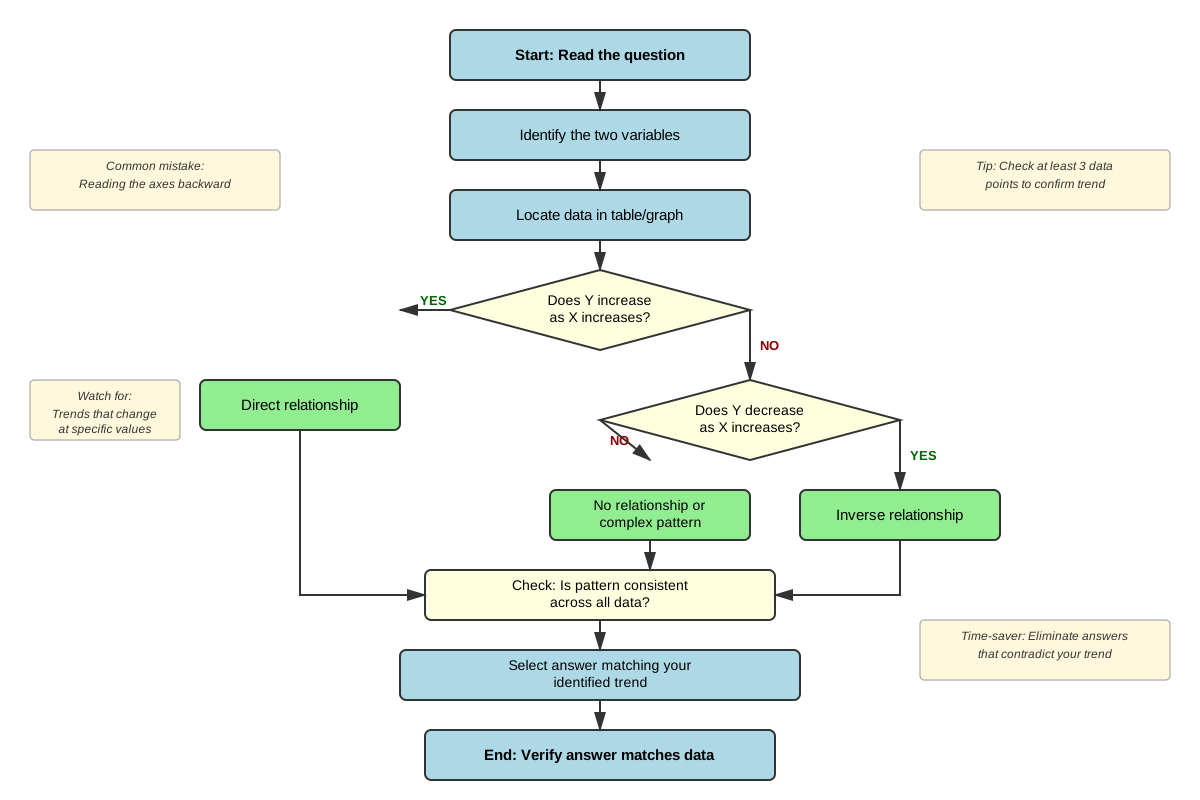
Trigger Word Recognition: Train yourself to immediately recognize trend questions through specific phrases. "As X increases," "relationship between," "what happens to," "which statement best describes," and "based on the trend" all signal trend analysis questions. When you see these phrases, shift into systematic trend identification mode rather than searching for individual data points.
The Two-Step Approach: For any trend question, always complete two steps: (1) Identify the direction of the relationship (direct, inverse, or none), and (2) Assess the magnitude or pattern (strong/weak, linear/non-linear, consistent/changing). This prevents the common error of providing incomplete answers that only address direction without considering magnitude.
Graph vs. Table Strategy: Graphs allow faster trend identification through visual pattern recognition. When given a choice between extracting information from a graph or table, use the graph for trend questions. However, tables provide more precise numerical values, so use them when questions require specific data points or exact calculations. Many passages include both formats—use each for its strength.
Process of Elimination for Trend Questions: Wrong answers typically fall into predictable categories:
- Direction reversal: States the opposite relationship (direct instead of inverse)
- Overgeneralization: Claims a relationship is stronger or more consistent than data supports
- Undergeneralization: Misses a clear pattern by focusing on minor variations
- Inappropriate extrapolation: Extends a trend beyond where it reasonably applies
- Causation confusion: Explains why a relationship exists rather than describing what the relationship is
Eliminate answers that commit these errors before selecting your response.
Time Management: Trend identification questions should be among your fastest. Aim to spend 20-30 seconds on straightforward trend questions, reserving more time for complex synthesis questions. If you find yourself spending more than 45 seconds on a trend question, you're likely overthinking it. Trust your initial pattern recognition and move forward.
Multi-Part Trend Questions: When questions require comparing trends across multiple conditions, create a quick mental or written note system. For example, if comparing three substances, jot down "A: up steep, B: up gradual, C: down" to organize your thinking. This prevents confusion when evaluating answer choices that mix information about different conditions.
Extrapolation Red Flags: Be cautious when extrapolating if: (1) the data shows a plateau pattern, (2) the trend reverses within the given range, (3) the question asks about a value far beyond the measured range, or (4) the context suggests a physical or biological limit. In these cases, look for answer choices that acknowledge limitations rather than simple linear extensions.
Memory Techniques
The DINO Mnemonic for Relationship Types:
- Direct: Both go up together
- Inverse: One up, one down
- None: No pattern, scattered
- Oscillating: Cyclical, repeating pattern
The "Slope Story" Visualization: Imagine walking up or down a hill. Upward slope = direct relationship (you're climbing as X increases). Downward slope = inverse relationship (you're descending as X increases). Flat terrain = no relationship (you're not going up or down despite moving forward).
The "STEEP" Acronym for Comparing Trends:
- Same direction or different?
- Type of pattern (linear, exponential, etc.)
- Extent of change (magnitude)
- Entire range or partial?
- Prediction: Can we extrapolate?
The Plateau Pattern Reminder: "Enzyme saturation, learning curves, and carrying capacity all LEVEL OFF" - Remember that biological and physical systems often approach maximum values, creating plateau patterns rather than continuing to increase indefinitely.
The Table Reading Rhythm: "Down the column, across the row, find the pattern, watch it grow" - This simple rhyme reminds students to read systematically through tables rather than jumping randomly between values.
The Extrapolation Caution: "Don't extend beyond what's sensible" - Before extrapolating, ask yourself if the real-world system could reasonably continue the pattern. This prevents unrealistic predictions.
Summary
Trends in data represent a foundational skill for ACT Science success, appearing in approximately one-third of all Science questions. Mastery requires the ability to quickly identify relationship types (direct, inverse, or none), assess whether patterns are linear or non-linear, compare trends across multiple conditions, and appropriately extrapolate beyond measured ranges. The key to success lies in systematic analysis: always identify both the direction and magnitude of relationships, use precise language when describing patterns, and recognize when trends change across different ranges of the independent variable. Graphs provide visual advantages for rapid pattern recognition, while tables offer numerical precision. Common question formats include "as X increases" constructions, "which statement best describes" prompts, and comparative questions requiring analysis of multiple data sets. Students must avoid common pitfalls like confusing correlation with causation, focusing only on endpoints while ignoring intermediate patterns, and inappropriately extrapolating beyond reasonable limits. With focused practice on recognizing trigger words, applying the two-step direction-and-magnitude approach, and using systematic elimination strategies, students can transform trend questions from time-consuming challenges into quick point-scoring opportunities.
Key Takeaways
- Trends in data questions appear in 30-40% of ACT Science passages and represent one of the highest-yield topics for focused study
- Direct relationships show both variables moving in the same direction; inverse relationships show opposite movement; always assess both direction and magnitude
- Systematic analysis of graphs (reading slope direction) and tables (reading vertically or horizontally) prevents errors and increases speed
- Non-linear patterns including exponential growth, exponential decay, and plateau effects require recognition of changing rates rather than constant slopes
- Extrapolation questions require assuming trends continue, but students must recognize when physical or biological limits make simple extension inappropriate
- Precise language matters: "increases proportionally," "generally increases," "increases at an accelerating rate," and "levels off" convey different meanings
- Comparing trends across conditions requires analyzing direction, magnitude, consistency, and range for each data set before selecting answers
Related Topics
Data Interpolation and Extrapolation: Building directly on trend identification, this topic focuses specifically on predicting values within and beyond measured ranges, including techniques for handling non-linear relationships and assessing prediction reliability.
Experimental Design and Controls: Understanding trends enables evaluation of whether experiments successfully tested their hypotheses by producing expected patterns in data, connecting data analysis to scientific methodology.
Conflicting Viewpoints Analysis: Scientists often interpret the same data trends differently; mastering trend identification provides the foundation for evaluating which interpretation best fits observed patterns.
Statistical Relationships and Correlation: Advanced analysis of trend strength, correlation coefficients, and statistical significance builds on basic trend identification skills.
Graphical Data Representation: Understanding how different graph types (line, bar, scatter, etc.) display trends differently enhances both interpretation and creation of scientific figures.
Practice CTA
Now that you've mastered the core concepts of trends in data, it's time to put your knowledge into action! The practice questions and flashcards have been specifically designed to mirror actual ACT Science questions, giving you the opportunity to apply these strategies under test-like conditions. Focus on identifying trigger words, practicing the two-step direction-and-magnitude approach, and timing yourself to build speed alongside accuracy. Remember: trend identification is a skill that improves dramatically with deliberate practice. Each question you work through strengthens your pattern recognition abilities and builds the confidence you need to excel on test day. You've got this—let's turn this knowledge into points!
Sign up free to keep reading
Create a free AnvayaPrep account to finish this ACT guide on Trends in data — plus flashcards and practice questions.