Overview
Units in data represent one of the most fundamental yet frequently overlooked aspects of scientific data interpretation on the ACT Science test. Every measurement in science carries a unit—whether it's meters, seconds, grams, degrees Celsius, or more complex derived units like meters per second squared. Understanding and correctly interpreting these units is essential for accurately reading graphs, tables, and experimental descriptions that form the backbone of ACT Science passages.
The ACT Science section tests students' ability to extract, interpret, and manipulate data from various scientific contexts. While the test doesn't require extensive content knowledge, it demands careful attention to detail—and units are where many students lose easy points. A graph showing temperature might use Kelvin instead of Celsius, or a table might present concentrations in milligrams per liter rather than grams per liter. Misreading or ignoring these units can lead to incorrect answers even when the underlying scientific reasoning is sound. The ACT units in data questions specifically assess whether students can track units through calculations, convert between related units, and recognize when unit mismatches indicate errors or require adjustments.
This topic connects directly to broader data representation skills and scientific reasoning. Units provide the context that transforms raw numbers into meaningful measurements. They're the bridge between abstract mathematical relationships and real-world phenomena. Mastering units in data strengthens overall graph interpretation, enhances understanding of experimental design, and improves the ability to evaluate whether conclusions drawn from data are valid—all critical skills for achieving a high score on the ACT Science section.
Learning Objectives
- [ ] Identify when Units in data is being tested in ACT Science passages
- [ ] Explain the core rule or strategy behind Units in data interpretation
- [ ] Apply Units in data concepts to ACT-style questions accurately
- [ ] Recognize and convert between common scientific units (metric prefixes, temperature scales, concentration units)
- [ ] Detect unit inconsistencies in data tables and graphs that signal potential errors or required conversions
- [ ] Evaluate whether mathematical operations on data maintain dimensional consistency
Prerequisites
- Basic metric system familiarity: Understanding prefixes (kilo-, centi-, milli-) is essential because ACT passages frequently switch between scales (e.g., kilometers vs. meters)
- Reading graphs and tables: Units appear as axis labels and column headers, so basic data visualization literacy is required
- Elementary algebra: Converting units often involves multiplication or division by conversion factors
- Scientific notation: Large and small measurements are often expressed in powers of ten, which interact with unit interpretation
Why This Topic Matters
In real-world science, units prevent catastrophic errors. The Mars Climate Orbiter famously crashed in 1999 because one team used metric units while another used imperial units—a $125 million mistake that underscores why scientists obsess over dimensional analysis. In medicine, pharmacists must convert between milligrams and micrograms to ensure proper dosing. Environmental scientists track pollutant concentrations in parts per million or parts per billion. Engineers calculate forces in Newtons and pressures in Pascals. Every quantitative field depends on precise unit usage.
On the ACT Science test, units in data questions appear with high frequency—typically 2-4 questions per test, representing roughly 5-10% of the Science section. These questions often appear in Data Representation passages (the shortest passage type, with 5 questions each) but also emerge in Research Summaries and Conflicting Viewpoints passages. The ACT tests units in several ways: direct questions asking students to identify the units of a particular measurement, questions requiring unit conversions to compare values, and questions where the correct answer depends on noticing that two quantities have different units and therefore cannot be directly compared.
Common manifestations include: tables with column headers specifying units; graphs with axis labels showing units in parentheses; questions asking "What are the units of [variable]?"; questions requiring students to calculate a derived quantity and determine its units; and questions where answer choices differ only in their units, testing whether students tracked units through a calculation correctly.
Core Concepts
Understanding What Units Represent
Units are standardized quantities used to express measurements. They answer the question "how much?" by providing a reference scale. When a data table shows "Temperature (°C)," the °C tells us the measurement scale is Celsius, not Fahrenheit or Kelvin. Without units, the number "25" is meaningless—it could represent 25 degrees, 25 meters, 25 seconds, or 25 of anything else.
On the ACT, units appear in three primary locations:
- Axis labels on graphs: Usually formatted as "Variable Name (unit)" such as "Time (s)" or "Concentration (mg/L)"
- Column headers in tables: Following the same format, like "Mass (kg)" or "Velocity (m/s)"
- Within passage text: Embedded in descriptions of experimental procedures or results
The SI System and Metric Prefixes
The International System of Units (SI) forms the foundation of scientific measurement. The ACT heavily favors metric units, though occasional imperial units (feet, pounds) appear. Key base units include:
| Quantity | SI Unit | Symbol |
|---|---|---|
| Length | meter | m |
| Mass | kilogram | kg |
| Time | second | s |
| Temperature | Kelvin | K |
| Amount of substance | mole | mol |
| Electric current | ampere | A |
Metric prefixes modify these base units to express larger or smaller quantities:
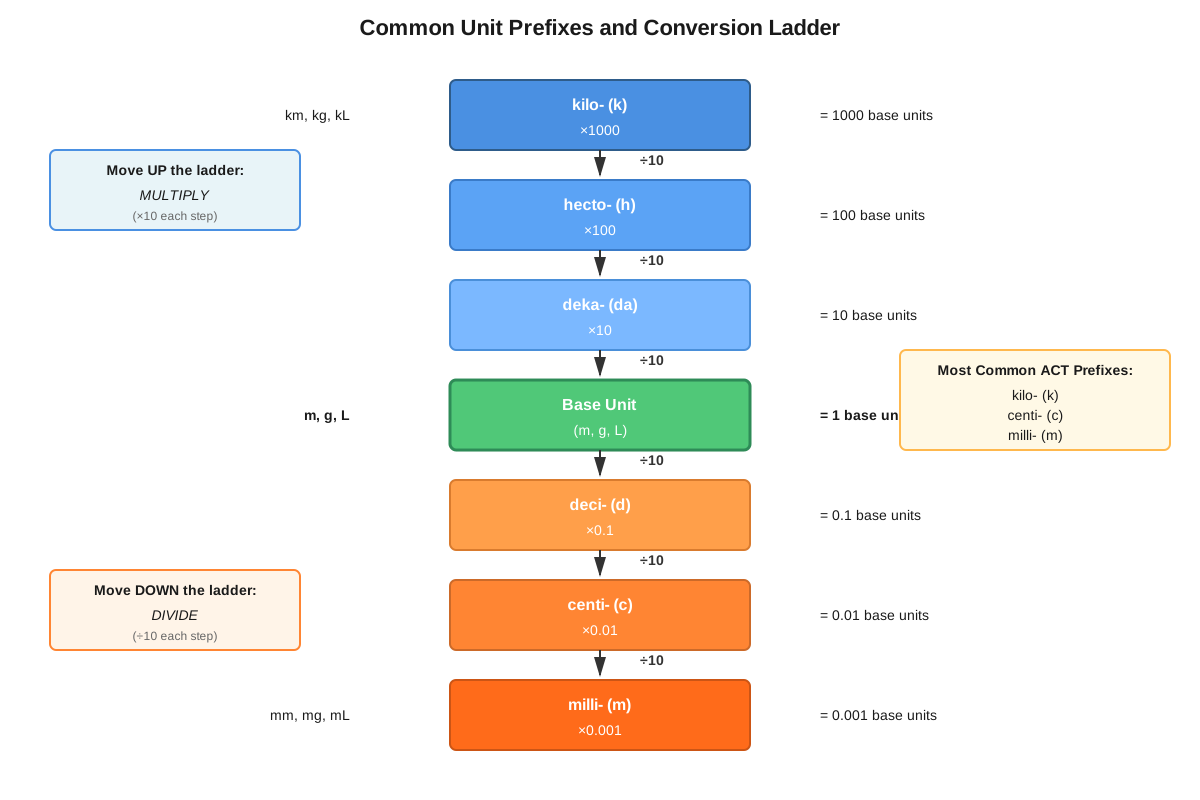
| Prefix | Symbol | Multiplication Factor | Example |
|---|---|---|---|
| kilo- | k | 1,000 (10³) | 1 km = 1,000 m |
| centi- | c | 0.01 (10⁻²) | 1 cm = 0.01 m |
| milli- | m | 0.001 (10⁻³) | 1 mL = 0.001 L |
| micro- | μ | 0.000001 (10⁻⁶) | 1 μg = 0.000001 g |
| nano- | n | 0.000000001 (10⁻⁹) | 1 nm = 0.000000001 m |
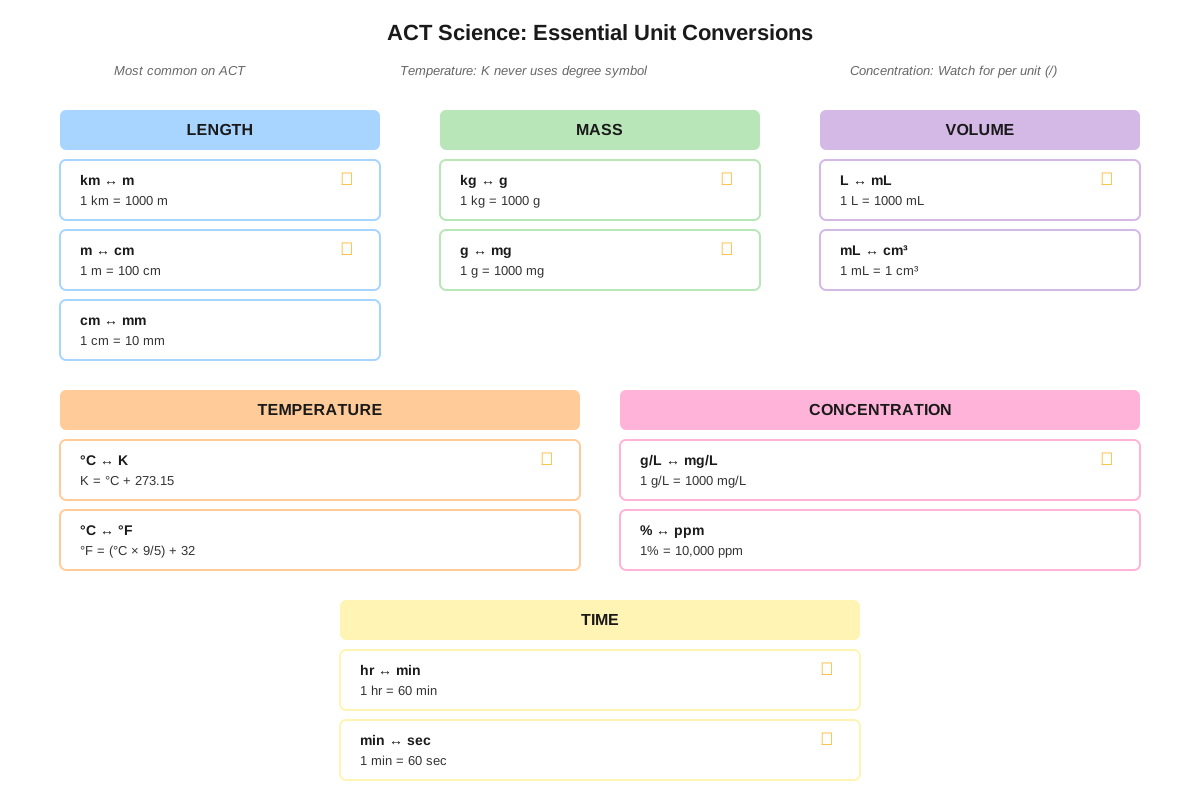
ACT questions frequently test whether students recognize that 5,000 meters equals 5 kilometers, or that 250 milliliters equals 0.25 liters. The test may present data in one unit and ask questions requiring conversion to another.
Derived Units and Compound Units
Many scientific measurements use derived units—combinations of base units. These appear constantly on the ACT:
- Velocity/Speed: meters per second (m/s) = distance/time
- Acceleration: meters per second squared (m/s²) = velocity/time
- Density: grams per cubic centimeter (g/cm³) = mass/volume
- Concentration: moles per liter (mol/L or M) = amount/volume
- Pressure: Pascals (Pa) or atmospheres (atm)
- Energy: Joules (J) or calories (cal)
When reading compound units, "per" indicates division. A speed of 10 m/s means 10 meters traveled per 1 second. Concentration of 5 mg/L means 5 milligrams of solute per 1 liter of solution.
Unit Consistency and Dimensional Analysis
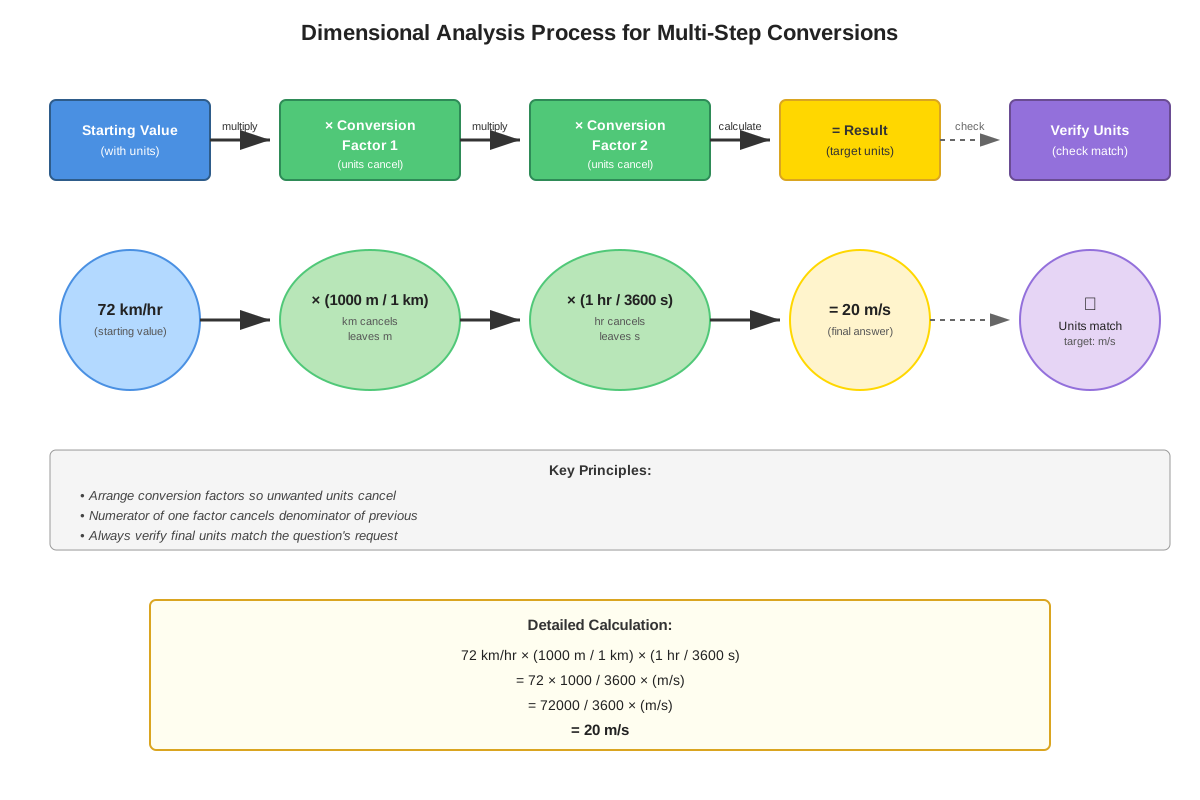
Dimensional analysis is the practice of tracking units through calculations to ensure consistency. On the ACT, this principle appears when:
- Comparing values: Two quantities can only be directly compared if they share the same units. A passage might show one experiment measuring temperature in Celsius and another in Kelvin—students must recognize these cannot be compared without conversion.
- Performing calculations: When multiplying or dividing measurements, units multiply or divide too. If distance is 100 meters and time is 5 seconds, velocity = 100 m ÷ 5 s = 20 m/s. The units follow the arithmetic.
- Identifying errors: If a calculation should yield velocity (m/s) but the units work out to m/s², something went wrong.
Temperature Scales
Temperature units deserve special attention because three scales appear on the ACT:
- Celsius (°C): Water freezes at 0°C, boils at 100°C
- Fahrenheit (°F): Water freezes at 32°F, boils at 212°F
- Kelvin (K): Absolute scale starting at absolute zero; water freezes at 273 K, boils at 373 K
Conversion formulas:
°F = (9/5)°C + 32
K = °C + 273
The ACT rarely requires precise conversions but frequently tests whether students recognize these are different scales. A question might ask which experiment had the highest temperature, requiring students to notice one used Celsius and another used Kelvin.
Concentration Units
Chemistry-related passages often involve concentration measurements:
- Molarity (M or mol/L): moles of solute per liter of solution
- Mass concentration (g/L, mg/L, μg/L): mass of solute per volume of solution
- Percent concentration (%): parts per hundred
- Parts per million (ppm): parts per million parts
- Parts per billion (ppb): parts per billion parts
These units are not directly interconvertible without additional information (like molecular weight), but students must recognize when different units are being used and understand their relative scales.
Concept Relationships
The hierarchy of understanding units in data flows logically:
Basic unit recognition → Understanding metric prefixes → Interpreting compound units → Applying dimensional analysis → Detecting unit inconsistencies
Unit recognition forms the foundation—students must first identify what units are present in a passage. This skill connects directly to prerequisite knowledge of reading graphs and tables, since units appear as labels. Once units are identified, understanding metric prefixes enables proper interpretation of scale (recognizing that 5 km is much larger than 5 m).
Compound units build on both base unit knowledge and mathematical understanding, since they represent ratios or products of simpler measurements. This connects to algebraic prerequisites. Dimensional analysis then applies these concepts to problem-solving, ensuring calculations maintain unit consistency—a skill that bridges to broader scientific reasoning.
Finally, detecting unit inconsistencies represents the highest-level application, requiring students to evaluate data critically and recognize when comparisons are invalid or conversions are necessary. This skill connects forward to more advanced data interpretation topics like identifying trends, evaluating experimental design, and drawing valid conclusions from evidence.
The relationship to other Science topics is extensive: units appear in virtually every passage type, making this a foundational skill that supports all other data representation competencies. Strong unit awareness enhances graph interpretation, table reading, and understanding of experimental procedures.
Quick check — test yourself on Units in data so far.
Try Flashcards →High-Yield Facts
⭐ Units always appear in parentheses after variable names on ACT graphs and tables (e.g., "Temperature (°C)" or "Mass (kg)")
⭐ When comparing two values, they must have the same units—different units mean direct comparison is invalid without conversion
⭐ Metric prefixes follow powers of 10: kilo = ×1,000, centi = ×0.01, milli = ×0.001, micro = ×0.000001
⭐ Compound units with "/" or "per" indicate division: m/s means meters divided by seconds
⭐ Temperature scales (Celsius, Fahrenheit, Kelvin) are not interchangeable—a value in one scale differs from the same number in another scale
- Derived units result from mathematical operations on base units (e.g., density = mass/volume, so units are g/cm³)
- The ACT frequently tests whether students notice when two data sets use different units for the same type of measurement
- Unit conversions require multiplication by conversion factors (e.g., to convert km to m, multiply by 1,000)
- Concentration units (M, g/L, ppm, ppb) represent different ways to express how much solute is in a solution
- When units are squared (m²) or cubed (cm³), the prefix multiplier is also squared or cubed (1 km² = 1,000,000 m², not 1,000 m²)
- Scientific notation interacts with units: 3.5 × 10³ m = 3,500 m = 3.5 km
- Percent (%) is technically a unit meaning "per hundred" (50% = 50/100 = 0.50)
Common Misconceptions
Misconception: All temperature scales are equivalent, so 25°C = 25°F = 25 K
Correction: Temperature scales have different zero points and scale sizes. 25°C = 77°F = 298 K. Always check which scale is being used and convert if necessary.
Misconception: When converting between metric units, always divide by the conversion factor
Correction: Converting to larger units requires division (1,000 m ÷ 1,000 = 1 km), but converting to smaller units requires multiplication (1 km × 1,000 = 1,000 m). Think about whether the number should get bigger or smaller.
Misconception: Units don't matter as long as the numbers are correct
Correction: Units are essential for interpreting data correctly. A velocity of 10 m/s is very different from 10 km/s (the latter is 1,000 times faster). Wrong units mean wrong answers.
Misconception: Compound units like g/cm³ can be simplified by canceling the "c" in both
Correction: The "c" is a prefix (centi-), not a variable. It cannot be canceled. Each part of a compound unit must be treated as a complete unit with its prefix.
Misconception: If two graphs show the same variable name, they use the same units
Correction: Always check the axis labels explicitly. One graph might show "Distance (m)" while another shows "Distance (km)". The variable is the same, but the scale differs by a factor of 1,000.
Misconception: Concentration units (M, g/L, ppm) can be directly compared
Correction: These represent fundamentally different ways of expressing concentration. A 1 M solution is not the same as a 1 g/L solution. Conversions require additional information like molecular weight.
Worked Examples
Example 1: Identifying Unit Inconsistencies
Passage Context: A study examines the growth rate of bacteria at different temperatures. Table 1 shows growth rates in cells/mL/hour at temperatures measured in °C. Table 2 shows growth rates in cells/mL/minute at temperatures measured in K.
Question: Which table shows the higher growth rate at 25°C?
Solution Process:
Step 1: Identify the units in each table
- Table 1: Growth rate in cells/mL/hour, temperature in °C
- Table 2: Growth rate in cells/mL/minute, temperature in K
Step 2: Recognize the unit differences
- Growth rate units differ: cells/mL/hour vs. cells/mL/minute
- Temperature units differ: °C vs. K
Step 3: Convert temperature to compare the same condition
- 25°C = 25 + 273 = 298 K
- Find the growth rate at 25°C in Table 1 and at 298 K in Table 2
Step 4: Convert growth rate units to compare
- If Table 1 shows 120 cells/mL/hour at 25°C, this equals 120 ÷ 60 = 2 cells/mL/minute
- If Table 2 shows 3 cells/mL/minute at 298 K, this is already in the correct units
Step 5: Compare
- Table 2 shows higher growth rate (3 > 2 cells/mL/minute)
Key Insight: This question tests multiple unit concepts simultaneously—temperature scale conversion and time unit conversion. The ACT frequently combines unit challenges to test thorough understanding.
Example 2: Determining Units of Calculated Quantities
Passage Context: An experiment measures the force (F) applied to an object in Newtons (N) and the resulting acceleration (a) in m/s². The mass (m) of the object is calculated using the formula m = F/a.
Question: What are the units of mass in this experiment?
Solution Process:
Step 1: Identify the given units
- Force (F): Newtons (N)
- Acceleration (a): m/s²
Step 2: Understand what a Newton represents
- 1 Newton = 1 kg⋅m/s² (this is a derived unit)
Step 3: Apply dimensional analysis to the formula m = F/a
- m = F/a = (kg⋅m/s²) / (m/s²)
Step 4: Simplify the units algebraically
- m = kg⋅m/s² × s²/m
- The m cancels: kg⋅m⋅s²/(s²⋅m) = kg
- The s² cancels: kg
Step 5: State the answer
- The units of mass are kilograms (kg)
Key Insight: This demonstrates how dimensional analysis works through calculations. Units follow the same algebraic rules as numbers—they can be multiplied, divided, and canceled. Understanding derived units (like Newton = kg⋅m/s²) is crucial for these problems.
Exam Strategy
Approaching ACT Units Questions
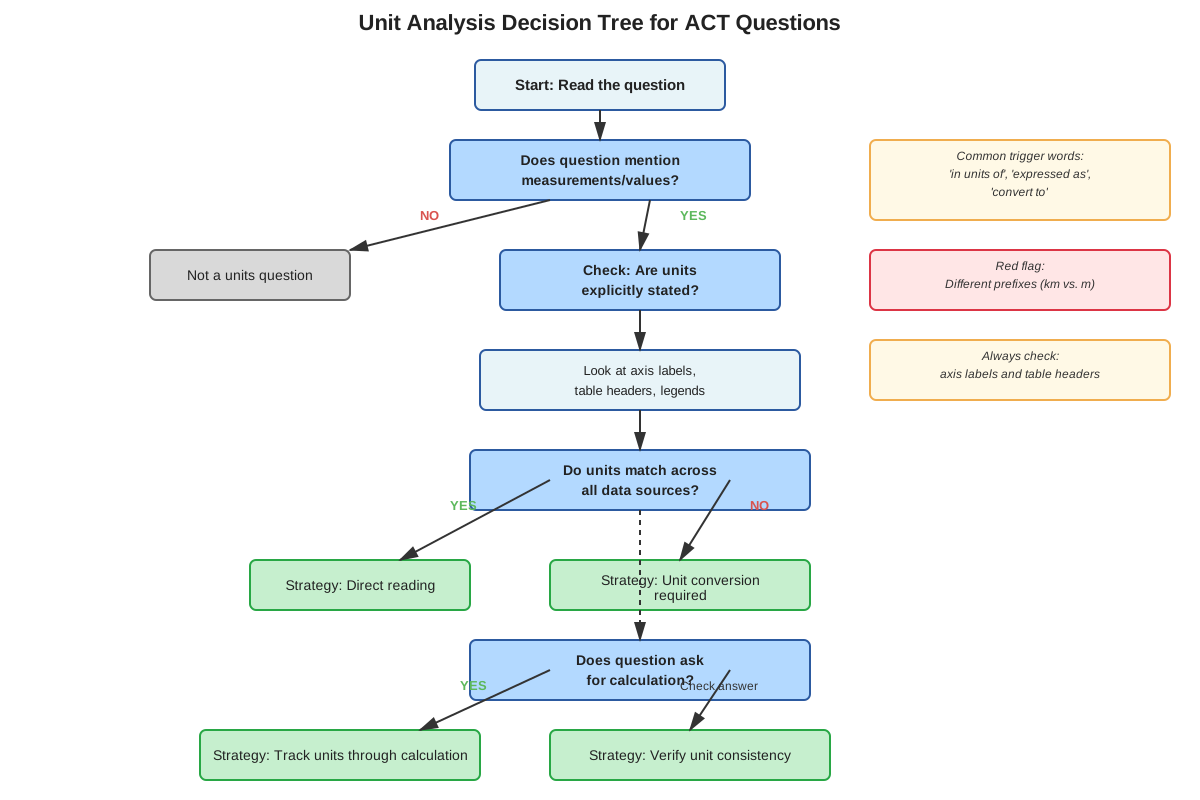
When encountering any ACT Science question, immediately scan for units:
- Check all axis labels and column headers before reading the question. Note what units are used for each variable.
- Circle or mentally note any unit differences between tables, graphs, or experiments. The ACT often tests whether students notice these differences.
- Read the question carefully for unit-specific language:
- "What are the units of...?" → Direct unit identification
- "Which is greater...?" → Check if units match before comparing
- "Calculate..." → Track units through the calculation
- "Convert..." → Explicit unit conversion required
- Use the answer choices as clues. If answer choices differ only in units (e.g., 5 m, 5 km, 5 cm, 5 mm), the question is testing unit conversion or recognition.
Trigger Words and Phrases
Watch for these phrases that signal unit-related questions:
- "expressed in"
- "measured in"
- "units of"
- "per" (indicates a rate or ratio)
- "at the same temperature" (check if scales match)
- "compared to" (verify units are compatible)
Process of Elimination Tips
When answer choices include different units:
- Eliminate choices with impossible units for the quantity being measured (e.g., temperature can't be measured in meters)
- Eliminate choices that don't match the passage units unless conversion is explicitly requested
- Check dimensional consistency: if calculating velocity, eliminate answers with units that aren't distance/time
Time Allocation
Unit questions are typically quick—30-45 seconds each—because they test recognition rather than complex reasoning. Don't overthink them:
- If the question asks "What are the units of X?" and X is labeled in the passage, it's a 10-second question
- If conversion is needed, spend 30-45 seconds setting up the conversion factor correctly
- If you're spending more than 1 minute on a unit question, you may be overcomplicating it
Exam Tip: The ACT rarely requires complex unit conversions. Most unit questions test whether you notice units exist and recognize when they differ. Precision matters more than calculation speed.
Memory Techniques
Metric Prefix Mnemonic
"King Henry Died By Drinking Chocolate Milk"
- King = Kilo (1,000)
- Henry = Hecto (100)
- Died = Deka (10)
- By = Base unit (1)
- Drinking = Deci (0.1)
- Chocolate = Centi (0.01)
- Milk = Milli (0.001)
Each step is a factor of 10. Moving right means dividing by 10; moving left means multiplying by 10.
Temperature Conversion Visualization
Remember: "Kelvin is Celsius plus 273"
- Visualize a thermometer with three scales side by side
- Celsius and Kelvin move together (same-sized degrees)
- Fahrenheit has a different scale size and offset
Compound Unit Reading
For units like m/s² or g/cm³, read the "/" as "per" and remember:
- Top = what you're measuring
- Bottom = what you're measuring it against
- m/s = meters per second = distance per time = speed
The "DUMB" Check for Units
Before finalizing any answer involving numbers:
- Do the units match what's asked?
- Units in the passage—did I check them?
- Math with units—did I track them through calculations?
- Both values—do they have the same units before comparing?
Summary
Units in data represent the essential context that transforms numbers into meaningful scientific measurements. On the ACT Science test, careful attention to units prevents common errors and unlocks straightforward points. Every measurement carries a unit—found in axis labels, column headers, and passage text—and these units must be tracked, compared, and converted appropriately. The metric system with its prefixes (kilo-, centi-, milli-, micro-) dominates ACT passages, though temperature scales (Celsius, Fahrenheit, Kelvin) and various concentration units also appear regularly. Compound units like m/s or g/cm³ represent derived quantities formed through mathematical operations, and dimensional analysis ensures these units remain consistent through calculations. The most common ACT unit questions test whether students notice when different data sets use different units, recognize when conversions are necessary, and can determine the units of calculated quantities. Success requires systematic checking of all labels, awareness of common unit types, and understanding that direct comparisons require matching units. This foundational skill supports all other data interpretation competencies and typically appears 2-4 times per test, making it a high-yield topic for focused study.
Key Takeaways
- Always check axis labels and column headers immediately—units appear there and are essential for correct interpretation
- Different units mean values cannot be directly compared without conversion (e.g., 25°C ≠ 25 K)
- Metric prefixes follow powers of 10: kilo = ×1,000, centi = ×0.01, milli = ×0.001
- Compound units indicate mathematical relationships: m/s means distance divided by time, g/cm³ means mass divided by volume
- Track units through calculations using dimensional analysis—units multiply and divide just like numbers
- Temperature scales are not interchangeable—always verify which scale (°C, °F, or K) is being used
- Unit questions are typically quick wins—they test recognition and careful reading rather than complex reasoning
Related Topics
Graph Interpretation: Units provide the scale and context for understanding trends in graphical data. Mastering units enables more sophisticated graph analysis, including identifying relationships between variables and evaluating the magnitude of changes.
Table Analysis: Tables organize data with units specified in headers. Strong unit skills allow efficient extraction of information and recognition of patterns across multiple variables.
Experimental Design: Understanding units helps evaluate whether experimental procedures are appropriate and whether measurements are precise enough for the research question.
Scientific Reasoning: Units connect to broader logical thinking about data—recognizing when comparisons are valid, when calculations make sense, and when conclusions are supported by evidence.
Quantitative Problem-Solving: Many ACT Science questions require basic calculations. Unit mastery ensures these calculations are set up correctly and answers have appropriate dimensions.
Practice CTA
Now that you understand the critical role of units in ACT Science data interpretation, it's time to apply these concepts! Work through the practice questions to test your ability to identify units, recognize inconsistencies, and track dimensions through calculations. The flashcards will help reinforce key conversions and unit types. Remember: unit questions are high-yield, quick points on test day—master them now and they'll boost your score reliably. Every practice question you complete strengthens your automatic unit-checking habits, making you faster and more accurate when it counts. You've got this!
Sign up free to keep reading
Create a free AnvayaPrep account to finish this ACT guide on Units in data — plus flashcards and practice questions.