Overview
Changing variables is a fundamental concept tested extensively in the Research Summaries section of the ACT Science test. This topic focuses on understanding how scientists manipulate independent variables in experiments and observe the resulting changes in dependent variables. The ability to identify which variables are being changed, which are being measured, and which are held constant is essential for interpreting experimental designs and analyzing data presented in research passages.
On the ACT Science test, questions about changing variables appear in approximately 40-50% of Research Summaries passages, making this one of the highest-yield topics for test preparation. Students must quickly identify experimental manipulations, understand the relationship between variables, and predict outcomes based on systematic changes. This skill directly connects to understanding experimental design, data interpretation, and the scientific method—all core competencies assessed throughout the ACT Science section.
Mastering changing variables provides the foundation for analyzing more complex experimental scenarios, including multi-variable experiments, control groups, and experimental validity. This topic bridges basic scientific literacy with advanced data analysis skills, enabling students to tackle the most challenging Research Summaries passages efficiently. Understanding how variables interact and change across experimental conditions is not just an isolated skill—it's the lens through which all experimental data must be interpreted on the ACT.
Learning Objectives
- [ ] Identify when Changing variables is being tested in ACT Science passages
- [ ] Explain the core rule or strategy behind Changing variables in experimental design
- [ ] Apply Changing variables concepts to ACT-style questions accurately
- [ ] Distinguish between independent, dependent, and controlled variables in multi-experiment passages
- [ ] Predict the effect of changing one variable while holding others constant
- [ ] Analyze tables and graphs to determine which variables were systematically changed
- [ ] Evaluate whether an experimental design appropriately tests a hypothesis by examining variable manipulation
Prerequisites
- Basic understanding of the scientific method: Essential for recognizing how experiments are structured and why variables must be controlled
- Ability to read data tables and graphs: Required to identify trends and patterns that result from changing variables
- Familiarity with cause-and-effect relationships: Necessary to understand how manipulating one factor leads to changes in another
- Knowledge of experimental terminology (hypothesis, control, trial): Provides the vocabulary framework for discussing variable manipulation
Why This Topic Matters
Real-World Significance
Scientists across all disciplines—from medicine to environmental science to engineering—rely on systematic variable manipulation to establish cause-and-effect relationships. When pharmaceutical researchers test a new drug, they change dosage levels while controlling patient characteristics. When engineers design more efficient solar panels, they systematically vary materials and angles while measuring energy output. Understanding changing variables is the cornerstone of evidence-based decision-making in every scientific field.
Exam Statistics and Frequency
Research Summaries passages constitute approximately 45-55% of the ACT Science test (typically 3 out of 6-7 passages). Within these passages, questions about changing variables appear with remarkable consistency:
- Direct variable identification questions: 2-3 per test
- Questions requiring analysis of variable relationships: 3-4 per test
- Questions about experimental design involving variable manipulation: 2-3 per test
This translates to roughly 7-10 questions per ACT Science test—nearly 20% of all Science questions—making this the single most frequently tested concept in Research Summaries.
Common Exam Appearances
The ACT presents changing variables through several recurring formats:
- Tables showing multiple trials with one variable systematically altered
- Graphs plotting dependent variables against independent variables
- Experimental descriptions requiring identification of what was changed between studies
- Questions asking what would happen if a specific variable were modified
- Comparisons between multiple experiments differing in one key variable
Core Concepts
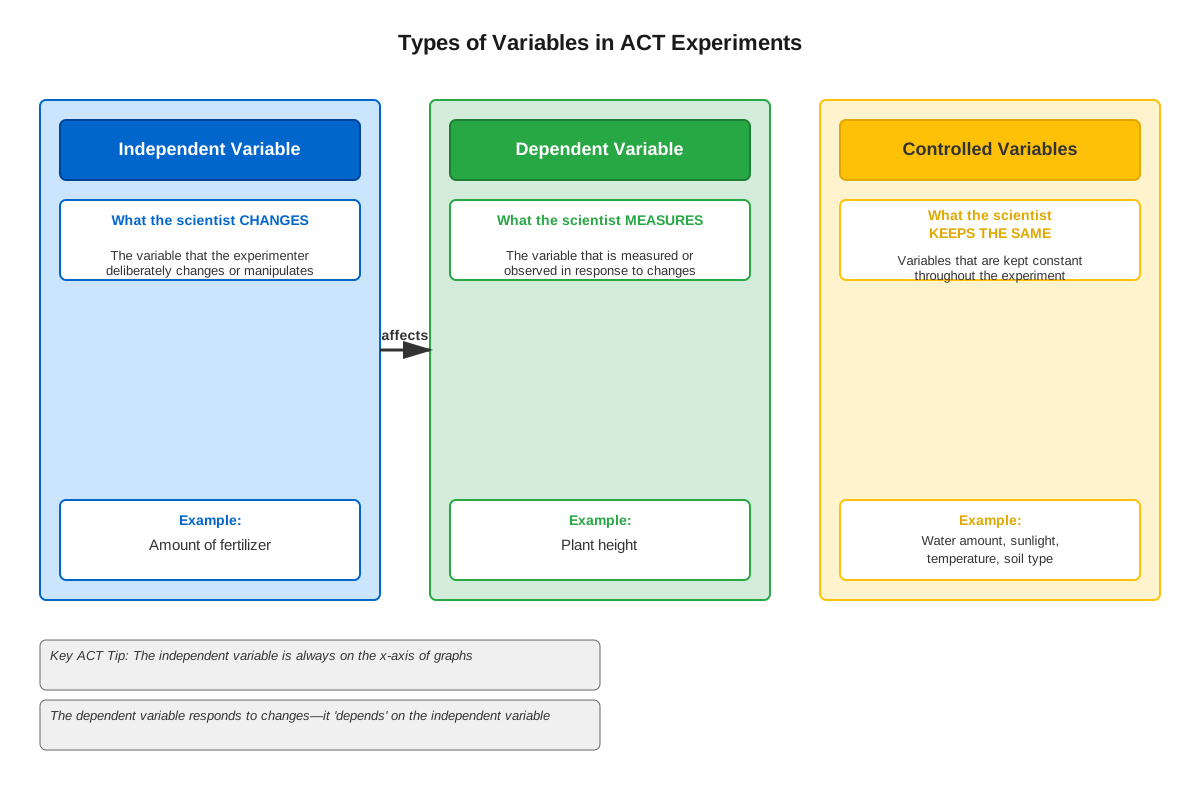
Independent Variables: What Scientists Change
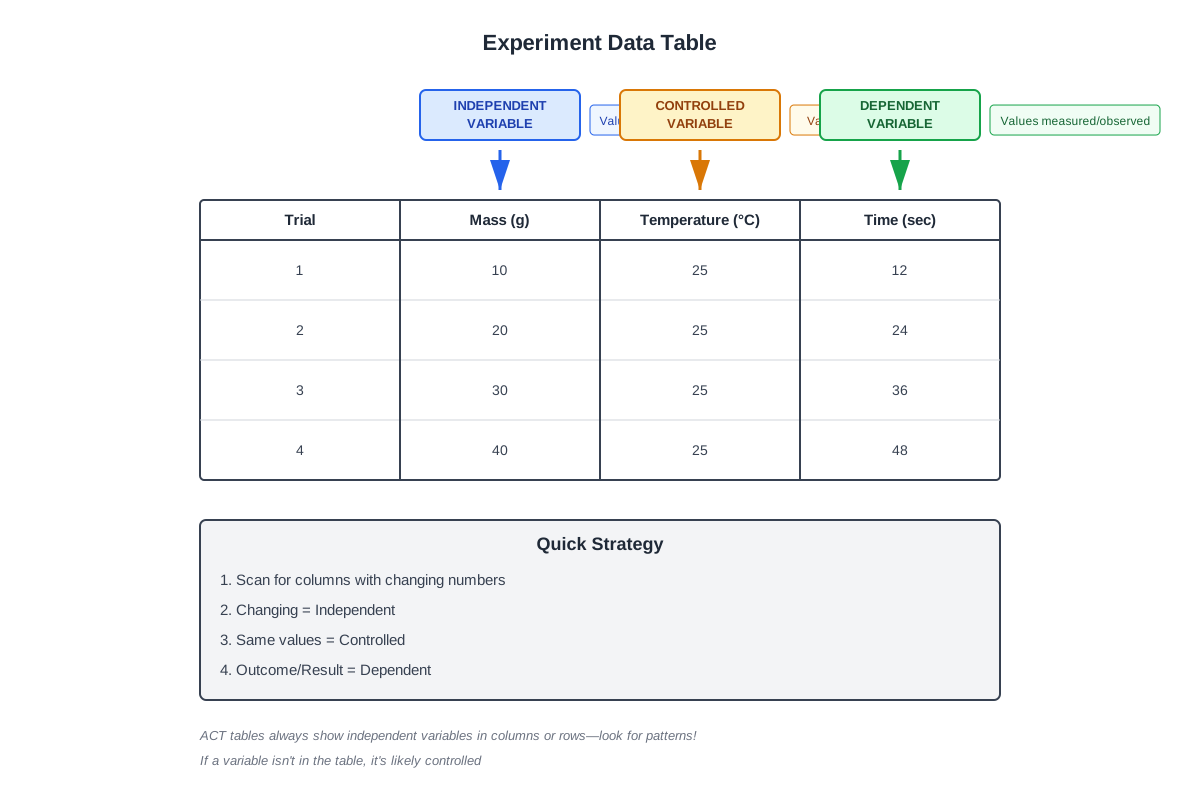
The independent variable is the factor that experimenters deliberately manipulate or change across different trials or experiments. This is the "cause" in a cause-and-effect relationship. On the ACT, independent variables are typically found:
- Along the x-axis of graphs
- In the leftmost column of data tables
- In experimental descriptions using phrases like "varied," "changed," "increased," or "tested at different levels"
For example, if researchers test plant growth at different temperatures (10°C, 20°C, 30°C, 40°C), temperature is the independent variable because scientists are systematically changing it to observe effects.
Key characteristics of independent variables:
- Controlled by the experimenter
- Changed systematically (often in regular intervals)
- Typically only ONE independent variable changes per experiment
- Remains the same across repeated trials at each level
Dependent Variables: What Scientists Measure
The dependent variable is the outcome or response that scientists measure or observe. This variable "depends on" changes in the independent variable—it's the "effect" in the cause-and-effect relationship. On the ACT, dependent variables appear:
- Along the y-axis of graphs
- In data columns to the right in tables
- In descriptions using words like "measured," "recorded," "observed," or "resulted in"
Continuing the plant growth example, if researchers measure plant height in centimeters, height is the dependent variable because it changes in response to temperature manipulation.
Key characteristics of dependent variables:
- Measured or observed by the experimenter
- Expected to change in response to independent variable manipulation
- Multiple dependent variables may be measured in a single experiment
- Values vary across trials and conditions
Controlled Variables: What Scientists Keep Constant
Controlled variables (also called constants or control factors) are all other factors that could potentially affect the outcome but are deliberately kept the same across all trials. Maintaining controlled variables is essential for establishing that changes in the dependent variable are truly caused by changes in the independent variable, not by other factors.
In the plant growth experiment, controlled variables might include:
- Amount of water given to each plant
- Type of soil used
- Amount of light exposure
- Size of containers
- Plant species tested
Why controlled variables matter on the ACT:
- Questions frequently ask what was "held constant" across experiments
- Identifying poor experimental design often involves recognizing uncontrolled variables
- Comparing experiments requires understanding which variables differ and which remain constant
Systematic Variable Manipulation
The ACT emphasizes systematic manipulation—changing variables in organized, measurable increments rather than randomly. This allows scientists to identify patterns and relationships. Common patterns include:
| Manipulation Type | Example | ACT Frequency |
|---|---|---|
| Linear intervals | Testing at 10°C, 20°C, 30°C, 40°C | Very High |
| Doubling/halving | Using 5 mL, 10 mL, 20 mL, 40 mL | High |
| Categorical changes | Comparing wood, metal, plastic | High |
| Time series | Measuring at 0 min, 30 min, 60 min, 90 min | Very High |
Multiple Experiments with Different Variables
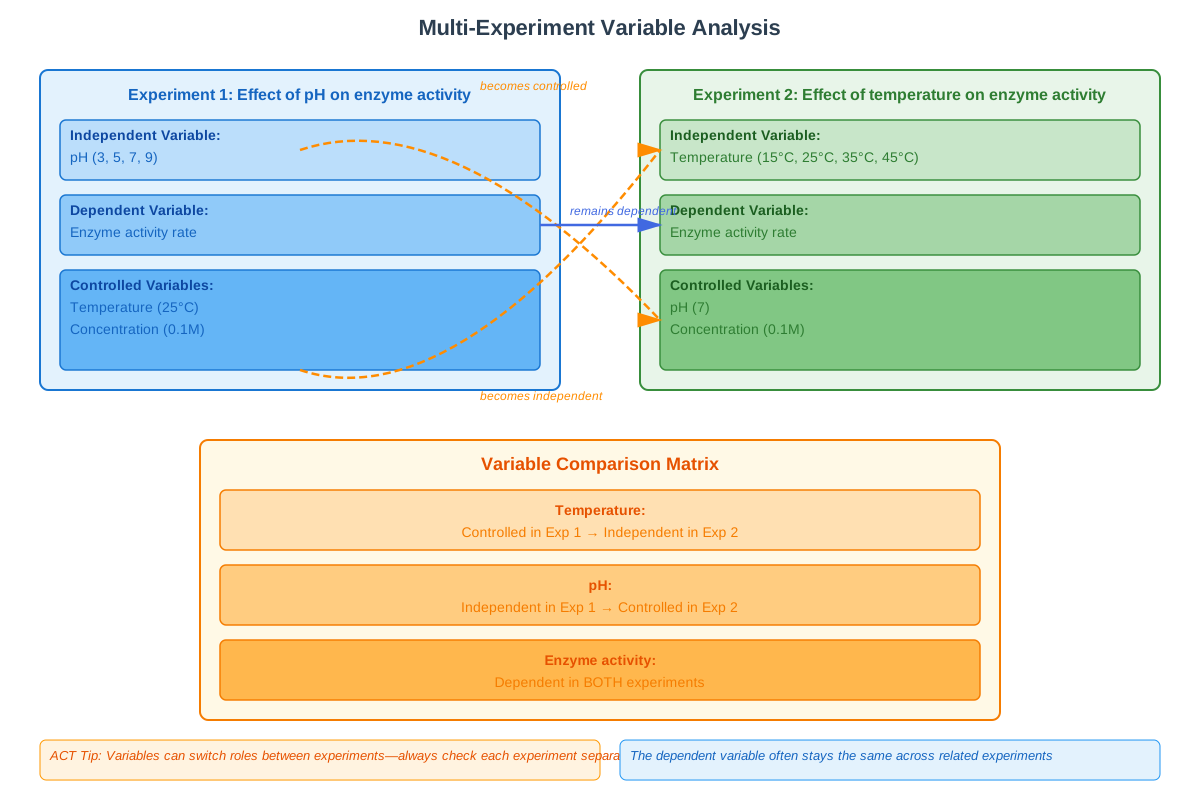
Research Summaries passages often present 2-4 related experiments. A critical skill is identifying which variable changed between experiments. The ACT tests this by:
- Presenting Experiment 1 with one set of conditions
- Presenting Experiment 2 that differs in exactly one variable
- Asking how the experiments differ or what additional information Experiment 2 provides
For example:
- Experiment 1: Tests enzyme activity at pH 4, 5, 6, 7, 8 at 25°C
- Experiment 2: Tests enzyme activity at pH 4, 5, 6, 7, 8 at 37°C
The variable that changed between experiments is temperature, while pH remains the independent variable within each experiment.
Direct vs. Inverse Relationships
When analyzing how changing variables affect outcomes, the ACT frequently tests understanding of relationship types:
Direct (positive) relationship: As the independent variable increases, the dependent variable increases
- Example: As fertilizer concentration increases, plant growth increases
Inverse (negative) relationship: As the independent variable increases, the dependent variable decreases
- Example: As altitude increases, air pressure decreases
No relationship: Changes in the independent variable produce no consistent pattern in the dependent variable
- Example: Changing music genre has no effect on plant growth
Recognizing these patterns quickly is essential for prediction questions and data interpretation.
Concept Relationships
The concepts within changing variables form an interconnected system:
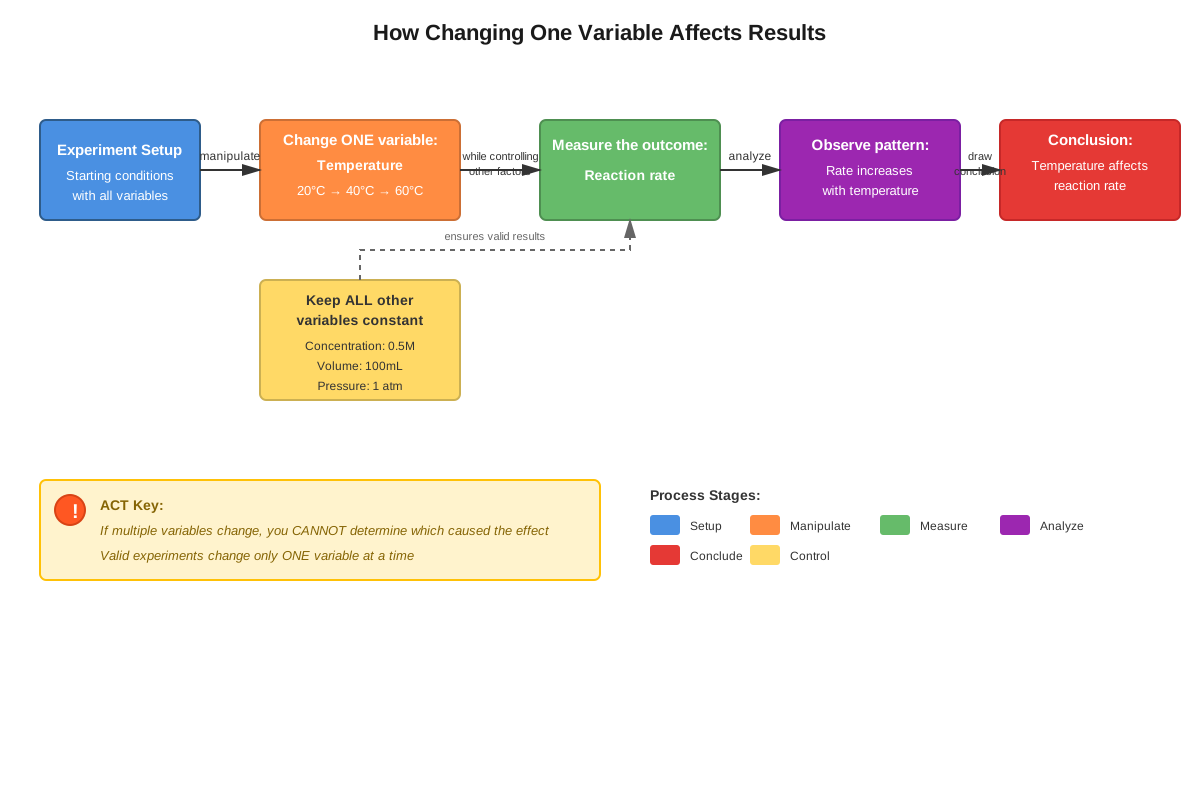
Independent Variable → manipulated by experimenter → produces changes in → Dependent Variable
Controlled Variables → held constant → ensures validity of → relationship between independent and dependent variables
Systematic Manipulation → creates measurable patterns → enables identification of → Direct or Inverse Relationships
Multiple Experiments → vary one additional factor → allow comparison of → how different conditions affect the same dependent variable
This topic connects to prerequisite knowledge of the scientific method by applying its principles to real experimental scenarios. It extends to more advanced topics like experimental design validity, statistical significance, and hypothesis testing. Understanding changing variables is also foundational for Data Representation passages, where students must interpret graphs showing variable relationships without explicit experimental descriptions.
The relationship map flows as follows:
Scientific Method → Experimental Design → Variable Identification → Data Collection → Pattern Recognition → Conclusion Drawing
High-Yield Facts
⭐ The independent variable is what the experimenter deliberately changes or manipulates across trials
⭐ The dependent variable is what the experimenter measures or observes as the outcome
⭐ Controlled variables must remain constant across all trials to ensure valid results
⭐ In data tables, the independent variable typically appears in the leftmost column
⭐ On graphs, the independent variable is conventionally plotted on the x-axis
- The dependent variable typically appears on the y-axis of graphs and in data columns to the right in tables
- When comparing multiple experiments, identify which single variable differs between them
- Systematic manipulation involves changing variables in organized, measurable increments
- A direct relationship means both variables increase or decrease together
- An inverse relationship means one variable increases while the other decreases
- Questions asking "what would happen if..." require understanding the established relationship between variables
- Proper experimental design changes only ONE independent variable at a time within a single experiment
- The number of trials or data points does not change the identity of variables—only their values change
- Temperature, time, concentration, and pH are among the most frequently manipulated independent variables on the ACT
- Recognizing which variables were controlled helps evaluate experimental validity
Quick check — test yourself on Changing variables so far.
Try Flashcards →Common Misconceptions
Misconception: The dependent variable is called "dependent" because it depends on the experimenter's choice.
Correction: The dependent variable is called "dependent" because its value depends on (is affected by) changes in the independent variable. The experimenter chooses to measure it, but doesn't directly control its value.
Misconception: Every factor mentioned in an experiment is a variable being tested.
Correction: Most factors mentioned are controlled variables kept constant. Only the independent variable is systematically changed, and only the dependent variable is measured as an outcome. All other factors are held constant.
Misconception: If an experiment has multiple trials, there must be multiple independent variables.
Correction: Multiple trials at the same condition test reliability and reduce error. The independent variable is identified by what changes across different conditions, not by the number of trials performed.
Misconception: The variable listed first in a passage or table is always the independent variable.
Correction: While independent variables often appear first in tables, always identify variables by their function: what's being changed (independent) versus what's being measured (dependent), not by their position.
Misconception: If two variables both change, they must both be independent variables.
Correction: In a properly designed experiment, only one variable is independently manipulated. If another variable changes, it's likely the dependent variable responding to the manipulation, or it indicates a confounding variable that should have been controlled.
Misconception: Controlled variables are unimportant and can be ignored when analyzing experiments.
Correction: Controlled variables are essential for experimental validity. ACT questions frequently ask what was held constant, and identifying uncontrolled variables is key to recognizing flawed experimental designs.
Misconception: The independent variable must be numerical.
Correction: Independent variables can be categorical (different materials, species, or methods) or numerical (different temperatures, concentrations, or times). Both types appear regularly on the ACT.
Worked Examples
Example 1: Identifying Variables in a Plant Growth Experiment
Passage Summary: Students conducted an experiment to test how different amounts of sunlight affect tomato plant growth. They placed 20 tomato plants of the same age and size in identical pots with the same soil. Five plants received 2 hours of sunlight daily, five received 4 hours, five received 6 hours, and five received 8 hours. All plants received 100 mL of water daily. After 30 days, students measured the height of each plant in centimeters.
Question: What is the independent variable in this experiment?
Step 1: Identify what the experimenters deliberately changed across different groups.
- The amount of sunlight varied: 2, 4, 6, and 8 hours daily
- This was systematically manipulated by the students
Step 2: Confirm this is what was changed, not what was measured.
- Sunlight exposure was controlled by placement, not measured as an outcome
- This is the "cause" being tested
Answer: The independent variable is the amount of daily sunlight exposure (or hours of sunlight per day).
Question: What is the dependent variable?
Step 1: Identify what was measured as the outcome.
- Plant height in centimeters was measured after 30 days
- This is the response to different sunlight amounts
Step 2: Confirm this depends on the independent variable.
- Height is expected to change based on sunlight exposure
- This is the "effect" being observed
Answer: The dependent variable is plant height in centimeters.
Question: Identify three controlled variables in this experiment.
Step 1: List factors that could affect plant growth but were kept constant.
- Plant age and initial size (all plants started the same)
- Pot type and size (identical pots)
- Soil type (same soil)
- Water amount (100 mL daily for all)
- Time period (all measured after 30 days)
- Plant species (all tomato plants)
Step 2: Select three clearly stated in the passage.
Answer: Three controlled variables are: (1) amount of water (100 mL daily), (2) type of soil (same for all plants), and (3) plant age and initial size (all started the same).
Connection to Learning Objectives: This example demonstrates identification of all three variable types and shows how proper experimental design requires controlling all factors except the one being tested.
Example 2: Comparing Multiple Experiments
Passage Summary:
- Experiment 1: Scientists tested the solubility of sodium chloride (NaCl) in water at 20°C, 40°C, 60°C, and 80°C. They measured how many grams of NaCl dissolved in 100 mL of water at each temperature.
- Experiment 2: Scientists tested the solubility of sodium chloride in water at 20°C, 40°C, 60°C, and 80°C, but used 200 mL of water. They measured how many grams of NaCl dissolved.
Question: How does Experiment 2 differ from Experiment 1?
Step 1: Identify what stayed the same between experiments.
- Same substance tested (NaCl)
- Same temperature values (20°C, 40°C, 60°C, 80°C)
- Same measurement (grams dissolved)
Step 2: Identify what changed between experiments.
- Volume of water: 100 mL in Experiment 1, 200 mL in Experiment 2
Answer: Experiment 2 used twice the volume of water (200 mL instead of 100 mL).
Question: In both experiments, what is the independent variable?
Step 1: Identify what was systematically changed within each experiment.
- Temperature was varied at four levels in both experiments
- This is what scientists manipulated to test its effect
Answer: The independent variable in both experiments is temperature.
Question: What additional information does Experiment 2 provide compared to Experiment 1?
Step 1: Consider why scientists would change the water volume.
- Experiment 2 tests whether the relationship between temperature and solubility changes with different water volumes
- It helps determine if solubility is affected by the amount of solvent
Step 2: Formulate the specific information gained.
Answer: Experiment 2 provides information about how water volume affects the solubility of NaCl at different temperatures, allowing scientists to determine whether the temperature-solubility relationship depends on the amount of water used.
Connection to Learning Objectives: This example shows how to identify the variable that differs between experiments while recognizing that the independent variable within each experiment remains the same. It demonstrates the strategic purpose of conducting multiple related experiments.
Exam Strategy
Approaching Variable Questions
When encountering Research Summaries passages, follow this systematic approach:
- Scan the experimental description first (before looking at data tables or graphs)
- Identify the independent variable by asking: "What did the scientists deliberately change?"
- Identify the dependent variable by asking: "What did they measure as a result?"
- Note controlled variables mentioned in the passage—these often appear in questions
- For multiple experiments, immediately identify what differs between them
Trigger Words and Phrases
For independent variables, watch for:
- "varied," "changed," "tested at different," "increased," "decreased"
- "at temperatures of," "using concentrations of," "with amounts of"
- "compared," "tested," "examined the effect of"
For dependent variables, watch for:
- "measured," "recorded," "observed," "determined," "calculated"
- "resulted in," "produced," "yielded," "showed"
- "the amount of," "the rate of," "the level of" (when referring to outcomes)
For controlled variables, watch for:
- "held constant," "kept the same," "identical," "same"
- "all plants/samples/trials received," "in each case"
- "constant," "fixed," "unchanged"
Process of Elimination Tips
When questions ask about variables:
- Eliminate options that describe outcomes when asked for independent variables
- Eliminate options that describe what experimenters controlled when asked for dependent variables
- For "what differs between experiments" questions, eliminate anything that appears in both experiments
- For "what was held constant" questions, eliminate the independent and dependent variables immediately
Time Allocation
- Variable identification questions: 15-20 seconds (these should be quick)
- Questions comparing experiments: 25-30 seconds (requires careful comparison)
- Prediction questions based on variable relationships: 30-40 seconds (requires analyzing trends)
Exam Tip: If a question asks what would happen if a variable were changed, first identify the current relationship (direct or inverse), then apply that pattern to the new condition.
Common Question Stems
Recognize these high-frequency question types:
- "Which of the following was the independent variable in Experiment 1?"
- "Based on the results, if [independent variable] were increased, [dependent variable] would most likely..."
- "Which factor was held constant across all trials?"
- "How did Experiment 2 differ from Experiment 1?"
- "Which variable was directly manipulated by the students?"
Memory Techniques
The DIM Acronym
Dependent variable = Data you collect (what you measure)
Independent variable = Intentionally changed (what you manipulate)
Maintained variables = Must stay constant (controlled variables)
The Cause-Effect Visualization
Visualize experiments as a chain:
CHANGE (independent) → CAUSES → EFFECT (dependent)
The independent variable is always the "cause" you introduce, and the dependent variable is always the "effect" you observe.
The Table/Graph Position Rule
"Left and Low, Change and Go"
- Left column in tables = independent variable
- Low (x-axis) on graphs = independent variable
- What you Change = independent variable
- What you measure as you Go = dependent variable
The Control Question
When identifying controlled variables, ask: "What could mess up this experiment if it weren't kept the same?" Those factors are your controlled variables.
The Multiple Experiment Comparison
"Spot the Difference"
When comparing experiments, play "spot the difference" like a puzzle—everything that's the same gets mentally crossed out, and what remains is what changed between experiments.
Summary
Changing variables is the foundation of experimental analysis on the ACT Science test. The independent variable is what experimenters deliberately manipulate or change across trials, typically appearing in the leftmost column of tables or on the x-axis of graphs. The dependent variable is the measured outcome that responds to these changes, usually found in data columns or on the y-axis. Controlled variables are all other factors kept constant to ensure experimental validity. Success on ACT questions requires quickly identifying these three variable types, recognizing systematic manipulation patterns, and understanding relationships between variables (direct, inverse, or none). When passages present multiple experiments, the key skill is identifying which single variable differs between them while recognizing that the independent variable within each experiment may remain the same. Mastering variable identification enables accurate prediction of outcomes, evaluation of experimental design, and interpretation of data—skills tested in approximately 20% of all ACT Science questions.
Key Takeaways
- Independent variables are deliberately changed by experimenters; dependent variables are measured outcomes that respond to these changes
- Controlled variables must remain constant across all trials to establish valid cause-and-effect relationships
- In tables and graphs, independent variables typically appear on the left/x-axis, while dependent variables appear on the right/y-axis
- When comparing multiple experiments, identify the single variable that differs between them
- Direct relationships show both variables changing in the same direction; inverse relationships show opposite directions
- Questions about "what would happen if" require identifying the established relationship pattern and applying it to new conditions
- Approximately 7-10 questions per ACT Science test directly assess understanding of changing variables, making this the highest-yield topic in Research Summaries
Related Topics
Experimental Design and Controls: Building on variable identification, this topic explores control groups, experimental groups, and how to design valid experiments. Mastering changing variables provides the foundation for evaluating whether experiments are properly controlled.
Data Interpretation and Trends: Understanding which variables were changed enables accurate interpretation of data patterns in tables and graphs. This topic extends variable analysis to complex data sets with multiple trends.
Hypothesis Testing: Scientists change variables to test specific hypotheses. This topic connects variable manipulation to the scientific method and prediction-making.
Conflicting Viewpoints Analysis: While less directly related, understanding how different scientists might manipulate different variables to test competing hypotheses appears in Conflicting Viewpoints passages.
Statistical Significance and Error: Advanced analysis of whether changes in dependent variables are truly caused by independent variable manipulation or could result from random variation.
Practice CTA
Now that you understand the core concepts of changing variables, it's time to apply this knowledge! Work through the practice questions to test your ability to identify independent, dependent, and controlled variables in real ACT-style passages. Use the flashcards to reinforce quick recognition of variable types and trigger words. Remember: this topic appears in approximately 20% of ACT Science questions, so mastering it will significantly boost your score. Each practice question you complete strengthens your pattern recognition and speeds up your analysis—skills that directly translate to points on test day. You've built the foundation; now practice until variable identification becomes automatic!
Sign up free to keep reading
Create a free AnvayaPrep account to finish this ACT guide on Changing variables — plus flashcards and practice questions.