Overview
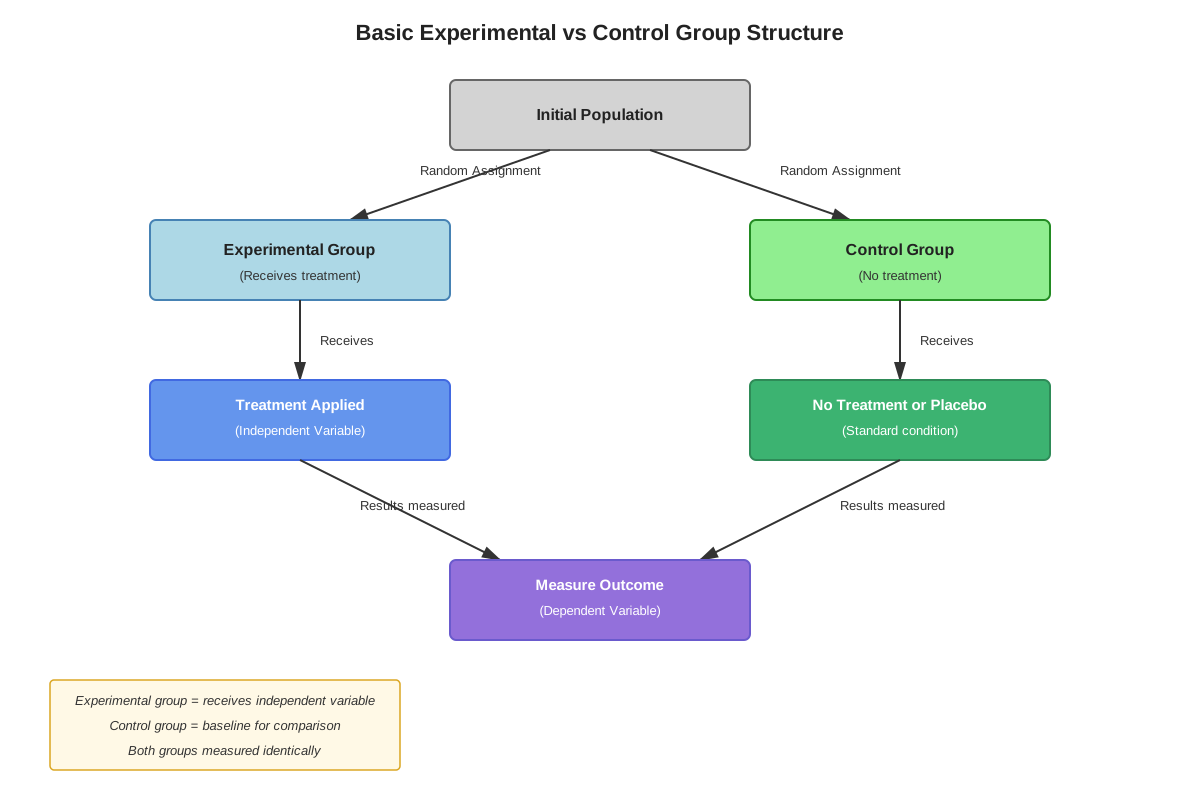
The experimental group is a fundamental concept in scientific research design that appears frequently on the ACT Science test, particularly in Research Summaries passages. An experimental group consists of subjects or samples that receive the treatment, intervention, or condition being tested in an experiment. This group is exposed to the independent variable that researchers manipulate to observe its effects on the dependent variable. Understanding experimental groups is critical because they form the basis of hypothesis testing and allow scientists to determine cause-and-effect relationships.
On the ACT Science test, questions about experimental groups assess your ability to identify which subjects received the treatment, understand how experimental design isolates variables, and interpret data from experiments with multiple groups. The ACT experimental group questions typically require you to distinguish between groups receiving different treatments, recognize control versus experimental conditions, and analyze how changes in the independent variable affect outcomes. These questions appear in approximately 30-40% of Research Summaries passages, making this a high-yield topic for test preparation.
Mastering experimental groups connects directly to broader scientific reasoning skills tested on the ACT, including understanding variables, interpreting experimental design, analyzing data tables and graphs, and drawing valid conclusions from evidence. This concept serves as the foundation for understanding how scientists test hypotheses and establish causation, which are central themes throughout the Science section. Strong comprehension of experimental groups enables students to quickly parse complex passages, identify what's being tested, and accurately answer questions about experimental procedures and results.
Learning Objectives
- [ ] Identify when Experimental group is being tested in ACT passages
- [ ] Explain the core rule or strategy behind Experimental group design and function
- [ ] Apply Experimental group concepts to ACT-style questions accurately
- [ ] Distinguish between experimental groups, control groups, and other comparison groups in multi-group studies
- [ ] Analyze how changes to experimental groups affect the validity and interpretation of results
- [ ] Evaluate whether an experimental design properly isolates the variable being tested through appropriate group selection
Prerequisites
- Basic understanding of independent and dependent variables: Experimental groups are defined by the independent variable they receive, and their outcomes are measured through dependent variables
- Familiarity with scientific method steps: Recognizing experimental groups requires understanding hypothesis testing and experimental design structure
- Ability to read data tables and graphs: ACT questions require extracting information about experimental groups from visual data representations
- Understanding of control groups: Experimental groups are most meaningful when compared to appropriate control or comparison groups
Why This Topic Matters
Understanding experimental groups has profound real-world significance across all scientific disciplines. Medical researchers use experimental groups to test new drugs, with patients receiving the medication forming the experimental group while others receive placebos. Environmental scientists create experimental groups of ecosystems exposed to different pollution levels to assess environmental impact. Agricultural researchers establish experimental groups of crops treated with various fertilizers to optimize food production. Every major scientific advancement—from vaccine development to climate change research—relies on properly designed experimental groups to establish causation and validate hypotheses.
On the ACT Science test, experimental group questions appear in approximately 35% of Research Summaries passages, which constitute one-third of the entire Science section. This translates to roughly 5-7 questions per test directly or indirectly involving experimental group identification and analysis. Questions typically fall into three categories: (1) identification questions asking which group received a specific treatment, (2) design questions evaluating whether experimental groups were properly constructed, and (3) interpretation questions requiring analysis of experimental group results.
Common ACT passage scenarios include: experiments comparing multiple treatment groups (e.g., plants receiving different fertilizer concentrations), studies with one experimental and one control group (e.g., bacteria exposed to antibiotics versus untreated bacteria), and complex designs with multiple experimental groups testing different variables simultaneously (e.g., temperature and pH effects on enzyme activity). The test frequently presents data tables where rows or columns represent different experimental groups, requiring students to track which conditions apply to each group and how outcomes differ across groups.
Core Concepts
Definition and Purpose of Experimental Groups
An experimental group is the set of subjects, samples, or units in a scientific study that receives the treatment, intervention, or specific condition being investigated. The primary purpose of an experimental group is to test the effect of the independent variable—the factor that researchers deliberately manipulate or change. By exposing the experimental group to this variable and measuring the resulting changes in the dependent variable (the outcome being measured), scientists can establish whether a cause-and-effect relationship exists.
The experimental group serves as the "test case" in hypothesis testing. For example, if researchers hypothesize that a new fertilizer increases plant growth, the experimental group would consist of plants that receive the fertilizer. The growth of these plants (dependent variable) is then measured and compared to plants that did not receive the fertilizer. Without a properly defined experimental group, scientists cannot determine whether observed changes result from the treatment or from other factors.
Characteristics of Well-Designed Experimental Groups
Effective experimental groups share several critical characteristics that ensure valid results:
Homogeneity: Members of the experimental group should be as similar as possible in all characteristics except the independent variable being tested. If testing a drug's effectiveness, experimental group members should have similar age ranges, health conditions, and other relevant factors. This similarity ensures that observed differences in outcomes result from the treatment rather than pre-existing differences.
Adequate sample size: The experimental group must contain enough subjects to produce statistically meaningful results. Small experimental groups may show effects due to random chance rather than the treatment. ACT passages typically indicate sample sizes, and questions may ask about the reliability of conclusions based on group size.
Proper exposure to the independent variable: The experimental group must receive the treatment in a controlled, consistent manner. If testing temperature effects on reaction rates, all members of the experimental group must experience the same temperature for the same duration.
Measurable outcomes: The dependent variable must be quantifiable so researchers can objectively compare the experimental group to other groups. ACT passages always provide numerical data or clear categorical outcomes for experimental groups.
Multiple Experimental Groups
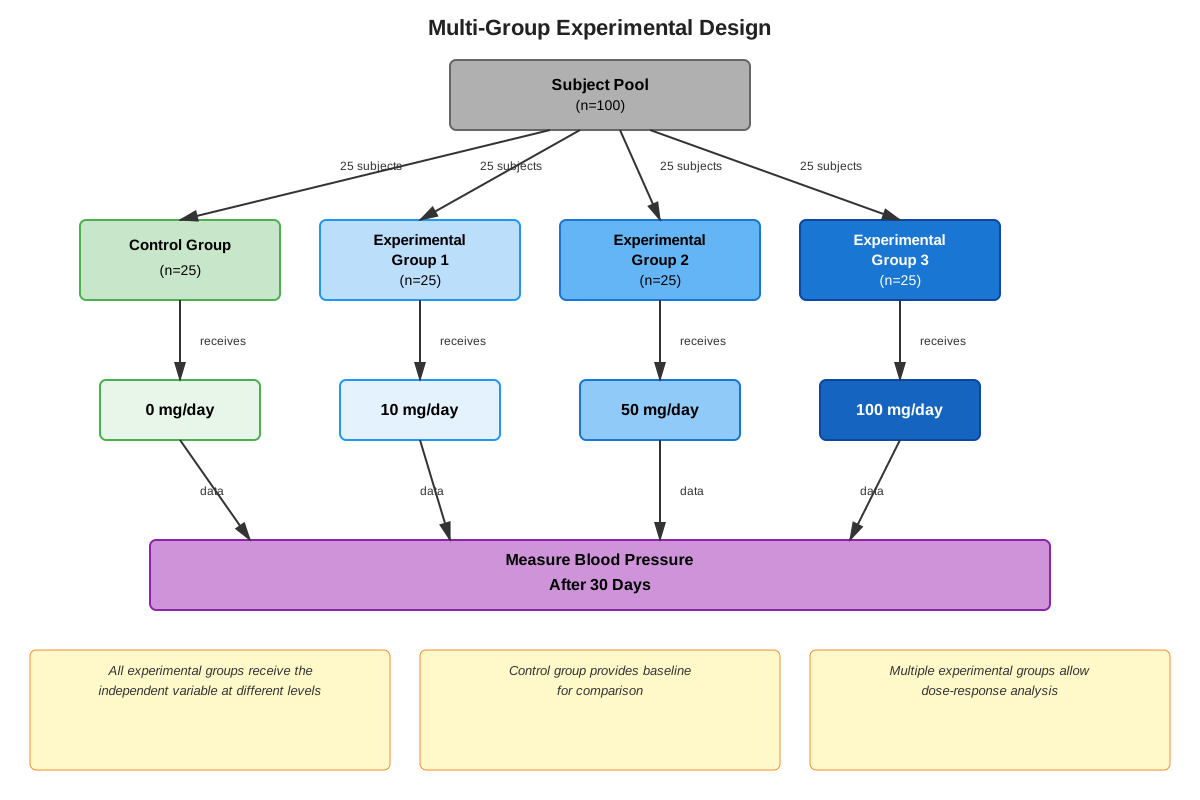
Many experiments include multiple experimental groups, each receiving different levels or types of the independent variable. This design allows researchers to test dose-response relationships, compare different treatments, or examine multiple conditions simultaneously.
For example, an experiment testing fertilizer concentration might include:
- Group 1: 0 mg/L fertilizer (control)
- Group 2: 10 mg/L fertilizer (experimental group 1)
- Group 3: 20 mg/L fertilizer (experimental group 2)
- Group 4: 30 mg/L fertilizer (experimental group 3)
In this design, Groups 2, 3, and 4 are all experimental groups because each receives a treatment (fertilizer), while Group 1 serves as the control. ACT questions frequently test whether students can identify all experimental groups and understand how they differ from each other and from the control.
Experimental Group vs. Control Group
The distinction between experimental and control groups is crucial for ACT success:
| Feature | Experimental Group | Control Group |
|---|---|---|
| Treatment | Receives the intervention/treatment being tested | Receives no treatment or a standard/placebo treatment |
| Purpose | Tests the effect of the independent variable | Provides baseline data for comparison |
| Independent Variable | Exposed to the variable | Not exposed (or exposed to standard condition) |
| Number | Can be one or multiple groups | Typically one group per experiment |
| Data Interpretation | Results compared to control to determine treatment effect | Results show what happens without treatment |
Understanding this distinction helps answer ACT questions like "Which group serves as the control?" or "How many experimental groups were tested?" Students must recognize that the control group is NOT an experimental group, even though both are essential to experimental design.
Identifying Experimental Groups in ACT Passages
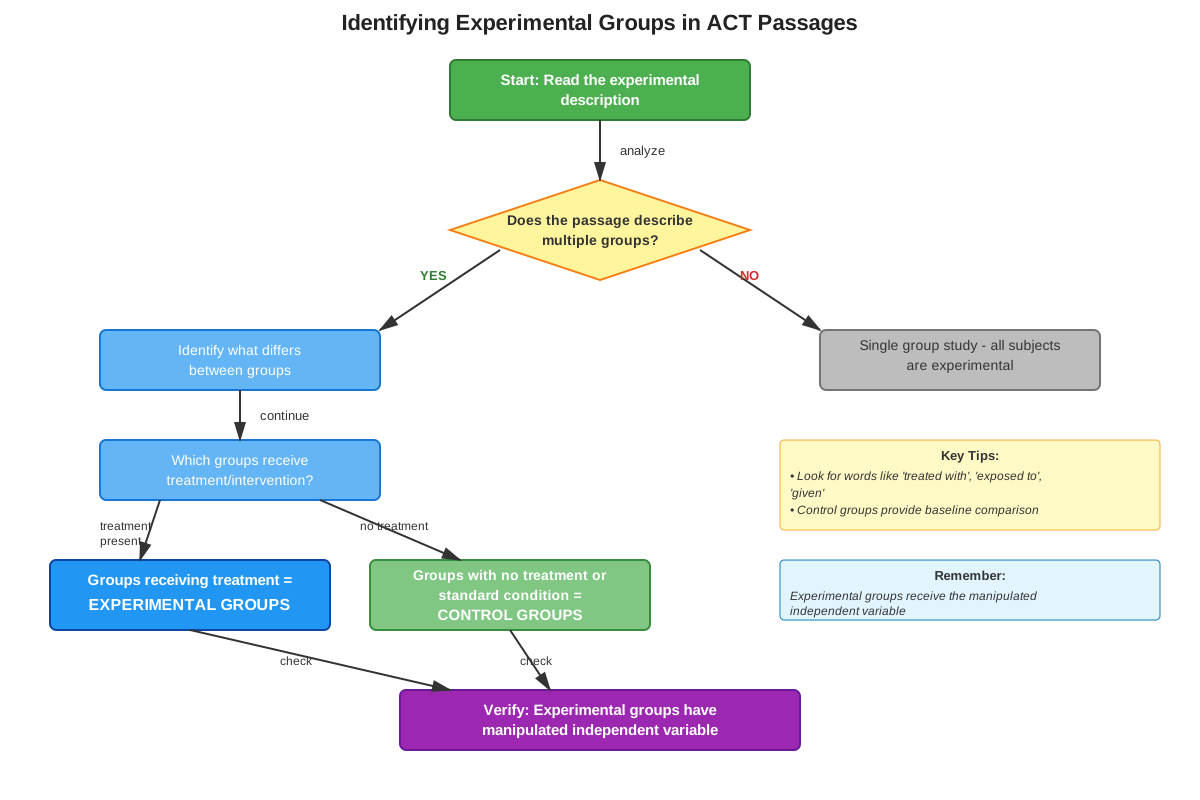
ACT Research Summaries passages present experimental groups in several standard formats:
Table format: Groups appear as rows or columns, with conditions and results listed. Look for labels like "Group A," "Treatment 1," or "Condition X." The experimental groups are those receiving the treatment being investigated.
Descriptive text: The passage describes procedures like "Plants in Group 1 were watered with distilled water, while plants in Groups 2 and 3 received solutions containing 5% and 10% salt, respectively." Here, Groups 2 and 3 are experimental groups (receiving salt treatment).
Graph format: Different lines, bars, or data series represent different groups. The legend or axis labels identify which groups received which treatments.
Key trigger phrases that signal experimental groups include: "treated with," "exposed to," "received," "subjected to," "given," and "administered." These phrases indicate which groups are experimental rather than control groups.
Concept Relationships
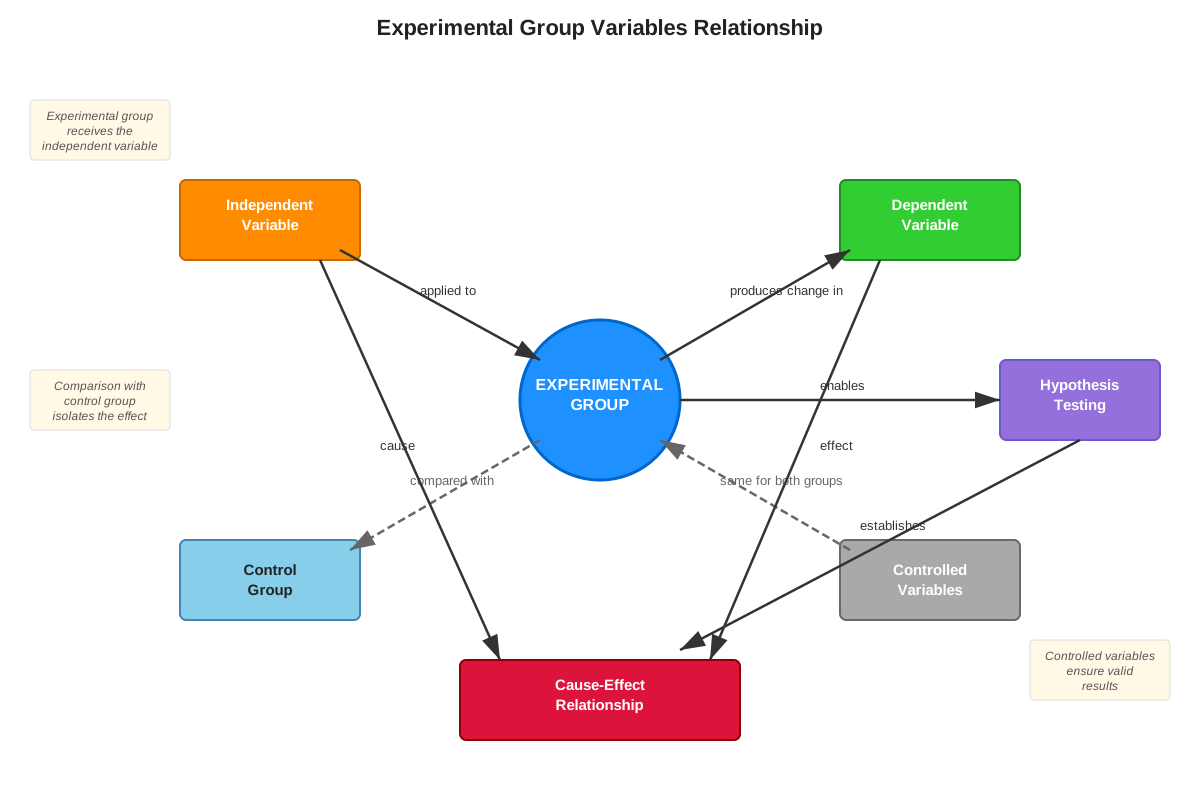
The concept of experimental groups connects hierarchically and functionally to multiple aspects of scientific research design. At the foundation level, variables (independent and dependent) define what experimental groups are and what they measure. The independent variable determines which subjects belong to which experimental group, while the dependent variable provides the data used to compare experimental groups.
Experimental groups connect laterally to control groups—they are complementary concepts that work together to establish causation. Neither concept is fully meaningful without the other; experimental groups show what happens with treatment, while control groups show what happens without it. This relationship flows into data analysis and interpretation, where comparing experimental group results to control group results allows scientists to draw conclusions about treatment effects.
Moving upward in complexity, experimental groups are components of larger experimental designs. Simple experiments may have one experimental group and one control group, while complex factorial designs may have multiple experimental groups testing combinations of variables. This connects to hypothesis testing, where experimental groups provide the evidence needed to support or refute hypotheses.
The relationship map flows as follows:
Variables → define → Experimental Groups → compared with → Control Groups → produces → Data → enables → Analysis → supports/refutes → Hypotheses → leads to → Conclusions
Understanding experimental groups also enables progression to more advanced topics like randomization, blinding, replication, and statistical significance—all concepts that build upon the foundation of properly designed experimental groups.
High-Yield Facts
⭐ The experimental group receives the treatment or intervention being tested in the experiment
⭐ Multiple experimental groups can exist in a single experiment, each receiving different levels or types of the independent variable
⭐ The experimental group is exposed to the independent variable, while outcomes are measured through the dependent variable
⭐ Experimental groups must be compared to control groups or other experimental groups to draw valid conclusions
⭐ All members of an experimental group should be treated identically except for the specific variable being tested
- The control group is NOT an experimental group, even though both are essential to experimental design
- Experimental groups allow researchers to establish cause-and-effect relationships rather than just correlations
- Proper experimental group design requires adequate sample size to ensure statistically meaningful results
- ACT passages typically identify experimental groups through descriptive labels, table headers, or graph legends
- When multiple experimental groups exist, they often test different doses, concentrations, or intensities of the same treatment
- The validity of experimental conclusions depends on how well the experimental groups isolate the variable being tested
- Experimental groups in ACT passages always have measurable, quantifiable outcomes presented in tables or graphs
Quick check — test yourself on Experimental group so far.
Try Flashcards →Common Misconceptions
Misconception: The control group is a type of experimental group because it's part of the experiment.
Correction: The control group and experimental group are distinct categories. The experimental group receives the treatment being tested, while the control group does not receive the treatment (or receives a standard/placebo treatment). They serve different purposes: experimental groups test the effect of the independent variable, while control groups provide baseline comparison data.
Misconception: An experiment can only have one experimental group.
Correction: Experiments frequently include multiple experimental groups, each receiving different levels, doses, or types of the independent variable. For example, testing three different drug doses would require three experimental groups plus a control group. ACT passages commonly present multi-group designs.
Misconception: The experimental group is always the group with the highest value or most extreme condition.
Correction: The experimental group is defined by receiving the treatment being tested, regardless of intensity. In an experiment testing temperature effects, both a "high temperature" group and a "low temperature" group could be experimental groups if both differ from normal room temperature (the control condition).
Misconception: If a passage describes multiple groups, they must all be experimental groups.
Correction: Passages typically include at least one control group alongside experimental groups. Students must carefully read the conditions each group receives to distinguish experimental groups (receiving treatment) from control groups (receiving no treatment or standard treatment).
Misconception: The experimental group always shows greater changes or more dramatic results than the control group.
Correction: The experimental group may show greater, lesser, or equal changes compared to the control group. The purpose of the experimental group is to test whether the treatment has an effect, which could be positive, negative, or neutral. "No difference" between groups is a valid experimental result.
Worked Examples
Example 1: Identifying Experimental Groups in a Multi-Group Study
Passage Summary: Scientists investigated the effect of light intensity on photosynthesis rates in aquatic plants. They established four groups of plants:
- Group A: Exposed to 0 lumens (complete darkness)
- Group B: Exposed to 100 lumens
- Group C: Exposed to 500 lumens
- Group D: Exposed to 1000 lumens
All groups contained 20 plants of the same species, were kept at 25°C, and received identical nutrient solutions. After 7 days, researchers measured oxygen production as an indicator of photosynthesis rate.
Question: Which groups serve as experimental groups in this study?
Solution Process:
Step 1: Identify the independent variable being tested. The passage states the study investigates "the effect of light intensity," so light intensity is the independent variable.
Step 2: Determine which groups receive the treatment (light exposure). Groups B, C, and D all receive light at different intensities (100, 500, and 1000 lumens).
Step 3: Identify the control group. Group A receives 0 lumens (complete darkness), representing the absence of the treatment. This is the control group.
Step 4: Classify the remaining groups. Since Groups B, C, and D all receive the treatment being tested (light), they are all experimental groups.
Answer: Groups B, C, and D are the experimental groups. This experiment has three experimental groups testing different light intensities and one control group (Group A) testing the baseline condition of no light.
Connection to Learning Objectives: This example demonstrates how to identify experimental groups when multiple groups exist (Objective 1) and how to distinguish experimental groups from control groups (Objective 4). The key strategy is identifying which groups receive the treatment being investigated.
Example 2: Analyzing Experimental Group Design
Passage Summary: Researchers tested whether a new antibiotic (Drug X) effectively kills bacteria. They created three groups:
- Group 1: 100 bacteria samples exposed to Drug X at 10 mg/mL
- Group 2: 100 bacteria samples exposed to a standard antibiotic at 10 mg/mL
- Group 3: 100 bacteria samples exposed to sterile water
After 24 hours, researchers counted surviving bacteria in each group.
Question: A student claims that Groups 1 and 2 are both experimental groups. Is this claim correct? Explain.
Solution Process:
Step 1: Identify what is being tested. The passage states researchers are testing "whether a new antibiotic (Drug X) effectively kills bacteria," so Drug X is the specific treatment being investigated.
Step 2: Determine which group receives the treatment being tested. Only Group 1 receives Drug X, the treatment under investigation.
Step 3: Classify Group 2. Group 2 receives a "standard antibiotic," which serves as a positive control or comparison group. This allows researchers to compare the new drug's effectiveness to an established treatment.
Step 4: Classify Group 3. Group 3 receives sterile water (no antibiotic), making it the negative control group showing what happens without treatment.
Step 5: Evaluate the student's claim. The claim is partially incorrect. Group 1 is the experimental group because it receives Drug X, the treatment being tested. Group 2 is a comparison/positive control group, not an experimental group, because it doesn't receive the treatment under investigation. The experiment tests Drug X specifically, not antibiotics in general.
Answer: The claim is incorrect. Only Group 1 is the experimental group because it receives Drug X, the specific treatment being investigated. Group 2 is a positive control or comparison group that allows researchers to compare Drug X's effectiveness to an existing treatment. Group 3 is the negative control showing baseline bacterial survival without any antibiotic.
Connection to Learning Objectives: This example illustrates the core strategy of identifying experimental groups by determining what specific treatment is being tested (Objective 2). It also demonstrates how to distinguish between experimental groups and various types of control or comparison groups (Objective 4), a common source of ACT questions.
Exam Strategy
When approaching ACT questions about experimental groups, follow this systematic process:
Step 1: Identify the research question or hypothesis stated in the passage introduction. This tells you what treatment or variable is being investigated, which defines the experimental group(s).
Step 2: Scan for group descriptions in the passage text, tables, or figure legends. Look for labels like "Group 1," "Treatment A," "Condition X," or descriptive phrases indicating different groups.
Step 3: Create a mental or written chart listing each group and what it receives. This prevents confusion in multi-group experiments.
Step 4: Apply the definition: Experimental groups receive the treatment being tested. Control groups do not receive the treatment or receive a standard/placebo treatment.
Trigger words and phrases that signal experimental groups include:
- "treated with"
- "exposed to"
- "received"
- "administered"
- "given"
- "subjected to"
- "in the presence of"
Trigger words that signal control groups include:
- "untreated"
- "no treatment"
- "distilled water" (when testing substances dissolved in water)
- "room temperature" (when testing temperature effects)
- "standard conditions"
- "placebo"
Process-of-elimination tips:
When a question asks "Which group is the experimental group?" eliminate options that:
- Describe the control group (receives no treatment or standard treatment)
- Describe the independent variable itself rather than the group receiving it
- Describe the dependent variable (the outcome being measured)
- Include groups that don't exist in the passage
When a question asks "How many experimental groups were tested?" count only groups receiving the treatment, excluding:
- Control groups
- The same group measured at different times (that's one group with multiple measurements)
Time allocation: Experimental group questions typically require 20-30 seconds once you understand the passage. Spend 10-15 seconds identifying all groups during your initial passage reading, then 10-15 seconds answering the specific question. If you cannot identify groups quickly, mark the question and return after completing easier questions.
Exam Tip: If a passage describes groups but doesn't explicitly label them as "experimental" or "control," YOU must classify them based on which receives the treatment being tested. The ACT expects you to apply the definition, not just recognize labels.
Memory Techniques
E-TREAT Mnemonic for remembering experimental group characteristics:
- Exposed to the independent variable
- Treatment received (the intervention being tested)
- Results measured through dependent variable
- Equal treatment within the group (all members treated identically)
- Adequate sample size needed
- Tested against control or other groups
Visualization Strategy: Picture an experimental group as a "test kitchen" where chefs (researchers) try a new recipe (treatment). The experimental group is the batch of food made with the new recipe, while the control group is the batch made with the standard recipe. Just as you'd compare the two batches to see if the new recipe is better, scientists compare experimental and control groups to see if the treatment works.
The "WHO GETS WHAT" Approach: When reading any ACT passage, immediately ask:
- WHO: What subjects/samples are in each group?
- GETS: Which groups receive treatment vs. no treatment?
- WHAT: What specific treatment does each experimental group receive?
This three-word question helps you quickly classify all groups in any experiment.
Acronym for Multiple Experimental Groups: DALE
- Different doses or levels
- All receive treatment (unlike control)
- Labeled separately in data
- Each tests one variation of the independent variable
Summary
The experimental group is the cornerstone of scientific research design and a high-yield concept for ACT Science success. An experimental group consists of subjects or samples that receive the treatment, intervention, or specific condition being investigated—they are exposed to the independent variable that researchers manipulate. The primary purpose of experimental groups is to test cause-and-effect relationships by comparing outcomes (dependent variables) between groups that receive treatment and those that do not. Experiments may include multiple experimental groups, each receiving different levels or types of the independent variable, allowing researchers to test dose-response relationships or compare multiple treatments. The critical distinction between experimental and control groups is that experimental groups receive the treatment being tested, while control groups do not receive treatment or receive a standard/placebo treatment. On the ACT, identifying experimental groups requires recognizing which groups receive the treatment described in the research question, distinguishing them from control groups, and understanding how multiple experimental groups relate to each other. Success on experimental group questions depends on carefully reading group descriptions, identifying the independent variable being tested, and applying the core definition that experimental groups are those exposed to the treatment under investigation.
Key Takeaways
- The experimental group receives the specific treatment or intervention being tested in the study
- Experimental groups are defined by exposure to the independent variable and are compared to control groups to establish causation
- A single experiment can include multiple experimental groups, each testing different levels, doses, or types of the independent variable
- The control group is NOT an experimental group—it provides baseline comparison data by not receiving the treatment
- On the ACT, identify experimental groups by determining what treatment is being investigated and which groups receive that treatment
- All members within an experimental group must be treated identically to ensure valid results
- Experimental group questions appear in approximately 35% of Research Summaries passages, making this a high-priority topic for test preparation
Related Topics
Control Groups: Understanding control groups deepens comprehension of experimental groups because these concepts are complementary. Control groups provide the baseline comparison that makes experimental group results meaningful. Mastering experimental groups naturally leads to studying control group design and function.
Independent and Dependent Variables: These concepts define what experimental groups receive (independent variable) and what outcomes are measured (dependent variable). Strong understanding of experimental groups requires and reinforces variable identification skills.
Experimental Design and Scientific Method: Experimental groups are components of larger experimental designs. After mastering this topic, students can progress to studying complex designs including factorial experiments, repeated measures, and randomized controlled trials.
Data Analysis and Interpretation: Once students can identify experimental groups, they can advance to analyzing and comparing data from different groups, calculating differences between groups, and drawing valid conclusions from experimental results.
Statistical Significance and Sample Size: These advanced topics build on experimental group concepts by addressing how many subjects are needed in experimental groups and how to determine whether differences between groups are meaningful or due to chance.
Practice CTA
Now that you've mastered the concept of experimental groups, it's time to apply your knowledge! Complete the practice questions to test your ability to identify experimental groups in various ACT-style passages, distinguish them from control groups, and analyze experimental designs. Use the flashcards to reinforce key definitions and characteristics until you can instantly recognize experimental groups in any passage format. Remember: experimental group questions appear on virtually every ACT Science test, so mastering this topic directly translates to points on test day. Your investment in understanding experimental groups will pay dividends across multiple passages and question types. You've got this!
Sign up free to keep reading
Create a free AnvayaPrep account to finish this ACT guide on Experimental group — plus flashcards and practice questions.