Overview
Method comparison is a critical skill tested in the Research Summaries section of the ACT Science Test. This question type requires students to analyze and contrast different experimental approaches, procedures, or techniques used to investigate the same phenomenon or answer related research questions. Unlike Data Representation passages that focus on interpreting graphs and tables, or Conflicting Viewpoints passages that present opposing theories, Research Summaries passages—where method comparison appears—describe one or more experiments and ask students to understand the experimental design, identify variables, and compare methodologies.
The ability to perform ACT method comparison is essential because approximately 45-55% of the ACT Science Test consists of Research Summaries passages, and method comparison questions appear in nearly every Research Summaries passage. These questions assess whether students can identify similarities and differences between experimental procedures, understand why researchers might choose one method over another, and recognize how changes in methodology affect results and conclusions. Mastering this skill directly impacts a student's ability to score in the upper percentile ranges on the Science Test.
Method comparison connects to broader scientific literacy by requiring students to think like researchers who must evaluate experimental designs, replicate studies, or choose appropriate methodologies for their investigations. This skill builds upon fundamental understanding of the scientific method, variables, controls, and experimental design. It also relates to data interpretation skills, as students must understand how different methods produce different types of data and how those differences affect the validity and applicability of conclusions drawn from experiments.
Learning Objectives
- [ ] Identify when Method comparison is being tested in ACT Science passages
- [ ] Explain the core rule or strategy behind Method comparison questions
- [ ] Apply Method comparison to ACT-style questions accurately
- [ ] Distinguish between independent variables, dependent variables, and controlled variables across multiple experiments
- [ ] Evaluate the advantages and limitations of different experimental approaches
- [ ] Predict how changes in methodology would affect experimental outcomes
- [ ] Synthesize information from multiple experiments to draw broader conclusions
Prerequisites
- Basic understanding of the scientific method: Necessary to recognize the purpose and structure of experiments being compared
- Knowledge of variables (independent, dependent, controlled): Essential for identifying what differs between experimental methods
- Familiarity with experimental design principles: Required to understand why certain methodological choices are made
- Ability to read and interpret data tables and graphs: Needed because method comparison often involves analyzing how different methods produce different data patterns
- Understanding of Research Summaries passage structure: Important for quickly locating relevant methodological information
Why This Topic Matters
Method comparison represents a fundamental aspect of scientific inquiry that extends far beyond standardized testing. In real-world research, scientists must constantly evaluate different approaches to answering questions, replicate studies using modified methods, and assess whether observed differences in results stem from actual phenomena or methodological variations. Medical researchers compare treatment protocols, environmental scientists evaluate different sampling techniques, and engineers test various design approaches—all requiring the same comparative analysis skills tested on the ACT.
On the ACT Science Test, method comparison questions appear with high frequency and predictability. Research Summaries passages constitute 18 of the 40 questions on the test (three passages with six questions each), and typically 2-3 questions per Research Summaries passage directly test method comparison skills. This means students can expect 6-9 method comparison questions per test, representing 15-22% of the entire Science Test score. These questions often appear in the middle difficulty range, making them ideal targets for score improvement—they're accessible to most students with proper preparation but challenging enough that mastering them provides a competitive advantage.
Method comparison questions typically appear in several recognizable formats: questions asking "How did Experiment 2 differ from Experiment 1?", questions requiring students to identify which variable was manipulated differently across studies, questions asking about the purpose of methodological changes, and questions requiring students to predict results if a different method were used. The passages themselves usually present 2-4 related experiments with clear descriptions of procedures, making the information accessible to students who know what to look for.
Core Concepts
Understanding Method Comparison Fundamentals
Method comparison refers to the systematic analysis of different experimental procedures, techniques, or approaches used to investigate scientific questions. On the ACT, this skill involves identifying what aspects of experimental design vary between studies and understanding the implications of those variations. The fundamental principle is that experiments can differ in numerous ways—the materials used, the procedures followed, the variables manipulated, the measurements taken, or the conditions maintained—and each difference potentially affects the results and conclusions.
When approaching method comparison, students must recognize that experiments within a Research Summaries passage are related but not identical. They typically investigate the same general phenomenon but use different approaches to gather complementary information. For example, one experiment might measure temperature effects on reaction rate at five different temperatures, while a second experiment might measure pressure effects on the same reaction at five different pressures. Both examine factors affecting reaction rate, but the methods differ in which independent variable is manipulated.
Types of Methodological Differences
Experimental methods can differ in several key dimensions that the ACT frequently tests:
Variable Manipulation: The most common difference involves which independent variable is changed. Experiment 1 might vary temperature while holding pressure constant, whereas Experiment 2 varies pressure while holding temperature constant. Recognizing these differences requires careful attention to the experimental descriptions and data tables.
Measurement Techniques: Different experiments may measure the same phenomenon using different instruments or methods. One experiment might measure plant growth by height, while another measures it by mass. These differences affect what aspects of the phenomenon are captured and how precisely they're quantified.
Sample or Subject Differences: Experiments may use different materials, organisms, or populations. One experiment might test a hypothesis using mice, while another uses rats. One might use freshwater samples, while another uses saltwater samples. These differences affect the generalizability of results.
Procedural Variations: The sequence of steps, timing, or specific techniques may differ. One experiment might heat samples gradually, while another heats them rapidly. One might measure continuously, while another takes periodic measurements.
Scale or Range Differences: Experiments may investigate the same variable but across different ranges. Experiment 1 might test temperatures from 0-50°C, while Experiment 2 tests temperatures from 50-100°C. This affects which portion of a relationship is observed.
Identifying Method Comparison Questions
Method comparison questions contain specific trigger words and phrases that signal what skill is being tested. Common question stems include:
- "How did Experiment X differ from Experiment Y?"
- "Which variable was manipulated in Experiment 2 but not in Experiment 1?"
- "The procedure in Study 3 differed from Study 2 in that..."
- "Unlike Experiment 1, Experiment 2..."
- "What was the purpose of using [different method] in Experiment 3?"
- "If the scientists had used [alternative method], the results would most likely..."
These questions require students to return to the passage and carefully compare the experimental descriptions, often presented in introductory paragraphs before data tables or in figure captions. The ACT typically provides clear, explicit descriptions of procedures, so the challenge lies not in finding information but in systematically comparing it.
Analyzing the Purpose of Methodological Differences
Understanding why researchers use different methods is crucial for deeper comprehension. Methods differ for specific reasons:
| Reason for Different Method | Example | Implication |
|---|---|---|
| To test different variables | Exp 1: vary temperature; Exp 2: vary pH | Each experiment isolates a different factor's effect |
| To extend the range of investigation | Exp 1: 0-50°C; Exp 2: 50-100°C | Together, experiments cover broader conditions |
| To verify results using alternative approaches | Exp 1: measure by mass; Exp 2: measure by volume | Consistent results across methods strengthen conclusions |
| To test different populations | Exp 1: Species A; Exp 2: Species B | Reveals whether findings generalize across groups |
| To increase precision or accuracy | Exp 1: visual observation; Exp 2: spectrophotometer | Later experiments often use more sophisticated techniques |
Comparing Controlled Variables
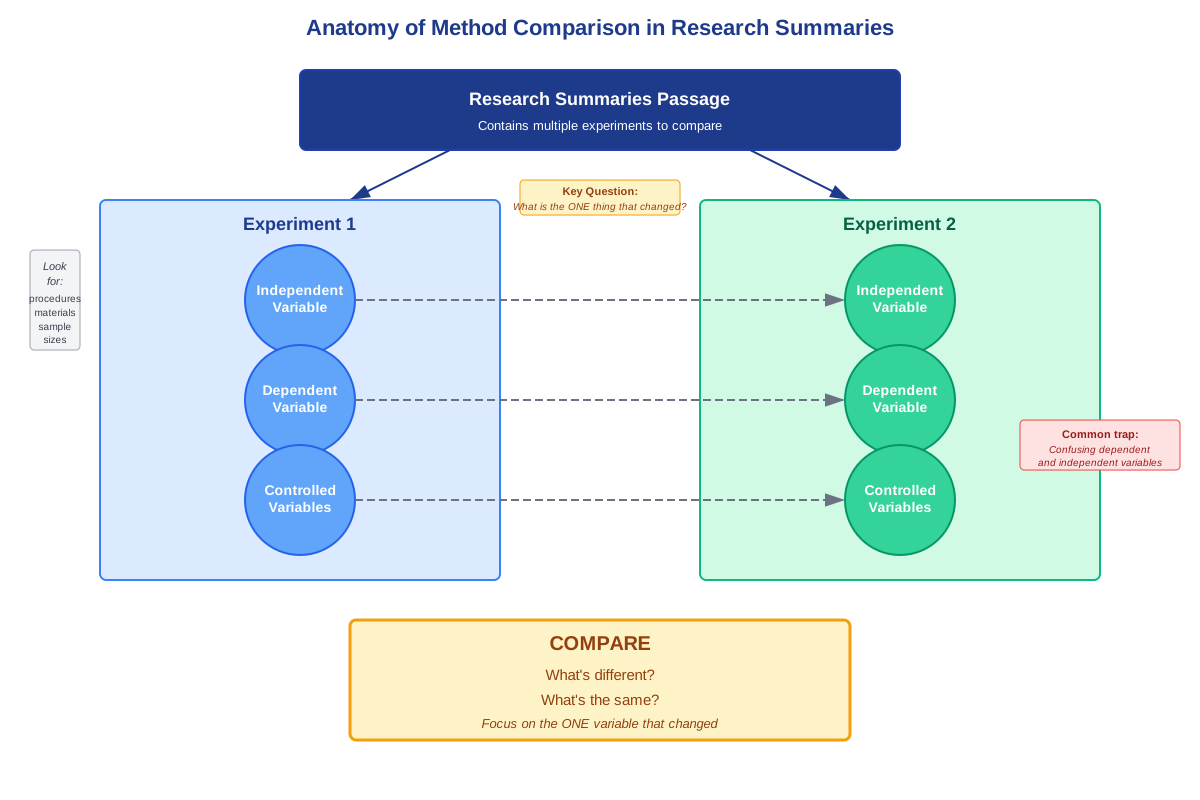
A sophisticated aspect of method comparison involves recognizing what remains constant across experiments versus what changes. Controlled variables are factors held constant within an experiment to ensure that observed effects result from the manipulated independent variable. When comparing methods, students must identify:
- Variables controlled in both experiments (held constant across all studies)
- Variables controlled in one experiment but varied in another (becoming the independent variable)
- Variables that differ between experiments but aren't the focus of investigation
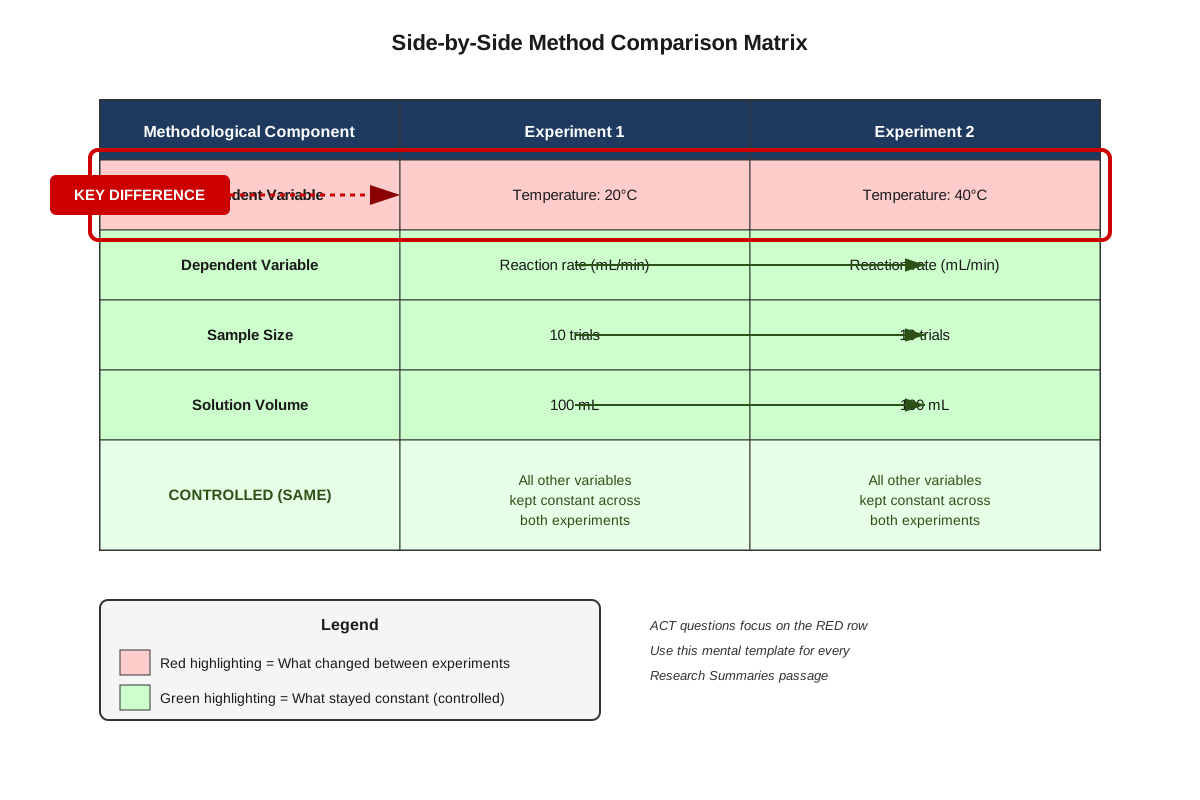
For example, if Experiment 1 tests temperature effects on enzyme activity at pH 7, and Experiment 2 tests pH effects on enzyme activity at 25°C, then temperature is the independent variable in Experiment 1 (controlled in Experiment 2), pH is the independent variable in Experiment 2 (controlled in Experiment 1), and both experiments likely control enzyme concentration, substrate concentration, and reaction time.
Evaluating Methodological Advantages and Limitations
Advanced method comparison questions may ask students to evaluate why one method might be preferable to another or what limitations a particular method has. This requires understanding that:
- More precise measurement techniques provide better data but may be more expensive or time-consuming
- Larger sample sizes increase reliability but require more resources
- Broader ranges of investigation provide more complete pictures but may require different equipment or techniques
- Different methods may be appropriate for different aspects of a phenomenon
Concept Relationships
Method comparison skills build directly on understanding of experimental design fundamentals. The ability to identify independent variables, dependent variables, and controlled variables (prerequisite knowledge) enables students to recognize when these elements differ between experiments. This recognition → leads to → understanding of methodological differences → which enables → evaluation of experimental design quality → which supports → drawing valid conclusions from research.
Within the topic itself, concepts connect hierarchically. First, students must identify that method comparison is being tested (recognition) → then locate relevant methodological information in the passage (information gathering) → then systematically compare procedures (analysis) → then understand the purpose and implications of differences (synthesis) → finally, apply this understanding to answer questions or make predictions (application).
Method comparison also connects to other Research Summaries skills. Understanding methodological differences helps students interpret why data patterns differ between experiments, predict results under modified conditions, and evaluate the validity of conclusions. It relates to the broader ACT Science skill of scientific reasoning, as comparing methods requires logical thinking about cause-and-effect relationships and experimental control.
The relationship map: Variable Identification → Methodological Comparison → Purpose Analysis → Outcome Prediction → Conclusion Evaluation
Quick check — test yourself on Method comparison so far.
Try Flashcards →High-Yield Facts
⭐ Method comparison questions appear in approximately 2-3 questions per Research Summaries passage, totaling 6-9 questions per ACT Science Test
⭐ The most common methodological difference tested is which independent variable is manipulated across experiments
⭐ Controlled variables in one experiment often become independent variables in another experiment within the same passage
⭐ Question stems containing "differ," "unlike," "instead," or "whereas" signal method comparison questions
⭐ The passage always contains explicit information about procedures; method comparison questions never require outside knowledge
- Experiments within a passage typically investigate related aspects of the same phenomenon using complementary approaches
- Methodological differences can involve variables manipulated, measurement techniques, samples used, procedural steps, or ranges investigated
- Later experiments in a passage often build upon or extend earlier experiments by changing one key methodological element
- Understanding why methods differ (the purpose) is as important as identifying what differs
- Method comparison questions can be answered by carefully reading experimental descriptions, usually found in introductory paragraphs or figure captions
- Comparing data tables side-by-side helps identify which variables changed between experiments
- The ACT never requires students to judge whether one method is "better" without providing evidence in the passage
Common Misconceptions
Misconception: All experiments in a Research Summaries passage use identical methods with different results. → Correction: Research Summaries passages specifically present multiple experiments with methodological variations designed to investigate different aspects of a phenomenon or test different variables.
Misconception: Method comparison requires memorizing specific scientific techniques or procedures. → Correction: The ACT provides all necessary information about methods in the passage; questions test the ability to compare what's described, not recall outside knowledge of techniques.
Misconception: If two experiments produce different results, the methods must be completely different. → Correction: Experiments often differ in only one or two key aspects (such as which independent variable is manipulated) while maintaining many similarities in overall approach.
Misconception: Method comparison questions are asking for opinions about which method is superior. → Correction: These questions ask for objective identification of differences or evidence-based evaluation of methodological advantages explicitly supported by passage information.
Misconception: The independent variable is always the same across all experiments in a passage. → Correction: Different experiments within a passage typically manipulate different independent variables to investigate multiple factors affecting the phenomenon of interest.
Misconception: Controlled variables are unimportant when comparing methods. → Correction: Identifying controlled variables is crucial because what's controlled in one experiment often becomes the manipulated variable in another, and recognizing this pattern is key to understanding experimental design.
Worked Examples
Example 1: Identifying Methodological Differences
Passage Summary: Scientists conducted three experiments to investigate factors affecting seed germination.
- Experiment 1: 100 bean seeds were placed in petri dishes with moist paper towels at 20°C. Light exposure varied: 0, 6, 12, 18, and 24 hours per day. After 7 days, the percentage of seeds germinated was recorded.
- Experiment 2: 100 bean seeds were placed in petri dishes with moist paper towels under 12 hours of light per day. Temperature varied: 10°C, 15°C, 20°C, 25°C, and 30°C. After 7 days, the percentage of seeds germinated was recorded.
- Experiment 3: 100 corn seeds were placed in petri dishes with moist paper towels at 20°C under 12 hours of light per day. After 7 days, the percentage of seeds germinated was recorded.
Question: How did the method used in Experiment 2 differ from the method used in Experiment 1?
Step 1 - Identify what's being asked: This question explicitly asks for methodological differences between two specific experiments, making it a clear method comparison question.
Step 2 - Locate relevant information: Return to the experimental descriptions and identify the key elements of each procedure.
Step 3 - Systematic comparison:
- Sample size: Both used 100 seeds (same)
- Seed type: Both used bean seeds (same)
- Container: Both used petri dishes with moist paper towels (same)
- Duration: Both measured after 7 days (same)
- Dependent variable: Both measured percentage germinated (same)
- Light exposure: Experiment 1 varied this (0-24 hrs); Experiment 2 held constant at 12 hrs (DIFFERENT)
- Temperature: Experiment 1 held constant at 20°C; Experiment 2 varied this (10-30°C) (DIFFERENT)
Step 4 - Formulate answer: Experiment 2 differed from Experiment 1 in that Experiment 2 varied temperature while holding light exposure constant, whereas Experiment 1 varied light exposure while holding temperature constant. The independent variable changed from light exposure to temperature.
Connection to learning objectives: This example demonstrates how to identify method comparison questions and apply systematic comparison strategies to determine what differs between experiments.
Example 2: Understanding Purpose of Methodological Changes
Passage Summary: Researchers investigated the effect of fertilizer on plant growth.
- Experiment 1: 20 tomato plants were grown in identical pots with standard soil. Each plant received a different amount of nitrogen fertilizer (0-100 g). After 30 days, plant height was measured.
- Experiment 2: 20 tomato plants were grown in identical pots with standard soil. Each plant received a different amount of phosphorus fertilizer (0-100 g). After 30 days, plant height was measured.
- Experiment 3: 20 tomato plants were grown in identical pots with standard soil. Each plant received 50 g of nitrogen fertilizer and varying amounts of phosphorus fertilizer (0-100 g). After 30 days, plant height was measured.
Question: What was the most likely purpose of Experiment 3?
Step 1 - Analyze the progression: Notice that Experiments 1 and 2 each tested one type of fertilizer independently, while Experiment 3 combines both.
Step 2 - Identify the methodological change: Experiment 3 differs from the previous experiments by including both nitrogen (held constant at 50 g) and phosphorus (varied from 0-100 g) simultaneously.
Step 3 - Consider the scientific reasoning: When experiments first test variables independently (Experiments 1 and 2) and then test them in combination (Experiment 3), researchers are typically investigating whether the variables interact or whether effects are additive.
Step 4 - Formulate answer: The most likely purpose of Experiment 3 was to determine how phosphorus affects plant growth when nitrogen is also present, or to investigate whether the two fertilizers interact. This tests whether findings from isolated variables (Experiments 1 and 2) hold true when variables are combined.
Connection to learning objectives: This example shows how to evaluate the purpose of methodological changes and predict how modifications affect experimental outcomes, demonstrating advanced method comparison skills.
Exam Strategy
When approaching method comparison questions on the ACT Science Test, employ a systematic strategy that maximizes accuracy while managing time effectively.
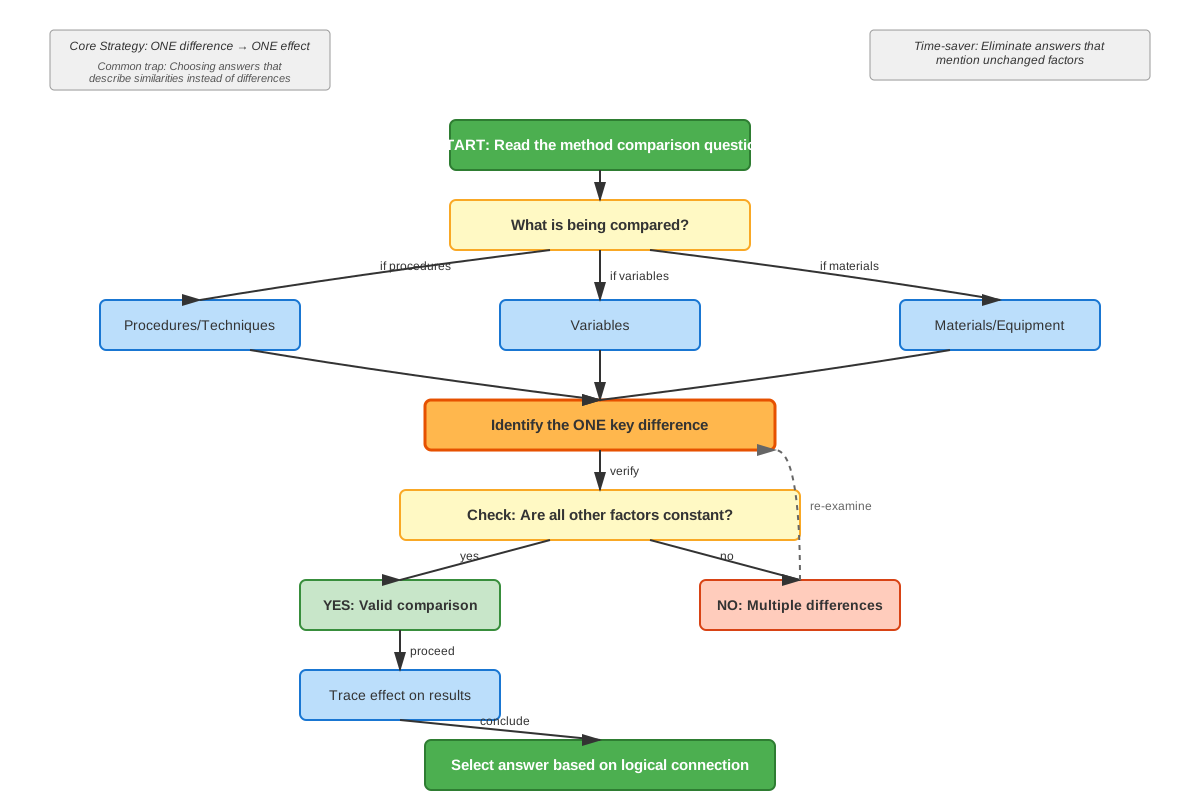
Step 1 - Recognize the question type: Immediately identify method comparison questions by their characteristic language ("differ," "unlike," "instead," "whereas," "compared to"). This recognition triggers the appropriate strategy.
Step 2 - Return to the passage: Never rely on memory for methodological details. Always return to the experimental descriptions, typically found in introductory paragraphs before data tables or in figure captions.
Step 3 - Create a mental or physical comparison chart: For complex passages, quickly note key elements of each experiment:
- What's being tested (independent variable)
- What's being measured (dependent variable)
- What's held constant (controlled variables)
- What samples/subjects are used
- What procedures are followed
Step 4 - Focus on differences, not similarities: The ACT typically asks what differs, so actively look for variations rather than getting distracted by the many elements that remain constant.
Exam Tip: When a question asks "How did Experiment X differ from Experiment Y?", wrong answer choices often describe similarities or differences that don't actually exist. Always verify your answer against the passage.
Trigger words to watch for:
- "Differ/difference" - signals direct comparison
- "Unlike/whereas" - indicates contrast
- "Instead/rather than" - points to alternative approach
- "Also/additionally" - may indicate added variable
- "Purpose of" - asks why method changed
Process-of-elimination strategy:
- Eliminate choices that describe similarities rather than differences
- Eliminate choices that describe differences not mentioned in the passage
- Eliminate choices that confuse which experiment used which method
- Select the choice that accurately describes a difference explicitly stated in the passage
Time allocation: Method comparison questions should take 30-45 seconds each. If you're spending more time, you're likely overthinking. The information is always explicitly stated; if you can't find it quickly, mark the question and return after completing easier questions.
Memory Techniques
VAMPS Mnemonic for remembering what can differ between experimental methods:
- Variables (independent, dependent, controlled)
- Apparatus/equipment used
- Materials/samples/subjects
- Procedures/steps followed
- Scale/range of investigation
The "Same-Different-Why" Framework: When comparing methods, ask three questions in order:
- What's the Same? (establishes baseline)
- What's Different? (identifies the key variation)
- Why does it differ? (understands purpose)
Visualization technique: Picture experiments as recipes. Just as recipes for chocolate cake and vanilla cake share many ingredients (flour, eggs, sugar) but differ in key flavoring, experiments share many elements but differ in crucial variables. This analogy helps students recognize that methodological differences are often specific and limited rather than wholesale changes.
The "Control Switch" concept: Remember that controlled variables in one experiment often become independent variables in another. Visualize a light switch: in Experiment 1, temperature is "switched off" (controlled) while light is "switched on" (varied); in Experiment 2, they switch roles.
Summary
Method comparison is a high-yield ACT Science skill that requires students to systematically analyze and contrast experimental procedures within Research Summaries passages. The core strategy involves identifying what elements of experimental design vary between studies—most commonly which independent variable is manipulated, but also potentially including measurement techniques, samples used, procedural steps, or ranges investigated. Success requires recognizing method comparison questions through trigger words, returning to passage descriptions rather than relying on memory, and systematically comparing experiments element by element. Understanding not just what differs but why methods vary enables students to evaluate experimental design quality and predict outcomes under modified conditions. Since method comparison questions appear 6-9 times per test and the information needed is always explicitly provided in passages, mastering this skill through deliberate practice offers significant score improvement potential for students at all levels.
Key Takeaways
- Method comparison questions constitute 15-22% of the ACT Science Test and appear in nearly every Research Summaries passage
- The most frequently tested methodological difference is which independent variable is manipulated across experiments
- All information needed to answer method comparison questions is explicitly stated in the passage; no outside knowledge is required
- Systematic comparison of experiments element-by-element (variables, materials, procedures, measurements) ensures accurate identification of differences
- Understanding the purpose of methodological changes—why researchers varied their approach—demonstrates deeper comprehension and helps with prediction questions
- Controlled variables in one experiment often become independent variables in another, representing a key pattern in Research Summaries passages
- Time-efficient strategy involves recognizing question type, returning to passage, focusing on differences rather than similarities, and using process of elimination
Related Topics
Experimental Design Fundamentals: Understanding how to structure valid experiments, including proper control of variables and selection of appropriate sample sizes, provides the foundation for evaluating and comparing different methodological approaches.
Data Interpretation Across Multiple Experiments: Once students master comparing methods, they can advance to synthesizing data from multiple experiments to draw broader conclusions, a higher-order skill frequently tested in complex Research Summaries passages.
Hypothesis Testing and Prediction: Method comparison skills enable students to predict how changing experimental methods would affect results, which connects to questions asking students to design new experiments or extend existing ones.
Variable Manipulation and Control: Deeper study of how scientists isolate variables and maintain experimental control enhances the ability to recognize subtle methodological differences and evaluate experimental validity.
Practice CTA
Now that you've mastered the core concepts and strategies for method comparison, it's time to apply these skills to authentic ACT-style questions. Complete the practice questions associated with this topic, paying special attention to identifying trigger words, systematically comparing experimental procedures, and understanding the purpose of methodological differences. Use the flashcards to reinforce high-yield facts and common question patterns. Remember: method comparison is one of the most predictable and high-yield topics on the ACT Science Test—consistent practice with these strategies will directly translate to points on test day. Your investment in mastering this skill will pay dividends across multiple passages and question types!
Sign up free to keep reading
Create a free AnvayaPrep account to finish this ACT guide on Method comparison — plus flashcards and practice questions.