Overview
Supporting conclusions is a critical skill tested in the ACT Science section, particularly within Research Summaries passages. This topic requires students to evaluate whether experimental data, observations, or scientific evidence adequately justify the conclusions drawn by researchers. Unlike simple data interpretation questions, ACT supporting conclusions questions demand that students assess the logical connection between evidence and claims, identify which data points strengthen or weaken a conclusion, and recognize when additional information would be necessary to validate a hypothesis.
The ACT Science test frequently presents students with experimental scenarios where researchers make claims based on their findings. Students must determine whether the presented evidence actually supports these claims or whether the conclusions overreach the data. This skill mirrors authentic scientific reasoning—scientists must constantly evaluate whether their data justifies their interpretations, or whether alternative explanations exist. Questions on this topic typically ask students to identify which piece of evidence best supports a given conclusion, determine what additional data would strengthen a claim, or recognize when a conclusion is not adequately supported by the experimental results.
Mastering supporting conclusions connects directly to broader scientific literacy skills tested throughout the ACT Science section. This topic builds upon data interpretation abilities while extending into higher-order critical thinking. It relates closely to experimental design evaluation, hypothesis testing, and the scientific method itself. Students who excel at supporting conclusions questions demonstrate not just reading comprehension, but genuine scientific reasoning—the ability to distinguish between correlation and causation, recognize the limits of experimental data, and understand what constitutes valid scientific evidence.
Learning Objectives
- [ ] Identify when Supporting conclusions is being tested in ACT Science passages
- [ ] Explain the core rule or strategy behind Supporting conclusions questions
- [ ] Apply Supporting conclusions reasoning to ACT-style questions accurately
- [ ] Distinguish between conclusions that are fully supported versus partially supported by data
- [ ] Evaluate what additional evidence would be needed to strengthen a weak conclusion
- [ ] Recognize when experimental limitations prevent a conclusion from being fully justified
- [ ] Identify alternative explanations that could account for the same data
Prerequisites
- Basic data interpretation skills: Students must be able to read graphs, tables, and charts to extract relevant information before evaluating whether that information supports conclusions.
- Understanding of variables: Recognizing independent and dependent variables is essential for determining whether changes in one factor actually support claims about relationships between variables.
- Familiarity with experimental design: Knowledge of controls, experimental groups, and basic scientific methodology helps students assess whether conclusions are justified by the experimental setup.
- Hypothesis and prediction concepts: Understanding the difference between a hypothesis (testable prediction) and a conclusion (interpretation of results) enables proper evaluation of support relationships.
Why This Topic Matters
In real-world scientific practice, the ability to evaluate whether evidence supports conclusions is fundamental to the peer review process, medical decision-making, policy formation, and technological innovation. Scientists must constantly scrutinize whether their data truly justifies their interpretations, and this skill prevents premature conclusions, flawed theories, and wasted resources. Beyond science, this critical thinking ability applies to evaluating news claims, advertising assertions, and everyday arguments—making it a cornerstone of informed citizenship.
On the ACT Science test, supporting conclusions questions appear with high frequency, typically comprising 15-20% of all Science questions. These questions appear most commonly in Research Summaries passages (which make up approximately 6 of the 40 questions per test), though they also surface in Data Representation and Conflicting Viewpoints passages. The ACT consistently tests this skill because it represents authentic scientific reasoning rather than mere memorization.
Common question formats include: "Which of the following statements is best supported by the data in Table 1?", "Based on the results of Experiment 2, which conclusion is justified?", "What additional information would be needed to support the researcher's claim that...?", and "The data in Figure 3 support which of the following hypotheses?" These questions require students to move beyond simple data lookup and engage in evaluative reasoning about the strength of evidence-conclusion relationships.
Core Concepts
What Constitutes Supporting Evidence
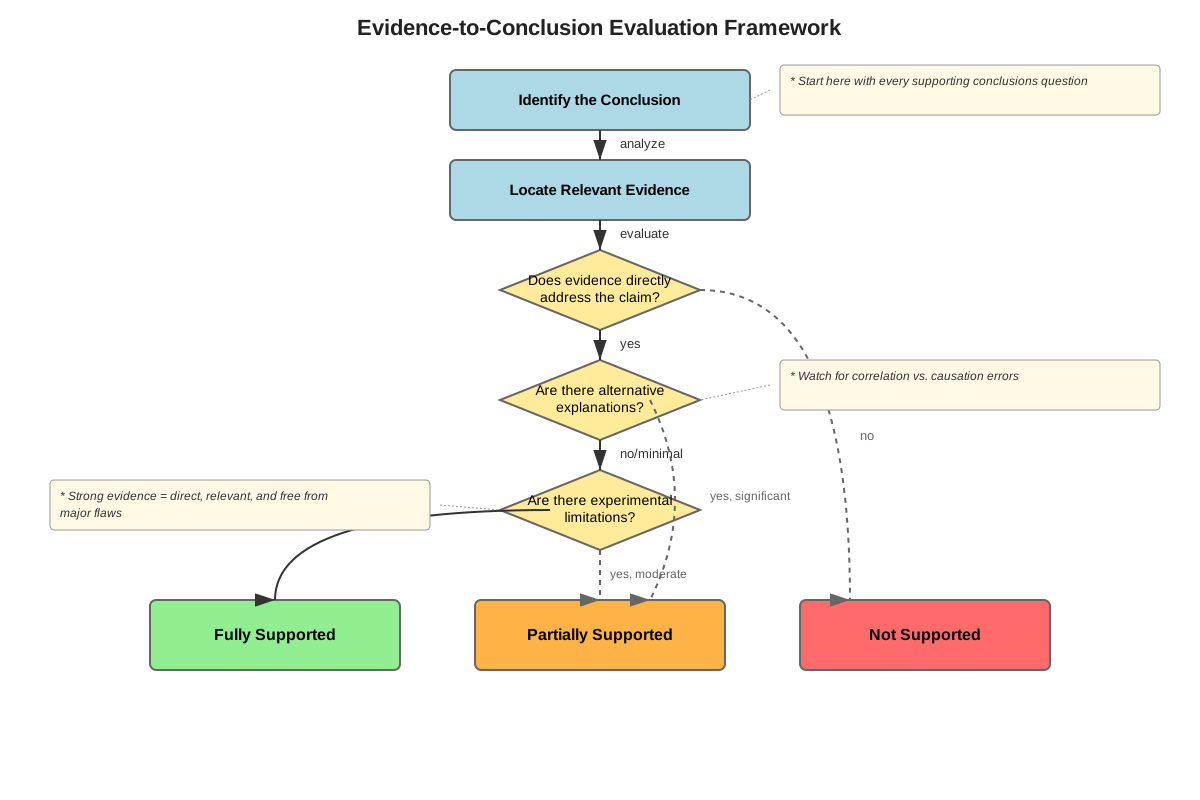
Supporting conclusions in science means establishing a logical, evidence-based connection between experimental observations and interpretive claims. For evidence to genuinely support a conclusion, three conditions must be met: the evidence must be relevant to the claim, the evidence must be sufficient in quantity and quality, and alternative explanations must be adequately ruled out or addressed.
Relevant evidence directly addresses the variables or relationships mentioned in the conclusion. If a researcher concludes that "increased temperature causes faster reaction rates," the supporting evidence must specifically show data about temperature changes and corresponding reaction rate measurements. Evidence about pressure changes or catalyst concentrations, while potentially interesting, would not be relevant to this particular conclusion.
Sufficient evidence means having enough data points, appropriate sample sizes, and proper controls to make the conclusion reliable rather than based on chance or isolated observations. A single trial showing a pattern does not provide sufficient support; multiple trials showing consistent results do. The ACT frequently tests whether students recognize this distinction.
Types of Support Relationships
Evidence can support conclusions in several distinct ways, and the ACT tests students' ability to recognize these different relationships:
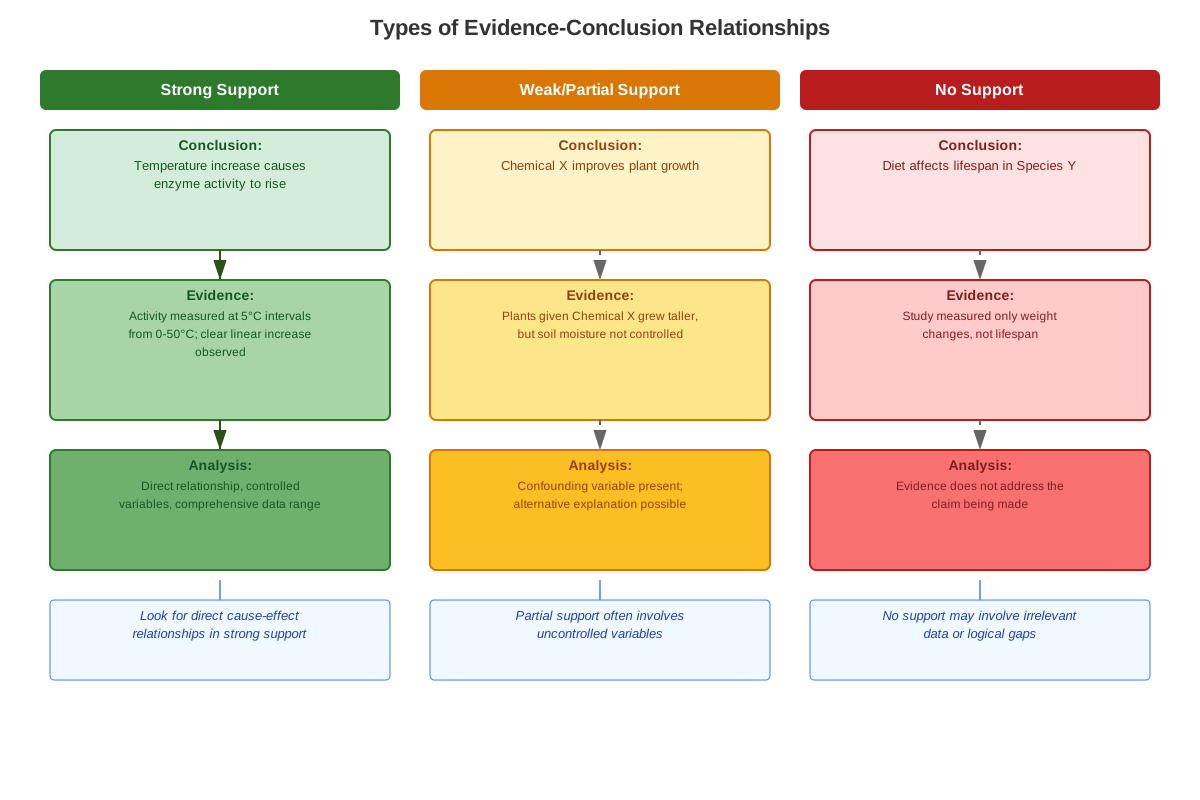
Direct support occurs when data explicitly demonstrates the claimed relationship. If a conclusion states "Plant growth increases with fertilizer concentration," and a table shows that plants receiving more fertilizer consistently grew taller across multiple trials, this represents direct support.
Indirect support involves evidence that, while not directly measuring the claimed variable, provides corroborating information. If researchers conclude that a chemical reaction is exothermic (releases heat), indirect support might come from observations that the reaction vessel became warm to the touch, even if precise temperature measurements weren't taken.
Comparative support strengthens conclusions by showing differences between experimental and control groups. When a conclusion claims that a treatment has an effect, evidence showing that the treatment group differs significantly from the control group provides strong support.
Correlational support demonstrates that two variables change together, though it doesn't necessarily prove causation. The ACT often tests whether students recognize that correlation alone may not fully support causal conclusions.
Evaluating Strength of Support
Not all supporting evidence is equally strong, and the ACT frequently asks students to identify which piece of evidence provides the strongest support for a conclusion. Several factors determine support strength:
| Factor | Weak Support | Strong Support |
|---|---|---|
| Sample size | Single trial or observation | Multiple trials with consistent results |
| Controls | No control group or baseline | Appropriate controls isolating variables |
| Consistency | Contradictory or mixed results | Uniform pattern across all measurements |
| Relevance | Tangentially related data | Directly measures claimed relationship |
| Precision | Qualitative observations only | Quantitative measurements with low error |
Students must evaluate these factors when determining whether a conclusion is well-supported, partially supported, or unsupported by the presented evidence.
Identifying Insufficient Support
A critical skill for ACT supporting conclusions questions is recognizing when evidence does NOT adequately support a claim. Common situations of insufficient support include:
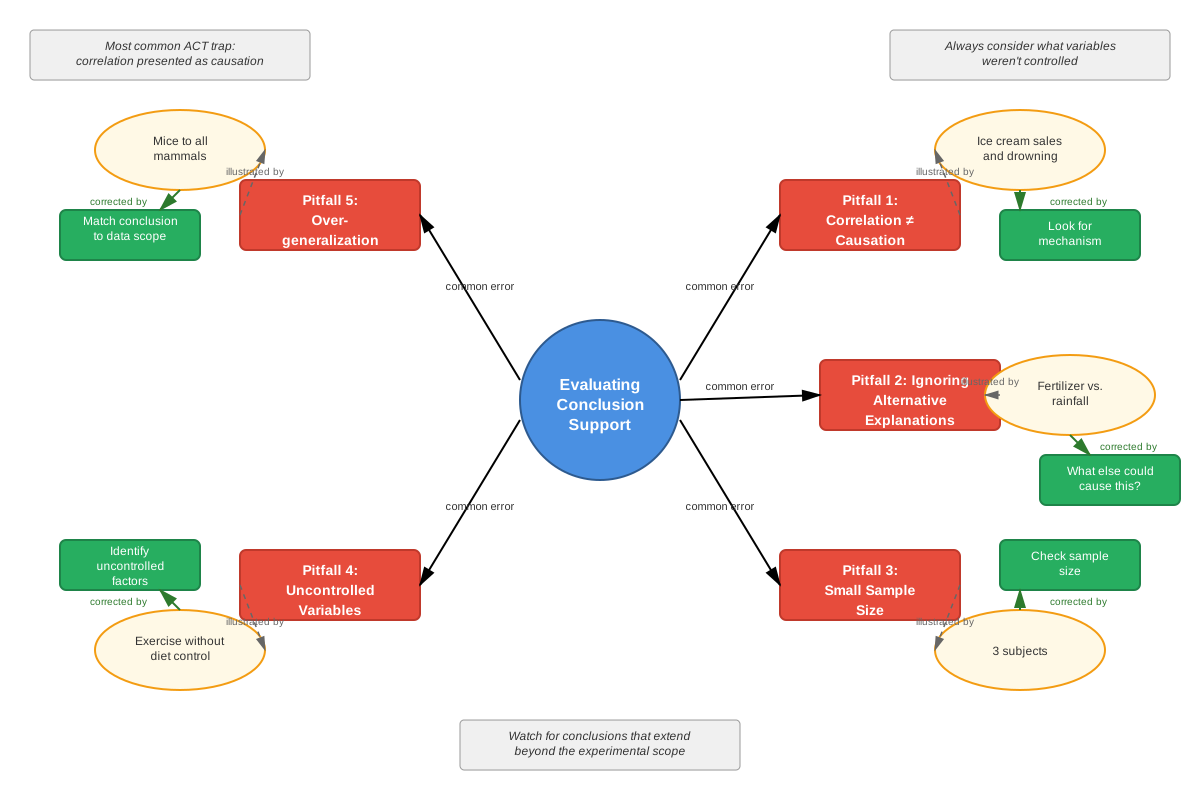
Overgeneralization: The conclusion extends beyond what the data actually shows. If an experiment tested only freshwater fish but the conclusion claims "all fish species," the evidence is insufficient for that broad claim.
Confounding variables: When multiple variables changed simultaneously, the data cannot support conclusions about which specific variable caused the observed effect. The ACT often presents scenarios where students must recognize that uncontrolled variables prevent definitive conclusions.
Lack of baseline or control: Without knowing what happens in the absence of the treatment or under normal conditions, observed results cannot definitively support claims about the treatment's effect.
Insufficient sample size or trials: A single observation or small sample cannot reliably support broad conclusions due to potential random variation.
What Additional Evidence Would Strengthen Conclusions
The ACT frequently asks what additional information or experiments would be needed to better support a conclusion. This question type tests whether students understand the gaps in the current evidence. Strong answers typically involve:
- Additional trials or larger samples to increase reliability
- Control experiments to rule out alternative explanations
- Measurements of additional variables that might influence the results
- Extended time periods to determine if effects are temporary or lasting
- Different conditions or populations to test generalizability
For example, if researchers conclude that a drug reduces blood pressure based on a single week-long study, additional evidence might include: longer-term studies to assess sustained effects, studies with diverse patient populations, measurements of side effects, and comparison with existing treatments.
Concept Relationships
The concepts within supporting conclusions form a logical progression: First, students must understand what constitutes valid supporting evidence (relevance, sufficiency, and ruling out alternatives). This foundation enables evaluation of different types of support relationships (direct, indirect, comparative, correlational). With these tools, students can then assess the strength of support by considering factors like sample size, controls, and consistency. Finally, students apply this evaluative framework to identify insufficient support and determine what additional evidence would strengthen weak conclusions.
Supporting conclusions connects directly to prerequisite knowledge of experimental design—understanding controls and variables is essential for evaluating whether evidence adequately supports claims. It also relates to data interpretation skills, as students must first extract information from graphs and tables before assessing whether that information justifies conclusions. Looking forward, mastering supporting conclusions enables progression to more advanced topics like evaluating conflicting scientific viewpoints and designing experiments to test specific hypotheses.
The relationship map flows as follows: Data Interpretation → provides raw information → Supporting Conclusions → evaluates evidence-claim relationships → Experimental Design Evaluation → determines what experiments would provide better support → Scientific Reasoning → synthesizes all skills for complex problem-solving.
High-Yield Facts
- ⭐ Supporting conclusions questions ask whether experimental data justifies the claims researchers make, not just what the data shows
- ⭐ Evidence must be both relevant (addresses the right variables) and sufficient (enough data with proper controls) to support a conclusion
- ⭐ Correlation between two variables does not automatically support conclusions about causation
- ⭐ A single trial or observation provides weak support; multiple consistent trials provide strong support
- ⭐ The strongest supporting evidence comes from controlled experiments that isolate the variable of interest
- Conclusions that extend beyond the tested conditions (overgeneralization) are not fully supported by the data
- Control groups or baseline measurements are essential for supporting claims about treatment effects
- When multiple variables change simultaneously, the data cannot support conclusions about which specific variable caused the effect
- Questions asking "what additional information is needed" test recognition of gaps in the current evidence
- Evidence that rules out alternative explanations provides stronger support than evidence that merely shows correlation
- Quantitative data (numerical measurements) generally provides stronger support than qualitative observations alone
- Consistent results across different conditions or populations strengthen support for conclusions
- The absence of an expected result can support conclusions just as much as the presence of a result
- Sample size and number of trials directly affect how strongly data supports conclusions
Quick check — test yourself on Supporting conclusions so far.
Try Flashcards →Common Misconceptions
Misconception: If data shows a pattern, it automatically supports any conclusion related to that pattern.
Correction: Data only supports conclusions that are directly justified by the specific pattern shown. A conclusion must not extend beyond what the data actually demonstrates. For example, if data shows plant growth increases with fertilizer up to 10g/L, it does NOT support conclusions about what happens at 20g/L.
Misconception: Correlation between two variables means one causes the other.
Correction: Correlation shows that variables change together but doesn't prove causation. Both variables might be influenced by a third factor, or the relationship might be coincidental. Supporting a causal conclusion requires controlled experiments that manipulate one variable while holding others constant.
Misconception: Any data from an experiment supports the researcher's conclusion.
Correction: Data only supports a conclusion if it's relevant to the specific claim being made. An experiment might generate lots of data, but only the data that directly addresses the variables in the conclusion provides support. Irrelevant data, no matter how abundant, doesn't strengthen the conclusion.
Misconception: If most of the data supports a conclusion, contradictory data can be ignored.
Correction: Contradictory data weakens support for a conclusion and suggests either experimental error, uncontrolled variables, or that the conclusion needs refinement. Strong conclusions are supported by consistent data across all trials, not just most trials.
Misconception: Expert opinion or theoretical reasoning can substitute for experimental evidence in supporting conclusions.
Correction: On the ACT Science test, conclusions must be supported by the actual experimental data presented in the passage. While expert reasoning matters in real science, ACT questions specifically test whether the data shown supports the conclusion, regardless of what might theoretically be true.
Misconception: More complex or detailed conclusions are better supported than simple ones.
Correction: The complexity of a conclusion doesn't determine how well it's supported—only the quality and relevance of the evidence matters. A simple conclusion with strong supporting data is better supported than a complex conclusion with weak or insufficient evidence.
Worked Examples
Example 1: Evaluating Direct Support
Passage Context: Researchers investigated whether caffeine affects reaction time. They measured how quickly 30 participants pressed a button after seeing a light, first without caffeine (baseline) and then 30 minutes after consuming 200mg of caffeine.
Results:
- Baseline average reaction time: 285 milliseconds
- After caffeine average reaction time: 245 milliseconds
- 27 of 30 participants showed faster reaction times after caffeine
Question: Which conclusion is best supported by the results?
A) Caffeine improves all types of cognitive performance
B) Caffeine decreases reaction time in button-pressing tasks
C) Higher caffeine doses produce greater reaction time improvements
D) Caffeine affects reaction time more in younger participants
Solution Process:
Step 1: Identify what the data actually shows. The experiment measured reaction time in a button-pressing task, comparing baseline to post-caffeine measurements. The data shows faster reaction times after caffeine consumption.
Step 2: Evaluate each conclusion against the data:
Option A claims caffeine improves "all types of cognitive performance." The experiment only tested reaction time in one specific task, not memory, problem-solving, or other cognitive functions. This conclusion overgeneralizes beyond the data. Not supported.
Option B claims caffeine decreases reaction time in button-pressing tasks. The data directly shows this: average reaction time decreased from 285ms to 245ms, and 27 of 30 participants showed improvement. This conclusion is directly relevant to and limited to what was actually measured. Strongly supported.
Option C claims higher doses produce greater improvements. The experiment only tested one caffeine dose (200mg), so there's no data about different doses or dose-response relationships. Not supported.
Option D claims caffeine affects younger participants more. The passage doesn't provide information about participant ages or compare different age groups. Not supported.
Step 3: Select the conclusion that is both relevant to the data and doesn't extend beyond what was measured. Answer: B
Key Lesson: The best-supported conclusion directly addresses what was measured without overgeneralizing to untested conditions, populations, or variables.
Example 2: Identifying What Would Strengthen Support
Passage Context: A study examined whether a new fertilizer increases tomato yield. Researchers applied the fertilizer to 10 tomato plants in a greenhouse and measured total fruit weight after 3 months. The average yield was 4.2 kg per plant, which the researchers noted was higher than the typical 3.5 kg per plant for this tomato variety.
Conclusion: The new fertilizer increases tomato yield.
Question: Which of the following would most strengthen support for this conclusion?
A) Testing the fertilizer on different vegetable species
B) Measuring the fertilizer's chemical composition
C) Growing 10 additional plants without the fertilizer under identical conditions
D) Extending the study to 6 months
Solution Process:
Step 1: Identify the weakness in the current evidence. The study lacks a control group—plants grown under identical conditions without the fertilizer. The comparison to "typical" yield is problematic because those plants might have been grown under different conditions (different greenhouse, season, watering schedule, etc.).
Step 2: Evaluate what each option would add:
Option A (testing other vegetables) would show whether the effect generalizes to other species, but doesn't address the fundamental problem that we don't know if the observed yield was due to the fertilizer or other factors in this specific greenhouse setup. This would expand scope but not strengthen the core conclusion about tomatoes.
Option B (chemical composition) might be scientifically interesting but doesn't provide evidence about whether the fertilizer actually increases yield. Knowing what's in the fertilizer doesn't tell us whether it works.
Option C (control group) would provide a direct comparison under identical conditions. If control plants yielded 3.5 kg while fertilized plants yielded 4.2 kg in the same greenhouse, same time period, same watering, etc., this would strongly support that the fertilizer caused the difference. This addresses the main weakness.
Option D (longer duration) might show whether the effect persists, but doesn't solve the control group problem. Even at 6 months, without a control, we couldn't be certain the fertilizer caused any observed differences.
Step 3: Choose the option that addresses the most critical gap in the evidence. Answer: C
Key Lesson: The strongest way to support causal conclusions is through controlled experiments that isolate the variable of interest. When evaluating what would strengthen support, identify what's missing from proper experimental design.
Exam Strategy
Trigger Phrases: Watch for questions containing "supported by," "justified by," "consistent with," "best explained by," "additional information needed," or "which conclusion can be drawn." These signal supporting conclusions questions.
Approach Process:
- Read the conclusion first: Before looking at data, understand exactly what claim needs support. Identify the specific variables and relationships mentioned.
- Check for relevance: Does the data actually address the variables in the conclusion? Eliminate answer choices that discuss variables not measured in the experiment.
- Assess sufficiency: Look for proper controls, adequate sample sizes, and multiple trials. Weak support often comes from single observations or lack of controls.
- Watch for overgeneralization: Be suspicious of conclusions that extend to populations, conditions, or time periods not actually tested. The ACT loves to include overly broad conclusions as wrong answers.
- For "additional information" questions: Identify what's missing from proper experimental design. Usually the answer involves adding controls, increasing sample size, testing additional variables, or extending the study duration.
Time Management: Supporting conclusions questions typically require 45-60 seconds. Spend 20 seconds understanding the conclusion and data, 20 seconds evaluating answer choices, and 10-20 seconds confirming your answer. Don't get stuck trying to understand every detail of the experiment—focus only on whether the data supports the specific conclusion asked about.
Process of Elimination Tips:
- Eliminate conclusions that mention variables not measured in the study
- Eliminate conclusions that claim causation when only correlation was shown
- Eliminate conclusions that extend beyond the tested population or conditions
- For "strengthen support" questions, eliminate options that don't address the main weakness in the experimental design
Common Wrong Answer Patterns:
- The overgeneralization: Extends beyond what was tested
- The irrelevant data: Uses data that doesn't address the conclusion's variables
- The causation claim: Asserts causation from correlational data
- The single-trial trap: Treats one observation as sufficient support
Memory Techniques
RACE Acronym for Evaluating Support:
- Relevant: Does the data address the right variables?
- Adequate: Is there enough data (sample size, trials)?
- Controlled: Were other variables held constant?
- Extent: Does the conclusion stay within what was tested?
The "Three Questions" Mnemonic:
When evaluating whether data supports a conclusion, ask:
- "Does it measure what they claim?" (relevance)
- "Is there enough of it?" (sufficiency)
- "Could something else explain it?" (alternative explanations)
Visualization Strategy: Picture a bridge between data and conclusion. Strong support is a solid bridge with multiple supports (multiple trials, controls, relevant measurements). Weak support is a shaky bridge with missing planks (no controls, single trial, irrelevant data). When you see a conclusion, visualize whether the data builds a solid bridge to that conclusion.
The "Control Group Check": Whenever you see a conclusion about a treatment or intervention causing an effect, immediately ask "Where's the control group?" If there isn't one, the support is weak, and adding a control group would strengthen it.
Summary
Supporting conclusions is a high-yield ACT Science skill that requires evaluating whether experimental evidence adequately justifies researchers' claims. Strong support requires data that is both relevant (addresses the specific variables in the conclusion) and sufficient (includes proper controls, adequate sample sizes, and multiple trials). Students must distinguish between correlation and causation, recognize when conclusions overgeneralize beyond tested conditions, and identify what additional evidence would strengthen weak conclusions. The ACT frequently tests this through questions asking which conclusion is best supported by data, what additional information is needed, or whether specific claims are justified. Success requires moving beyond simple data interpretation to genuine scientific reasoning—assessing the logical connection between evidence and claims while recognizing the limitations of experimental data.
Key Takeaways
- Supporting conclusions questions test whether data justifies claims, not just what the data shows
- Strong support requires relevant data (right variables), sufficient data (proper controls, multiple trials), and ruling out alternative explanations
- Correlation does not automatically support causal conclusions—controlled experiments are needed
- The best-supported conclusions stay within the bounds of what was actually tested, avoiding overgeneralization
- Control groups or baseline measurements are essential for supporting claims about treatment effects
- When asked what would strengthen support, identify the main gap in experimental design (usually missing controls or insufficient sample size)
- Watch for trigger phrases like "supported by," "justified by," and "additional information needed" to identify these questions
Related Topics
Experimental Design Evaluation: Building on supporting conclusions, this topic involves assessing the overall quality of experimental methodology, including identifying flaws in procedure, recognizing confounding variables, and suggesting improvements. Mastering supporting conclusions provides the foundation for this more comprehensive evaluation skill.
Conflicting Viewpoints Analysis: This advanced topic requires evaluating which scientist's hypothesis is better supported by presented evidence, directly applying supporting conclusions skills to compare multiple interpretations of the same data.
Hypothesis Testing: Understanding how to determine whether experimental results support or refute a hypothesis extends the supporting conclusions framework to the scientific method's hypothesis-testing cycle.
Data Interpretation and Analysis: While prerequisite knowledge, deeper data interpretation skills enhance the ability to evaluate support by enabling more sophisticated extraction of patterns and relationships from complex datasets.
Practice CTA
Now that you understand the principles of supporting conclusions, it's time to apply these skills to ACT-style questions. The practice questions will challenge you to evaluate evidence-conclusion relationships in realistic experimental scenarios, just as you'll encounter on test day. Work through each question systematically using the RACE framework, and pay special attention to identifying overgeneralizations and missing controls. Remember, mastering this skill significantly boosts your ACT Science score because these questions appear frequently and test genuine scientific reasoning rather than content memorization. You've got the tools—now practice applying them!
Sign up free to keep reading
Create a free AnvayaPrep account to finish this ACT guide on Supporting conclusions — plus flashcards and practice questions.