Overview
Trial comparisons form the backbone of the Research Summaries passage type on the ACT Science test, representing one of the most frequently tested analytical skills across the entire exam. When scientists conduct experiments, they systematically vary one or more factors while keeping others constant, creating multiple trials that can be compared to identify cause-and-effect relationships. Understanding how to analyze these comparisons efficiently and accurately is essential for success on approximately 40% of all ACT Science questions.
The ability to perform ACT trial comparisons requires students to identify what changed between experimental conditions, determine what remained constant, and draw logical conclusions about how those changes affected the results. This skill extends beyond simple data reading—it demands critical thinking about experimental design, variable relationships, and the scientific method itself. Students who master trial comparisons can quickly navigate complex experimental setups, distinguish between independent and dependent variables, and extract meaningful patterns from data tables and graphs.
Trial comparisons connect directly to broader scientific reasoning skills tested throughout the ACT Science section. They form the foundation for understanding experimental design, interpreting graphical data, and evaluating scientific hypotheses. This topic bridges the gap between simple data representation questions and more complex analysis questions, making it a critical stepping stone toward achieving scores in the 30+ range on the Science section.
Learning Objectives
- [ ] Identify when Trial comparisons is being tested in ACT Science passages
- [ ] Explain the core rule or strategy behind Trial comparisons
- [ ] Apply Trial comparisons to ACT-style questions accurately
- [ ] Distinguish between independent and dependent variables across multiple trials
- [ ] Determine which factors remain constant and which vary between experimental conditions
- [ ] Synthesize information from multiple trials to identify trends and patterns
- [ ] Evaluate whether experimental design allows for valid trial comparisons
Prerequisites
- Basic understanding of variables: Students must recognize independent variables (what experimenters change), dependent variables (what experimenters measure), and controlled variables (what stays the same)—this forms the foundation for identifying what differs between trials
- Data interpretation skills: Ability to read tables, graphs, and charts accurately—trial comparisons require extracting specific values from data presentations
- Scientific method fundamentals: Understanding that experiments test hypotheses by systematically changing conditions—this context helps students recognize why trials are designed with specific variations
- Basic mathematical comparison: Ability to determine whether values increase, decrease, or remain constant—essential for describing relationships between trials
Why This Topic Matters
Trial comparisons represent the most practical application of scientific thinking that students encounter in everyday life. From comparing product effectiveness to evaluating medical treatments, the ability to analyze controlled experiments underpins evidence-based decision-making in modern society. Scientists use trial comparisons to isolate cause-and-effect relationships, eliminate confounding variables, and build reliable knowledge across all disciplines.
On the ACT Science test, trial comparison questions appear in approximately 15-20 questions per exam, making them the single most important skill set for Research Summaries passages. These questions typically account for 40-50% of all Research Summaries questions and appear in 5-6 of the 7 Science passages. The ACT specifically tests whether students can identify what changed between trials, predict outcomes based on observed patterns, and determine which trials should be compared to answer specific questions.
Common manifestations include questions asking "How did Trial 2 differ from Trial 1?", "Based on the results of Trials 1-3, what would happen in Trial 4?", and "Which two trials should be compared to determine the effect of temperature?" These questions appear across all scientific disciplines tested—biology, chemistry, physics, and Earth/space sciences—making trial comparison skills universally applicable throughout the exam.
Core Concepts
Understanding Experimental Trials
An experimental trial represents a single run of an experiment under specific conditions. Each trial in a well-designed experiment differs from others in precisely controlled ways, allowing researchers to isolate the effects of individual variables. The fundamental principle underlying trial comparisons is that when only one variable changes between two trials, any difference in results can be attributed to that variable.
Consider a simple experiment testing plant growth under different light conditions. Trial 1 might use red light, Trial 2 blue light, and Trial 3 white light, while all other factors (water, soil, temperature, time) remain constant. By comparing plant height across these trials, researchers can determine how light color affects growth. This isolation of variables represents the core logic that ACT questions test repeatedly.
The One-Variable Rule
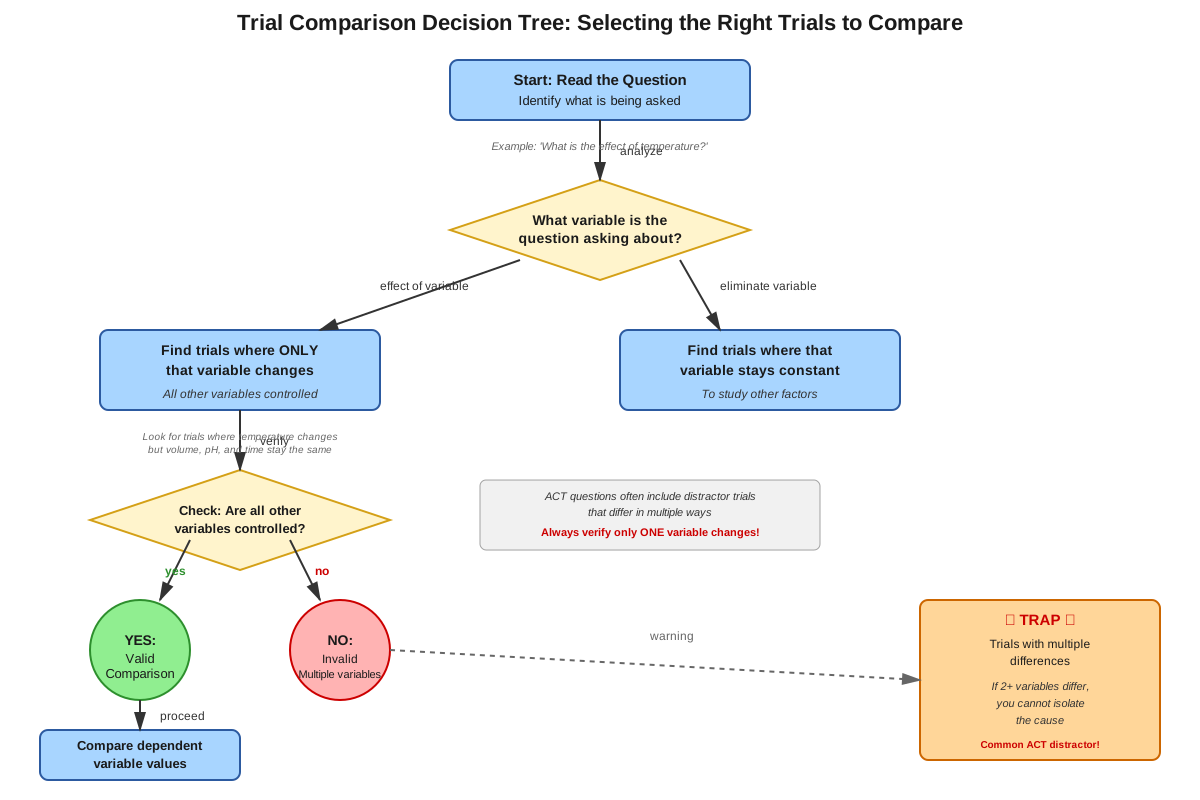
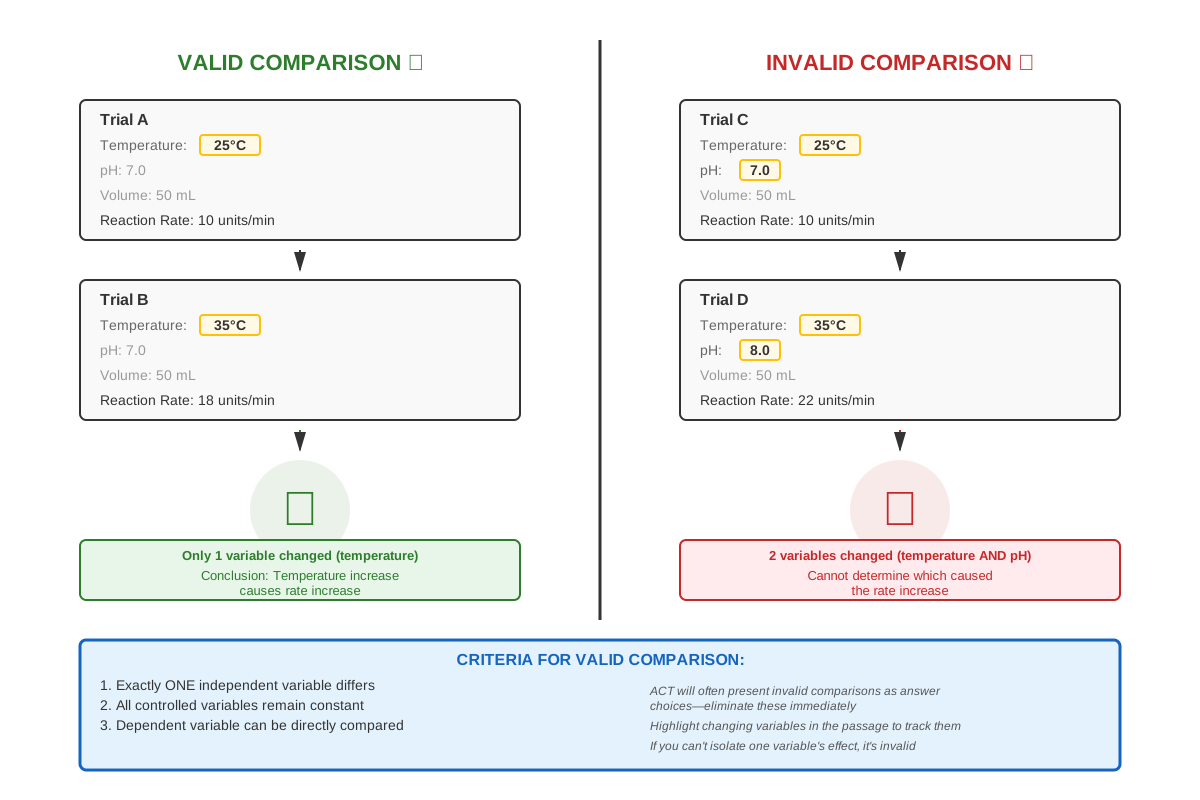
The one-variable rule states that valid comparisons between trials require changing only one independent variable while holding all others constant. This principle ensures that observed differences in results stem from the manipulated variable rather than confounding factors. On the ACT, questions frequently test whether students can identify which trials follow this rule and therefore allow meaningful comparison.
For example, if Trial 1 uses 20°C and pH 7, while Trial 2 uses 30°C and pH 8, these trials violate the one-variable rule because both temperature and pH changed. Comparing their results wouldn't reveal whether temperature, pH, or their interaction caused any observed differences. However, if Trial 3 uses 30°C and pH 7, then comparing Trial 1 and Trial 3 isolates temperature's effect, while comparing Trial 2 and Trial 3 isolates pH's effect.
Identifying Variables Across Trials
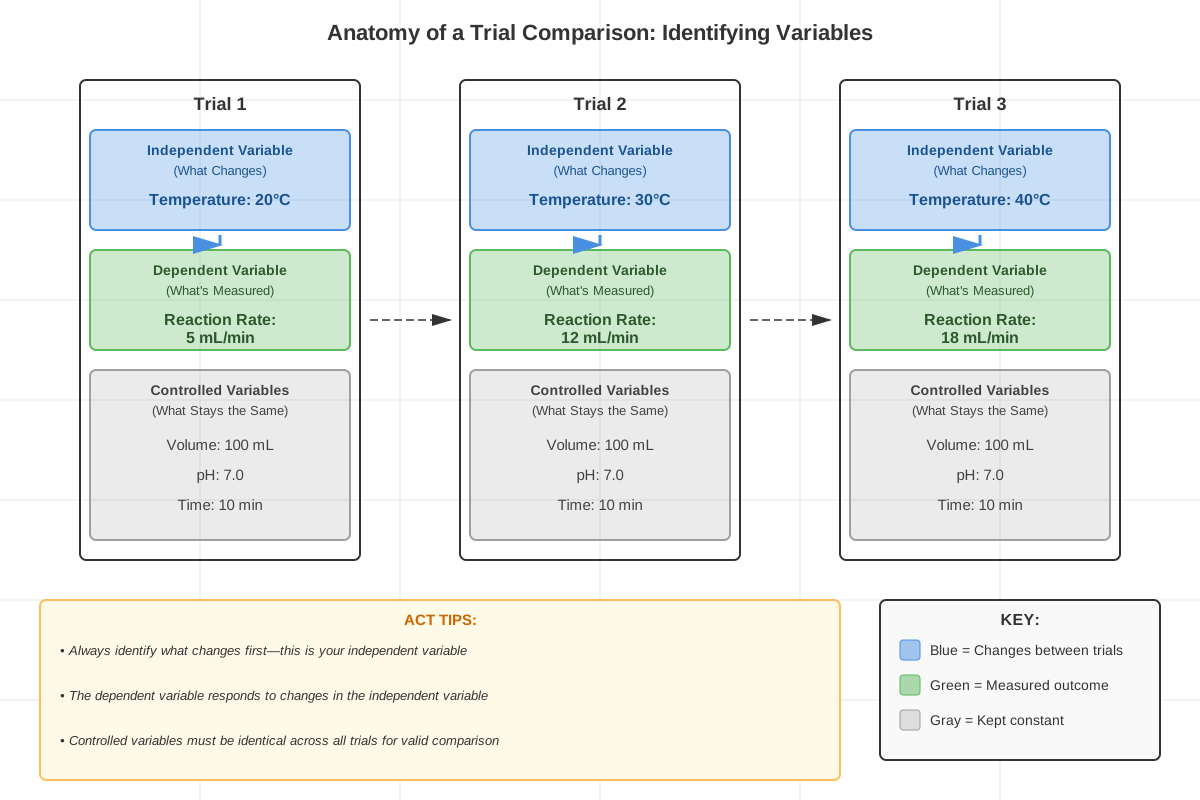
Successful trial comparison begins with systematically identifying three categories of variables:
- Independent variables: Factors deliberately changed by experimenters between trials
- Dependent variables: Measurements or observations recorded as outcomes
- Controlled variables: Factors kept constant across all trials
| Variable Type | Definition | Example | How to Identify |
|---|---|---|---|
| Independent | What experimenters change | Temperature settings | Look for different values in trial descriptions |
| Dependent | What experimenters measure | Plant growth rate | Found in results columns or y-axes |
| Controlled | What stays the same | Soil type, water amount | Mentioned once or implied as constant |
The ACT frequently presents this information in table format, with trials listed in rows and variables in columns, or vice versa. Students must quickly scan to determine which columns contain varying values (independent variables) and which contain constant values (controlled variables).
Comparing Trial Results
Once variables are identified, comparing trials involves three systematic steps:
- Locate the specific trials mentioned in the question
- Identify what changed between those trials (which independent variable varied)
- Determine how results differed (how the dependent variable responded)
For quantitative comparisons, students should note whether the dependent variable increased, decreased, remained constant, or showed no clear pattern. For qualitative comparisons, students should identify categorical differences in observations. The ACT rewards precise language: "increased from 5 to 8" is better than "went up," and "remained constant at 3" is better than "didn't change much."
Pattern Recognition Across Multiple Trials
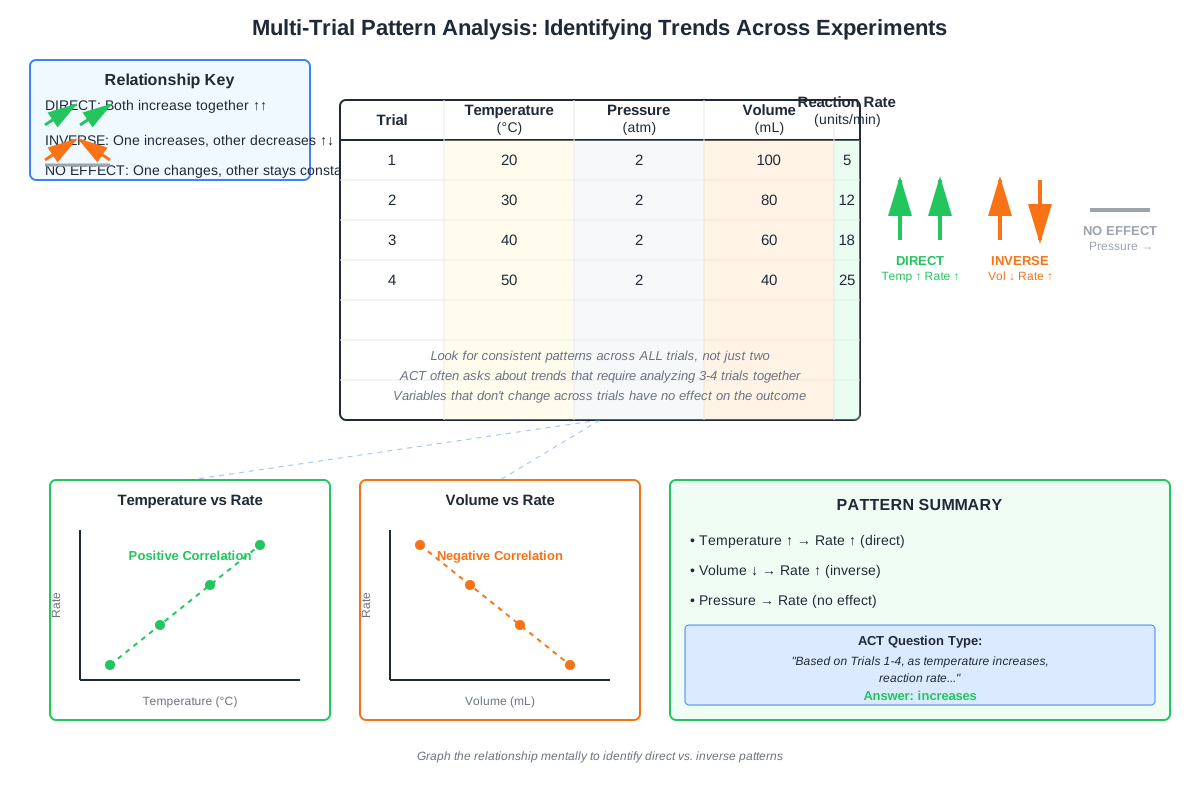
Advanced trial comparison questions require synthesizing information from three or more trials to identify trends. This involves recognizing direct relationships (as X increases, Y increases), inverse relationships (as X increases, Y decreases), or no relationship (X changes but Y remains constant or varies randomly).
Consider trials where temperature increases from 10°C to 20°C to 30°C to 40°C, while reaction rate increases from 2 to 5 to 11 to 20 units. Students must recognize not just that both increase together, but that the relationship is non-linear—the rate of increase accelerates. The ACT tests this deeper pattern recognition by asking prediction questions: "If Trial 5 used 50°C, the reaction rate would most likely be..."
Experimental Control and Baseline Trials
Many experiments include a control trial or baseline condition that serves as a reference point for comparison. This trial typically represents either the natural state (no intervention) or standard conditions. Identifying the control trial helps students understand the experimental design and make appropriate comparisons.
For instance, in a drug effectiveness study, Trial 1 might be a placebo (control), while Trials 2-4 test different drug dosages. All comparisons should reference back to Trial 1 to determine whether each dosage produced effects different from no treatment. Questions might ask, "Which trial showed the greatest difference from the control?" requiring students to identify Trial 1 as the baseline and calculate differences for Trials 2-4.
Concept Relationships
Trial comparisons build directly on understanding of the scientific method, particularly the principle of controlled experimentation. The ability to identify variables (prerequisite knowledge) enables students to perform trial comparisons, which in turn enables hypothesis evaluation and prediction of experimental outcomes (advanced skills tested on the ACT).
The relationship flows as follows: Variable identification → Trial comparison → Pattern recognition → Prediction/Hypothesis testing. Each step depends on the previous one. Students cannot accurately compare trials without first identifying which variables changed, and they cannot make valid predictions without first recognizing patterns across multiple trial comparisons.
Within the topic itself, concepts connect hierarchically. The one-variable rule governs which trials can be meaningfully compared, variable identification determines what changed between valid comparison pairs, result comparison reveals the direction and magnitude of effects, and pattern recognition synthesizes multiple comparisons into generalizable trends. Understanding experimental controls ties back to the one-variable rule—control trials provide a constant reference point that simplifies comparisons.
Trial comparisons also connect forward to other Research Summaries skills like experimental design evaluation (determining whether an experiment was properly constructed) and data interpretation (extracting meaning from complex results). Mastering trial comparisons provides the analytical framework for these more advanced skills.
High-Yield Facts
- ⭐ Valid trial comparisons require changing only ONE independent variable while keeping all others constant
- ⭐ The independent variable is what experimenters deliberately change; the dependent variable is what they measure as a result
- ⭐ When comparing two trials, first identify what changed, then determine how results differed
- ⭐ Direct relationships show both variables changing in the same direction (both increase or both decrease)
- ⭐ Inverse relationships show variables changing in opposite directions (one increases while the other decreases)
- Control trials or baseline conditions provide reference points for all other comparisons
- Controlled variables remain constant across all trials and are often mentioned only once in passage introductions
- Questions asking "How did Trial X differ from Trial Y?" test variable identification skills
- Questions asking "What would happen in Trial Z?" test pattern recognition and prediction skills
- Multiple trials showing the same pattern provide stronger evidence than a single comparison
- The ACT often presents trial information in tables where rows represent trials and columns represent variables
- Graphs showing multiple trials typically use different symbols, colors, or line styles to distinguish between conditions
- When no clear pattern emerges across trials, the correct answer often states "no relationship" or "cannot be determined"
- Experimental design flaws (like changing multiple variables simultaneously) prevent valid trial comparisons
Quick check — test yourself on Trial comparisons so far.
Try Flashcards →Common Misconceptions
Misconception: All trials in an experiment must be compared to each other to answer questions → Correction: Most questions require comparing only specific trials—usually those that differ by exactly one variable. Comparing all trials wastes time and may introduce confusion from trials that differ in multiple ways.
Misconception: The dependent variable is always listed in the rightmost column of a data table → Correction: While dependent variables often appear in results columns, table organization varies. Students must read column headers and passage descriptions to identify which variables are independent (manipulated) versus dependent (measured).
Misconception: If two trials show different results, the variable that changed between them must have caused the difference → Correction: This conclusion is only valid if all other variables were controlled. If multiple variables changed, the difference could result from either variable, both, or their interaction.
Misconception: Control trials always involve doing nothing or using a placebo → Correction: Control trials represent baseline conditions for comparison, which might be standard treatment, natural conditions, or any reference state. The key is that they provide a consistent comparison point, not that they involve "no treatment."
Misconception: More trials always make an experiment better → Correction: The quality of trials matters more than quantity. Three well-designed trials that systematically vary one factor provide more useful information than ten poorly designed trials that change multiple variables simultaneously.
Misconception: Pattern recognition requires complex mathematical calculations → Correction: The ACT tests qualitative pattern recognition (increasing, decreasing, constant) more often than quantitative calculations. Students should focus on trends and directions rather than precise numerical relationships.
Worked Examples
Example 1: Identifying Valid Comparisons
Passage Setup: Students conducted four trials testing how temperature and light intensity affect photosynthesis rate in aquatic plants.
| Trial | Temperature (°C) | Light Intensity (lumens) | O₂ Production (mL/hr) |
|---|---|---|---|
| 1 | 15 | 100 | 2.3 |
| 2 | 15 | 200 | 4.1 |
| 3 | 25 | 100 | 3.8 |
| 4 | 25 | 200 | 6.5 |
Question: To determine the effect of temperature on oxygen production, which two trials should be compared?
Solution Process:
Step 1: Identify what the question asks—the effect of temperature specifically, meaning we need trials that differ only in temperature.
Step 2: Examine each variable across trials:
- Temperature: Trials 1 and 2 use 15°C; Trials 3 and 4 use 25°C
- Light intensity: Trials 1 and 3 use 100 lumens; Trials 2 and 4 use 200 lumens
Step 3: Find trial pairs that differ only in temperature:
- Trials 1 and 3: Temperature changes (15°C → 25°C), light stays constant (100 lumens) ✓
- Trials 2 and 4: Temperature changes (15°C → 25°C), light stays constant (200 lumens) ✓
- Trials 1 and 2: Light changes, temperature stays constant ✗
- Trials 3 and 4: Light changes, temperature stays constant ✗
Step 4: Either Trials 1 and 3 OR Trials 2 and 4 would be correct answers. Both pairs isolate temperature's effect by keeping light intensity constant.
Key Insight: This example demonstrates the one-variable rule. Multiple valid comparison pairs may exist in well-designed experiments, as long as each pair changes only the variable of interest.
Example 2: Pattern Recognition and Prediction
Passage Setup: Researchers tested enzyme activity at different pH levels.
| Trial | pH | Enzyme Activity (units) |
|---|---|---|
| 1 | 4 | 12 |
| 2 | 5 | 28 |
| 3 | 6 | 45 |
| 4 | 7 | 44 |
| 5 | 8 | 29 |
| 6 | 9 | 13 |
Question: Based on the results, if the researchers conducted Trial 7 at pH 3, the enzyme activity would most likely be:
A) Less than 12 units
B) Between 12 and 28 units
C) Between 28 and 45 units
D) Greater than 45 units
Solution Process:
Step 1: Identify the pattern across existing trials. As pH increases from 4 to 6, activity increases (12 → 28 → 45). As pH increases from 6 to 9, activity decreases (45 → 44 → 29 → 13).
Step 2: Recognize that pH 6 represents a peak or optimal point. Activity is highest at pH 6 and decreases in both directions away from this optimum.
Step 3: Determine where pH 3 falls relative to existing data. pH 3 is lower than pH 4 (the current lowest tested value).
Step 4: Extend the pattern. Since activity decreased from pH 6 toward pH 4 (45 → 28 → 12), and pH 3 is even further from the optimum, activity should be even lower than at pH 4.
Step 5: Select answer A—less than 12 units—because the pattern suggests continued decrease beyond pH 4.
Key Insight: This example shows how recognizing non-linear patterns (the peak at pH 6) enables accurate predictions. The ACT frequently tests whether students can extrapolate beyond given data by identifying underlying trends.
Exam Strategy
When approaching trial comparison questions on the ACT Science test, implement this systematic process:
Step 1: Identify the question type. Trigger phrases include "How did Trial X differ from Trial Y?", "Which trials should be compared?", "Based on Trials 1-3, what would happen?", and "What was the effect of [variable]?" These phrases signal trial comparison questions.
Step 2: Locate relevant trials quickly. If the question mentions specific trial numbers, go directly to those rows or data points. If it asks about a variable's effect, scan for trials where only that variable changes.
Step 3: Apply the one-variable rule. Before comparing results, verify that only one independent variable differs between the trials. If multiple variables changed, those trials cannot validly answer the question.
Step 4: Describe changes precisely. Use specific language: "increased from X to Y," "decreased by Z%," or "remained constant at W." Avoid vague terms like "changed" or "was different."
Time-Saving Tip: Most trial comparison questions can be answered in 20-30 seconds once you've identified the relevant trials. Don't waste time reading the entire passage—go straight to the data table or graph.
Process of elimination strategies:
- Eliminate answers that compare trials differing in multiple variables
- Eliminate answers that contradict the direction of change shown in data (if data shows increase, eliminate "decreased" options)
- Eliminate answers that reference trials not mentioned in the question
- For prediction questions, eliminate answers that violate established patterns
Common trigger words to watch for:
- "Differ" or "difference" → identify what changed between trials
- "Effect of" → find trials isolating that specific variable
- "Based on" → use pattern from specified trials to predict
- "Compared to" → direct comparison between specific conditions
- "Relationship between" → determine if variables show direct, inverse, or no relationship
Allocate approximately 30-45 seconds per trial comparison question, including time to locate data. These questions should be among the fastest to answer once you've mastered the systematic approach.
Memory Techniques
VICO Mnemonic for systematic trial comparison:
- Variables: Identify independent, dependent, and controlled
- Isolate: Find trials that change only one variable
- Compare: Determine how results differ
- Outcome: State the relationship or pattern
The "One Change Rule" visualization: Picture an experiment as a row of light switches. Valid comparisons flip only one switch at a time. If two switches flip simultaneously, you can't tell which one caused the lights to change.
DICE for Pattern Recognition:
- Direct: Both variables move the same direction
- Inverse: Variables move opposite directions
- Constant: One variable changes, the other doesn't
- Erratic: No clear pattern emerges
The Control Trial Anchor: Visualize the control trial as an anchor point. All other trials are boats floating at various distances from this anchor. The further a trial's results are from the control, the stronger the effect of the changed variable.
Table Reading Strategy—"Columns are Categories": Remember that each column represents a different category of information. Scan horizontally across rows to compare trials; scan vertically down columns to identify patterns in single variables.
Summary
Trial comparisons represent the fundamental analytical skill for Research Summaries passages on the ACT Science test, requiring students to identify what changed between experimental conditions and how those changes affected results. Mastery depends on understanding the one-variable rule—that valid comparisons require changing only one independent variable while holding all others constant—and systematically applying this principle to identify which trials can be meaningfully compared. Students must distinguish between independent variables (what experimenters change), dependent variables (what they measure), and controlled variables (what stays constant), then use these identifications to compare specific trials, recognize patterns across multiple trials, and make predictions about untested conditions. Success requires both careful attention to experimental design and efficient data extraction from tables and graphs. The ability to perform trial comparisons quickly and accurately directly determines performance on 40-50% of Research Summaries questions, making this skill essential for achieving competitive Science section scores.
Key Takeaways
- Valid trial comparisons require changing exactly one independent variable while keeping all other factors constant
- Always identify what changed between trials before attempting to explain differences in results
- Direct relationships show variables moving together; inverse relationships show variables moving in opposite directions
- Control or baseline trials provide reference points for evaluating all other experimental conditions
- Pattern recognition across multiple trials enables prediction of outcomes under untested conditions
- Most trial comparison questions can be answered in 20-30 seconds by focusing only on relevant trials
- The ACT rewards systematic approaches: identify variables, isolate single changes, compare results, state outcomes
Related Topics
Experimental Design Evaluation: Building on trial comparison skills, this topic examines how to assess whether experiments are properly constructed to test hypotheses. Mastering trial comparisons provides the foundation for identifying design flaws and suggesting improvements.
Data Interpretation and Graphical Analysis: Trial comparisons often require extracting information from complex graphs showing multiple data series. Advanced graph reading skills enhance the speed and accuracy of trial comparisons.
Hypothesis Testing and Scientific Reasoning: Understanding how trial comparisons support or refute hypotheses represents the next level of scientific thinking. This topic synthesizes trial comparison skills with logical reasoning about cause and effect.
Variable Relationships and Trends: This advanced topic explores quantitative relationships between variables, including linear, exponential, and logarithmic patterns. Trial comparison skills provide the qualitative foundation for these quantitative analyses.
Practice CTA
Now that you understand the principles and strategies behind trial comparisons, it's time to apply these skills to authentic ACT-style questions. The practice questions and flashcards have been specifically designed to reinforce the concepts covered in this guide, progressing from basic variable identification to complex pattern recognition and prediction. Each practice attempt strengthens your ability to quickly identify valid comparisons, recognize patterns, and select correct answers under timed conditions. Consistent practice with trial comparison questions is the most reliable path to mastery—students who complete focused practice sessions typically see improvement within just a few attempts. Challenge yourself to apply the VICO method and one-variable rule to every practice question, and watch your confidence and accuracy grow!
Sign up free to keep reading
Create a free AnvayaPrep account to finish this ACT guide on Trial comparisons — plus flashcards and practice questions.