Overview
Validity is a cornerstone concept in the ACT Science section, particularly within Research Summaries passages. Understanding validity means being able to evaluate whether an experiment actually measures what it claims to measure and whether the conclusions drawn from data are justified by the experimental design. On the ACT, validity questions test a student's ability to critically analyze experimental procedures, identify flaws in methodology, and determine whether results can be legitimately interpreted in the way researchers suggest.
The ACT Science section frequently presents students with experiments that may contain design flaws, confounding variables, or unjustified conclusions. Questions about ACT validity require students to think like scientists—evaluating whether the experimental setup appropriately tests the hypothesis, whether controls are adequate, and whether alternative explanations exist for observed results. These questions go beyond simple data interpretation and demand higher-order critical thinking skills that distinguish top scorers from average performers.
Validity connects intimately with other Research Summaries concepts including experimental design, control variables, and data interpretation. A valid experiment must have appropriate controls, minimize confounding variables, and use measurement techniques that accurately capture the phenomenon under investigation. Understanding validity also supports skills in identifying independent and dependent variables, recognizing patterns in data, and evaluating scientific claims—all essential competencies for ACT Science success.
Learning Objectives
- [ ] Identify when Validity is being tested in ACT Science passages
- [ ] Explain the core rule or strategy behind Validity assessment
- [ ] Apply Validity concepts to ACT-style questions accurately
- [ ] Distinguish between internal validity and external validity in experimental contexts
- [ ] Evaluate whether experimental conclusions are justified by the data presented
- [ ] Recognize common threats to validity in research designs
- [ ] Determine whether appropriate controls have been implemented to ensure valid results
Prerequisites
- Basic experimental design principles: Understanding independent and dependent variables is essential because validity assessment requires evaluating whether the correct variables are being manipulated and measured
- Control variables and constants: Recognizing what should be held constant in an experiment is necessary to identify when confounding variables threaten validity
- Hypothesis formation: Knowing how scientific hypotheses are structured helps determine whether an experiment actually tests what it claims to test
- Data interpretation fundamentals: Basic ability to read graphs and tables is required since validity questions often ask whether data supports specific conclusions
Why This Topic Matters
Validity is not merely an academic concept—it represents the foundation of reliable scientific knowledge. In real-world applications, validity determines whether medical treatments actually work, whether environmental policies are based on sound evidence, and whether technological innovations deliver promised results. Scientists, policymakers, and informed citizens must constantly evaluate the validity of research claims to make evidence-based decisions.
On the ACT Science section, validity-related questions appear in approximately 15-20% of Research Summaries passages, making this a high-yield topic for score improvement. These questions typically appear as the more challenging items within a passage, often positioned as the final question or among the last few questions. Students who master validity concepts gain a significant competitive advantage because these questions effectively separate students who can merely read data from those who can think critically about experimental design.
Validity questions on the ACT commonly appear in several formats: asking whether a specific conclusion is supported by the data, identifying which additional experiment would strengthen a claim, determining what factor might invalidate results, or evaluating whether an experimental design appropriately tests a hypothesis. Passages may present experiments with subtle flaws—such as missing control groups, confounding variables, or measurement issues—and expect students to recognize these problems. Understanding validity transforms students from passive data readers into active scientific evaluators, precisely the skill the ACT Science section aims to assess.
Core Concepts
What is Validity?
Validity refers to the degree to which an experiment, test, or measurement actually assesses what it purports to assess. In simpler terms, validity answers the question: "Does this experiment really test what the researchers claim it tests?" A valid experiment produces results that can be legitimately interpreted as evidence for or against the hypothesis under investigation. Without validity, even the most precise measurements and sophisticated statistical analyses become meaningless because they don't actually address the research question.
Validity differs fundamentally from reliability (consistency of measurements) and accuracy (closeness to true values). An experiment can produce highly consistent results (reliable) that are completely irrelevant to the research question (invalid). For ACT purposes, validity focuses on whether the experimental design logically connects to the conclusions being drawn.
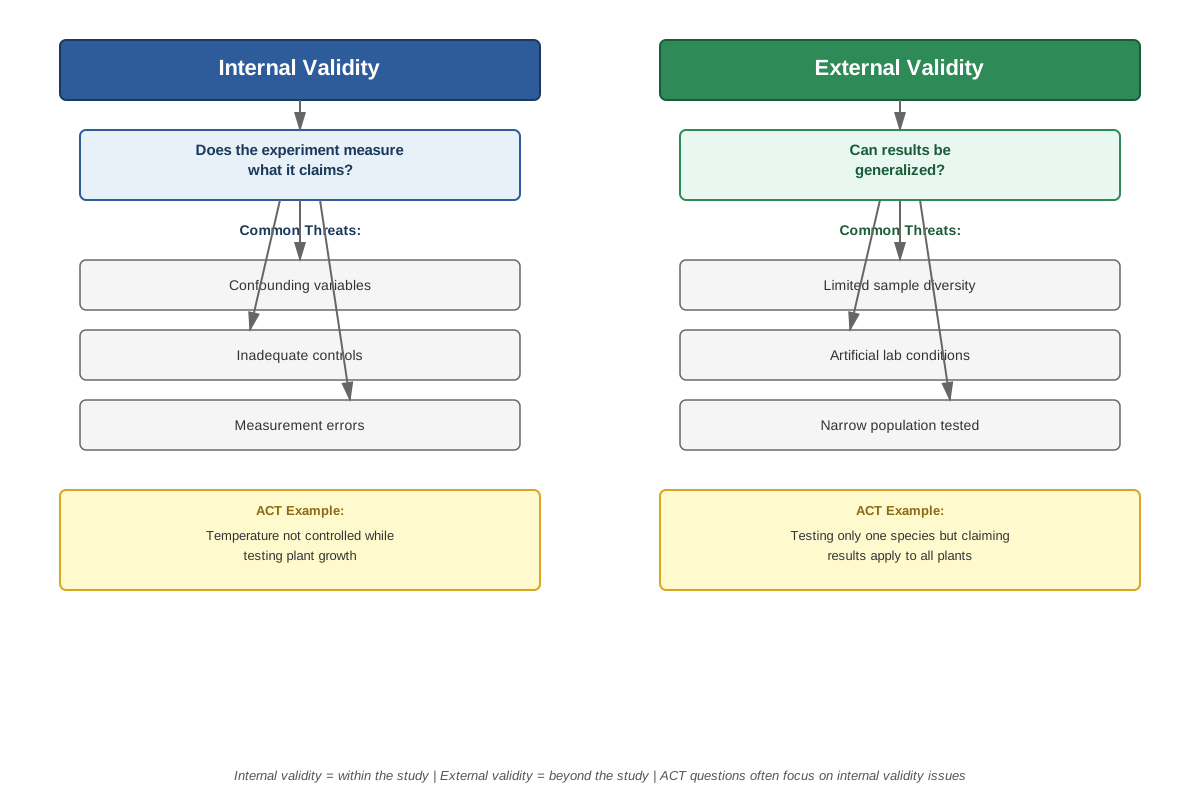
Internal Validity
Internal validity refers to the extent to which an experiment establishes a causal relationship between the independent and dependent variables, free from confounding factors. High internal validity means that observed changes in the dependent variable can confidently be attributed to manipulations of the independent variable rather than to other uncontrolled factors.
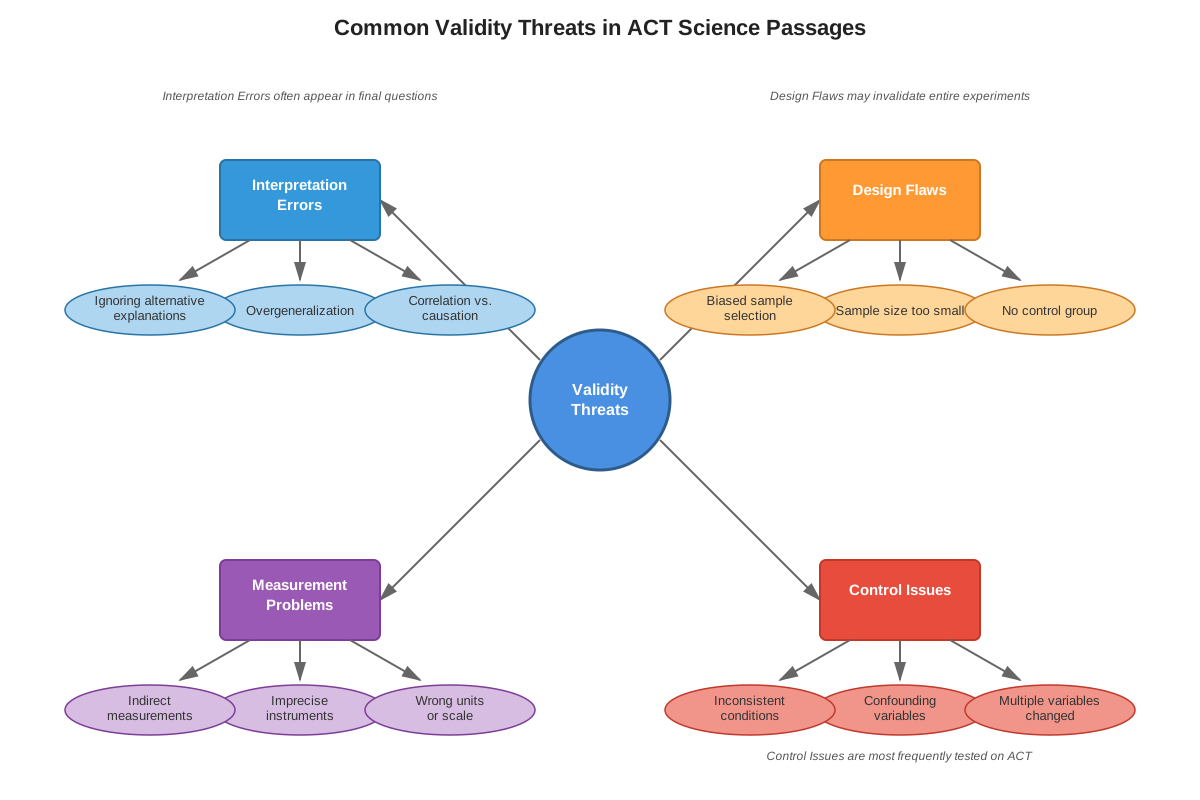
Threats to internal validity include:
- Confounding variables: Uncontrolled factors that vary along with the independent variable and could alternatively explain results
- Selection bias: Non-random assignment of subjects to experimental groups that creates systematic differences between groups
- Instrumentation changes: Modifications to measurement tools or procedures during the experiment
- Maturation effects: Natural changes in subjects over time that could explain observed differences
- History effects: External events occurring during the experiment that affect results
On the ACT, internal validity questions often present an experiment and ask students to identify what factor might invalidate the results or what additional control would strengthen the design. For example, a passage might describe an experiment testing fertilizer effectiveness on plant growth but fail to control for sunlight exposure—students must recognize that differences in plant growth could be due to sunlight rather than fertilizer.
External Validity
External validity concerns the generalizability of experimental results to other populations, settings, or conditions beyond those specifically tested. An experiment with high external validity produces findings that apply broadly, while low external validity means results may only hold under the specific conditions tested.
Factors affecting external validity include:
- Sample representativeness: Whether the subjects tested represent the broader population of interest
- Ecological validity: Whether experimental conditions resemble real-world situations
- Temporal validity: Whether findings remain true across different time periods
- Setting generalizability: Whether results apply in different locations or contexts
ACT questions about external validity might ask whether results from one species can be applied to another, whether laboratory findings would hold in natural environments, or whether conclusions from a small sample can be generalized to a larger population.
Construct Validity
Construct validity addresses whether the operational definitions and measurements used in an experiment actually capture the theoretical constructs they're intended to measure. This becomes particularly important when studying abstract concepts that cannot be directly observed.
For example, if researchers claim to measure "plant stress," they must use indicators (like chlorophyll content or growth rate) that genuinely reflect stress rather than other factors. On the ACT, construct validity questions might ask whether a particular measurement technique appropriately assesses the phenomenon under investigation.
Validity in Experimental Design
| Design Element | Purpose for Validity | ACT Application |
|---|---|---|
| Control group | Provides baseline for comparison; eliminates alternative explanations | Identify missing controls that threaten validity |
| Random assignment | Eliminates selection bias; ensures groups are equivalent | Recognize when non-random assignment creates validity problems |
| Standardized procedures | Ensures consistent treatment across subjects | Spot procedural variations that could confound results |
| Appropriate sample size | Reduces random error; increases confidence in results | Evaluate whether samples are sufficient for conclusions |
| Operational definitions | Clarifies exactly what is being measured | Assess whether measurements match research questions |
Evaluating Conclusions for Validity
A critical ACT skill involves determining whether stated conclusions are justified by the experimental data and design. Valid conclusions must:
- Directly address the hypothesis tested: Conclusions should answer the specific research question posed
- Be supported by the data presented: Numerical or graphical evidence must actually demonstrate the claimed pattern
- Acknowledge limitations: Valid conclusions recognize the scope and constraints of the findings
- Avoid overgeneralization: Claims should not extend beyond what the experimental design can support
- Account for alternative explanations: Valid conclusions address or eliminate competing hypotheses
On the ACT, students frequently encounter passages where researchers draw conclusions that exceed what their data actually demonstrates. For instance, an experiment showing correlation between two variables might be followed by a causal claim—students must recognize that correlation does not establish causation without proper experimental controls.
Concept Relationships
Validity serves as the central evaluative framework that connects all other Research Summaries concepts. The relationship flows as follows:
Hypothesis Formation → determines what needs to be tested → Experimental Design → must ensure validity through proper controls → Variable Identification → independent and dependent variables must be correctly operationalized → Data Collection → measurements must validly capture intended constructs → Data Analysis → patterns must be interpreted within validity constraints → Conclusion Formation → claims must be justified by valid experimental design
Internal validity depends heavily on proper control of variables—without adequate controls, confounding factors threaten the ability to draw causal conclusions. External validity connects to sampling methods and experimental conditions—the more representative and naturalistic these are, the more broadly results can be generalized.
Validity also relates inversely to experimental error: as uncontrolled sources of variation increase, validity decreases. Understanding measurement techniques is essential for construct validity—the measurement method must appropriately capture what researchers claim to measure.
The concept of validity integrates with scientific reasoning more broadly: evaluating validity requires the same critical thinking skills used to assess scientific arguments, identify assumptions, and recognize logical fallacies. Students who master validity develop transferable analytical skills applicable across all ACT Science passage types.
High-Yield Facts
⭐ Validity refers to whether an experiment actually measures what it claims to measure, not whether measurements are precise or consistent
⭐ A valid conclusion must be directly supported by the experimental data and design—correlation alone does not establish causation
⭐ Control groups are essential for internal validity because they provide a baseline for comparison and eliminate alternative explanations
⭐ Confounding variables are the most common threat to validity on ACT passages—look for factors that vary along with the independent variable
⭐ External validity concerns generalizability—results from one population, setting, or condition may not apply to others
- Internal validity focuses on whether causal relationships are established within the experiment itself
- Random assignment of subjects to groups increases internal validity by eliminating selection bias
- Operational definitions must match theoretical constructs for construct validity
- Sample size affects validity—very small samples may not support broad generalizations
- Standardized procedures across all experimental groups are necessary to maintain validity
- Temporal factors (time of day, season, duration) can threaten validity if not controlled
- Measurement instruments must remain consistent throughout an experiment to preserve validity
- Valid conclusions acknowledge limitations and avoid claims beyond what the data demonstrates
- Multiple trials or replications strengthen validity by reducing the influence of random variation
- The presence of a control does not guarantee validity if the control is inappropriate for the hypothesis being tested
Quick check — test yourself on Validity so far.
Try Flashcards →Common Misconceptions
Misconception: Validity and accuracy are the same thing → Correction: Validity concerns whether you're measuring the right thing; accuracy concerns whether measurements are close to true values. An experiment can accurately measure something that's completely irrelevant to the research question (invalid but accurate).
Misconception: If an experiment has a control group, it automatically has high validity → Correction: The control group must be appropriate for the specific hypothesis being tested. An inappropriate control (one that differs from the experimental group in multiple ways) does not ensure validity.
Misconception: Correlation between two variables in experimental data proves causation → Correction: Correlation only suggests a relationship; causation requires demonstrating that changes in the independent variable directly cause changes in the dependent variable, with confounding factors eliminated through proper controls.
Misconception: Results from a well-designed laboratory experiment automatically apply to real-world situations → Correction: This confuses internal validity with external validity. Laboratory experiments may have high internal validity (establishing causation) but low external validity (limited generalizability to natural settings).
Misconception: Larger sample sizes always make experiments more valid → Correction: While adequate sample size is important, validity primarily depends on experimental design, controls, and appropriate measurements. A large sample with confounding variables is still invalid.
Misconception: If data shows a clear pattern, the experiment must be valid → Correction: Clear patterns can emerge from invalid experiments due to confounding variables or systematic errors. The experimental design determines validity, not the clarity of results.
Misconception: Validity only matters for the final conclusions, not for individual measurements → Correction: Construct validity applies to each measurement technique—if individual measurements don't validly capture what they claim to measure, no amount of data analysis can produce valid conclusions.
Worked Examples
Example 1: Evaluating Internal Validity
Passage Summary: Researchers investigated whether a new fertilizer increases tomato plant growth. They applied the fertilizer to 20 plants in a greenhouse and measured height after 4 weeks. Plants grew an average of 15 cm taller than the typical growth rate reported in gardening literature. The researchers concluded that the fertilizer significantly enhances growth.
Question: Which of the following represents the greatest threat to the validity of this conclusion?
A) The sample size was too small
B) No control group of unfertilized plants was included in this experiment
C) Plant height was measured only once
D) The experiment was conducted in a greenhouse rather than outdoors
Solution Process:
Step 1: Identify what type of validity is being questioned. The question asks about threats to the conclusion that fertilizer causes increased growth—this is an internal validity question about establishing causation.
Step 2: Evaluate each option for its impact on internal validity:
- Option A: While 20 plants is modest, sample size primarily affects statistical confidence, not fundamental validity
- Option B: This is critical—without a control group grown simultaneously under identical conditions except for fertilizer, we cannot determine if the growth was due to fertilizer or other factors (greenhouse conditions, that particular season, the specific seeds used, watering practices, etc.)
- Option C: Single measurements are less reliable but don't fundamentally invalidate the design
- Option D: Greenhouse vs. outdoor setting affects external validity (generalizability), not internal validity
Step 3: The comparison to "typical growth rate reported in gardening literature" is problematic because those plants were grown under different conditions, possibly different varieties, different years, etc. This is not an adequate control.
Answer: B
Connection to Learning Objectives: This example demonstrates identifying when validity is being tested (recognizing a question about experimental design flaws) and applying validity concepts (understanding that control groups are essential for establishing causation).
Example 2: Assessing Conclusion Validity
Passage Summary: Scientists studied the effect of water temperature on fish metabolism. They measured oxygen consumption (an indicator of metabolic rate) in 15 goldfish at 20°C and 15 different goldfish at 25°C. Fish at 25°C consumed significantly more oxygen. The researchers concluded that higher temperatures increase metabolic rate in all fish species.
Question: Which statement best describes the validity of the researchers' conclusion?
A) The conclusion is valid because oxygen consumption is an appropriate measure of metabolism
B) The conclusion is valid because the data clearly shows higher oxygen consumption at higher temperature
C) The conclusion is not valid because different individual fish were used at each temperature
D) The conclusion is not valid because it overgeneralizes from one species to all fish species
Solution Process:
Step 1: Identify the specific claim being evaluated: "higher temperatures increase metabolic rate in all fish species"
Step 2: Assess whether the experimental design supports this broad claim:
- The experiment used only goldfish (one species)
- Different fish species have different physiological adaptations
- Generalizing from one species to "all fish species" requires evidence from multiple species
Step 3: Evaluate each option:
- Option A: Addresses construct validity (whether oxygen consumption measures metabolism) but doesn't address the overgeneralization problem
- Option B: Acknowledges the data pattern but ignores the scope problem in the conclusion
- Option C: Using different individuals at each temperature is actually appropriate (between-subjects design); this is not a validity problem
- Option D: Correctly identifies the external validity problem—the conclusion extends beyond what the experimental design can support
Step 4: This is an external validity issue—the results may be internally valid (temperature does affect goldfish metabolism) but cannot be generalized to all fish species without testing other species.
Answer: D
Connection to Learning Objectives: This example illustrates explaining the core strategy behind validity (matching conclusions to experimental scope) and applying validity concepts to determine whether conclusions are justified.
Exam Strategy
Recognizing Validity Questions
ACT validity questions typically include trigger phrases such as:
- "Which of the following weakens/strengthens the conclusion?"
- "What is a limitation of this experimental design?"
- "Based on the experimental design, can the researchers conclude...?"
- "Which additional experiment would be necessary to support the claim?"
- "What factor might invalidate the results?"
- "To what extent can these results be generalized?"
Exam Tip: Validity questions often appear as the last or second-to-last question in a Research Summaries passage. They require synthesis of the entire experimental design, so save them for after you've thoroughly understood the passage.
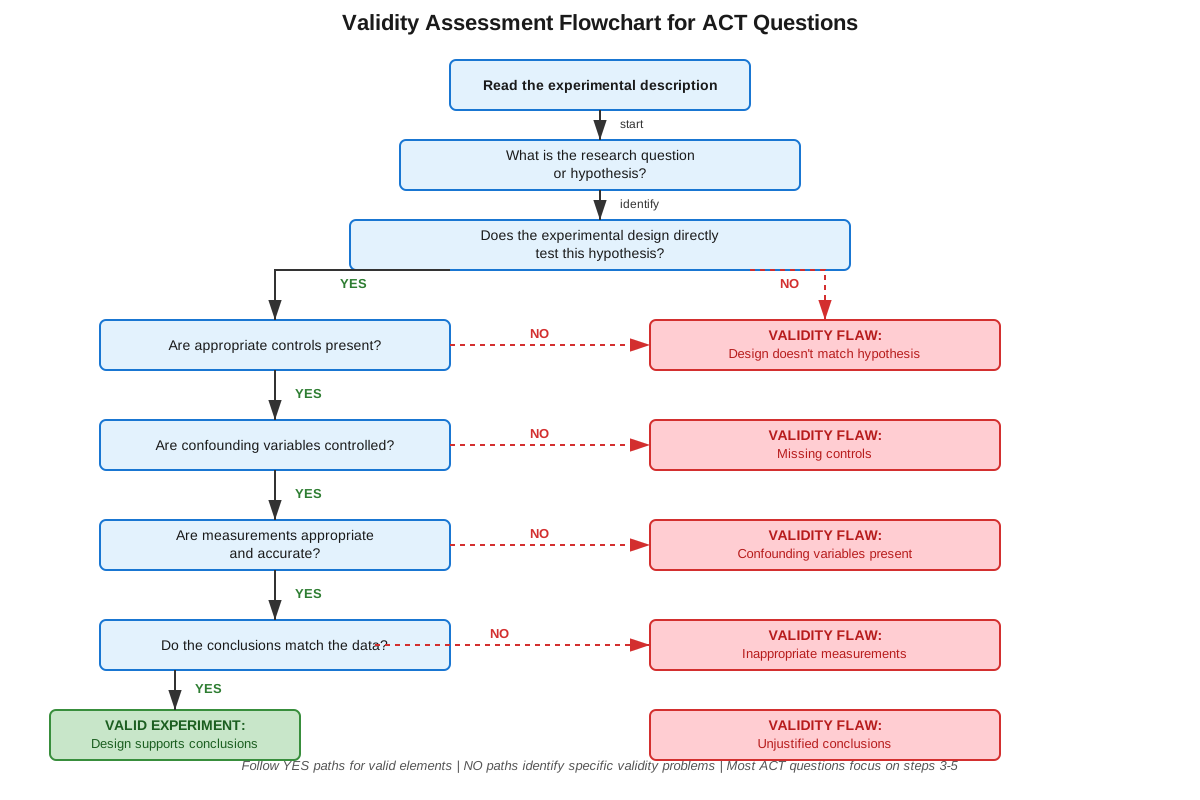
Systematic Approach to Validity Questions
- Identify the specific claim or conclusion being evaluated: Underline or mentally note exactly what the researchers claim
- Map the experimental design: Note what was actually tested, what controls were used, and what was measured
- Check for gaps: Look for differences between what was tested and what is claimed
- Consider confounding variables: Ask "What else could explain these results?"
- Evaluate generalizability: Determine if the conclusion extends beyond the experimental conditions
Process of Elimination for Validity Questions
Eliminate options that:
- Confuse validity with other concepts (reliability, accuracy, precision)
- Identify minor issues that don't fundamentally threaten the conclusion
- Misunderstand the experimental design (claiming something wasn't controlled when it was)
- Focus on external validity when the question asks about internal validity, or vice versa
Favor options that:
- Identify missing control groups or inappropriate controls
- Point out confounding variables that could alternatively explain results
- Recognize overgeneralization beyond experimental scope
- Note measurement issues that affect construct validity
Time Management
Allocate approximately 45-60 seconds for validity questions, as they require more critical thinking than simple data-reading questions. If a validity question seems unclear on first reading, mark it and return after completing easier questions in the passage. Your understanding of the experimental design will deepen as you work through other questions, making validity questions easier to answer later.
Strategic Insight: Validity questions reward careful reading of the experimental procedure description. Many students rush through this section to get to graphs and tables, but validity questions specifically test whether you understood the methodology.
Memory Techniques
VALID Checklist for evaluating experiments:
- Variables: Are independent and dependent variables clearly defined and appropriate?
- Alternatives: Have alternative explanations been eliminated through controls?
- Limitations: Does the conclusion acknowledge scope and constraints?
- Internal controls: Are confounding factors controlled within the experiment?
- Data match: Do the data actually support the stated conclusion?
The "Could It Be Something Else?" Question: When evaluating internal validity, always ask this question about results. If you can identify another factor that could explain the results, the experiment has a validity problem.
Control Group Visualization: Picture two identical setups side-by-side, differing only in the one factor being tested. If you can't visualize this, the experiment likely lacks adequate controls.
Generalization Boundary Check: Draw a mental circle around what was actually tested (species, conditions, location, time). Any conclusion extending outside that circle has external validity limitations.
The Three-Level Validity Hierarchy:
- Construct: Are we measuring the right thing?
- Internal: Are we correctly identifying cause and effect?
- External: Can we apply this beyond the specific test case?
This hierarchy helps organize thinking: construct validity must be established before internal validity matters, and internal validity must be established before external validity is relevant.
Summary
Validity represents the fundamental criterion for evaluating whether scientific experiments produce meaningful, interpretable results. On the ACT Science section, validity questions assess whether students can think critically about experimental design, identify flaws in methodology, and determine if conclusions are justified by the data and procedures presented. Internal validity concerns whether causal relationships are properly established within an experiment through adequate controls and elimination of confounding variables. External validity addresses whether results can be generalized beyond the specific conditions tested. Construct validity ensures that measurements actually capture the intended phenomena. Successful ACT test-takers recognize that valid conclusions must be directly supported by experimental design and data, acknowledge limitations, and avoid overgeneralization. Common validity problems include missing or inappropriate control groups, confounding variables, and conclusions that extend beyond experimental scope. Mastering validity concepts enables students to evaluate scientific claims critically—a skill that distinguishes top scorers and reflects genuine scientific literacy.
Key Takeaways
- Validity determines whether an experiment actually tests what it claims to test—this is distinct from accuracy, precision, or reliability
- Control groups are essential for internal validity because they eliminate alternative explanations for observed results
- Confounding variables represent the most common threat to validity on ACT passages—always ask "what else could explain these results?"
- Valid conclusions must match the scope of the experimental design—generalizing beyond what was tested indicates an external validity problem
- The presence of clear data patterns does not guarantee validity—flawed experimental designs can produce clear but meaningless results
- Validity questions typically appear as challenging items late in Research Summaries passages and require synthesis of the entire experimental design
- Systematic evaluation using the VALID checklist (Variables, Alternatives, Limitations, Internal controls, Data match) provides a reliable approach to validity questions
Related Topics
Experimental Design Fundamentals: Understanding how to structure experiments with proper controls, randomization, and variable manipulation provides the foundation for validity assessment. Mastering validity deepens experimental design knowledge by adding evaluative criteria.
Statistical Significance and Confidence: While validity concerns whether the right thing is being measured, statistical concepts address whether observed differences are meaningful or due to chance. These topics complement each other in evaluating research quality.
Scientific Method and Hypothesis Testing: Validity connects directly to the scientific method's emphasis on testable hypotheses and reproducible results. Understanding validity enhances appreciation for why the scientific method requires specific procedural steps.
Data Interpretation and Graph Analysis: Valid conclusions require both sound experimental design and accurate data interpretation. These skills work together—even valid experiments require correct data reading to draw appropriate conclusions.
Conflicting Viewpoints Passages: The critical thinking skills developed through validity assessment transfer directly to evaluating competing scientific theories and identifying strengths and weaknesses in different arguments.
Practice CTA
Now that you understand the principles of validity and how to evaluate experimental designs critically, you're ready to apply these concepts to ACT-style practice questions. The practice questions will challenge you to identify validity threats, evaluate conclusions, and distinguish between different types of validity in realistic test scenarios. Approach each question systematically using the VALID checklist and the strategies outlined above. Remember that validity questions reward careful thinking rather than quick pattern recognition—take your time to fully understand what each experiment actually demonstrates versus what researchers claim. Mastering validity will not only improve your ACT Science score but also develop critical thinking skills valuable far beyond standardized testing. You've got this!
Sign up free to keep reading
Create a free AnvayaPrep account to finish this ACT guide on Validity — plus flashcards and practice questions.