Overview
Weakening conclusions is a critical analytical skill tested extensively in the ACT Science section, particularly within Research Summaries passages. This skill requires students to evaluate experimental evidence and identify information, data, or scenarios that would undermine or cast doubt on a researcher's conclusion. Unlike strengthening arguments or simply understanding experimental design, weakening conclusions demands that students think critically about alternative explanations, confounding variables, methodological flaws, and contradictory evidence that could challenge the validity of stated findings.
The ACT Science test frequently presents students with experimental scenarios where researchers draw conclusions from their data. Students must then identify which additional piece of information, alternative result, or experimental modification would make those conclusions less reliable or invalid. This skill is essential because it mirrors real scientific thinking—scientists must constantly evaluate whether their conclusions are justified by their evidence or whether alternative explanations exist. Questions testing this concept typically appear 2-4 times per ACT Science section and are considered medium-to-high difficulty because they require synthesis of information rather than simple data retrieval.
Within the broader context of Research Summaries passages, ACT weakening conclusions questions connect directly to understanding experimental design, identifying variables, interpreting results, and evaluating scientific reasoning. Students who master this topic demonstrate higher-order thinking skills that distinguish top scorers from average performers. This topic builds upon foundational knowledge of the scientific method while preparing students for more complex evaluation tasks that appear throughout the Science section.
Learning Objectives
- [ ] Identify when Weakening conclusions is being tested in ACT Science passages
- [ ] Explain the core rule or strategy behind Weakening conclusions questions
- [ ] Apply Weakening conclusions strategies to ACT-style questions accurately
- [ ] Distinguish between information that weakens versus strengthens a conclusion
- [ ] Recognize common types of weakening evidence (confounding variables, alternative explanations, contradictory data)
- [ ] Evaluate whether new information logically undermines a stated conclusion
- [ ] Analyze experimental limitations that could weaken researchers' claims
Prerequisites
- Understanding of the scientific method: Necessary to recognize how conclusions should logically follow from evidence and when they don't
- Ability to identify independent and dependent variables: Required to understand which factors could interfere with or alter experimental relationships
- Basic data interpretation skills: Essential for recognizing when new data contradicts or challenges existing conclusions
- Familiarity with experimental controls: Needed to identify when lack of controls or confounding variables weaken conclusions
- Reading comprehension of scientific passages: Fundamental for understanding what conclusions researchers are actually making
Why This Topic Matters
In real-world scientific research, the ability to critically evaluate conclusions is fundamental to the peer review process, replication studies, and scientific progress. Scientists must constantly question whether their conclusions are justified or whether alternative explanations exist. This skill prevents premature acceptance of flawed findings and drives more rigorous experimental design. Beyond academia, professionals in medicine, engineering, policy-making, and business regularly evaluate whether conclusions drawn from data are truly supported or whether weakening factors exist.
On the ACT Science test, weakening conclusions questions appear with high frequency—typically 2-4 questions per test, representing approximately 5-10% of all Science questions. These questions are considered high-yield because they test critical thinking rather than content knowledge, making them accessible to well-prepared students regardless of their science background. The ACT specifically includes these questions to assess scientific reasoning skills that predict college readiness.
Common question formats include: "Which of the following findings would most weaken the hypothesis that...?", "The conclusion would be less valid if which of the following were true?", "Which observation would cast doubt on the researchers' claim?", and "Which result would contradict the conclusion that...?" These questions typically appear after students have read about an experiment and its stated conclusions, requiring integration of the experimental design, results, and logical reasoning.
Core Concepts
What Does "Weakening a Conclusion" Mean?
Weakening conclusions refers to identifying information, evidence, or circumstances that make a stated conclusion less reliable, less valid, or less likely to be true. When a conclusion is weakened, it doesn't necessarily mean the conclusion is completely false—rather, it means there is now reasonable doubt about whether the conclusion is justified by the evidence. A weakened conclusion has reduced confidence or credibility.
To weaken a conclusion effectively, new information must create one of several logical problems: it might suggest an alternative explanation for the observed results, reveal a confounding variable that wasn't controlled, present contradictory data, expose a methodological flaw, or demonstrate that the conclusion overgeneralizes beyond what the data actually support.
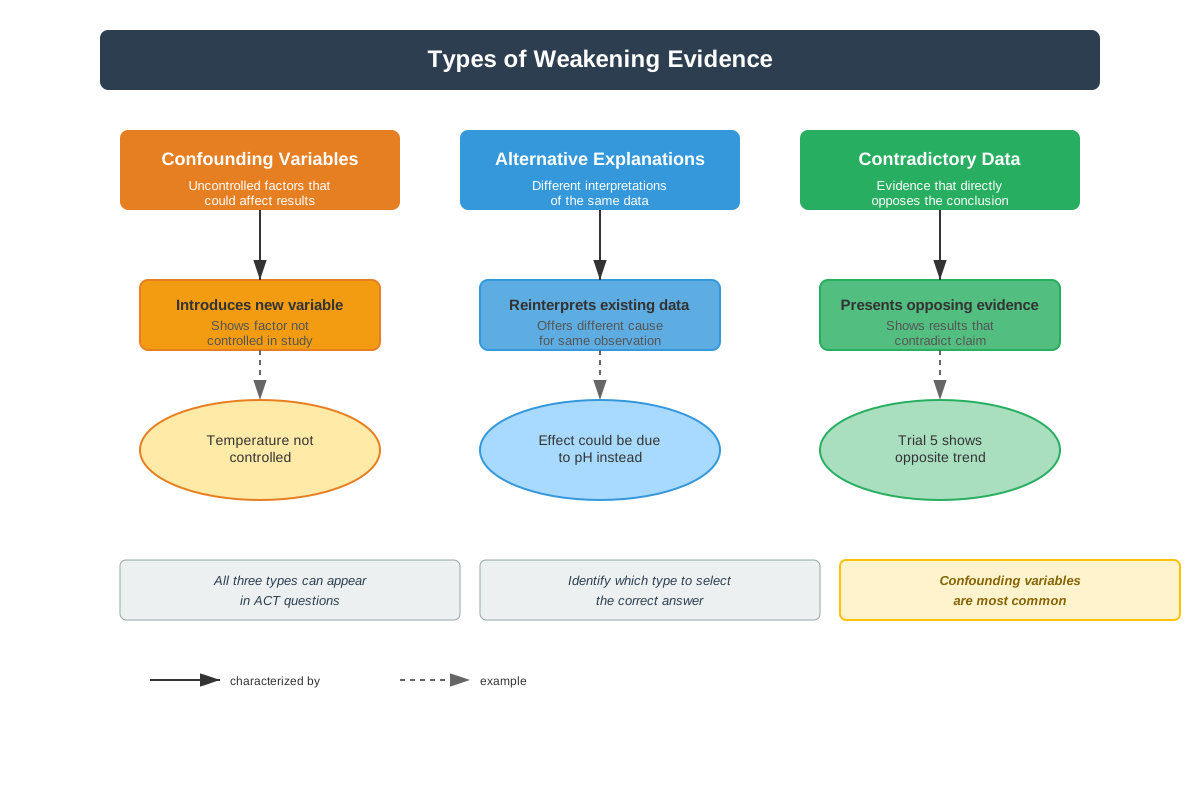
Types of Weakening Evidence
Understanding the different categories of weakening evidence helps students quickly identify correct answers on the ACT:
| Type of Weakening Evidence | Description | Example |
|---|---|---|
| Confounding Variables | Uncontrolled factors that could explain results instead of the proposed cause | If a study concludes fertilizer increases growth, discovering that fertilized plants also received more sunlight weakens the conclusion |
| Alternative Explanations | Different causal mechanisms that could produce the same observed results | If researchers conclude a drug reduces symptoms, finding that symptoms naturally decrease over the same time period weakens the conclusion |
| Contradictory Data | New observations or measurements that conflict with the stated conclusion | If a study concludes temperature doesn't affect reaction rate, finding examples where temperature clearly changes the rate weakens the conclusion |
| Methodological Flaws | Problems with experimental design that undermine result validity | If researchers conclude their sample represents all adults, revealing the sample only included college students weakens the conclusion |
| Scope Limitations | Evidence that the conclusion applies to fewer cases than claimed | If researchers conclude a finding applies to all mammals, showing it doesn't work in primates weakens the conclusion |
The Logic of Weakening Arguments
When evaluating whether information weakens a conclusion, students should follow this logical framework:
- Identify the conclusion clearly: What exactly are the researchers claiming? Be precise about the cause-effect relationship or pattern they assert.
- Understand the evidence supporting it: What data or observations led to this conclusion? What is the logical connection between evidence and conclusion?
- Evaluate the new information: Does this new piece of information break the logical connection between evidence and conclusion? Does it suggest the conclusion might be wrong or unjustified?
- Apply the "reasonable doubt" test: After considering the new information, is there now reasonable doubt about whether the conclusion is valid?
Common Weakening Scenarios on the ACT
The ACT repeatedly tests certain weakening scenarios that students should recognize immediately:
Scenario 1: The Uncontrolled Variable
Researchers conclude that Factor X causes Result Y, but new information reveals that Factor Z (which wasn't controlled) also changed and could have caused Result Y instead. This is perhaps the most common weakening scenario on the ACT.
Scenario 2: The Sampling Problem
Researchers draw a broad conclusion from a limited sample, and new information reveals the sample was not representative or was too small to justify the generalization.
Scenario 3: The Temporal Confusion
Researchers conclude that A causes B because A happened before B, but new information suggests the timing was coincidental or that both A and B were caused by something else.
Scenario 4: The Measurement Error
Researchers base their conclusion on measurements, but new information reveals the measuring instrument was faulty, imprecise, or used incorrectly.
Scenario 5: The Overlooked Exception
Researchers conclude that a pattern always holds, but new information provides clear counterexamples where the pattern doesn't apply.
Distinguishing Weakening from Irrelevant Information
A critical skill is recognizing that not all new information weakens a conclusion—some information is simply irrelevant. Information is only weakening if it logically undermines the connection between evidence and conclusion. For example, if researchers conclude that Plant A grows faster than Plant B in sunlight, learning that Plant C grows even faster doesn't weaken the conclusion about the relative growth rates of Plants A and B—it's simply additional information that doesn't affect the original claim.
Students should ask: "Does this new information give me a reason to doubt the conclusion?" If the answer is no, the information doesn't weaken the conclusion, even if it's related to the topic.
Concept Relationships
The skill of weakening conclusions builds directly upon understanding experimental design and the scientific method. Students must first understand what makes a valid conclusion (proper controls, representative samples, accurate measurements) before they can identify what would make a conclusion invalid. This creates the relationship: Understanding Valid Experimental Design → Enables Recognition of → Factors That Weaken Conclusions.
Within the topic itself, the different types of weakening evidence are interconnected. Confounding Variables → Often Lead to → Alternative Explanations, because an uncontrolled variable provides an alternative reason for the observed results. Similarly, Methodological Flaws → Can Produce → Contradictory Data, because flawed methods might yield inconsistent or unreliable measurements.
The concept also connects forward to other ACT Science skills. Mastering weakening conclusions enhances the ability to Evaluate Conflicting Viewpoints (another ACT passage type) because both require assessing the strength of arguments and evidence. It also improves Strengthening Conclusions skills, as these are mirror images—what strengthens a conclusion is often the opposite of what weakens it.
The relationship map looks like this:
Scientific Method & Experimental Design → Provides Foundation for → Identifying Valid Conclusions → Enables Recognition of → Weakening Factors (Confounding Variables, Alternative Explanations, Contradictory Data, Methodological Flaws) → Applies to → Research Summaries Questions → Connects to → Conflicting Viewpoints Evaluation
High-Yield Facts
⭐ Confounding variables are the most common type of weakening evidence on the ACT—if an uncontrolled factor could explain the results, the conclusion is weakened.
⭐ Information only weakens a conclusion if it creates reasonable doubt about the logical connection between evidence and conclusion—irrelevant information doesn't weaken anything.
⭐ Alternative explanations weaken conclusions by showing that the observed results could have occurred for a different reason than the one claimed.
⭐ Sample size and representativeness issues frequently weaken conclusions that make broad generalizations from limited data.
⭐ Contradictory data from additional trials or observations directly weakens conclusions by showing the pattern doesn't always hold.
- Methodological flaws (faulty equipment, improper procedures, lack of controls) weaken conclusions by undermining data reliability.
- Temporal relationships alone don't prove causation—showing that correlation doesn't equal causation weakens causal conclusions.
- Scope limitations weaken conclusions by showing they apply to fewer cases than originally claimed.
- Measurement errors or imprecise instruments weaken conclusions based on quantitative data.
- Exceptions to stated patterns weaken conclusions that claim universal or consistent relationships.
- Lack of replication weakens conclusions because single studies may reflect chance results rather than true patterns.
- Researcher bias or conflicts of interest can weaken conclusions by suggesting results may be influenced by non-scientific factors.
Quick check — test yourself on Weakening conclusions so far.
Try Flashcards →Common Misconceptions
Misconception: Any new information related to the experiment weakens the conclusion.
Correction: Only information that logically undermines the connection between evidence and conclusion weakens it. Related but irrelevant information doesn't weaken anything. For example, learning additional details about the experimental setup that don't affect the validity of the conclusion is not weakening evidence.
Misconception: Weakening a conclusion means proving it completely false.
Correction: Weakening creates doubt or reduces confidence in a conclusion but doesn't necessarily prove it wrong. A weakened conclusion might still be true, but there's now less certainty or justification for believing it based on the available evidence.
Misconception: Information that strengthens one part of an experiment automatically weakens the conclusion.
Correction: Strengthening and weakening are opposites. Information that makes a conclusion more reliable strengthens it, while information that makes it less reliable weakens it. Students sometimes confuse these directions, especially under time pressure.
Misconception: Identifying a limitation of the study always means the conclusion is weakened.
Correction: All studies have limitations, but only limitations that directly affect the validity of the specific conclusion being tested actually weaken it. A limitation that doesn't impact the logical connection between evidence and conclusion doesn't weaken the conclusion.
Misconception: More data always strengthens conclusions, so less data always weakens them.
Correction: The quality and relevance of data matters more than quantity. A small amount of contradictory data can weaken a conclusion, while large amounts of irrelevant data don't strengthen it. Similarly, discovering that existing data was collected improperly weakens conclusions even though the quantity of data hasn't changed.
Misconception: If one variable wasn't controlled, all conclusions from the experiment are automatically invalid.
Correction: Only conclusions that could be affected by that specific uncontrolled variable are weakened. If the uncontrolled variable is irrelevant to the particular conclusion being tested, it doesn't weaken that conclusion.
Worked Examples
Example 1: Identifying Confounding Variables
Passage Summary: Researchers conducted an experiment to test whether a new fertilizer increases tomato plant growth. They applied the fertilizer to plants in Garden A and used no fertilizer on plants in Garden B. After 8 weeks, plants in Garden A were 30% taller on average. The researchers concluded that the fertilizer caused increased growth.
Question: Which of the following findings would most weaken the researchers' conclusion?
A) Plants in Garden A also received more water than plants in Garden B
B) The fertilizer contains nitrogen and phosphorus
C) Some plants in Garden A grew more than others
D) Tomato plants typically grow rapidly during 8-week periods
Solution Process:
Step 1: Identify the conclusion clearly.
The researchers conclude that the fertilizer caused the increased growth in Garden A plants.
Step 2: Understand the logical connection.
The evidence is that Garden A plants (with fertilizer) grew more than Garden B plants (without fertilizer). The conclusion assumes the fertilizer was the only relevant difference between the groups.
Step 3: Evaluate each answer choice.
Choice A: If Garden A plants received more water, this is an uncontrolled variable (confounding variable) that could explain the increased growth instead of the fertilizer. This creates an alternative explanation and weakens the conclusion that fertilizer caused the growth. This is likely correct.
Choice B: Knowing the fertilizer's composition doesn't weaken the conclusion—it's just additional information about what the fertilizer contains. This doesn't create doubt about whether the fertilizer caused growth.
Choice C: Variation within a group is normal and expected. This doesn't weaken the conclusion about the average difference between groups.
Choice D: If tomato plants naturally grow rapidly, this doesn't explain why Garden A plants grew MORE than Garden B plants. Both groups would experience natural growth, so this doesn't weaken the conclusion about the difference between them.
Step 4: Apply the "reasonable doubt" test.
Choice A creates reasonable doubt because we now have an alternative explanation (more water) for the observed results. The conclusion that fertilizer caused the growth is weakened because the increased growth might have been caused by water instead.
Answer: A
Connection to Learning Objectives: This example demonstrates how to identify when weakening conclusions is being tested (a question asking what would "weaken" a stated conclusion) and how to apply the core strategy (identifying confounding variables that provide alternative explanations).
Example 2: Recognizing Contradictory Data
Passage Summary: A study examined the relationship between exercise and sleep quality. Researchers surveyed 100 adults who exercised regularly and found that 85% reported good sleep quality. They concluded that regular exercise improves sleep quality for all adults.
Question: Which of the following observations would most weaken the conclusion?
A) A separate study of 200 adults who don't exercise found that 80% reported good sleep quality
B) Exercise increases heart rate and body temperature
C) The survey defined "good sleep quality" as sleeping at least 7 hours per night
D) Some of the surveyed adults exercised in the morning while others exercised in the evening
Solution Process:
Step 1: Identify the conclusion.
The researchers conclude that regular exercise improves sleep quality for all adults.
Step 2: Understand the evidence.
The evidence is that 85% of adults who exercise regularly reported good sleep quality. The conclusion assumes this high percentage is due to exercise.
Step 3: Evaluate each choice.
Choice A: If 80% of adults who DON'T exercise also report good sleep quality, this contradicts the conclusion that exercise improves sleep quality. The sleep quality is nearly as good without exercise, suggesting exercise isn't the cause of good sleep. This directly weakens the conclusion.
Choice B: This is just factual information about exercise's physiological effects. It doesn't weaken the conclusion about sleep quality.
Choice C: This clarifies the study's definition but doesn't weaken the conclusion about the relationship between exercise and sleep.
Choice D: Variation in exercise timing within the group doesn't weaken the conclusion about whether exercise in general improves sleep.
Step 4: Apply the "reasonable doubt" test.
Choice A creates strong doubt because if people who don't exercise have nearly the same good sleep quality, then exercise probably isn't the cause of good sleep quality. The conclusion is significantly weakened.
Answer: A
Connection to Learning Objectives: This example shows how contradictory data weakens conclusions and demonstrates the application of weakening strategies to ACT-style questions. It also illustrates the importance of distinguishing between relevant weakening information and irrelevant details.
Exam Strategy
Recognizing Weakening Questions
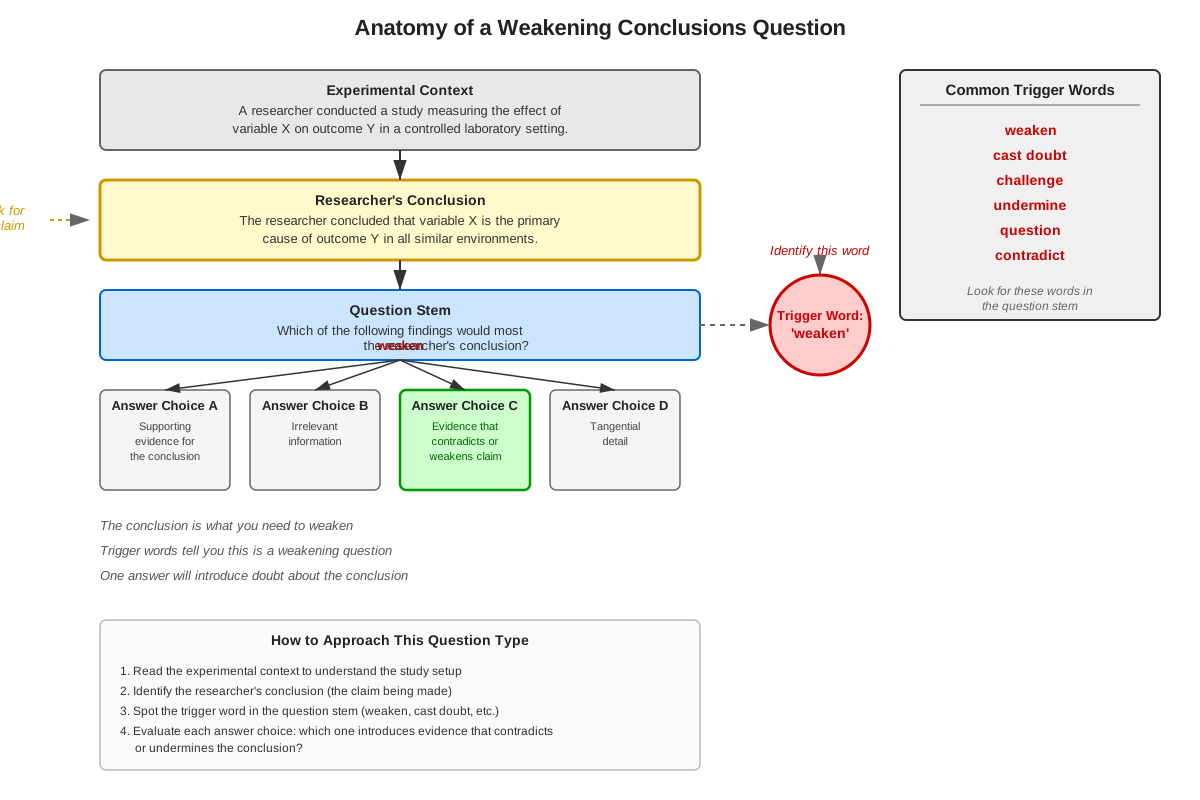
Watch for these trigger phrases that signal weakening conclusions questions:
- "Which would weaken the conclusion/hypothesis?"
- "Which would cast doubt on the claim?"
- "The conclusion would be less valid if..."
- "Which finding would contradict the results?"
- "Which observation would undermine the hypothesis?"
- "Which would make the conclusion less reliable?"
Exam Tip: When you see these phrases, immediately identify the specific conclusion being tested. Underline or mentally note the exact claim you need to weaken.
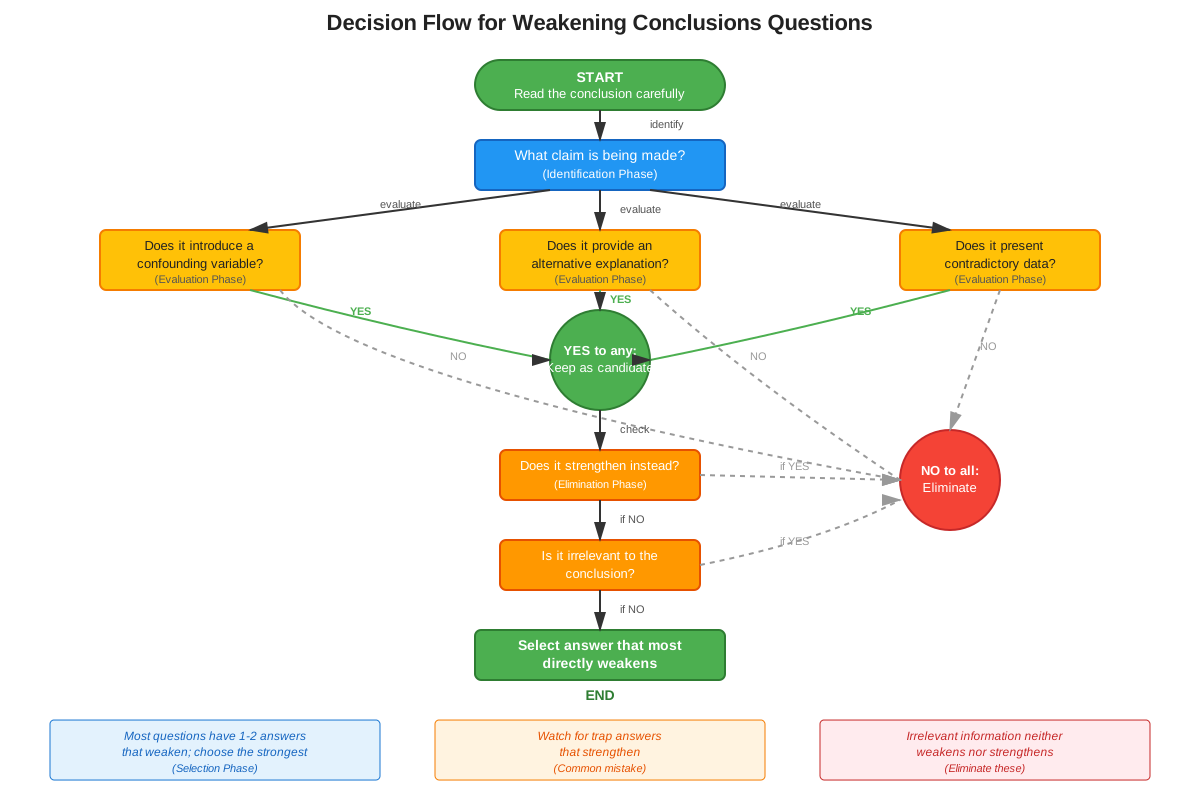
Step-by-Step Approach
- Read the conclusion carefully: Know exactly what claim you're trying to weaken. Don't weaken a different conclusion than the one asked about.
- Identify the evidence-conclusion link: Understand why the researchers believe their conclusion follows from their evidence.
- Predict weakening categories: Before reading answer choices, think "What type of information would weaken this? A confounding variable? Contradictory data? A sampling problem?"
- Evaluate each answer choice: Ask "Does this create reasonable doubt about the conclusion?" If yes, it's likely correct. If no, eliminate it.
- Choose the strongest weakener: Sometimes multiple choices might slightly weaken a conclusion, but one will create the most significant doubt.
Process of Elimination Tips
Eliminate immediately:
- Choices that strengthen rather than weaken the conclusion
- Choices that are completely irrelevant to the conclusion
- Choices that simply restate information already in the passage
- Choices that describe normal variation or expected results
Keep for consideration:
- Choices that identify uncontrolled variables
- Choices that provide alternative explanations
- Choices that present contradictory data
- Choices that reveal methodological problems
Time Management
Weakening conclusions questions typically require 45-60 seconds to answer—slightly longer than simple data retrieval questions but shorter than complex calculation questions. Don't rush these questions, as they reward careful logical thinking. However, if you're stuck between two choices after 60 seconds, make your best guess and move on rather than spending 2+ minutes on a single question.
Exam Tip: If you're unsure between two answer choices, ask yourself: "Which one creates MORE doubt about the conclusion?" The stronger weakener is usually correct.
Memory Techniques
The CAVE Mnemonic
Remember the four main types of weakening evidence with CAVE:
- Confounding variables (uncontrolled factors)
- Alternative explanations (different causes for same results)
- Varying/contradictory data (results that don't match the conclusion)
- Experimental flaws (methodological problems)
When you see a weakening question, mentally run through CAVE to predict what type of answer you're looking for.
The "Reasonable Doubt" Visualization
Visualize the conclusion as a bridge connecting evidence to a claim. Weakening information is like removing support beams from the bridge—it makes the connection less stable and reliable. The more beams removed (the stronger the weakening evidence), the less confident you can be that the bridge will hold (that the conclusion is valid).
The "Alternative Story" Technique
When evaluating whether information weakens a conclusion, imagine telling two different stories about the results:
- Story 1: The researchers' conclusion (their explanation for the results)
- Story 2: An alternative explanation using the new information
If Story 2 is plausible and contradicts Story 1, the information weakens the conclusion.
The Question Flip
Remember: Weakening is the opposite of strengthening. If you're unsure whether information weakens a conclusion, ask yourself "Would the opposite of this information strengthen the conclusion?" If yes, then the original information weakens it.
Summary
Weakening conclusions is a high-yield ACT Science skill that requires students to identify information that undermines the validity or reliability of researchers' stated conclusions. The most common types of weakening evidence include confounding variables (uncontrolled factors that provide alternative explanations), contradictory data (observations that conflict with the conclusion), methodological flaws (experimental design problems), and scope limitations (evidence that the conclusion doesn't apply as broadly as claimed). To successfully answer weakening questions, students must first clearly identify the specific conclusion being tested, understand the logical connection between evidence and conclusion, and then evaluate whether new information breaks that logical connection by creating reasonable doubt. The key distinction is that weakening information must be logically relevant to the conclusion—not all new information weakens a conclusion, only information that undermines the evidence-conclusion relationship. Students should watch for trigger words like "weaken," "cast doubt," "undermine," and "contradict," and should use the CAVE mnemonic (Confounding variables, Alternative explanations, Varying data, Experimental flaws) to quickly categorize potential weakening evidence. Mastering this skill requires practice distinguishing between information that genuinely weakens conclusions versus information that is merely related but irrelevant to the conclusion's validity.
Key Takeaways
- Weakening conclusions means identifying information that creates reasonable doubt about whether a stated conclusion is valid or justified by the evidence
- Confounding variables (uncontrolled factors) are the most frequently tested type of weakening evidence on the ACT Science section
- Information only weakens a conclusion if it logically undermines the connection between evidence and conclusion—related but irrelevant information doesn't weaken anything
- The four main categories of weakening evidence are: confounding variables, alternative explanations, contradictory data, and methodological flaws (remember: CAVE)
- Always identify the specific conclusion being tested before evaluating answer choices, as passages may contain multiple conclusions
- Weakening doesn't mean proving false—it means reducing confidence or creating doubt about the conclusion's validity
- Watch for trigger words like "weaken," "cast doubt," "undermine," "contradict," and "less valid" to identify these question types
Related Topics
Strengthening Conclusions: The mirror skill to weakening conclusions, where students identify information that makes conclusions more reliable and valid. Mastering weakening conclusions makes strengthening conclusions much easier to understand.
Experimental Design and Controls: Understanding proper experimental design is essential for recognizing when lack of controls or methodological flaws weaken conclusions. This topic provides the foundation for weakening conclusions skills.
Conflicting Viewpoints Passages: These ACT Science passages require evaluating the strength of different scientists' arguments, which builds directly on the ability to identify weakening and strengthening evidence.
Identifying Variables: Recognizing independent, dependent, and confounding variables is crucial for understanding how uncontrolled factors can weaken conclusions about cause-and-effect relationships.
Data Interpretation and Analysis: The ability to recognize when new data contradicts existing conclusions requires strong data interpretation skills, making this a natural progression from weakening conclusions mastery.
Practice CTA
Now that you've mastered the core concepts of weakening conclusions, it's time to put your knowledge into action! Complete the practice questions to test your ability to identify weakening evidence in realistic ACT Science scenarios. The flashcards will help you memorize the key categories of weakening evidence and trigger words that signal these questions. Remember, weakening conclusions questions are high-yield and appear frequently on the ACT—investing time in practice now will directly improve your Science score. You've built a strong foundation with this guide; now reinforce it through active practice and watch your confidence soar!
Sign up free to keep reading
Create a free AnvayaPrep account to finish this ACT guide on Weakening conclusions — plus flashcards and practice questions.