Overview
The ACT science elimination strategy is a systematic approach to answering multiple-choice questions on the ACT Science test by strategically removing incorrect answer choices to increase the probability of selecting the correct response. Unlike content-heavy science exams that require extensive memorization of facts, the ACT Science section primarily tests scientific reasoning, data interpretation, and analytical skills. The elimination strategy becomes particularly powerful on this test because wrong answers often contain specific, identifiable flaws—such as contradicting presented data, making unsupported logical leaps, or misrepresenting relationships shown in graphs and tables.
This strategic approach is essential for the ACT because it transforms uncertainty into opportunity. When students cannot immediately identify the correct answer, the act science elimination strategy provides a reliable framework for systematically narrowing options and making educated selections. This method is especially valuable given the time constraints of the ACT Science section, where students have approximately 52 seconds per question across 40 questions in 35 minutes. Rather than spending excessive time trying to prove which answer is correct, elimination allows students to efficiently identify and remove obviously incorrect options, often leaving only one viable choice.
The elimination strategy connects fundamentally to all other ACT Science skills, including data interpretation, experimental design analysis, and conflicting viewpoints evaluation. It serves as the tactical execution layer that applies to every question type—whether analyzing research summaries, interpreting data representation passages, or evaluating conflicting scientific perspectives. Mastering this strategy creates a safety net that improves performance even when content knowledge is incomplete or time pressure increases, making it one of the highest-yield skills for score improvement across all ACT Science question formats.
Learning Objectives
- [ ] Identify when ACT science elimination strategy is being tested
- [ ] Explain the core rule or strategy behind ACT science elimination strategy
- [ ] Apply ACT science elimination strategy to ACT-style questions accurately
- [ ] Recognize the five most common types of incorrect answer choices in ACT Science questions
- [ ] Execute a systematic four-step elimination process within 30-45 seconds per question
- [ ] Distinguish between answers that are factually wrong versus answers that are irrelevant to the specific question asked
- [ ] Combine elimination strategy with data interpretation skills to achieve 90%+ accuracy on medium-difficulty questions
Prerequisites
- Basic graph reading skills: Understanding axes, scales, trends, and data points is essential because elimination often requires comparing answer choices against visual data representations
- Fundamental scientific vocabulary: Familiarity with common terms (independent/dependent variables, control groups, hypotheses) enables quick recognition of answer choice errors
- Multiple-choice test-taking experience: General awareness of how standardized tests construct wrong answers provides context for ACT-specific elimination patterns
- Time management fundamentals: Ability to pace through questions systematically ensures elimination strategy can be applied without rushing or overthinking
Why This Topic Matters
The act act science elimination strategy represents one of the most practical and immediately applicable skills for ACT test-takers. In real-world scientific practice, researchers constantly evaluate competing hypotheses and eliminate explanations that contradict experimental evidence—exactly the skill this strategy develops. Beyond test preparation, this systematic approach to evaluating multiple options and identifying logical flaws transfers to critical thinking in academic research, medical diagnosis, engineering troubleshooting, and data-driven decision-making across professional fields.
On the ACT Science test specifically, elimination strategy appears in 100% of questions because every question presents four answer choices. Statistical analysis of ACT Science sections reveals that approximately 60-70% of questions can be answered correctly through elimination alone, even without complete understanding of the underlying scientific content. The strategy proves particularly valuable for three question types that appear with high frequency: data interpretation questions (45-50% of the test), research summary questions (30-35%), and conflicting viewpoints questions (15-20%). In each format, wrong answers exhibit predictable patterns that trained students can identify rapidly.
Common manifestations include questions asking students to identify trends in data (where wrong answers misstate the direction or magnitude of change), questions about experimental design (where wrong answers confuse variables or misidentify controls), and questions requiring inference from multiple data sources (where wrong answers overgeneralize or contradict specific data points). The elimination strategy transforms these challenging question types into manageable tasks by providing a systematic framework that works regardless of the specific scientific content being tested.
Core Concepts
The Fundamental Principle of Strategic Elimination
The ACT science elimination strategy operates on a core principle: wrong answers on the ACT Science test are not randomly generated but rather systematically constructed to include specific, identifiable flaws. Test developers create incorrect options (called "distractors") that appeal to students who make predictable errors—misreading data, confusing cause and effect, overgeneralizing from limited information, or selecting answers that sound scientific but don't address the actual question. By understanding these patterns, students can actively hunt for these flaws rather than passively evaluating each answer as potentially correct.
This approach differs fundamentally from guessing. Random guessing provides a 25% success rate on four-option questions, while systematic elimination that removes even one clearly wrong answer increases success probability to 33%, removing two wrong answers yields 50%, and eliminating three wrong answers guarantees 100% accuracy. The strategy leverages the ACT's predictable construction patterns to shift odds dramatically in the student's favor.
The Four-Step Elimination Process
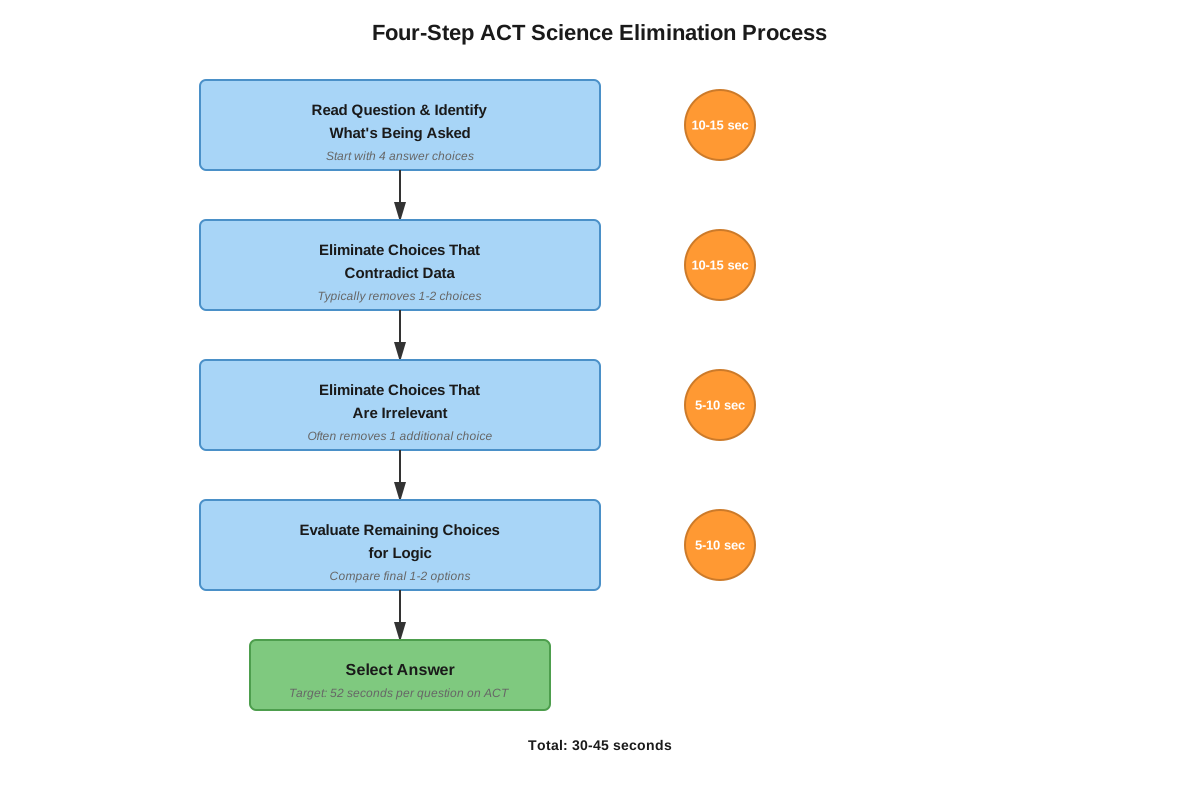
Effective elimination follows a systematic sequence that maximizes efficiency while minimizing errors:
- Read the question stem carefully and identify what is specifically being asked: Before examining answer choices, determine whether the question asks about a trend, a specific data point, a relationship between variables, an experimental design element, or a scientific explanation. This focus prevents the common error of selecting answers that are factually true but irrelevant to the specific question.
- Scan all four answer choices quickly to identify obvious outliers: Look for answers that immediately contradict presented data, use extreme language ("always," "never," "only"), or reference information not present in the passage. These can often be eliminated in 5-10 seconds.
- Compare remaining answers against the passage systematically: For each surviving answer choice, locate the specific data, figure, or text that would support or refute it. Eliminate answers that require assumptions not supported by the passage or that contradict any presented information.
- Select the answer that is most directly supported by the passage: Among remaining options, choose the one that requires the fewest logical leaps and is most explicitly supported by the data or text provided.
Five Categories of Wrong Answers
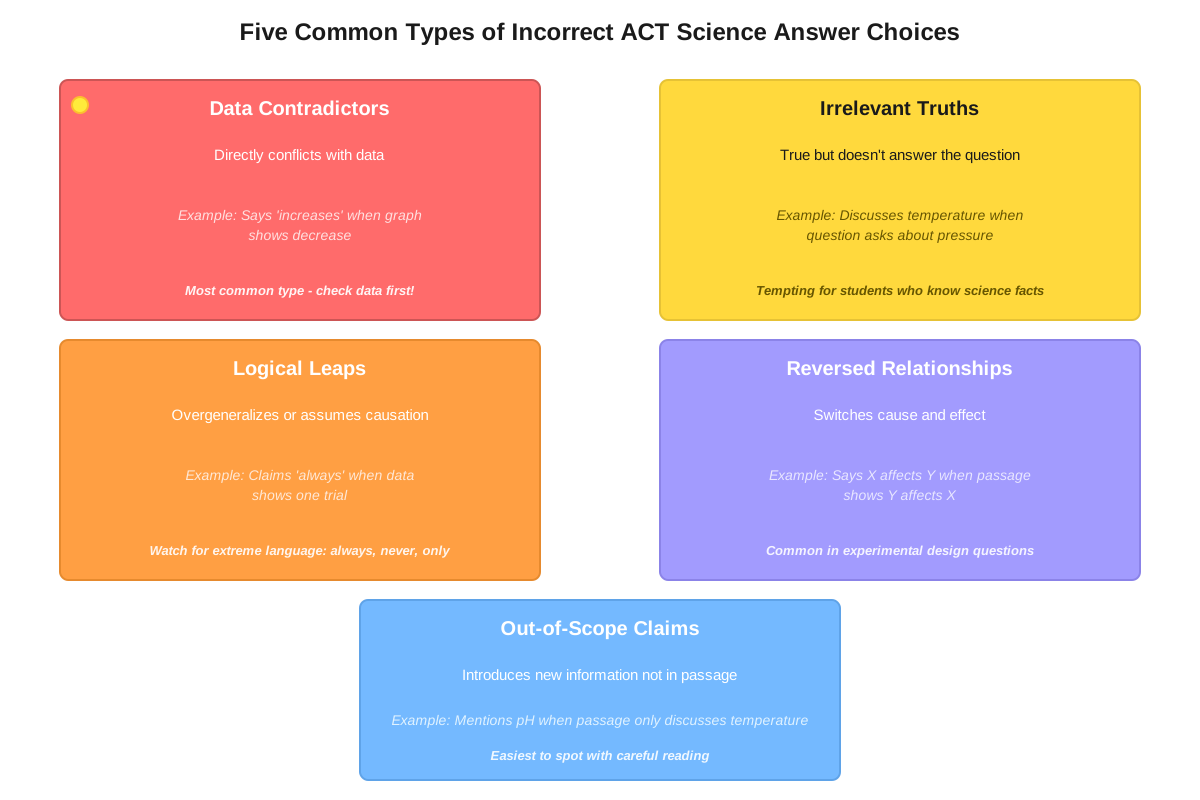
Understanding the types of incorrect answers helps students recognize them rapidly:
| Wrong Answer Type | Characteristics | Example Context |
|---|---|---|
| Data Contradictors | Directly contradict information shown in graphs, tables, or text | States temperature increased when graph shows decrease |
| Scope Violators | Make claims beyond what the data can support; overgeneralize | Concludes about all mammals when study examined only mice |
| Irrelevant Truths | Contain factually accurate information that doesn't answer the question | Provides correct definition when question asks about experimental results |
| Relationship Reversers | Confuse cause and effect or invert correlations | States X causes Y when passage shows Y causes X |
| Extreme Language Users | Include absolute terms that are rarely supported by scientific data | Uses "always," "never," "impossible," "only," "must" |
Recognizing Data Contradictors
Data contradictors represent the most common and easiest-to-identify wrong answers. These options make claims that directly oppose information presented in the passage. On graph-based questions, this might mean stating that a variable increased when the graph clearly shows it decreased, or claiming the highest value occurred at one point when the data shows it occurred elsewhere. In table-based questions, data contradictors might reverse numerical relationships or misstate which experimental condition produced which result.
The key to identifying data contradictors is developing the habit of immediately checking answer choices against the source data. When an answer makes a claim about a trend, relationship, or specific value, students should locate that information in the passage and verify whether the answer accurately represents it. Data contradictors can typically be eliminated in 10-15 seconds once this verification habit is established.
Identifying Scope Violators
Scope violators make claims that extend beyond what the experimental data or passage information can legitimately support. These answers are particularly tricky because they often contain information that seems logical or scientifically plausible—but the ACT Science test specifically requires answers to be supported by the passage, not by outside knowledge or reasonable assumptions.
Common scope violations include: generalizing from a specific sample to a broader population (concluding about all plants when the study examined only ferns), extending conclusions beyond the tested range (predicting what happens at 100°C when experiments only tested up to 50°C), or making causal claims when data only shows correlation. Recognizing scope violators requires asking: "Does the passage actually provide evidence for this specific claim, or am I filling in gaps with assumptions?"
Spotting Irrelevant Truths
Irrelevant truths are perhaps the most sophisticated distractors because they contain accurate information—just not information that answers the question being asked. These answers exploit students' tendency to select options that "sound right" or contain familiar scientific facts without carefully checking whether those facts address the specific question.
For example, if a question asks "According to Figure 2, what happened to oxygen levels between hours 2 and 4?" an irrelevant truth might state "Oxygen is necessary for cellular respiration"—a true statement, but one that doesn't answer what the figure shows about oxygen levels during that time period. Avoiding irrelevant truths requires strict discipline: after reading each answer choice, explicitly ask "Does this directly answer the question that was asked?"
Understanding Relationship Reversers
Relationship reversers confuse the direction of causation, correlation, or logical relationships presented in the passage. These wrong answers are especially common in experimental design questions and conflicting viewpoints passages where understanding the relationship between variables is crucial.
Examples include: stating that the independent variable depends on the dependent variable (reversing cause and effect), claiming that increasing X decreases Y when data shows increasing X increases Y (inverting correlation direction), or attributing an effect to the wrong cause when multiple variables are present. Identifying relationship reversers requires careful attention to which variable is manipulated and which responds, and to the direction of any trends shown in data.
Recognizing Extreme Language
Extreme language users employ absolute terms that scientific data rarely supports. Words like "always," "never," "impossible," "only," "must," "cannot," and "exclusively" should trigger immediate scrutiny. Scientific experiments typically show trends and patterns rather than absolute universal laws, and the ACT Science passages reflect this reality.
While extreme language doesn't automatically make an answer wrong—occasionally the data does support an absolute claim—it serves as a red flag that demands verification. Students should check whether the passage explicitly supports such strong language or whether a more moderate answer choice (using terms like "generally," "typically," "often," "suggests") better reflects the data's implications.
Concept Relationships
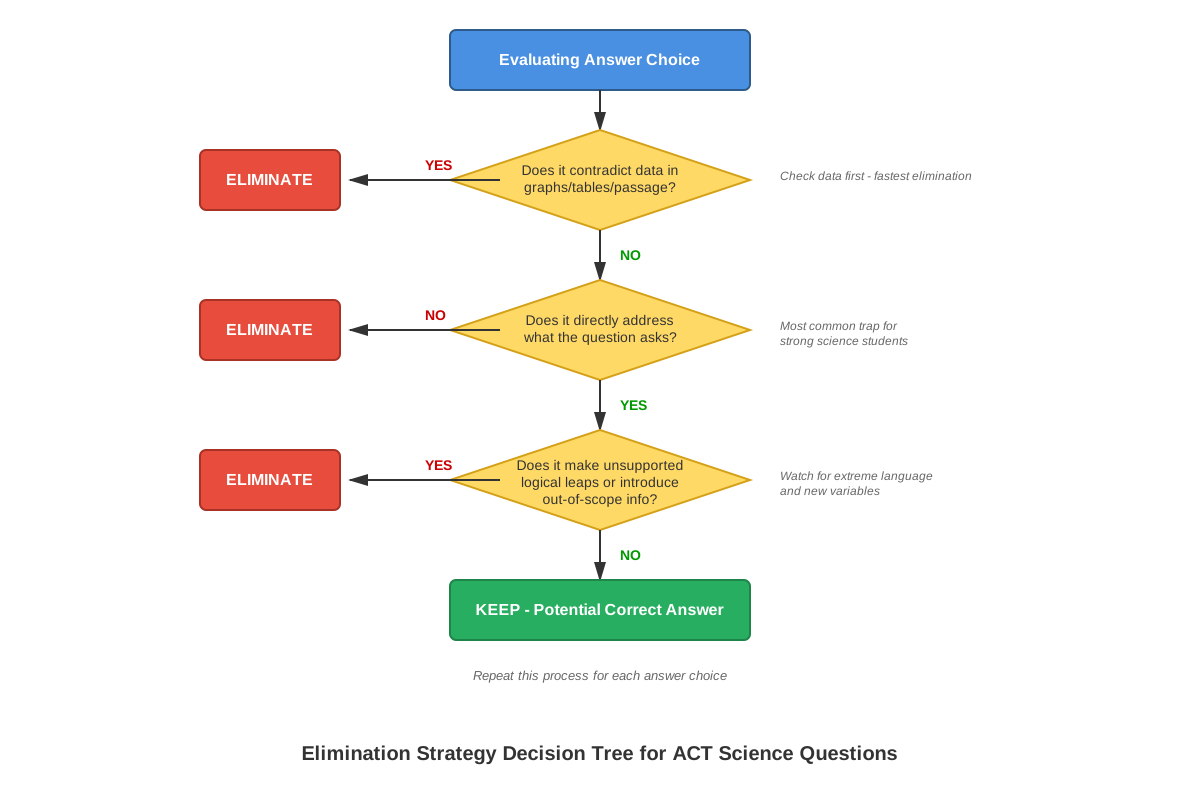
The elimination strategy concepts form an interconnected system where each element reinforces the others. The four-step elimination process serves as the overarching framework, while the five categories of wrong answers provide the specific patterns to identify during steps 2 and 3 of that process. Understanding data contradictors and scope violators proves most valuable during the initial quick scan (step 2), as these often represent the most obvious wrong answers. Irrelevant truths and relationship reversers typically require the more careful comparison of step 3, while extreme language serves as a warning flag throughout the entire process.
This topic connects directly to prerequisite skills: graph reading ability enables identification of data contradictors, scientific vocabulary knowledge helps spot relationship reversers, and general test-taking experience provides context for recognizing irrelevant truths. The elimination strategy then feeds forward into all other ACT Science skills—it's the tactical execution method applied when interpreting data representations, analyzing experimental designs, or evaluating conflicting scientific viewpoints.
The relationship map flows as follows: Question stem analysis → identifies what to look for → Quick scan for obvious errors → removes 1-2 wrong answers → Systematic comparison against passage → removes additional wrong answers → Selection of best-supported answer → yields correct response. Each wrong answer category (data contradictors, scope violators, irrelevant truths, relationship reversers, extreme language) can be identified at various stages of this process, with some more apparent during initial scanning and others requiring deeper analysis.
High-Yield Facts
⭐ The ACT Science test can be answered primarily through elimination strategy rather than extensive content knowledge—approximately 60-70% of questions yield to systematic elimination alone.
⭐ Data contradictors (answers that directly oppose presented information) represent the most common type of wrong answer and should be eliminated first.
⭐ Answers containing extreme language ("always," "never," "only," "must") require explicit verification against the passage and are wrong more often than they are correct.
⭐ Irrelevant truths—factually accurate statements that don't answer the specific question—are designed to trap students who don't carefully read the question stem.
⭐ Scope violators make claims beyond what the data supports; the ACT requires answers to be explicitly supported by the passage, not by outside knowledge or logical assumptions.
- Wrong answers on the ACT Science test follow predictable patterns that can be learned and recognized rapidly with practice.
- Eliminating even one obviously wrong answer increases success probability from 25% to 33%—a 32% improvement in odds.
- The four-step elimination process (read question carefully, quick scan for outliers, systematic comparison, select best-supported answer) should take 30-45 seconds per question.
- Relationship reversers confuse cause and effect or invert correlations, appearing most frequently in experimental design and conflicting viewpoints questions.
- The elimination strategy works across all three ACT Science passage types: data representation, research summaries, and conflicting viewpoints.
- Students should verify answer choices against the passage rather than relying on what "sounds right" based on outside scientific knowledge.
- Time invested in carefully reading the question stem (5-10 seconds) prevents the error of selecting irrelevant truths and improves overall efficiency.
Quick check — test yourself on ACT science elimination strategy so far.
Try Flashcards →Common Misconceptions
Misconception: The elimination strategy is just guessing with extra steps. → Correction: Strategic elimination is fundamentally different from guessing because it uses systematic analysis of answer choice patterns to identify specific flaws, increasing success rates from 25% (random guessing) to 50-100% depending on how many wrong answers can be confidently eliminated.
Misconception: If an answer choice contains true scientific information, it must be correct. → Correction: Irrelevant truths are a common wrong answer type on the ACT Science test; an answer can be factually accurate but still wrong if it doesn't address the specific question being asked. Always verify that the answer directly responds to the question stem.
Misconception: Elimination strategy only works when you don't know the answer. → Correction: Even when confident about the correct answer, using elimination as a verification tool helps catch careless errors and confirms the selection by identifying why the other three options are wrong, increasing overall accuracy.
Misconception: You should spend equal time considering all four answer choices. → Correction: Efficient elimination involves quickly scanning for obvious wrong answers first (data contradictors, extreme language, scope violators), then spending more time comparing only the remaining viable options, which saves significant time across the entire test.
Misconception: Outside scientific knowledge should guide answer selection when the passage is unclear. → Correction: The ACT Science test explicitly requires answers to be supported by the passage provided; using outside knowledge often leads to selecting scope violators or irrelevant truths. When uncertain, always choose the answer most directly supported by the passage data, even if outside knowledge suggests a different conclusion.
Misconception: Extreme language ("always," "never") automatically makes an answer wrong. → Correction: While extreme language serves as a red flag requiring verification, occasionally the passage data does support absolute claims. The key is to check whether the passage explicitly supports such strong language rather than automatically eliminating these answers.
Misconception: The longest or most detailed answer is usually correct. → Correction: The ACT does not follow predictable length patterns for correct answers; both correct and incorrect answers vary in length. Selecting based on length rather than content analysis leads to falling for irrelevant truths, which are often detailed but don't answer the question.
Worked Examples
Example 1: Data Interpretation with Elimination Strategy
Passage Context: A graph shows the relationship between temperature (x-axis, 0-100°C) and enzyme activity (y-axis, 0-100 units). The curve rises from 0°C to a peak at 40°C (90 units of activity), then decreases to near zero at 80°C.
Question: According to the graph, what happens to enzyme activity as temperature increases from 40°C to 80°C?
Answer Choices:
- A) Enzyme activity increases steadily
- B) Enzyme activity remains constant at maximum levels
- C) Enzyme activity decreases
- D) Enzyme activity is impossible to measure at these temperatures
Elimination Process:
Step 1 - Read question carefully: The question asks specifically about the trend between 40°C and 80°C, not the entire temperature range.
Step 2 - Quick scan for obvious errors:
- Choice A states activity "increases steadily" but the graph clearly shows a decrease in this range—this is a data contradictor. Eliminate immediately.
- Choice D uses extreme language ("impossible") and makes a claim not supported by the graph, which shows measurable activity throughout this range—this is a scope violator with extreme language. Eliminate.
Step 3 - Systematic comparison of remaining choices:
- Choice B claims activity "remains constant at maximum levels." Checking the graph: at 40°C activity is at maximum (90 units), but by 80°C it has dropped to near zero. This contradicts "remains constant"—another data contradictor. Eliminate.
- Choice C states activity "decreases." Checking the graph: at 40°C activity is 90 units, at 60°C it's approximately 60 units, at 80°C it's near zero. This accurately describes the trend shown.
Step 4 - Select best-supported answer: Choice C is the only option that accurately reflects the data shown in the graph.
Answer: C
Learning objective connection: This example demonstrates identifying data contradictors (A, B), recognizing extreme language and scope violators (D), and applying the four-step process to arrive at the correct answer through systematic elimination.
Example 2: Experimental Design with Relationship Reversers
Passage Context: An experiment examines whether fertilizer amount affects plant growth. Scientists plant 20 identical seeds, divide them into 4 groups of 5, and give each group different fertilizer amounts (0g, 5g, 10g, 15g). After 30 days, they measure plant height. Results show: 0g = 10cm average height, 5g = 15cm, 10g = 22cm, 15g = 18cm.
Question: Based on the experimental design, which statement is best supported?
Answer Choices:
- A) Plant height determines the optimal fertilizer amount needed
- B) Fertilizer amount affects plant growth, with 10g producing the greatest height
- C) All plants require exactly 10g of fertilizer to survive
- D) Temperature was the independent variable in this experiment
Elimination Process:
Step 1 - Read question carefully: The question asks what is "best supported" by the experimental design and results—must be directly supported by the passage.
Step 2 - Quick scan for obvious errors:
- Choice C uses extreme language ("all plants," "exactly," "require") and makes a claim far beyond what the data shows—this is a scope violator with extreme language. The experiment only tested these specific conditions with these specific plants. Eliminate.
- Choice D states temperature was the independent variable, but the passage clearly identifies fertilizer amount as what was manipulated—this is a data contradictor about experimental design. Eliminate.
Step 3 - Systematic comparison of remaining choices:
- Choice A states "plant height determines the optimal fertilizer amount." This is a relationship reverser—it confuses cause and effect. In this experiment, fertilizer amount (independent variable) was manipulated to observe its effect on plant height (dependent variable), not the reverse. Eliminate.
- Choice B states "fertilizer amount affects plant growth, with 10g producing the greatest height." This correctly identifies the causal relationship (fertilizer affects growth, not growth affects fertilizer) and accurately reports that 10g produced the greatest height (22cm) according to the data.
Step 4 - Select best-supported answer: Choice B correctly describes both the experimental relationship and the specific results.
Answer: B
Learning objective connection: This example demonstrates identifying relationship reversers (A), recognizing scope violators with extreme language (C), spotting data contradictors about experimental design (D), and applying elimination strategy to experimental design questions.
Exam Strategy
Approaching ACT Science Questions with Elimination
Begin every question by investing 5-10 seconds in carefully reading the question stem, identifying exactly what is being asked. This small time investment prevents the costly error of selecting irrelevant truths—answers that sound correct but don't address the specific question. Underline or mentally note key words in the question: "according to Figure 2," "between hours 3 and 5," "Student 1's hypothesis," or "the independent variable."
After reading the question, perform a rapid 10-second scan of all four answer choices before diving into detailed analysis. This scan identifies obvious wrong answers—particularly data contradictors and extreme language users—that can be eliminated immediately. Mark these eliminated choices with a small "X" or strikethrough in your test booklet to avoid reconsidering them.
Trigger Words and Phrases
Certain words and phrases should trigger immediate verification:
Extreme language triggers: "always," "never," "only," "must," "cannot," "impossible," "exclusively," "all," "none," "every" → Verify that the passage explicitly supports such absolute claims.
Scope expansion triggers: "proves," "demonstrates conclusively," "in all cases," "for every," "universally" → Check whether the data actually supports such broad conclusions or if the answer is overgeneralizing.
Causation triggers: "causes," "results in," "leads to," "produces," "is responsible for" → Verify the direction of causation and ensure the passage supports a causal (not just correlational) relationship.
Comparison triggers: "more than," "less than," "higher," "lower," "increased," "decreased" → Locate the specific data points being compared and verify the direction and magnitude of the relationship.
Process-of-Elimination Tips Specific to ACT Science
For data interpretation questions: Always check answer choices against the actual data source (graph, table, diagram). Data contradictors are the most common wrong answers in this question type. If an answer makes a claim about a trend or value, locate that information in the figure and verify accuracy before considering other factors.
For experimental design questions: Identify the independent variable (what scientists manipulated), dependent variable (what they measured), and control conditions (what they kept constant). Wrong answers frequently confuse these elements or reverse cause-and-effect relationships. Eliminate any answer that misidentifies these components.
For conflicting viewpoints questions: Track which scientist or student holds which position. Wrong answers often attribute a viewpoint to the wrong person or make claims that neither perspective supports. Eliminate answers that misattribute positions or require assumptions beyond what each viewpoint explicitly states.
Time Allocation Advice
Allocate approximately 45-50 seconds per question, distributed as follows:
- 5-10 seconds: Read and understand the question stem
- 10-15 seconds: Quick scan and eliminate obvious wrong answers
- 15-20 seconds: Systematic comparison of remaining answers against passage
- 5-10 seconds: Final selection and verification
If you can eliminate two wrong answers quickly but struggle to choose between the remaining two, invest an additional 15-20 seconds in careful comparison rather than guessing. However, if after one minute you remain uncertain, make your best selection and move forward—spending excessive time on one question jeopardizes performance on others.
Exam Tip: On your first pass through a passage, answer all questions where you can eliminate at least two wrong answers confidently. Mark questions where you're completely uncertain and return to them after completing the entire section. This ensures you capture all "easier" points before investing time in the most challenging questions.
Memory Techniques
The "DRIES" Mnemonic for Wrong Answer Types
Remember the five categories of wrong answers with DRIES:
- Data contradictors
- Relationship reversers
- Irrelevant truths
- Extreme language
- Scope violators
Visualize your wrong answers "drying up" and disappearing as you eliminate them using these five categories.
The "SCAN" Process for Elimination
Remember the four-step elimination process with SCAN:
- Stem: Read the question stem carefully
- Catch: Catch obvious wrong answers in a quick scan
- Analyze: Analyze remaining answers against the passage
- Narrow: Narrow to the best-supported answer
Visualization Strategy: The Elimination Funnel
Visualize a funnel with four answer choices entering at the top. As you apply elimination strategy, wrong answers get filtered out at different levels:
- Level 1 (Quick Scan): Data contradictors and extreme language users fall out
- Level 2 (Systematic Analysis): Scope violators and relationship reversers fall out
- Level 3 (Final Selection): Irrelevant truths fall out
- Bottom of Funnel: Only the correct, best-supported answer remains
This mental image reinforces the systematic, step-by-step nature of effective elimination.
The "Prove It" Technique
For each answer choice that survives initial elimination, mentally ask "Can I prove this with the passage?" If you cannot point to specific data, text, or figures that support the claim, the answer is likely a scope violator or irrelevant truth. This simple question prevents selecting answers that "sound right" but lack passage support.
Summary
The ACT science elimination strategy transforms the Science section from a content knowledge test into a systematic reasoning challenge. By understanding that wrong answers follow predictable patterns—data contradictors, relationship reversers, irrelevant truths, extreme language users, and scope violators—students can efficiently identify and eliminate incorrect options even when uncertain about the correct answer. The four-step process (read question stem carefully, quick scan for obvious errors, systematic comparison against passage, select best-supported answer) provides a reliable framework that works across all question types and passage formats. This strategy proves particularly powerful because it leverages the ACT's construction patterns: wrong answers are not random but rather systematically designed with specific flaws. Mastering elimination strategy doesn't replace scientific reasoning skills but rather provides the tactical execution method that applies those skills efficiently under time pressure. Students who internalize these patterns and practice the systematic process consistently achieve higher accuracy rates while completing questions more quickly, creating a compound advantage that significantly improves overall Science section scores.
Key Takeaways
- The elimination strategy increases success probability dramatically: removing just one wrong answer improves odds from 25% to 33%, while eliminating two wrong answers yields 50% success rate
- Data contradictors (answers that directly oppose presented information) are the most common and easiest-to-identify wrong answers—always verify claims against source data
- The four-step elimination process (read stem, quick scan, systematic comparison, select best answer) should take 30-45 seconds per question and works across all ACT Science question types
- Five predictable wrong answer categories exist: data contradictors, relationship reversers, irrelevant truths, extreme language users, and scope violators (remember: DRIES)
- Answers must be supported by the passage, not by outside knowledge—irrelevant truths and scope violators exploit the tendency to select what "sounds right" rather than what the passage actually supports
- Extreme language ("always," "never," "only") serves as a red flag requiring verification, as scientific data rarely supports absolute claims
- Investing 5-10 seconds in carefully reading the question stem prevents the costly error of selecting irrelevant truths that don't address what was actually asked
Related Topics
Data Interpretation Skills: Building on elimination strategy, advanced data interpretation focuses on extracting complex relationships from graphs, tables, and diagrams. Mastering elimination provides the foundation for efficiently analyzing multi-variable data sets and identifying subtle trends.
Experimental Design Analysis: Understanding how scientists structure experiments enables more sophisticated application of elimination strategy, particularly for identifying relationship reversers and scope violators in research summary passages.
Conflicting Viewpoints Evaluation: The elimination strategy applies powerfully to conflicting viewpoints passages, where wrong answers often misattribute positions or make unsupported claims about what each perspective implies.
Time Management and Pacing: Effective elimination strategy directly improves time management by providing a systematic process that prevents overthinking and enables confident, efficient decision-making across all 40 Science questions.
Scientific Reasoning Fundamentals: Deeper understanding of how scientific arguments are constructed enhances ability to identify logical flaws in wrong answers, particularly relationship reversers and scope violators.
Practice CTA
Now that you understand the systematic approach to elimination strategy, it's time to put these concepts into action. The practice questions and flashcards for this topic are specifically designed to help you recognize the five wrong answer types and execute the four-step elimination process under realistic time pressure. Each practice question includes detailed explanations showing how elimination strategy leads to the correct answer, reinforcing the patterns you've learned. Consistent practice with these materials will transform elimination from a conscious process into an automatic skill that you apply instinctively during the actual ACT. Start with the practice questions to build confidence, then use the flashcards to reinforce recognition of wrong answer patterns. Your investment in mastering this high-yield strategy will pay dividends across every passage and question type on test day!
Sign up free to keep reading
Create a free AnvayaPrep account to finish this ACT guide on ACT science elimination strategy — plus flashcards and practice questions.