Overview
Understanding cause and effect relationships is one of the most critical skills tested in the ACT Science section. This reasoning skill requires students to distinguish between variables that directly influence outcomes (causes) and the resulting changes or consequences (effects). The ACT frequently presents experimental data, research studies, and scientific observations where students must identify which factors lead to specific results, differentiate between correlation and causation, and predict outcomes based on established causal relationships.
The ability to analyze cause and effect is fundamental to scientific thinking and appears across all passage types in the ACT Science test—Data Representation, Research Summaries, and Conflicting Viewpoints. Questions may ask students to identify independent and dependent variables, determine which experimental changes produced specific results, or evaluate whether evidence supports a causal claim. This skill extends beyond simple identification; students must understand the logical chain connecting causes to their effects and recognize when multiple factors interact to produce outcomes.
Mastering cause and effect reasoning connects directly to broader scientific reasoning skills, including experimental design, hypothesis testing, and data interpretation. This topic serves as a foundation for understanding how scientists establish relationships between variables, control for confounding factors, and draw valid conclusions from evidence. Strong performance on cause and effect questions significantly impacts overall ACT Science scores, as these questions appear with high frequency and often determine whether students can accurately interpret complex experimental scenarios.
Learning Objectives
- [ ] Identify when cause and effect is being tested in ACT Science passages and questions
- [ ] Explain the core rule or strategy behind analyzing cause and effect relationships
- [ ] Apply cause and effect reasoning to ACT-style questions accurately
- [ ] Distinguish between correlation and causation in experimental data
- [ ] Recognize independent variables (causes) and dependent variables (effects) in scientific studies
- [ ] Evaluate whether experimental evidence supports a claimed causal relationship
- [ ] Predict outcomes based on established cause and effect patterns
Prerequisites
- Basic understanding of variables: Necessary to identify which factors are being manipulated (independent variables) and which are being measured (dependent variables)
- Graph and table interpretation: Required to extract data showing relationships between variables and identify trends
- Scientific method fundamentals: Essential for understanding how experiments are designed to test causal relationships
- Basic logic and reasoning: Needed to follow chains of causation and evaluate whether conclusions follow from evidence
Why This Topic Matters
In real-world science, establishing cause and effect relationships is fundamental to progress across all disciplines. Medical researchers must determine whether treatments cause improvements in patient outcomes, environmental scientists need to identify which pollutants cause ecosystem damage, and engineers must understand how design changes affect product performance. The ability to distinguish true causal relationships from mere coincidences or correlations prevents flawed conclusions and enables effective problem-solving.
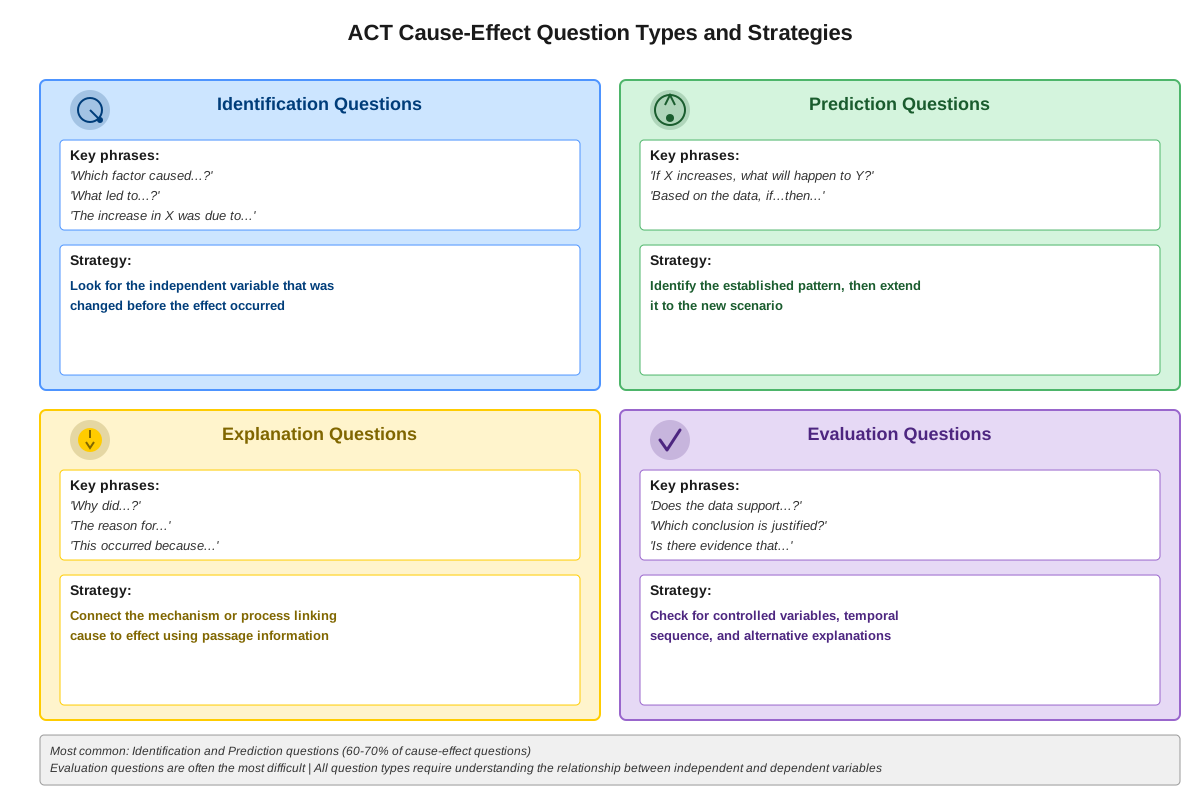
On the ACT Science test, cause and effect questions appear in approximately 25-35% of all passages, making this one of the highest-yield topics for score improvement. These questions typically appear 2-3 times per passage in Research Summaries (the most common passage type) and frequently in Data Representation passages. The ACT tests this skill through various question formats: direct identification questions ("Which factor caused the increase in...?"), prediction questions ("If X increases, what will happen to Y?"), and evaluation questions ("Does the data support the hypothesis that A causes B?").
Common manifestations in ACT passages include: experiments where one variable is systematically changed while others are controlled; studies comparing outcomes under different conditions; scenarios requiring students to trace effects back to their causes; and situations where students must distinguish between factors that directly cause changes versus factors that merely correlate with changes. Understanding cause and effect is particularly crucial for the Research Summaries passage type, which comprises 45-55% of the Science test and focuses heavily on experimental design and interpretation.
Core Concepts
Defining Cause and Effect Relationships
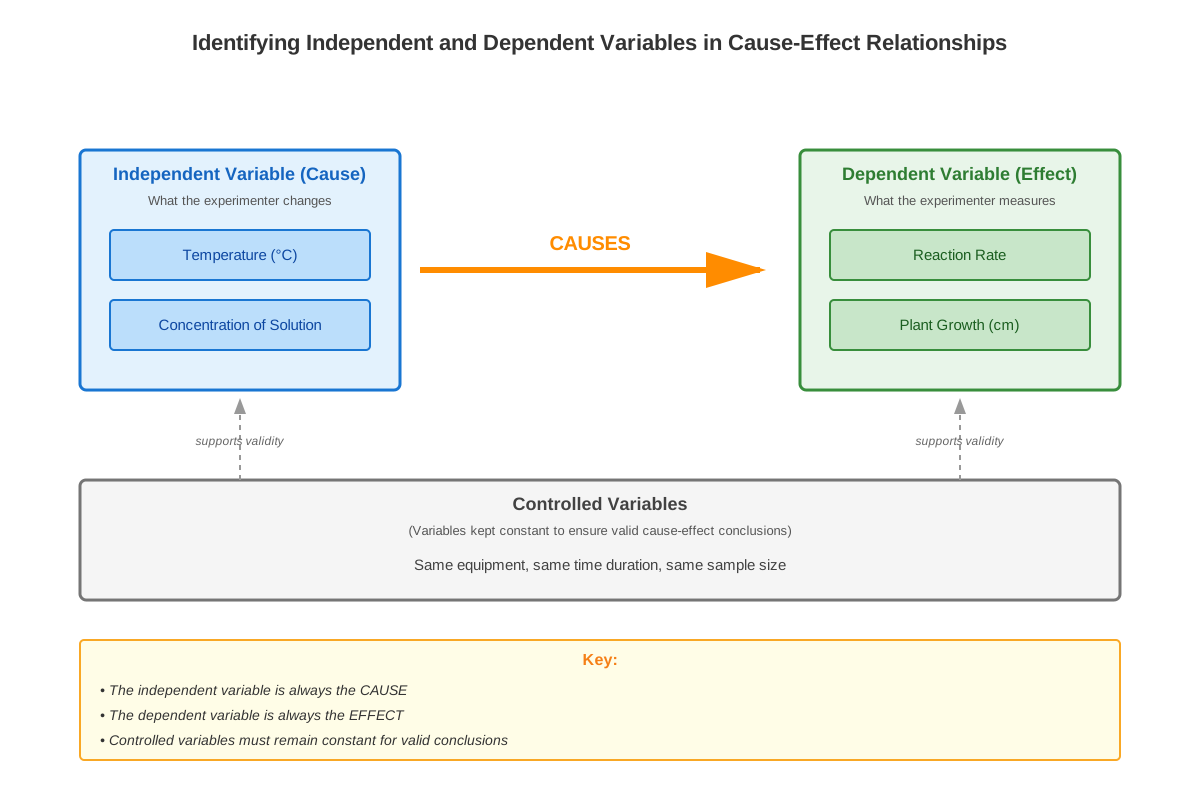
A cause and effect relationship exists when one event, condition, or variable (the cause) directly produces or influences another event, condition, or variable (the effect). In scientific contexts, the cause is typically the independent variable—the factor that researchers deliberately manipulate or that naturally varies—while the effect is the dependent variable—the outcome that researchers measure to see if it changes in response to the cause.
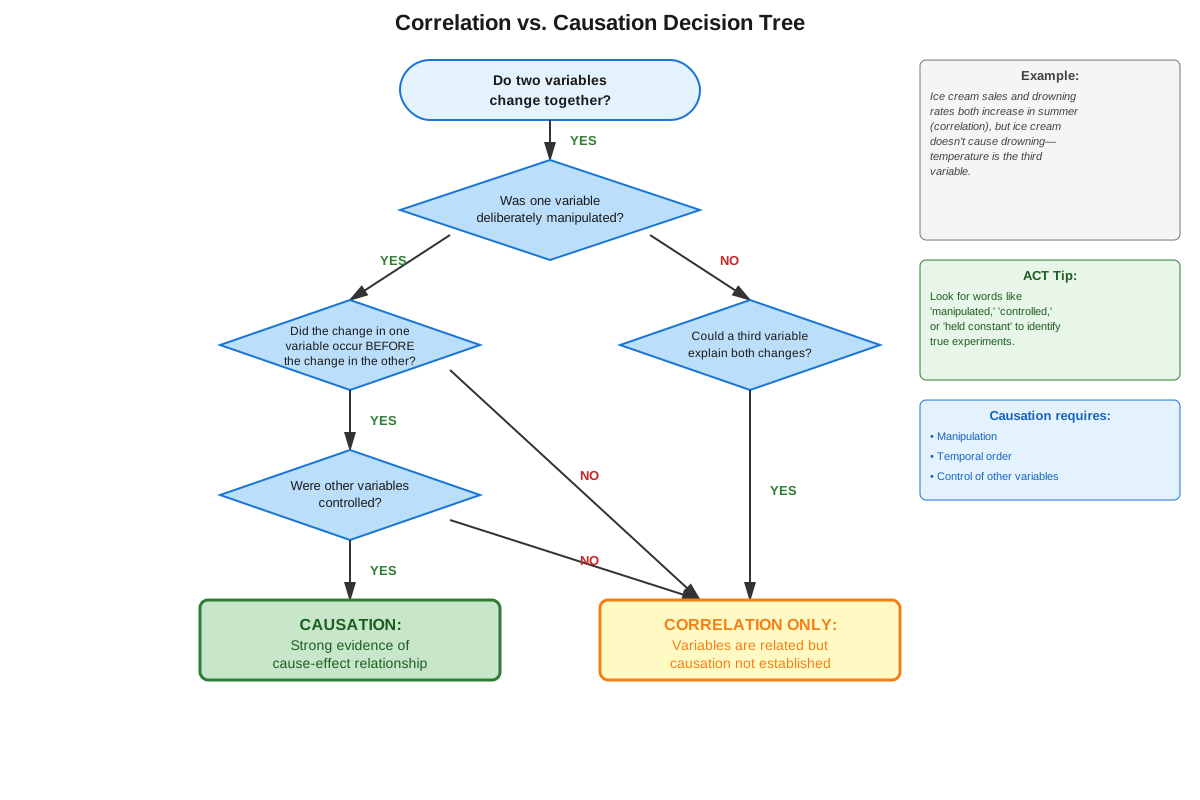
True causal relationships have three essential characteristics: temporal precedence (the cause must occur before the effect), covariation (changes in the cause must correspond with changes in the effect), and elimination of alternative explanations (other potential causes must be ruled out through experimental control). The ACT frequently tests whether students can verify these characteristics when evaluating scientific claims.
Independent and Dependent Variables
The independent variable represents the presumed cause in an experiment. Scientists manipulate this variable intentionally to observe its effects. For example, in a study testing how temperature affects plant growth, temperature is the independent variable because researchers control and vary it systematically. The ACT often asks students to identify which variable is being manipulated or changed across experimental trials.
The dependent variable represents the presumed effect—what scientists measure to determine the outcome. In the plant growth example, height or biomass would be dependent variables because they depend on the temperature conditions. ACT questions frequently require students to recognize which measurements represent effects and how they respond to changes in the independent variable.
| Variable Type | Role | Example in Experiment | ACT Question Clues |
|---|---|---|---|
| Independent | Cause (manipulated) | Temperature settings | "Which factor was varied?" |
| Dependent | Effect (measured) | Plant growth rate | "What was measured?" |
| Controlled | Kept constant | Water, light, soil type | "Which factors remained the same?" |
Correlation vs. Causation
One of the most critical distinctions in scientific reasoning is between correlation (two variables changing together) and causation (one variable directly causing changes in another). Two variables can be strongly correlated without having a causal relationship. The ACT frequently includes questions that require students to recognize this distinction.
Correlation exists when two variables show a statistical relationship—as one increases, the other tends to increase (positive correlation) or decrease (negative correlation). However, correlation alone does not prove causation. Three scenarios can produce correlation without causation: coincidence (random chance), confounding variables (a third factor causes both observed variables), or reverse causation (the presumed effect actually causes the presumed cause).
To establish causation, scientists use controlled experiments where they manipulate only the independent variable while holding all other factors constant. The ACT rewards students who recognize when experimental design supports causal claims versus when data only shows correlation. Key indicators of causation include: systematic manipulation of the independent variable, control groups for comparison, elimination of confounding variables, and consistent, reproducible results.
Direct and Indirect Effects
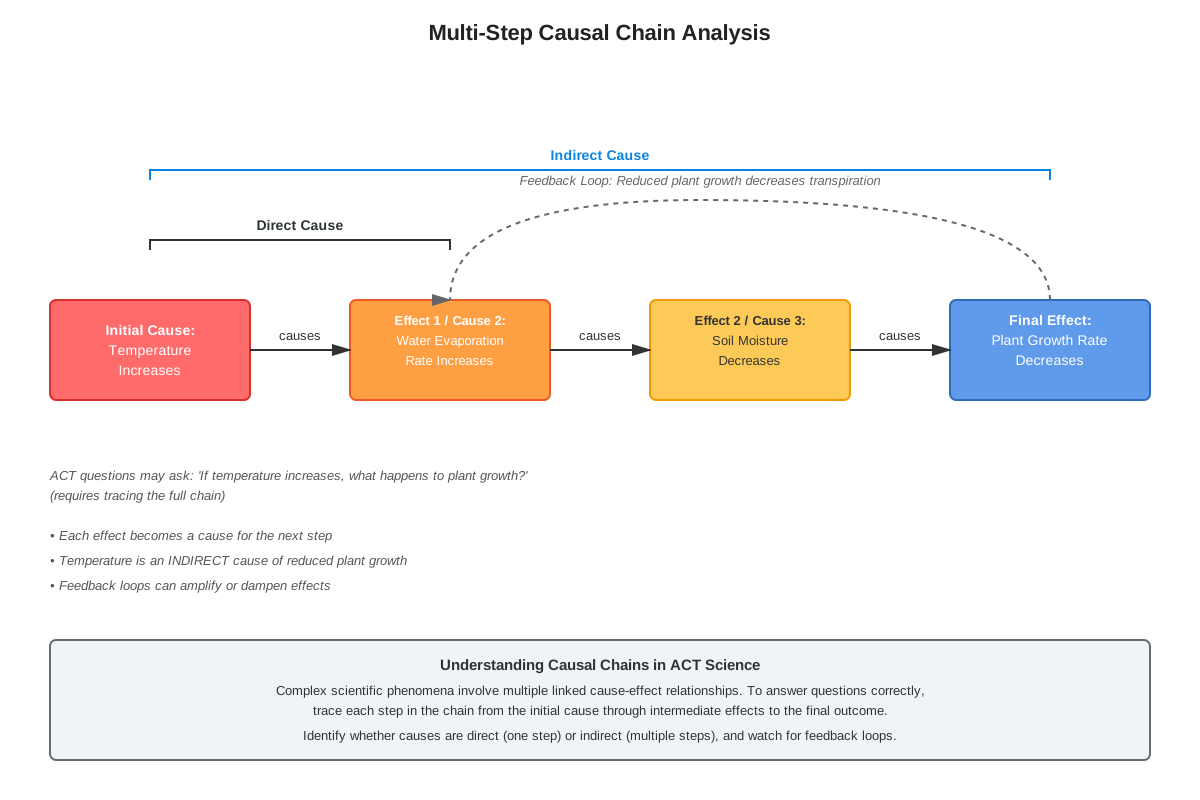
Direct effects occur when a cause immediately produces an effect without intermediate steps. For example, increasing the concentration of a reactant directly increases the reaction rate in many chemical reactions. Indirect effects involve a chain of causation where the initial cause produces an intermediate effect, which then causes the final outcome.
The ACT tests understanding of causal chains, where students must trace effects through multiple steps. For instance, increased carbon dioxide (cause 1) leads to higher atmospheric temperature (effect 1/cause 2), which leads to ice melting (effect 2/cause 3), which leads to sea level rise (effect 3). Questions may ask students to identify any link in this chain or predict what happens if an intermediate step is altered.
Positive and Negative Causal Relationships
In a positive causal relationship, increases in the cause produce increases in the effect (or decreases produce decreases). For example, increasing fertilizer concentration causes increased plant growth, up to a certain point. In a negative causal relationship (also called inverse relationship), increases in the cause produce decreases in the effect. For example, increasing altitude causes decreased air pressure.
The ACT frequently presents graphs showing these relationships and asks students to describe or predict the causal connection. Students must recognize whether the relationship is positive (both variables move in the same direction) or negative (variables move in opposite directions) and whether the relationship is linear (constant rate of change) or nonlinear (changing rate of change).
Multiple Causes and Interaction Effects
Many real-world phenomena result from multiple causes acting simultaneously. The ACT often presents experiments where several factors influence an outcome, requiring students to determine which factors have the strongest effects or how factors interact. For example, plant growth depends on water, light, temperature, and nutrients—all acting as causes.
Interaction effects occur when the effect of one cause depends on the level of another cause. For instance, fertilizer might increase plant growth significantly in high-light conditions but have minimal effect in low-light conditions. ACT questions may present data tables showing results under different combinations of conditions and ask students to identify these interactions.
Concept Relationships
The core concepts within cause and effect reasoning form an interconnected framework. Understanding independent and dependent variables provides the foundation for identifying cause and effect relationships in any scientific context. This identification skill then enables students to distinguish between correlation and causation, a critical higher-order reasoning task. The relationship flows as: Variable Identification → Causal Relationship Recognition → Correlation vs. Causation Evaluation.
Direct and indirect effects build upon basic cause and effect understanding by adding complexity—students must trace causal chains rather than simple one-step relationships. This connects to multiple causes and interaction effects, where students analyze how several causal factors work together or influence each other's effects. The progression is: Simple Cause-Effect → Causal Chains → Multiple Interacting Causes.
The distinction between positive and negative causal relationships applies across all other concepts, serving as a descriptor of how causes and effects relate quantitatively. This connects directly to prerequisite knowledge of graph interpretation, as students must read trends to determine relationship direction.
All these concepts connect to the broader ACT Science skills of experimental design (understanding how experiments establish causation), data interpretation (reading evidence for causal relationships), and hypothesis evaluation (determining whether data supports causal claims). Mastering cause and effect reasoning enables progression to more complex topics like experimental design analysis and scientific argumentation.
High-Yield Facts
⭐ The independent variable is the cause (what is manipulated); the dependent variable is the effect (what is measured)
⭐ Correlation does not prove causation—two variables can change together without one causing the other
⭐ Controlled experiments are necessary to establish causation because they eliminate confounding variables
⭐ In a positive causal relationship, the cause and effect change in the same direction; in a negative relationship, they change in opposite directions
⭐ To establish causation, the cause must occur before the effect, and changes in the cause must consistently produce changes in the effect
- Multiple factors can act as causes for a single effect, requiring analysis of which factors have the strongest influence
- Indirect effects involve causal chains where one effect becomes the cause of another effect
- Interaction effects occur when the impact of one cause depends on the level of another cause
- Confounding variables are factors that affect both the presumed cause and effect, creating false appearance of causation
- Time-series data showing that changes in the cause precede changes in the effect provide strong evidence for causation
- Control groups (where the independent variable is not applied) help establish that observed effects result from the manipulated cause
- Dose-response relationships (where larger changes in the cause produce proportionally larger effects) strengthen causal claims
Quick check — test yourself on Cause and effect so far.
Try Flashcards →Common Misconceptions
Misconception: If two variables are correlated, one must cause the other → Correction: Correlation indicates a statistical relationship but does not prove causation. Both variables might be caused by a third factor, the relationship might be coincidental, or causation might run in the opposite direction from what is assumed. Only controlled experiments with proper controls can establish causation.
Misconception: The dependent variable causes changes in the independent variable → Correction: By definition, the independent variable (cause) influences the dependent variable (effect), not the reverse. The independent variable is what experimenters manipulate, while the dependent variable is what they measure as a result. Confusing these reverses the causal relationship.
Misconception: If A happens before B, then A must cause B → Correction: Temporal precedence (A occurring before B) is necessary for causation but not sufficient. Many events occur in sequence without causal connection. For example, a rooster crowing before sunrise doesn't cause the sun to rise. Additional evidence of covariation and elimination of alternative explanations is required.
Misconception: A single experiment showing a relationship proves causation → Correction: Establishing causation requires reproducible results across multiple trials or studies. A single experiment might show a relationship due to chance, measurement error, or uncontrolled variables. Scientific consensus on causation builds through repeated confirmation.
Misconception: All causes produce immediate, observable effects → Correction: Many causal relationships involve time delays or indirect pathways. For example, exposure to a carcinogen (cause) might not produce cancer (effect) for years. The ACT often tests understanding of delayed effects and causal chains where intermediate steps occur between initial cause and final effect.
Misconception: Stronger correlations always indicate stronger causal relationships → Correction: The strength of correlation (how closely two variables track together) is separate from whether a causal relationship exists. Two variables might have a strong correlation due to a confounding variable while having no direct causal connection. Conversely, a weak correlation might reflect a genuine but noisy causal relationship.
Worked Examples
Example 1: Identifying Cause and Effect in an Experiment
Passage Summary: Scientists investigated how light intensity affects the rate of photosynthesis in aquatic plants. They placed identical plants in five tanks with different light intensities (measured in lumens): 100, 200, 300, 400, and 500. All tanks had the same water temperature (25°C), pH (7.0), and carbon dioxide concentration. After 2 hours, they measured the oxygen production rate (mL/hour) as an indicator of photosynthesis rate.
Question: Based on the experimental design, which variable is the cause and which is the effect?
Solution Process:
Step 1: Identify what the experimenters manipulated. The passage states they "placed identical plants in five tanks with different light intensities." Light intensity is being deliberately varied across the five conditions (100, 200, 300, 400, 500 lumens).
Step 2: Identify what the experimenters measured as an outcome. The passage states "they measured the oxygen production rate." This is the outcome being observed to see if it changes.
Step 3: Identify what was held constant. Temperature, pH, and carbon dioxide concentration were kept the same across all tanks. These are controlled variables, not causes or effects in this experiment.
Step 4: Apply the definitions. The independent variable (cause) is what experimenters manipulate—light intensity. The dependent variable (effect) is what they measure—oxygen production rate.
Answer: Light intensity is the cause (independent variable), and oxygen production rate is the effect (dependent variable). The experiment tests whether changes in light intensity cause changes in photosynthesis rate.
Connection to Learning Objectives: This example demonstrates how to identify when cause and effect is being tested (Learning Objective 1) by recognizing the experimental structure of manipulated and measured variables. It applies the core strategy (Learning Objective 2) of distinguishing independent from dependent variables.
Example 2: Distinguishing Correlation from Causation
Passage Summary: A study examined data from 50 cities and found a strong positive correlation between ice cream sales and drowning deaths—cities with higher ice cream sales had more drowning deaths. A researcher concluded that eating ice cream causes drowning.
Question: Does the data support the conclusion that ice cream consumption causes drowning? Explain your reasoning.
Solution Process:
Step 1: Identify the claimed causal relationship. The researcher claims ice cream consumption (cause) leads to drowning deaths (effect).
Step 2: Evaluate whether the data shows correlation or causation. The passage states there is a "strong positive correlation"—the two variables change together. However, correlation alone does not prove causation.
Step 3: Consider alternative explanations. Both ice cream sales and drowning deaths could be caused by a third factor. Temperature is a likely confounding variable: hot weather increases ice cream sales (people want cold treats) and also increases swimming activity (people cool off in water), which increases drowning risk.
Step 4: Assess the experimental design. This is an observational study comparing cities, not a controlled experiment. No variables were manipulated, and confounding factors were not controlled. The study cannot establish causation.
Step 5: Evaluate biological plausibility. There is no plausible mechanism by which eating ice cream would cause drowning. This further suggests the correlation is coincidental or due to a confounding variable.
Answer: No, the data does not support a causal relationship. While ice cream sales and drowning deaths are correlated, this is likely due to a confounding variable (temperature/season) that causes both. The study design cannot establish causation because it lacks experimental manipulation and control of variables. Correlation does not prove causation.
Connection to Learning Objectives: This example applies cause and effect reasoning to evaluate a causal claim (Learning Objective 3), demonstrates the core strategy of distinguishing correlation from causation (Learning Objective 2), and shows how to evaluate whether evidence supports a causal relationship (Learning Objective 6).
Exam Strategy
Recognizing Cause and Effect Questions
ACT cause and effect questions use specific trigger words and phrases that signal the skill being tested. Watch for: "caused by," "resulted in," "led to," "produced," "affected," "influenced," "factor that," "reason for," "because," "due to," "as a result of," and "consequence of." Questions asking "Which variable was manipulated?" or "What was measured?" are testing variable identification, the foundation of cause and effect reasoning.
Questions may also ask about predictions: "If X increases, what will happen to Y?" or "Based on the results, what would occur if...?" These require understanding the established causal relationship and extending it to new situations. Evaluation questions like "Does the data support the hypothesis that A causes B?" test whether students can distinguish correlation from causation.
Systematic Approach to Cause and Effect Questions
- Identify the variables: Before reading answer choices, determine which factors are being discussed. Label them as independent (manipulated/cause), dependent (measured/effect), or controlled (held constant).
- Determine the relationship direction: Is it positive (both increase together) or negative (one increases while the other decreases)? Look at graphs, tables, or descriptions of results.
- Check for experimental control: Does the study manipulate variables in a controlled way, or does it merely observe correlations? Controlled experiments support causal claims; observational studies only show correlation.
- Trace causal chains: For complex scenarios, map out the sequence: Cause 1 → Effect 1 (which becomes Cause 2) → Effect 2, etc. The ACT often asks about intermediate steps.
- Eliminate answers that reverse causation: A common wrong answer type switches the cause and effect. If the passage shows X causes Y, eliminate answers suggesting Y causes X.
Process of Elimination Tips
Wrong answers in cause and effect questions typically fall into these categories:
- Reversed causation: Switches the independent and dependent variables
- Confounding variables: Identifies a controlled variable as the cause
- Correlation without causation: Claims causation based only on correlation
- Unrelated factors: Mentions variables not discussed in the passage
- Opposite relationship: States the relationship is positive when it's negative, or vice versa
Exam Tip: When a question asks what "caused" an observed result, immediately look for which variable was manipulated in the experiment. The manipulated variable is almost always the cause.
Time Allocation
Cause and effect questions typically require 30-45 seconds each. Spend the first 10-15 seconds identifying variables and relationships from the passage, then 15-20 seconds evaluating answer choices. If a question requires tracing a complex causal chain, allow up to 60 seconds. Don't spend excessive time debating between two answers—if you've correctly identified the independent and dependent variables, the answer should be clear.
Exam Tip: If you're stuck between two answers, return to the experimental design. The answer that correctly identifies what was manipulated (cause) and what was measured (effect) is almost always correct.
Memory Techniques
"I-M-D-M" for Variable Types: Independent variables are Manipulated; Dependent variables are Measured. This mnemonic helps remember which variable is which and connects to cause (manipulated) and effect (measured).
"C-C-C" for Causation Requirements: To prove causation, remember the three C's: Covariation (cause and effect change together), Chronology (cause precedes effect), and Control (alternative explanations eliminated). If all three C's are present, causation is established.
"DICE" for Experimental Analysis: When analyzing experiments, remember DICE:
- Dependent variable (what's measured/effect)
- Independent variable (what's manipulated/cause)
- Controlled variables (what's kept constant)
- Experimental design (how causation is established)
Visualization Strategy: Picture a cause and effect relationship as an arrow: Cause → Effect. The arrow points from independent to dependent variable. For causal chains, extend the arrows: Cause 1 → Effect 1/Cause 2 → Effect 2. This visual helps track complex relationships.
"POSITIVE = PARALLEL": In positive causal relationships, both variables move in parallel (both increase or both decrease). In negative relationships, they move in opposite directions. This alliteration helps remember relationship types.
Summary
Understanding cause and effect relationships is essential for ACT Science success, appearing in approximately 25-35% of questions across all passage types. The fundamental principle is distinguishing between independent variables (causes that are manipulated) and dependent variables (effects that are measured). True causal relationships require three elements: the cause must precede the effect temporally, changes in the cause must correspond with changes in the effect, and alternative explanations must be eliminated through experimental control. The ACT frequently tests whether students can identify these variables, distinguish correlation from causation, trace causal chains through multiple steps, and evaluate whether experimental evidence supports causal claims. Success requires recognizing trigger words in questions, systematically identifying variables and their relationships, understanding that controlled experiments establish causation while observational studies only show correlation, and applying process of elimination to remove answers that reverse causation or confuse correlation with causation. Mastering this topic provides the foundation for interpreting experimental results and evaluating scientific arguments throughout the Science test.
Key Takeaways
- The independent variable (cause) is what experimenters manipulate; the dependent variable (effect) is what they measure as a result
- Correlation shows that two variables change together, but only controlled experiments with proper controls can establish causation
- Positive causal relationships mean cause and effect change in the same direction; negative relationships mean they change in opposite directions
- Causal chains involve multiple steps where one effect becomes the cause of the next effect, requiring students to trace relationships through intermediate stages
- ACT questions use trigger words like "caused by," "resulted in," "affected," and "due to" to signal cause and effect reasoning
- Confounding variables can create false appearances of causation by affecting both the presumed cause and effect
- To establish causation, three criteria must be met: temporal precedence (cause before effect), covariation (changes correspond), and elimination of alternative explanations
Related Topics
Experimental Design and Controls: Understanding how scientists design experiments to test causal hypotheses builds directly on cause and effect reasoning. This includes learning about control groups, randomization, and replication—all methods for establishing causation rather than mere correlation.
Hypothesis Testing and Scientific Method: Cause and effect reasoning is central to forming and testing hypotheses. Mastering this topic enables deeper understanding of how scientists develop predictions about causal relationships and design studies to test them.
Data Interpretation and Graph Analysis: Reading trends in graphs and tables to identify relationships between variables extends cause and effect skills. This includes recognizing linear versus nonlinear relationships and determining relationship strength.
Conflicting Viewpoints Analysis: Many Conflicting Viewpoints passages present competing explanations for the same phenomenon—essentially different theories about what causes observed effects. Strong cause and effect reasoning helps evaluate which explanation the evidence supports.
Practice CTA
Now that you understand the principles of cause and effect reasoning, it's time to apply these skills to ACT-style questions. The practice questions and flashcards will reinforce your ability to identify independent and dependent variables, distinguish correlation from causation, and trace causal relationships through complex experimental scenarios. Each practice question you complete strengthens your pattern recognition and speeds up your analysis—essential skills for achieving your target score. Remember, cause and effect questions appear frequently on the ACT Science test, making this practice time a high-yield investment in your score improvement. Approach each practice question systematically using the strategies you've learned, and review any mistakes to understand where your reasoning went astray. You've built a strong foundation—now solidify it through deliberate practice!
Sign up free to keep reading
Create a free AnvayaPrep account to finish this ACT guide on Cause and effect — plus flashcards and practice questions.