Overview
Confounding variables represent one of the most critical concepts tested in the ACT Science section, particularly within Research Summaries passages. A confounding variable is an external factor that influences both the independent and dependent variables in an experiment, creating a false appearance of causation or masking the true relationship between variables. Understanding how to identify and analyze confounding variables is essential for evaluating experimental design, interpreting data correctly, and answering questions about the validity of scientific conclusions.
The ACT Science test frequently presents experiments where students must determine whether proper controls were established, whether alternative explanations exist for observed results, or whether the experimental design adequately isolates the variable being tested. Questions about act confounding variables appear in approximately 15-20% of Research Summaries passages, making this a high-yield topic that directly impacts test scores. Students who master this concept gain a significant advantage in evaluating experimental validity and selecting correct answers when multiple interpretations of data are presented.
This topic connects fundamentally to experimental design, control groups, variable manipulation, and data interpretation—all core competencies assessed throughout the ACT Science section. Confounding variables also relate to broader scientific reasoning skills, including hypothesis testing, causation versus correlation, and the scientific method. Mastery of this concept enables students to think critically about any experimental scenario presented on the test, making it a foundational skill that supports success across multiple question types and passage formats.
Learning Objectives
- [ ] Identify when confounding variables are being tested in ACT Science passages
- [ ] Explain the core rule or strategy behind confounding variables and their impact on experimental validity
- [ ] Apply confounding variables concepts to ACT-style questions accurately
- [ ] Distinguish between confounding variables and independent/dependent variables in experimental scenarios
- [ ] Evaluate whether an experimental design adequately controls for potential confounding variables
- [ ] Predict how the presence of confounding variables would affect experimental conclusions
- [ ] Recommend modifications to experimental procedures to eliminate or control confounding variables
Prerequisites
- Basic understanding of independent and dependent variables: Essential for distinguishing what experimenters manipulate versus what they measure, and recognizing what could interfere with this relationship
- Knowledge of experimental controls: Necessary foundation for understanding why confounding variables matter and how proper experimental design prevents them
- Familiarity with the scientific method: Provides context for why isolating variables is crucial to establishing cause-and-effect relationships
- Ability to read and interpret data tables and graphs: Required skill for identifying patterns that might indicate the presence of confounding variables
Why This Topic Matters
Confounding variables represent a fundamental challenge in scientific research that extends far beyond standardized testing. In real-world applications, failing to account for confounding variables has led to incorrect medical treatments, flawed policy decisions, and wasted research resources. For example, early studies suggesting that hormone replacement therapy reduced heart disease risk failed to account for socioeconomic status as a confounding variable—wealthier women both received the therapy more often and had better overall health habits. Understanding confounding variables enables critical evaluation of scientific claims encountered in news media, medical advice, and everyday decision-making.
On the ACT Science test, confounding variables appear with remarkable frequency and predictability. Research Summaries passages—which constitute approximately 45% of the Science section—regularly include 1-2 questions requiring students to identify confounding variables, evaluate experimental controls, or recognize alternative explanations for results. These questions typically appear as:
- "Which of the following factors, if not controlled, would most likely affect the results?"
- "Based on the experimental design, which conclusion is NOT supported?"
- "The scientists could improve the experiment by..."
- "Which variable should have been held constant?"
Questions about confounding variables often serve as medium-to-difficult items that separate high scorers from average performers. Students who can quickly identify these questions and apply systematic reasoning typically gain 2-3 additional correct answers per test, potentially raising their Science score by 2-4 points. The topic appears across diverse scientific contexts—biology, chemistry, physics, and Earth science—making it a universally applicable skill that provides consistent value regardless of passage content.
Core Concepts
Definition and Characteristics of Confounding Variables
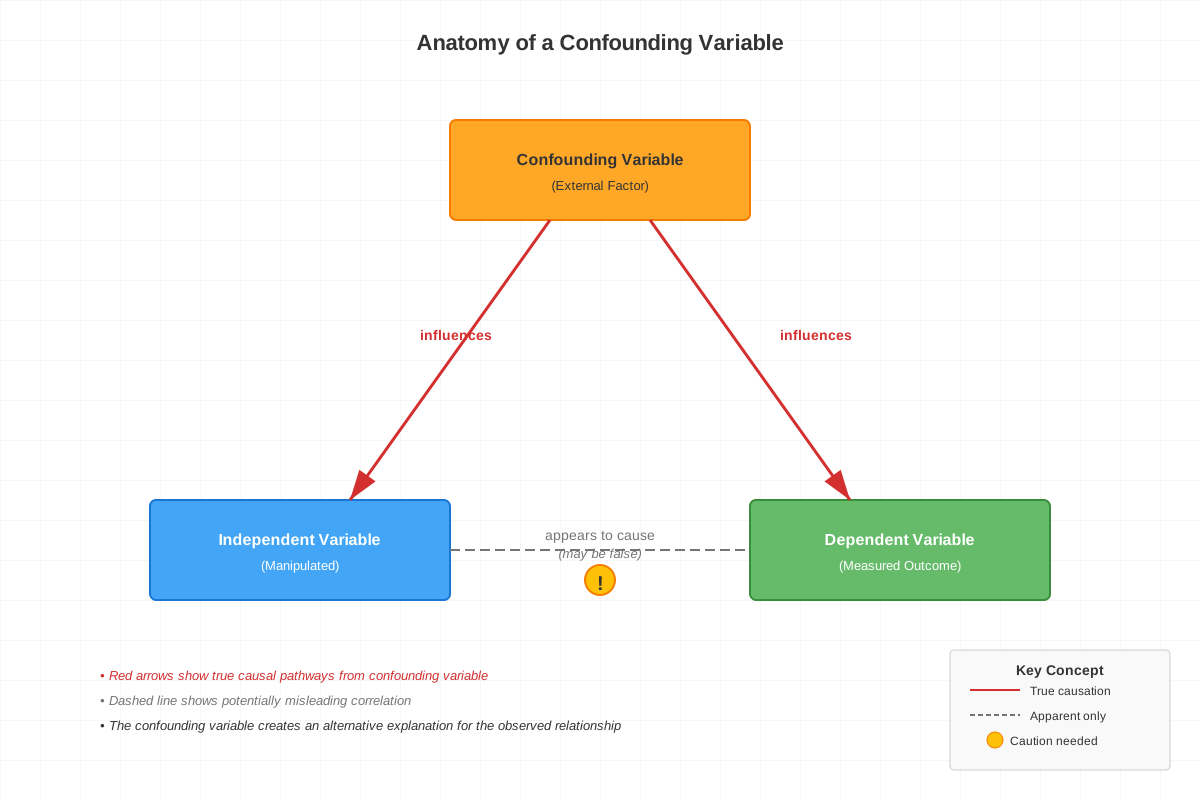
A confounding variable (also called a confounding factor or confounder) is an extraneous variable that correlates with both the independent variable and the dependent variable in an experiment, potentially creating a spurious association or obscuring the true relationship between the variables being studied. The defining characteristic of a confounding variable is that it provides an alternative explanation for observed results, making it impossible to determine whether changes in the dependent variable resulted from the independent variable or from the confounder.
For a variable to be considered a true confounder, it must meet three criteria:
- Association with the independent variable: The confounding variable must be related to or vary along with the independent variable
- Causal relationship with the dependent variable: The confounding variable must independently affect the outcome being measured
- Not part of the causal pathway: The confounding variable must not be an intermediate step between the independent and dependent variables (those are mediating variables, not confounders)
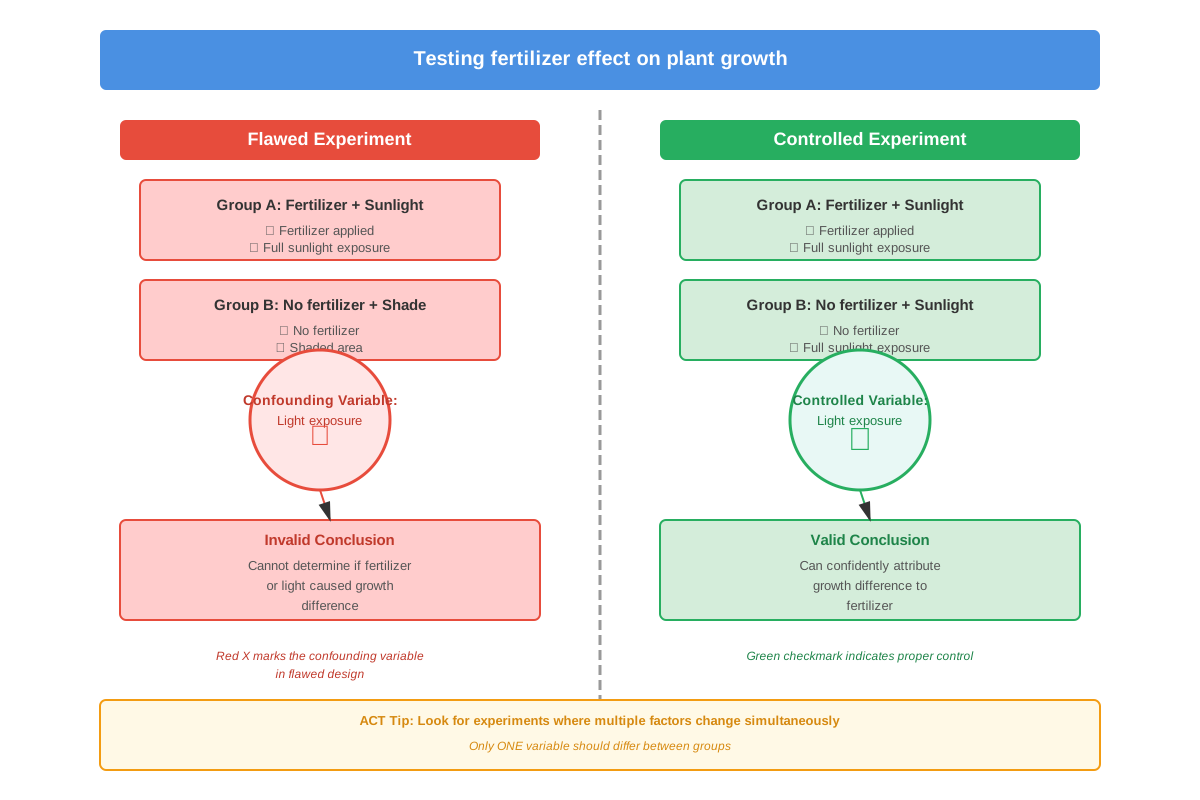
Consider an experiment testing whether a new fertilizer increases plant growth. If plants receiving the fertilizer are also placed in sunnier locations, sunlight becomes a confounding variable because it correlates with fertilizer use (independent variable) and independently affects plant height (dependent variable). The experimenter cannot determine whether observed growth resulted from the fertilizer, the sunlight, or both factors combined.
Types of Confounding Variables
Understanding different categories of confounding variables helps students recognize them more quickly in ACT passages:
| Type | Description | ACT Example |
|---|---|---|
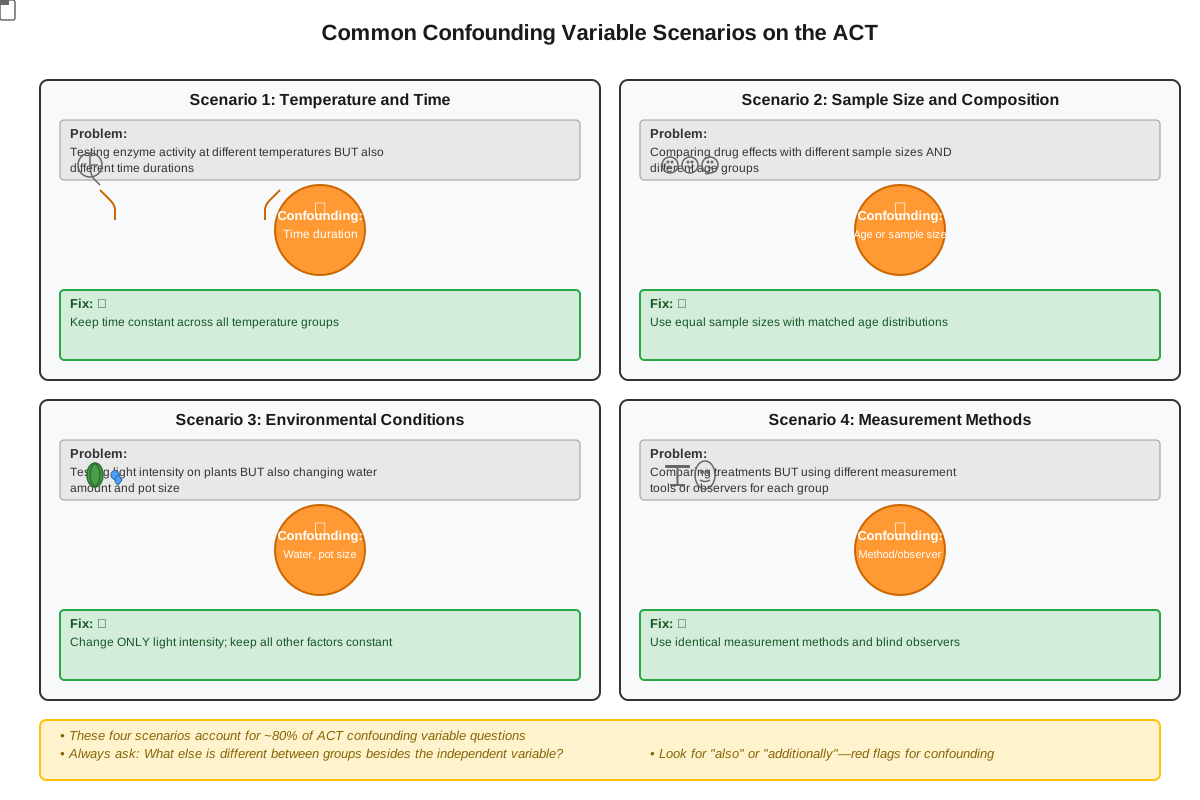
| Environmental | Physical conditions affecting the experiment | Temperature, humidity, light exposure, air pressure |
| Temporal | Time-related factors that change during the experiment | Seasonal variations, time of day, aging of materials |
| Subject-related | Characteristics of experimental subjects | Age, size, health status, genetic variation |
| Procedural | Differences in how the experiment is conducted | Different researchers, equipment calibration, measurement timing |
| Selection bias | Non-random assignment creating systematic differences | Self-selection into groups, convenience sampling |
Identifying Confounding Variables in Experimental Design
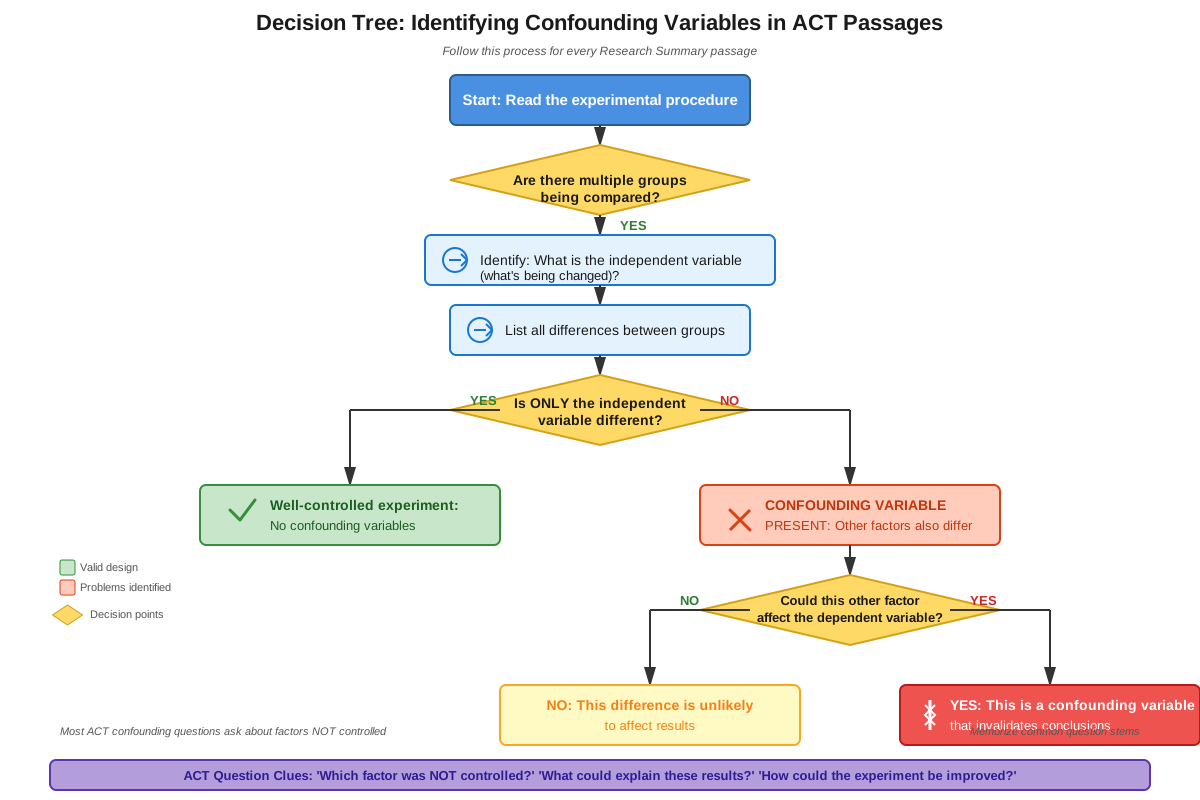
The ACT frequently tests the ability to spot potential confounders by presenting experimental procedures with subtle flaws. Students should systematically evaluate experiments using this framework:
- Identify the independent variable: What is the experimenter deliberately changing or manipulating?
- Identify the dependent variable: What outcome is being measured?
- List all other variables mentioned or implied: What else could vary between experimental groups or conditions?
- Apply the three-criteria test: For each additional variable, determine if it meets the definition of a confounder
- Evaluate controls: Has the experimenter held these variables constant or randomized them?
For example, if an experiment tests whether music improves studying by having students study with music in the morning and without music in the evening, time of day becomes a confounding variable. Students cannot determine whether any performance differences result from music or from circadian rhythm effects on cognitive function.
Controlling for Confounding Variables
Proper experimental design employs several strategies to eliminate or minimize confounding variables:
Randomization: Randomly assigning subjects to experimental groups distributes potential confounders evenly across groups, preventing systematic differences. This is the gold standard for controlling unknown confounders.
Holding variables constant: Keeping potential confounders the same across all experimental groups eliminates their influence. For example, conducting all trials at the same temperature, using subjects of the same age, or measuring all samples with the same equipment.
Matching: Pairing subjects with similar characteristics across experimental groups ensures that subject-related confounders are balanced. This is particularly useful when randomization is not possible.
Statistical control: Using mathematical techniques to account for confounders in data analysis. While this appears less frequently on the ACT, students should recognize that "adjusting for" or "controlling for" variables in results descriptions indicates this approach.
Blinding: Preventing subjects or researchers from knowing group assignments reduces procedural confounders related to expectations or bias. Double-blind designs (where neither subjects nor researchers know assignments) provide the strongest control.
Confounding Variables Versus Other Variable Types
Students frequently confuse confounding variables with other experimental elements. Clear distinctions are essential:
Independent variable vs. confounding variable: The independent variable is deliberately manipulated by the experimenter to test its effect. A confounding variable varies unintentionally and was not adequately controlled.
Dependent variable vs. confounding variable: The dependent variable is the outcome being measured. A confounding variable influences this outcome but is not the focus of measurement.
Control variable vs. confounding variable: A control variable is successfully held constant throughout the experiment. A confounding variable is one that should have been controlled but was not.
Mediating variable vs. confounding variable: A mediating variable lies in the causal pathway between independent and dependent variables (A causes B, which causes C). A confounding variable provides an alternative causal pathway that bypasses the independent variable.
Impact on Experimental Validity
The presence of uncontrolled confounding variables fundamentally undermines internal validity—the degree to which an experiment can establish causation. When confounders are present, the experiment suffers from:
- Inability to establish causation: Results show correlation but cannot prove that the independent variable caused changes in the dependent variable
- Alternative explanations: Multiple plausible interpretations exist for the observed data
- Unreliable conclusions: Findings may not reflect the true relationship between variables
- Reduced reproducibility: Other researchers may obtain different results if confounders vary
On the ACT, questions often ask students to identify which conclusion is "supported" or "NOT supported" by the data. The presence of confounding variables typically means that causal conclusions are not supported, even if correlational patterns are observed.
Concept Relationships
The concept of confounding variables sits at the intersection of multiple fundamental scientific principles. Understanding these relationships strengthens overall experimental reasoning skills:
Experimental Design → Confounding Variables → Data Interpretation: Proper experimental design aims to eliminate confounding variables, which in turn enables accurate data interpretation. Flawed design allows confounders to persist, which necessitates cautious interpretation that acknowledges alternative explanations.
Independent Variables ← Distinguished from → Confounding Variables: Both types of variables can affect the dependent variable, but independent variables are intentionally manipulated while confounding variables represent unintended variation. Recognizing this distinction is essential for evaluating what an experiment actually tests.
Control Groups → Minimize → Confounding Variables: Control groups serve primarily to account for confounding variables by providing a baseline for comparison. Without proper controls, confounders cannot be distinguished from the effects of the independent variable.
Confounding Variables → Threaten → Internal Validity → Limits → Generalizability: This causal chain shows how confounders create a cascade of problems. When internal validity is compromised, researchers cannot confidently generalize findings to other contexts or populations.
Randomization + Standardization → Control → Confounding Variables → Enable → Causal Conclusions: This represents the positive pathway where proper methodology controls confounders, allowing researchers to make strong causal claims.
The relationship to prerequisite knowledge is equally important. Students must first understand what independent and dependent variables are before they can recognize what should have been controlled but was not. Similarly, knowledge of the scientific method provides the framework for understanding why controlling variables matters—the goal of experimentation is to isolate cause-and-effect relationships, which confounders prevent.
High-Yield Facts
⭐ A confounding variable must correlate with the independent variable AND independently affect the dependent variable to truly confound results
⭐ The most common ACT question format asks which factor "if not controlled" would affect results—this directly tests confounding variable identification
⭐ When experimental groups differ in multiple ways, any uncontrolled difference is a potential confounding variable
⭐ Randomization is the most effective method for controlling both known and unknown confounding variables
⭐ The presence of a confounding variable means causal conclusions are NOT supported, even if correlations are observed
- Confounding variables provide alternative explanations for experimental results, creating ambiguity about causation
- Environmental factors (temperature, light, humidity) are among the most frequently tested confounders on the ACT
- Time-related confounders often appear when different experimental groups are tested at different times
- Subject characteristics (age, size, initial health) commonly confound biological experiments
- Proper controls hold confounding variables constant across all experimental groups
- Blinding prevents researcher expectations from becoming a confounding variable
- Statistical significance does not eliminate the possibility of confounding variables affecting results
- Multiple confounding variables can act simultaneously, compounding interpretation difficulties
- Confounding variables can either exaggerate or mask the true effect of an independent variable
- Identifying potential confounders requires considering all aspects of experimental procedure, not just explicitly mentioned variables
Quick check — test yourself on Confounding variables so far.
Try Flashcards →Common Misconceptions
Misconception: Any variable present in an experiment is a confounding variable.
Correction: Only variables that are uncontrolled, correlate with the independent variable, and independently affect the dependent variable are true confounders. Variables that are properly controlled or measured as dependent variables are not confounders.
Misconception: If an experiment shows a strong correlation, confounding variables must not be present.
Correction: Strong correlations can exist even when confounding variables are present. The strength of a relationship does not indicate whether it is causal or spurious. Confounders can create strong apparent relationships that disappear when the confounder is controlled.
Misconception: Confounding variables only matter in poorly designed experiments.
Correction: Even well-designed experiments can have confounding variables, particularly when studying complex systems. The difference is that good experiments identify potential confounders and implement controls, while poor experiments fail to recognize or address them.
Misconception: The control group eliminates all confounding variables automatically.
Correction: A control group only helps identify confounders if the control and experimental groups are identical except for the independent variable. If groups differ in multiple ways, confounders persist. The control group must be properly matched or randomized.
Misconception: Confounding variables and dependent variables are the same thing because both are affected by other factors.
Correction: Dependent variables are the outcomes being measured and are the focus of the study. Confounding variables are extraneous factors that interfere with interpreting the relationship between independent and dependent variables. Confounders affect the dependent variable but are not the primary measurement of interest.
Misconception: If researchers mention controlling for a variable, it cannot be a confounding variable.
Correction: Researchers may claim to control variables but implement inadequate controls. ACT questions often present experiments where attempted controls are insufficient. Students must evaluate whether the control method actually eliminates the confounder's influence.
Misconception: Confounding variables always make results appear more significant than they actually are.
Correction: Confounders can either exaggerate effects (positive confounding) or mask true effects (negative confounding). For example, if a confounding variable works opposite to the independent variable, it might hide a real effect, making the independent variable appear ineffective when it actually has an impact.
Worked Examples
Example 1: Identifying Confounding Variables in a Plant Growth Experiment
Scenario: Students conducted an experiment to test whether a new fertilizer increases tomato plant growth. They used 20 plants total:
- Group A (10 plants): Received new fertilizer, placed on south-facing windowsill, watered daily with 100 mL water
- Group B (10 plants): Received standard fertilizer, placed on north-facing windowsill, watered daily with 100 mL water
- After 4 weeks, Group A plants were 15% taller on average
Question: Which factor, if not controlled, would most likely affect the validity of the conclusion that the new fertilizer caused increased growth?
Step 1 - Identify the independent variable: The type of fertilizer (new vs. standard)
Step 2 - Identify the dependent variable: Plant height/growth
Step 3 - List other variables:
- Light exposure (south-facing vs. north-facing windowsill)
- Water amount (100 mL - same for both groups)
- Watering frequency (daily - same for both groups)
- Number of plants (10 per group - same)
- Time period (4 weeks - same)
Step 4 - Apply confounding variable criteria:
Light exposure meets all three criteria:
- Correlates with independent variable: Plants receiving new fertilizer also received more light (south-facing)
- Independently affects dependent variable: Light is essential for photosynthesis and plant growth
- Not part of causal pathway: Light is not an intermediate step between fertilizer and growth
Step 5 - Evaluate the conclusion: The conclusion that new fertilizer caused increased growth is NOT supported because light exposure is a confounding variable. The observed growth could result from the fertilizer, the increased light, or both factors.
Answer: Light exposure (window location) is the confounding variable. To improve the experiment, all plants should be placed in the same location or randomly distributed across locations.
Connection to Learning Objectives: This example demonstrates identification of confounding variables (Objective 1), explains how confounders affect validity (Objective 2), and shows application to an ACT-style scenario (Objective 3).
Example 2: Evaluating Experimental Design for Adequate Controls
Scenario: Researchers investigated whether a new teaching method improves test scores. They implemented the following design:
- School A: 100 students taught using new method in September-December
- School B: 100 students taught using traditional method in January-April
- Both groups took the same final exam
- School A students scored 12% higher on average
Question: Based on the experimental design, which of the following conclusions is supported?
A) The new teaching method causes higher test scores
B) Students at School A perform better than students at School B
C) The new teaching method is associated with higher test scores, but causation cannot be established
D) Teaching method has no effect on test scores
Step 1 - Identify potential confounding variables:
- School differences: Different student populations, resources, teacher quality
- Time period: Different semesters (September-December vs. January-April)
- Seasonal factors: Weather, holidays, academic calendar position
- Teacher differences: Different instructors implementing the methods
Step 2 - Evaluate each confounder:
School differences: School A and School B likely differ in many ways beyond teaching method. Student demographics, prior preparation, school resources, and teacher experience could all affect test scores. This is a major confounder.
Time period: Testing in different semesters introduces temporal confounding. Students tested in January-April have had more total schooling, face different seasonal challenges, and experience different academic pressures (end of year vs. beginning).
Step 3 - Assess what the data actually shows: The data demonstrates an association (correlation) between the new teaching method and higher scores, but multiple alternative explanations exist. The design does not isolate the teaching method as the sole difference between groups.
Step 4 - Evaluate each answer choice:
- A) NOT supported - causation cannot be established due to confounders
- B) Supported but irrelevant - this is true but doesn't address the research question
- C) SUPPORTED - accurately describes what the data shows (association) and acknowledges limitations (no causation)
- D) NOT supported - an association was observed, even if causation is unclear
Answer: C is correct. The experiment shows correlation but cannot establish causation due to multiple confounding variables.
Improvement recommendations: To establish causation, researchers should:
- Use students from the same school randomly assigned to teaching methods
- Implement both methods during the same time period
- Use the same teachers for both methods (if possible) or randomly assign teachers
- Ensure all other instructional variables remain constant
Connection to Learning Objectives: This example demonstrates evaluation of experimental design (Objective 5), distinguishing between correlation and causation (Objective 2), and recommending improvements (Objective 7).
Exam Strategy
Recognizing Confounding Variable Questions
ACT Science questions about confounding variables typically use specific trigger phrases that signal the concept is being tested:
Direct trigger phrases:
- "Which factor, if not controlled, would affect..."
- "Which variable should have been held constant..."
- "The experiment could be improved by..."
- "Which of the following is a weakness of the experimental design..."
- "Based on the design, which conclusion is NOT supported..."
Indirect trigger phrases:
- "An alternative explanation for the results is..."
- "Which factor might account for the difference..."
- "To ensure valid results, the scientists should..."
- "Which of the following assumptions must be true..."
When these phrases appear, immediately shift to confounding variable analysis mode.
Systematic Approach to Confounding Variable Questions
Use this step-by-step process for maximum accuracy:
- Identify what's being manipulated (independent variable) and what's being measured (dependent variable)
- List everything else mentioned in the experimental procedure
- Ask for each factor: "Does this differ between groups?" If yes, it's a potential confounder
- Evaluate whether the difference matters: Would this factor independently affect the outcome?
- Select the answer that identifies the most significant uncontrolled difference
Process of Elimination Strategies
When multiple answer choices seem plausible:
Eliminate factors that are controlled: If the passage states a variable was "held constant," "standardized," or "kept the same," it cannot be a confounding variable in that experiment.
Eliminate factors unrelated to the outcome: If a variable wouldn't logically affect the dependent variable, it's not a confounder. For example, the color of data recording sheets wouldn't confound a chemistry experiment about reaction rates.
Eliminate the independent and dependent variables themselves: These are the focus of study, not confounders. Questions asking about confounders want you to identify other factors.
Prioritize environmental and temporal factors: When multiple confounders exist, ACT questions typically focus on physical conditions (temperature, light, time) rather than subtle statistical issues.
Time Management
Confounding variable questions typically require 45-60 seconds to answer thoroughly:
- 15-20 seconds: Read and understand the experimental design
- 15-20 seconds: Identify independent/dependent variables and list other factors
- 10-15 seconds: Evaluate which factors are uncontrolled
- 5-10 seconds: Select and verify answer
Do not rush these questions. They reward systematic analysis and often serve as medium-difficulty items where careful reasoning yields correct answers that faster test-takers miss.
Common Trap Answers
Be alert for these frequently appearing incorrect answer choices:
The independent variable itself: Questions may list the factor being manipulated as an answer choice. This is never the confounder—it's what's being tested.
Properly controlled variables: Answer choices may mention factors that the passage explicitly states were held constant. Read carefully to identify what was actually controlled.
Irrelevant factors: Some choices mention variables that sound scientific but wouldn't actually affect the outcome. Use logical reasoning about cause-and-effect.
The dependent variable: Occasionally, the outcome being measured appears as an answer choice. Remember that confounders affect the dependent variable; they are not the dependent variable itself.
Memory Techniques
The "CITE" Framework for Confounding Variables
Use this acronym to remember the key questions for identifying confounders:
Correlates with independent variable?
Independently affects dependent variable?
Tested or controlled?
Explains results alternatively?
If the answer to C, I, and E is "yes" and the answer to T is "no," you've identified a confounding variable.
The "Same-Same-Different" Rule
For valid experiments, groups should be:
- Same in all characteristics except the independent variable
- Same in all environmental conditions
- Different only in the one factor being tested
When you spot multiple differences between groups, you've found confounding variables.
Visualization Strategy: The Triangle Test
Mentally draw a triangle with three points:
- Top: Confounding variable
- Bottom left: Independent variable
- Bottom right: Dependent variable
A true confounder has arrows pointing to BOTH bottom points. If arrows only go one direction, it's not a confounder.
The "What Else Changed?" Question
When reading experimental procedures, constantly ask: "What else changed between groups besides the independent variable?" This simple question naturally directs attention to potential confounders.
Mnemonic for Common Confounders: "TEMPS"
Time (when experiments are conducted)
Environment (temperature, light, humidity)
Materials (equipment, supplies, quality)
Population (subject characteristics)
Selection (how subjects were assigned to groups)
These categories cover the majority of confounders appearing on the ACT.
Summary
Confounding variables represent extraneous factors that correlate with the independent variable and independently affect the dependent variable, creating alternative explanations for experimental results and preventing establishment of causation. Mastery of this concept requires the ability to systematically analyze experimental designs, identify uncontrolled variables that differ between groups, and evaluate whether these differences could plausibly affect outcomes. The ACT Science section tests this skill through questions asking which factors "if not controlled" would affect results, which conclusions are "not supported," or how experiments could be improved. Proper experimental design controls confounding variables through randomization, standardization, matching, or blinding. When confounders are present, researchers can only establish correlation, not causation, regardless of how strong the observed relationship appears. Students who can quickly identify the independent and dependent variables, list all other factors present in the experiment, and apply the three-criteria test for confounders will consistently answer these high-yield questions correctly, gaining a significant advantage on Research Summaries passages.
Key Takeaways
- Confounding variables provide alternative explanations for experimental results by correlating with the independent variable and independently affecting the dependent variable
- The presence of uncontrolled confounding variables means causal conclusions are NOT supported, even when strong correlations are observed in the data
- Identify confounders by asking: "What differs between experimental groups besides the independent variable, and could those differences affect the outcome?"
- Environmental factors (temperature, light, humidity), temporal factors (time of day, season), and subject characteristics (age, size, health) are the most commonly tested confounders on the ACT
- Proper experimental design controls confounders through randomization, holding variables constant, matching subjects, or blinding participants and researchers
- ACT questions use trigger phrases like "if not controlled," "should have been held constant," and "NOT supported" to signal confounding variable concepts
- Systematic analysis using the CITE framework (Correlates, Independently affects, Tested/controlled, Explains alternatively) ensures accurate identification of confounders
Related Topics
Experimental Controls and Control Groups: Understanding how control groups function to isolate the effects of independent variables and reveal the presence of confounding variables. Mastering confounding variables provides the foundation for evaluating whether controls are adequate.
Independent and Dependent Variables: Deeper exploration of variable relationships, including how to identify variables in complex experimental scenarios. This builds directly on confounding variable knowledge by clarifying what should be isolated versus what should be measured.
Correlation vs. Causation: Advanced analysis of when observed relationships indicate causal mechanisms versus mere association. Confounding variables are the primary reason correlations fail to establish causation.
Experimental Design Principles: Comprehensive study of how to structure valid experiments, including randomization, replication, and sample size considerations. Confounding variables represent one specific design flaw within this broader framework.
Data Interpretation and Graph Analysis: Skills for extracting meaning from experimental results while accounting for potential confounders. Understanding confounders enhances the ability to critically evaluate whether data supports stated conclusions.
Statistical Significance vs. Practical Significance: Exploration of how statistical tests relate to real-world importance and how confounders can create statistically significant but misleading results.
Practice CTA
Now that you understand confounding variables and their critical role in experimental validity, it's time to apply this knowledge! Work through the practice questions to test your ability to identify confounders in diverse experimental scenarios, evaluate whether conclusions are supported, and recommend design improvements. The flashcards will help reinforce key definitions and the systematic approach to analyzing experiments. Remember: confounding variable questions are high-yield opportunities to demonstrate your scientific reasoning skills and gain points that separate top scorers from the rest. Each practice question you complete strengthens your pattern recognition and builds the confidence needed to tackle these questions quickly and accurately on test day. You've got this!
Sign up free to keep reading
Create a free AnvayaPrep account to finish this ACT guide on Confounding variables — plus flashcards and practice questions.