Overview
Modeling scientific systems is a fundamental skill tested throughout the ACT Science section, appearing in approximately 30-40% of all passages. This topic assesses a student's ability to interpret, analyze, and manipulate visual and conceptual representations of scientific phenomena, including diagrams, graphs, flowcharts, and theoretical frameworks. Unlike pure data interpretation, modeling questions require students to understand how scientists represent complex systems in simplified forms and how changes to one component affect the entire system.
The ACT Science test frequently presents passages containing models of biological processes, chemical reactions, physical systems, and Earth science phenomena. Students must demonstrate proficiency in reading these models, identifying their components and relationships, predicting outcomes based on model manipulation, and recognizing the limitations of different modeling approaches. Success with act modeling scientific systems questions directly correlates with overall Science section performance, as these questions integrate data interpretation, scientific reasoning, and critical thinking skills.
This topic serves as a bridge between pure data analysis and hypothesis evaluation. While data interpretation focuses on extracting information from tables and graphs, and hypothesis evaluation examines competing explanations, modeling questions require students to understand the underlying structure and function of scientific systems. Mastery of modeling enables students to tackle the most challenging multi-step reasoning questions that combine elements from multiple passages or require synthesis of information across different representations.
Learning Objectives
- [ ] Identify when Modeling scientific systems is being tested
- [ ] Explain the core rule or strategy behind Modeling scientific systems
- [ ] Apply Modeling scientific systems to ACT-style questions accurately
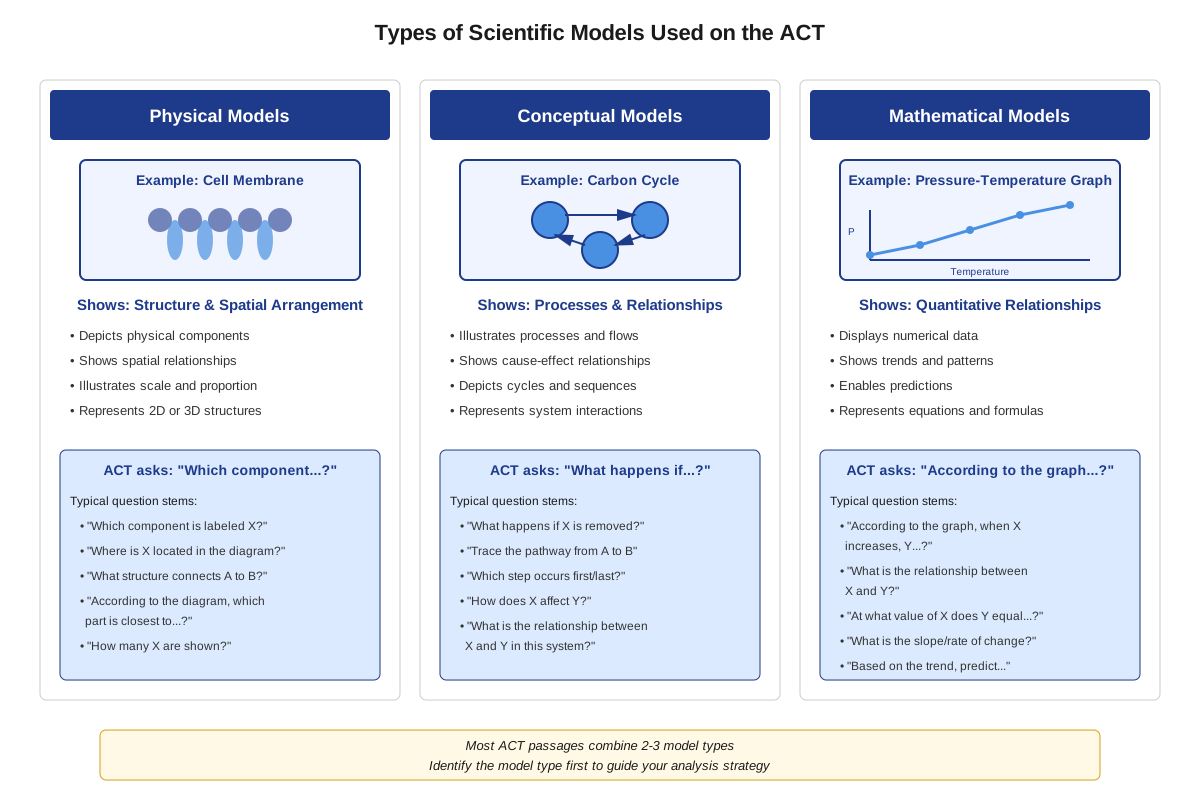
- [ ] Distinguish between different types of scientific models (physical, conceptual, mathematical)
- [ ] Predict system behavior when model parameters are modified
- [ ] Evaluate the strengths and limitations of specific modeling approaches
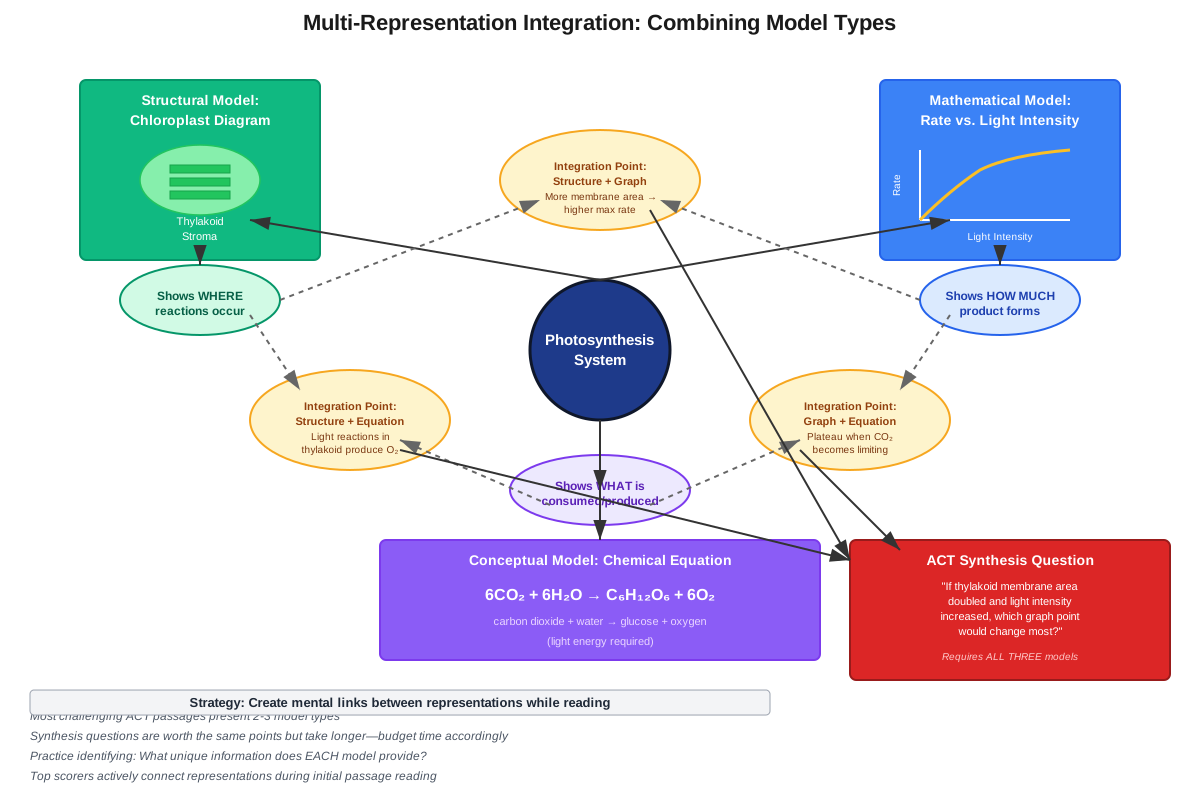
- [ ] Synthesize information from multiple model representations within a single passage
Prerequisites
- Basic graph reading skills: Essential for interpreting visual models presented as coordinate systems, including understanding axes, scales, and data point relationships
- Fundamental scientific vocabulary: Necessary to comprehend model components across biology, chemistry, physics, and Earth science contexts
- Logical reasoning ability: Required to trace cause-and-effect relationships within system models and predict outcomes
- Pattern recognition: Enables identification of trends, cycles, and relationships depicted in model representations
Why This Topic Matters
Scientific modeling forms the foundation of modern research across all disciplines. Scientists use models to simplify complex phenomena, test hypotheses without expensive experiments, predict future outcomes, and communicate findings to diverse audiences. From climate models predicting global temperature changes to molecular models explaining drug interactions, modeling enables scientific progress and practical applications that affect daily life.
On the ACT Science test, modeling questions appear in 3-5 passages per exam, accounting for 10-15 questions total. These questions typically appear in Research Summaries passages (which describe experiments) and Conflicting Viewpoints passages (which present competing theories). The ACT tests modeling through several question types: identifying model components, tracing pathways through system diagrams, predicting outcomes when variables change, comparing different model representations, and recognizing model limitations or assumptions.
Common passage formats include food web diagrams, energy flow charts, geological cross-sections, chemical reaction mechanisms, cell signaling pathways, ecosystem models, atmospheric circulation patterns, and experimental apparatus diagrams. Students who master modeling can quickly extract relevant information, avoid trap answers that misrepresent system relationships, and confidently tackle the highest-difficulty questions that separate top scorers from average performers.
Core Concepts
Types of Scientific Models
Scientific models fall into three primary categories, each serving distinct purposes and appearing with different frequencies on the ACT. Physical models represent tangible objects or systems through scaled replicas or diagrams, such as molecular structures, anatomical drawings, or geological cross-sections. These models emphasize spatial relationships and structural features. Conceptual models illustrate abstract relationships and processes through flowcharts, cycle diagrams, or schematic representations, such as food webs, water cycles, or energy transfer diagrams. Mathematical models use equations, graphs, or numerical relationships to represent system behavior, though these appear less frequently as standalone models and more often as components within larger passages.
The ACT most commonly tests conceptual and physical models, requiring students to understand how visual representations convey scientific information. Successful students recognize that models simplify reality by focusing on relevant features while omitting unnecessary details. This simplification is intentional and necessary—models that included every variable would be too complex to use effectively.
Components of System Models
Every scientific model contains three essential elements: components (the individual parts or variables), relationships (how components interact or connect), and boundaries (what the model includes or excludes). On the ACT, questions frequently test whether students can identify these elements correctly.
Components appear as labeled parts in diagrams, variables in equations, or nodes in flowcharts. For example, in an ecosystem model, components might include producers, consumers, decomposers, and abiotic factors. Relationships show how components affect each other through arrows, lines, mathematical operations, or spatial proximity. In the ecosystem example, arrows might show energy flow from producers to consumers. Boundaries define the model's scope—an ecosystem model might focus on a single pond while excluding surrounding terrestrial environments.
Understanding these three elements enables students to answer questions about model function, predict outcomes when components change, and recognize what the model cannot explain due to its boundaries.
Reading Flow Diagrams and Pathways
Flow diagrams represent processes or sequences through connected boxes, circles, or other shapes linked by arrows. The ACT frequently presents these models in passages about biological processes (cell signaling, metabolic pathways), chemical reactions (multi-step syntheses), or Earth systems (rock cycles, water cycles). Success requires systematic reading strategies.
First, identify the starting point and endpoint of the process. Most flow diagrams have clear inputs and outputs, though some represent cycles without distinct beginnings. Second, trace the main pathway by following arrows in sequence, noting any decision points or branches. Third, identify feedback loops where outputs influence earlier steps. Fourth, recognize parallel pathways that operate simultaneously. Finally, note any conditions or requirements labeled on arrows or connections.
Common ACT questions ask students to identify what happens at specific steps, predict outcomes if a step is blocked or enhanced, determine the sequence of events, or explain how feedback affects the system. Students should practice verbalizing the process represented by flow diagrams to ensure complete understanding.
Interpreting Spatial Models
Spatial models show physical arrangements and structural relationships, appearing frequently in passages about geology (rock layers, fault structures), biology (cell anatomy, organism structures), or chemistry (molecular geometry, experimental apparatus). These models require different reading strategies than flow diagrams.
For layered or cross-sectional models, establish orientation by identifying labels for directions (top/bottom, north/south, surface/depth). Recognize that layers or structures may represent different time periods, materials, or functional regions. Note scale information, as spatial models may represent microscopic structures or continental features. Identify any symbols or patterns used to distinguish different materials or regions.
For three-dimensional structures represented in two dimensions, mentally rotate the model to understand spatial relationships. The ACT may ask questions requiring students to visualize what the structure looks like from different angles or how components connect in three-dimensional space.
Model Manipulation and Prediction
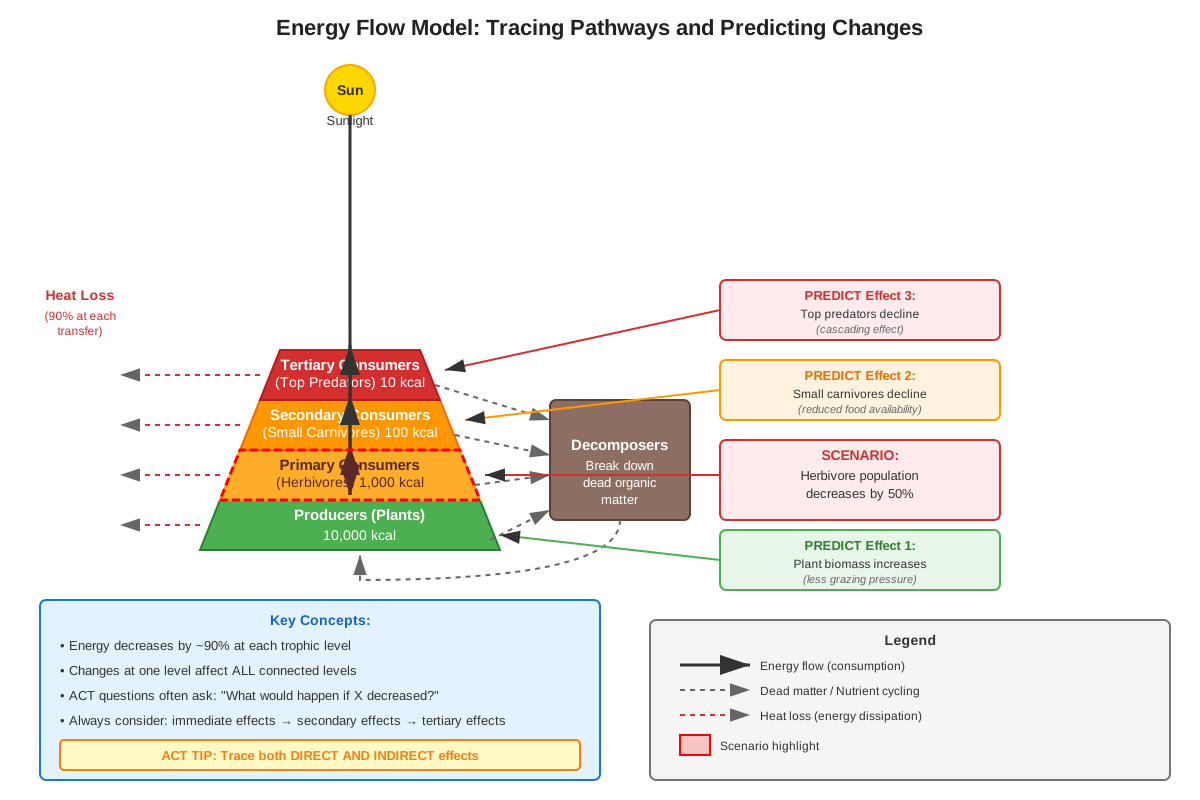
The highest-yield ACT questions require students to predict how systems respond to changes. These questions test whether students understand causal relationships within models rather than simply reading labels. Successful prediction requires identifying which components are directly affected by the change, tracing how effects propagate through the system, and determining the final outcome.
For example, given a food web model, students might need to predict population changes if one species is removed. This requires recognizing that the removed species' prey will increase (less predation), its predators will decrease (less food), and these changes will cascade through connected species. The ACT often includes trap answers that reverse causation or ignore indirect effects.
When approaching prediction questions, students should: (1) locate the changed component in the model, (2) identify all direct connections to that component, (3) determine whether each connection represents a positive or negative relationship, (4) trace effects through subsequent connections, and (5) synthesize the overall system response. This systematic approach prevents errors and builds confidence.
Model Limitations and Assumptions
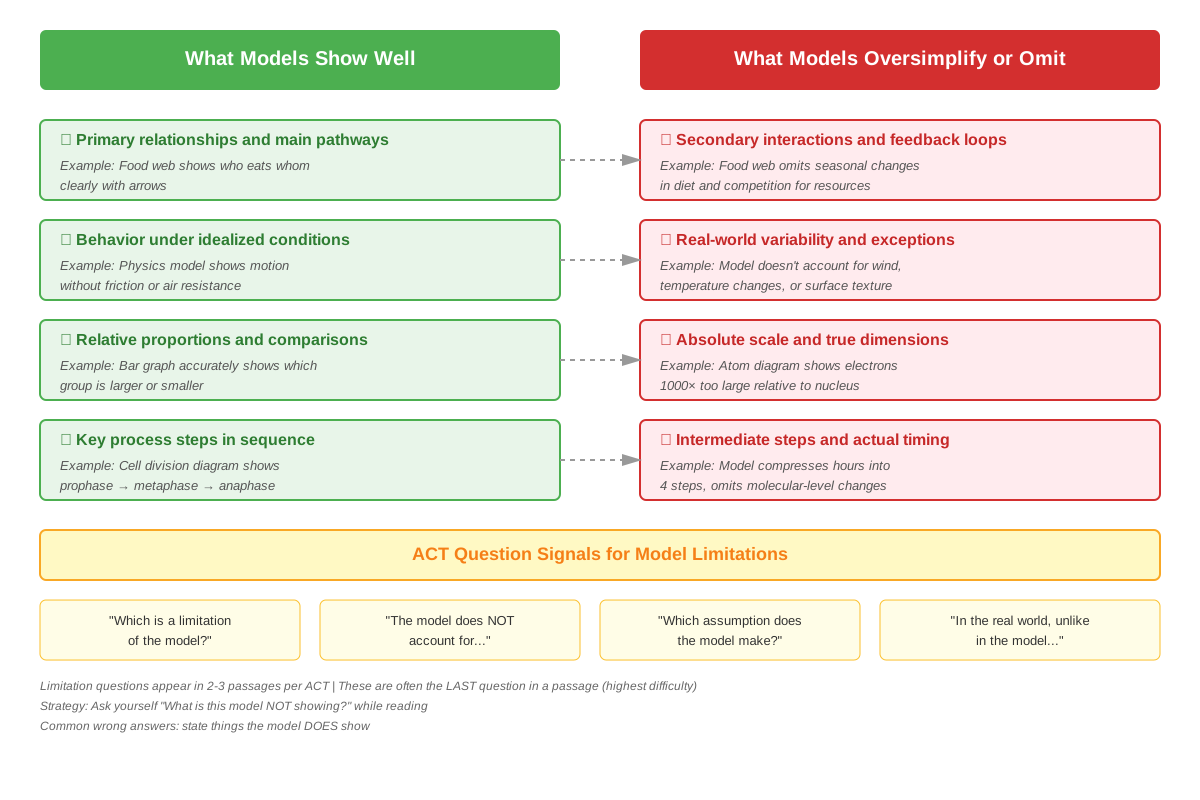
Advanced ACT questions assess whether students recognize that all models have limitations. Models simplify reality by making assumptions—treating certain variables as constant, ignoring minor factors, or representing continuous processes as discrete steps. Understanding these limitations is crucial for evaluating model validity and applicability.
Common model assumptions include: constant environmental conditions, closed systems with no external inputs, linear relationships between variables, equilibrium states, and uniform properties throughout regions. The ACT may ask students to identify which assumption is most critical, what happens if an assumption is violated, or what phenomena the model cannot explain.
Students should approach these questions by considering what real-world complexity the model omits. For example, a simple predator-prey model might assume constant birth rates, unlimited resources, and no other species interactions—assumptions that rarely hold in nature. Recognizing these limitations doesn't invalidate the model but defines its appropriate use.
Concept Relationships
The concepts within modeling scientific systems build hierarchically. Understanding model types provides the foundation for recognizing model components, which enables reading flow diagrams and spatial models. These reading skills support model manipulation and prediction, the most complex skill tested. Throughout this progression, awareness of model limitations provides critical context.
This topic connects directly to data interpretation skills, as many models incorporate graphs, tables, or numerical data. Students must integrate modeling and data interpretation to answer synthesis questions. Modeling also supports hypothesis evaluation, as competing scientific viewpoints often involve different models of the same phenomenon. The relationship map follows this structure:
Model Types → identify → Model Components → enable → Reading Strategies → support → Prediction Skills → contextualized by → Limitation Awareness
Additionally, modeling connects to prerequisite graph reading skills (models often include coordinate systems), scientific vocabulary (understanding component labels), and logical reasoning (tracing cause-effect chains). Mastery of modeling enables progression to advanced scientific reasoning topics and multi-passage synthesis questions.
Quick check — test yourself on Modeling scientific systems so far.
Try Flashcards →High-Yield Facts
- ⭐ Arrows in flow diagrams indicate direction of flow, causation, or sequence—never trace arrows backward when answering questions
- ⭐ When a component is removed from a system model, examine both direct and indirect effects on connected components
- ⭐ Models intentionally simplify reality by focusing on relevant variables and omitting minor factors
- ⭐ Feedback loops (where outputs affect inputs) are frequently tested and often appear as curved arrows returning to earlier steps
- ⭐ The ACT commonly asks "What would happen if..." questions requiring prediction based on model manipulation
- Spatial models showing layers or cross-sections typically represent either different time periods or different materials/regions
- Parallel pathways in flow diagrams indicate processes that occur simultaneously, not sequentially
- Model boundaries define what the model includes and excludes, limiting its explanatory scope
- Positive relationships mean components change in the same direction; negative relationships mean they change in opposite directions
- Mathematical models on the ACT typically appear as graphs rather than complex equations
- Decision points in flow diagrams (where pathways split) usually depend on conditions or thresholds
- Scale information is critical for spatial models—microscopic and macroscopic structures follow different principles
- Cycle diagrams have no true beginning or end, representing continuous processes
- Models with multiple feedback loops exhibit complex behavior that may not be immediately intuitive
Common Misconceptions
Misconception: All arrows in diagrams mean the same thing → Correction: Arrows can represent flow of materials, energy transfer, causation, sequence, or influence depending on context. Always check diagram legends and passage text to understand what arrows represent in each specific model.
Misconception: Removing one component from a system only affects directly connected components → Correction: Effects cascade through systems via indirect connections. In food webs, removing a predator affects its prey, which affects the prey's food source, potentially impacting species with no direct connection to the removed predator.
Misconception: More complex models are always better or more accurate → Correction: Model complexity should match the question being asked. Simple models often provide clearer insights for specific questions, while excessive complexity can obscure important relationships. The ACT tests understanding of appropriate model use, not preference for complexity.
Misconception: Models represent exact reality → Correction: All models make simplifying assumptions and have limitations. Models are tools for understanding and prediction, not perfect representations. The ACT frequently tests recognition of what models cannot explain or when assumptions are violated.
Misconception: If a model shows a relationship between A and B, then A causes B → Correction: Models may show correlation, association, or mutual dependence without indicating causation direction. Some relationships are bidirectional, and some are correlations without direct causation. Always consider whether the model explicitly indicates causal direction.
Misconception: Feedback loops always stabilize systems → Correction: Negative feedback loops stabilize systems by counteracting changes, but positive feedback loops amplify changes and can destabilize systems. The ACT tests understanding of both feedback types and their different effects.
Worked Examples
Example 1: Food Web Model Analysis
Passage Context: A passage presents a food web diagram showing: grass → grasshoppers → frogs → snakes → hawks. Additionally, grasshoppers also feed on flowers, and spiders (which eat grasshoppers) are eaten by frogs.
Question: If a disease eliminates most of the frog population, which population would most likely increase?
Solution Process:
Step 1: Identify the removed component (frogs) and its direct connections. Frogs eat grasshoppers and spiders; frogs are eaten by snakes.
Step 2: Determine immediate effects. With fewer frogs, grasshopper and spider populations will increase (less predation). Snake populations will decrease (less food).
Step 3: Trace secondary effects. Increased grasshoppers will reduce grass and flower populations (more herbivory). Decreased snakes will reduce predation pressure on any snake prey not shown.
Step 4: Evaluate answer choices. The question asks which population would increase. Direct effects: grasshoppers and spiders increase. Indirect effects: hawks might increase slightly (more available snakes initially, though this is minor). Grass and flowers decrease.
Step 5: Select the best answer. Grasshoppers would most likely increase because they experience direct release from predation pressure, and this effect is immediate and substantial.
Key Insight: This question tests understanding of direct versus indirect effects and the ability to trace causation through multiple steps. The ACT often includes trap answers focusing on indirect effects (hawks) or reversed causation (snakes).
Example 2: Chemical Process Flow Diagram
Passage Context: A flow diagram shows a multi-step chemical synthesis: Compound A → (Step 1: add catalyst X) → Compound B → (Step 2: heat to 100°C) → Compound C → (Step 3: add reagent Y) → Compound D. A feedback arrow shows that Compound D inhibits the catalyst X in Step 1.
Question: What would happen to the production rate of Compound D if Step 2 were performed at 80°C instead of 100°C?
Solution Process:
Step 1: Identify the changed parameter. Temperature in Step 2 is reduced from 100°C to 80°C.
Step 2: Determine the direct effect. Lower temperature typically slows chemical reactions. The conversion of Compound B to Compound C would slow, reducing Compound C production rate.
Step 3: Trace downstream effects. Less Compound C means less substrate for Step 3, reducing Compound D production rate.
Step 4: Consider feedback effects. Less Compound D means less inhibition of catalyst X in Step 1. This would increase the rate of Step 1, producing more Compound B. However, the bottleneck is now Step 2, so this increased Compound B production cannot fully compensate.
Step 5: Synthesize the overall effect. The production rate of Compound D would decrease because Step 2 becomes rate-limiting. The feedback loop partially compensates but cannot overcome the slowed Step 2.
Key Insight: This question tests understanding of rate-limiting steps, feedback loops, and how changes propagate through sequential processes. Students must recognize that feedback can partially compensate for changes but may not fully restore original rates.
Exam Strategy
Trigger Phrase Alert: Watch for "according to the diagram," "based on the model," "the figure shows," and "as represented in" as signals that the question tests modeling skills rather than passage text comprehension.
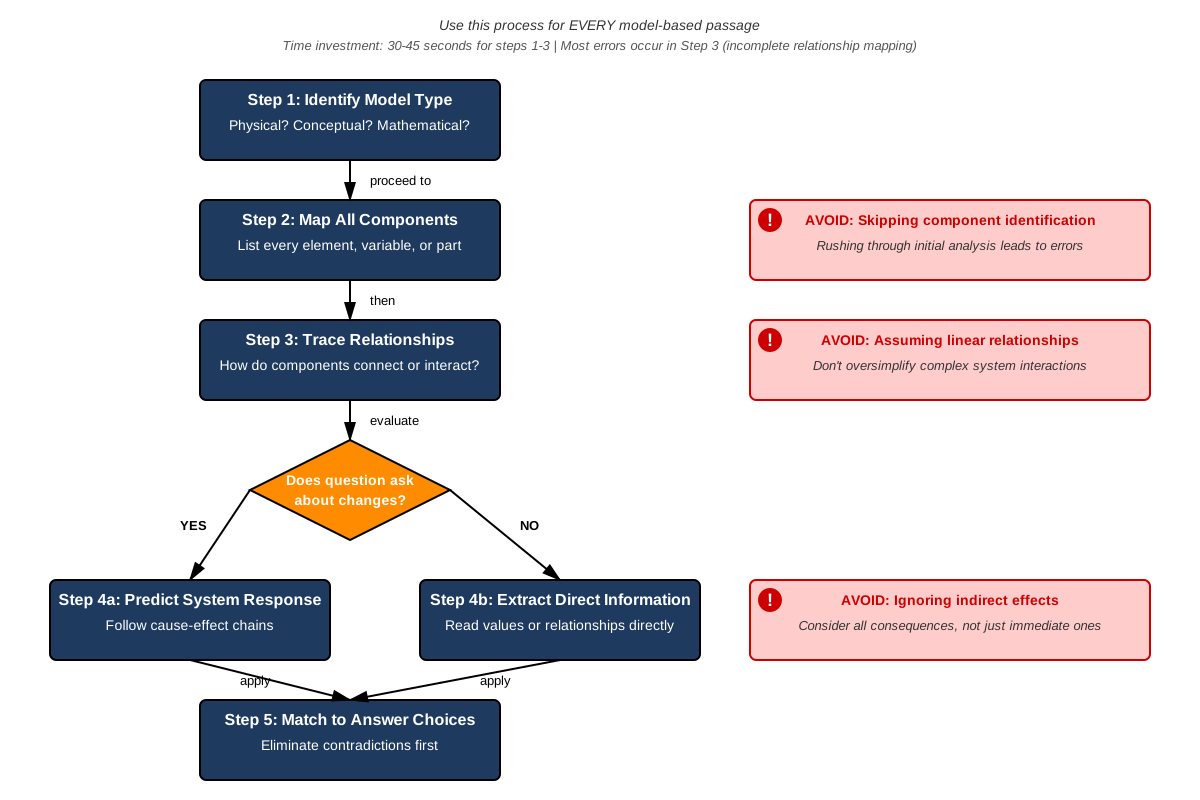
When approaching modeling questions on the ACT, follow this systematic process:
Step 1: Identify the model type (flow diagram, spatial model, cycle, etc.) to activate appropriate reading strategies. Spend 10-15 seconds orienting yourself to the model's structure before reading questions.
Step 2: Locate relevant components mentioned in the question stem. Use your finger or pencil to physically trace pathways or identify structures—this prevents errors and focuses attention.
Step 3: Trace relationships systematically. For flow diagrams, follow arrows in sequence. For spatial models, identify relative positions and connections. Never assume relationships not explicitly shown.
Step 4: Predict the answer before looking at choices. This prevents trap answers from influencing reasoning. For prediction questions, work through the logic completely before evaluating options.
Step 5: Eliminate wrong answers using these common patterns:
- Answers that reverse causation or flow direction
- Answers that confuse direct and indirect effects
- Answers that ignore feedback loops or secondary effects
- Answers that extend the model beyond its stated boundaries
- Answers that treat correlations as causation without support
Time Management: Allocate 30-45 seconds per modeling question. Simple identification questions (naming components, reading labels) should take 20-30 seconds. Complex prediction or synthesis questions may require 60 seconds. If a question requires more than 90 seconds, mark it and return after completing easier questions.
Common Trap Patterns: The ACT frequently includes answers that sound scientific but misrepresent the model. Watch for answers using passage vocabulary in incorrect contexts, answers that describe real-world phenomena not shown in the model, and answers that require assumptions beyond the model's scope.
Memory Techniques
TRACE Acronym for systematic model analysis:
- Type: Identify the model type (flow, spatial, cycle, mathematical)
- Relationships: Map connections between components
- Arrows: Follow directional indicators carefully
- Components: Locate all relevant parts
- Effects: Predict outcomes of changes
Flow Diagram Reading: Remember "START-PATH-LOOP-END"
- START: Find the input or initial component
- PATH: Trace the main sequence
- LOOP: Identify any feedback connections
- END: Locate the output or final state
Prediction Questions: Use "DICE"
- Direct effects first (immediate consequences)
- Indirect effects second (downstream consequences)
- Cascade through the system (trace all connections)
- Evaluate the overall outcome (synthesize effects)
Visual Memory Aid: For spatial models, create a mental "compass"—always establish orientation (top/bottom, left/right, near/far) before analyzing relationships. This prevents confusion about relative positions.
Feedback Loop Recognition: Remember "SAME-OPPOSITE"—negative feedback produces the OPPOSITE effect (stabilizing), while positive feedback produces the SAME effect (amplifying).
Summary
Modeling scientific systems represents a critical ACT Science skill that integrates visual interpretation, logical reasoning, and scientific understanding. Success requires recognizing different model types (physical, conceptual, mathematical), identifying model components and their relationships, systematically reading flow diagrams and spatial representations, predicting system behavior when parameters change, and understanding model limitations and assumptions. The ACT tests modeling through identification questions (naming components or relationships), interpretation questions (explaining what models show), prediction questions (determining outcomes of changes), and evaluation questions (recognizing limitations or comparing models). Students must trace both direct and indirect effects through systems, recognize feedback loops and their stabilizing or amplifying effects, and avoid trap answers that reverse causation or extend models beyond their boundaries. Mastery of modeling enables confident approach to 30-40% of ACT Science questions and provides essential skills for the most challenging multi-step reasoning problems that distinguish top scorers.
Key Takeaways
- Models simplify reality by focusing on relevant variables while making explicit or implicit assumptions about what can be ignored
- Always trace arrows and connections systematically—never assume relationships not explicitly shown in the model
- Changes to system components produce both direct effects (immediate consequences) and indirect effects (cascading consequences through connected components)
- Feedback loops are frequently tested: negative feedback stabilizes systems while positive feedback amplifies changes
- The ACT commonly asks prediction questions requiring manipulation of model parameters and systematic tracing of effects
- Model limitations define what the model can and cannot explain—recognizing boundaries is essential for advanced questions
- Different model types (flow diagrams, spatial models, cycles) require different reading strategies and systematic approaches
Related Topics
Data Interpretation and Graph Analysis: Modeling questions often incorporate graphs and tables within larger system representations. Mastering data interpretation enhances ability to extract information from complex models that integrate multiple representation types.
Hypothesis Evaluation and Conflicting Viewpoints: Different scientific theories often involve different models of the same phenomenon. Understanding modeling enables comparison of competing explanations and evaluation of which model better explains observed data.
Experimental Design: Models of experimental apparatus and procedures appear in Research Summaries passages. Understanding how scientists model experimental systems supports comprehension of methodology and results interpretation.
Systems Thinking and Integration: Advanced ACT questions may require synthesizing information from multiple models or passages. Modeling skills provide the foundation for these highest-difficulty integration questions that appear 2-3 times per test.
Practice CTA
Now that you understand the principles of modeling scientific systems, it's time to apply these skills to ACT-style practice questions. The concepts covered in this guide appear in approximately one-third of all ACT Science questions, making this one of the highest-yield topics for score improvement. Focus your practice on prediction questions and complex flow diagrams, as these question types challenge even well-prepared students and offer the greatest opportunity for score gains. Remember to use the systematic approaches outlined in the Exam Strategy section—consistent methodology prevents careless errors and builds the confidence needed for test day success. Review the worked examples whenever you encounter challenging practice questions, and use the memory techniques to reinforce your understanding. Your investment in mastering modeling will pay dividends across the entire Science section!
Sign up free to keep reading
Create a free AnvayaPrep account to finish this ACT guide on Modeling scientific systems — plus flashcards and practice questions.