Overview
Proportional reasoning is one of the most fundamental and frequently tested skills in the ACT Science section. This mathematical reasoning approach involves understanding and applying relationships between quantities that change at constant rates relative to one another. When one variable doubles, the proportionally related variable also doubles; when one is cut in half, so is the other. This concept appears across all three major passage types in ACT Science: Data Representation, Research Summaries, and Conflicting Viewpoints.
The ACT Science test consistently evaluates students' ability to interpret graphs, tables, and experimental data through the lens of proportional relationships. Questions may ask students to predict values, compare trends across different conditions, or identify which variables maintain constant ratios. Unlike complex mathematical calculations, ACT proportional reasoning focuses on recognizing patterns, understanding direct and inverse relationships, and making logical predictions based on established trends. This skill bridges pure data interpretation with quantitative analysis, making it essential for achieving scores in the upper ranges.
Mastering proportional reasoning connects directly to broader scientific literacy. Scientists routinely use proportional relationships to scale experiments, predict outcomes, and understand natural laws. In the context of the ACT Science section, this topic integrates with graph interpretation, trend analysis, and experimental design evaluation. Students who develop strong proportional reasoning skills can approach complex data sets with confidence, quickly identifying relationships that lead to correct answers while avoiding common traps designed to catch those who merely memorize formulas without understanding underlying principles.
Learning Objectives
- [ ] Identify when proportional reasoning is being tested in ACT Science passages
- [ ] Explain the core rule or strategy behind proportional reasoning
- [ ] Apply proportional reasoning to ACT-style questions accurately
- [ ] Distinguish between direct proportional relationships and inverse proportional relationships
- [ ] Calculate missing values using proportional relationships from tables and graphs
- [ ] Recognize when relationships are NOT proportional and avoid applying proportional reasoning incorrectly
Prerequisites
- Basic algebraic manipulation: Understanding variables and simple equations is necessary to set up and solve proportional relationships
- Graph interpretation skills: Reading x and y axes, identifying trends, and extracting data points forms the foundation for recognizing proportional patterns
- Ratio and fraction concepts: Proportional reasoning fundamentally involves comparing ratios, requiring comfort with fraction equivalence and simplification
- Scientific notation: Many ACT Science data sets present values in scientific notation, which must be compared proportionally
- Unit awareness: Recognizing when units change or remain constant helps identify whether proportional reasoning applies
Why This Topic Matters
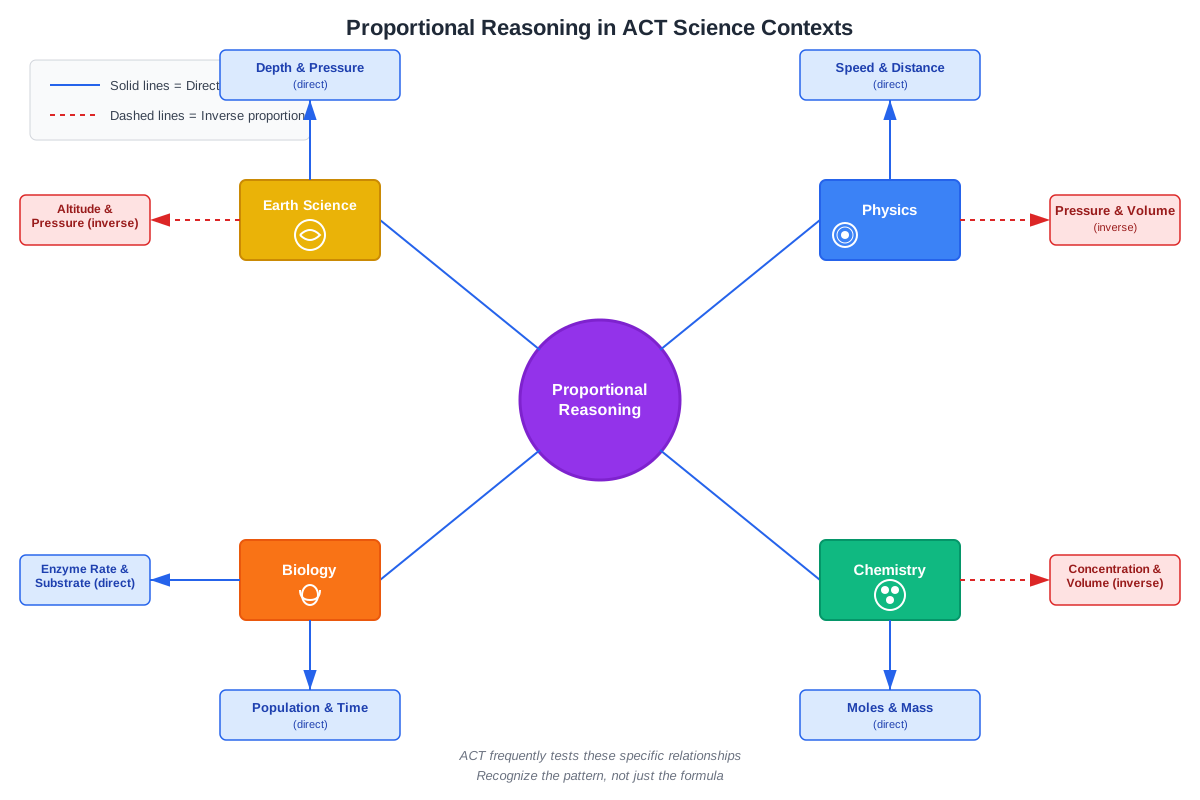
Proportional reasoning appears in approximately 20-30% of ACT Science questions, making it one of the highest-yield topics for score improvement. This skill transcends individual scientific disciplines, appearing in physics problems involving speed and distance, chemistry questions about concentration and volume, biology data on population growth, and earth science scenarios involving temperature and altitude. The ACT specifically designs questions to test whether students can move beyond rote memorization to apply mathematical reasoning in scientific contexts.
In real-world applications, proportional reasoning underpins countless scientific and practical scenarios. Pharmacists use it to calculate medication dosages based on patient weight, engineers apply it to scale models and prototypes, environmental scientists employ it to project pollution levels, and economists utilize it to analyze market trends. The ability to recognize and work with proportional relationships represents a fundamental component of quantitative literacy that extends far beyond standardized testing.
On the ACT Science test, proportional reasoning most commonly appears in Data Representation passages featuring graphs and tables, where students must extrapolate values beyond the given data range or interpolate between data points. Research Summary passages frequently test this skill when comparing experimental conditions or predicting outcomes under modified parameters. Even Conflicting Viewpoints passages may require proportional reasoning when evaluating quantitative evidence supporting different scientific hypotheses. Questions typically ask students to predict values, compare rates of change, or identify which variables maintain proportional relationships across different conditions.
Core Concepts
Direct Proportional Relationships
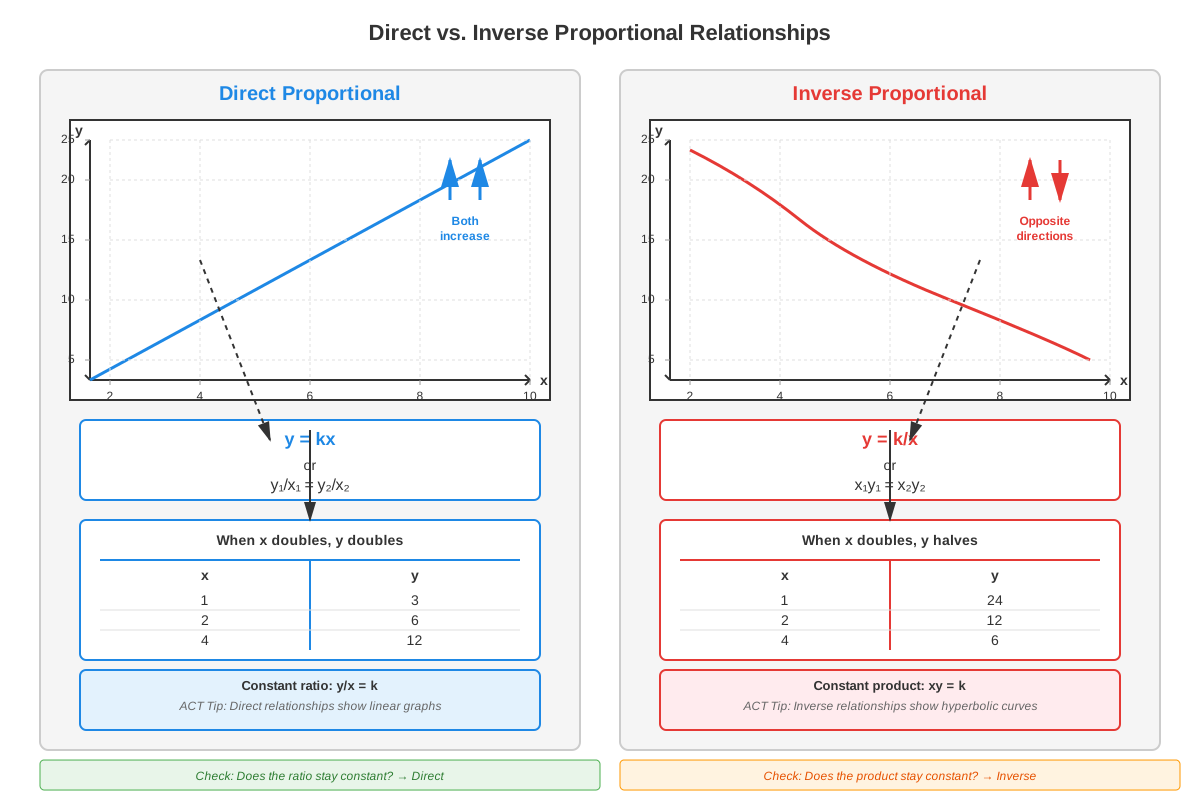
A direct proportional relationship exists when two variables change in the same direction at a constant rate. As one variable increases, the other increases proportionally; as one decreases, the other decreases proportionally. Mathematically, this relationship is expressed as y = kx, where k represents the constant of proportionality. The key characteristic of direct proportionality is that the ratio y/x remains constant across all data points.
On the ACT Science test, direct proportional relationships appear frequently in graphs as straight lines passing through the origin (0,0). However, students must recognize that not all linear relationships are proportional—only those with a y-intercept of zero qualify. When examining tables, direct proportionality can be identified by calculating the ratio between corresponding values; if this ratio remains constant, the relationship is directly proportional.
Common examples include:
- Distance traveled at constant speed versus time elapsed
- Mass of a substance versus its volume (density relationship)
- Force applied versus acceleration produced (when mass is constant)
- Number of organisms versus total biomass (when individual mass is constant)
Inverse Proportional Relationships
An inverse proportional relationship (also called indirect or reciprocal proportionality) occurs when two variables change in opposite directions such that their product remains constant. As one variable increases, the other decreases proportionally. This relationship follows the form y = k/x or xy = k, where k is the constant of proportionality. The ratio of one variable to the reciprocal of the other remains constant.
Graphically, inverse proportional relationships appear as hyperbolic curves that approach but never touch the axes. In tables, students can identify inverse proportionality by multiplying corresponding x and y values—if the product remains constant, the relationship is inversely proportional. The ACT frequently tests whether students can distinguish between direct and inverse relationships, as confusing these leads to incorrect predictions.
Common examples include:
- Pressure versus volume of a gas at constant temperature (Boyle's Law)
- Speed versus time to travel a fixed distance
- Concentration versus volume when amount of solute is constant
- Wavelength versus frequency of electromagnetic radiation
Recognizing Proportional Patterns in Data
The ACT Science section rarely asks students to perform complex calculations. Instead, questions focus on pattern recognition and logical reasoning. When examining a data table, students should look for consistent multiplicative relationships. If variable A doubles and variable B also doubles, a direct proportional relationship likely exists. If variable A doubles and variable B is cut in half, an inverse proportional relationship is indicated.
For graphical data, proportional reasoning involves extending trends beyond the given data range. The ACT commonly presents a graph with data points ranging from x = 0 to x = 50, then asks what value y would have at x = 75. Students must recognize whether the relationship is linear and proportional, then apply the appropriate reasoning to extrapolate the answer.
Setting Up Proportional Equations
When ACT questions require calculation, the most reliable approach involves setting up a proportion equation. This method uses the principle that equivalent ratios can be cross-multiplied to solve for unknown values. The general form is:
a/b = c/dWhere three values are known and one is unknown. Cross-multiplying gives ad = bc, which can be solved for the unknown variable. This approach works for both direct and inverse relationships, though the setup differs.
For direct proportions, corresponding values are placed in the same position:
value₁/value₂ = new_value₁/new_value₂For inverse proportions, the relationship is reciprocal:
value₁ × value₂ = new_value₁ × new_value₂Scaling and Unit Conversion
Proportional reasoning extends to problems involving unit conversion and scaling. When the ACT presents data in one unit system and asks for answers in another, proportional relationships govern the conversion. Similarly, when experimental conditions are scaled up or down, proportional reasoning determines how dependent variables change.
The key principle is maintaining consistent ratios. If an experiment uses 50 mL of solution and produces 10 grams of product, scaling to 150 mL (a 3× increase) should produce 30 grams of product (also a 3× increase), assuming a directly proportional relationship. The ACT tests whether students can apply this reasoning across various scientific contexts.
Concept Relationships
The concepts within proportional reasoning form an interconnected framework. Direct proportional relationships and inverse proportional relationships represent two fundamental patterns that students must distinguish. Both rely on the principle of constant ratios, but they differ in whether variables change in the same or opposite directions. Recognizing proportional patterns in data serves as the diagnostic skill that determines which type of relationship exists, enabling students to set up proportional equations correctly.
Setting up proportional equations connects directly to both direct and inverse relationships, providing the mathematical tool to calculate specific values once the relationship type is identified. Scaling and unit conversion represent practical applications of proportional reasoning, demonstrating how the same principles apply across different contexts and measurement systems.
The relationship map flows as follows:
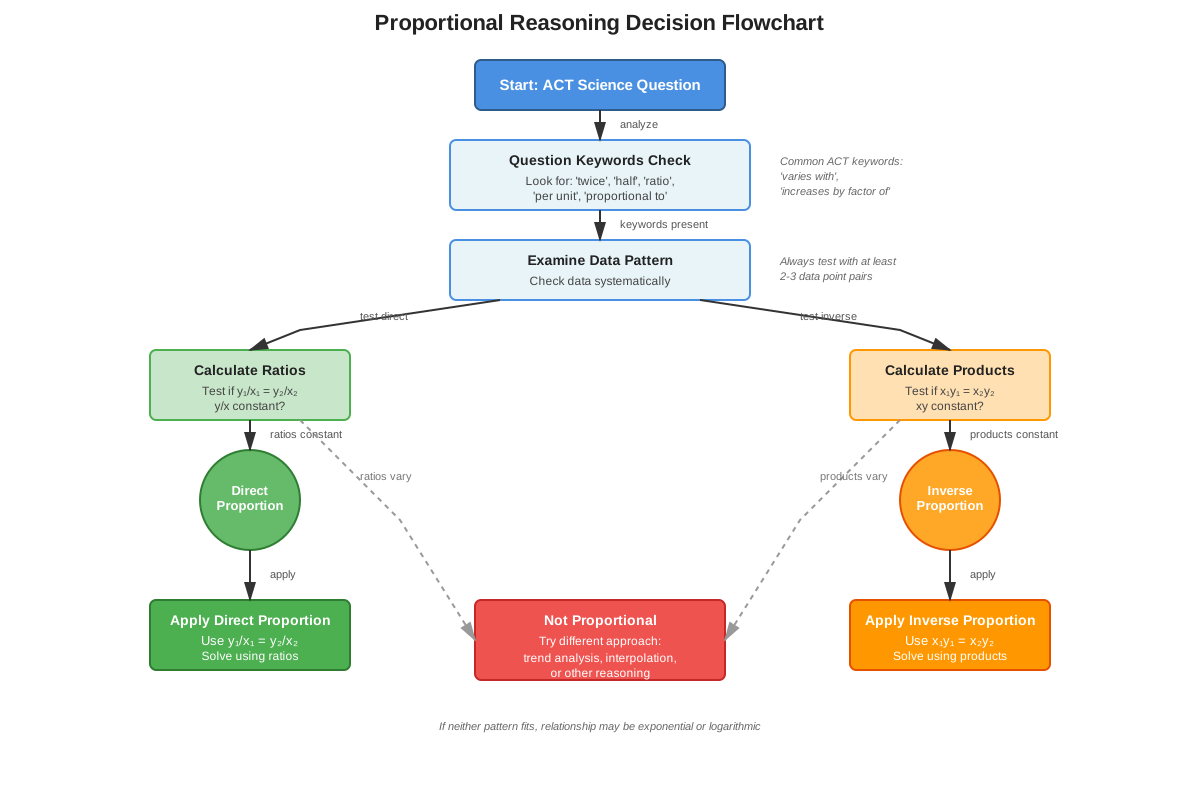
Data Analysis → Pattern Recognition → Relationship Classification (Direct vs. Inverse) → Equation Setup → Problem Solution
This topic builds on prerequisite knowledge of ratios and fractions, as proportional reasoning is fundamentally about comparing ratios. Graph interpretation skills enable students to visualize proportional relationships and identify them quickly. The connection to broader ACT Science skills includes trend analysis, data extrapolation, and experimental design evaluation—all of which frequently involve proportional thinking.
High-Yield Facts
⭐ Direct proportional relationships maintain a constant ratio y/x and graph as straight lines through the origin
⭐ Inverse proportional relationships maintain a constant product xy and graph as hyperbolic curves
⭐ When one variable doubles in a direct proportion, the other variable also doubles
⭐ When one variable doubles in an inverse proportion, the other variable is cut in half
⭐ Not all linear relationships are proportional—only those with y-intercept of zero
- Proportional reasoning questions appear in approximately 20-30% of ACT Science passages
- Cross-multiplication (ad = bc from a/b = c/d) is the most reliable method for solving proportion problems
- The constant of proportionality (k) can be calculated from any data point in a proportional relationship
- Proportional relationships can be identified in tables by checking if ratios or products remain constant
- Extrapolation beyond given data ranges requires assuming the proportional relationship continues
Quick check — test yourself on Proportional reasoning so far.
Try Flashcards →Common Misconceptions
Misconception: All linear relationships are proportional relationships.
Correction: Only linear relationships that pass through the origin (y-intercept = 0) are proportional. A line with equation y = 2x + 5 is linear but not proportional because when x = 0, y ≠ 0. The ratio y/x is not constant across all points.
Misconception: If two variables both increase, they must be directly proportional.
Correction: Variables can both increase without being proportional. For example, in y = x², both variables increase together, but the relationship is quadratic, not proportional. Direct proportionality requires that the ratio y/x remains constant, which means the rate of increase must be constant, not accelerating or decelerating.
Misconception: Inverse proportional relationships mean the variables are negatively correlated.
Correction: Inverse proportionality is a specific mathematical relationship (xy = k) where variables change in opposite directions at a specific rate. Negative correlation is a broader statistical concept. Two variables can be negatively correlated without being inversely proportional, and inverse proportionality is more restrictive than simple negative correlation.
Misconception: Proportional reasoning can be applied to any two variables that appear related in a data set.
Correction: Proportional relationships must be verified before applying proportional reasoning. The ACT includes data sets with exponential, logarithmic, or other non-proportional relationships. Students must check whether ratios (for direct) or products (for inverse) remain constant before assuming proportionality.
Misconception: When setting up proportions, units don't matter as long as the numbers are correct.
Correction: Units must be consistent within each ratio. If the numerator is in meters, the denominator must be in the same units across the proportion. Mixing units (e.g., meters in one ratio, centimeters in another) leads to incorrect answers. Unit consistency is essential for accurate proportional reasoning.
Misconception: Proportional relationships always involve simple whole number ratios.
Correction: The constant of proportionality can be any real number, including decimals and fractions. A relationship where y = 0.37x is just as proportional as one where y = 2x. The ACT frequently uses non-integer constants to test true understanding rather than pattern matching with simple numbers.
Worked Examples
Example 1: Direct Proportional Relationship in a Data Table
Problem: A student conducts an experiment measuring the distance a spring stretches when different masses are attached. The data table shows:
| Mass (g) | Stretch (cm) |
|---|---|
| 10 | 2.5 |
| 20 | 5.0 |
| 30 | 7.5 |
| 40 | 10.0 |
Based on this data, what stretch distance would be expected for a mass of 55 grams?
Solution:
Step 1: Identify the relationship type. Calculate the ratio of stretch to mass for each data point:
- 2.5/10 = 0.25
- 5.0/20 = 0.25
- 7.5/30 = 0.25
- 10.0/40 = 0.25
The ratio is constant, confirming a direct proportional relationship.
Step 2: Set up a proportion using any known data point and the unknown:
2.5/10 = x/55Step 3: Cross-multiply and solve:
10x = 2.5 × 55
10x = 137.5
x = 13.75 cm
Step 4: Verify the answer makes sense. Since 55 g is between 50 g and 60 g, the stretch should be between 12.5 cm (for 50 g) and 15.0 cm (for 60 g). The answer of 13.75 cm fits this range.
Connection to Learning Objectives: This example demonstrates identifying when proportional reasoning is being tested (constant ratios in the table), explaining the core strategy (setting up equivalent ratios), and applying it accurately to find a specific value.
Example 2: Inverse Proportional Relationship in a Graph
Problem: An experiment examines the relationship between the pressure and volume of a gas at constant temperature. The graph shows pressure on the y-axis (in kPa) and volume on the x-axis (in mL). At 100 mL, the pressure is 200 kPa. At 200 mL, the pressure is 100 kPa. What pressure would be expected at 50 mL?
Solution:
Step 1: Identify the relationship type. Check if the product of corresponding values is constant:
- 100 mL × 200 kPa = 20,000
- 200 mL × 100 kPa = 20,000
The product is constant, confirming an inverse proportional relationship.
Step 2: Set up the inverse proportion equation using the constant product:
V₁ × P₁ = V₂ × P₂
100 × 200 = 50 × P₂
Step 3: Solve for the unknown pressure:
20,000 = 50 × P₂
P₂ = 20,000/50
P₂ = 400 kPa
Step 4: Verify the logic. As volume decreases from 100 mL to 50 mL (cut in half), pressure should increase from 200 kPa to 400 kPa (doubled). This inverse relationship makes sense.
Connection to Learning Objectives: This example shows how to distinguish inverse from direct proportional relationships, apply the appropriate strategy (constant product rather than constant ratio), and verify the answer through logical reasoning about the relationship direction.
Exam Strategy
When approaching ACT Science questions involving proportional reasoning, begin by identifying trigger words and phrases. Look for language such as "directly proportional," "inversely proportional," "constant rate," "linear relationship," or questions asking to "predict," "extrapolate," or "estimate" values beyond the given data range. Questions that ask "if X doubles, what happens to Y?" are classic proportional reasoning prompts.
Exam Tip: Before attempting any calculation, invest 10-15 seconds determining whether the relationship is direct, inverse, or neither. This diagnostic step prevents the most common error—applying the wrong type of proportional reasoning.
The most efficient approach follows this sequence:
- Scan the data (table or graph) for patterns
- Test for proportionality by checking ratios (direct) or products (inverse)
- Set up the appropriate equation based on relationship type
- Solve using cross-multiplication or the constant product method
- Verify the answer makes logical sense given the relationship direction
For process-of-elimination strategies, recognize that incorrect answer choices often result from:
- Applying inverse reasoning to a direct relationship (or vice versa)
- Adding instead of multiplying scale factors
- Confusing which variable should increase or decrease
- Using the wrong data point as the reference
Time allocation for proportional reasoning questions should typically be 30-45 seconds. These questions reward quick pattern recognition rather than lengthy calculations. If a problem seems to require complex mathematics, reconsider the approach—the ACT Science section emphasizes reasoning over computation.
Trigger phrases to watch for:
- "Based on the trend shown..."
- "If the pattern continues..."
- "At constant [variable]..."
- "Directly related to..."
- "Inversely related to..."
- "Proportional to..."
Memory Techniques
DIRECT Mnemonic for Direct Proportional Relationships:
- Doubling one doubles the other
- Increases together
- Ratio stays constant
- Equation: y = kx
- Cross through origin
- Together they rise or fall
INVERSE Mnemonic for Inverse Proportional Relationships:
- Increase one, decrease the other
- Never touch the axes (hyperbolic graph)
- Values multiply to constant
- Equation: xy = k
- Reciprocal relationship
- See-saw motion (one up, one down)
- Example: Boyle's Law
Visualization Strategy: Picture a see-saw for inverse relationships—when one side goes up, the other must come down. For direct relationships, visualize two people walking together at the same pace—when one speeds up, so does the other.
The "Double-Check" Rule: When a variable doubles, ask yourself: "Does the other variable double (direct) or halve (inverse)?" This simple question quickly identifies the relationship type and prevents the most common errors.
Summary
Proportional reasoning represents a critical skill for ACT Science success, appearing in approximately one-quarter of all questions across various passage types. The core principle involves recognizing and applying relationships where variables change at constant rates relative to one another. Direct proportional relationships maintain constant ratios (y/x = k) and appear as straight lines through the origin, while inverse proportional relationships maintain constant products (xy = k) and appear as hyperbolic curves. Success requires distinguishing between these relationship types, setting up appropriate equations, and applying logical reasoning to predict values. The ACT emphasizes pattern recognition over complex calculation, rewarding students who can quickly identify proportional relationships in tables and graphs, then extrapolate or interpolate values accurately. Mastery involves not only applying proportional reasoning when appropriate but also recognizing when relationships are non-proportional and avoiding incorrect application of these strategies.
Key Takeaways
- Proportional reasoning appears in 20-30% of ACT Science questions, making it one of the highest-yield topics for score improvement
- Direct proportional relationships maintain constant ratios (y/x = k), while inverse proportional relationships maintain constant products (xy = k)
- Always verify proportionality before applying proportional reasoning—not all relationships that appear related are actually proportional
- The most efficient solution method involves setting up proportion equations and using cross-multiplication rather than attempting complex calculations
- When one variable doubles in a direct proportion, the other doubles; in an inverse proportion, the other is cut in half
- Graph analysis reveals proportionality through line shape: straight lines through the origin indicate direct proportionality, while hyperbolic curves suggest inverse proportionality
- Time efficiency comes from quick pattern recognition—invest 10-15 seconds identifying the relationship type before attempting any calculations
Related Topics
Trend Analysis and Data Interpretation: Building on proportional reasoning, this topic explores more complex patterns including exponential growth, logarithmic relationships, and polynomial trends. Mastering proportional reasoning provides the foundation for recognizing when relationships deviate from simple proportionality.
Experimental Design and Variable Relationships: Understanding how independent and dependent variables relate through proportional and non-proportional relationships enhances the ability to evaluate experimental methodology and predict outcomes under modified conditions.
Graph Interpretation and Extrapolation: This broader skill set includes proportional reasoning as one tool among many for extracting information from visual data representations, including non-linear relationships and multi-variable graphs.
Quantitative Analysis in Research Summaries: Proportional reasoning integrates with statistical thinking and experimental comparison when evaluating multiple studies or comparing results across different experimental conditions.
Practice CTA
Now that you've mastered the core concepts of proportional reasoning, it's time to solidify your understanding through active practice. The practice questions and flashcards designed for this topic will challenge you to apply these principles in varied contexts, mimicking the exact style and difficulty of actual ACT Science questions. Each practice problem provides an opportunity to refine your pattern recognition skills and build the confidence needed to tackle proportional reasoning questions quickly and accurately on test day. Remember, the difference between knowing these concepts and scoring points lies in repeated application—so dive into the practice materials and watch your proportional reasoning skills transform from theoretical knowledge into automatic, test-day-ready expertise!
Sign up free to keep reading
Create a free AnvayaPrep account to finish this ACT guide on Proportional reasoning — plus flashcards and practice questions.