Overview
Units and conversions form a critical foundation for success on the ACT Science test, appearing in approximately 15-20% of all science questions across biology, chemistry, physics, and Earth science passages. The ability to recognize, interpret, and convert between different measurement systems represents an essential scientific reasoning skill that the ACT consistently evaluates. Students who master this topic gain a significant advantage because unit-related questions often serve as "giveaway" points—they test methodical thinking rather than advanced content knowledge.
The ACT Science section frequently embeds unit conversions within data representation passages, research summaries, and conflicting viewpoints scenarios. Questions may ask students to convert metric to imperial units, recognize equivalent measurements, identify appropriate units for specific quantities, or detect unit inconsistencies in experimental data. Unlike pure mathematics problems, ACT units and conversions questions typically appear within scientific contexts, requiring students to understand both the mathematical mechanics of conversion and the conceptual meaning of different measurement systems.
Understanding units and conversions connects directly to broader scientific reasoning competencies tested on the ACT, including data interpretation, experimental design evaluation, and hypothesis testing. When students can fluently work with units, they better comprehend graphs with labeled axes, tables with multiple measurement systems, and experimental procedures that require precise quantification. This topic serves as a bridge between mathematical literacy and scientific thinking, making it indispensable for achieving competitive scores in the Science section.
Learning Objectives
- [ ] Identify when Units and conversions is being tested in ACT Science passages
- [ ] Explain the core rule or strategy behind Units and conversions
- [ ] Apply Units and conversions to ACT-style questions accurately
- [ ] Convert between metric system units using powers of ten
- [ ] Convert between imperial and metric systems using standard conversion factors
- [ ] Recognize when unit inconsistencies invalidate experimental conclusions
- [ ] Determine appropriate units for derived quantities (e.g., density, velocity, concentration)
Prerequisites
- Basic arithmetic operations: Multiplication, division, and working with decimals are essential for performing conversion calculations efficiently
- Scientific notation: Understanding powers of ten enables quick metric conversions and helps manage very large or small quantities
- Fraction manipulation: Many conversion factors are expressed as fractions, requiring comfort with multiplying and canceling units
- Reading graphs and tables: Unit information typically appears on axis labels and column headers, requiring careful attention to data presentation
Why This Topic Matters
Units and conversions represent a universal language in science, enabling researchers worldwide to communicate findings accurately and replicate experiments reliably. In real-world applications, unit errors have caused catastrophic failures—the Mars Climate Orbiter crashed in 1999 due to a confusion between metric and imperial units, costing $327 million. Medical professionals must convert drug dosages between milligrams and micrograms daily, where mistakes can prove fatal. Engineers routinely convert between measurement systems when collaborating internationally or working with legacy specifications.
On the ACT Science test, unit-related questions appear in approximately 3-5 questions per exam, distributed across different passage types. These questions typically fall into three categories: direct conversion problems (20% of unit questions), unit identification and interpretation (50%), and error detection in experimental design (30%). Data Representation passages most frequently test units through graph interpretation, while Research Summaries passages often embed conversions within experimental procedures or results analysis.
Common ACT manifestations include: comparing data sets presented in different units, identifying which graph correctly represents converted data, determining whether experimental measurements use appropriate units, recognizing when unit mismatches explain unexpected results, and calculating derived quantities that require unit manipulation. The ACT favors practical, everyday units (meters, grams, liters, seconds) over obscure specialized units, making this topic highly learnable through focused preparation.
Core Concepts
The Metric System (SI Units)
The metric system, formally known as the International System of Units (SI), provides the foundation for scientific measurement worldwide. This decimal-based system uses seven base units from which all other measurements derive. The ACT primarily tests four base units: the meter (m) for length, the kilogram (kg) for mass, the second (s) for time, and the kelvin (K) for temperature. Additionally, the liter (L), though technically a derived unit, appears frequently in chemistry and biology contexts.
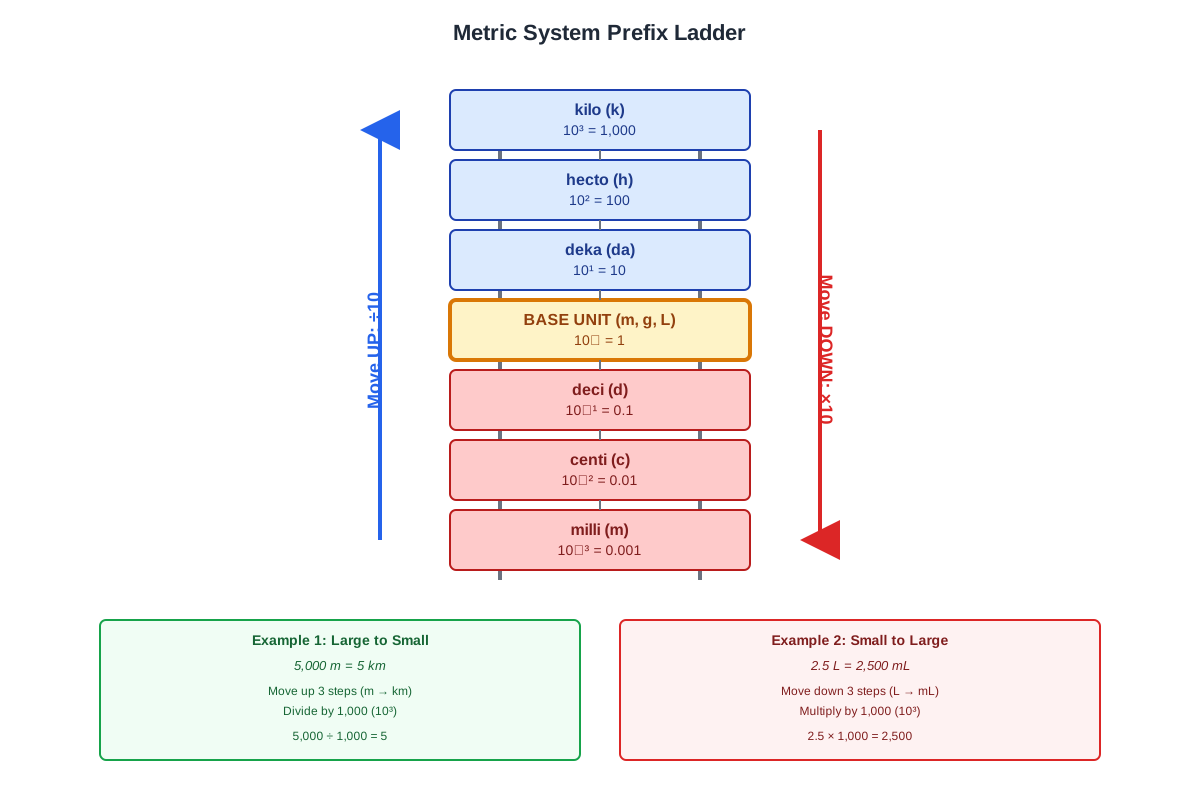
The metric system's power lies in its use of prefixes that modify base units by powers of ten. Understanding these prefixes enables rapid mental conversions without complex calculations:
| Prefix | Symbol | Power of 10 | Decimal Equivalent | Common Example |
|---|---|---|---|---|
| kilo- | k | 10³ | 1,000 | kilometer (km) |
| hecto- | h | 10² | 100 | hectometer (hm) |
| deka- | da | 10¹ | 10 | dekameter (dam) |
| (base) | — | 10⁰ | 1 | meter (m) |
| deci- | d | 10⁻¹ | 0.1 | decimeter (dm) |
| centi- | c | 10⁻² | 0.01 | centimeter (cm) |
| milli- | m | 10⁻³ | 0.001 | millimeter (mm) |
| micro- | μ | 10⁻⁶ | 0.000001 | micrometer (μm) |
| nano- | n | 10⁻⁹ | 0.000000001 | nanometer (nm) |
Metric Conversion Strategy
Converting within the metric system requires only moving the decimal point. The number of places moved equals the difference in powers of ten between the units. When converting from a larger unit to a smaller unit, multiply (move decimal right); when converting from smaller to larger, divide (move decimal left).
Example: Convert 2.5 kilometers to centimeters.
- From kilo- (10³) to centi- (10⁻²) represents a change of 5 powers of ten
- Moving to a smaller unit requires multiplication: 2.5 × 10⁵ = 250,000 cm
Imperial System Units
The imperial system (also called U.S. customary units) uses non-decimal relationships between units, making conversions more challenging. The ACT tests common imperial units including inches, feet, yards, and miles for length; ounces and pounds for weight; and fluid ounces, cups, pints, quarts, and gallons for volume.
Key imperial relationships frequently tested:
- Length: 12 inches = 1 foot; 3 feet = 1 yard; 5,280 feet = 1 mile
- Weight: 16 ounces = 1 pound; 2,000 pounds = 1 ton
- Volume: 8 fluid ounces = 1 cup; 2 cups = 1 pint; 2 pints = 1 quart; 4 quarts = 1 gallon
Metric-Imperial Conversions
The ACT provides conversion factors when necessary, but memorizing common conversions saves valuable time. The dimensional analysis method (also called factor-label method or unit cancellation) provides a foolproof approach to complex conversions.
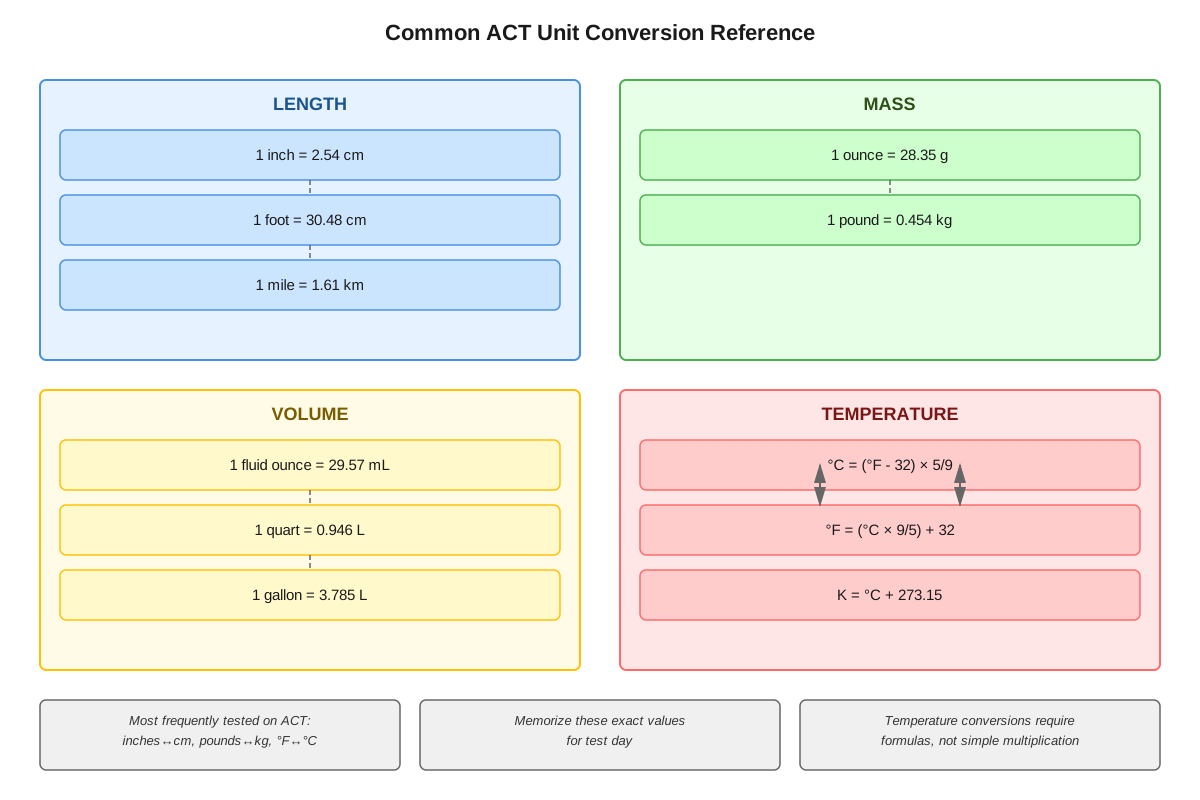
Essential metric-imperial conversion factors:
- 1 inch = 2.54 centimeters (exact)
- 1 meter ≈ 3.28 feet
- 1 kilometer ≈ 0.621 miles
- 1 kilogram ≈ 2.20 pounds
- 1 liter ≈ 0.264 gallons
Dimensional Analysis Method
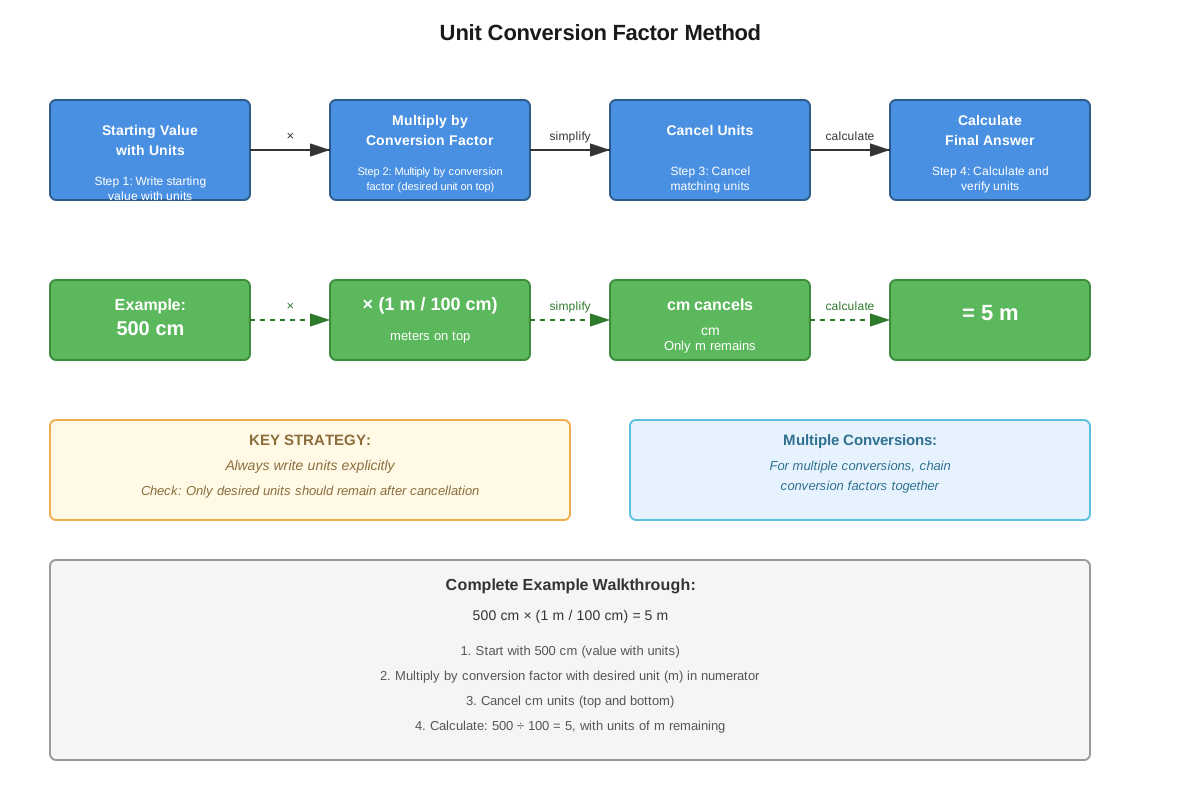
Dimensional analysis uses conversion factors written as fractions to systematically cancel unwanted units and arrive at desired units. Each conversion factor equals 1 (since numerator and denominator represent equivalent quantities), so multiplying by conversion factors doesn't change the actual value—only its expression.
Steps for dimensional analysis:
- Write the given quantity with its units
- Multiply by conversion factors arranged so unwanted units cancel
- Continue until only desired units remain
- Perform the arithmetic calculation
- Verify that final units match the question's requirements
Example: Convert 50 miles per hour to meters per second.
50 miles/hour × (5,280 feet/1 mile) × (12 inches/1 foot) × (2.54 cm/1 inch) × (1 m/100 cm) × (1 hour/3,600 seconds)
= 50 × 5,280 × 12 × 2.54 × 1 × 1 / (1 × 1 × 1 × 100 × 3,600)
≈ 22.4 m/s
Derived Units and Compound Units
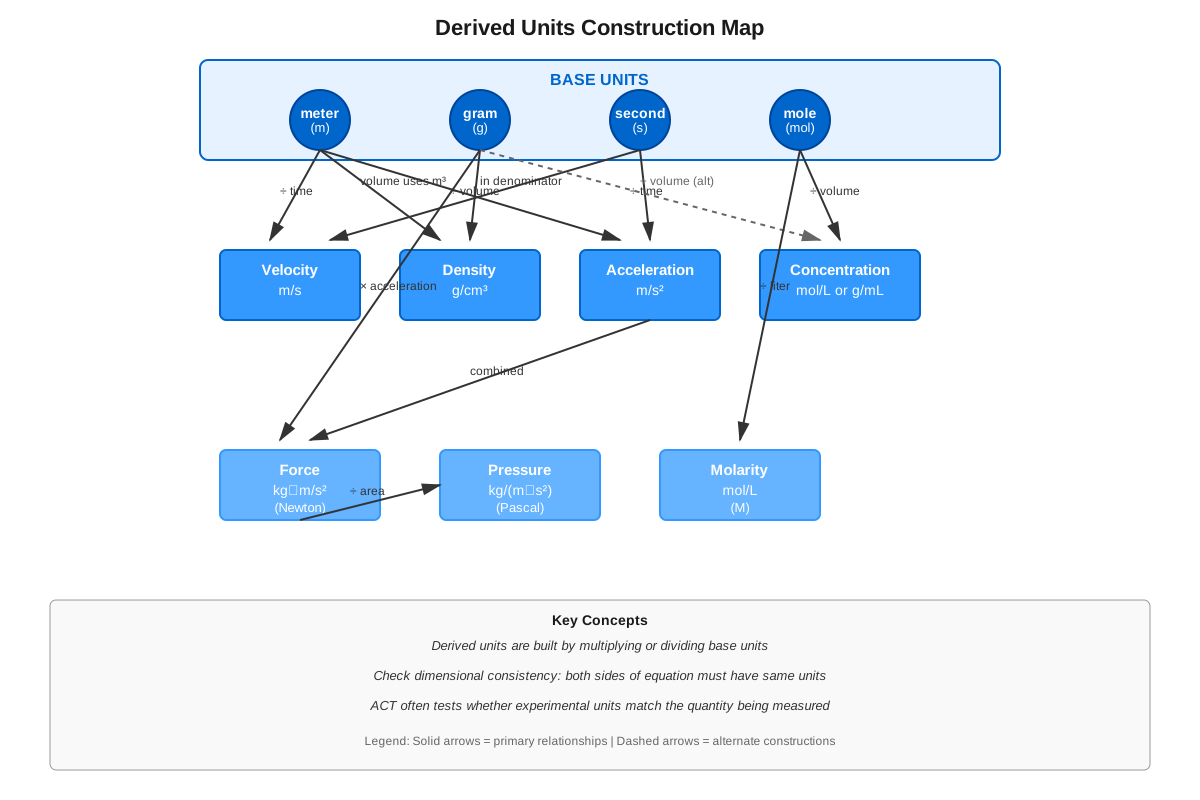
Many scientific quantities use derived units formed by combining base units. The ACT frequently tests whether students recognize appropriate units for common derived quantities:
- Density: mass/volume (g/cm³, kg/L, g/mL)
- Velocity: distance/time (m/s, km/h, mph)
- Acceleration: velocity/time (m/s², ft/s²)
- Concentration: amount/volume (mol/L, g/L, mg/mL)
- Pressure: force/area (Pa, atm, mmHg, psi)
- Energy: force × distance (joules, calories, BTU)
Understanding the component units helps identify errors and perform conversions. For example, converting density from g/cm³ to kg/m³ requires converting both the mass unit (g to kg) and the volume unit (cm³ to m³).
Temperature Conversions
Temperature presents unique conversion challenges because different scales use different zero points and degree sizes. The ACT tests three temperature scales:
- Celsius (°C): Water freezes at 0°C, boils at 100°C
- Fahrenheit (°F): Water freezes at 32°F, boils at 212°F
- Kelvin (K): Absolute zero at 0 K, water freezes at 273.15 K
Conversion formulas:
°F = (9/5)°C + 32
°C = (5/9)(°F - 32)
K = °C + 273.15
Note that Kelvin uses no degree symbol and represents an absolute scale (no negative values possible).
Unit Consistency in Calculations
Scientific calculations require unit consistency—all quantities must use compatible units before performing operations. The ACT tests this concept by presenting scenarios where mixing units produces incorrect results or by asking students to identify which data set uses consistent units.
When adding or subtracting quantities, units must be identical. When multiplying or dividing, units combine algebraically (multiply in numerator, divide in denominator). This principle allows checking whether an answer makes sense: if calculating velocity (distance/time), the final units must reduce to a distance unit divided by a time unit.
Concept Relationships
The metric system prefixes → enable rapid within-system conversions → which form the foundation for → more complex metric-imperial conversions. Understanding base units and derived units → allows recognition of appropriate measurement units → which enables detection of experimental design errors involving unit mismatches.
Dimensional analysis → provides a systematic method for → converting between any unit systems → and naturally extends to → verifying unit consistency in calculations. Temperature conversions → require special formulas due to different zero points → connecting to the broader concept that → not all unit conversions follow simple multiplication patterns.
Unit conversions connect to prerequisite knowledge of scientific notation by providing context for expressing very large or small measurements. They extend to graph interpretation skills by requiring careful attention to axis labels and scale units. This topic also relates to experimental design evaluation, as appropriate unit selection affects measurement precision and data comparability across studies.
High-Yield Facts
⭐ The metric system uses powers of ten for all conversions between prefixed units, making mental math possible by moving decimal points.
⭐ When converting from larger to smaller units, multiply (or move decimal right); when converting from smaller to larger units, divide (or move decimal left).
⭐ Dimensional analysis allows any conversion by multiplying by fractions equal to 1, arranged so unwanted units cancel.
⭐ Temperature conversions require special formulas because Celsius, Fahrenheit, and Kelvin use different zero points and degree sizes.
⭐ Derived units (like density, velocity, or concentration) combine base units and require converting each component separately.
- The ACT always provides necessary conversion factors for uncommon or complex conversions within passage text or question stems.
- Unit consistency errors in experimental design often explain unexpected results or conflicting data between studies.
- 1 milliliter (mL) equals exactly 1 cubic centimeter (cm³ or cc), a relationship frequently tested in biology and chemistry contexts.
- Kelvin temperatures cannot be negative because the scale begins at absolute zero, the theoretical lowest possible temperature.
- When multiplying or dividing quantities with units, treat units algebraically: m/s × s = m (seconds cancel).
- The prefix "micro-" (μ) represents one-millionth, while "milli-" represents one-thousandth—confusing these causes thousand-fold errors.
- Converting squared or cubed units requires squaring or cubing the conversion factor (e.g., 1 m² = 10,000 cm² because 1 m = 100 cm, and 100² = 10,000).
Quick check — test yourself on Units and conversions so far.
Try Flashcards →Common Misconceptions
Misconception: All unit conversions simply require multiplying by a conversion factor.
Correction: Temperature conversions require formulas with addition/subtraction terms because different scales use different zero points. Converting °C to °F isn't just multiplication—it requires the formula °F = (9/5)°C + 32.
Misconception: When converting area or volume units, use the same conversion factor as for length.
Correction: Area conversions require squaring the linear conversion factor, and volume conversions require cubing it. For example, since 1 m = 100 cm, then 1 m² = 10,000 cm² (not 100 cm²) and 1 m³ = 1,000,000 cm³ (not 100 cm³).
Misconception: Larger numbers always correspond to larger units.
Correction: The numerical value and unit size have an inverse relationship. A larger measurement in smaller units converts to a smaller number in larger units. For example, 5,000 millimeters equals 5 meters—the number decreased because meters are larger units.
Misconception: The metric prefixes kilo-, centi-, and milli- mean the same thing regardless of the base unit.
Correction: While the prefixes maintain their power-of-ten meanings (kilo- = 10³, centi- = 10⁻², milli- = 10⁻³), students sometimes forget that these multiply the base unit. A kilogram is 1,000 grams, but a kilometer is 1,000 meters—different absolute quantities despite the same prefix.
Misconception: Units don't matter as long as the numerical calculation is correct.
Correction: Units carry essential information about what a number represents. The number "5" means completely different things when expressed as 5 meters versus 5 centimeters versus 5 kilometers. The ACT specifically tests whether students track units through calculations and recognize when unit errors invalidate conclusions.
Misconception: Kelvin and Celsius degrees are different sizes.
Correction: A change of 1 Kelvin equals a change of 1 degree Celsius—the degree sizes are identical. The scales differ only in their zero points (Kelvin starts at absolute zero, Celsius starts at water's freezing point). This means temperature changes convert simply (ΔT in K = ΔT in °C), but absolute temperatures require adding 273.15.
Worked Examples
Example 1: Multi-Step Metric-Imperial Conversion
Problem: A research study reports that a bacterial culture grew at a rate of 3.5 millimeters per hour. Convert this growth rate to inches per day.
Solution:
Step 1: Identify the given quantity and desired units.
- Given: 3.5 mm/hour
- Desired: inches/day
Step 2: Set up dimensional analysis with appropriate conversion factors.
- Need to convert mm → inches (metric to imperial length)
- Need to convert hours → days (time unit)
Step 3: Apply conversion factors systematically.
3.5 mm/hour × (1 cm/10 mm) × (1 inch/2.54 cm) × (24 hours/1 day)Step 4: Cancel units and calculate.
- mm cancels with mm
- cm cancels with cm
- hours cancels with hours
- Remaining units: inches/day
= (3.5 × 1 × 1 × 24)/(10 × 2.54 × 1) inches/day
= 84/25.4 inches/day
≈ 3.31 inches/day
Step 5: Verify the answer makes sense.
- 3.5 mm/hour is a small rate
- Converting to larger units (inches) and longer time (day) should increase the number
- 3.31 inches/day is reasonable
Connection to Learning Objectives: This example demonstrates applying units and conversions to ACT-style questions by using dimensional analysis (core strategy) and recognizing when conversions are needed (identification skill).
Example 2: Identifying Unit Inconsistency in Experimental Data
Problem: A student conducted an experiment measuring the density of different liquids. The data table shows:
| Liquid | Mass | Volume | Calculated Density |
|---|---|---|---|
| Water | 50 g | 50 mL | 1.0 g/mL |
| Oil | 45 g | 50 mL | 0.9 g/mL |
| Ethanol | 39.5 g | 5 cm³ | 7.9 g/cm³ |
The student concluded that ethanol is much denser than water. Identify the error and calculate the correct density.
Solution:
Step 1: Examine units for consistency.
- Water and oil: volume in mL
- Ethanol: volume in cm³
- The volume units differ, but 1 mL = 1 cm³, so this isn't the problem
Step 2: Check the volume values.
- Water: 50 mL
- Oil: 50 mL
- Ethanol: 5 cm³ (equivalent to 5 mL)
- This is much smaller than the other volumes—possible data entry error
Step 3: Recalculate ethanol density assuming the volume should be 50 cm³ (consistent with other trials).
Density = Mass/Volume = 39.5 g / 50 cm³ = 0.79 g/cm³Step 4: Compare to the student's calculation.
- Student calculated: 7.9 g/cm³
- Correct value: 0.79 g/cm³
- The student's value is exactly 10 times too large, confirming a decimal point error in the volume measurement
Step 5: Evaluate the conclusion.
- Ethanol density (0.79 g/cm³) is actually less than water (1.0 g/mL)
- The student's conclusion was incorrect due to the measurement error
- Proper unit tracking would have revealed the inconsistency
Connection to Learning Objectives: This example shows how to identify when units and conversions are being tested (recognizing unit inconsistencies), explain the core strategy (checking unit consistency across data sets), and apply this knowledge to detect experimental errors.
Exam Strategy
When approaching ACT Science questions involving units and conversions, begin by carefully reading all axis labels, table headers, and measurement units in the passage. The ACT often tests whether students notice unit differences between data sets or graphs. Circle or underline units as you read to maintain awareness.
Trigger words and phrases that signal unit conversion questions include:
- "Convert the measurement to..."
- "Expressed in units of..."
- "Which graph correctly shows the data in [different units]?"
- "The same measurement in [alternative unit system]..."
- "If the experiment had used [different units]..."
- "According to the passage, 1 [unit A] equals..."
For direct conversion questions, immediately identify whether the conversion stays within one system (metric-to-metric or imperial-to-imperial) or crosses systems (metric-to-imperial). Within-system conversions typically require only decimal point movement or simple multiplication, while cross-system conversions need specific conversion factors. If the passage doesn't provide a needed conversion factor, check the question stem—the ACT always supplies necessary information.
Process-of-elimination strategies specific to units:
- Eliminate answers with incorrect units immediately—if the question asks for meters and an answer shows grams, it's wrong regardless of the number
- Check whether the numerical value makes sense for the unit size—converting to larger units should decrease the number, converting to smaller units should increase it
- For temperature conversions, eliminate any answer that treats the conversion as simple multiplication (except for temperature changes, not absolute temperatures)
- When comparing data sets, eliminate interpretations that ignore unit differences between the sets
Time allocation: Most unit conversion questions should take 30-45 seconds once you've identified them. If a conversion requires more than two steps or involves unfamiliar units, check whether the passage provides a shortcut (like a conversion graph or pre-calculated values). Don't spend more than 60 seconds on any single conversion question—if you're stuck, make your best estimate and move on.
For questions asking about experimental design or data interpretation where units might be relevant, spend 5-10 seconds checking unit consistency before analyzing the science content. Many "conflicting results" or "unexpected findings" questions have unit mismatches as the explanation.
Memory Techniques
Metric Prefix Ladder Mnemonic: "King Henry Died By Drinking Chocolate Milk" represents the metric prefixes from largest to smallest: Kilo, Hecto, Deka, Base unit, Deci, Centi, Milli. Each step represents one power of ten. To convert, count steps between units and move the decimal that many places.
Temperature Conversion Memory Aid: For Celsius to Fahrenheit, remember "Times Two, plus Thirty" (approximately: multiply by 2, add 30). This gives a quick estimate: 20°C × 2 + 30 = 70°F (actual: 68°F). For exact conversions, remember the formula has 9/5 (which is close to 2) and 32 (close to 30).
Metric-Imperial Anchor Points: Memorize these reference points for quick estimation:
- 1 meter ≈ 1 yard (actually 1.09 yards)
- 1 kilogram ≈ 2 pounds (actually 2.2 pounds)
- 1 liter ≈ 1 quart (actually 1.06 quarts)
- 1 inch = 2.5 cm (actually 2.54 cm)
Dimensional Analysis Visualization: Picture conversion factors as "bridges" between units. Each bridge must connect the unit you have to the unit you want, with the unwanted unit on the bottom (denominator) so it cancels. Visualize drawing a line through matching units that appear in both numerator and denominator.
Unit Consistency Check: Use the acronym SAME - Same operations need All Measurements in Equivalent units. Before adding, subtracting, or comparing values, verify they use the same units.
Summary
Units and conversions represent a high-yield, learnable topic that appears consistently throughout the ACT Science section. Mastery requires understanding the metric system's power-of-ten structure, memorizing common metric-imperial conversion factors, and applying dimensional analysis for systematic conversions. The metric system uses prefixes (kilo-, centi-, milli-, etc.) that modify base units by powers of ten, enabling rapid mental conversions by moving decimal points. Imperial system conversions require memorizing specific relationships like 12 inches per foot or 16 ounces per pound. Cross-system conversions use standard factors such as 2.54 centimeters per inch or 2.2 pounds per kilogram. Temperature conversions require special formulas because different scales use different zero points. Derived units like density or velocity combine base units and require converting each component separately. The ACT tests units through direct conversion questions, graph interpretation with different unit systems, and experimental design scenarios where unit inconsistencies explain unexpected results. Success requires careful attention to unit labels, systematic application of dimensional analysis, and verification that final answers have appropriate units and reasonable numerical values.
Key Takeaways
- The metric system enables easy conversions using powers of ten—moving from larger to smaller units requires multiplication (decimal moves right), while smaller to larger requires division (decimal moves left)
- Dimensional analysis provides a foolproof conversion method by multiplying by fractions equal to 1, arranged so unwanted units cancel algebraically
- Temperature conversions require special formulas with addition/subtraction terms because Celsius, Fahrenheit, and Kelvin use different zero points
- Unit consistency is essential in scientific calculations—all quantities must use compatible units before performing operations, and final answers must have appropriate units
- The ACT tests units through direct conversions, graph interpretation, and identifying experimental errors caused by unit mismatches—carefully reading all unit labels prevents careless mistakes
- Converting area or volume units requires squaring or cubing the linear conversion factor (1 m = 100 cm, but 1 m² = 10,000 cm²)
- Memorizing common conversion factors (2.54 cm/inch, 2.2 lb/kg, 1 mL = 1 cm³) saves valuable time on test day
Related Topics
Scientific Notation and Significant Figures: Understanding how to express very large or small measurements connects directly to unit conversions, as changing units often requires adjusting the power of ten. Mastering units enables more sophisticated work with precision and measurement uncertainty.
Graph Interpretation and Data Analysis: Unit conversions frequently appear in questions asking students to compare data sets presented with different axis units or to identify which graph correctly represents converted data. Strong unit skills enhance overall graph reading ability.
Experimental Design and Variables: Recognizing appropriate units for different types of measurements (independent variables, dependent variables, controlled variables) strengthens experimental design evaluation skills. Understanding units helps identify flawed experimental procedures.
Stoichiometry and Chemical Calculations: Chemistry problems on the ACT Science test often require converting between grams, moles, liters, and molarity. The dimensional analysis method learned for unit conversions applies directly to stoichiometric calculations.
Practice CTA
Now that you've mastered the core concepts of units and conversions, it's time to solidify your understanding through active practice. Attempt the practice questions to test your ability to identify conversion opportunities, apply dimensional analysis, and avoid common unit-related errors. Use the flashcards to memorize essential conversion factors and metric prefixes until they become automatic. Remember: unit conversion questions are among the most predictable on the ACT Science test—consistent practice transforms them into reliable points that boost your score. Every conversion you practice now is one you'll execute flawlessly on test day!
Sign up free to keep reading
Create a free AnvayaPrep account to finish this ACT guide on Units and conversions — plus flashcards and practice questions.