Overview
The data sufficiency format is one of the most distinctive and challenging question types on the GMAT, appearing exclusively in the Data Insights section. Unlike traditional problem-solving questions that ask test-takers to calculate a specific answer, data sufficiency questions assess the ability to analyze information critically and determine whether given data is adequate to answer a question. This format tests logical reasoning, mathematical understanding, and analytical efficiency—skills that are essential for success in graduate business programs and real-world business decision-making.
Understanding the GMAT data sufficiency format is crucial because these questions comprise a significant portion of the Data Insights section and require a fundamentally different approach than standard quantitative problems. Rather than solving for a numerical answer, students must evaluate the sufficiency of information provided in two separate statements, either individually or in combination. This unique structure demands that test-takers develop specialized strategies to avoid common traps, manage time effectively, and recognize patterns that indicate sufficiency or insufficiency.
The data sufficiency format connects deeply to other Data Insights concepts by requiring integration of quantitative reasoning, algebraic manipulation, geometric principles, and statistical analysis. Mastery of this format enhances overall analytical thinking and prepares students for the integrated reasoning demands of modern business environments, where determining what information is needed to make decisions is often more valuable than performing calculations themselves.
Learning Objectives
- [ ] Identify data sufficiency format questions on the GMAT
- [ ] Explain the structure and answer choices of data sufficiency format questions
- [ ] Apply data sufficiency format strategies to GMAT questions
- [ ] Distinguish between sufficient and insufficient information in mathematical contexts
- [ ] Evaluate statements both independently and in combination systematically
- [ ] Recognize common data sufficiency traps and avoid premature conclusions
- [ ] Determine the minimum information required to answer various question types
Prerequisites
- Basic algebra: Essential for manipulating equations and understanding variable relationships in sufficiency analysis
- Arithmetic operations: Required to evaluate whether numerical information provides adequate data for calculations
- Geometric principles: Necessary for assessing sufficiency in questions involving shapes, angles, and spatial relationships
- Number properties: Fundamental for determining whether statements provide enough information about integers, primes, or divisibility
- Logical reasoning: Critical for evaluating the relationship between given information and what needs to be determined
Why This Topic Matters
Data sufficiency questions represent approximately 30-40% of the Data Insights section on the GMAT, making them one of the highest-yield question types for focused preparation. Business schools value this format because it mirrors real-world analytical scenarios where executives must determine whether they have sufficient information to make strategic decisions, rather than simply performing calculations with complete data sets.
In professional contexts, the skills tested by data sufficiency questions translate directly to situations like evaluating whether market research provides adequate information for product launches, determining if financial data is sufficient for investment decisions, or assessing whether operational metrics enable accurate forecasting. The ability to identify information gaps and recognize when additional data is unnecessary saves time and resources in business environments.
On the GMAT, data sufficiency questions appear in various mathematical contexts including algebra, geometry, statistics, and word problems. They frequently test concepts like systems of equations, inequalities, absolute values, and geometric measurements. The format's emphasis on logical analysis rather than computational speed makes it particularly valuable for distinguishing between test-takers who truly understand mathematical relationships versus those who simply memorize procedures. Common question stems involve determining specific values, comparing quantities, establishing relationships, or verifying properties of numbers or geometric figures.
Core Concepts
The Standard Data Sufficiency Structure
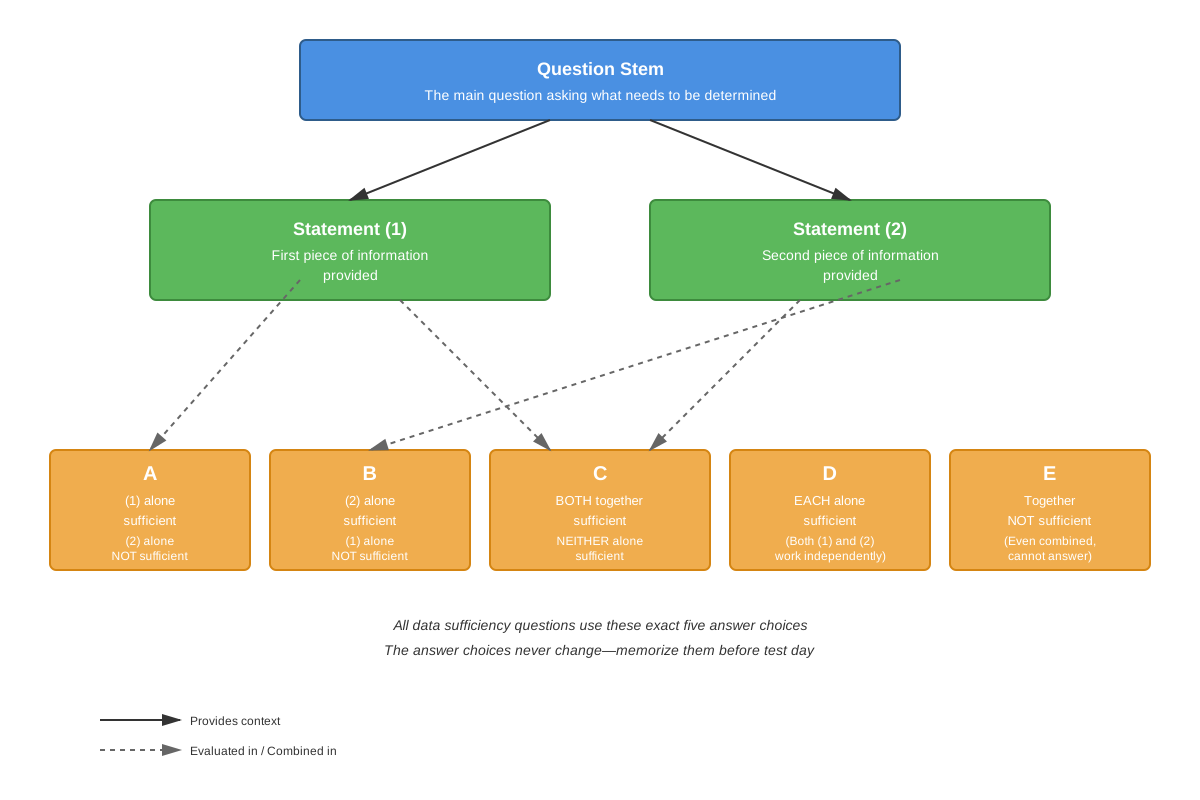
Every data sufficiency format question follows a consistent structure that students must internalize. The question begins with a question stem that poses a problem or asks for specific information. This is followed by two numbered statements labeled (1) and (2), each providing additional information that may or may not be sufficient to answer the question. The key distinction from traditional problems is that test-takers do not need to calculate the actual answer—only determine whether enough information exists to do so.
The question stem establishes what needs to be determined. It might ask for a specific numerical value ("What is the value of x?"), request a comparison ("Is x greater than y?"), or seek to establish a property ("Is n a prime number?"). Understanding exactly what the question asks is critical, as sufficiency depends entirely on whether the statements enable answering that specific question, not related questions.
The Five Standard Answer Choices
The GMAT data sufficiency format uses the same five answer choices for every question, making memorization of these options essential for exam efficiency:
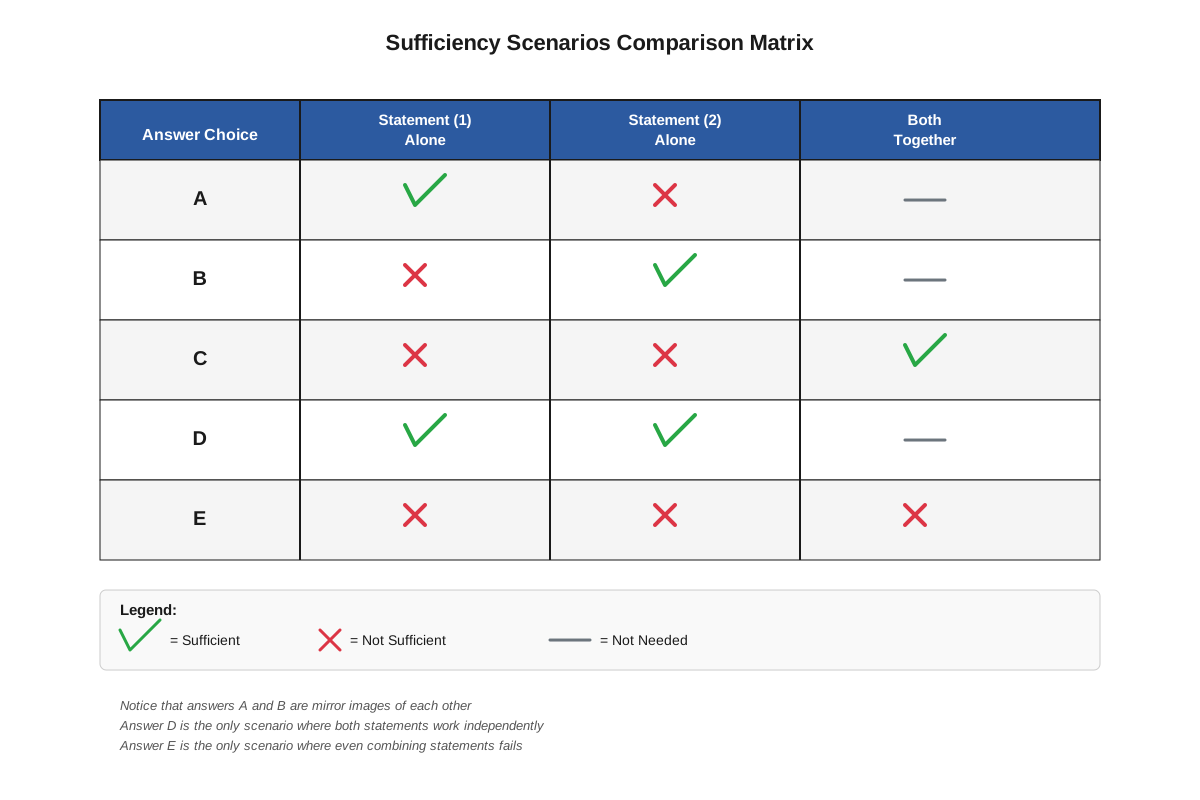
| Answer Choice | Meaning |
|---|---|
| (A) | Statement (1) ALONE is sufficient, but statement (2) alone is not sufficient |
| (B) | Statement (2) ALONE is sufficient, but statement (1) alone is not sufficient |
| (C) | BOTH statements TOGETHER are sufficient, but NEITHER statement ALONE is sufficient |
| (D) | EACH statement ALONE is sufficient |
| (E) | Statements (1) and (2) TOGETHER are NOT sufficient |
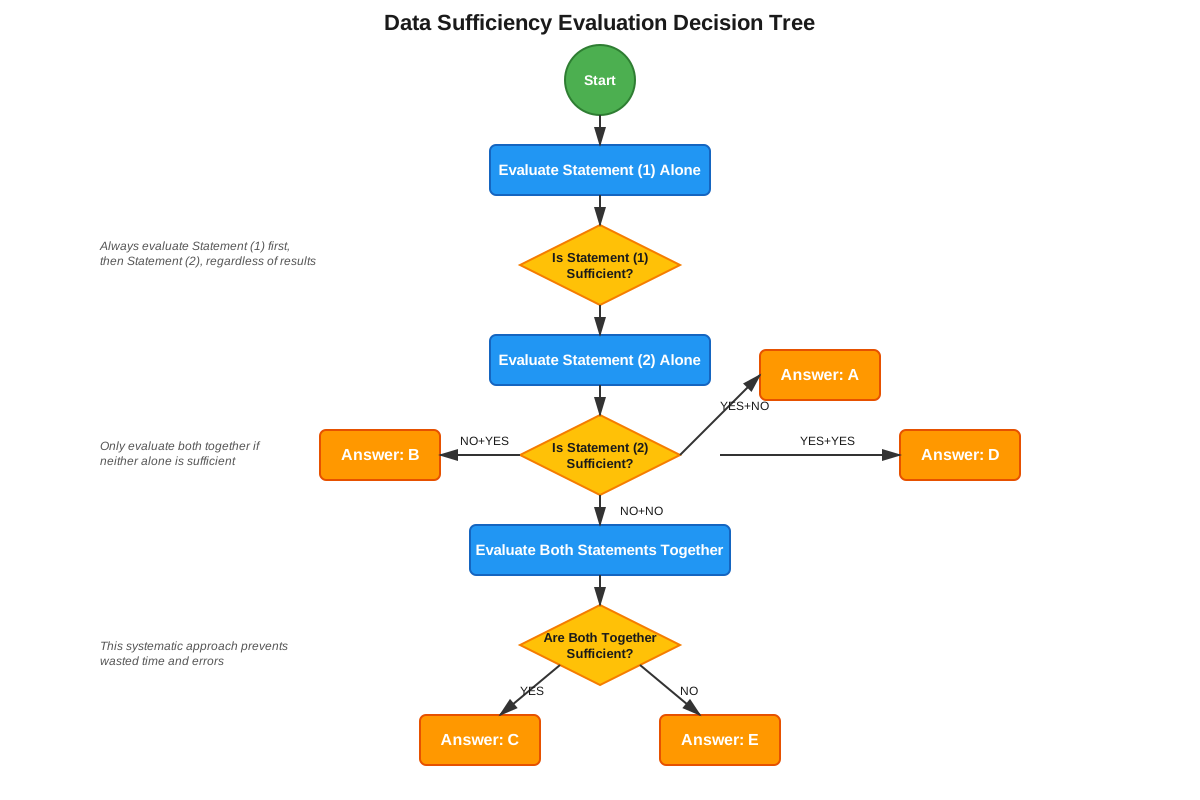
These answer choices create a logical decision tree. First, evaluate whether statement (1) alone is sufficient. Then evaluate whether statement (2) alone is sufficient. If neither is sufficient alone, determine whether combining both statements provides sufficiency. This systematic approach prevents errors and ensures comprehensive analysis.
The Sufficiency Evaluation Process
Determining sufficiency requires understanding what constitutes "enough information." For questions asking for a specific value, sufficiency means the statements enable calculation of one and only one answer. If multiple values remain possible, the information is insufficient. For yes/no questions, sufficiency means the statements enable a definitive "yes" or definitive "no" answer—not "maybe" or "sometimes yes, sometimes no."
Consider the question "What is the value of x?" If a statement provides "x² = 9," this is insufficient because x could be 3 or -3. However, if the question asks "Is x positive?" and a statement provides "x² = 9 and x > 0," this is sufficient because it definitively answers "yes." The nature of sufficiency changes based on what the question asks.
Independent vs. Combined Statement Analysis
A critical aspect of the data sufficiency format is evaluating statements both independently and in combination. When analyzing statement (1), completely ignore statement (2)—treat it as if it doesn't exist. Similarly, when analyzing statement (2) independently, disregard statement (1). Only after determining that neither statement alone is sufficient should both statements be considered together.
When combining statements, all information from both becomes available simultaneously. However, statements never contradict each other on the GMAT—if they appear to contradict, an error has occurred in the analysis. Combined statements often provide systems of equations, multiple constraints, or complementary pieces of information that together enable sufficiency.
Value Questions vs. Yes/No Questions
Data sufficiency questions fall into two primary categories with different sufficiency criteria. Value questions ask for specific numerical answers or exact values. For these questions, sufficiency requires that only one possible answer exists. If a statement narrows possibilities to two or more values, it remains insufficient.
Yes/No questions ask whether a certain condition holds true. For these questions, sufficiency requires a consistent answer—either always "yes" or always "no." A common trap involves statements that sometimes yield "yes" and sometimes "no" depending on specific values; such statements are insufficient. However, if a statement definitively answers "no" for all cases, it is sufficient even though the answer is negative.
The AD/BCE Decision Framework
Experienced test-takers use a systematic decision framework to navigate answer choices efficiently. After reading the question stem, evaluate statement (1). If statement (1) is sufficient, the answer must be either A or D (both include statement (1) being sufficient). If statement (1) is insufficient, the answer must be B, C, or E (none of these include statement (1) alone being sufficient).
This creates two pathways: the AD path (when statement (1) is sufficient) and the BCE path (when statement (1) is insufficient). After determining the path, evaluate statement (2). On the AD path, if statement (2) is also sufficient, choose D; if insufficient, choose A. On the BCE path, if statement (2) alone is sufficient, choose B; if insufficient, evaluate both statements together—if sufficient combined, choose C; if still insufficient, choose E.
Concept Relationships
The data sufficiency format integrates multiple mathematical concepts into a unified analytical framework. The format itself serves as a meta-skill that applies to virtually all quantitative topics tested on the GMAT. Understanding algebraic manipulation enables evaluation of whether equations provide sufficient constraints to solve for variables. Geometric knowledge allows assessment of whether given measurements determine unique shapes or angles. Statistical reasoning helps determine whether data sets provide adequate information for calculating means, medians, or probabilities.
The relationship flows as follows: Question Stem → defines what must be determined → Statement (1) Analysis → evaluates first information source independently → Statement (2) Analysis → evaluates second information source independently → Combined Analysis (if needed) → evaluates both sources together → Sufficiency Conclusion → determines which answer choice applies.
The format also connects to logical reasoning and critical thinking skills. Recognizing that sufficiency depends on the specific question asked (not just the information provided) requires careful attention to detail. Understanding that yes/no questions have different sufficiency criteria than value questions demands flexible thinking. The ability to avoid calculating actual answers when only sufficiency matters demonstrates strategic test-taking efficiency.
Quick check — test yourself on Data sufficiency format so far.
Try Flashcards →High-Yield Facts
⭐ The five answer choices are identical for every data sufficiency question on the GMAT—memorizing them saves valuable time during the exam.
⭐ Statements (1) and (2) never contradict each other—if they appear to contradict, an error has occurred in the analysis.
⭐ For value questions, sufficiency requires exactly one possible answer—if multiple values remain possible, the information is insufficient.
⭐ For yes/no questions, sufficiency requires a definitive "always yes" or "always no" answer—"sometimes yes, sometimes no" means insufficient.
⭐ When evaluating statement (1), completely ignore statement (2)—and vice versa when evaluating statement (2) independently.
- The AD/BCE decision framework provides a systematic approach: if statement (1) is sufficient, choose between A and D; if insufficient, choose between B, C, and E.
- Data sufficiency questions test whether information is adequate, not whether calculations can be performed quickly.
- Combining statements means using all information from both simultaneously—not comparing or choosing between them.
- Sufficiency depends entirely on what the question asks—the same statement might be sufficient for one question but insufficient for another.
- Approximately 30-40% of Data Insights questions use the data sufficiency format, making it one of the highest-yield areas for focused preparation.
- The format appears across all mathematical content areas including algebra, geometry, arithmetic, statistics, and word problems.
- Recognizing that you don't need to calculate the actual answer (only determine if you could) is the most important strategic insight for data sufficiency questions.
Common Misconceptions
Misconception: If a statement provides some useful information, it must be sufficient. → Correction: Sufficiency requires complete information to answer the question definitively. Partial information that narrows possibilities but doesn't determine a unique answer (for value questions) or consistent yes/no answer (for yes/no questions) remains insufficient.
Misconception: For yes/no questions, getting different answers for different cases means the statement is insufficient. → Correction: This is correct—but students often forget that a consistent "no" answer is sufficient. If a statement definitively proves the answer is "no" in all cases, it is sufficient even though the answer is negative.
Misconception: When evaluating statement (2), information from statement (1) can be used. → Correction: Statements must be evaluated independently first. Only after determining that neither alone is sufficient should both be considered together. Using statement (1) while evaluating statement (2) independently is a critical error.
Misconception: If both statements together are sufficient, the answer must be C. → Correction: Answer choice C specifically means "BOTH statements TOGETHER are sufficient, but NEITHER statement ALONE is sufficient." If either statement alone is sufficient, the answer is A, B, or D—not C, even though the statements together would also be sufficient.
Misconception: Data sufficiency questions are easier than problem-solving questions because you don't need to calculate the answer. → Correction: Data sufficiency questions require deeper conceptual understanding and more sophisticated logical reasoning. They test whether students truly understand mathematical relationships rather than just computational procedures. Many students find them more challenging precisely because they can't rely on calculation alone.
Misconception: Statements can contradict each other on the GMAT. → Correction: The GMAT never presents contradictory statements. If statements appear to contradict, the test-taker has made an error in interpretation or calculation. This principle can help identify mistakes during the exam.
Worked Examples
Example 1: Value Question with Algebraic Relationships
Question Stem: What is the value of x?
Statement (1): x² - 5x + 6 = 0
Statement (2): x > 2
Solution Process:
First, evaluate statement (1) independently. The equation x² - 5x + 6 = 0 can be factored as (x - 2)(x - 3) = 0, which means x = 2 or x = 3. Since two possible values exist, statement (1) alone is insufficient. We are now on the BCE path.
Next, evaluate statement (2) independently. The inequality x > 2 provides a constraint but doesn't determine a specific value—x could be any number greater than 2. Statement (2) alone is insufficient.
Now combine both statements. Statement (1) tells us x = 2 or x = 3. Statement (2) tells us x > 2. The only value that satisfies both conditions is x = 3. Together, the statements determine exactly one value, making them sufficient when combined.
Since neither statement alone is sufficient but both together are sufficient, the answer is (C).
Connection to Learning Objectives: This example demonstrates applying the data sufficiency format by systematically evaluating each statement independently before combining them, and distinguishing between sufficient and insufficient information based on whether a unique value is determined.
Example 2: Yes/No Question with Number Properties
Question Stem: Is the integer n even?
Statement (1): n² is even
Statement (2): n + 3 is odd
Solution Process:
Evaluate statement (1) independently. If n² is even, what can we conclude about n? Consider the properties of even and odd numbers: if n were odd, then n² would be odd (odd × odd = odd). Since n² is even, n cannot be odd, so n must be even. Statement (1) alone provides a definitive "yes" answer, making it sufficient. We are now on the AD path.
Evaluate statement (2) independently. If n + 3 is odd, then n must be even (because even + odd = odd, so n + 3 being odd means n is even). Statement (2) alone also provides a definitive "yes" answer, making it sufficient.
Since both statements independently provide sufficiency, the answer is (D).
Connection to Learning Objectives: This example illustrates how yes/no questions require definitive answers and demonstrates the importance of understanding number properties to evaluate sufficiency. It also shows that both statements can be sufficient independently (answer choice D), which students often overlook.
Exam Strategy
When approaching data sufficiency questions on the GMAT, begin by carefully reading the question stem to understand exactly what must be determined. Identify whether it's a value question (requiring a specific answer) or a yes/no question (requiring a consistent answer). This classification determines the sufficiency criteria.
Trigger words and phrases to watch for include:
- "What is the value of..." signals a value question requiring exactly one answer
- "Is..." or "Does..." signals a yes/no question requiring a consistent answer
- "Could..." or "Might..." in the question stem requires careful attention to whether all possibilities or just one possibility matters
- "Must be" indicates necessity—sufficiency requires proving something is always true
Use the AD/BCE decision framework systematically. After reading the question, cover statement (2) and evaluate statement (1) alone. Determine whether you're on the AD path (statement 1 sufficient) or BCE path (statement 1 insufficient). This immediately eliminates three answer choices. Then evaluate statement (2), which narrows to one or two remaining choices. Finally, if needed, evaluate both statements together.
Process-of-elimination tips specific to data sufficiency:
- If statement (1) is sufficient, immediately eliminate B, C, and E
- If statement (1) is insufficient, immediately eliminate A and D
- If both statements are individually sufficient, the answer must be D (not C)
- If both statements are individually insufficient but you haven't checked them together, the answer must be C or E (not A, B, or D)
Time allocation advice: Spend approximately 2 minutes per data sufficiency question. Allocate 15-20 seconds to understanding the question stem, 30-40 seconds evaluating statement (1), 30-40 seconds evaluating statement (2), and 20-30 seconds combining statements if necessary. If you find yourself calculating extensively, pause and reconsider—data sufficiency questions rarely require complex calculations. Often, recognizing that you could calculate the answer (without actually doing so) is sufficient.
Avoid the trap of calculating actual answers when only sufficiency matters. If you can determine that enough information exists to find a unique answer, that's sufficient—you don't need to complete the calculation. This strategic approach saves significant time and reduces computational errors.
Memory Techniques
Mnemonic for Answer Choices: "Alone 1, By itself 2, Combine them, Double sufficient, Either way insufficient"
The 1-2-Together Framework: Visualize three separate boxes labeled "Statement 1 Only," "Statement 2 Only," and "Both Together." Mentally place information in the appropriate box as you evaluate, preventing contamination between independent analyses.
The "Definite Answer" Rule: For any data sufficiency question, create a mental stamp that says "DEFINITE?" If you can stamp "DEFINITE" on the answer (whether it's a specific value or a consistent yes/no), the information is sufficient. If you must stamp "MAYBE" or "DEPENDS," it's insufficient.
The AD/BCE Split Visualization: Picture a fork in the road after evaluating statement (1). The left path (AD) is labeled "Statement 1 Works" and the right path (BCE) is labeled "Statement 1 Fails." This visual reinforces the decision tree structure.
Acronym for Evaluation Order: I-C-E = Individual statement 1, Check statement 2 individually, Evaluate together if needed. This ensures systematic analysis without skipping steps.
Summary
The data sufficiency format is a distinctive GMAT question type that tests analytical reasoning by asking whether given information is adequate to answer a question, rather than requiring calculation of the actual answer. Every data sufficiency question uses the same five answer choices, creating a systematic framework where statement (1) is evaluated independently, then statement (2) independently, and finally both together if neither alone is sufficient. The format requires understanding that value questions need exactly one possible answer for sufficiency, while yes/no questions need a consistent "always yes" or "always no" answer. Mastery involves recognizing that statements never contradict each other, that independent evaluation means completely ignoring the other statement, and that strategic thinking about sufficiency is more important than computational speed. The AD/BCE decision framework provides an efficient approach by immediately eliminating three answer choices after evaluating statement (1), then narrowing further based on statement (2). Success with data sufficiency questions requires both strong mathematical foundations and sophisticated logical reasoning skills.
Key Takeaways
- The five standard answer choices are identical for every data sufficiency question—memorize them to save time and reduce errors during the exam
- Always evaluate statements independently before combining them; using information from one statement while evaluating the other independently is a critical error
- For value questions, sufficiency requires exactly one possible answer; for yes/no questions, sufficiency requires a consistent answer in all cases
- The AD/BCE decision framework provides systematic efficiency: determine if statement (1) is sufficient to choose between two paths, then narrow based on statement (2)
- Recognizing that you don't need to calculate the actual answer—only determine whether you could—is the most important strategic insight for time management
- Statements never contradict each other on the GMAT; apparent contradictions indicate errors in analysis that should be corrected
- Data sufficiency questions comprise 30-40% of Data Insights and test deeper conceptual understanding than traditional problem-solving questions
Related Topics
Systems of Equations: Data sufficiency frequently tests whether given equations provide enough constraints to solve for multiple variables. Understanding when systems are solvable enhances sufficiency evaluation.
Inequalities and Absolute Values: These concepts appear regularly in data sufficiency questions, particularly in determining whether ranges of values can be narrowed to specific answers or consistent yes/no responses.
Geometric Sufficiency: Specialized data sufficiency questions about triangles, circles, and other shapes require understanding which measurements uniquely determine geometric figures.
Number Properties in Data Sufficiency: Questions involving even/odd properties, divisibility, prime numbers, and integer constraints are high-yield areas where sufficiency analysis requires deep conceptual understanding.
Statistical Sufficiency: Determining whether data sets provide adequate information for calculating means, medians, standard deviations, or probabilities represents an advanced application of the data sufficiency format.
Mastering the data sufficiency format creates a foundation for success across all Data Insights questions and develops analytical skills that transfer to integrated reasoning and real-world business decision-making.
Practice CTA
Now that you understand the data sufficiency format, it's time to apply these concepts through deliberate practice. Attempt the practice questions associated with this topic, focusing on systematic evaluation using the AD/BCE framework rather than rushing to calculate answers. Use flashcards to reinforce the five standard answer choices and key sufficiency principles until they become automatic. Remember that data sufficiency mastery develops through repeated exposure to diverse question types—each practice question strengthens your pattern recognition and analytical efficiency. Your investment in understanding this format will pay dividends throughout the Data Insights section and beyond!
Sign up free to keep reading
Create a free AnvayaPrep account to finish this GMAT guide on Data sufficiency format — plus flashcards and practice questions.