Overview
Geometry DS (Data Sufficiency) represents one of the most strategically important question types on the GMAT Data Insights section. Unlike traditional problem-solving questions that require calculating a specific numerical answer, GMAT Geometry DS questions test whether students can determine if given information is sufficient to answer a geometric question—without necessarily solving for the answer itself. This unique format demands a different cognitive approach: students must analyze relationships between geometric properties, recognize when information is redundant or incomplete, and understand the logical structure of geometric proofs.
Geometry Data Sufficiency questions appear with notable frequency on the GMAT, typically comprising 15-20% of the Quantitative and Data Insights sections combined. These questions integrate fundamental geometric principles—including properties of triangles, circles, quadrilaterals, coordinate geometry, and three-dimensional figures—with the logical reasoning skills that define Data Sufficiency problems. Mastering this topic requires both solid geometric knowledge and the ability to think strategically about what information is truly necessary to answer a question.
Within the broader Data Insights framework, Geometry DS serves as a bridge between pure mathematical knowledge and analytical reasoning. Success in this area demonstrates not only geometric fluency but also the ability to evaluate evidence, recognize sufficiency thresholds, and avoid the common trap of over-calculating. This skill set directly parallels the analytical demands of business school coursework and real-world decision-making, where determining whether available data is adequate to reach a conclusion is often more valuable than performing calculations with incomplete information.
Learning Objectives
- [ ] Identify Geometry DS question types and distinguish them from standard geometry problems
- [ ] Explain the logical structure of Data Sufficiency questions as applied to geometric scenarios
- [ ] Apply Geometry DS strategies to GMAT questions involving various geometric figures and properties
- [ ] Evaluate each statement independently before considering them together
- [ ] Recognize geometric sufficiency patterns and common traps in DS questions
- [ ] Determine when geometric properties provide implicit information that affects sufficiency
Prerequisites
- Basic geometric formulas and properties: Essential for recognizing what information is needed to solve geometric problems (area, perimeter, volume formulas for common shapes)
- Understanding of Data Sufficiency format: Required to interpret the five answer choices (A, B, C, D, E) and the logical framework of DS questions
- Algebraic manipulation skills: Necessary for setting up equations from geometric relationships and determining when unique solutions exist
- Coordinate geometry fundamentals: Needed for questions involving points, lines, and shapes on the coordinate plane
- Properties of angles and parallel lines: Critical for analyzing sufficiency in questions involving polygons and intersecting lines
Why This Topic Matters
Geometry DS questions hold particular significance on the GMAT because they efficiently test multiple competencies simultaneously. Business schools value these questions because they mirror real-world analytical scenarios: executives must frequently determine whether available data is sufficient to make informed decisions about market entry, resource allocation, or strategic planning. The ability to recognize when information is adequate—or when additional data is needed—represents a crucial business skill that transcends pure mathematical ability.
From an exam perspective, Geometry DS questions appear in approximately 3-5 questions per GMAT administration, making them high-yield study material. These questions typically appear at medium to high difficulty levels and serve as differentiators between good and excellent scores. The GMAT algorithm often uses Geometry DS questions to calibrate a test-taker's score in the 650-750 range, making mastery essential for competitive applicants.
Common manifestations include questions about triangle congruence and similarity, circle properties (especially involving tangent lines and inscribed angles), rectangle and square area problems, coordinate geometry involving distance and slope, and three-dimensional geometry involving surface area and volume. The GMAT particularly favors questions that combine multiple geometric concepts or require recognizing special cases (such as right triangles, isosceles triangles, or squares) where limited information becomes sufficient due to inherent properties.
Core Concepts
The Data Sufficiency Framework for Geometry
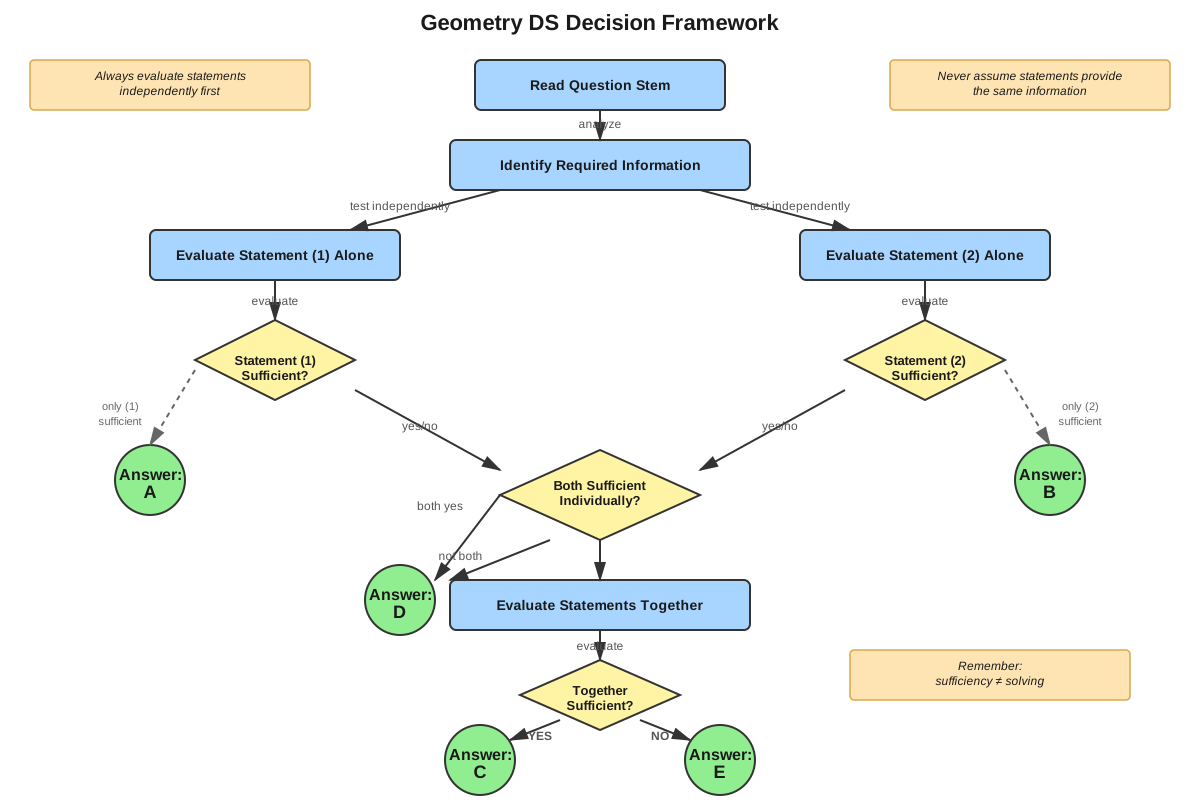
The fundamental structure of geometry ds questions follows the standard Data Sufficiency format: a question stem presents a geometric scenario and asks whether a specific value or relationship can be determined. Two statements provide additional information, and test-takers must evaluate whether each statement alone, both together, or neither combination provides sufficient information to answer the question definitively.
The five answer choices follow this pattern:
- (A) Statement (1) ALONE is sufficient, but statement (2) alone is not sufficient
- (B) Statement (2) ALONE is sufficient, but statement (1) alone is not sufficient
- (C) BOTH statements TOGETHER are sufficient, but NEITHER statement ALONE is sufficient
- (D) EACH statement ALONE is sufficient
- (E) Statements (1) and (2) TOGETHER are NOT sufficient
Geometric Sufficiency Principles
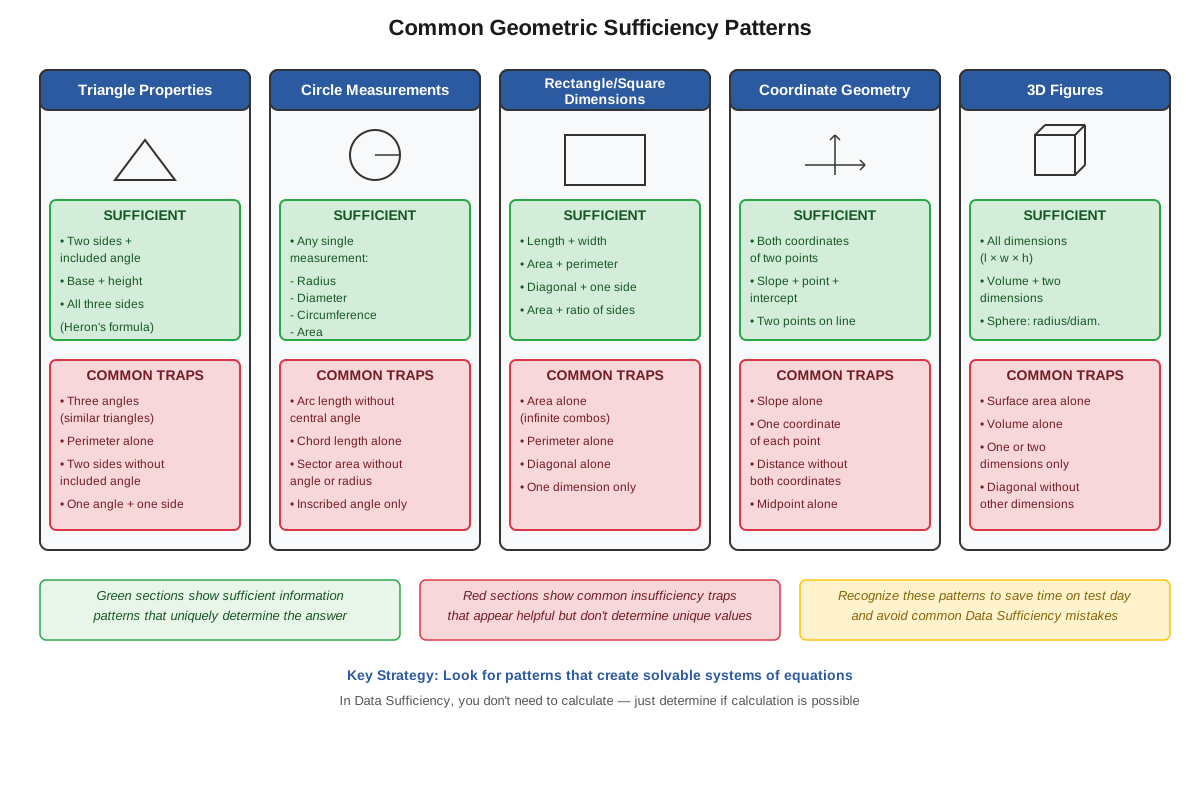
Understanding what makes geometric information sufficient requires recognizing the minimum requirements to determine specific properties. For example, to find the area of a triangle, one needs either: (1) base and height, (2) two sides and the included angle, (3) all three sides (using Heron's formula), or (4) the triangle's coordinates. Recognizing these multiple pathways to sufficiency is crucial.
Unique determination is the key concept: information is sufficient only if it leads to exactly one possible answer. If a statement allows for multiple possible values, it is insufficient. For instance, knowing that a triangle has two sides of length 5 is insufficient to determine the third side, as it could range from just over 0 to just under 10 (by the triangle inequality).
Triangle Properties in DS Questions
Triangles generate numerous DS questions because they have rich mathematical properties with specific sufficiency thresholds. Key considerations include:
Congruence criteria: Two triangles are congruent (and therefore have equal corresponding parts) if they satisfy SSS (three sides), SAS (two sides and included angle), ASA (two angles and included side), or AAS (two angles and a non-included side). Recognizing these patterns helps determine sufficiency quickly.
Similarity criteria: Triangles are similar if they have AA (two equal angles), SSS (proportional sides), or SAS (two proportional sides with equal included angle). Similar triangles have proportional sides and equal angles, which often provides sufficient information for DS questions.
Special triangles: Right triangles (especially 30-60-90 and 45-45-90 triangles), isosceles triangles, and equilateral triangles have special properties that make certain information sufficient when it wouldn't be for general triangles. For example, knowing one side of an equilateral triangle is sufficient to determine all other measurements.
Circle Properties and Sufficiency
Circle problems in DS format frequently involve determining radius, diameter, circumference, or area. Since all these measurements are related through the radius (C = 2πr, A = πr²), knowing any one is sufficient to determine all others.
Tangent lines create right angles with radii at the point of tangency—a property that often provides hidden sufficiency. Inscribed angles measure half their intercepted arc, while central angles equal their intercepted arc. These relationships frequently appear in DS questions where angle information must be evaluated for sufficiency.
Chord properties include the perpendicular from the center bisecting the chord, which creates right triangles that can be analyzed for sufficiency. Questions often ask whether sufficient information exists to determine chord length, requiring recognition of these geometric relationships.
Quadrilateral Sufficiency Patterns
Different quadrilaterals have different sufficiency requirements. A rectangle requires two dimensions (length and width) to determine area, but if it's specified as a square, only one dimension suffices. A parallelogram requires base and height for area, but knowing all four sides is insufficient without angle information.
Trapezoid area requires both bases and height, while rhombus area can be determined from diagonals (A = ½d₁d₂) or from side and height. Recognizing which quadrilateral type is specified dramatically affects sufficiency analysis.
Coordinate Geometry Sufficiency
In coordinate geometry DS questions, determining whether points, lines, or shapes can be uniquely identified requires understanding what information defines each object:
- A line requires two points, or one point and a slope, or an equation
- A circle requires a center and radius
- Distance between two points requires both coordinates: d = √[(x₂-x₁)² + (y₂-y₁)²]
- Slope requires two points or the line equation: m = (y₂-y₁)/(x₂-x₁)
Questions often test whether partial coordinate information is sufficient, requiring careful analysis of what can be uniquely determined.
Three-Dimensional Geometry
3D geometry DS questions typically involve rectangular solids, cylinders, spheres, or cones. Key sufficiency principles include:
Rectangular solids require three dimensions (length, width, height) to determine volume, but surface area requires the same three dimensions. Knowing volume alone is insufficient to determine dimensions uniquely (multiple dimension combinations yield the same volume).
Cylinders require radius and height for volume (V = πr²h) and surface area (SA = 2πr² + 2πrh). Knowing volume alone is insufficient to determine radius or height uniquely.
Spheres require only radius for all calculations (V = 4/3πr³, SA = 4πr²), making any measurement sufficient to determine all others.
Implicit Information and Hidden Sufficiency
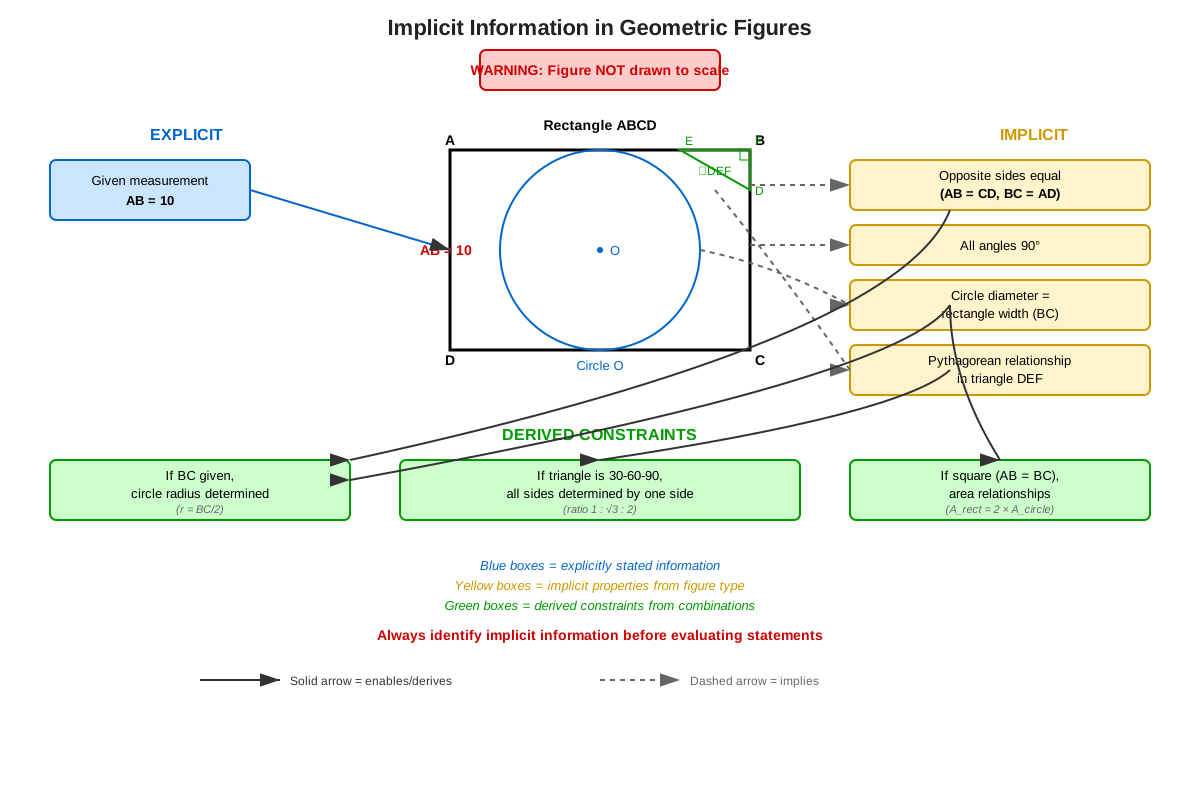
Many Geometry DS questions contain implicit information—facts not explicitly stated but necessarily true given the problem setup. For example:
- If a figure is described as a square, all sides are equal and all angles are 90°
- If two lines are parallel, corresponding angles are equal and alternate interior angles are equal
- If a triangle is inscribed in a semicircle with the diameter as one side, it must be a right triangle
- If a quadrilateral is inscribed in a circle, opposite angles sum to 180°
Recognizing implicit information is crucial for correctly evaluating sufficiency, as it often provides the "missing piece" that makes a statement sufficient.
Concept Relationships
The concepts within Geometry DS form an interconnected web where understanding one area enhances analysis in others. The Data Sufficiency framework serves as the overarching structure, while specific geometric properties provide the content knowledge needed to evaluate sufficiency.
Triangle properties → connect to → Circle properties through inscribed and circumscribed triangles, where circle theorems determine triangle angles and vice versa. Coordinate geometry → integrates with → all planar figures by providing an algebraic framework for geometric relationships, allowing distance and slope formulas to determine sufficiency.
Special figure properties (squares, equilateral triangles, etc.) → reduce → information requirements by providing implicit constraints that make limited information sufficient. Congruence and similarity → establish → proportional relationships that allow indirect determination of measurements.
The relationship map flows: Question stem → defines → target value → requires → minimum information set → evaluated against → Statement 1 and Statement 2 → considering → implicit geometric properties → yields → sufficiency determination.
Understanding these connections allows efficient evaluation: recognizing that a question involves a special figure immediately triggers consideration of which properties reduce information requirements, while coordinate geometry questions prompt analysis of whether algebraic relationships provide unique solutions.
High-Yield Facts
⭐ In Data Sufficiency, never actually solve for the answer—only determine whether you could solve if needed
⭐ For triangles, knowing two sides is never sufficient to determine the third side uniquely (triangle inequality allows a range)
⭐ All circle measurements (radius, diameter, circumference, area) are interrelated, so knowing any one is sufficient to determine all others
⭐ A rectangle specified as having equal diagonals that bisect each other is actually a square, making one side sufficient for all measurements
⭐ In coordinate geometry, two distinct points uniquely determine a line, but one point and a slope also suffice
- For any triangle, knowing all three sides uniquely determines all angles and the area (via Heron's formula)
- Inscribed angles in a circle that intercept the same arc are equal, which often provides hidden sufficiency
- The area of a parallelogram requires base and height, not just all four sides (unlike triangles where three sides suffice)
- Perpendicular lines have slopes that are negative reciprocals (m₁ × m₂ = -1), allowing sufficiency determination from slope information
- A triangle inscribed in a semicircle with the diameter as one side is always a right triangle (Thales' theorem)
- For rectangular solids, knowing volume alone is insufficient to determine dimensions, but volume plus surface area typically suffices
- Similar triangles have proportional corresponding sides, so knowing the ratio and one side length of each triangle suffices to determine all sides
- The diagonal of a square with side s equals s√2, making diagonal length sufficient to determine all square properties
- Tangent lines from an external point to a circle are equal in length, which often provides sufficiency in complex circle problems
- In coordinate geometry, parallel lines have equal slopes, while perpendicular lines have negative reciprocal slopes
Quick check — test yourself on Geometry DS so far.
Try Flashcards →Common Misconceptions
Misconception: If you can calculate a numerical answer from a statement, that statement must be sufficient.
Correction: Sufficiency requires that exactly one answer is possible. If a statement allows multiple possible answers, it is insufficient regardless of whether you can calculate specific values for some scenarios.
Misconception: In Geometry DS, you should always try to solve for the exact numerical answer to verify sufficiency.
Correction: Data Sufficiency tests whether you could solve, not whether you should solve. Actually calculating wastes time and increases error risk. Instead, determine whether the given information uniquely determines the answer.
Misconception: Knowing the perimeter of a rectangle is sufficient to determine its area.
Correction: Perimeter alone allows infinite length-width combinations (e.g., 3×7 and 4×6 both have perimeter 20 but different areas). Both dimensions are needed for area, or perimeter plus one dimension, or perimeter plus the length-to-width ratio.
Misconception: If Statement 1 is insufficient and Statement 2 is insufficient, the answer must be C or E.
Correction: While this narrows the choices, you must still evaluate whether combining the statements provides sufficient information (C) or remains insufficient (E). Many students incorrectly assume combination always helps.
Misconception: In triangle problems, knowing two angles is sufficient to determine the triangle's area.
Correction: Two angles determine the third angle (since angles sum to 180°) and establish the triangle's shape (similarity class), but infinite triangles share the same angles with different sizes. At least one side length is needed to determine area.
Misconception: Geometric figures drawn in DS questions are drawn to scale and can be used to estimate sufficiency.
Correction: GMAT explicitly states that figures are not necessarily drawn to scale unless specified. Relying on visual appearance leads to incorrect sufficiency judgments. Only use explicitly stated information and geometric properties.
Misconception: If a statement provides an equation with one variable, it's always sufficient to solve for that variable.
Correction: The equation must be solvable for a unique value. For example, x² = 25 has two solutions (x = 5 or x = -5), making it insufficient if the question asks for x's value. However, if the question asks for x², the statement would be sufficient.
Worked Examples
Example 1: Triangle Area Sufficiency
Question: What is the area of triangle ABC?
(1) Side AB = 6 and side BC = 8
(2) Triangle ABC is a right triangle with the right angle at vertex B
Solution Process:
First, identify what's needed: triangle area requires base × height ÷ 2, or sufficient information to determine these values.
Evaluating Statement (1): Two sides are given (AB = 6, BC = 8), but without knowing the angle between them or the third side, we cannot determine the area. The triangle could be obtuse, acute, or right, each yielding different areas. For example, if angle B is 90°, area = ½(6)(8) = 24. If angle B is 60°, area = ½(6)(8)sin(60°) ≈ 20.8. Multiple areas are possible. Statement (1) is INSUFFICIENT.
Evaluating Statement (2): Knowing the triangle is right-angled at B tells us the angle but provides no side lengths. Infinite right triangles exist with different areas. Statement (2) is INSUFFICIENT.
Evaluating Both Together: Statement (1) gives AB = 6 and BC = 8. Statement (2) tells us these sides meet at a right angle (angle B = 90°). For a right triangle, the two legs serve as base and height, so area = ½(6)(8) = 24. This is uniquely determined. Both statements TOGETHER are SUFFICIENT.
Answer: C
Key Insight: This example demonstrates how geometric properties (right angle) transform insufficient information into sufficient information by establishing the relationship between given measurements. Statement (2) alone seems weak, but it provides the crucial constraint that makes Statement (1)'s data sufficient.
Example 2: Circle and Tangent Line
Question: In the coordinate plane, point P lies on circle C. What is the radius of circle C?
(1) Circle C has center at (0, 0) and point P is at (3, 4)
(2) A line tangent to circle C at point P has slope -3/4
Solution Process:
The radius of a circle is the distance from center to any point on the circle.
Evaluating Statement (1): The center is at origin (0, 0) and point P is at (3, 4). Using the distance formula: r = √[(3-0)² + (4-0)²] = √[9 + 16] = √25 = 5. This uniquely determines the radius. Statement (1) is SUFFICIENT.
Evaluating Statement (2): The tangent line at P has slope -3/4. A key property: the radius to a point of tangency is perpendicular to the tangent line. If the tangent has slope -3/4, the radius has slope 4/3 (negative reciprocal). However, this tells us the direction of the radius from P to the center, not the length of the radius or the center's location. Infinite circles of different radii could have a tangent with slope -3/4 at some point P. Statement (2) is INSUFFICIENT.
Answer: A
Key Insight: This example illustrates how coordinate geometry provides concrete numerical sufficiency (Statement 1) while geometric properties alone (Statement 2) may establish relationships without determining specific values. The perpendicularity property is valuable but insufficient without additional information. Also note that we don't need Statement (2) at all—a common DS pattern where one statement provides complete sufficiency independently.
Exam Strategy
When approaching GMAT geometry DS questions, employ a systematic evaluation process that maximizes efficiency and accuracy:
Step 1: Analyze the Question Stem Thoroughly
- Identify exactly what value or relationship must be determined
- Note any implicit information (figure types, special properties)
- Mentally list what information would be sufficient (multiple pathways often exist)
Step 2: Evaluate Statement (1) Independently
- Consider only Statement (1) with the question stem
- Determine if it provides unique determination (not just some information)
- Resist the temptation to look at Statement (2)
- Eliminate answer choices based on this evaluation
Step 3: Evaluate Statement (2) Independently
- Completely ignore Statement (1) during this evaluation
- Determine sufficiency using only Statement (2) and the question stem
- Further narrow answer choices
Step 4: If Necessary, Evaluate Both Statements Together
- Only if both statements alone are insufficient
- Look for how the statements complement each other
- Check whether combined information eliminates ambiguity
Trigger Words and Phrases to Watch For:
- "What is the area..." → requires specific measurements, not just relationships
- "Is triangle ABC similar to..." → requires angle or proportional side information
- "Square ABCD" → immediately know all angles are 90° and all sides equal
- "Inscribed in a circle" → triggers circle theorems about angles
- "Perpendicular" → creates right angles and allows Pythagorean theorem
- "Tangent to" → creates right angle with radius at point of tangency
Process-of-Elimination Tips:
- If Statement (1) is sufficient, eliminate B, C, E (answer must be A or D)
- If Statement (1) is insufficient, eliminate A, D (answer must be B, C, E)
- If both statements alone are insufficient, eliminate A, B, D (answer must be C or E)
- Never choose an answer without evaluating what the question requires
Time Allocation:
- Spend 15-20 seconds understanding the question stem and identifying sufficiency requirements
- Allocate 30-40 seconds per statement evaluation
- Reserve 20-30 seconds for combined evaluation if needed
- Total target: 90-120 seconds per Geometry DS question
- If exceeding 2 minutes, make an educated guess and move forward
Common Traps to Avoid:
- Don't assume figures are drawn to scale
- Don't calculate actual values unless necessary to determine sufficiency
- Don't combine statements prematurely—always evaluate each independently first
- Don't forget implicit properties of special figures
- Don't confuse "some information" with "sufficient information"
Memory Techniques
The "SURF" Method for DS Evaluation:
- Stem: What exactly is being asked?
- Unique: Does this lead to one answer?
- Relationships: What geometric properties apply?
- First alone: Evaluate each statement independently first
Triangle Sufficiency Mnemonic: "3-2-1 RULE"
- 3 sides → sufficient for everything (SSS)
- 2 sides + included angle → sufficient (SAS)
- 1 side alone → never sufficient (need more information)
Circle Sufficiency: "ORCA"
- One measurement (radius, diameter, circumference, or area)
- Relates to all others
- Completely determines
- All circle properties
Coordinate Geometry: "Two to Tango"
- Two points determine a line
- Two coordinates determine a point
- Two equations determine intersection
- Remember: one point + slope also determines a line
Special Figures Acronym: "RISE"
- Right triangles: Pythagorean theorem applies
- Isosceles: Two equal sides, two equal angles
- Squares: All sides equal, all angles 90°
- Equilateral: All sides equal, all angles 60°
Visualization Strategy for Sufficiency:
Mentally draw multiple scenarios that fit the given information. If you can draw two different figures that both satisfy the statement but yield different answers to the question, the statement is insufficient. If all possible figures yield the same answer, it's sufficient.
Summary
Geometry DS represents a critical intersection of geometric knowledge and logical reasoning on the GMAT. Success requires not just understanding geometric properties but also developing the analytical skill to determine when information is sufficient for unique determination. The key distinction from standard geometry problems is that calculation is secondary to evaluation—test-takers must assess whether they could solve rather than actually solving. Mastery involves recognizing the minimum information requirements for various geometric figures: triangles need three pieces of information (with specific combinations like SSS, SAS, ASA), circles need any single measurement, rectangles need two dimensions (or one if specified as a square), and coordinate geometry requires sufficient constraints to eliminate ambiguity. The systematic approach of evaluating each statement independently before considering them together, combined with recognition of implicit properties and special figure characteristics, enables efficient and accurate sufficiency determination. Understanding common traps—such as assuming figures are to scale, confusing partial information with sufficiency, or prematurely combining statements—is equally important as knowing geometric formulas.
Key Takeaways
- Geometry DS tests sufficiency determination, not calculation ability—focus on whether you could solve, not on actually solving
- Evaluate each statement independently first, then together only if both alone are insufficient; this systematic approach prevents errors
- Recognize implicit information from special figures (squares, right triangles, inscribed angles) that reduces information requirements
- For triangles, three pieces of information typically suffice (SSS, SAS, ASA, AAS), but two sides alone never determine the third uniquely
- All circle measurements are interrelated through radius, making any single measurement sufficient to determine all others
- Coordinate geometry requires enough constraints for unique determination—two points for a line, center and radius for a circle
- Never assume figures are drawn to scale; rely only on stated information and geometric properties, not visual appearance
Related Topics
Advanced Triangle Properties: Explores medians, altitudes, angle bisectors, and circumcircles/incircles in DS contexts, building on basic triangle sufficiency to handle more complex geometric relationships.
Optimization in Geometry DS: Covers maximum/minimum problems where sufficiency must be determined for optimal values, connecting geometric constraints with optimization principles.
3D Geometry Advanced Topics: Extends rectangular solid and cylinder concepts to pyramids, cones, and composite figures, requiring spatial reasoning combined with sufficiency analysis.
Coordinate Geometry Systems: Deepens understanding of lines, parabolas, and circles in the coordinate plane, particularly focusing on system of equations and intersection points in DS format.
Geometric Probability: Combines geometric area/volume calculations with probability concepts in DS questions, requiring determination of whether sufficient information exists to calculate probability ratios.
Mastering Geometry DS creates a foundation for these advanced topics while developing the analytical reasoning skills that permeate all GMAT Data Insights questions. The logical framework learned here—systematic evaluation, recognition of sufficiency thresholds, and strategic thinking—transfers directly to other DS domains.
Practice CTA
Now that you've mastered the core concepts of Geometry DS, it's time to solidify your understanding through deliberate practice. Attempt the practice questions associated with this topic, focusing on applying the systematic evaluation process rather than rushing to answers. Use the flashcards to reinforce high-yield facts and geometric properties until they become automatic. Remember: excellence in Geometry DS comes not from memorizing every geometric formula but from developing the analytical instinct to recognize what information matters and when it's sufficient. Each practice question is an opportunity to refine your strategic thinking and build the confidence that translates to higher scores on test day. You've invested the time to understand the concepts—now invest the practice time to make them second nature!
Sign up free to keep reading
Create a free AnvayaPrep account to finish this GMAT guide on Geometry DS — plus flashcards and practice questions.