Overview
Hidden constraints are unstated mathematical or logical restrictions that exist within a problem but are not explicitly mentioned in the question stem or statements. In GMAT Data Sufficiency questions, these constraints fundamentally alter what information is actually needed to answer a question. A hidden constraint might emerge from the mathematical properties of the scenario itself—for example, when a problem asks about "the number of employees," the answer must be a non-negative integer, even though the problem never explicitly states this requirement. Similarly, when dealing with geometric figures, the properties of shapes impose constraints that aren't always spelled out but are nonetheless binding.
Understanding GMAT hidden constraints is crucial because they represent one of the most sophisticated traps the test designers employ. Many test-takers evaluate sufficiency based solely on the explicit information provided, missing the implicit restrictions that make seemingly insufficient statements actually sufficient—or vice versa. This topic sits at the intersection of mathematical reasoning, logical analysis, and strategic test-taking, requiring students to think beyond surface-level algebra and consider the deeper nature of what a problem is actually asking.
Within the broader Data Insights framework, hidden constraints connect directly to the fundamental skill of determining sufficiency. They require the same analytical rigor as other Data Sufficiency concepts but add an additional layer: the ability to recognize what the problem structure itself tells you, independent of the statements provided. Mastering hidden constraints elevates performance from mechanical equation-solving to sophisticated mathematical reasoning—exactly what the GMAT rewards at higher score levels.
Learning Objectives
- [ ] Identify hidden constraints in GMAT Data Sufficiency questions
- [ ] Explain how hidden constraints affect the sufficiency of given statements
- [ ] Apply hidden constraints to GMAT questions to determine correct answers
- [ ] Distinguish between explicit conditions and implicit mathematical restrictions
- [ ] Recognize common scenarios where hidden constraints typically appear
- [ ] Evaluate how hidden constraints can make seemingly insufficient information actually sufficient
Prerequisites
- Basic algebra and equation-solving skills: Hidden constraints often emerge when solving equations, requiring the ability to manipulate algebraic expressions to recognize when solutions are restricted.
- Understanding of Data Sufficiency question format: Students must know how to evaluate statements independently and together, as hidden constraints affect sufficiency determinations at each stage.
- Number properties fundamentals: Many hidden constraints involve integer restrictions, divisibility, or sign constraints that require solid number sense.
- Basic geometry principles: Geometric hidden constraints require understanding of shape properties, angle relationships, and measurement restrictions.
Why This Topic Matters
Hidden constraints represent a high-frequency, high-impact concept on the GMAT Data Insights section. Approximately 15-20% of Data Sufficiency questions involve some form of hidden constraint, making this one of the most commonly tested advanced concepts. The GMAT specifically designs questions to exploit test-takers' tendency to overlook implicit restrictions, making this a key differentiator between mid-range and high scores.
In real-world applications, recognizing hidden constraints mirrors critical business and analytical thinking. When analyzing data or making decisions, professionals must identify not just the explicit parameters but also the implicit limitations of their models and assumptions. A financial analyst must recognize that "number of transactions" cannot be fractional; a logistics manager must understand that "number of trucks" must be a whole number. These real-world parallels make hidden constraints both practically relevant and pedagogically important.
On the GMAT, hidden constraints most commonly appear in questions involving: counting problems (where answers must be integers), rate problems (where time and distance must be non-negative), age problems (where ages must be positive), geometry problems (where side lengths must satisfy triangle inequalities), and percentage problems (where certain values must fall within specific ranges). The test designers frequently craft questions where Statement (1) appears insufficient until the hidden constraint is recognized, or where both statements together seem necessary when actually one statement combined with the hidden constraint is sufficient.
Core Concepts
Definition and Nature of Hidden Constraints
A hidden constraint is an unstated restriction on the possible values or solutions in a problem that arises from the inherent nature of what is being measured or counted. Unlike explicit constraints, which are stated directly in the problem ("where x > 0" or "if n is an integer"), hidden constraints must be inferred from the context and meaning of the variables involved.
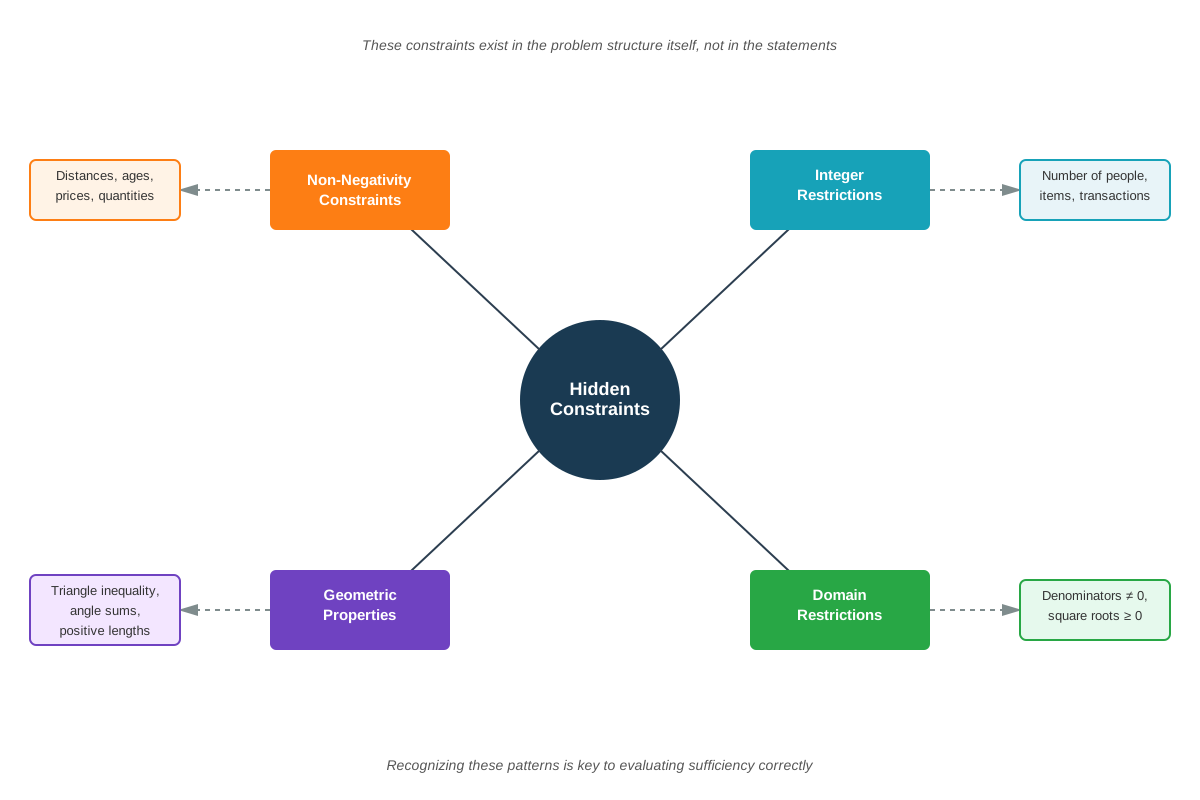
Hidden constraints typically fall into several categories:
- Integer constraints: Variables representing countable quantities (people, objects, events) must be whole numbers
- Non-negativity constraints: Variables representing physical quantities (distance, time, age, length) cannot be negative
- Range constraints: Variables representing percentages, probabilities, or ratios must fall within specific bounds
- Structural constraints: Relationships between variables that must hold due to mathematical or logical necessity
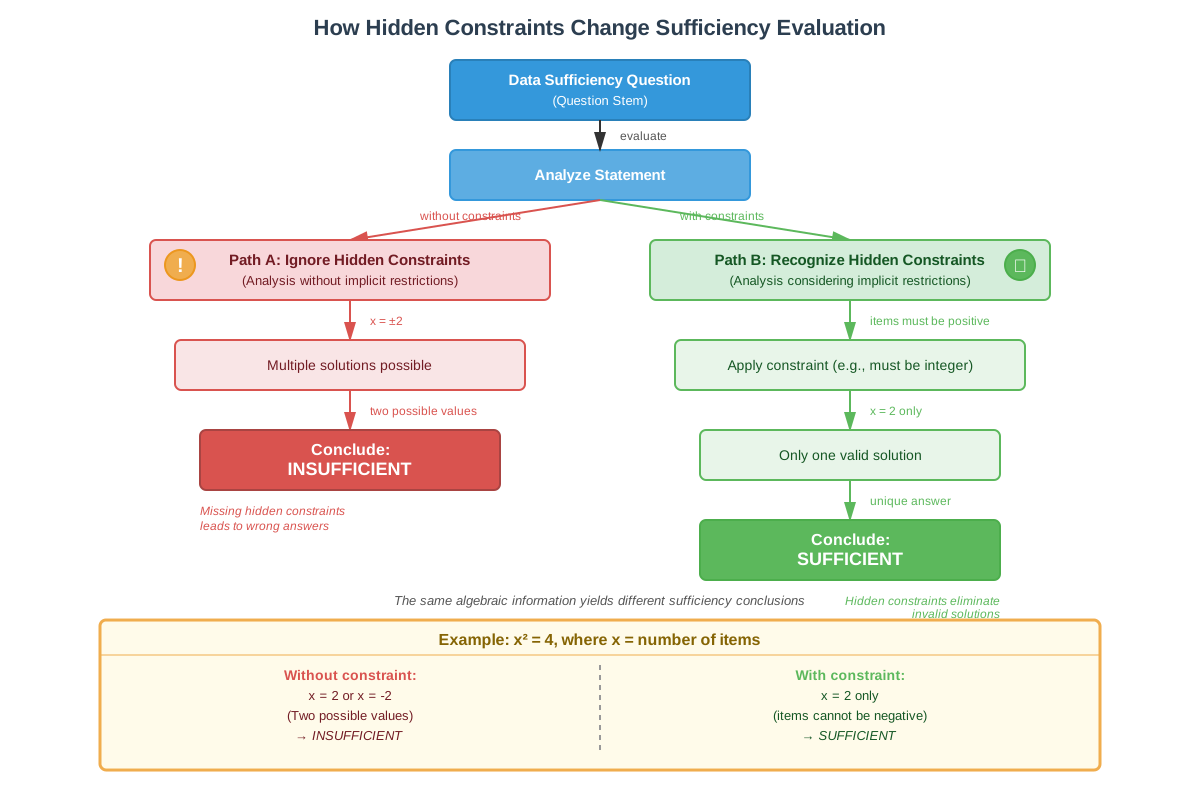
The power of hidden constraints lies in their ability to restrict solution sets without explicit statement. When solving an equation yields x = 3 or x = -2, but x represents "the number of books," the hidden constraint immediately eliminates x = -2 as impossible, potentially making a statement sufficient that would otherwise be insufficient.
Integer Constraints in Counting Problems
Integer constraints are perhaps the most common type of hidden constraint on the GMAT. Whenever a problem asks about quantities that can only be whole numbers—employees, items, transactions, days, trips—the answer must be an integer even if this isn't explicitly stated.
Consider a problem asking: "How many employees does Company X have?" If a statement provides enough information to establish an equation like E = 15.7, this is actually sufficient to answer "Cannot be determined" or to recognize an error in reasoning, because the hidden constraint (employees must be integers) creates a contradiction. More subtly, if an equation yields two solutions, E = 12 or E = 12.5, the hidden constraint eliminates the non-integer solution, making the statement sufficient with the unique answer E = 12.
This principle extends to systems of equations. If you have two variables representing integers and one equation relating them, you might initially think this is insufficient. However, if the equation is something like 3x + 7y = 100, where both x and y must be non-negative integers, the hidden constraints might limit the solution set to just one or two possibilities, potentially making the statement sufficient.
Non-Negativity and Positivity Constraints
Physical quantities impose natural constraints on their values. Time cannot be negative. Distance cannot be negative. Age cannot be negative. Length cannot be negative. These non-negativity constraints eliminate entire portions of the solution space without being explicitly stated.
The GMAT exploits this by creating scenarios where solving an equation yields both positive and negative solutions. For example, if a statement allows you to determine that t² = 16, where t represents time in hours, you might initially think this is insufficient because t could be 4 or -4. However, the hidden constraint that time must be non-negative makes this sufficient: t = 4 hours.
Similarly, certain contexts require strict positivity (values greater than zero, not just non-negative). Ages of living people, prices of items being sold, speeds of moving objects—these must all be positive, not merely non-negative. This distinction can be crucial when zero is a potential solution.
Geometric Hidden Constraints
Geometry problems contain numerous hidden constraints arising from the fundamental properties of shapes and space. The triangle inequality states that the sum of any two sides of a triangle must be greater than the third side—a constraint that's never stated but always applies. If a problem asks about the length of the third side of a triangle, and a statement provides information that, combined with the triangle inequality, narrows the possibilities to a unique value, that statement is sufficient.
Other geometric hidden constraints include:
- Angles in a triangle sum to 180 degrees
- Side lengths must be positive
- Areas and perimeters must be non-negative
- In a rectangle, opposite sides are equal
- The hypotenuse is the longest side in a right triangle
- Angles in a quadrilateral sum to 360 degrees
These constraints can dramatically affect sufficiency. A statement might seem to provide insufficient information about a triangle's angles, but when combined with the hidden constraint that angles sum to 180°, it becomes sufficient.
Constraints from Definitions and Context
Sometimes hidden constraints emerge from the specific definitions or contexts within a problem. If a problem discusses "the average of three distinct positive integers," multiple hidden constraints apply: the values must be integers, they must be positive, and they must be different from each other. Each of these restrictions can eliminate potential solutions.
Context-based constraints require careful reading. A problem about "the number of complete rotations" implies an integer. A problem about "the percentage of students who passed" implies a value between 0 and 100. A problem about "the probability of an event" implies a value between 0 and 1. These constraints exist because of what the variables represent, not because the problem explicitly states them.
Recognizing When Hidden Constraints Apply
The key to identifying hidden constraints is asking: "What is this variable actually measuring?" and "What values make sense in this context?" This requires moving beyond pure algebraic manipulation to semantic understanding of the problem.
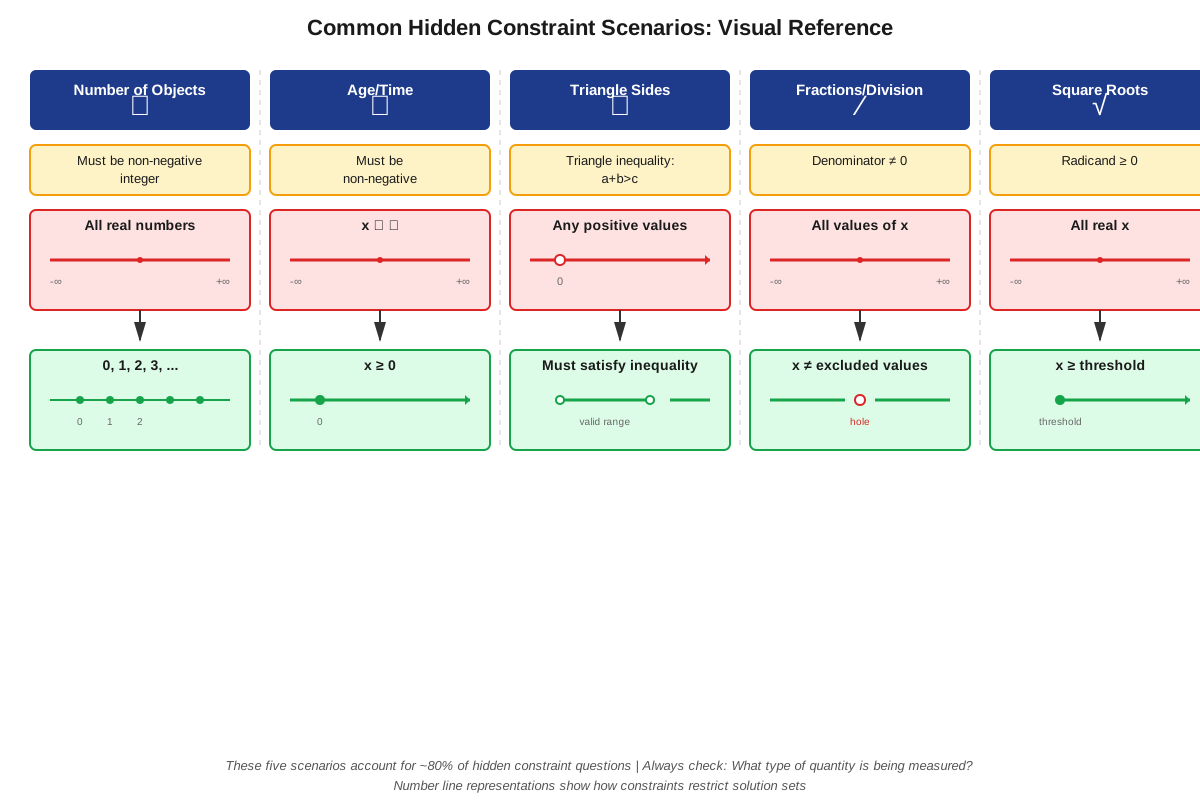
| Variable Type | Hidden Constraint | Example Context |
|---|---|---|
| Number of objects/people | Must be non-negative integer | "How many employees..." |
| Age | Must be non-negative (usually positive) | "How old is Sarah..." |
| Time duration | Must be non-negative | "How long did the trip take..." |
| Distance | Must be non-negative | "How far did she travel..." |
| Percentage | Must be between 0 and 100 | "What percent of students..." |
| Probability | Must be between 0 and 1 | "What is the probability..." |
| Price | Usually must be positive | "What is the cost..." |
| Geometric measurements | Must be positive | "What is the length of side AB..." |
Concept Relationships
Hidden constraints fundamentally connect to the core principle of Data Sufficiency: determining whether given information is adequate to answer a question. The relationship flows as follows:
Question Stem → Identifies Variables → Implies Hidden Constraints → Restricts Solution Space → Affects Sufficiency Determination
Within the topic itself, the various types of hidden constraints (integer, non-negativity, geometric, contextual) all serve the same function but apply in different scenarios. Integer constraints most commonly appear in counting and discrete problems, while non-negativity constraints dominate rate and measurement problems. Geometric constraints are specific to spatial reasoning questions, while contextual constraints can appear anywhere.
Hidden constraints connect to prerequisite knowledge of number properties because recognizing that a solution must be an integer requires understanding what integers are and how they behave. They connect to algebraic skills because you must first solve equations to find potential solutions before applying hidden constraints to eliminate impossible values.
The relationship to broader Data Sufficiency strategy is crucial: hidden constraints represent additional information that exists in every problem, functioning as an unstated "Statement (0)" that applies before evaluating Statements (1) and (2). This means the evaluation process should be:
- Read question stem and identify hidden constraints
- Evaluate Statement (1) alone, incorporating hidden constraints
- Evaluate Statement (2) alone, incorporating hidden constraints
- If necessary, evaluate both statements together, incorporating hidden constraints
Quick check — test yourself on Hidden constraints so far.
Try Flashcards →High-Yield Facts
⭐ Variables representing countable quantities (people, objects, events) must be integers, even when not explicitly stated.
⭐ Physical measurements (time, distance, length, age) cannot be negative, eliminating negative solutions from equations.
⭐ When an equation has multiple solutions but hidden constraints eliminate all but one, a statement is sufficient.
⭐ Geometric figures impose hidden constraints: triangle inequality, angle sums, positive side lengths.
⭐ The presence of a hidden constraint can make a single equation with two unknowns sufficient if it restricts solutions to one possibility.
- Percentages must fall between 0% and 100%, eliminating solutions outside this range.
- Probabilities must fall between 0 and 1 (or 0% and 100%), restricting possible values.
- "Distinct" in a problem statement means values must be different, eliminating solutions where variables are equal.
- Age problems have a hidden constraint that current ages must be non-negative and past/future ages must be consistent with time elapsed.
- In rate problems (distance = rate × time), all three quantities typically must be non-negative.
- When a problem asks for "the number of complete cycles/rotations/trips," the answer must be a non-negative integer.
- Square roots in real-number contexts have hidden constraints: the expression under the radical must be non-negative.
- In problems involving "more than" or "at least," hidden constraints about ordering and inequality apply.
Common Misconceptions
Misconception: If an equation has two solutions, the statement providing that equation is automatically insufficient.
Correction: If hidden constraints eliminate one solution (e.g., one is negative but the variable represents age), the statement is sufficient because only one valid solution remains.
Misconception: Hidden constraints only apply to word problems, not pure mathematical questions.
Correction: Even abstract mathematical questions can have hidden constraints. If a problem asks about "integer n" and later refers to "n items," the integer constraint applies throughout, even if not repeated.
Misconception: You should only consider hidden constraints after evaluating both statements.
Correction: Hidden constraints should be identified immediately when reading the question stem, as they affect the evaluation of each statement independently.
Misconception: A statement that leads to an equation with no valid solutions (after applying hidden constraints) is insufficient.
Correction: A statement that proves no valid solution exists is actually sufficient—it sufficiently answers that the question cannot be satisfied, which is itself an answer in some contexts, or it may indicate that the statement allows you to determine the answer is "not possible."
Misconception: All variables in a problem have the same constraints.
Correction: Different variables can have different hidden constraints. In a problem about "x employees working for y hours," x must be an integer but y need not be (someone can work 7.5 hours).
Misconception: Hidden constraints are rare and only appear in difficult problems.
Correction: Hidden constraints appear across all difficulty levels; recognizing them is what makes problems easier, while missing them makes even medium-difficulty problems challenging.
Misconception: If a problem explicitly states one constraint (like "x > 0"), there are no other hidden constraints.
Correction: Explicit constraints and hidden constraints coexist. A problem might state "x > 0" while x also has the hidden constraint of being an integer based on context.
Worked Examples
Example 1: Integer Constraint in a System
Question: A company has only full-time and part-time employees. If the company has fewer than 50 employees total, how many part-time employees does the company have?
Statement (1): The number of full-time employees is 3 times the number of part-time employees.
Statement (2): The company has more than 10 employees.
Solution:
First, identify hidden constraints. The question asks about "employees," so both the number of full-time employees (F) and part-time employees (P) must be non-negative integers. Additionally, F + P < 50.
Evaluating Statement (1):
Statement (1) tells us F = 3P.
Since F and P must be non-negative integers, and F + P < 50:
- 3P + P < 50
- 4P < 50
- P < 12.5
Since P must be an integer, P ≤ 12.
However, this doesn't give us a unique value for P. P could be 0, 1, 2, 3, ..., or 12. Statement (1) alone is INSUFFICIENT.
Evaluating Statement (2):
Statement (2) tells us F + P > 10.
This provides a lower bound but no way to determine the specific values. Statement (2) alone is clearly INSUFFICIENT.
Evaluating Both Statements Together:
Combining both statements:
- F = 3P (from Statement 1)
- F + P > 10 (from Statement 2)
- F + P < 50 (from question stem)
Substituting: 3P + P > 10, so 4P > 10, meaning P > 2.5.
Since P must be an integer (hidden constraint), P ≥ 3.
Combined with P ≤ 12 from Statement (1)'s analysis, we have 3 ≤ P ≤ 12.
This still doesn't give a unique value. Both statements together are INSUFFICIENT.
Answer: E
Key Insight: The hidden constraint that P must be an integer restricted the solution space but wasn't sufficient to determine a unique answer. This example shows that recognizing hidden constraints is necessary but not always sufficient to solve the problem—you must still evaluate whether the restricted solution space contains exactly one value.
Example 2: Non-Negativity Constraint in Geometry
Question: Triangle ABC has sides of length a, b, and c. What is the value of c?
Statement (1): a = 5 and b = 12
Statement (2): The area of triangle ABC is 30.
Solution:
Identify hidden constraints: Since a, b, and c are side lengths of a triangle, they must all be positive (geometric hidden constraint). Additionally, the triangle inequality must hold: the sum of any two sides must be greater than the third side.
Evaluating Statement (1):
Statement (1) gives us a = 5 and b = 12.
From the triangle inequality:
- a + b > c → 5 + 12 > c → c < 17
- a + c > b → 5 + c > 12 → c > 7
- b + c > a → 12 + c > 5 (automatically satisfied for positive c)
So 7 < c < 17. This doesn't give a unique value. Statement (1) alone is INSUFFICIENT.
Evaluating Statement (2):
Statement (2) gives us the area = 30, but without knowing any side lengths, we cannot determine c. Statement (2) alone is INSUFFICIENT.
Evaluating Both Statements Together:
With a = 5, b = 12, and area = 30, we can use the formula for the area of a triangle.
If we consider a and b as two sides, one formula is: Area = (1/2) × a × b × sin(θ), where θ is the angle between sides a and b.
30 = (1/2) × 5 × 12 × sin(θ)
30 = 30 × sin(θ)
sin(θ) = 1
θ = 90°
So the angle between sides a and b is 90°, making this a right triangle with a and b as the legs. Using the Pythagorean theorem:
c² = a² + b² = 5² + 12² = 25 + 144 = 169
c = 13 (taking only the positive root due to the hidden constraint that side lengths must be positive)
Both statements together are SUFFICIENT.
Answer: C
Key Insight: The hidden constraint that side lengths must be positive eliminated the negative solution to c² = 169. Additionally, the triangle inequality (another hidden constraint) helped establish the range of possible values in Statement (1). This example demonstrates how multiple hidden constraints can operate simultaneously.
Exam Strategy
When approaching Data Sufficiency questions, implement this systematic process for identifying and applying hidden constraints:
Step 1: Read the question stem carefully and ask "What am I solving for?" Identify the variable and what it represents in real-world terms. Is it counting something? Measuring something? Representing a percentage or probability?
Step 2: Immediately identify hidden constraints. Before even reading the statements, determine what restrictions apply to the answer. Write these down mentally or on your noteboard: "must be integer," "must be positive," "must be between 0 and 1," etc.
Step 3: Watch for trigger words and phrases:
- "How many..." → integer constraint
- "number of..." → integer constraint
- "age," "time," "distance," "length" → non-negative constraint
- "percent" → 0-100 constraint
- "probability" → 0-1 constraint
- "distinct" → values must differ
- "positive integer" → explicitly stated, but reinforces to check for integer constraints elsewhere
- Geometric terms (triangle, rectangle, etc.) → geometric property constraints
Step 4: When evaluating each statement, solve algebraically first, then apply hidden constraints. Don't prematurely restrict your algebra; find all mathematical solutions, then eliminate those that violate hidden constraints.
Step 5: Be especially alert when:
- An equation yields exactly two solutions (one may be eliminated by hidden constraints)
- You have one equation with two unknowns (hidden constraints might restrict to one solution)
- A statement seems "too simple" to be sufficient (hidden constraints might be doing the heavy lifting)
- The problem involves real-world quantities (almost always have hidden constraints)
Time allocation: Don't spend excessive time searching for hidden constraints that don't exist. The identification should take 5-10 seconds as part of reading the question stem. If no obvious hidden constraint appears after this quick check, proceed with standard evaluation and remain alert for constraints that become apparent during solving.
Process of elimination: If you're stuck between answer choices, ask: "Did I consider what type of value this variable must be?" Often, the difference between answer choice (A) and (C), or between (B) and (E), hinges on whether a hidden constraint makes one statement sufficient.
Memory Techniques
COIN Mnemonic for common hidden constraint categories:
- Counting (must be integers)
- Order/Ordering (distinct values, inequalities)
- Inherent properties (geometric rules, mathematical definitions)
- Non-negative (physical quantities)
The "Real World" Test: When in doubt, ask yourself: "If I were actually measuring/counting this in real life, what values would be impossible?" This quickly reveals hidden constraints. You can't have -3 employees, 2.7 cars, or 150% probability.
Visualization Strategy: For geometric hidden constraints, quickly sketch the figure (even if not provided). Visual representation makes constraints like the triangle inequality or positive side lengths immediately obvious.
The "Solution Filter" Approach: Think of hidden constraints as a filter. Your algebraic work produces potential solutions, and hidden constraints filter out the impossible ones. Visualize this as: Algebra → [Filter] → Valid Solutions.
Acronym for Physical Quantities - TIDAL:
- Time (non-negative)
- Items/Inventory (non-negative integer)
- Distance (non-negative)
- Age (non-negative)
- Length (positive)
Summary
Hidden constraints are unstated mathematical or logical restrictions that fundamentally affect the solution space of GMAT Data Sufficiency problems. These constraints arise from the inherent nature of what variables represent—countable quantities must be integers, physical measurements must be non-negative, geometric figures must obey spatial laws, and contextual variables must fall within meaningful ranges. Mastering hidden constraints requires shifting from purely mechanical equation-solving to semantic understanding of problems, asking not just "what does the algebra say?" but "what values actually make sense?" The GMAT systematically exploits test-takers' tendency to overlook these implicit restrictions, making hidden constraints a high-frequency differentiator between mid-range and top scores. Success requires a disciplined approach: identify constraints immediately upon reading the question stem, solve algebraically to find all mathematical solutions, then apply constraints to filter impossible values. When a hidden constraint eliminates all but one solution from a set of possibilities, seemingly insufficient information becomes sufficient—the core insight that makes this topic both challenging and high-yield for score improvement.
Key Takeaways
- Hidden constraints are unstated restrictions that arise from what a variable represents, not from explicit problem statements
- Variables representing countable quantities must be integers; physical measurements must be non-negative
- A statement that yields multiple solutions algebraically may be sufficient if hidden constraints eliminate all but one valid solution
- Geometric problems contain numerous hidden constraints from shape properties (triangle inequality, angle sums, positive lengths)
- Identify hidden constraints immediately when reading the question stem, before evaluating any statements
- The presence of hidden constraints can make a single equation with two unknowns sufficient by restricting the solution space
- Always ask "What is this variable actually measuring?" to reveal hidden constraints that pure algebra might miss
Related Topics
Number Properties in Data Sufficiency: Understanding divisibility, factors, and integer properties deepens the ability to work with integer constraints, as many hidden constraint problems involve determining whether solutions must be integers and what specific integer properties apply.
Inequalities and Absolute Values: Hidden constraints often create inequality restrictions (like x > 0 or 0 < p < 1), making facility with inequality manipulation essential for applying constraints effectively.
Geometry Fundamentals: Since geometric hidden constraints arise from shape properties, stronger geometry knowledge reveals more constraints and makes them easier to apply systematically.
Systems of Equations: Hidden constraints frequently determine whether a system with seemingly too few equations is actually solvable, making this a natural extension topic.
Advanced Data Sufficiency Strategies: Mastering hidden constraints enables progression to more sophisticated sufficiency concepts like testing extreme values, considering special cases, and recognizing when information is redundant.
Practice CTA
Now that you understand hidden constraints and their critical role in Data Sufficiency questions, it's time to cement this knowledge through practice. Attempt the practice questions specifically designed for this topic, paying special attention to identifying constraints before you begin solving. Use the flashcards to drill the common constraint types until recognizing them becomes automatic. Remember: hidden constraints appear in 15-20% of Data Sufficiency questions, making every practice problem an opportunity to build the pattern recognition that separates good scores from great ones. The investment you make in mastering this concept will pay dividends across the entire Data Insights section. You've got this!
Sign up free to keep reading
Create a free AnvayaPrep account to finish this GMAT guide on Hidden constraints — plus flashcards and practice questions.