Overview
Number properties DS (Data Sufficiency) represents one of the most frequently tested and strategically important question types on the GMAT Data Insights section. These questions combine the logical reasoning demands of Data Sufficiency format with the mathematical rigor of number theory, requiring test-takers to determine whether given information is sufficient to answer a question about integers, divisibility, prime numbers, even/odd properties, and other fundamental number characteristics. Unlike traditional problem-solving questions that require calculating a specific answer, GMAT number properties DS questions demand that students evaluate the adequacy of information without necessarily solving for exact values.
The significance of mastering number properties in the Data Sufficiency context cannot be overstated. These questions appear with remarkable frequency throughout the GMAT, often accounting for 20-30% of all quantitative reasoning questions in the Data Insights section. The GMAT test-makers favor number properties because they efficiently assess multiple competencies simultaneously: mathematical knowledge, logical reasoning, pattern recognition, and the ability to work with constraints rather than concrete values. Students who excel at these questions demonstrate not just computational ability but also the analytical thinking skills that business schools value.
Within the broader Data Insights framework, number properties DS questions serve as a bridge between pure mathematical reasoning and the logical sufficiency analysis that characterizes all DS questions. They require students to understand how different pieces of information interact, how constraints limit possibilities, and when enough information exists to reach a definitive conclusion. This topic connects directly to other GMAT areas including inequalities, algebra, and word problems, making it a foundational skill that enhances performance across multiple question types.
Learning Objectives
- [ ] Identify Number properties DS questions by recognizing characteristic question stems and information patterns
- [ ] Explain the logical structure of how number properties create sufficient or insufficient conditions
- [ ] Apply Number properties DS concepts to GMAT questions efficiently and accurately
- [ ] Evaluate whether statements about divisibility, prime factors, and integer properties provide sufficient information
- [ ] Recognize when testing cases with specific numbers reveals sufficiency or insufficiency
- [ ] Synthesize multiple number property rules to determine combined statement sufficiency
Prerequisites
- Basic integer properties: Understanding of positive/negative integers, zero, and the number line is essential for evaluating constraints in DS questions
- Divisibility rules: Knowledge of factors, multiples, and divisibility by common numbers (2, 3, 5, etc.) forms the foundation for most number properties questions
- Even and odd number arithmetic: Familiarity with how even/odd properties behave under addition, subtraction, and multiplication is required to evaluate statement sufficiency
- Prime numbers and factorization: Understanding prime numbers, prime factorization, and the fundamental theorem of arithmetic enables analysis of divisibility and factor-based questions
- Data Sufficiency format: Familiarity with the five standard DS answer choices (A, B, C, D, E) and the logical framework for evaluating statement sufficiency
Why This Topic Matters
Number properties DS questions represent a high-leverage investment of study time because they appear consistently across all difficulty levels of the GMAT. Research on GMAT question distributions indicates that approximately 15-25% of Data Sufficiency questions involve number properties as their primary concept, with many additional questions incorporating number properties as secondary elements. For students targeting scores above the 70th percentile, mastery of these questions is virtually mandatory, as the adaptive algorithm will continue presenting increasingly complex number properties challenges to high-performing test-takers.
In real-world business contexts, the reasoning skills developed through number properties DS questions translate directly to analytical decision-making. Business professionals regularly face situations where they must determine whether available information is sufficient to reach a conclusion, whether additional data is needed, and how different constraints interact to limit possibilities. The ability to work with abstract properties rather than concrete values mirrors the strategic thinking required in financial modeling, operations management, and strategic planning.
On the GMAT specifically, number properties DS questions appear in several characteristic forms: questions about whether a number is even or odd, whether a number is prime, whether one number divides another, questions about remainders, questions about the number of factors, and questions about the greatest common divisor or least common multiple of numbers. These questions often incorporate algebraic expressions, requiring students to analyze properties of variables rather than specific numbers. The GMAT particularly favors questions where naive approaches fail and where strategic thinking about number properties reveals elegant solutions.
Core Concepts
Integer Classification and Properties
Integers form the foundation of number properties DS questions, encompassing all whole numbers including positive numbers, negative numbers, and zero. The GMAT frequently tests understanding of how integers behave differently from non-integers, particularly in questions where the distinction between "number" and "integer" becomes critical. When a DS question asks about a "number" without specifying "integer," the variable could be any real number, dramatically changing what information is sufficient.
Key integer classifications include:
- Positive integers: {1, 2, 3, 4, ...}
- Negative integers: {-1, -2, -3, -4, ...}
- Non-negative integers: {0, 1, 2, 3, ...}
- Non-positive integers: {0, -1, -2, -3, ...}
The distinction between these categories matters enormously in DS questions. For example, knowing that x² = 4 tells us |x| = 2, but without additional information about whether x is positive or negative, we cannot determine x uniquely. This type of ambiguity is precisely what GMAT number properties DS questions exploit.
Even and Odd Number Properties
Even numbers are integers divisible by 2 (expressible as 2k where k is an integer), while odd numbers leave a remainder of 1 when divided by 2 (expressible as 2k + 1). Understanding how these properties behave under arithmetic operations is crucial for evaluating statement sufficiency.
| Operation | Even ± Even | Odd ± Odd | Even ± Odd |
|---|---|---|---|
| Result | Even | Even | Odd |
| Operation | Even × Even | Odd × Odd | Even × Odd |
|---|---|---|---|
| Result | Even | Odd | Even |
These rules enable powerful deductions in DS questions. If a statement tells us that x + y is odd, we can definitively conclude that one number is even and the other is odd, even without knowing their specific values. If xy is even, at least one of the numbers must be even, but we cannot determine which one without additional information.
Divisibility and Factors
Divisibility means that one integer divides another with no remainder. If a divides b, we write a|b, and b is a multiple of a while a is a factor (or divisor) of b. Understanding divisibility is essential because many DS questions ask whether one expression divides another or whether a number has certain factors.
Critical divisibility rules include:
- Divisibility by 2: Last digit is even (0, 2, 4, 6, 8)
- Divisibility by 3: Sum of digits is divisible by 3
- Divisibility by 4: Last two digits form a number divisible by 4
- Divisibility by 5: Last digit is 0 or 5
- Divisibility by 6: Number is divisible by both 2 and 3
- Divisibility by 9: Sum of digits is divisible by 9
- Divisibility by 10: Last digit is 0
In DS contexts, these rules allow rapid evaluation of whether statements provide sufficient information. For instance, if Statement 1 says "n is divisible by 6" and the question asks whether n is even, this statement alone is sufficient because divisibility by 6 requires divisibility by 2.
Prime Numbers and Prime Factorization
A prime number is an integer greater than 1 that has exactly two distinct positive divisors: 1 and itself. The first several primes are 2, 3, 5, 7, 11, 13, 17, 19, 23, 29, 31, 37, 41, 43, 47... Note that 2 is the only even prime number, a fact the GMAT exploits regularly.
The Fundamental Theorem of Arithmetic states that every integer greater than 1 can be expressed uniquely as a product of prime numbers (up to the order of factors). This prime factorization is crucial for analyzing divisibility, GCD, and LCM questions. For example, 60 = 2² × 3 × 5, which immediately tells us all factors of 60 and what numbers divide 60.
In DS questions, prime factorization enables sophisticated reasoning. If we know that n = 2³ × 3² × 5, we can determine:
- The number of factors of n
- Whether any specific number divides n
- The GCD of n with any other number whose factorization we know
- The LCM of n with any other number
Remainders and Modular Arithmetic
When integer a is divided by positive integer b, we can write a = bq + r, where q is the quotient and r is the remainder with 0 ≤ r < b. The GMAT frequently asks about remainders, often disguising them in questions about "what is left over" or "the last digit."
Understanding remainder patterns is essential for DS questions. For example:
- If n leaves remainder 1 when divided by 3, then n = 3k + 1 for some integer k
- If both n and m leave remainder 2 when divided by 5, then n + m leaves remainder 4 when divided by 5
- If n leaves remainder 3 when divided by 7, then 2n leaves remainder 6 when divided by 7
These patterns allow us to evaluate whether statements about remainders provide sufficient information to answer questions about divisibility or other number properties.
Consecutive Integers
Consecutive integers are integers that follow one another in order: n, n+1, n+2, etc. The GMAT loves consecutive integer questions because they combine multiple number properties. Key facts about consecutive integers:
- Among any 2 consecutive integers, exactly one is even
- Among any 3 consecutive integers, exactly one is divisible by 3
- Among any n consecutive integers, exactly one is divisible by n
- The product of k consecutive integers is divisible by k!
These properties enable powerful sufficiency analysis. If a statement tells us that x, x+1, and x+2 are consecutive integers, we immediately know their product is divisible by 6 (since one is divisible by 2 and one is divisible by 3).
Greatest Common Divisor (GCD) and Least Common Multiple (LCM)
The greatest common divisor (GCD) of two integers is the largest positive integer that divides both numbers. The least common multiple (LCM) is the smallest positive integer that both numbers divide. These concepts appear frequently in GMAT DS questions, often in disguised forms.
For numbers with known prime factorizations:
- GCD: take the minimum power of each prime that appears
- LCM: take the maximum power of each prime that appears
For example, if a = 2³ × 3² × 5 and b = 2² × 3³ × 7:
- GCD(a,b) = 2² × 3² = 36
- LCM(a,b) = 2³ × 3³ × 5 × 7 = 7560
A crucial relationship: For any positive integers a and b, GCD(a,b) × LCM(a,b) = a × b
This relationship enables sufficiency analysis. If a DS question asks for GCD(a,b) and Statement 1 provides LCM(a,b) and the product ab, we can determine GCD(a,b), making the statement sufficient.
Concept Relationships
The concepts within number properties DS form an interconnected web where understanding one concept enhances reasoning about others. Integer classification serves as the foundation, establishing the universe of numbers under consideration. This leads directly to even/odd properties, which represent the most basic classification of integers beyond positive/negative.
Divisibility builds upon integer classification, introducing the relationship between pairs of integers. This concept connects directly to prime numbers, since understanding which primes divide a number completely characterizes that number's divisibility properties. Prime factorization serves as the unifying framework that explains divisibility, GCD, and LCM simultaneously.
Remainders represent a refinement of divisibility—they describe what happens when divisibility fails. This connects back to even/odd properties (even numbers are those with remainder 0 when divided by 2) and forward to modular arithmetic patterns that the GMAT tests implicitly.
Consecutive integers synthesize multiple concepts: they involve integer classification, even/odd properties, divisibility by various numbers, and often prime considerations. Questions about consecutive integers typically require applying several number properties simultaneously.
The relationship map flows as follows:
Integer Classification → Even/Odd Properties → Divisibility → Prime Numbers → Prime Factorization → GCD/LCM
↓
Remainders ← Consecutive Integers
In the Data Sufficiency context, these relationships become crucial because information about one property often provides sufficient information about another. Recognizing these connections enables efficient evaluation of statement sufficiency without exhaustive calculation.
Quick check — test yourself on Number properties DS so far.
Try Flashcards →High-Yield Facts
⭐ Any integer can be expressed as either 2k (even) or 2k+1 (odd) for some integer k—this representation enables algebraic analysis of even/odd properties
⭐ The product of integers is even if and only if at least one factor is even—this is the most tested even/odd property on the GMAT
⭐ If a|b and a|c, then a|(b+c) and a|(b-c)—divisibility is preserved under addition and subtraction
⭐ The number 2 is the only even prime number—GMAT questions frequently exploit this unique property
⭐ Among n consecutive integers, exactly one is divisible by n—this enables quick sufficiency analysis for consecutive integer questions
- If n is divisible by both a and b where GCD(a,b)=1, then n is divisible by ab (coprime divisibility)
- The sum of an even number and an odd number is always odd
- The sum or difference of two odd numbers is always even
- If n² is even, then n must be even; if n² is odd, then n must be odd
- A number is divisible by 6 if and only if it is divisible by both 2 and 3
- The remainder when n is divided by 10 equals the last digit of n
- If a number is divisible by 9, it is also divisible by 3 (but not vice versa)
- The product of k consecutive integers is always divisible by k!
- For any integer n, exactly one of n, n+1, or n+2 is divisible by 3
- If p is prime and p|ab, then p|a or p|b (or both)
Common Misconceptions
Misconception: If x² = 4, then x = 2 → Correction: x could be either 2 or -2. In DS questions, failing to consider negative solutions is a common trap. Always consider both positive and negative roots when dealing with even powers.
Misconception: If n is divisible by 4 and divisible by 6, then n is divisible by 24 → Correction: n is divisible by LCM(4,6) = 12, not by 4×6 = 24. Only when the divisors are coprime (GCD = 1) can you multiply them directly. For example, 12 is divisible by both 4 and 6 but not by 24.
Misconception: All prime numbers are odd → Correction: The number 2 is prime and even. This is the only even prime, but forgetting it leads to incorrect sufficiency analysis in questions about prime numbers.
Misconception: If xy is odd, then x and y could have different even/odd properties → Correction: For a product to be odd, both factors must be odd. If either factor were even, the product would be even. This is a definitive constraint that often makes statements sufficient.
Misconception: Zero is neither positive nor negative, so it's not even → Correction: Zero is even because it equals 2×0. Zero is divisible by every non-zero integer. Forgetting that zero is even causes errors in DS questions that don't explicitly exclude zero.
Misconception: If a statement provides an equation like x + y = 10, this is sufficient to determine whether x is even → Correction: Without knowing whether y is even or odd, we cannot determine x's parity. If y is even, x is even; if y is odd, x is odd. The statement alone is insufficient.
Misconception: Testing one or two values is sufficient to prove a statement is sufficient → Correction: In DS questions, you must test values that could potentially give different answers. Testing only similar cases (like only positive integers) misses counterexamples that prove insufficiency.
Worked Examples
Example 1: Even/Odd and Divisibility
Question: Is the integer n even?
Statement (1): 3n is even
Statement (2): n² - n is divisible by 4
Solution:
Analyzing Statement (1): 3n is even
For 3n to be even, the product must be divisible by 2. Since 3 is odd, the only way 3n can be even is if n is even. (Recall: odd × odd = odd, so if n were odd, 3n would be odd.)
Therefore, Statement (1) alone is SUFFICIENT to determine that n is even.
Analyzing Statement (2): n² - n is divisible by 4
Factor the expression: n² - n = n(n-1)
This is the product of two consecutive integers. Among any two consecutive integers, exactly one is even. Therefore, n(n-1) is always even regardless of whether n is even or odd.
But the statement says n(n-1) is divisible by 4, not just 2. Let's test cases:
- If n = 2: n(n-1) = 2(1) = 2, which is NOT divisible by 4
- If n = 3: n(n-1) = 3(2) = 6, which is NOT divisible by 4
- If n = 4: n(n-1) = 4(3) = 12, which IS divisible by 4
- If n = 5: n(n-1) = 5(4) = 20, which IS divisible by 4
We see that when n = 4 (even), the condition is satisfied, but when n = 5 (odd), the condition is also satisfied. However, when n = 2 (even) or n = 3 (odd), the condition fails.
Let's think more systematically. For n(n-1) to be divisible by 4, we need at least two factors of 2 in the product. This happens when:
- n is divisible by 4 (n is even), OR
- n-1 is divisible by 4 (n is odd)
Both even and odd values of n can satisfy this condition, so Statement (2) alone is INSUFFICIENT.
Answer: A (Statement 1 alone is sufficient, but Statement 2 alone is not sufficient)
This example demonstrates the importance of understanding how even/odd properties interact with multiplication and how to systematically test cases to determine sufficiency.
Example 2: Prime Factorization and Divisibility
Question: If x and y are positive integers, is x/y an integer?
Statement (1): x = 2³ × 3² × 5 and y = 2² × 3
Statement (2): x is divisible by 72 and y is divisible by 12
Solution:
Analyzing Statement (1): x = 2³ × 3² × 5 and y = 2² × 3
For x/y to be an integer, y must divide x evenly. Using prime factorizations, y divides x if and only if every prime in y's factorization appears in x's factorization with at least the same power.
y = 2² × 3¹
x = 2³ × 3² × 5¹
Comparing powers:
- Power of 2 in y: 2; Power of 2 in x: 3 ✓ (3 ≥ 2)
- Power of 3 in y: 1; Power of 3 in x: 2 ✓ (2 ≥ 1)
- y has no factor of 5, so no constraint there ✓
Since x contains all prime factors of y with sufficient powers, y divides x, so x/y is an integer.
Statement (1) alone is SUFFICIENT.
Analyzing Statement (2): x is divisible by 72 and y is divisible by 12
First, find prime factorizations:
- 72 = 2³ × 3²
- 12 = 2² × 3
Statement (2) tells us:
- x = 2³ × 3² × k for some positive integer k
- y = 2² × 3 × m for some positive integer m
For x/y to be an integer, we need y|x. But we don't know what k and m are. Let's test cases:
Case 1: x = 72 (k=1) and y = 12 (m=1)
x/y = 72/12 = 6 ✓ (integer)
Case 2: x = 72 (k=1) and y = 24 (m=2, since 24 = 2³ × 3 is divisible by 12)
x/y = 72/24 = 3 ✓ (integer)
Case 3: x = 72 (k=1) and y = 60 (m=5, since 60 = 2² × 3 × 5 is divisible by 12)
x/y = 72/60 = 1.2 ✗ (not an integer)
Since we found both cases where x/y is an integer and cases where it is not, Statement (2) alone is INSUFFICIENT.
Answer: A (Statement 1 alone is sufficient, but Statement 2 alone is not sufficient)
This example illustrates how specific prime factorizations provide sufficient information while general divisibility constraints may not, and demonstrates the critical importance of testing multiple cases to verify insufficiency.
Exam Strategy
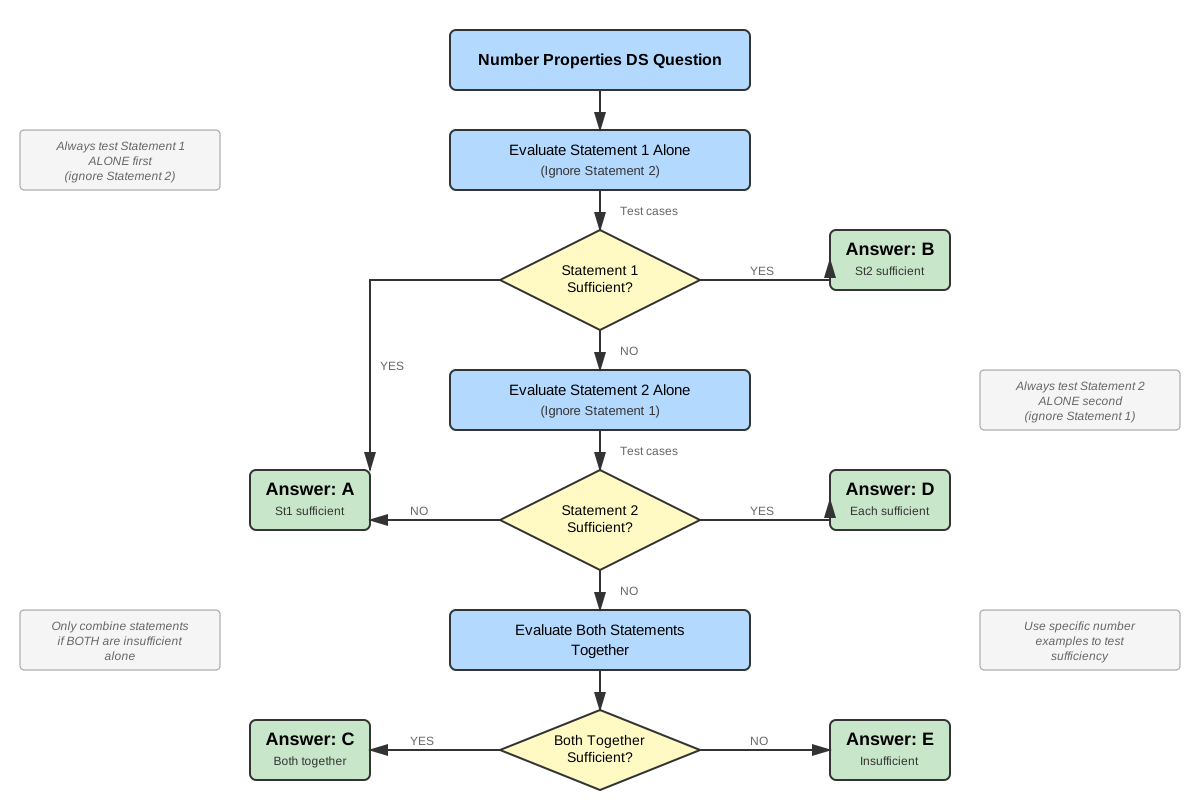
When approaching GMAT number properties DS questions, employ a systematic framework that balances conceptual understanding with strategic testing:
Step 1: Identify the Question Type
Look for trigger words and phrases that signal number properties:
- "integer," "even," "odd," "prime"
- "divisible by," "factor of," "multiple of"
- "remainder when divided by"
- "consecutive integers"
- "positive integer," "non-negative integer"
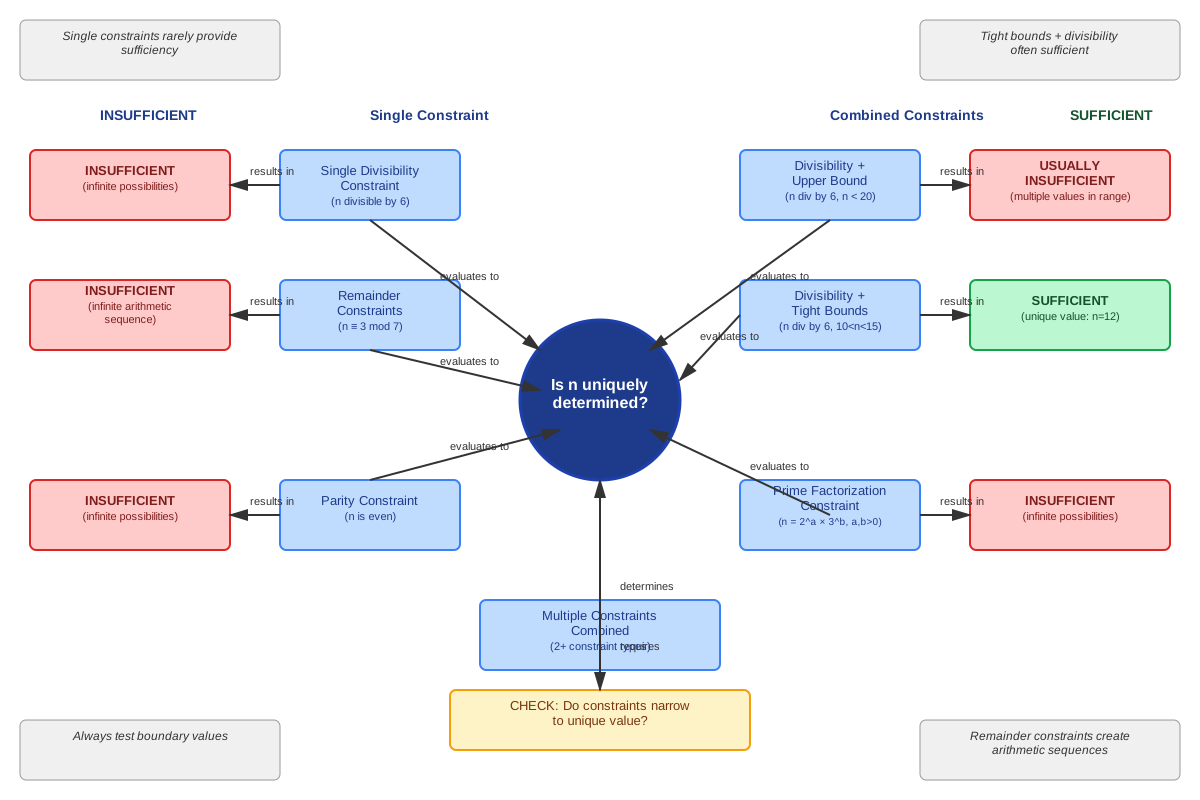
Step 2: Determine What Would Be Sufficient
Before analyzing the statements, clarify exactly what information would answer the question definitively. For example, if asked "Is n even?", recognize that any information establishing n's parity (even/odd status) would be sufficient.
Step 3: Analyze Each Statement Using Properties First
Apply number properties rules before testing specific values. If Statement 1 says "n² is even," immediately apply the rule that n² is even if and only if n is even, rather than testing multiple values.
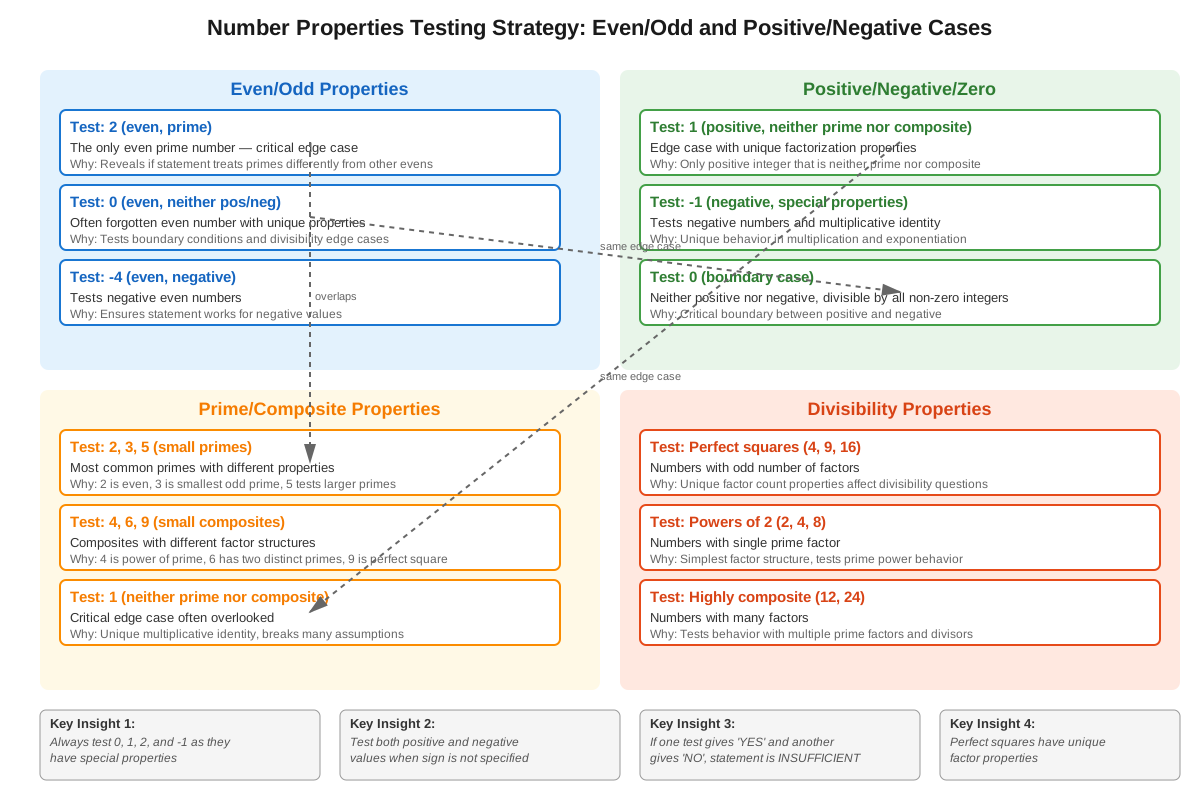
Step 4: Test Strategic Cases When Properties Don't Resolve
When pure property analysis doesn't determine sufficiency, test carefully chosen values:
- Test extreme cases (0, 1, -1, very large numbers)
- Test both even and odd values
- Test prime and composite numbers
- Test positive and negative values
Step 5: Look for Counterexamples
To prove insufficiency, you need only one counterexample—two cases that satisfy the statement but give different answers to the question. Actively search for such cases rather than testing random values.
Time Management: Allocate approximately 2 minutes per DS question. If property analysis doesn't quickly resolve sufficiency, move to strategic testing rather than attempting exhaustive case analysis. Remember that you're evaluating sufficiency, not solving for specific values—often you can determine sufficiency without calculating exact answers.
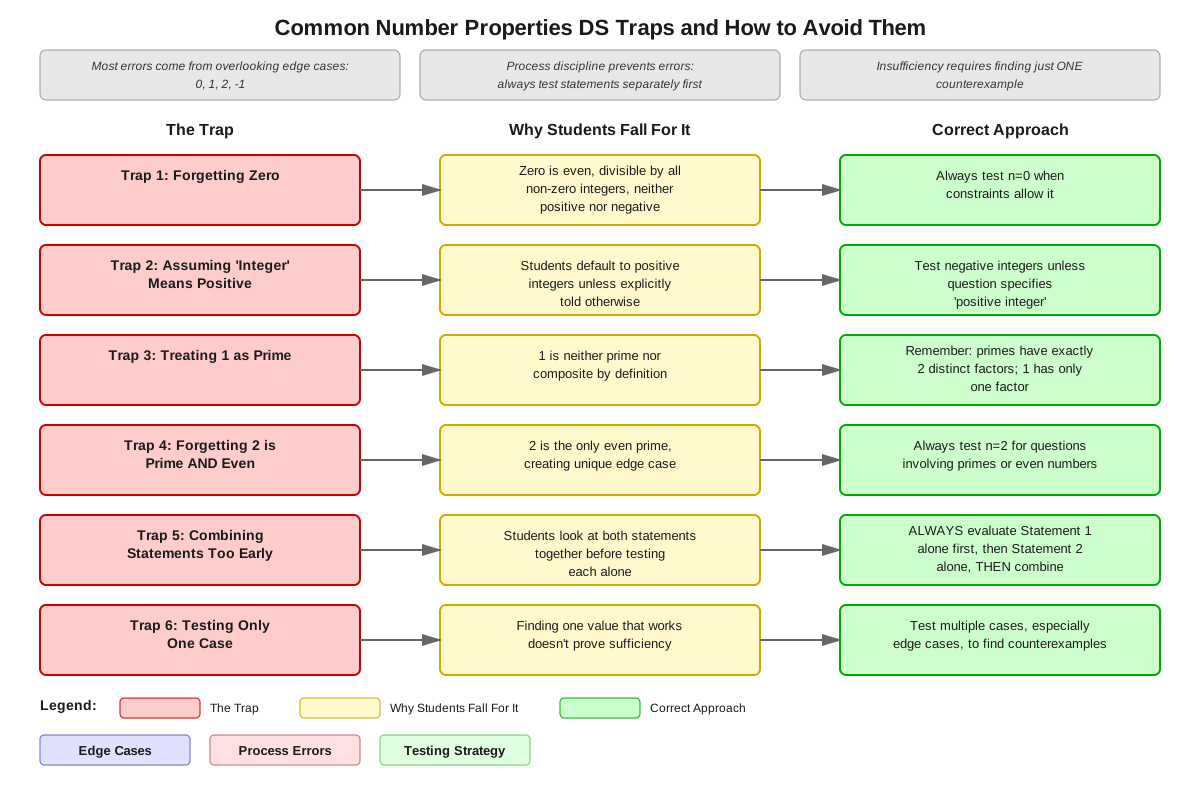
Common Traps to Avoid:
- Don't assume variables are positive unless explicitly stated
- Don't forget that zero is even and divisible by all non-zero integers
- Don't confuse "number" with "integer"—if the question says "number," it could be non-integer
- Don't multiply divisors unless they're coprime (GCD = 1)
Exam Tip: In 70% of number properties DS questions, at least one statement can be evaluated using pure property analysis without testing specific values. Train yourself to recognize these patterns to save time.
Memory Techniques
PEMDAS for Parity (Even/Odd Operations):
- Product: Even if ANY factor is even
- Even ± Even = Even
- Mixed (Even ± Odd) = Odd
- Divisibility preserved in sums/differences
- Add odds to get even
- Subtract odds to get even
PRIME-2 for Prime Number Facts:
- Positive integers greater than 1
- Remember 2 is the only even prime
- Infinitely many primes exist
- Multiply primes for unique factorization
- Every integer > 1 has unique prime factorization
- 2, 3, 5, 7, 11, 13, 17, 19, 23, 29, 31, 37, 41, 43, 47 (memorize first 15)
Divisibility Rules Visualization:
Picture a number written on paper:
- 2: Look at the last digit only (right edge)
- 3: Add all digits (whole number)
- 4: Look at last two digits (right corner)
- 5: Look at last digit only (right edge)
- 9: Add all digits (whole number)
- 10: Look at last digit only (right edge)
Consecutive Integer Mnemonic - "Every N has One":
Among every N consecutive integers, exactly ONE is divisible by N. This creates a memorable pattern: 2 consecutive → 1 divisible by 2; 3 consecutive → 1 divisible by 3, etc.
GCD/LCM Relationship - "Greatest times Least equals Product":
GCD(a,b) × LCM(a,b) = a × b
Visualize: the Greatest and Least working together to recreate the original Product.
Summary
Number properties DS questions represent a critical high-yield topic on the GMAT Data Insights section, combining mathematical knowledge of integer properties with logical sufficiency analysis. Mastery requires understanding how integers are classified (positive/negative, even/odd), how divisibility works through prime factorization, and how these properties interact under arithmetic operations. The key to success lies in recognizing that DS questions test whether information is sufficient to answer a question, not whether you can calculate a specific answer. Strategic approaches include applying property rules before testing values, testing carefully chosen cases to find counterexamples, and recognizing common patterns like consecutive integer properties and even/odd arithmetic. The most frequently tested concepts include even/odd determination, divisibility analysis, prime number properties, and the behavior of consecutive integers. Students must avoid common traps such as forgetting that 2 is prime, assuming variables are positive without explicit statement, and confusing general divisibility with coprime divisibility. Success on these questions requires both conceptual understanding and strategic thinking—knowing when pure analysis suffices and when strategic testing is necessary.
Key Takeaways
- Number properties DS questions test sufficiency, not calculation—focus on whether you can determine an answer, not on finding the specific answer itself
- Even/odd properties provide definitive constraints—if xy is odd, both x and y must be odd; if xy is even, at least one must be even
- Prime factorization is the universal key—it unlocks divisibility, GCD, LCM, and factor counting questions simultaneously
- Test strategic cases, not random values—look for extreme cases, different parities, and potential counterexamples that prove insufficiency
- Consecutive integers have predictable divisibility—among n consecutive integers, exactly one is divisible by n, enabling quick sufficiency analysis
- The number 2 is unique—it's the only even prime, a fact the GMAT exploits in approximately 15% of prime number questions
- Zero is even and divisible by everything—forgetting this causes errors when questions don't explicitly exclude zero from consideration
Related Topics
Algebraic Inequalities DS: Building on number properties, inequality questions often incorporate constraints about whether variables are positive, negative, or zero, requiring similar sufficiency analysis frameworks.
Absolute Value and Number Line: Understanding how number properties interact with absolute value and distance on the number line extends the concepts covered here to more complex scenarios.
Ratio and Proportion DS: Many ratio questions involve determining whether quantities are integers or have specific divisibility properties, directly applying number properties concepts.
Exponents and Roots: Questions about whether expressions involving exponents yield integers or have specific properties require understanding how number properties behave under exponentiation.
Word Problems with Integer Constraints: Real-world scenarios involving discrete quantities (people, objects, days) require integer solutions, making number properties essential for sufficiency analysis.
Practice CTA
Now that you've mastered the conceptual framework for number properties DS questions, it's time to solidify your understanding through deliberate practice. Attempt the practice questions associated with this topic, focusing on applying the systematic approach outlined in the Exam Strategy section. As you work through problems, pay special attention to recognizing when pure property analysis suffices versus when strategic case testing is necessary. Use the flashcards to reinforce high-yield facts and divisibility rules until they become automatic. Remember: the GMAT rewards not just knowledge but also strategic thinking and efficient execution. Each practice question is an opportunity to refine your approach and build the pattern recognition that distinguishes top scorers. You've built a strong foundation—now transform that knowledge into exam-day performance through focused, strategic practice!
Sign up free to keep reading
Create a free AnvayaPrep account to finish this GMAT guide on Number properties DS — plus flashcards and practice questions.